Hubbry Logo
EsusEsusMain
Open search
Esus
Community hub
Esus
logo
8 pages, 0 posts
0 subscribers
Be the first to start a discussion here.
Esus
Esus
from Wikipedia

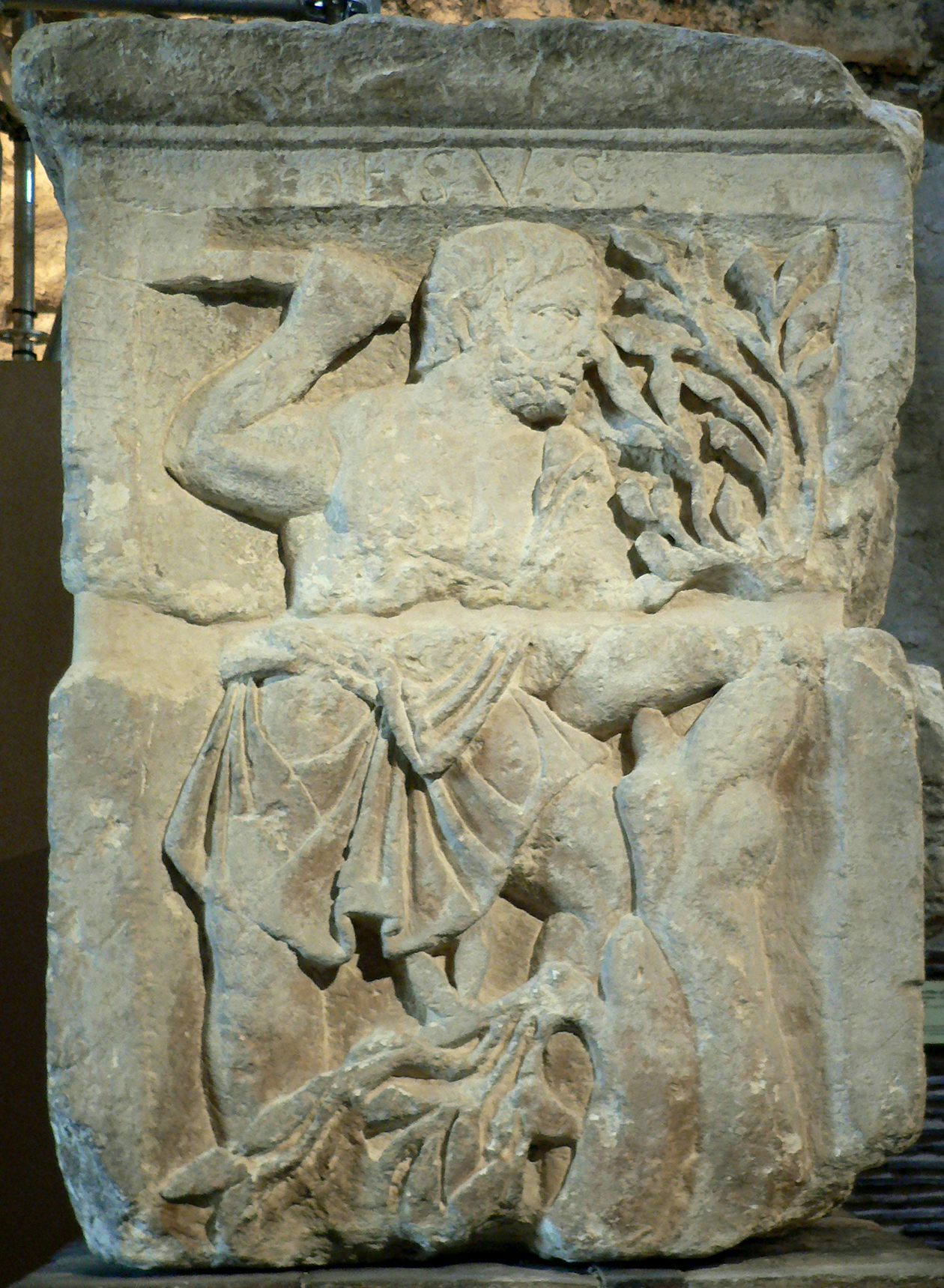
Esus as depicted on the Pillar of the Boatmen

Esus[a] is a Celtic god known from iconographic, epigraphic, and literary sources.

The 1st-century CE Roman poet Lucan's epic Pharsalia mentions Esus, Taranis, and Teutates as gods to whom the Gauls sacrificed humans. This rare mention of Celtic gods under their native names in a Greco-Roman text has been the subject of much comment. Almost as often commented on are the scholia to Lucan's poem (early medieval, but relying on earlier sources) which tell us the nature of these sacrifices: in particular, that Esus's victims were suspended from a tree and bloodily dismembered. The nature of this ritual is obscure, but it has been compared with a wide range of sources, including Welsh and Germanic mythology, as well as with the violent end of the Lindow Man.

Esus has been connected (through an inscription which identifies him and an allied character, Tarvos Trigaranos, by name) with a pictorial myth on the Pillar of the Boatmen, a Gallo-Roman column from Paris. This myth associates Esus, felling or pruning a tree, with a bull and three cranes. A similar monument to Esus and Tarvos Trigaranos from Trier confirms this association. The nature of this myth is little understood; it at least confirms the scholia's association of Esus with trees.

Esus appears rarely in inscriptions, with only two certain attestations of his name in the epigraphic record. His name appears more commonly as an element of personal names. While Lucan only attributes the worship of Esus to unspecified Gauls, inscriptions place the worship of Esus in Gaul, Noricum, and perhaps Roman North Africa; personal names may also place his worship in Britain. In inscriptions, Esus is attested as early as the 1st century BCE. In Latin literature, he may appear as late as the 5th century CE.

Etymology

[edit]

A large number of etymologies have been proposed for the name "Esus".[3]: 201  The nature of the god's name is not certain. Wolfgang Meid [de] has suggested it may be a euphemism, cover-name, or epithet of the god.[4]: 34–35  Claude Sterckx [fr] has even questioned whether "Esus" was a name given to only one deity (though his view is a minority one).[2]: 119 

The most widely adopted etymology derives Esus's name from the proto-Indo-European verbal root *h₁eis- ("to be reverent, to worship"), cognate with Italic aisos ("god").[5]: 323  This etymology is supported by the fact that it makes the initial vowel of Esus's name long, which agrees with both Lucan's poetic stress and the variant spellings which use "ae" for this vowel.[4]: 35  However, D. Ellis Evans points out that the more common etymology for Italic aisos derives this word from an Etruscan word; since Etruscan is non-Indo-European and Celtic is Indo-European, this would rule out a relationship between Esus and aisos.[3]: 201 

Joseph Vendryes linked the name with proto-Indo-European *esu- ("good"). Jan de Vries is sceptical of this, pointing out that this is difficult to reconcile with the fearful god described in Lucan and the scholia.[6]: 98  Meid suggests the name would then be a euphemism, comparing it with the Irish god-name Dagda ("the good god").[4]: 35  Henri d'Arbois de Jubainville linked it to proto-Indo-European *is- ("to wish"). T. F. O'Rahilly linked it to proto-Indo-European *eis- ("vital force, life").[6]: 98  Félix Guirand suggested the name was cognate with Latin erus ("lord", "master"),[6]: 98  which Meid notes is a common epiclesis given to deities (Freyr, Ba'al).[4]: 35  Other etymologies have variously connected the name with German Ehre ("honour"), Ancient Greek αἰδέομαι (aidéomai, "to be ashamed"), Old Norse eir ("brass, copper"), and Breton heuzuz ("terrible") [3]: 201 [6]: 98 

Lucan and the scholia

[edit]

Lucan

[edit]

Lucan's Pharsalia or De Bello Civili (On the Civil War) is an epic poem, begun about 61 CE, on the events of Caesar's civil war (49–48 BCE). The passage relevant to Esus occurs in "Gallic excursus", an epic catalogue detailing the rejoicing of the various Gaulish peoples after Julius Caesar removed his legions from Gaul (where they were intended to control the natives) to Italy. The passage thus brings out two themes of Lucan's work, the barbarity of the Gauls and the unpatriotism of Caesar.[5]: 296 

Tu quoque laetatus converti proelia, Trevir,
Et nunc tonse Ligur, quondam per colla decore
Crinibus effusis toti praelate Comatae;
Et quibus inmitis placatur sanguine diro
Teutates horrensque feris altaribus Esus
Et Taranis Scythicae non mitior ara Dianae.[7]

Translation:

Transferral of the warfare pleased you too, Treviri,
and you, Ligures, now shorn of hair but once in all of Long-Haired
Gaul unrivalled for your tresses flowing gracefully over your necks;
and the people who with grim blood-offering placate
Teutates the merciless and Esus dread with savage altars
and the slab of Taranis, no kinder than Diana of the Scythians.[8]

The substance of the last few lines is this: unspecified Gauls, who made human sacrifices to their gods Teutates, Esus, and Taranis, were overjoyed by the exit of Caesar's troops from their territory.[5]: 298–299  The reference to "Diana of the Scythians" refers to the human sacrifices demanded by Diana at her temple in Scythian Taurica, well known in antiquity.[9]: 66–67  That Lucan says little about these gods is not surprising. Lucan's aims were poetic, and not historical or ethnographic. The poet never travelled to Gaul and relied on secondary sources for his knowledge of Gaulish religion. When he neglects to add more, this may well reflect the limits of his knowledge.[10]: 4 [5]: 296 

We have no literary sources prior to Lucan which mention these deities, and the few which mention them after Lucan (in the case of Esus, Lactantius and Petronius) seem to borrow directly from this passage.[5]: 299  The secondary sources on Celtic religion which Lucan relied on in this passage (perhaps Posidonius) have not come down to us, so it is hard to date or contextualise his information.[5]: 297  This passage is one of the very few in classical literature in which Celtic gods are mentioned under their native names,[b] rather than identified with Greek or Roman gods. This departure from classical practice likely had poetic intent: emphasising the barbarity and exoticness the Gauls, whom Caesar had left to their own devices.[5]: 298 

Some scholars, such as de Vries, have argued that the three gods mentioned together here (Esus, Teutates, and Taranis) formed a divine triad in ancient Gaulish religion. However, there is little other evidence associating these gods with each other. Other scholars, such as Graham Webster, emphasise that Lucan may as well have chosen these deity-names for their poetic stress and harsh sound.[5]: 299 

Scholia

[edit]

Lucan's Pharsalia was a very popular school text in late antiquity and the medieval period. This created a demand for commentaries and scholia (explanatory notes) dealing with difficulties in the work, both in grammar and subject matter.[5]: 312  The earliest Lucan scholia that have come down to us are the Commenta Bernensia and Adnotationes Super Lucanum, both from manuscripts datable between the 9th and 11th centuries.[12]: 453  Also important are comments from a Cologne codex (the Glossen ad Lucan), datable to the 11th and 12th centuries.[5]: 312  In spite of their late date, these scholia are thought to incorporate very ancient material, some of it now lost. The Commenta and Adnotationes are known to contain material at least as old as Servius the Grammarian (4th century CE).[12]: 453–454  Below are excerpts from these scholia relevant to Esus:

Commentary Latin English
Commenta Bernensia ad Lucan, 1.445 Hesus Mars sic placatur: homo in arbore suspenditur usque donec per cruorem membra digesserit. Hesus Mars is appeased in this way: a man is suspended from a tree until his limbs are divided as a result of the bloodshed (?).[13]
Commenta Bernensia ad Lucan, 1.445 item aliter exinde in aliis invenimus. [...] Hesum Mercurium credunt, si quidem a mercatoribus colitur We also find it [depicted] differently by other [authors]. [...] They believe Hesus to be Mercury, because he is worshipped by the merchants[13]
Adnotationes super Lucanum, 1.445. Esus Mars sic dictus a Gallis, qui hominum cruore placatur. Esus is the name given by the Gauls to Mars, who is appeased with human blood.[14]
Glossen ad Lucan, 1.445 Esus id est Mars. Esus, that is Mars.[15]

The first excerpt, about the sacrifice to Esus, comes from a passage in the Commenta which details the human sacrifices offered to each of the three gods (persons were drowned in a barrel for Teutates, persons were burned in a wooden tub for Taranis). This passage, which is not paralleled anywhere else in classical literature, has been the subject of much commentary. It seems to have been preserved in the Commenta by virtue of its author's preference for factual (over grammatical) explanation.[5]: 318  The Adnotationes, by comparison, tell us nothing about the sacrifices to Esus, Teutates, and Taranis beyond that they were each murderous.[5]: 332  The nature of the sacrifice to Esus described here is unclear; the Latin text is cramped and ambiguous. Early Celticists relied on drastic emendations to the text, which have not been sustained in later scholarship.[5]: 321 [c] To give a few difficulties: digesserit here could refer to a process of decomposition or a violent severing of the limbs; cruor means "blood" and "raw meat", but also metaphorically "murder";[5]: 322  and in arbore suspenditur, often read as suggesting that Esus's victims were hanged by the neck from a tree, is perhaps nearer in meaning to saying that his victims were "fixed to" or "suspended from a tree".[10]: 9–10 

As a result of this ambiguity, a very large number of interpretations of the sacrificial ritual to Esus have been given.[5]: 322  It has been pointed out that hanging by the neck does not result in loss of blood; and that neither of these lead to a dislocation of the limbs. Suggestions include that the victim was tied to the tree in order to be dismembered; or dismembered by means of tree branches; or injured and then suspended from the tree, by their armpits or limbs.[10]: 10–11  This ritual has been compared with various legendary demises: the human sacrifices to Odin,[17]: 16 [d] the death of the mythological Welsh hero Lleu Llaw Gyffes,[20]: 395  and the martyrdom of St Marcel de Chalon.[10]: 12 [e] The violent end of the bog body known as the Lindow Man—throat slashed, strangled, bludgeoned, and drowned—has even been connected with this sacrificial ritual.[21][22]

All three commentaries offer an interpretatio romana (i.e., the identification of a foreign god with a Roman god) which identifies Esus as Mars (Roman god of war). The scholiast of the Commenta, however, notes that other sources give an interpretatio of Esus as Mercury,[f] for which they offer a rationale: Esus, like Mercury, was worshipped by merchants.[5]: 321  It is not possible to demonstrate the authenticity of either of these equations, as we have no source outside these commentaries which pairs the name of Esus with that of a Roman god.[10]: 13  The evident confusion of the sources the scholiast had available to him has been taken to count against the evidentiary value of either of these interpretatios.[23]: 27 [19]: 56  Max Ihm [de] regards the equation of Esus with Mercury as unlikely, because the Trier monument depicts Esus and Mercury next to each other, as separate divinities.[24] On the other hand, a Mercury statue from Lezoux is sometimes believed to have a dedicatory inscription to Esus on its rear, which may count in favour of the existence of such an interpretatio.[4]: 35 

Iconography

[edit]
Esus and Tarvos on the Pillar of the Boatmen

The Pillar of the Boatmen is a Roman column erected in Lutetia (Roman Paris) in the time of Tiberius (i.e., 14–37 CE) by a company of sailors. It contains a number of depictions of Roman and Gaulish gods with legends identifying them. On one block of this pillar is an image identified as Esus (alongside Tarvos Trigaranus, and the Roman gods Jupiter and Vulcan). The image is of a bearded man in a tunic with a billhook in his left hand; he is aiming at a tree which he grasps with his right hand. The panel carrying the legend "Tarvos Trigaranus" (literally, "Bull with three cranes") has foliage which continues over from Esus's panel; it depicts a bull with two birds on its back and one between its horns.[25][10]: 5–6 

The Trier monument: Left, Mercury and Rosmerta; Right, Esus chopping a tree, which holds a bull and three birds.

A monument from Trier shows an arrangement very similar to the Paris monument. This monument, dedicated to Mercury by one Indus of the Mediomatrici,[g] is a four-sided block with depictions of gods, much like the Paris monument. On one side is a depiction of Mercury and Rosmerta. On another side, a beardless man in a tunic strikes at a tree; within the tree's foliage, a bull's head and three birds are visible. The similarity of iconography allow the beardless man to be identified with Esus. The monument has been dated to the early imperial period.[5]: 322 [20]: 394 

These two monuments reveal a pictorial myth about Esus, involving a tree, a bull, and three cranes. The nature of this myth is unknown,[26] but has given rise to much "imaginative speculation".[21] It is not clear whether Esus is engaged in felling or pruning the tree.[6]: 98–99  The cultic significance which the Gauls attached to bulls is well attested,[27]: 26  and Anne Ross has argued that there was such a significance associated with cranes as well.[28] De Vries conjectured that the panels represented a sacred enthronement ritual, with the felling of a sacred tree and slaughter of a bull.[29]: 20  Henri d'Arbois de Jubainville connected these scenes with events in the mythology of the Irish warrior hero Cú Chulainn,[30] however James MacKillop cautions that this suggestion "now seems ill-founded".[21]

Esus's iconography confirms the importance of trees to his cult, otherwise suggested by the Lucan scholia.[5]: 322  Émile Thévenot [fr] suggested that the tree Esus chops down on these monuments is the sacrificial tree.[10]: 9  Françoise Le Roux [fr] suggested that the dendolatry (tree worship) of Esus's cult may reflect the influence of Germanic religion (specifically the cult of Odin).[19]: 54 

Jean-Jacques Hatt [fr] has identified eight other images as of Esus. Marcel Le Glay (writing for the Lexicon Iconographicum Mythologiae Classicae) dismisses these identifications as "uncertain" and "very random".[27]

Other attestations

[edit]

Geographic distribution

[edit]

Lucan is not clear about which Gauls worshipped Esus, Taranis, and Teutates. Early Celticists, forced to conjecture about the geographic extent of their worship, gave hypotheses ranging from pan-Celtic (Camille Jullian) to "between the Seine and the Loire" (Salomon Reinach).[5]: 299  The epigraphic evidence places Esus in Gaul and Noricum, and perhaps also Roman North Africa.[5]: 322–323  Evidence for the worship of Esus in Britain may be provided by a small number of proper names, which perhaps incorporate the god's name (such as the place-name Aesica).[31]: 133 

Epigraphy

[edit]
Statue of Mercury from Lezoux

The epigraphic evidence for Esus is very limited. There are only two certain attestations of his name in epigraphy and a handful of conjectured ones.[5]: 322  Philippe Leveau and Bernard Remy have suggested that this paucity of evidence may be explained by a Roman suppression of the cult of Esus, on the basis of its purported sacrificial practices.[32]: 89 

The first of the two certain inscriptions to Esus is on the Pillar of the Boatmen, below the image of the god. The second was found in 1987 by a metal detectorist, inscribed on a bronze statuette base[h] (the statuette missing). The base was found in Gurina (part of Roman Noricum, now Austria), where there was once a Gallo-Roman religious centre. It is a votive offering to Esus (spelled Aeso, dative of Aesos) made by an individual with a Celtic name. It dates to the end of the 1st century BCE, which makes it the earliest attestation of the god Esus.[33][5]: 322–323 

An inscription on a fragment of a stele[i] from the necropolis of Caesarea in Mauretania, a Roman city in Algeria, appears to record a votive inscription to Esus from one Peregrinus. The intervention of a Gaulish god in Africa is surprising, and the incomplete preservation of the inscription frustrates interpretation.[32] Andreas Hofeneder withholds judgement as to whether it is an attestation of the Gaulish god.[5]: 323  Leveau and Remy dedicate a study to this inscription, in which they date it to the first half of the 1st century CE and consider the possibility that Peregrinus was a Gaulish soldier in North Africa.[32]

Two Gaulish language inscriptions have been conjectured to mention Esus. The well-known statue of Mercury from Lezoux has a badly weathered inscription on its rear.[j] The text has received several different readings. Michel Lejeune will only allow a[...] / ie[...] / eso[...] to be read.[34] John Rhŷs proposed to read Gaulish Apronios / ieuru sosi / Esu ("Apronios dedicated this object to Esus").[6]: 394  This reading has been the subject of repeated doubt and was later abandoned by Rhŷs himself.[20]: 394 [34] Another Gaulish inscription, on a terrine found near Lezoux,[k] has an unclear initial word which Oswald Szemerényi proposed to read Esus. Pierre-Yves Lambert and Lejeune prefer eso ("this").[5]: 323 

As an element of proper names

[edit]
A votive bust dedicated by a man with the name "Esumopas Cnusticus"

Esus's name features as an element of some Celtic personal names (indeed, it is more common in personal names than in inscriptions).[4]: 35  Karl Horst Schmidt [de] lists Esugenus[l] ("Fathered by Esus"), Esumagius[m] ("Powerful through Esus"), Esumopas[n] ("Slave to Esus"), and Esunertus[o] ("Having the power of Esus").[35]: 211  Other personal names connected with Esus include Aesugesli,[p] Esullus,[q] and (on a British coin) Æsus.[5]: 323 [6]: 98  Bernhard Maier is sceptical that the god's name is part of the etymologies of all of these names.[36]: 92 

Other Celtic names perhaps incorporating Esus include the tribe-name Esuvii (perhaps "sons of Esus", from Sées);[37]: 172  the river-name Esino (in Italy);[2]: 120  and the place-names Aesica (in Northumberland),[1]: 510  Aeso (in Hispania Tarraconensis),[2]: 119  and Essé (in Brittany).[21]

Literary sources

[edit]

The Roman author Petronius names a minor character "Hesus" in his picaresque Latin novel Satyricon (c. 54–68 CE). There is nothing in what we know of Petronius that suggests he could have known about Gaulish religion first-hand. If this is a reference to the god Esus, it is probably (as Jean Gricourt suggests) Petronius using Lucan's text to make an obscure joke about the nature of this character.[38][5]: 345–346 

Lactantius's Christian apologia The Divine Institutes (c. 303-311 CE), in discussing human sacrifice among the pagans, very briefly mentions Esus and Teutates as pagan gods to whom the Gauls sacrificed humans. It is almost universally agreed that Lactantius borrows from Lucan here. He is known to have read Lucan's poem, and Lactantius's testimony does not go beyond Lucan's.[1]: 231–232 

The Gaulish medical writer Marcellus of Bordeaux may offer a textual reference to Esus not dependent on Lucan in his De medicamentis, a compendium of pharmacological preparations written in Latin in the early 5th century which is the sole source for several Celtic words. The work contains a magico-medical charm, which Gustav Must [et] and Léon Fleuriot proposed was a Gaulish language invocation of the aid of Esus (spelled Aisus) in curing throat trouble.[39] The text, however, is quite corrupt and the number of possible interpretations of it have led Alderik H. Blom and Andreas Hofeneder to doubt that the god Esus is referenced here.[1]: 370–372 

Notes

[edit]

References

[edit]

Further reading

[edit]
[edit]
Revisions and contributorsEdit on WikipediaRead on Wikipedia
from Grokipedia
Esus, also known as Hesus or Aisus, was a deity in ancient Gaulish religion, commonly interpreted as meaning "lord" or "master," though this etymology is debated, and often depicted as an axeman or woodcutter symbolizing themes of control, regeneration, and ritual sacrifice. He is primarily attested through Roman-period sources, including literary references and epigraphic monuments, where he appears alongside other Gaulish gods such as Taranis and Teutates. The earliest literary mention comes from the 1st-century CE Roman poet Lucan in his epic Pharsalia (Book I, lines 444–446), which describes Esus as a god of "savage shrines" propitiated with "pitiful victims" in harsh rituals; later scholia suggest these involved human sacrifice by hanging from trees. Archaeological evidence for Esus centers on two key Roman-era artifacts: the (Nautae Parisiaci), erected around 1 CE in , which portrays him pruning branches from a tree-like figure, possibly representing the or a sacrificial motif, and a similar axeman depiction on the Trier pillar from the same period. These icons suggest associations with woodland activities, birds such as egrets and cranes, and broader Celtic spiritual concepts of authority and renewal in a colonial Roman context. Later interpretations by Roman commentators, including the Berne Scholiasts, equated Esus with Mars as a patron of or Mercury as a protector, reflecting syncretic influences, while evidence of his worship extends to Britain, potentially linked to bog body finds like (1st century BCE–1st century CE).

Name and Etymology

Etymology

The name Esus derives from the Proto-Celtic form *esu-, ultimately traceable to the Proto-Indo-European (PIE) root *h₁eis- ("to be reverent" or "passionate"), which yields the nominal form *h₁ésh₂os meaning "lord" or "master." This etymology aligns with cognates in other Indo-European branches, such as Latin erus ("master" or "lord") and Hittite išḫaš ("lord"), reflecting a shared of and reverence. In , a Continental Celtic language primarily attested through Roman-era inscriptions, personal names, and glosses from the BCE to the CE, the appears as Esus or Aesus, with potential scribal variations including initial aspiration as Hesus in later Latin transcriptions, possibly indicating a short initial vowel /e/ in the original pronunciation. , as one of the earliest attested , preserves this root in a form distinct from Insular Celtic developments, where direct equivalents for "lord" diverge (e.g., flaith from a different PIE source). The scarcity of comparative terms in other underscores Esus as a characteristically Continental , emphasizing mastery or divine lordship.

Interpretations

The name Esus is most commonly interpreted as deriving from the h₁eis-, meaning "to be reverent" or "to ," yielding a sense of "lord" or "master" in context, indicative of a high-status . This , proposed by Celtic linguist Xavier Delamarre, aligns Esus with similar titles in other Indo-European traditions, such as the Italic aisos ("sacrosanct"), suggesting a divine figure commanding deep respect and authority, potentially in domains like oaths, , or oversight of natural cycles including . An alternative linguistic analysis by Peter Schrijver links Esus to the Proto-Indo-European h₁ey-, connoting "to fear" or "to respect," thus rendering the name as "the Respected One" and emphasizing themes of reverence or even passionate devotion. This interpretation ties into broader Celtic concepts of divine , possibly connecting to rituals of renewal, such as sacrificial practices or vegetative cycles symbolizing life's fervor and regeneration—though associations with Esus are elaborated in ancient literary accounts. Scholars debate whether Esus functions primarily as a proper name or a titular , akin to descriptive labels for other like ("Thunderer") or Teutates ("Tribal Protector"). This view is supported by Patrizia de Bernardo Stempel's analysis of Aisos/Esus as a "taboo-theonym," a sacred or restricted divine in , implying it may denote a categorical role rather than a unique identity, with parallels in Indo-European naming conventions for exalted beings. Post-2000 linguistic has refined these Indo-European connections, with Delamarre's updated analyses reinforcing the reverential root without altering the core "lordly" implication, while de Bernardo Stempel's 2010 study integrates epigraphic evidence to underscore Esus as part of a taboo-avoidance tradition in Celtic theonyms, preserving the name's aura of sanctity across inscriptions.

Literary Sources

Lucan's Pharsalia

In Marcus Annaeus Lucanus's epic poem Pharsalia (also known as Bellum Civile), composed in the mid-1st century CE, Esus appears in Book 1, lines 441–445, as one of three Gaulish gods propitiated through human sacrifice by druidic rites. The passage occurs amid a description of Gallic tribes, including the Treveri and Ligurians, who rejoice at the outbreak of Rome's civil war between Julius Caesar and Pompey, seeing it as an opportunity to resume their ancestral religious practices free from Roman oversight. Lucan, writing under Nero's regime and drawing on earlier Roman accounts of the Gallic Wars (such as Julius Caesar's Commentarii de Bello Gallico), portrays these rituals as barbaric to underscore the chaos and moral decay of the era, contrasting Roman internal strife with perceived Celtic savagery. The original Latin text reads:
tu quoque laetatus conuerti proelia, Treuir,
et nunc tonse Ligur, quondam per colla decore
crinibus effusis toti praelate Comatae,
et quibus inmitis placatur sanguine diro
Teutates horrensque feris altaribus Esus
A literal English translation is: "and you too, Treveri, glad to turn your battles, and you Ligurians, now shorn, once preferred by all the long-haired Gauls for the beauty of your flowing locks, and those by whom grim Teutates is placated with dreadful blood, and Esus with wild altars." The subsequent line extends the triad to Taranis, whose altar Lucan compares unfavorably to the Scythian Diana's, renowned in Roman lore for human offerings. Lucan's depiction frames Esus within a divine triad—Teutates, Esus, and —associated with blood-soaked rituals in untamed settings, evoking the druids' authority over life and death in sacred natural spaces. This portrayal aligns with Roman ethnographic traditions that amplified Celtic to justify conquest and cultural superiority during and after the of the 50s BCE. The name "Esus" appears in the (Esus), a grammatical form denoting the indirect object of the sacrificial act, consistent with Indo-European theonymic patterns where the dative indicates dedication or offering.

Scholia and Commentaries

The medieval scholia to Lucan's , compiled between the 9th and 12th centuries in manuscripts such as the Adnotationes super Lucanum and the Commenta Bernensia, offer interpretive expansions on the poet's passing reference to Esus in Book 1, lines 444–446, where the god is named alongside Teutates and as a recipient of sacrifices during times of . These annotations, originating from Carolingian scholarly traditions possibly drawing on late antique commentaries, equate Esus with Roman deities and elaborate on practices, thereby preserving fragments of otherwise lost Celtic religious knowledge. In the Adnotationes super Lucanum, edited by Johannes Endt from the earliest codices, the scholion to line 1.445 identifies the Gallic gods through Roman : "Teutates Mercurius sic dicitur, qui a Gallis hominibus caesis placatur. Esus Mars sic dictus a Gallis, qui hominum cruore placatur. Et Taranis ordo: et quibus placatur Taranis diro sanguine laetantur hic converti proelia. Taranis Iuppiter dictus a Gallis, qui sanguine litatur humano." This portrays Esus as equivalent to Mars, propitiated specifically through the shedding of human , aligning the rite with martial desperation in Lucan's narrative of . The Commenta Bernensia, a related 9th-century compilation likely produced in and edited by Hermann Usener, provides a more vivid of the sacrificial method for Esus: "Hesus Mars sic placatur: homo in arbore suspenditur, usque donec per cruorem membra digesserit." Here, a victim is suspended from a until dismembered by flow, evoking a suspension akin to and suggesting druidic influences in tree-based offerings central to Celtic lore. An additional note in the same commentary shifts the , stating "Hesum Mercurium credunt, si quidem a mercatoribus colitur," linking Esus to Mercury due to associations with and . These scholia, while valuable for transmitting obscure details of Gaulish religion, derive from aggregated medieval glosses on earlier sources, raising questions about their direct fidelity to 1st-century Celtic practices; scholars note their Carolingian origins likely incorporate late antique interpretations, blending classical with Christian-era annotations to explain Lucan's "barbarous" deities. Despite potential interpretive layers, the descriptions consistently emphasize human blood offerings and arboreal suspension as key to Esus's , distinguishing it from the drowning for Teutates and burning for outlined in the same texts.

Other Literary References

Literary attestations of Esus beyond and his scholia are rare but include a few additional ancient references. In ' Satyricon (c. 54–68 CE), a character or ship is named "Hesus," potentially alluding to the god. Early Christian writer , in The Divine Institutes (c. 304–313 CE, Book 1, chapter 21), reiterates the Lucanian triad of Teutates, Esus, and as recipients of human sacrifices among the , using it to critique pagan practices. A possible further mention appears in Marcellus of Bordeaux's De medicamentis (early CE), where a charm may invoke Esus, though this interpretation is debated among scholars. Late Roman authors such as , who described the cultural landscape of Aquitania in works like Mosella, and , whose letters and poems offer glimpses into 5th-century Gaulish life, provide no direct or indirect allusions to Esus, despite their occasional references to local customs and pagan remnants. In medieval Irish and Welsh literature, direct mentions of Esus are absent, but mythic parallels emerge in the recurring motif of tree-hanging sacrifices, which may echo the ritual practices associated with the god. For instance, Irish texts like the depict sacred trees and groves as sites of ritual significance, where victims or offerings were suspended, potentially preserving elements of pre-Roman Celtic sacrificial traditions. Similarly, Welsh tales in the feature tree-related motifs symbolizing life, death, and renewal, akin to the interpretive links drawn between Esus and arboreal symbolism. These parallels suggest a broader Celtic cultural memory of hanging rites, though without explicit connection to Esus himself. Scholars of the 19th and 20th centuries, such as Henri Hubert and Georges Dottin, have compiled and analyzed the limited literary evidence for Esus, primarily centering on the Lucan tradition while noting the dearth of independent attestations. Hubert, in works like The Greatness and Decline of the Celts, links Esus to Irish onomastics (e.g., Eogan from Esugenos) and positions him within the Gaulish pantheon based on classical accounts. Dottin, in La Religion des Celtes, evaluates the sparse textual record, attributing the primary description of Esus's rites—suspension from trees—to Lucan's verse and underscoring the challenges of reconstructing Gaulish theology from fragmentary classical allusions. These works underscore the reliance on a single poetic source, with no substantial additional literary corroboration emerging in later antiquity or the medieval period.

Iconography and Representations

Pillar of the Boatmen

The (Pilier des Nautes), a Gallo-Roman votive monument erected around AD 14–37 by the guild of Seine boatmen (Nautes Parisiacae) in honor of and the emperor , stands as the primary iconographic evidence for the god Esus. Composed of four blocks stacked vertically, each carved with bas-reliefs on all sides, the pillar originally measured approximately 5–6 meters in height with a base of 80–100 cm, though the reconstructed version at the in exceeds 250 cm. Discovered in 1710–1711 during excavations beneath Notre-Dame Cathedral on the , where it had been reused in a Late Roman wall, the monument exemplifies early Romano-Celtic , blending Roman anthropomorphic figures with indigenous deities across its surfaces. Esus appears on one of the pillar's faces in a panel alongside the bull-god and elements associated with , the thunder deity, identified explicitly by the Latin inscription "ESVS" carved beside his figure. Depicted as a cloaked, possibly bearded workman with his upper bare, Esus wields a (a pruning axe) in his raised right hand, actively felling or a tree—likely a —while birds perch nearby, evoking themes of vegetative renewal or sacrificial ritual linked to literary accounts of tree-cutting ceremonies. The rough, detailed bas-relief style reflects provincial Roman craftsmanship adapted to local motifs, with Esus's axe symbolizing dominion over nature and cycles of life, death, and rebirth in a post-conquest context of cultural negotiation. This canonical representation, housed today in the frigidarium of the Thermes de Cluny (Musée National du Moyen Âge), underscores Esus's role in the Gaulish pantheon as a figure tied to arboreal and regenerative forces, distinct yet integrated with Roman imperial dedications on adjacent panels featuring gods like Jupiter and Vulcan. The pillar's fragmented survival—lacking its original base, possible crowning statue, and some sections—highlights its historical reuse, yet preserves a vivid snapshot of 1st-century Lutetian religious life.

Other Visual Depictions

Beyond the primary attestation on the Pillar of the Boatmen, a key supplementary depiction of Esus appears on a Gallo-Roman relief from Trier in the Rhineland, dating to the 1st or 2nd century CE, where the god is shown as a bearded figure wielding an axe to fell a tree, underscoring his association with woodland activity and possibly ritual pruning or sacrifice. This imagery parallels the Parisian pillar but lacks an explicit inscription naming Esus, leading some interpretations to view it as a localized variant within Rhineland votive traditions. Other fragmentary reliefs from the Rhineland, such as those featuring axe-holding males near sacred trees or branches, have been tentatively linked to Esus by scholars examining syncretic Gallo-Roman iconography, though direct attributions remain uncertain without textual confirmation. Scholarly analysis has extended Esus's visual tradition into pre-Roman contexts, suggesting continuity with European art motifs that portray axe-wielding figures as manifestations of tree-related deities. In a study by Brendan Mac Gonagle, Esus is argued to embody an aspirated form of earlier Celtic woodland lords, tracing parallels to bronzes like the Waldalgesheim flagon (c. 330–320 BCE), where human forms interact with vegetative elements in ways evocative of arboreal divinity and seasonal renewal. These motifs, common in La Tène-style artifacts across central and , emphasize the god's role in mediating human intervention with sacred groves, predating Roman influences and linking Esus to proto-Celtic concepts of cosmic trees as axes mundi. Disputed identifications of Esus occur in unlabeled Celtic art from peripheral regions, particularly British examples without epigraphic support. The Rhynie Man, a 5th–6th century CE Pictish symbol stone from , , depicts a turbaned, axe-bearing figure that some interpretations propose as a northern rendition of Esus, given the tool's symbolic tie to tree-felling and the stone's potential context near early elite sites. Similar tentative links have been suggested for Iberian Celtic sculptures featuring armed males amid foliage, though these lack consensus and may reflect broader warrior-vegetation archetypes rather than specific to Esus. Within Gallo-Roman votive art, Esus's restrained, utilitarian imagery as a tree-pruner sets him apart from prolific deities like , whose horned, cross-legged form with animal entourages evokes untamed wilderness and abundance in reliefs from sites like itself. This distinction highlights Esus's niche focus on cultivated or sacrificial arboreal elements, often appearing in modest dedications by local guilds or individuals, contrasting Cernunnos's pan-Celtic prominence in grander, syncretic monuments blending native and Roman motifs.

Epigraphic and Onomastic Evidence

Inscriptions

The epigraphic evidence for Esus is sparse but significant, primarily consisting of labels inscribed above relief depictions rather than full votive dedications. The most famous example is the "ESVS" inscription on the (Pilier des nautes) from (modern ), erected by the guild of boatmen (nautes parisiaci) in honor of during the reign of (14–37 CE). This early 1st-century CE monument uses to render the divine name, with "ESVS" appearing in capital letters above a bas-relief showing a bearded figure wielding an axe to prune a tree, likely a , symbolizing renewal or a mythic act. The inscription forms part of a larger dedicatory text (CIL XIII 3026), reflecting Romanized Celtic worship practices among urban guilds in northern . Another key attestation comes from a pillar discovered in (Augusta Treverorum), dated to the 2nd or CE, where "ESVS" is similarly inscribed in Latin capitals above a nearly identical relief of the god pruning a tree, accompanied by a and three birds (cranes or ). This monument, associated with the tribe, demonstrates the god's cult in the region of , blending local with Roman epigraphic conventions. The form "ESVS" here follows the same nominative or dative pattern as in , highlighting the adaptation of nomenclature (*Esus, possibly meaning "" or "master") into Latin without inflectional changes. Further epigraphic evidence includes a 2nd-century CE Latin dedication from Cherchel (Caesarea, modern ) invoking Esus (AE 1985, 934), likely by Gaulish traders or veterans in Roman . An additional attestation appears in Noricum (modern and ), where a variant "Aesus" or "Aisus" is recorded in a local inscription, extending the god's worship to Celtic-influenced provinces beyond . Linguistic analysis of these inscriptions reveals consistent use of the uninflected stem "ESV-" in , contrasting with potential Gaulish dative forms like "Esu" or "Aesu" inferred from related theophoric names and later variants. Votive formulas are absent in these cases, as the labels serve identificatory purposes within broader Roman-style dedications to syncretic deities. Overall, these 1st–3rd century CE inscriptions underscore Esus's role in Romanized religion, often tied to guilds, trade, and natural cycles, with no evidence of pre-Roman epigraphy.

Esus in Proper Names

The use of "Esus" as a theophoric element in personal names reflects a common Celtic practice of incorporating divine names to express devotion or invoke protection, similar to the integration of other gods such as in names like Lugubelus or Brigantia in compounds like Brigomaglus. In , "Esus" typically appears in the genitive form "Esu-" as the initial component of compound names, followed by a descriptive denoting attributes, relationships, or qualities associated with the . This structure underscores the god's role in and familial during the Roman period. Representative examples from epigraphic records include Esugenus, interpreted as "begotten by Esus" or "son of Esus," attesting to paternal or generative connotations; Esumagius, meaning "powerful through Esus" or "good servant of Esus," highlighting themes of strength and service; Esunertus, signifying "having the strength of Esus," which emphasizes divine empowerment; and Esumopas, rendered as "slave of Esus," indicating submission or dedication. These names, documented in inscriptions such as those in the Corpus Inscriptionum Latinarum (CIL) collections from Gaul, demonstrate the adaptability of "Esus" in forming idiomatic expressions within the Gaulish naming system. Theophoric names incorporating "Esus" occur with moderate frequency in contexts, particularly among inscriptions from the 1st to 3rd centuries CE, suggesting the god's cult held appeal within specific social strata, such as local elites or religious devotees in northern and eastern . This pattern aligns with broader Celtic onomastic trends where divine elements were preferentially used in male names to signify status or spiritual allegiance, though direct attestations remain limited compared to more widespread deities.

Geographic Distribution

The worship of Esus is primarily attested through epigraphic evidence in northern , with the core concentrations in the and along the valley among the Parisii tribe. The most significant dedication appears on the , erected in (modern ) by the collegium of nautes Parisiaci, a of river boatmen, during the early 1st century CE under (CIL XIII 3026). Other inscriptions link Esus to personal names and local cults in this region, reflecting his integration into Romanized civic life via trade s operating along vital fluvial routes. The cult extended eastward to the , particularly among the tribe at Augusta Treverorum (modern , ), where a 2nd-century CE depicts Esus alongside , suggesting associations with military and frontier dedications in this Roman provincial center (CIL XIII 3656). The tribe name of the Esuvii in the of northwestern (modern , ) may derive from Esus, suggesting possible localized veneration potentially tied to pre-Roman Celtic traditions, while onomastic evidence appears in personal names from various regions, such as Esunertus in Pfalsbourg (CIL XIII 11644). These sites align with Roman infrastructure, including legionary bases and commerce hubs that facilitated the spread of Gallo-Roman syncretic practices. Rare outliers point to broader dissemination beyond core Gallic territories, including a 2nd-century CE inscription from Cherchel (Caesarea in Roman Mauretania Caesariensis, modern ), where Esus is invoked in a Latin dedication, likely by traders or veterans along Mediterranean maritime networks (AE 1985, 934). In Britain, potential extensions are inferred from the bog body discovered in (1st century CE), whose "triple death" (throat-cutting, garroting, and skull trauma) mirrors Roman descriptions of sacrificial rites to gods like Esus, though direct attribution remains conjectural without (Stead et al. 1986). Literary references in Lucan's Pharsalia (1st century CE) portray Esus as part of a pan-Gallic druidic triad with Teutates and Taranis, implying a wider Celtic sphere unbound by provincial borders, yet archaeological finds confine verifiable cult activity to urbanized, Roman-influenced zones rather than rural or non-Romanized areas. This distribution pattern underscores the role of economic and military mobility—via river trade like the Seine and guild sponsorships, or Rhine frontier garrisons—in propagating Esus's veneration among Gallo-Roman elites (Green 1992). Recent analysis of Lucan's text speculates on underlying Celtic oral traditions that may have influenced broader insular and continental practices, but lacks new material evidence to confirm extensions beyond these attested loci (Breeze 2024).

References

Add your contribution
Related Hubs
User Avatar
No comments yet.