Hubbry Logo
search
logo
2255343

Sunda Strait

logo
Community Hub0 Subscribers
Read side by side
from Wikipedia

The Sunda Strait (Indonesian: Selat Sunda) is the strait between the Indonesian islands of Java and Sumatra. It connects the Java Sea with the Indian Ocean.

Key Information

Etymology

[edit]

The strait takes its name from the Sunda Kingdom, which ruled the western portion of Java (an area covering the present day West Java, Jakarta, Banten, and some of western Central Java) from 669 to around 1579.[1]

The name also alludes to the Sundanese people native to West Java and Banten.[1]

Geography

[edit]
Map of the Sunda Strait in 1729 by Pierre van der Aa

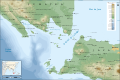
Extending in a roughly southwest/northeast orientation, with a minimum width of 24 km (15 mi) at its northeastern end between Cape Tua on Sumatra and Cape Pujat on Java, the strait is part of the Java Sea.[2][3] It is essentially triangular in shape, with two large bays on its northern side. It is also very broad and deep at its southwestern end, but as it narrows to the northeast it becomes much shallower, with a minimum depth of only 20 m (66 ft) in parts of its northeastern end.[3]

The strait is notoriously difficult to navigate because of this shallowness, very strong tidal currents, sandbanks, and man-made obstructions such as oil platforms off the Java coast.[3]

For centuries, the strait was an important shipping route, especially during the period when the Dutch East India Company used it as the gateway to the Spice Islands of Indonesia (1602–1799). However, its narrowness, shallowness, and lack of accurate charting make it unsuitable for many modern, large ships, most of which use the Strait of Malacca instead.[3]

The strait is dotted with a number of islands, many of which are volcanic in origin. They include: Sangiang (Thwart-the-Way), Sebesi, Sebuku, and Panaitan (Prince's). The 1883 eruption of Krakatau, one of these islands, had a profound effect on the area, both short and long term. Tsunamis and pyroclastic flows which floated on clouds of steam killed tens of thousands. Out of 3,000 people on nearby Sebesi at the time, not one survived. Some land was never resettled and became Ujung Kulon National Park.

Siger Tower, Bakauheni, Sumatra, at the strait's northeastern entrance

The Krakatoa eruption drastically altered the topography of the strait, with as much as 18–21 km3 of ignimbrite being deposited over an area of 1.1 million km2 around the volcano. However, the population has recovered and much of the coastline is now very densely populated. Aside from Krakatoa's sole remaining peak, Rakata, the Krakatoa Archipelago consists of the islands of Lang (Panjang or Rakata Kecil), Verlaten (Sertung), and most recently, Anak Krakatau, which emerged in 1927 from the original Krakatoa's shattered remains.

Battle of Sunda Strait

[edit]

On March 1, 1942, the Battle of Sunda Strait—part of the larger Battle of the Java Sea—took place when the Allied cruisers HMAS Perth and USS Houston encountered a Japanese amphibious landing force near Bantam, commanded by Rear Admiral Kenzaburo Hara.[4] That force included a light cruiser and eleven destroyers, four heavy cruisers and a light aircraft carrier.[5] The two Allied cruisers were sunk, while a Japanese minesweeper and a transport vessel were sunk by friendly fire.[3]

Planned bridge

[edit]

In the 1960s proposals were made for a bridge across the Sunda Strait, and in the 1990s further suggestions arose. A new plan was announced in October 2007. It would use the islands of Ular, Sangiang and Prajurit to create a four-part suspension bridge reaching 70 metres (230 ft) above sea level. This bridge would have a maximum span of 3 kilometers, around 50% longer than the current record holder, the 1915 Çanakkale Bridge. Construction was projected to begin in 2014 if funding of at least US$10 billion could be secured.[6]

An accord was signed in April 2012 with China Railway Construction Corporation for an $11 billion road and double track rail bridge.[7] However, in November 2014 the incoming government of President Joko Widodo shelved plans to build the bridge.[8]

Islands in the strait

[edit]

Bays

[edit]
[edit]

See also

[edit]

References

[edit]
Revisions and contributorsEdit on WikipediaRead on Wikipedia
from Grokipedia
The Sunda Strait is a strait separating the Indonesian islands of Sumatra to the northwest and Java to the southeast, linking the Java Sea in the northeast with the Indian Ocean in the southwest.[1][2] It measures approximately 24 kilometers at its narrowest point near the northeastern end and up to 110 kilometers wide overall, with an average depth of around 50 meters that poses navigational challenges due to shallows, sandbanks, and powerful tidal currents exceeding 5 knots.[3][1] Despite its strategic position as a maritime passage for smaller vessels avoiding longer routes, the strait sees limited large-scale shipping compared to alternatives like the Malacca Strait, primarily owing to these hazardous conditions including seasonal wind-driven currents and man-made obstacles such as oil platforms.[1][4] The region gained global notoriety from the catastrophic 1883 eruption of Krakatoa (Krakatau) volcano on an island within the strait, which ejected over 20 cubic kilometers of material, generated tsunamis up to 40 meters high, and resulted in more than 36,000 deaths across nearby coasts, with atmospheric effects observable worldwide for years.[5][6] More recently, the 2018 collapse of Anak Krakatau, the post-eruption cone, triggered tsunamis affecting over 400 people, underscoring the area's ongoing volcanic risks amid tectonic activity at the Sunda subduction zone.[2][7]

Physical Geography

Location and Dimensions

The Sunda Strait constitutes a narrow waterway separating the Indonesian islands of Sumatra to the northwest and Java to the southeast. It links the Java Sea in the northeast with the Indian Ocean in the southwest, oriented along a northeast-southwest axis.[8] The strait falls entirely within Indonesian territorial waters, with its central position approximated at coordinates 5°55′S 105°53′E.[9] At its narrowest extent, the strait measures approximately 24 kilometers across, situated between Cape Tua on Sumatra's southeastern tip and Cape Rakata on Java's northwestern shore.[1] [10] Widths broaden progressively toward the southwest, accommodating larger navigational spans, though exact maximum dimensions vary by measurement criteria. The shallowest depths reach about 20 meters, influencing vessel traffic and sediment dynamics.[1] [4]

Islands and Bays

The Sunda Strait features several volcanic islands, primarily the Krakatoa archipelago located centrally within the channel. This group includes Rakata, the largest remnant island rising to 821 meters, situated to the southeast; Sertung (also known as Verlaten) to the northwest; Panjang (or Lang) to the northeast; and the dynamically forming Anak Krakatau in the caldera center, which emerged in 1927 and varies in size between approximately 1.5 and 3.3 square kilometers due to ongoing eruptions.[11][1] These islands originated from the cataclysmic 1883 eruption that destroyed the original Krakatoa island, leaving the current fragments as projections from the submerged caldera.[11] Other notable islands in the strait include Panaitan off the western coast of Java near Ujung Kulon, Sangiang closer to the Java shoreline, and Sebesi and Sebuku positioned between the main islands of Java and Sumatra.[1] These formations are predominantly volcanic, reflecting the region's tectonic activity along the Sunda Plate boundary. On the northern periphery, the strait borders two significant bays: Banten Bay on the northwestern tip of Java, encompassing about 150 square kilometers of water surface with an average depth of 7 meters, and Lampung Bay on the southeastern coast of Sumatra, a larger inlet adjacent to the strait that supports marine ecosystems including sharks and rays.[12][1] Banten Bay connects to the Java Sea, while Lampung Bay facilitates access to ports like Bandar Lampung and influences local oceanographic patterns through its interaction with strait currents.[12]

Geological Formation

The Sunda Strait occupies a rift zone within the Sunda Arc, arising from the subduction of the Indo-Australian Plate beneath the Eurasian Plate, which generates the regional volcanic and seismic activity.[13] This subduction transitions from oblique along the Sumatra margin to near-orthogonal along Java, producing extensional stresses that facilitated the strait's development.[14] The strait's formation reflects crustal extension linked to the northwestward motion of the Sumatra block relative to Java, accommodated by the Great Sumatra Fault system.[15] Initiation of the Sumatra Fault occurred in the Middle Miocene, with the strait opening as a pull-apart basin in the early Late Miocene around 11-10 million years ago.[16] This rifting dismantled portions of the Indonesian volcanic arc, creating a volcano-tectonic depression characterized by fault-bounded basins and submerged volcanic structures.[17] Seismicity data confirm an ongoing extensional regime, with normal faulting and low-angle thrusting indicative of back-arc spreading influenced by the slab's geometry.[14] Volcanism, a dominant feature since the Late Miocene, supplies clastic sediments to the strait, shaping its bathymetry through repeated eruptions and caldera formations, as seen in the historic 1883 Krakatoa event that excavated much of the central depression.[16] The presence of acid volcanic products from early activity underscores the strait's evolution within a dynamic subduction-related extensional environment.[17]

Oceanography and Climate

Currents and Tides

The Sunda Strait exhibits a mixed tidal regime dominated by semi-diurnal components, with principal constituents M2 and S2 propagating from the Pacific Ocean through northern Indonesian passages before influencing the strait.[18] Tidal ranges typically vary from 0.5 to 1 meter, peaking at approximately 1 meter in March due to alignment with seasonal wind forcings.[19] In northern sectors, tidal currents constitute the primary driver, accounting for 52% of flow generation, with flood tides directed northeastward and ebb tides southwestward.[20] Velocities at the strait's narrowest constriction, around 25 km wide, frequently exceed 2 m/s, creating high shear and potential for energy extraction, as modeled in hydrodynamic simulations.[21] Oceanic currents in the strait are modulated by monsoon variability, facilitating limited but bidirectional exchange between the Java Sea and Indian Ocean as part of the broader Indonesian Throughflow system. During the boreal winter (northwest) monsoon from November to March, northwesterly winds induce southward flows via Ekman veering, with surface velocities reaching up to 1-2 m/s in response to wind stress and local topography.[22] In contrast, the southeast monsoon from May to September drives stronger westward currents, often exceeding 2 m/s, advecting fresher Java Sea waters into the eastern Indian Ocean and suppressing intraseasonal oscillations.[23] Intraseasonal variability, with periods of 25-45 days, overlays these seasonal patterns, linked to remote wind forcings and local eddies from the southeast Indian Ocean, as observed in satellite altimetry and moored current meter data after tidal removal via low-pass filtering.[24] Overall current speeds in northern waters range from 0.01 to 2.6 m/s, with stronger flows during ebb phases, contributing to nutrient upwelling and ecological dynamics despite the strait's secondary role relative to major throughflow passages like Lombok Strait.[25]

Climate Influences

The Sunda Strait region experiences a tropical maritime climate characterized by consistently high temperatures averaging 26–30°C (79–86°F) year-round, with minimal seasonal variation due to its equatorial proximity. Relative humidity remains elevated at 80–90%, fostering persistent cloud cover and frequent convective activity. These conditions are driven by the strait's position within the Indonesian Maritime Continent, where warm sea surface temperatures exceeding 28°C promote atmospheric instability and limit diurnal temperature swings to less than 5°C.[26] Precipitation is abundant, averaging 2,000–3,000 mm annually, though distributed unevenly due to the interplay of monsoon circulation and local orographic effects from Java and Sumatra. The wet season peaks from October to April, with monthly rainfall often surpassing 300 mm, while drier conditions prevail from May to September, influenced by suppressed convection during the southeast monsoon. This pattern reflects moisture convergence from the Indian Ocean and Java Sea, modulated by the strait's role as a conduit for inter-oceanic water exchange.[27][26] Seasonal monsoon winds dominate atmospheric forcing, with northeasterly flows (December–March) bringing humid air masses from the Asian continent and southeasterly trades (June–September) enhancing upwelling and reducing rainfall. Wind speeds typically range from 5–15 m/s, exerting causal influence on surface currents and wave heights in the strait, which reach significant values of 1–2 m during peak monsoon periods. Variability is amplified by the Indian Ocean Dipole (IOD) and El Niño-Southern Oscillation (ENSO), where positive IOD phases correlate with drier conditions and reduced precipitation by up to 20% in the region.[22][28][29]

Historical Significance

Etymology and Early Records

The designation "Sunda Strait" derives from the historical Sunda Kingdom, a polity that governed the western reaches of Java from the 7th to the 16th century, encompassing modern West Java, Banten, and parts of Jakarta.[1] The root "Sunda" also pertains to the Sundanese people native to West Java and the regional term Pasundan, denoting that area, reflecting its longstanding cultural and political association with the strait's eastern approaches.[2] The earliest epigraphic evidence explicitly naming a "Sunda" kingdom appears in the Kebon Kopi II inscription, dated 854 Saka (corresponding to 932 CE), which records administrative matters in Old Sundanese script and confirms the polity's existence by that time.[30] Traditional accounts attribute the kingdom's founding to 669 CE under Maharaja Tarusbawa, though this lacks contemporary corroboration and relies on later chronicles.[31] Textual sources suggest the strait itself served as a navigational route by the late 7th century, evidenced by interactions between the Śrīvijaya maritime empire and Javanese entities, indicating frequent passage amid regional trade networks.[32] A 13th-century Chinese compendium, Zhao Rukuo's Zhū Fān Zhì (c. 1225), provides one of the earliest external descriptions of Sunda as a distinct Javanese domain with export goods like pepper, underscoring the strait's role in Indian Ocean commerce.[33] European awareness emerged in the early modern era, with a rare 1602 nautical chart depicting the strait between Sumatra and Java, marking its integration into Western hydrographic records.[34]

Colonial Era and Trade Routes

![The H.C.S. Sir David Scott at the entrance of the Straights of Sunda, February 1830][float-right] The Sunda Strait emerged as a pivotal conduit during the colonial era, particularly for European powers navigating to the spice-rich Indonesian archipelago. Portuguese mariners, establishing footholds in the early 16th century, traversed the strait to access ports such as Banten on western Java, where they traded for pepper and other goods essential to European markets. This route complemented their control over the Strait of Malacca, enabling direct voyages from the Indian Ocean to Javanese entrepôts amid the expanding global spice trade.[35] Dutch interests intensified in the late 16th and early 17th centuries, as they sought to circumvent Portuguese dominance. Pioneering the Brouwer Route around 1611, Dutch navigators sailed eastward from the Cape of Good Hope, harnessing trade winds to enter the Sunda Strait and proceed to Java, thereby avoiding the perilous and monopolized Malacca passage. The Dutch East India Company (VOC), chartered in 1602, capitalized on this path to assert control over regional commerce; by establishing Batavia (present-day Jakarta) in 1619 adjacent to the strait, the VOC redirected spice trade flows from Malacca toward Sunda, securing monopolies on cloves, nutmeg, and pepper from the Moluccas through fortified coastal positions and naval enforcement.[36][37][38] Throughout the 17th and 18th centuries, the strait facilitated voluminous European shipping, with Dutch hegemony ensuring its centrality in intra-Asian and Europe-bound trade networks until the 19th-century Suez Canal reduced reliance on Cape routes. British vessels, including those of the East India Company, increasingly utilized the passage for similar purposes, as demonstrated by documented transits like the 1830 voyage of the H.C.S. Sir David Scott at the strait's entrance, underscoring its enduring role in colonial maritime logistics despite shifting imperial balances.[39]

1883 Krakatoa Eruption

The 1883 eruption of Krakatau, located in the Sunda Strait between Java and Sumatra, commenced on May 20 with submarine explosions north of the Perbuwatan cone, which produced steam and ash plumes and led to the temporary emergence of new islands.[7] Seismic activity and eruptions escalated through June and July, with plumes reaching heights of several kilometers, but the climactic phase unfolded on August 26–27.[40] Over a 23-hour period, more than 20 cubic kilometers (approximately 4 cubic miles) of dacitic ejecta were expelled in a series of Plinian explosions, equivalent in energy to roughly 200 megatons of TNT, ranking it as a Volcanic Explosivity Index 6 event.[40] [41] The final major blast at 10:02 a.m. on August 27 triggered caldera collapse, obliterating the northern two-thirds of the island, including the Danan and Perbuwatan cones, and leaving only the southern remnant of Rakata intact.[7] Immediate local devastation was profound, with pyroclastic flows, surges, and falls incinerating vegetation and structures across the Krakatau group and nearby islands like Sebesi.[7] Caldera subsidence generated mega-tsunamis propagating through the Sunda Strait, with waves reaching heights of up to 30–40 meters along the coasts of Java and Sumatra, inundating 165 villages and causing the majority of the estimated 36,000–36,400 fatalities.[6] [7] These tsunamis, amplified by the strait’s confined geography, traveled at speeds exceeding 100 km/h, depositing marine debris far inland and temporarily altering coastal bathymetry through sediment redistribution.[6] Ash fallout blanketed the strait and adjacent seas, disrupting maritime navigation for weeks due to reduced visibility and floating pumice rafts that clogged shipping lanes.[40] Globally, the eruption injected massive quantities of sulfur dioxide into the stratosphere, forming an aerosol veil that encircled the Earth within weeks and induced a mean surface temperature drop of about 0.6°C for over a year, with amplified cooling in the Northern Hemisphere.[42] This led to anomalous optical phenomena, including persistent vivid sunsets, bishop's rings, and blue moons/ suns observable worldwide from late 1883 into 1884, as documented in meteorological records.[42] The eruption's acoustic waves were detected over 4,800 km away, registering on barographs globally and producing the loudest sound in recorded history, with pressures equivalent to 172 decibels at 160 km distance.[40] Post-eruption, the Sunda Strait's ecosystem began recolonizing the submerged caldera, influencing long-term biodiversity studies in the region.[7]

Battle of Sunda Strait (1942)

The Battle of Sunda Strait occurred on the night of 28–1 March 1942 as part of the Japanese conquest of the Dutch East Indies during World War II. Allied cruisers USS Houston and HMAS Perth, the only major surface combatants to survive the preceding Battle of the Java Sea on 27 February, departed Batavia (modern-day Jakarta) attempting to evade Japanese forces by transiting the Sunda Strait westward toward allied bases. Accompanied briefly by the Dutch destroyer HNLMS Evertsz, the cruisers instead encountered a large Japanese invasion convoy off Banten Bay, Java, escorted by heavy cruisers Mogami and Mikuma, light cruiser Natori, and approximately eleven destroyers including Fubuki, Shirayuki, and Harukaze. [43] [44] The engagement marked the final Allied naval action in the region, ending organized surface resistance and enabling unopposed Japanese landings on Java.[45] Prior to entering the strait, Houston and Perth sank one Japanese transport and forced three others to beach, damaging the invasion preparations. At approximately 2310 hours on 28 February, the Allied ships opened fire on silhouettes mistaken for destroyers screening the convoy, initiating a running night battle characterized by confused identifications and heavy torpedo exchanges. The Japanese, vastly outnumbering the Allies in firepower and vessels, launched over 80 Long Lance torpedoes while returning gunfire; Perth absorbed multiple hits, including torpedoes that crippled her engineering spaces, leading to her sinking at around 0025 hours on 1 March after refusing to surrender. Houston pressed the fight alone, expending nearly all ammunition and suffering severe damage, including the death of Captain Albert H. Rooks; she succumbed to torpedoes and shells around 0043 hours, with crew abandoning ship amid oil fires and explosions. HNLMS Evertsz disengaged early but was later scuttled after running aground.[43] [44] [45] Japanese losses were light, confined primarily to auxiliary vessels such as the minesweeper W-2 and damage to several destroyers and cruisers from Allied shelling, with no major warships sunk despite a friendly fire incident involving destroyer Shirakumo. Of Houston's complement of about 1,068, approximately 368 survived to be taken prisoner, while Perth lost 328 of 686 crew, with 218 captured. The battle demonstrated the Allies' tactical aggression against overwhelming odds but underscored their strategic disadvantage in coordination and intelligence, as Japanese code-breaking and air reconnaissance had anticipated escape routes. Surviving Allied personnel endured harsh captivity, with many perishing in Japanese prison camps or during transport sinkings like the Maros Maru. The action facilitated the fall of Java by early March 1942, shifting Japanese focus to other Pacific objectives.[43] [44] [46]

Strategic and Economic Importance

Maritime Shipping and Trade

![H.C.S. Sir David Scott at the entrance of the Straits of Sunda, February 1830]float-right The Sunda Strait functions as a secondary maritime corridor connecting the Indian Ocean to the Java Sea, offering an alternative pathway for shipping between the Indian and Pacific Oceans, particularly for vessels seeking to bypass the congested or piracy-prone Strait of Malacca.[47] Despite its strategic position, the strait handles significantly lower volumes than the Malacca Strait, which processes nearly 100,000 vessels annually and over 40% of global trade, due to navigational constraints including strong tidal currents, sandbanks, and minimum depths of approximately 20 meters in certain sections.[48][49] Vessel traffic in the Sunda Strait includes a mix of international cargo ships, primarily general cargo and bulk carriers, alongside high-frequency domestic ferries operating between Merak on Java and Bakauheni on Sumatra, which transport passengers, vehicles, and regional goods.[50] Automatic Identification System (AIS) data from May 2021 recorded 1,740 vessels transiting the area over the month, indicating dense local and crossing traffic patterns that necessitate structured management.[51] To mitigate collision risks and enhance safety, Indonesia implemented a Traffic Separation Scheme (TSS) in the strait on July 1, 2020, dividing flows into designated lanes, precautionary areas, and inshore zones, though violations persist as evidenced by post-implementation monitoring from 2020 to 2022.[52][53] The strait's economic role supports Indonesia's internal trade and serves as a contingency route for East Asian merchant vessels, but its shallower drafts and environmental hazards limit access for larger deep-draft tankers and container ships, confining much of the throughput to smaller regional operators rather than high-volume global trade flows.[54] This positions the Sunda Strait as a vital but supplementary asset in Southeast Asian maritime logistics, with ongoing risks from near-miss incidents underscoring the need for vigilant traffic oversight to sustain reliable passage.[50]

Geopolitical and Military Role

The Sunda Strait serves as a critical geopolitical chokepoint, connecting the Indian Ocean to the Java Sea and facilitating access to the South China Sea and Pacific Ocean, thereby influencing regional power dynamics and trade security in Southeast Asia.[55] As an alternative to the congested Strait of Malacca, it enables rerouting of commercial shipping to mitigate risks from piracy, bottlenecks, or potential disruptions, with vessels opting for its path to avoid the Malacca's annual traffic exceeding 120,000 ships.[47] For China, the strait addresses the "Malacca Dilemma" by providing a viable bypass for energy imports and exports, reducing vulnerability to naval interdiction in Malacca, though its narrower channels and stronger currents limit full-scale substitution.[56] Indonesia, exercising sovereignty over the strait as part of its archipelagic waters, designated it within Archipelagic Sea Lane I under UNCLOS Article 53, mandating inclusion of normal international navigation routes while asserting regulatory authority over traffic separation schemes implemented on July 1, 2020, to enhance safety without impeding transit passage rights.[57][58] Militarily, the strait underscores Indonesia's archipelagic defense doctrine, requiring naval capabilities to patrol and secure sea lanes against threats like smuggling or unauthorized incursions, amid ongoing modernization efforts to equip the Indonesian Navy with frigates and submarines for effective deterrence across its 17,000 islands.[59] Under UNCLOS, foreign warships enjoy transit passage through the strait, permitting continuous movement without halting or prior notification, a regime distinct from innocent passage in territorial seas and enabling rapid deployment in Indo-Pacific contingencies.[60] Historical precedents, such as the 1964-1966 Sunda Straits Crisis during Indonesia's Konfrontasi with Malaysia and the UK, highlight its sensitivity, where British carrier HMS Victorious navigated the strait amid threats of blockade, demonstrating brinkmanship over passage rights that escalated tensions but avoided direct clash due to mutual deterrence.[61] In contemporary contexts, the strait's role amplifies Indonesia's non-aligned balancing act, with discussions of hosting U.S. Navy maintenance operations reflecting potential alignment shifts, while Chinese naval transits underscore competing great-power interests in unobstructed access.[62] Ensuring navigational freedom here bolsters regional stability, as disruptions could reroute global trade flows, imposing costs estimated at millions daily for alternatives like Lombok Strait.[63]

Natural Hazards and Environmental Dynamics

Volcanic Activity and Geological Risks

The Sunda Strait lies within the Sunda Arc, a highly active subduction zone where the Indo-Australian Plate converges with the Eurasian Plate at rates of approximately 5-7 cm per year, driving intense volcanism and seismicity. This tectonic setting fosters magma generation through partial melting of the subducting slab, resulting in stratovolcanoes like Krakatau positioned centrally in the strait between Sumatra and Java. The region's oblique subduction transitions from orthogonal under Java to more oblique under Sumatra, contributing to crustal extension and elevated geological hazards, including frequent earthquakes and volcanic eruptions.[14][13] Krakatau Volcano, the dominant feature, underwent a cataclysmic Plinian eruption on August 26-28, 1883, ejecting over 10 cubic kilometers of dense-rock equivalent material and forming a 7-km-wide caldera through partial island collapse. The event generated pyroclastic flows that entered the sea, displacing water and producing tsunamis up to 40 meters high that killed more than 35,000 people along Sunda Strait coasts, with atmospheric effects including a global temperature drop of 0.6°C and vivid sunsets persisting for years due to stratospheric aerosols. Geological analysis attributes the eruption's explosivity to rapid degassing of silicic magma under high pressure, underscoring the strait's vulnerability to caldera-forming events that amplify tsunami risks through flank instability.[64][65] Post-1883, Anak Krakatau ("Child of Krakatau") emerged in the caldera in 1927 and has grown rapidly at rates exceeding 5 meters per year vertically, fueled by ongoing basaltic-andesitic eruptions that build an unstable edifice prone to sector collapses. A major flank failure on December 22, 2018, involving approximately 0.5 cubic kilometers of material sliding into the strait, generated a volcanogenic tsunami with waves up to 13 meters, resulting in over 400 fatalities and widespread coastal damage in Lampung and Banten provinces. This event, preceded by heightened eruptive activity including Strombolian explosions and lava flows, highlights the causal link between edifice oversteepening and tsunami generation via landslide displacement, with modeling indicating waves propagating at 80-110 km/h across the strait. Recent monitoring through 2023 records persistent unrest, such as ash plumes to 1-2 km altitude and seismic swarms, signaling continued hazard potential from partial collapses or pyroclastic flows entering the water.[66][67][68] Seismic risks compound volcanic threats, with the subduction interface and back-arc faults producing frequent moderate-to-large earthquakes; for instance, a magnitude 5.6 event in the strait in 1935 exemplifies ongoing activity tied to slab deformation. Probabilistic assessments identify the Sunda Strait as a high-hazard zone for both tectonic quakes and volcano-tectonic events, where magma intrusion can trigger seismicity, potentially destabilizing flanks further. Mitigation challenges persist due to dense populations exceeding 10 million within 100 km, necessitating real-time monitoring by Indonesia's PVMBG for early warnings against combined eruption-collapse-tsunami scenarios.[69][70][7]

Tsunamis and Recent Events

The Sunda Strait is susceptible to tsunamis primarily generated by volcanic flank collapses rather than tectonic earthquakes, due to the presence of active volcanoes like Anak Krakatau within its confines.[71] Historical records indicate sporadic volcanogenic tsunamis prior to the 19th century, though documentation is limited and often tied to undocumented eruptions of ancient Krakatau predecessors.[67] The most significant modern tsunami in the strait, excluding the 1883 event, struck on December 22, 2018, triggered by the partial collapse of Anak Krakatau's southwestern flank during an ongoing eruption.[72] This submarine landslide displaced approximately 0.18 cubic kilometers of material into the strait, generating initial waves of 2-5 meters that amplified to 13 meters near the source before propagating outward.[71] The tsunami impacted 158 kilometers of coastline across Banten Province on Java and Lampung Province on Sumatra, arriving within 15-30 minutes of the collapse at popular coastal areas like Tanjung Lesung and Carita Beach.[67] The disaster resulted in 437 confirmed deaths, 14,936 injuries, 5,203 missing persons, and the destruction or severe damage of over 560 structures, including hotels and homes, with economic losses exceeding $186 million USD.[72] Unlike seismic tsunamis, the event produced no detectable foreshocks, evading Indonesia's earthquake-based warning system and relying instead on delayed volcanic alerts from the Badan Meteorologi, Klimatologi, dan Geofisika (BMKG).[71] Wave run-up heights varied by location, reaching 6.6 meters in Pandeglang Regency and 3.75 meters in Labuan, with non-directional propagation patterns due to the strait's bathymetry confining energy.[67] Post-2018 monitoring has intensified, with satellite interferometry and seismic networks tracking Anak Krakatau's instability, as the volcano rebuilt its edifice through continued eruptions in 2019-2022, raising concerns over recurrent collapse risks.[72] No subsequent tsunamis of comparable scale have occurred in the strait as of 2025, though minor seismic swarms and effusive activity persist, underscoring the need for enhanced volcanogenic tsunami modeling and early warning integration.[67]

Traffic Management and Safety Protocols

The Traffic Separation Scheme (TSS) in the Sunda Strait, established by the Indonesian government and aligned with International Maritime Organization (IMO) standards under COLREGS Rule 10, organizes vessel traffic into designated inbound and outbound lanes separated by a central zone to mitigate collision risks in the strait's narrowest section of approximately 30 kilometers.[54][73] This scheme, integrated within Indonesia's Archipelagic Sea Lanes (ASL), mandates that all vessels, including foreign ships exercising transit passage rights, adhere to lane-specific directions unless exempted for safety reasons, with non-compliance observed in some cases leading to near-miss incidents.[57][50] The Merak Vessel Traffic Service (VTS), operated by Indonesian maritime authorities on the Java side, monitors real-time vessel movements through radar, AIS, and VHF communications, providing navigational guidance, traffic advisories, and emergency coordination to enhance safety amid high traffic volumes exceeding thousands of transits annually.[74][75] VTS operators enforce TSS protocols, issue warnings for deviations, and facilitate reporting requirements under Ministerial Decree, where ships must notify authorities of entry, position updates during transit, and exit, including details on cargo, draft, and destination to preempt hazards like strong tidal currents reaching 4-6 knots.[54][76] Additional safety protocols include precautionary areas for course alterations, inshore traffic zones for local ferries and fishing vessels, and restrictions on anchoring or fishing within TSS boundaries to prevent entanglements or groundings on shallow banks.[77] Formal safety assessments recommend counterclockwise routing in precautionary zones and integration with e-navigation tools for digital compliance tracking, though empirical studies highlight persistent challenges from vessel overcrowding and incomplete adherence, contributing to analyzed near-misses between 2010 and 2019.[78][50] These measures collectively prioritize causal risk reduction through spatial segregation and surveillance, without impeding unimpeded transit under UNCLOS Article 38.[73]

Sunda Strait Bridge Project

The Sunda Strait Bridge, also known as Jembatan Selat Sunda, is a proposed 30-kilometer-long suspension bridge designed to link the western tip of Java (near Merak, Banten province) with the southeastern end of Sumatra (near Bakauheni, Lampung province), facilitating both road and rail transport across the strait.[79] The project aims to reduce ferry dependency, cut travel times from 2-3 hours by sea to under 30 minutes by bridge, and lower logistics costs for inter-island trade, which currently handles over 50 million passengers and 3 million vehicles annually via ferries.[80] Initial conceptualization traces to Indonesian President Sukarno in 1958, with early engineering studies in the 1960s exploring bridge and tunnel options amid post-independence infrastructure ambitions.[81] Engineering designs envision a multi-span suspension structure with a central span exceeding 2 kilometers, towers up to 200 meters high, and integrated rail lines capable of accommodating high-speed trains, alongside provisions for utilities like fiber optics.[82] Cost estimates have escalated over decades: early 2010 projections pegged the bridge at US$10 billion, with surrounding economic zones adding US$15 billion, totaling around US$25 billion by 2011; later feasibility analyses revised this to US$18.87 billion for core construction alone, factoring in seismic reinforcements due to proximity to active volcanoes like Anak Krakatau.[83] [84] Financial viability studies using internal rate of return (IRR) and net present value (NPV) models indicate marginal returns without additional revenue streams, such as tolls projected at Rp 1 million per vehicle crossing, though demand forecasts rely on optimistic growth in Sumatra-Java freight volumes exceeding 100 million tons yearly by 2040.[85] Value engineering approaches suggest incorporating commercial functions (e.g., ports, industrial parks) could boost IRR above 10%, but these assume stable funding and minimal geological disruptions.[82] The project gained renewed momentum under the 2011 Masterplan for Acceleration and Expansion of Indonesia's Economic Development (MP3EI), targeting groundbreaking in 2012-2014 and operational status by 2025, with public-private partnerships sought for 70% of financing.[86] However, President Joko Widodo deprioritized it in 2014, citing fiscal constraints and preference for upstream infrastructure like Sumatra's internal roads and ports over mega-crossings.[87] Seismic risks, including potential tsunamis and eruptions—evidenced by the 1883 Krakatoa disaster and 2018 Anak Krakatau events—have prompted repeated design revisions, increasing costs by 20-30% for earthquake-resistant features.[88] Critics, including economic analysts, argue the bridge's benefits are overstated given existing ferry efficiencies and longer-term alternatives like high-speed rail loops within islands, while proponents highlight untapped GDP gains of 1-2% from seamless connectivity.[89] As of October 2025, no construction has commenced, with official statements from the Ministry of Public Works and Housing indicating indefinite postponement due to misalignment with national development priorities favoring toll road expansions and new capital relocation to Nusantara.[90] Earlier cancellation signals emerged around 2015-2016 amid funding shortfalls, and recent assessments confirm the project's shelving, rendering it an unrealized vision despite periodic revivals under engineering firms like Wiratman Associates.[88] [79] Ongoing debates center on opportunity costs, with empirical data showing ferry traffic growth at 5-7% annually but insufficient to justify the capital outlay without subsidies, underscoring causal challenges in mega-infrastructure delivery amid Indonesia's debt-to-GDP ratio hovering near 40%.[91]

References

User Avatar
No comments yet.