


Community hub
Recent from talks
Contribute something
Nothing was collected or created yet.
Acanthuridae
View on Wikipedia
| Surgeonfish Temporal range:
| |
|---|---|

| |
| Sohal surgeonfish, Acanthurus sohal. The orange mark on the tail peduncle shows where the spine is folded in. | |
Scientific classification 
| |
| Kingdom: | Animalia |
| Phylum: | Chordata |
| Class: | Actinopterygii |
| Order: | Acanthuriformes |
| Suborder: | Acanthuroidei |
| Family: | Acanthuridae Bonaparte, 1835[1] |
| Type species | |
| Acanthurus triostegus | |
| Genera | |
|
see text | |

Acanthuridae are a family of ray-finned fish which includes surgeonfishes, tangs, and unicornfishes. The family includes about 86 extant species of marine fish living in tropical seas, usually around coral reefs. Many of the species are brightly colored and popular in aquaria.
Etymology
[edit]The family name comes from Ancient Greek ἄκανθα (ákantha), meaning "spine", and οὐρά (ourá), meaning "tail", a reference to the scalpel-like bony plates on the type species' caudal peduncle[2]. In the early 1900s, the family was called Hepatidae.[3]
Subfamilies and genera
[edit]
Acanthuridae contains the following extant subfamilies and genera:[4][1]
- Subfamily Nasinae Fowler & Bean, 1929
- Subfamily Acanthurinae Bonaparte, 1835
- Tribe Acanthurini Bonaparte, 1839[5]
- Genus Acanthurus Forsskål 1775
- Genus Ctenochaetus Gill, 1884
- Tribe Prionurini J. L. B. Smith, 1966
- Genus Prionurus Lacépède, 1804
- Tribe Zebrasomini Winterbottom, 1993
- Genus Paracanthurus Bleeker, 1863
- Genus Zebrasoma Swainson, 1839
- Tribe Acanthurini Bonaparte, 1839[5]
Evolution and fossil record
[edit]There are several extinct genera known from fossils dating from the Eocene to Miocene:
Eocene genera
[edit]A particularly large diversity of fossil surgeonfish is known from the Monte Bolca lagerstatte of Italy. These represent some of the earliest representatives of the individual tribes within the Acanthuridae.[6]
- †Acanthuroides Blot & Tyler, 1990
- †Eorandallius Blot & Tyler, 1990 (=Naseus Agassiz, 1842 (preocc.))
- †Frigosorbinia Bannikov & Tyler, 2012
- †Gazolaichthys Blot & Tyler, 1990
- †Lehmanichthys Blot & Tyler, 1990
- †Metacanthurus Blot & Tyler, 1990
- †Metaspisurus Blot & Tyler, 1990
- †Padovathurus Tyler, 2005
- †Pesciarichthys Blot & Tyler, 1990
- †Proacanthurus Blot & Tyler, 1990
- †Protozebrasoma Sorbini & Tyler, 1998
- †Sorbinithurus Tyler, 1999
- †Tauichthys Tyler, 1999
- †Tylerichthys Blot, 1980
Oligocene genera
[edit]- †Arambourgthurus Tyler, 2000[7]
- †Caprovesposus Daniltshenko, 1960[8]
- †Glarithurus Tyler & Micklich, 2011[8]
- ?†Eonaso Blot, 1984[9]
Miocene genera
[edit]- †Marosichthys Whitley, 1951[10]
Morphology
[edit]The distinctive characteristic of the family is that they have scalpel-like modified scales, one or more on either side of the peduncle of the tail.[11] The spines are dangerously sharp and may seriously injure anyone who carelessly handles such a fish. The dorsal, anal, and caudal fins are large, extending for most of the length of the body. The mouths are small and have a single row of teeth adapted to grazing on algae.[2]
Surgeonfishes sometimes feed as solitary individuals, but they often travel and feed in schools. Feeding in schools may be a mechanism for overwhelming the highly aggressive defense responses of small territorial damselfishes that vigorously guard small patches of algae on coral reefs.[12] Most species are fairly small, with a maximum length of 15–40 cm (6–15.5 in), but some in the genus Acanthurus, some in the genus Prionurus, and most species in the genus Naso may grow larger; the whitemargin unicornfish (Naso annulatus) is the largest species in the family, reaching a length of up to 1 m (3 ft 3 in). These fishes may grow quickly in aquaria, so average growth size and suitability should be checked before adding them to any marine aquarium.
_(28822279247).jpg)
A larval acanthurid, known as an acronurus, looks strikingly different from the juvenile and adult forms of the same individual. It is mostly transparent and tends to have a pelagic lifestyle, living in open water for an extended period of time before settling on the ocean bottom near the shore, where it develops into the juvenile and ultimately the adult form.[13]
Symbiotic bacteria
[edit]Acanthurids are the only known hosts of the bacteria of the genus Epulopiscium. These bacteria affect the digestion of surgeonfishes enabling them to digest the algae in their diet.[14][15][16]
In the aquarium
[edit] |
Tangs are very sensitive to disease in the home aquarium. However, if the tang is fed enough algae and the aquarium is properly maintained disease should not be a problem. It is usually necessary to quarantine the animals for a period before introducing them to the aquarium.
Adults range from 15 to 40 centimetres (5.9 to 15.7 in) in length and most grow quickly even in aquaria. When considering a tang for an aquarium it is important to consider the size to which these fish can grow. Larger species such as the popular Pacific blue tang surgeonfish (of Finding Nemo fame), Naso or lipstick tang, lined surgeonfish, Sohal surgeonfish and Atlantic blue tang surgeonfish can grow to 40 cm (16 in) and require swimming room and hiding places.
Many also suggest adding aggressive tangs to the aquarium last as they are territorial and may fight and possibly kill other fish.
Tangs primarily graze on macroalgae from genera such as Caulerpa and Gracilaria, although they have been observed in an aquarium setting to eat meat-based fish foods. A popular technique for aquarists is to grow macroalgae in a sump or refugium. This technique not only is economically beneficial, but serves to promote enhanced water quality through nitrate absorption. The growth of the algae can then be controlled by feeding it to the tang.
Gallery
[edit]- Selected species
-
 Achilles tang, Acanthurus achilles
 -
 Eyestripe surgeonfish, Acanthurus dussumieri
 -
 Powderblue surgeonfish, Acanthurus leucosternon
 -
 Doubleband surgeonfish, Acanthurus tennenti
 -
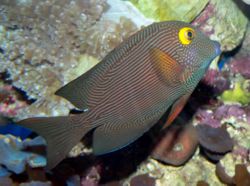 Kole tang, Ctenochaetus strigosus
 -
 Bignose unicornfish, Naso vlamingii
 -
 Bluespine unicornfish, Naso unicornis
 -
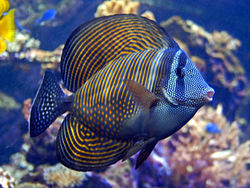 Red Sea sailfin tang, Zebrasoma desjardinii
 -
 Orangespot surgeonfish, Acanthurus olivaceus
 -
 Regal tang, Paracanthurus hepatus in an aquarium


References
[edit]- ^ a b Richard van der Laan; William N. Eschmeyer & Ronald Fricke (2014). "Family-group names of recent fishes". Zootaxa. 3882 (2): 1–230. doi:10.11646/zootaxa.3882.1.1. PMID 25543675.
- ^ a b Froese, Rainer; Pauly, Daniel (eds.). "Family Acanthuridae". FishBase. February 2007 version.
- ^ Seale, Alvin (1909). "New Species of Philippine Fishes". Philippine Journal of Science. 4 (6). Bureau of Science in Manila. doi:10.5962/bhl.title.54135.
- ^ J. S. Nelson; T. C. Grande; M. V. H. Wilson (2016). Fishes of the World (5th ed.). Wiley. pp. 497–502. ISBN 978-1-118-34233-6. Archived from the original on 2019-04-08. Retrieved 2023-07-10.
- ^ Samuel Hubbard Scudder (1884). "Nomenclator Zoologicus: An Alphabetical List of All Generic Names that Have Been Employed by Naturalists for Recent and Fossil Animals from the Earliest Times to the Close of the Year 1879". Bulletin of the United States National Museum (19).
- ^ Carnevale, G.; Bannikov, Alexandre F.; Marramà, G.; Tyler, James C.; Zorzin., R. (2014). "The Bolca Fossil-Lagerstätte: A window into the Eocene World. 5. The Pesciara- Monte Postale Fossil-Lagerstätte: 2. Fishes and other vertebrates. Excursion guide" (PDF). Rendiconti della Società Paleontologica Italiana. 4 (1): i–xxvii. hdl:10088/25678.
- ^ Carnevale, Giorgio; Tyler, James C. (2018-04-23). "The caudal skeleton of Arambourgthurus scombrurus (Arambourg, 1967), a Paleogene oceanic surgeonfish". Proceedings of the Biological Society of Washington. 131 (1): 101–110. doi:10.2988/17-00023. ISSN 0006-324X.
- ^ a b Tyler, James C.; Micklich, Norbert R. (2011-10-01). "A new genus and species of surgeon fish (Perciformes, Acanthuridae) from the Oligocene of Kanton Glarus, Switzerland". Swiss Journal of Palaeontology. 130 (2): 203–216. doi:10.1007/s13358-011-0016-5. ISSN 1664-2384.
- ^ Klanten, Selma O.; Herwerden, Lynne van; Choat, J. Howard; Blair, David (2004-07-01). "Patterns of lineage diversification in the genus Naso (Acanthuridae)". Molecular Phylogenetics and Evolution. 32 (1): 221–235. doi:10.1016/j.ympev.2003.11.008. ISSN 1055-7903.
- ^ Tyler, James C. (1997-01-01). "The Miocene fish Marosichthys, a putative tetraodontiform, actually a perciform surgeon fish (Acanthuridae) related to the recent Naso". Beaufortia. 47 (1): 1–10. ISSN 0067-4745.
- ^ Sorenson, L., Santini, F., Carnevale, G. and Alfaro, M.E. (2013) "A multi-locus timetree of surgeonfishes (Acanthuridae, Percomorpha), with revised family taxonomy". Molecular phylogenetics and evolution, 68(1): 150–160. doi:10.1016/j.ympev.2013.03.014
- ^ W. S. Alevizon (1976). "Mixed schooling and its possible significance in a tropical western Atlantic parrotfish and surgeonfish". Copeia. 1976 (4): 797–798. doi:10.2307/1443464. JSTOR 1443464.
- ^ Jonna, R. Jamil. "Acanthuridae (Surgeonfishes, tangs, unicornfishes)". Animal Diversity Web. Retrieved 2024-04-20.
- ^ Miyake, Sou; Ngugi, David Kamanda; Stingl, Ulrich (2015). "Diet strongly influences the gut microbiota of surgeonfishes". Molecular Ecology. 24 (3): 656–672. doi:10.1111/mec.13050. ISSN 1365-294X. PMID 25533191. S2CID 206181801.
- ^ Fishelson, L. (1999-03-01). "Polymorphism in gigantobacterial symbionts in the guts of surgeonfish (Acanthuridae: Teleostei)". Marine Biology. 133 (2): 345–351. doi:10.1007/s002270050473. ISSN 1432-1793. S2CID 84816281.
- ^ Pollak, Peggy E.; Montgomery, W. Linn (1994-08-01). "Giant bacterium (Epulopiscium fishelsoni ) influences digestive enzyme activity of an herbivorous surgeonfish (Acanthurus nigrofuscus)". Comparative Biochemistry and Physiology Part A: Physiology. 108 (4): 657–662. doi:10.1016/0300-9629(94)90352-2. ISSN 0300-9629.
External links
[edit] Media related to Acanthuridae at Wikimedia Commons
- R. Jamil Jonna. "Acanthuridae: surgeonfishes, tangs, unicornfishes". Animal Diversity Web. University of Michigan Museum of Zoology.
- Sepkoski, Jack (2002). "A compendium of fossil marine animal genera". Bulletins of American Paleontology. 364: 560. Archived from the original on 2011-07-23.

| International | |
|---|---|
| Other | |

Acanthuridae
View on GrokipediaTaxonomy
Etymology
The family name Acanthuridae derives from the type genus Acanthurus, combining the Ancient Greek words akantha (thorn or spine) and oura (tail), in reference to the sharp, scalpel-like spines on the caudal peduncle characteristic of its members.[4] The name was first proposed by Charles Lucien Bonaparte in 1835.[5] Members of the family are commonly known as surgeonfishes, tangs, or unicornfishes. The name "surgeonfish" alludes to the lancet- or scalpel-shaped spines that resemble surgical tools.[4] "Tangs" is a widespread vernacular term, particularly for species in the genus Acanthurus.[4] "Unicornfishes" applies to species of the genus Naso, so called for the prominent, horn-like rostral projection on the foreheads of many adults, reminiscent of a unicorn's horn.[4]Taxonomic history
The family Acanthuridae was initially described by Charles Lucien Bonaparte in 1835 as part of his systematic arrangement of fishes in Prodromus systematis ichthyologiae, where it was recognized as a distinct group within the Perciformes based on morphological features such as the compressed body and lancet-like spines on the caudal peduncle.[5] William Swainson expanded on this in 1839, treating Acanthurinae as a subfamily under the broader assemblage Teiostomi in The natural history and classification of fishes, amphibians, & reptiles, emphasizing dentition and fin structure to distinguish it from related groups.[6] In the late 19th century, classifications increasingly recognized Acanthuridae at the family level. Theodore Gill, in his 1861 Analytical Synopsis of the Order of Squamipinnes, elevated it to family status, highlighting its unique combination of a single dorsal fin, small terminal mouth, and defensive caudal spines as warranting separation from other percoidean families. David Starr Jordan reinforced this in 1887's Synopsis of the Fishes of North America, incorporating it as a full family in the suborder Acanthuroidei and noting its tropical marine distribution. These elevations reflected growing appreciation for the group's ecological and anatomical distinctiveness amid broader revisions of perciform taxonomy.[1] The 20th century brought significant revisions amid debates over monophyly and internal divisions. Early proposals, such as the subfamily Nasinae by Henry Weed Fowler and Barton Appler Bean in 1929 for unicornfishes (genus Naso), sparked discussions on whether to split it as a separate family due to differences in snout morphology and feeding habits, though most authors retained it within Acanthuridae. John E. Randall's influential 1955 works, particularly "An Analysis of the Genera of Surgeon Fishes (Family Acanthuridae)," provided a morphological synthesis of the six genera, resolving synonymies and describing new species in genera like Ctenochaetus, while affirming the family's coherence based on shared osteological traits.[7] Molecular studies from the late 20th and early 21st centuries confirmed Acanthuridae's monophyly and clarified subfamily boundaries. A 1998 analysis by Michael D. Sorenson and colleagues, using mitochondrial 12S and 16S rRNA genes alongside morphological data, robustly supported the family's unity within Acanthuroidei, countering earlier suggestions of paraphyly from long-branch attraction artifacts. Subsequent DNA-based phylogenies, such as those integrating multi-locus data, upheld the division into Nasinae (originating around 17 million years ago) and Acanthurinae, with no major boundary changes. Recent taxonomic additions include Acanthurus albimento Carpenter, Williams, and Santos, 2017, described from Philippine specimens and notable for its white chin patch, underscoring continued refinement in Indo-Pacific diversity.[8][9][10]Subfamilies and genera
The family Acanthuridae comprises approximately 84 extant species, with the vast majority—over 90%—endemic to the Indo-Pacific region, particularly coral reef habitats, while a small number occur in the tropical Atlantic.[1][11] Current taxonomy recognizes three subfamilies within Acanthuridae: Acanthurinae, Nasinae, and Prionurinae.[1] Members of Acanthurinae, the largest subfamily with 57 species, are characterized by a single sharp spine on each side of the caudal peduncle and a three-spined anal fin.[1] Nasinae, containing 20 species, features a two-spined anal fin and, in some genera, prominent nasal projections or "horns" on the snout.[1] Prionurinae, with 7 species, is distinguished by multiple (typically 6–9) sharp spines along the caudal peduncle, forming a saw-like structure.[1] The six recognized genera are distributed across these subfamilies as follows:| Subfamily | Genus | Species Count | Key Characteristics |
|---|---|---|---|
| Acanthurinae | Acanthurus | 40 | Diverse surgeonfishes with varied body patterns and colors; includes species like the blue tang (A. coeruleus) and the sohal surgeonfish (A. sohal); single caudal peduncle spine per side.[12] |
| Acanthurinae | Ctenochaetus | 9 | Bristle-tooths with fine, comb-like teeth adapted for scraping algae; examples include the striated surgeonfish (C. striatus) and chevron tang (C. hawaiiensis).[13] |
| Acanthurinae | Zebrasoma | 7 | Sailfins with tall, sail-like dorsal and anal fins; notable for species such as the yellow tang (Z. flavescens) and sailfin tang (Z. velifer).[14] |
| Acanthurinae | Paracanthurus | 1 | Monotypic genus represented by the palette surgeonfish (P. hepatus), known for its bright blue body with black markings and a yellow tail; three pelvic fin rays.[15] |
| Nasinae | Naso | 20 | Unicornfishes with prominent rostral horns in adults; includes the bluespine unicornfish (N. unicornis) and lipstick tang (N. lituratus); two anal fin spines and three pelvic fin rays.[16] |
| Prionurinae | Prionurus | 7 | Sawtails with multiple caudal peduncle spines; examples include the razor surgeonfish (P. laticlavius) and sixplate sawtail (P. microlepidotus).[17] |