


Community hub
Recent from talks
Contribute something
Nothing was collected or created yet.
Susanna Clarke
View on Wikipedia
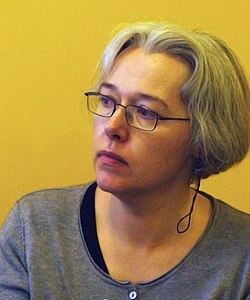
Susanna Mary Clarke (born 1 November 1959) is an English author best known for her debut novel Jonathan Strange & Mr Norrell (2004), a Hugo Award-winning alternative history. Clarke began Jonathan Strange in 1993 and worked on it during her spare time. For the next decade, she published short stories from the Strange universe, but it was not until 2003 that Bloomsbury bought her manuscript and began work on its publication. The novel became a best-seller.
Key Information


Two years later, she published a collection of her short stories, The Ladies of Grace Adieu and Other Stories (2006). Both Clarke's debut novel and her short stories are set in a magical England and written in a pastiche of the styles of 19th-century writers such as Jane Austen and Charles Dickens. While Strange focuses on the relationship of two English magicians with opposing views, Jonathan Strange and Gilbert Norrell, the stories in Ladies focus on the power female characters gain through magic.
Clarke's second novel, Piranesi, was published in September 2020, and won the 2021 Women's Prize for Fiction.
In January 2024, she stated that she was currently working on a novel set in Bradford, England.[1]
Biography
[edit]Early life
[edit]Clarke was born on 1 November 1959 in Nottingham, England, the eldest daughter of a Methodist minister and his wife.[2][3] Owing to her father's posts, she spent her childhood in various towns across Northern England and Scotland,[4] and enjoyed reading the works of Sir Arthur Conan Doyle, Charles Dickens, and Jane Austen.[3] She studied philosophy, politics, and economics at St Hilda's College, Oxford,[5] receiving her degree in 1981.[6]
For eight years, she worked in publishing at Quarto and Gordon Fraser.[4] She spent two years teaching English as a foreign language in Turin, Italy, and Bilbao, Spain. She returned to England in 1992 and spent the rest of that year in County Durham, in a house that looked out over the North Sea.[7] There she began working on her first novel, Jonathan Strange and Mr Norrell.[7] In 1993, she was hired by Simon & Schuster in Cambridge to edit cookbooks, a job she kept for the next ten years.[4]
Jonathan Strange and Mr Norrell
[edit]Clarke first developed the idea for Jonathan Strange & Mr Norrell while she was teaching in Bilbao: "I had a kind of waking dream ... about a man in 18th-century clothes in a place rather like Venice, talking to some English tourists. And I felt strongly that he had some sort of magical background – he'd been dabbling in magic, and something had gone badly wrong."[8] She had also recently reread J. R. R. Tolkien's The Lord of the Rings and afterwards was inspired to "[try] writing a novel of magic and fantasy".[9]
After she returned from Spain in 1993, Clarke began to think seriously about writing her novel. She signed up for a five-day fantasy and science-fiction writing workshop, co-taught by science fiction and fantasy writers Colin Greenland and Geoff Ryman. The students were expected to prepare a short story before attending, but Clarke only had "bundles" of material for her novel. From this she extracted "The Ladies of Grace Adieu", a fairy tale about three women secretly practising magic who are discovered by the famous Jonathan Strange.[10] Greenland was so impressed with the story that, without Clarke's knowledge, he sent an excerpt to his friend, the fantasy writer Neil Gaiman. Gaiman later said, "It was terrifying from my point of view to read this first short story that had so much assurance ... It was like watching someone sit down to play the piano for the first time and she plays a sonata."[10] Gaiman showed the story to his friend, science-fiction writer and editor Patrick Nielsen Hayden. Clarke learned of these events when Nielsen Hayden called and offered to publish her story in his anthology Starlight 1 (1996), which featured pieces by well-regarded science-fiction and fantasy writers.[10] She accepted, and the book won the World Fantasy Award for best anthology in 1997.[11]

Clarke spent the next ten years working on the novel in her spare time.[13] She also published stories in Starlight 2 (1998) and Starlight 3 (2001); according to The New York Times Magazine, her work was known and appreciated by a small group of fantasy fans and critics on the internet.[10] Overall, she published seven short stories in anthologies. "Mr Simonelli, or The Fairy Widower" was shortlisted for a World Fantasy Award in 2001.[14]
Clarke was never sure if she would finish her novel or if it would be published.[13] Clarke tried to write for three hours each day, beginning at 5:30 am, but struggled to keep this schedule. Rather than writing the novel from beginning to end, she wrote in fragments and attempted to stitch them together.[15] Clarke, admitting that the project was for herself and not for the reader,[16] "clung to this method" "because I felt that if I went back and started at the beginning, [the novel] would lack depth, and I would just be skimming the surface of what I could do. But if I had known it was going to take me ten years, I would never have begun. I was buoyed up by thinking that I would finish it next year, or the year after next."[15] Clarke and Greenland fell in love while she was writing the novel and moved in together.[10]
Around 2001, Clarke "had begun to despair", and started looking for someone to help her finish and sell the book.[10] Giles Gordon became her first literary agent and sold the unfinished manuscript to Bloomsbury in early 2003, after two publishers rejected it as unmarketable.[15] Bloomsbury were so sure the novel would be a success that they offered Clarke a £1 million advance.[17] They printed 250,000 hardcover copies simultaneously in the United States, Britain, and Germany. Seventeen translations were begun before the first English publication was released on 8 September 2004 in the United States and on 30 September in the United Kingdom.[10][18]
Jonathan Strange & Mr Norrell is an alternate history novel set in 19th-century England during the Napoleonic Wars. It is based on the premise that magic once existed in England and has returned with two men: Gilbert Norrell and Jonathan Strange. Centring on the relationship between these two men,[19] the novel investigates the nature of Englishness[20] and the boundary between reason and madness.[21] It has been described as a fantasy novel, an alternative history, and an historical novel and draws on various Romantic literary traditions, such as the comedy of manners, the Gothic tale, and the Byronic hero.[22] Clarke's style has frequently been described as a pastiche, particularly of 19th-century British writers such as Charles Dickens, Jane Austen, and George Meredith.[19][23] The supernatural is contrasted with and highlighted by mundane details and Clarke's tone combines arch wit with antiquarian quaintness.[24][25] The text is supplemented with almost 200 footnotes, outlining the backstory and an entire fictional corpus of magical scholarship. The novel was well received by critics[26] and reached number three on the New York Times best-seller list,[18] remaining on the list for eleven weeks.[27]
A seven-part adaptation of the book by the BBC began broadcast on BBC One on Sunday 17 May 2015. The book was adapted by Peter Harness, directed by Toby Haynes, and produced by Cuba Pictures and Feel Films.[28][29]
The Ladies of Grace Adieu and Other Stories
[edit]In 2006, Clarke published a collection of eight fairy tales presented as the work of several different writers, seven of which had been previously anthologized.[30][31][32] The volume's focus on "female mastery of the dark arts" is reflected in the ladies of Grace Adieu's magical abilities and the prominent role needlework plays in saving the Duke of Wellington and Mary, Queen of Scots.[33] The collection is a "sly, frequently comical, feminist revision" of Jonathan Strange.[34] In tone, the stories are similar to the novel—"nearly every one of them is told in a lucid, frequently deadpan, bedtime-story voice strikingly similar to the voice that narrates the novel."[34]
The title story, "The Ladies of Grace Adieu", is set in early 19th-century Gloucestershire and concerns the friendship of three young women, Cassandra Parbringer, Miss Tobias, and Mrs. Fields. Though the events of the story do not actually appear in Jonathan Strange & Mr Norrell, they are referenced in a footnote in Chapter 43. Clarke has said, "For a long time it was my hope that these three ladies should eventually find a place in ... the novel ... I decided there was no place for them ... I deliberately kept women to the domestic sphere in the interests of authenticity ... it was important that real and alternate history appeared to have converged. This meant that I needed to write the women and the servants, as far as possible, as they would have been written in a 19th-century novel."[35] Reviewers highlighted this tale, one calling it "the most striking story" of the collection and "a staunchly feminist take on power relations".[36] In her review of the volume in Strange Horizons, Victoria Hoyle writes that "there is something incredibly precise, clean, and cold about Clarke's portrayal of 'women's magic' in this story (and throughout the collection)—it is urgent and desperate, but it is also natural and in the course of things."[37]
The collection received many positive reviews, though some critics compared the short stories unfavourably with the highly acclaimed and more substantial Jonathan Strange and Mr Norrell. Hoyle wrote in her review that "the stories ... are consistently subtle and enchanting, and as charismatic as any reader could wish, but, while the collection has the panache of the novel, it lacks its glorious self-possession."[37]
Piranesi
[edit]When she began writing her next book, Clarke was living in Cambridge with her partner, the science fiction novelist and reviewer Colin Greenland.[14] They met when she took his fantasy writing course.[38] She was, in 2004, working on a book that begins a few years after Jonathan Strange & Mr Norrell ends and which would involve characters who, as Clarke said, are "a bit lower down the social scale".[16] She commented in 2005 and 2007[39] that progress on the book had been slowed by her ill health.[40] In 2006 it was reported that she suffered from chronic fatigue syndrome.[41] Clarke found that writing the sequel to Jonathan Strange & Mr Norrell was becoming too complex considering her illness, and she returned instead to an earlier project with fewer characters and requiring less research – which became her second novel. While writing this book she moved to Derbyshire.[38]
In September 2019, Publishers Weekly reported that Clarke's second novel would be titled Piranesi and published in September 2020 by Bloomsbury. Quoting their press release, "A Bloomsbury spokesperson said the novel is set in 'a richly imagined, very unusual world.' The title character lives in a place called the House and is needed by his friend, the Other, to work on a scientific project. The publisher went on: 'Piranesi records his findings in his journal. Then messages begin to appear; all is not what it seems. A terrible truth unravels as evidence emerges of another person and perhaps even another world outside the House's walls.'"[42][43] Piranesi was published on 15 September 2020 by Bloomsbury. The audiobook is narrated by actor Chiwetel Ejiofor.[44]
Awards and nominations
[edit]| Year | Work | Award | Result | Ref. |
|---|---|---|---|---|
| 2001 | "Mr Simonelli, or the Fairy Widower" | World Fantasy Award for Best Novella | Shortlisted | [45] |
| 2004 | Jonathan Strange & Mr Norrell | Booker Prize | Longlisted | [46] |
| Guardian First Book Award | Shortlisted | [47] | ||
| Whitbread First Novel Award | Shortlisted | [48] | ||
| Time's Best Novel of the Year | Won | [49] | ||
| 2005 | British Book Awards Literary Fiction Award | Shortlisted | [50] | |
| Hugo Award for Best Novel | Won | [51] | ||
| Locus Award for Best First Novel | Won | [52] | ||
| Mythopoeic Award for Adult Literature | Won | [53] | ||
| Nebula Award for Best Novel | Shortlisted | [54] | ||
| World Fantasy Award for Best Novel | Won | [55] | ||
| — | British Book Awards as Newcomer of the Year | Won | [56] | |
| 2020 | Piranesi | Costa Book Award for Novel | Shortlisted | [57] |
| 2021 | Encore Award | Shortlisted | [58] | |
| Hugo Award for Best Novel | Shortlisted | [59] | ||
| Nebula Award for Best Novel | Shortlisted | [60] | ||
| Kitschies Red Tentacle for Best Novel | Won | [61] | ||
| Women's Prize for Fiction | Won | [62][63] |
List of works
[edit]Novels
[edit]- —— (September 2004). Jonathan Strange & Mr Norrell (hardcover ed.). New York and London: Bloomsbury. pp. 1–782. ISBN 978-1582344164.[64]
- —— (September 2020). Piranesi (hardcover ed.). New York and London: Bloomsbury. pp. 1–245. ISBN 978-1526622426.[65]
- —— (October 2024). The Wood at Midwinter (hardcover ed.). New York and London: Bloomsbury. pp. 1–63. ISBN 978-1526675217.[66]
Collections
[edit]- —— (October 2006). The Ladies of Grace Adieu and Other Stories (hardcover US 1st ed.). New York & London: Bloomsbury. pp. 1–235. ISBN 978-1596912519.[67][68]
Short stories
[edit]Clarke has published her short stories in multiple publications, including traditional press and newspapers as well as radio broadcast. This list contains the first publication of each as well as first appearance of "John Uskglass and the Cumbrian Charcoal Burner" in her collection The Ladies of Grace Adieu and Other Stories.
- Kramer, Ed; Gaiman, Neil, eds. (1996). "Stopp't-Clock Yard". The Sandman: Book of Dreams. New York: Harper Prism.[67]
- Hayden, Patrick Nielsen, ed. (1996). "The Ladies of Grace Adieu". Starlight 1. New York: Tor Books.[67]
- Datlow, Ellen; Windling, Terri, eds. (1997). "On Lickerish Hill". Black Swan, White Raven. New York: Avon.[67]
- Hayden, Patrick Nielsen, ed. (1998). "Mrs Mabb". Starlight 2. New York: Tor Books.[67]
- Vess, Charles, ed. (1999). "The Duke of Wellington Misplaces His Horse". A Fall of Stardust. Green Man Press.[67]
- Datlow, Ellen; Windling, Terri, eds. (2000). "Mr. Simonelli or the Fairy Widower". Black Heart, Ivory Bones. New York: Avon.[67]
- Hayden, Patrick Nielsen, ed. (2001). "Tom Brightwind, or, How the Fairy Bridge Was Built at Thoresby". Starlight 3. New York: Tor Books.[67]
- "Antickes and Frets". The New York Times. 31 October 2004.[67]
- "John Uskglass and the Cumbrian Charcoal Burner". The Ladies of Grace Adieu and Other Stories. New York & London: Bloomsbury. 2006. pp. 221–235.[67]
- Datlow, Ellen, ed. (2010). "The Dweller in High Places". Tails of Wonder and Imagination. San Francisco: Night Shade Books.
- "The Wood at Midwinter". Bloomsbury Publishing. 22 October 2024.[69]
Radio dramas
[edit]- "The Dweller in High Places". BBC. 26 February 2007.[70]
- "The Wood at Midwinter". BBC. 23 December 2022.[71]
References
[edit]- ^ Susanna Clarke And Alan Moore In Conversation at British Library, retrieved 11 January 2024
- ^ Alter, Alexandra (25 October 2024). "Susanna Clarke Wrote a Hit Novel Set in a Magical Realm. Then She Disappeared". The New York Times. Retrieved 25 October 2024.
- ^ a b Dewey, Joseph (2007). "Susanna Clarke". Guide to Literary Masters and Their Works. Great Neck Publishing – via Literary Reference Center (EBSCO).
- ^ a b c "The Three Susanna Clarkes". Locus. April 2005. Retrieved 17 March 2009.
- ^ Stade, George; Karbiener, Karen (12 May 2010). Encyclopedia of British Writers, 1800 to the Present. Vol. 2. Infobase. p. 110. ISBN 9781438116891.
- ^ "Susanna Clarke (Autor) - Bücher".
- ^ a b "Susanna Clarke". Bloomsbury.com. Archived from the original on 10 May 2012. Retrieved 28 October 2017.
- ^ Grossman, Lev (8 August 2004). "Of Magic and Men". Time. Retrieved 5 January 2009.
{{cite magazine}}: CS1 maint: deprecated archival service (link) - ^ Stockton, Jessica (12 July 2004). "Harry Potter Meets History". Publishers Weekly. Retrieved 20 May 2009 – via LexisNexis.
- ^ a b c d e f g Hodgman, John (1 August 2004). "Susanna Clarke's Magic Book". The New York Times Magazine. Retrieved 5 January 2009.
- ^ "Award Winners & Nominees: 2007 World Fantasy Awards Ballot". World Fantasy Awards. Archived from the original on 30 July 2009. Retrieved 13 January 2009.
- ^ Silver, Steven H. (October 2004). "An Interview of Susanna Clarke, Part 2". sfsite.com. Archived from the original on 16 February 2005. Retrieved 25 January 2009.
- ^ a b Grossman, Wendy (7 October 2004). "Ten years — but Susanna's book is worth the wait". The Daily Telegraph. Retrieved 5 January 2009.
- ^ a b "About Jonathan Strange and Mr Norrell". JonathanStrange.com. Retrieved 12 April 2009.
- ^ a b c Rose, Hilary (2 October 2004). "Her dark materials". The Times – via LexisNexis.
- ^ a b Silver, Steven H. (October 2004). "An Interview of Susanna Clarke, Part 1". sfsite.com. Archived from the original on 16 February 2005. Retrieved 25 January 2009.
- ^ Craig, Amanda (27 September 2004). "With the fairies". New Statesman. Retrieved 5 January 2009.
- ^ a b Dawtrey, Adam (19 September 2004). "'Strange' casts pic spell". Variety. Retrieved 12 January 2009.
- ^ a b Hendrix, Grady (24 August 2004). "Do You Believe in Magic?". The Village Voice. Archived from the original on 29 October 2017. Retrieved 5 January 2009.
- ^ Miller, Laura (4 September 2004). "When Harry Potter met Jane Austen". Salon. Retrieved 5 January 2009.
- ^ Shulman, Polly (16 September 2004). "Fantasy for Grown-ups". Slate. Retrieved 5 January 2009.
- ^ Dirda, Michael (5 September 2004). "Jonathan Strange and Mr Norrell". The Washington Post. Retrieved 5 January 2009.
- ^ Brown, Helen (15 September 2004). "Under her spell". The Daily Telegraph. Retrieved 5 January 2009.
- ^ Freeman, John (3 October 2004). "Magic to do: Faux footnotes, social observation, and wizard rivalry stir the pot in Susanna Clarke's 19th-century tale". The Boston Globe – via LexisNexis.
- ^ Faber, Michel (2 October 2004). "It's a kind of magick". The Guardian. Retrieved 5 January 2009.
- ^ Linskey, Annie (29 September 2004). "Stranger than Fiction — After 10 years of writing, Susanna Clarke has found overnight success, and perhaps a bit of the old Potter magic, with her debut novel". The Baltimore Sun – via Access World News.
- ^ "Best Sellers". The New York Times. 16 January 2005 – via LexisNexis.
- ^ "Danny Cohen, looks ahead at the five key themes that will define the channel in 2013". BBC. 30 November 2012. Retrieved 9 April 2013.
- ^ Itzkoff, Dave (8 April 2013). "BBC to Adapt 'Jonathan Strange & Mr. Norrell' as Mini-Series". The New York Times. Retrieved 9 April 2013.
- ^ Zipp, Yvonne (31 October 2006). "All the faerie young ladies". The Christian Science Monitor. Retrieved 7 April 2009.
- ^ Luscombe, Karen (23 December 2006). "You'll believe in magic". The Globe and Mail. Retrieved 7 April 2009.
- ^ Morrissy, Mary (21 October 2006). "Flitting into the world of Faerie". The Irish Times. Retrieved 9 April 2009.
- ^ Montgomery, Isobel (8 September 2007). "Stitches in time". The Guardian. Retrieved 7 April 2009.
- ^ a b Collins-Hughes, Laura (10 November 2006). "Clarke's protagonist seen in less flattering light in 'Ladies'". Chicago Tribune – via Access World News.
- ^ Steele, Colin (27 January 2007). "Literary journey to faerie realms". The Canberra Times – via Lexis Nexis.
- ^ Lalumiere, Claude (20 January 2007). "Stories mix everyday and magic realms". The Gazette – via LexisNexis.
- ^ a b Hoyle, Victoria (20 November 2006). "Review: 'The Ladies of Grace Adieu' by Susanna Clarke". Strange Horizons. Archived from the original on 27 July 2008. Retrieved 10 April 2009.
- ^ a b Jordan, Justine (20 September 2020). "Susanna Clarke: 'I was cut off from the world, bound in one place by illness'". The Guardian.
- ^ "Susanna Clarke responds to your questions..." The Friends of English Magic. 10 January 2007. Archived from the original on 10 January 2007.
- ^ Goodwin, Geoffrey. "An Interview with Susanna Clarke". Bookslut. Archived from the original on 1 July 2015. Retrieved 29 June 2015.
- ^ "Susanna Clarke cancels book tour". Adweek. 18 August 2006. Retrieved 22 August 2018.
- ^ "Book Deals: Week of September 30, 2019". Publishers Weekly. 27 September 2019. Retrieved 28 September 2019.
- ^ Flood, Alison (30 September 2019). "Jonathan Strange and Mr Norrell author to return after 16-year gap". The Guardian. Retrieved 30 September 2019.
- ^ Hackett, Tamsin (24 July 2020). "Chiwetel Ejiofor to narrate audiobook of Susanna Clarke's Piranesi". The Bookseller. Retrieved 15 September 2020.
- ^ "Award Winners & Nominees: 2001 World Fantasy Awards Ballot". World Fantasy Awards. Archived from the original on 18 December 2001. Retrieved 7 April 2009.
- ^ "The Longlist". The Man Booker Prize. 2004. Retrieved 5 January 2009.
- ^ Ezard, John (4 November 2004). "Guardian shortlist takes world as its oyster". The Guardian. Retrieved 5 January 2009.
- ^ "2004 Whitbread Book Awards Shortlist" (PDF) (Press release). The Booksellers Association. Archived from the original (PDF) on 3 October 2006. Retrieved 12 January 2009.
- ^ "2004 Best and Worst Books". Time. Archived from the original on 31 January 2009. Retrieved 12 January 2009.
- ^ "Literary Awards". Contemporary Writers in the UK. Archived from the original on 20 July 2009. Retrieved 12 January 2009.
- ^ "2005 Hugo Awards". thehugoawards.org. 24 July 2007. Retrieved 5 January 2009.
- ^ "Locus Index to SF Awards". Locus. Archived from the original on 16 August 2009. Retrieved 10 March 2009.
- ^ "Locus Index to SF Awards". Locus. Archived from the original on 6 May 2009. Retrieved 10 March 2009.
- ^ "2005 Nebula Awards". nebulas.sfwa.org. Retrieved 4 June 2021.
- ^ "2005 World Fantasy Awards". worldfantasy.org. Archived from the original on 6 May 2009. Retrieved 5 January 2009.
- ^ "British Book Awards". britishbookawards.co.uk. Archived from the original on 8 September 2009. Retrieved 5 January 2009.
- ^ Flood, Alison (24 November 2020). "Costa book awards: Susanna Clarke nominated for second novel after 16-year wait". The Guardian.
- ^ Chandler, Mark (5 May 2021). "Oneworld takes two places on Encore Award shortlist". The Bookseller. Retrieved 25 June 2021.
- ^ "2021 Hugo Awards". thehugoawards.org. January 2021. Retrieved 17 April 2021.
- ^ "2021 Nebula Awards". nebulas.sfwa.org. 16 March 2021. Retrieved 17 April 2021.
- ^ "The Kitschies Blackwell's". blackwells.co.uk. Retrieved 13 March 2023.
- ^ Flood, Alison (8 September 2021). "Women's prize for fiction goes to Susanna Clarke's 'mind-bending' Piranesi". The Guardian.
- ^ "Announcing the 2021 winner of the Women's Prize!". Women's Prize for Fiction. 8 September 2021. Retrieved 8 September 2021.
- ^ Clarke, Susanna (September 2004). Jonathan Strange & Mr Norrell. Illustrated by Portia Rosenberg. New York and London: Bloomsbury. ISBN 9781582346038. OCLC 61660468.
- ^ "Piranesi". Bloomsbury Publishing. Retrieved 15 September 2020.
- ^ "The Wood at Midwinter". Bloomsbury Publishing. Retrieved 25 February 2026.
- ^ a b c d e f g h i j "The Locus Index to Science Fiction Authors: 2006, Stories". Locus. Retrieved 12 April 2009.
- ^ Clarke, Susanna (2006). The ladies of Grace Adieu and other stories. Internet Archive. New York : Bloomsbury USA : Distributed to the trade by Holtzbrinck Publishers. ISBN 978-1-59691-251-9.
- ^ Alter, Alexandra (25 October 2024). "Susanna Clarke Wrote a Hit Novel Set in a Magical Realm. Then She Disappeared". New York Times. Retrieved 27 October 2024.
- ^ "The Dweller in High Places". BBC Radio 7. Retrieved 14 April 2009.
- ^ "The Wood at Midwinter". BBC Radio 7. Retrieved 19 February 2023.
External links
[edit]
- Jonathan Strange & Mr Norrell at Bloomsbury Publishing
- The Library at Hurtfew, a comprehensive fan wiki
- Susanna Clarke on her early life
- Susanna Clarke at the Internet Speculative Fiction Database
- Susanna Clarke at British Council: Literature
- Susanna Clarke at Library of Congress, with 2 library catalog records
