Hubbry Logo
search
logo
Symbel
Symbel
current hub
2259540

Symbel

logo
Community Hub0 Subscribers
Read side by side
from Wikipedia
A drinking scene on an image stone from Gotland, in the Swedish Museum of National Antiquities in Stockholm

Symbel (OE) and sumbl (ON) are Germanic terms for "feast, banquet".

Accounts of the symbel are preserved in the Anglo-Saxon Beowulf (lines 489–675 and 1491–1500), Dream of the Rood (line 141) and Judith (line 15), Old Saxon Heliand (line 3339), and the Old Norse Lokasenna (stanza 8) as well as other Eddic and Saga texts, such as in the Heimskringla account of the funeral ale held by King Sweyn, or in the Fagrskinna.

Paul C. Bauschatz in 1976 suggested that the term reflects a pagan ritual which had a "great religious significance in the culture of the early Germanic people".[1]

Etymology

[edit]

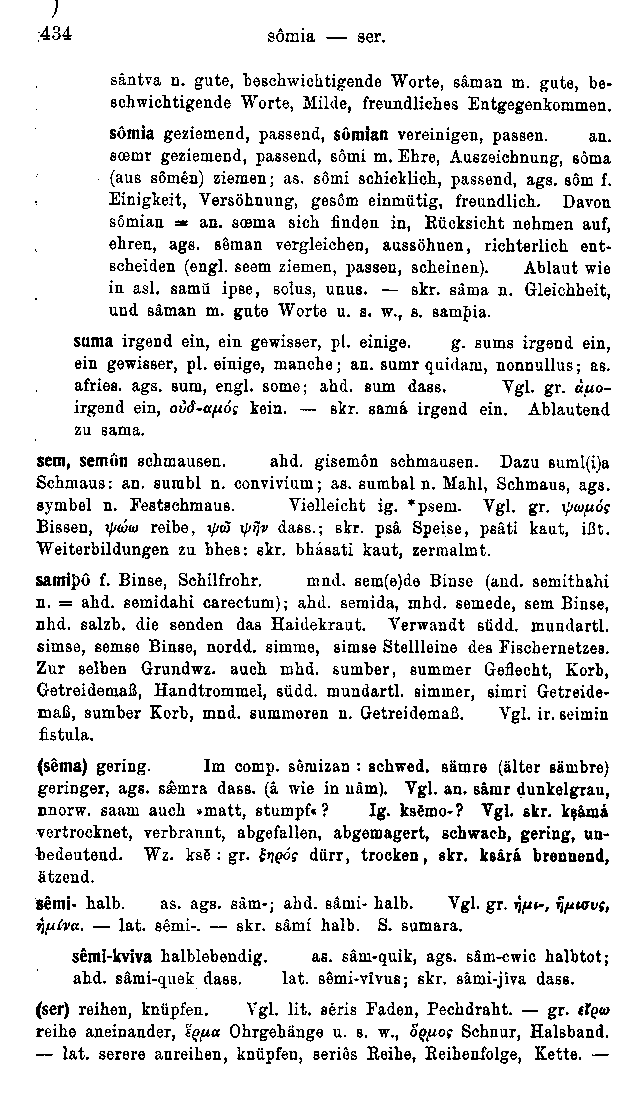
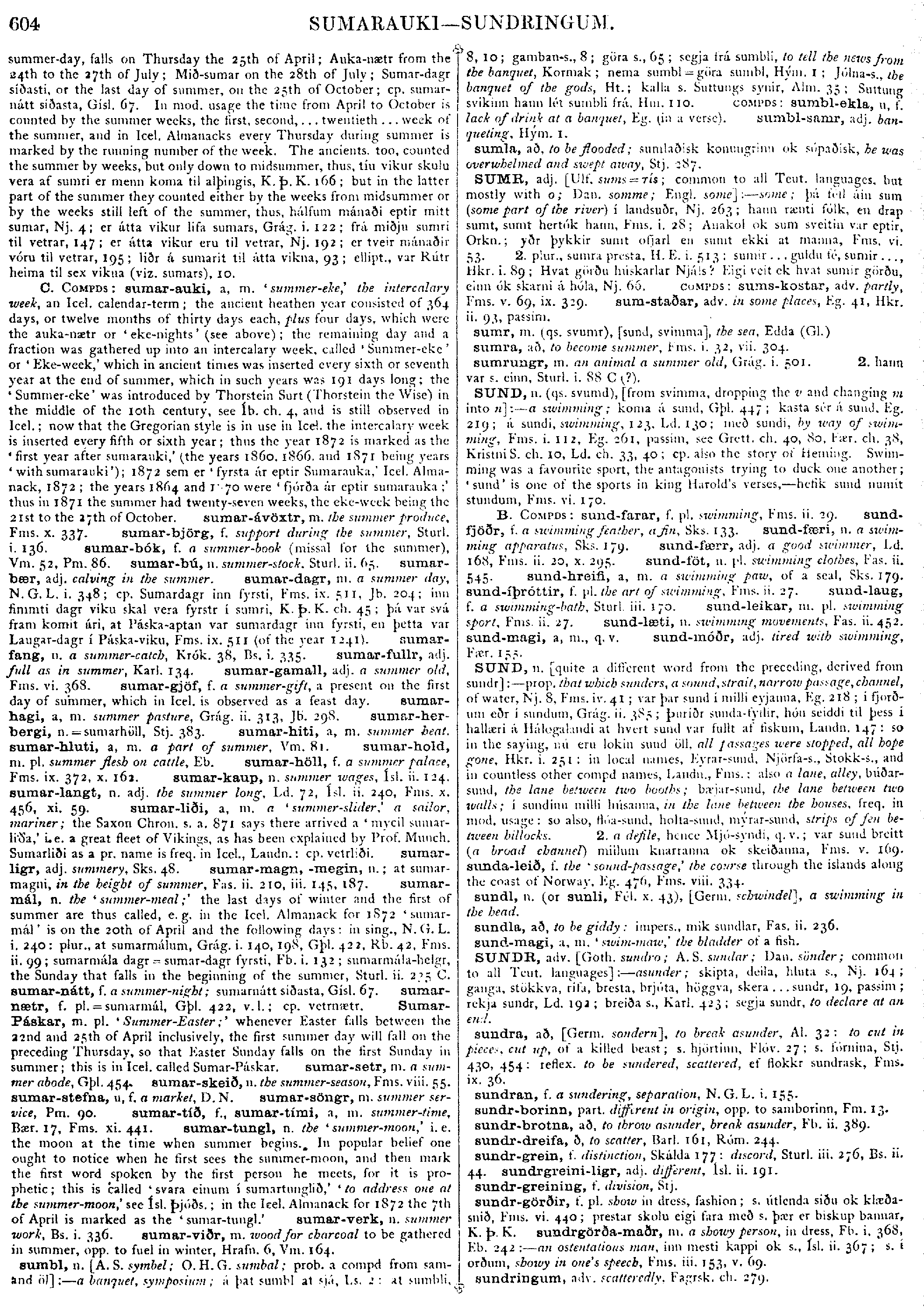
The prevalent view today is that Old English symbel, Old Saxon symbal, sumbal[2] (Old High German *sumbal) and Old Norse sumbl,[3] all of which translate roughly as "feast, banquet, (social) gathering", continue a Common Germanic *sumlan "banquet", which would correspond to a PIE *sṃ-lo- "joint meal" or "congregation" (literally, symposium or assembly).[4]

A number of earlier scholars have argued for a borrowing from Latin symbola,[5] Against this derivation (in the case of OE symbel), P.A. Erades argues that these cognates go back to Common Germanic *sumil or *sumal "gathering" (in the last case, with ablaut in the suffix). He explains the Germanic stem *sum- as ultimately deriving from Proto-Indo-European *sṃ- prefix, the zero-grade of ablaut of *sem "one, together".[6] This is the same element which developed into copulative a in Ancient Greek.

Paul Bauschatz appears to accept sum, sam "together", but proposes that the word represents a compound with alu "ale" as its second element (rather than a suffix). This would render the meaning "gathering or coming together of ale".[7]

The Old English noun is usually translated as "feast", and forms various compounds such as symbel-wyn "joy at feasting", symbel-dæg "feast day", symbel-niht "feast-night", symbel-hūs "feast-house, guest-room", symbel-tīd "feast time", symbel-werig "weary of feasting" etc. There is also a derived verb, symblian or symblan, meaning "to feast, caraouse, enjoy one's self". Not to be confused is the unrelated homophone symbel, symble meaning "always, ever".

Anglo-Saxon cultures

[edit]

In Old English poetry, especially Beowulf, feasts could be instrumental occasions to bind the community, secure the loyalty of warriors and to bolster their determination to perform heroic deeds.

  • In Beowulf, Unferth the thyle (cf.: ON þulr) appears to act as a royal officiant at the feast which King Hrothgar organised for the Geatish newcomers, Beowulf and his companions. He challenged and questioned Beowulf, not eschewing taunts and mockery (flyting). Since no one intervenes during the incident, such behaviour appears to have been expected of him.
  • In Beowulf, a warrior's boast (gielp, gylp) or his oath (beot) is often spoken at a feast.
  • Another role commonly attested for during a feast was that of the scop (cf.: ON skald), who recited genealogies, folklore and metrical poetry.
  • The alcoholic drink was served by women or alekeepers (ealu bora "ale bearer"), the first round usually poured by the lady of the house.

Scandinavian cultures

[edit]

Bragafull

[edit]
At the funeral feast of Harald Bluetooth, Jarl Sigvaldi swears an oath on his father's memory to go to Norway and kill or drive away Haakon Jarl.

The bragarfull "promise-cup" or bragafull "best cup" or "chieftain's cup" (compare Bragi) was in Norse culture a particular drinking from a cup or drinking horn on ceremonial occasions, often involving the swearing of oaths when the cup or horn was drunk by a chieftain or passed around and drunk by those assembled. The names are sometimes anglicized as bragarful and bragaful respectively.

That the name appears in two forms with two meanings makes it difficult to determine the literal meaning. The word bragr 'best, foremost' is a source for its first element. The form bragafull (but not bragarfull) can also be interpreted as 'Bragi's cup', referring to the Bragi, god of poetry, though no special connection to Bragi appears in any of the sources.

Snorri Sturluson in his Heimskringla, in the Saga of Hákon the Good, describes the custom of the bragarfull at feasts:

The fire was in the middle of the floor of the temple, and over it hung the kettles, and the full goblets were handed across the fire; and he who made the feast, and was a godi ['chief'], blessed the full goblets, and all the meat of the sacrifice. And first Odin's goblet was emptied for victory and power to his king; thereafter, Njörd's and Freyr's goblets for peace and a good season. Then it was the custom of many to empty the bragafull; and then the guests emptied a goblet to the memory of departed friends, called the minni ['remembrance'].

In Ynglinga saga section of the same work, Snorri relates:

It was the custom at that time that he who gave an heirship-feast after kings or jarls, and entered upon the heritage, should sit upon the footstool in front of the high seat, until the full bowl, which was called the bragafull, was brought in. Then he should stand up, take the bragafull, make solemn vows to be afterwards fulfilled, and thereupon empty the beaker. Then he should ascend the high seat which his father had occupied; and thus he came to the full heritage after his father. Now it was done so on this occasion. When the full bragafull came in, King Ingjald stood up, grasped a large bull's horn, and made a solemn vow to enlarge his dominions by one half, towards all the four corners of the world, or die; and thereupon pointed with the horn to the four quarters.

The Fagrskinna (a 13th-century history of the Kings of Norway), has a similar account in respect to Svein Forkbeard, mentioning first ceremonial drinkings dedicated to the greatest of one's kindred, then to Thor or others of the gods. Then the bragarfull was poured out and when the giver of the feast had drunk this, he was to make a vow, to be also sworn by those present with him, and only then to sit himself on throne of the deceased.

A prose passage inserted in the Poetic Edda poem Helgakviða Hjörvarðssonar relates:

Hedin was coming home alone from the forest one Yule-eve, and found a troll-woman; she rode on a wolf, and had snakes in place of a bridle. She asked Hedin for his company. "Nay," said he. She said, "Thou shalt pay for this at the bragarfull." That evening the great vows were taken; the sacred boar was brought in, the men laid their hands thereon, and took their vows at the bragarfull. Hedin vowed that he would have Sváva, Eylimi's daughter, the beloved of his brother Helgi; then such great grief seized him that he went forth on wild paths southward over the land, and found Helgi, his brother.

Hervarar saga ok Heiðreks relates that Hjörvard, the son of Arngrim, promised at his bragarfull to wed Ingeborg the princess of Sweden, and the legends of Ragnar Lodbrok relate that the Geatish jarl Herraud promised his daughter to anyone who could liberate her from a dragon or talk to her in its presence.

Minni

[edit]

The term minni "remembrance, memory" was used for ritual drinking dedicated to the remembrance of the gods. Terms used in this context, both in the Eddaic poems and in the sagas, include minnis-öl "memory-ale", minnis-horn "memory-horn", minnis-full "memory-cup", minni-sveig "memory-draught". The term minnisveig is used by the annotator of the Sigrdrífumál before the valkyrie's invocation of the gods. Olafssaga has minniǫl signuð ásom "memory-ale dedicated to the æsir". "Memory-cups" dedicated to individual gods are also named Oðins full, Niarðar full, Freys full etc. The custom was continued uninterrupted by Christianization, and minni was now drunk to Christ, Mary and the saints (Krists minni, Michaêls minni, etc.).[8]

But the minni given to gods or saints was only the most prominent instance of this custom, placed at the beginning of the ritual drinking. Later on, drinkers would also give minni to their departed friends. The term minni is the exact cognate of the Middle High German minne. The German word had the same meaning of "remembrance of absent or departed loved ones", but acquired the meaning of "romantic longing for an unattainable woman of higher status" in courtly culture, giving rise to the genre of Minnesang, and the personification of "remembrance" as Frau Minne.

Bauschatz's theory

[edit]

Paul C. Bauschatz in 1976 suggested that the term reflects a pagan ritual which had a "great religious significance in the culture of the early Germanic people".[1]

The ritual according to Bauschatz was always conducted indoors, usually in a chieftain's mead hall. Symbel involved a formulaic ritual that was more solemn and serious than mere drinking or celebration. The primary elements of symbel are drinking ale or mead from a drinking horn, speech making (which often included formulaic boasting and oaths) and gift giving. Eating and feasting were specifically excluded from symbel, and no alcohol was set aside for the gods or other deities in the form of a sacrifice.[9]

Modern paganism

[edit]

Inspired by Bauschatz' theory from the 1970s, the sumbel has become a central ritual of Heathenry in the United States. In this version, sumbel is a drinking-ritual in which a drinking horn full of mead or ale is passed around and a series of toasts are made, usually to gods, ancestors, and/or heroes of the religion. The toasts vary by group, and some groups make a distinction between a "regular" sumbel and a "high" sumbel, which have different levels of formality, and different rules during toasting. Participants may also make boasts of their own deeds, or oaths or promises of future actions. Words spoken during the sumbel are considered carefully and any oaths made are considered sacrosanct, becoming part of the destiny of those assembled.

The name sumbel (or symbel) is mainly derived from Anglo-Saxon sources. For this reason, the ritual is not known by this name among Icelandic Nordic pagans, who nevertheless practice a similar ritual as part of their blot.[10]

In Theodism or Anglo-Saxon neopaganism in particular, the symbel has a particularly high importance, considered "perhaps the highest rite" or "amongst the most holy rites"[11] celebrated. Symbel consists of rounds of ritual drinking and toasting, and invariably takes place within an enclosed space of some kind.[12] It is usually inaugurated by three formal rounds, as determined by the host; often led by toasts in honor of the Gods, then ancestors and/or heroes, and then a general or personal boast. Other boasts may take place as necessary. Symbel is always formally closed once the formal boasts are completed, in order that the symbel might maintain its dignity and not degenerate into "mere partying".[13] The two types of boast are the ȝielp (pronounced 'yelp') and the beot (pronounced 'bayawt', but as one syllable). The former is a boast of one's own worthiness, such as one's accomplishments, ancestry, etc. The latter is a boast of an action one plans to undertake. In order to protect the luck of the hall, such boasts are subject to challenge by the thyle, whose job it is to make sure that unlucky boasts do not contaminate the luck of all present.

Notes

[edit]

See also

[edit]

References

[edit]
[edit]
Revisions and contributorsEdit on WikipediaRead on Wikipedia
from Grokipedia
Symbel, also known as sumbel or sumbl, is a pre-Christian Germanic ritual centered on communal drinking and ceremonial toasting, primarily documented in Anglo-Saxon and Norse literary sources as a structured feast held in enclosed halls without accompanying food.[1] Participants, seated in hierarchical order, pass a drinking vessel—typically filled with ale or mead—and offer toasts in successive rounds to deities such as Odin, Njörðr, and Freyr, to ancestors, to heroic figures or boasts of personal deeds, and finally to kin or allies, thereby reinforcing social bonds, oaths, and communal identity.[2] This practice, distinct from sacrificial blóts, emphasized verbal pledges, often facilitated by high-status cup-bearers, and served both secular and sacred functions in maintaining tribal cohesion.[1] The term symbel derives from Old English, denoting a "feast" or "banquet," with cognates in Old Norse sumbl, and appears frequently in Anglo-Saxon poetry, most notably in Beowulf, where it describes hall-based gatherings involving toasts and the consumption of drink (e.g., lines 563b–564a, 617–619a, 1010, 2633–2636).[2] In Beowulf, symbel scenes, such as those in Heorot, illustrate its role in elite social interactions, with verbs like þicgan (to partake) and geþeah (drank up) underscoring the ritualistic intake of mead or ale amid storytelling and oath-making.[2] Parallel Norse accounts, including Snorri Sturluson's Heimskringla (in Hákonar saga góða, chapter 14), depict similar drinking rites during seasonal festivals like Yule, where toasts to gods were mandatory under customary law and linked to offerings in sacred spaces such as groves or halls.[2] Archaeological evidence from sites like Sutton Hoo and Prittlewell supports the ritual's material context, including drinking vessels and hall structures indicative of feasting hierarchies from the 6th to 7th centuries CE.[1] Scholarly interpretations emphasize symbel's dual social and religious dimensions, viewing it as a mechanism for elevating status and invoking divine favor rather than a purely mystical sacrament akin to Christian communion.[1] In Bede's Ecclesiastical History, the phrase weorðunge symbeldaga translates Latin in celebratione dierum festorum, suggesting symbel's persistence into early Christian contexts as a form of feast-day observance tied to honoring traditions.[2] Debates among historians, such as those by Bruce Dickins and Paul Bauschatz, highlight its evolution from pagan roots—potentially influencing later medieval customs—while cautioning against over-romanticizing it as exclusively mead-based or universally religious, given its primary role in secular diplomacy and alliance-building.[1] Today, symbel is reconstructed in modern Heathenry and Ásatrú practices, adapting ancient forms to contemporary rituals for community and remembrance.[1]

Terminology

Etymology

The term "symbel" derives from Old English symbel, denoting a feast or banquet, and is cognate with Old Norse sumbl, sharing the same semantic field of communal feasting.[3] These forms reflect a common Proto-Germanic root reconstructed as sumbalą or sumblą, a neuter noun referring to a ritual or social gathering involving drink and oaths.[3][4] Linguists trace sumbalą to a deeper Proto-Indo-European origin in sṃ-lo-, interpreted as denoting a "joint meal" or collective repast, with the initial element from *sem- ("together, one") combining with a suffix indicating assembly or sharing.[3] Though the exact morphological composition remains debated.[4] Scholar Paul C. Bauschatz proposed an interpretation as a compound of sam- ("together") and alu ("ale"), yielding "gathering of ale" and emphasizing its role in pre-Christian ritual contexts. Following Christianization in Anglo-Saxon and Scandinavian societies around the 10th–11th centuries, the term's usage evolved toward secular connotations, appearing in later texts as a general reference to banquets without overt ritual implications, as pagan elements were suppressed or repurposed.[3] This shift is evident in Middle English adaptations, where "symbel" influenced broader vocabulary for festive meals, detached from its original ceremonial depth.[4] In Anglo-Saxon contexts, gebēorscipe denoted an informal drinking rite or "beer-party," where participants gathered for feasting and entertainment, often involving sequential performances such as songs, as illustrated in Bede's description of gatherings at the monastery of Streanæshalch where the poet Cædmon felt compelled to withdraw rather than contribute.[5] This term contrasts with blót (or geblōt), a sacrificial ceremony focused on offerings to deities, typically involving the ritual killing of animals and communal consumption of meat, emphasizing propitiation through blood and food rather than symbel's structured rounds of drink and verbal pledges.[6] Among Scandinavian equivalents, armannablót referred to an "all-men's sacrifice," a public blót conducted for the benefit of the entire community or army, blending sacrificial elements with festive communal participation but differing from symbel by prioritizing collective offerings over individual toasts.[7] Such terms intersect with symbel in their role as social rituals but diverge in scale and purpose, with blót variants like armannablót often tied to seasonal or military cycles. Following Christian conversion, adaptations preserved symbel-like practices through terms such as Krists minni, a toast to Christ that repurposed the traditional "memory" round to honor Christian figures, integrating pagan drinking customs into religious observance as noted in medieval Norse sagas.[8] For broader context, symbel parallels non-Germanic rituals like the Roman symposium (convivium), an aristocratic gathering centered on wine, conversation, and entertainment after meals, yet Germanic variants uniquely stressed oaths sworn over horns, reinforcing legal and social obligations absent in the more philosophical Roman counterpart.[9][10]

Historical Practices in Anglo-Saxon Culture

Literary Descriptions

In Anglo-Saxon literature, symbel is depicted as a formalized ritual of communal drinking and verbal exchange within the enclosed setting of a mead-hall, serving to reinforce social bonds and heroic narratives. The epic poem Beowulf provides the most detailed accounts, particularly in lines 489–675, where the arrival of the Geatish hero Beowulf at King Hrothgar's hall, Heorot, leads to a symbel that emphasizes hospitality and mutual pledges. Here, the hall is portrayed as a grand, timbered structure adorned with gold and tapestries, a symbol of royal power and safety where warriors gather on benches for the occasion. A thane circulates an ornate ale-cup filled with sweet mead, offering it first to Hrothgar and then to Beowulf and his retainers, prompting speeches of welcome, boasts of past victories, and vows to confront the monster Grendel. This sequence highlights drink rounds as the core mechanism, with verbal exchanges—such as the challenge from Hrothgar's retainer Unferth and Beowulf's retort—fostering communal solidarity without any reference to food offerings or sacrifices.[11] A second symbel in Beowulf (lines 1161–1232) occurs after Beowulf's victory over Grendel, again in Heorot, where the focus remains on mead-sharing and celebratory toasts that affirm alliances between the Danes and Geats. Queen Wealhtheow plays a central role, passing the cup in ritual order to honor the hero and his men, underscoring the symbel's indoor, hierarchical nature as a space for reinforcing kinship and loyalty. A later celebration after the defeat of Grendel's mother (lines 1651–1887) also involves communal gathering and gift-giving, though without explicit drink rounds or Wealhtheow's involvement. The texts consistently omit animal or food sacrifices, centering instead on the circulation of drink and spoken pledges, which bind participants in a formalized exchange of words and intentions.[11] Beyond Beowulf, symbel appears in briefer references that evoke it as a venue for heroic or divine gatherings. In The Dream of the Rood, a heavenly scene of communal reward (around line 141) adapts the motif of feasting in joy among the faithful to a Christian context. Similarly, the Old English poem Judith (line 15) sets the Assyrian banquet in a hall where warriors indulge in wine rounds, portraying a scene of excess and narrative tension leading to Judith's triumph, reminiscent of symbel traditions. These depictions collectively illustrate symbel's role as an enclosed, verbal ritual integral to Anglo-Saxon heroic storytelling.[12][13]

Social and Ritual Roles

In Anglo-Saxon symbel rituals, the thyle served as a key figure responsible for overseeing proceedings, challenging participants' boasts to test their veracity, and maintaining social order within the mead hall. Exemplified by Unferth in Beowulf, the thyle acted as a reprover or spokesman, intervening to provoke debate and ensure that claims aligned with communal standards of honor and truth, thereby preventing unchecked hubris.[14][15] High-status women played a prominent role as cup-bearers, circulating mead or ale to participants in a deliberate sequence that underscored hierarchical relationships and diplomatic ties. This act symbolized the forging of alliances and peacekeeping, as women like Wealhtheow in Beowulf mediated interactions between lords and retainers, reinforcing bonds of loyalty and mutual obligation through their service.[16] Symbel functioned primarily to strengthen kinship networks, heroic ideals, and communal solidarity, with participants exchanging boasts (beot) and oaths that affirmed personal valor and collective commitments. These verbal pledges, made over rounds of drink, elevated individuals' status while binding the group in shared narratives of prowess and fidelity, essential to the warrior society's cohesion.[1] Distinct from battlefield practices, symbel excluded physical combat or sacrificial elements, emphasizing instead a peaceful, introspective verbal exchange confined to the hall setting to cultivate harmony and resolve tensions through discourse rather than violence.[1]

Historical Practices in Scandinavian Culture

Bragafull

The bragafull, derived from Old Norse bragi meaning "chief" or "foremost" and full meaning "cup" or "goblet," refers to a ceremonial drinking vessel used in Scandinavian symbel rituals for solemn oath-swearing, often translated as the "chief's cup" or "promise cup."[8] This practice, documented in medieval sagas, centered on toasts that invoked divine favor before personal vows, emphasizing hierarchy and binding commitments during feasts.[8] The overall sequence of toasts in symbel typically began with offerings to the gods to establish a sacred framework: first to Odin for victory and the power of the ruler, followed by toasts to Njörd and Freyr for peace, prosperity, and good harvests, known collectively as the toast for árs ok friðar.[17] This progression then escalated to toasts honoring heroes, kin, or the host, culminating in the bragafull, where participants swore forward-looking oaths over the passed cup, heightening the ritual's gravity through increasing personal stakes.[8] A prominent historical example appears in Heimskringla's Óláfs saga Tryggvasonar, at a grand commemorative feast hosted by King Sveinn Forkbeard following the death of his father, Harald Bluetooth, where Jarl Sigvaldi of the Jomsvikings drank from the bragafull and vowed to sail to Norway within three winters to kill or expel Jarl Hákon, or perish in the attempt.[17] Sigvaldi's oath, sworn publicly amid the feast's toasts, prompted escalating vows from his brother Þorkell hávi and champion Vagn Ákason, binding the Jomsvikings to a collective campaign that underscored the ritual's role in forging martial resolve.[17] These bragafull practices persisted into the Viking Age as mechanisms for alliance-building among chieftains, where oaths sworn at seasonal or funeral feasts solidified coalitions, inheritance claims, and military pacts, as seen in the Jomsvikings' vows leading to expeditions against Norwegian rulers.[8] By invoking gods and escalating commitments, the ritual reinforced social bonds and authority in a decentralized warrior society.[8]

Minni

In Scandinavian symbel rituals, minni refers to memorial toasts dedicated to the memory of ancestors, gods, or the deceased, serving as a solemn act of remembrance during communal feasts.[17] These toasts are described in medieval Icelandic texts such as Heimskringla, where participants drank to kinsfolk buried in mounds, explicitly termed minni or "memorial toasts," often as part of larger sacrificial or Yule banquets at sites like Hlaðir in Þrándheimr.[17] Similar practices appear in Fagrskinna, which recounts royal feasts involving commemorative drinking to honor the dead alongside oaths, emphasizing the ritual's role in preserving historical and familial legacies.[18] The minni persisted into the post-Christian era, adapting to new religious contexts while retaining its core function of commemoration. In sagas like Svarfdæla saga, phrases such as "minni ok minning" denote acts of memory and remembrance for departed kin during gatherings, evolving in Christianized settings to forms like "Krists minni," where toasts shifted from pagan deities to Christ or saints such as Michael (Michaêls minni).[19] Heimskringla's Saga of Hákon the Good illustrates this transition during a Yule feast, where King Hákon, a Christian ruler, modified traditional toasts—originally to Óðinn, Njǫrðr, and Freyr, including minni to the dead—into pledges to Christ, blending heathen custom with emerging Christian observance to maintain social cohesion.[17] Structurally, minni typically formed the final round of symbel, following initial toasts to gods and promissory elements like the bragafull, fostering a reflective atmosphere through solemn pledges and shared narratives of the honored figures.[20] In royal feasts depicted in Heimskringla, this phase involved participants recounting tales of the deceased or divine, reinforcing communal bonds and tying remembrance to the Norse concept of wyrd, or fate, by invoking the enduring influence of past actions on future destinies.[17]

Scholarly Interpretations

Bauschatz's Theory

Paul C. Bauschatz, in his 1978 article "The Germanic Ritual Feast," interpreted symbel as a formalized pagan ritual of profound religious importance in early Germanic society, distinct from sacrificial practices and centered on communal drinking, verbal pledges, and gift exchange.[21] He outlined the rite as an exclusively indoor ceremony held in mead halls, structured around three sequential rounds of toasting that progressively connected participants to divine, heroic, and personal dimensions of existence.[1] The first round honored the gods through libations and speeches invoking their favor; the second commemorated heroes and ancestors via boasts (gielp) and recitations of tribal lore; and the third involved solemn oaths (béot) and pledges for future actions, binding individuals to their commitments under the gaze of the community.[1] Bauschatz emphasized the ritual's exclusion of blood sacrifices, positioning symbel instead as a non-bloody rite focused on eloquence, reciprocity through gifts, and the transformative power of speech to shape reality. He linked the ale or mead—served from a horn or cup by a designated bearer, often a high-status woman—to Germanic cosmology, portraying it as a sacred medium akin to the primordial waters of the cosmic wells (such as Urðr's Well), which facilitated the flow of maegen (spiritual power) and divine blessing among participants. This beverage not only fostered social cohesion but also embodied the interplay between human agency and the supernatural, allowing toasts to weave personal destinies into the fabric of wyrd (fate or cosmic order).[22] Expanding on these ideas in his 1982 monograph The Well and the Tree: World and Time in Early Germanic Culture, Bauschatz argued that symbel played a pivotal role in upholding cosmic harmony by aligning past heroic narratives, present communal bonds, and future obligations within the Germanic worldview of interconnected time and space. His framework influenced subsequent scholarship on "ale-oaths," framing them as ritualized vows sworn over the shared drink to ensure accountability and invoke supernatural enforcement.[1] Bauschatz reconstructed this theory primarily from textual evidence in the Old English poem Beowulf—particularly scenes of hall-based feasting and toasting—and Icelandic sagas like Lokasenna, interpreting fragmented descriptions as remnants of a cohesive pre-Christian practice.[1]

Evidence and Criticisms

Archaeological evidence supports the existence of feasting practices associated with symbel in Anglo-Saxon England, particularly through the excavation of large hall structures and associated artifacts from the 6th to 11th centuries. At Yeavering in Northumberland, England, multiple timber halls dating to the 7th century have been uncovered, featuring dimensions up to 24 meters long and evidence of high-status communal gatherings, including hearths and benches indicative of organized feasting events that fostered social and political bonds among elites.[23] Similarly, drinking vessels such as glass claw beakers and large horns, often found in high-status burials and settlement sites like Sutton Hoo (c. 7th century), suggest ritualized or ceremonial drinking, with their elaborate designs implying symbolic use in group settings rather than everyday consumption.[24] However, literary sources describing symbel, such as those in Beowulf (composed c. 8th-11th century) and Heimskringla (13th century), are limited by their post-conversion Christian authorship, which introduces biases that portray pre-Christian practices through a lens of moral judgment or euhemerization. In Beowulf, pagan feasting scenes are juxtaposed with Christian themes of providence and transience, potentially downplaying or reinterpreting ritual elements to align with monastic values.[25] Likewise, Snorri Sturluson's Heimskringla rationalizes Norse paganism as historical rather than divine, embedding potential propagandistic elements that favor Norwegian royal legitimacy over accurate depiction of indigenous rituals.[26] Scholarly interpretations of symbel, including Paul Bauschatz's theory positing it as a structured religious rite tied to Germanic cosmology, have faced criticism for overemphasizing sacred dimensions at the expense of its secular functions. Post-2000 studies argue that symbel primarily served as a mechanism for social cohesion and hierarchy reinforcement in mead-halls, where drinking rounds built alliances and distributed prestige rather than invoking rigid ritual protocols.[27] These alternative views highlight symbel's flexibility as a cultural practice embedded in everyday elite interactions, drawing on archaeological and textual evidence to question overly formalized reconstructions.[24] Significant gaps persist in reconstructing symbel due to the absence of direct pre-Christian written accounts, with surviving evidence filtered through later oral traditions and Christian redactions that obscure original details. Additionally, potential influences from Celtic feasting customs—such as communal alcohol distribution for power legitimation—and Roman banquet practices may have shaped Anglo-Saxon variants, though distinguishing these borrowings remains challenging without contemporaneous indigenous records.

Modern Revival

Reconstruction in Heathenry

In modern Heathenry, particularly within Ásatrú and related reconstructionist groups, symbel has been revived as a central ritual since the post-1970s resurgence of Germanic paganism, drawing on literary descriptions from sources like Beowulf and Norse sagas to create a structured ceremonial toast.[https://thetroth.org/resource/symbel/] The core practice involves ceremonial toasts that can be performed solo or in groups, often with participants gathered indoors in a circle or rectangular formation with hierarchical seating based on rank or role, passing a drinking horn filled with mead, ale, beer, or non-alcoholic alternatives like juice to build frith and honor commitments through solemn speech acts.[https://thetroth.org/resource/symbel/] [https://www.englatheod.org/symbel.htm] The ritual typically follows a three-round structure, adapted from historical accounts to honor the divine, the past, and future commitments without incorporating sacrificial elements that distinguish it from blót offerings: first to the gods and goddesses, such as "Hail Odin!" to invoke their presence and blessings; second to heroes, ancestors, or the dead in minni, or memory toasts, emphasizing emotional reflection on lineage and heritage; and third for oaths and boasts (ȝielp in Anglo-Saxon traditions), where participants recount personal or ancestral achievements and pledge future actions or vows, often challenged in a flyting exchange to ensure sincerity and truth.[https://thetroth.org/resource/symbel/] [https://www.englatheod.org/symbel.htm] This reconstruction emphasizes fidelity to Paul Bauschatz's 1982 analysis in The Well and the Tree, which interprets symbel as a rite linking past, present, and future through the flow of wyrd (fate), as depicted in sagas like Hymiskviða and Heimskringla, while deliberately excluding animal sacrifices or libations set aside for deities to maintain its focus on verbal hallowing and fellowship.[https://thetroth.org/resource/symbel/] [https://www.englatheod.org/symbel.htm] In U.S.-based organizations, symbel holds prominence: The Troth promotes it as a key Ásatrú practice in resources like Our Troth Vol. 3, often held after communal meals to build harmony, while Theodism— an Anglo-Saxon-focused tradition—integrates it with roles like the ealu bora (ale-bearer, a noble woman who sanctifies the drink) and þyle (challenger), highlighting ȝielp boasts of lineage and beot oaths tied to wyrd's inevitability, as in Beowulf.[https://thetroth.org/resource/symbel/] [https://www.englatheod.org/symbel.htm] Contemporary examples include symbel integrated into larger blots, such as Yule or harvest gatherings, where it follows offerings to extend the ritual into personal vows, or as standalone "high symbel" events in Theodish kindreds for formal tribal bonding, and more informal "gebeorscipe" variants around campfires in Ásatrú circles, all post-1970s developments popularized through early influencers like Edred Thorsson and Theodish groups.[https://thetroth.org/resource/symbel/] [https://www.englatheod.org/symbel.htm]

Variations and Cultural Influence

In modern Heathenry, symbel has evolved beyond traditional reconstructions to include informal adaptations, such as "gebēorscipe," an Anglo-Saxon term for casual beer-sharing gatherings used by some UK-based groups to foster community without rigid structure. These less formal variants emphasize social bonding over ceremonial oaths, often occurring in hearth settings or pub-like environments to align with contemporary British pagan social norms. Symbel has also integrated with Wiccan and eclectic pagan practices, particularly through early influences in American Theodism, where elements like shared libations blend with circle-casting or seasonal rites to create hybrid rituals that appeal to diverse pagan communities. For instance, some eclectic groups incorporate symbel toasts into solstice celebrations, adapting the three-round format—honoring deities, ancestors, and personal intentions—to include broader spiritual invocations. Post-2020, virtual symbels emerged as adaptations to pandemic restrictions, with participants using platforms like Zoom to share personal drinks and toasts via video, text chains with photos, or livestreams, maintaining the ritual's communal essence remotely.[28][29] The ritual's cultural influence extends to fantasy literature, where J.R.R. Tolkien drew inspiration from Anglo-Saxon mead-hall traditions, including symbel-like toasting scenes in Beowulf, to depict communal halls like Meduseld in The Lord of the Rings as spaces of heroic boasting and alliance-building. In media, depictions in the TV series Vikings (2013–2020) popularized symbel-inspired feasting and toasting rituals, portraying them as central to Viking social and spiritual life, which has encouraged wider public interest in Heathen practices. These representations have helped symbel foster community in diaspora Heathenry, serving as a tool for building frith (peace and kinship) among scattered groups in urban or immigrant settings.[28][30] Globally, symbel practices differ between North America and Europe, with North American variants often emphasizing individualistic adaptations and inclusivity, while European groups, such as those in the UK and Iceland, prioritize group-oriented authenticity tied to local folklore. Debates on authenticity persist, particularly in 21st-century scholarship, where North American "Viking drinking culture" interpretations face criticism for oversimplifying European Forn Siðr's more orthodox approaches, prompting discussions on cultural appropriation and heritage specificity. Organizations like The Troth promote inclusivity, standing against racism, sexism, transphobia, homophobia, ableism, or white supremacy, allowing participants to engage in rituals aligning with their identities. Non-alcoholic options, such as fruit juices or sweetened milk, have gained prominence to accommodate sober participants and health-conscious practitioners, ensuring broader accessibility.[29][31][28][32]

References

User Avatar
No comments yet.