Hubbry Logo
search
logo
Tataka
Tataka
current hub
1813885

Tataka

logo
Community Hub0 Subscribers
Read side by side
from Wikipedia

Tataka
Ramayana character
Tadaka
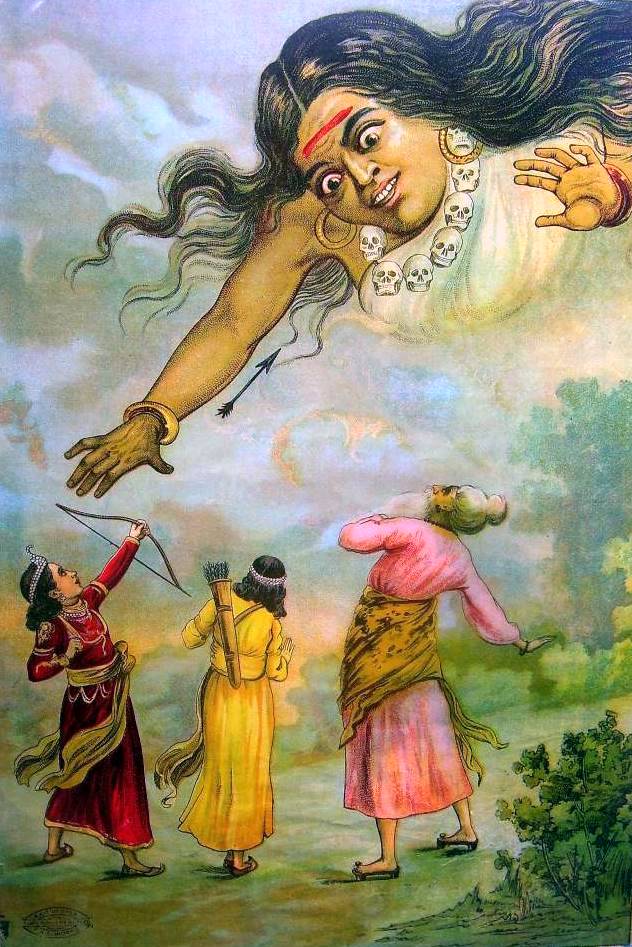
Rāma Killing Tāṭakā, print by the Ravi Varma Press, c. 1910s
In-universe information
GenderFemale
AffiliationRakṣasa
FamilySuketu (Father)
SpouseSunda
ChildrenMārīca

Tāṭakā is a minor yakṣī antagonist in the Rāmāyaṇa. Along with her son, Mārīca, Tāṭakā would harass and attack sages performing yajñas in the forest. They were ultimately slain by Rāma and Lakṣmaṇa on behest of their teacher, Viśvāmitra.[1][2]

Rāmāyaṇa

[edit]

In the Rāmāyaṇa, Viśvāmitra tells Rāma and Lakṣmaṇa the story of Tāṭakā when they reach a forest inhabited by her. Viśvāmitra states that a yakṣa named Suketu had undertaken austerities to obtain children, and was given a daughter with the strength of a thousand elephants named Tāṭakā, but not a son. When she became of age, she was married to Sunda, and gave birth to a son named Mārīca. After Sunda is killed, Tāṭakā and Mārīca attack the seer Agastya, who curses Mārīca to become a rākṣasa and curses Tāṭakā to become an ugly man-eater. Driven mad by the curse, she roams the region where Agastya used to live.[3]

Rāma killing Tāṭaka from 17th century royal Mewar manuscript

The Critical Edition of the Vālmīki Rāmāyaṇa does not mention many details of the previous narrative, but later commentators and recensions have more fleshed out versions of the story. According to three traditional commentaries on the Rāmāyaṇa, Sunda is killed due to a curse by Agastya, which Bhandare states gives proper cause for Tāṭakā's seemingly unwarranted attack on Agastya. The southern recensions of the epic state that Tāṭakā (prior to become a man-eater) tries to eat Agastya. An undated Malayālam script recension states that Taṭakā is smitten after seeing Agastya: stating that she proceeds to strip naked and run towards him singing with love. According to Goldman, this Malayālam script recension preserves an important part of the Tāṭakā legend that was suppressed in the Vālmīki Rāmāyaṇa.[4]

Viśvāmitra, after narrating Tāṭakā's past, instructs Rāma that he must kill Tāṭakā, and he should not have any compassion for her or disgust for killing a woman, and he recounts other occasions where unrighteous women were killed by moral men. Rāma agrees, stating the killing of Tāṭakā is uttamam "[an] eminently justifiable action". He twangs his bowstring, which attracts Tāṭakā to the scene. Rāma then states that he will not kill her on account of she being a woman, but vows to merely cut off her ears and nose and dispossess her of her strength and lair. Tāṭakā then charges Rāma, who proceeds to shoot and kill her with a single arrow to the chest.[3]

Only in the southern recensions is the vow of Rāma cutting off Tāṭakā's ears and nose mentioned, and Rāma actually fulfils his vow in those recensions. The northern recensions neither mention the vow or its fulfillment, which leads Goldman to believe that the verses mentioning it are dubious.[5]

References

[edit]
[edit]
Revisions and contributorsEdit on WikipediaRead on Wikipedia
from Grokipedia
Tāṭakā (Sanskrit: ताटका) is a demoness (rākṣasī) in the ancient Hindu epic Rāmāyaṇa, originally a beautiful yakṣiṇī (female yakṣa) who was transformed into a ferocious, shape-shifting man-eater due to a sage's curse.[1] As the daughter of the yakṣa king Suketu, she was endowed by Brahma with the immense strength of a thousand elephants following her father's severe penance.[1] Married to the yakṣa Sunda, son of the daitya Jambha, she became the mother of the demon Mārīca, who inherited her demonic traits and later played a role in the epic.[2] Tāṭakā's transformation stemmed from an incident of vengeance: after her husband Sunda was incinerated by the sage Agastya for disturbing his meditation, she and her son Mārīca attacked the sage's hermitage in retaliation.[3] Agastya cursed Mārīca to become a rākṣasa and Tāṭakā to lose her beauty, assuming a grotesque, cannibalistic form with a deformed face, thereby turning her into a relentless predator who devoured ascetics and ravaged the prosperous lands once blessed by Indra.[1] Relocating to the haunted forest of Mālinī near Mithilā (modern-day Bihar), she and her son terrorized the region, polluting sacrificial fires, destroying yajñas (rituals), and instilling fear among sages and villagers alike.[3] In the Bāla Kāṇḍa (Book of Childhood) of the Vālmīki Rāmāyaṇa, the sage Viśvāmitra narrates Tāṭakā's tale to the young princes Rāma and Lakṣmaṇa during their journey to protect his yajña from demonic interruptions.[1] Despite the traditional prohibition against harming women, Viśvāmitra commands Rāma—a sixteen-year-old prince skilled in archery—to eliminate her as a test of dharma (righteous duty) and to safeguard society.[4] In the ensuing confrontation (Sargas 26–27), Tāṭakā assaults the brothers at dusk, when her powers peak, hurling boulders and dust storms through her māyā (illusion).[4] Rāma first disables her by severing her arms with arrows, while Lakṣmaṇa mutilates her further, but ultimately slays her with a fatal shot to the heart at Viśvāmitra's insistence, freeing the forest from her curse and earning divine praise from the gods.[4] This episode underscores themes of duty overriding convention and the eradication of adharma (unrighteousness), with Tāṭakā symbolizing ignorance subdued by wisdom.[3]

Background and Origins

Etymology and Identity

In the Valmiki Ramayana, Tāṭakā is introduced as a yakṣiṇī of exceptional beauty and inherent power, born as the daughter of the yakṣa king Suketu following his intense penance to Brahma. Endowed at birth with a youthful and radiant form, along with the prodigious strength equivalent to that of a thousand elephants, she embodied the yakṣa qualities of vitality and dominion over natural realms, serving as a symbol of fertility through her allure and the lineage's ties to abundance in forests and waters.[5] This pre-transformation identity underscores her virtuous nature, inherited from Suketu's devout practices, positioning her as a figure of poised strength and grace within mythological lore. The Bala Kāṇḍa specifically portrays her superhuman capabilities—rooted in Brahma's boon—as innate to her yakṣiṇī essence, highlighting her role as a formidable yet benevolent entity before subsequent events alter her path.[5]

Family and Early Life

Tataka was the daughter of Suketu, a prominent yaksha known for his formidable nature and childlessness prior to her birth.[2] Through intense ascetic practices, Suketu earned a boon from Brahma, who granted him a daughter rather than a son, deeming the latter potentially more perilous; this child, named Tataka, was celebrated as a "gemlike" beauty endowed with the extraordinary strength of a thousand elephants, qualities that rendered her highly regarded among celestial entities.[6] Her inherited prowess and allure positioned her as an exemplary figure in yaksha lineage, embodying both grace and power.[2] As Tataka matured into a youthful woman, her father arranged her marriage to Sunda, a yaksha and son of Jambha.[2] This union united two esteemed yaksha families, fostering a period of domestic stability reflective of their harmonious celestial heritage.[6] Tataka and Sunda became parents to two sons, Maricha and Subahu, both of whom carried forward the robust yaksha traits of their forebears, initially embodying roles aligned with protective duties in their kin's domain.[2] Maricha, in particular, was described as indomitable from birth, highlighting the family's inherent vitality.[6] This early familial life underscored Tataka's transition from a cherished daughter to a devoted mother within the yaksha realm, before a subsequent curse altered her destiny into that of a rakshasi.[2]

The Curse and Transformation

Incident with Sage Agastya

Sage Agastya journeyed to an auspicious province, where he performed various rituals and established his hermitage.[2] This serene province, once thriving under his presence, became the site of later turmoil.[2] The yaksha Sunda, Tataka's husband and father to her son Mareecha, was eliminated through a curse pronounced by Agastya.[2] Enraged by Sunda's death, Tataka, driven by vengeance, along with her son Mareecha, launched a furious assault on the sage, roaring and charging forward with the intent to devour him.[2] In response to their attack, the highly infuriated Agastya first cursed Mareecha, declaring, "You will attain demon-hood."[2] He then turned to Tataka and cursed her, stating, "Forthwith divested of this form of a beautiful female, oh, great yakshii, you shall become a man-eater with your form distorted, face contorted, and shape monstrous."[2] This curse stripped Tataka of her beauty and transformed her into a flesh-eating demoness, while Mareecha also became a demon.[2]

Consequences and Powers

Following the curse pronounced by Sage Agastya in retribution for her aggression, Tataka underwent a profound physical transformation, shifting from a beautiful yakshini endowed with grace to an ugly, grotesque rakshasi characterized by a distorted face, contorted features, and a monstrous, gigantic physique.[2][7] This alteration rendered her repulsive and fearsome, yet paradoxically amplified her pre-existing strength—originally bestowed by Brahma as equivalent to that of a thousand elephants—allowing her to hurl massive boulders, raise dust storms, and unleash torrents of stones with ease.[8][4] Additionally, her innate ability to change form at will persisted and intensified, enabling her to alter her guise through illusory and magical powers, further enhancing her capacity to devour humans as a voracious man-eater.[2][3] Behaviorally, the curse drove Tataka to nocturnal predation, becoming particularly unassailable at dusk when demons gain heightened prowess, as she roamed the Malada region unleashing strident roars and malevolent fury.[4] She terrorized the once-prosperous landscape by systematically destroying habitations, rendering forests uninhabitable, and targeting ascetics engaged in Vedic rituals, thereby hindering their sacred observances through her sinister interventions.[8][7] Her actions included defiling ritual sites, which prevented the proper conduct of yajnas and polluted the sanctity of the area, compelling sages like Vishwamitra to seek protection elsewhere.[4][3] The irony of Agastya's curse lay in its unintended empowerment: while intended as punishment, it endowed Tataka with a ravenous appetite for flesh and supernatural durability via her illusory faculties, allowing rapid recovery from injuries and solidifying her as a formidable adversary who ravaged the province with unrelenting diabolism.[2][4] This transformation not only stripped her of beauty but fortified her as a relentless force, her enhanced resilience ensuring she evaded conventional threats and perpetuated chaos despite the curse's punitive design.[7]

Role in the Ramayana

Vishwamitra's Narrative

Sage Vishwamitra arrives at the court of King Dasharatha in Ayodhya, seeking the assistance of Rama to safeguard his impending Vedic ritual from demonic interference. He explains that demons Maricha and Subahu repeatedly disrupt the sacrifice by showering flesh and blood upon the sacred altar just before its completion, compelling him to abandon the rite multiple times. Vishwamitra praises Rama's inherent valor and divine qualities, asserting that the young prince, though only a youth of less than sixteen years old, possesses the prowess to vanquish these foes and thereby ensure the ritual's success over a period of ten days.[9] Dasharatha initially refuses, overcome by paternal affection and concern for Rama's youth and inexperience in battle, offering instead to lead his own vast army—comprising an akshouhini of chariots, elephants, cavalry, and infantry—to confront the demons himself. After persuasion from his family priest Vashishta, who emphasizes the honor and growth Rama would gain under Vishwamitra's guidance, Dasharatha relents and entrusts Rama and his brother Lakshmana to the sage. The trio departs from Ayodhya amid blessings and auspicious signs, traveling southward along the Sarayu River toward the site of the ritual in the forests beyond the Ganga.[10][11][12] As they proceed across the Ganga into a desolate region, Vishwamitra warns Rama of the immediate peril posed by the demoness Tataka, who haunts the forest and has rendered the provinces of Malada and Karusha uninhabitable through her relentless depredations. He describes her as a shape-shifting yakshini with the strength of a thousand elephants, who ambushes travelers, devours ascetics, and obstructs sacred rites by destroying sacrificial grounds and scattering the offerings. Vishwamitra stresses the urgent need for a capable warrior like Rama to eliminate her, as her presence blocks access to the ritual site and endangers all who approach, thereby necessitating her removal to restore safety and order to the land.[13][14] Rama expresses hesitation at the prospect of slaying a female, invoking the traditional protection afforded to women under dharma and suggesting instead that he merely incapacitate her to curb her menace. Vishwamitra counters this ethical concern by declaring that Tataka, through her heinous and demonic deeds, has forfeited any claim to womanhood and must be regarded solely as a rakshasi whose elimination upholds righteousness by safeguarding the virtuous and preventing further sacrilege. He urges Rama to act decisively before dusk, when her illusory powers would render her invincible, framing the deed as a sacred duty aligned with kshatriya obligations to protect society from such malevolent forces.[15]

Confrontation with Rama and Lakshmana

As Rama twanged his bowstring to signal readiness, Tataka, enraged, ambushed the princes by raising a tumultuous dust storm that shrouded the sky and hurled volleys of stones from all directions. Employing her demonic illusions (maya), she shapeshifted repeatedly, vanishing into darkness and reappearing to evade direct strikes, thereby prolonging the assault on the hermitage vicinity.[4] Demonstrating initial restraint out of respect for her female form, Rama countered her attacks with precise arrows that shattered her boulder showers and severed her arms, aiming to disable rather than kill the demoness. Lakshmana aided his brother by fending off her frenzied charges and further mutilating her by cutting off her ears and the tip of her nose, temporarily crippling her ferocity. Despite these efforts, Tataka persisted with her onslaughts until Sage Vishwamitra, emphasizing the necessity to eradicate the threat, commanded Rama to deliver a fatal blow. As twilight approached—before she could regain full strength under the cover of night—Rama released a decisive arrow that pierced her heart, felling her to the ground. In certain regional retellings and adaptations, this culminating strike is attributed to the invocation of the Brahmastra, a divine weapon.[16][4] In the immediate aftermath, the gods showered praise upon Rama for his valor, and Vishwamitra expressed profound approval, lauding the prince's obedience and prowess in upholding dharma. With Tataka's demise, the pervasive menace to the sages' hermitages was lifted, transforming the once desolate woodland into a verdant haven and signifying Rama's inaugural heroic accomplishment in the epic.

Cultural and Symbolic Significance

Interpretations in Hindu Texts

In the Valmiki Ramayana's Bala Kanda (sargas 24-27), Tataka's narrative serves as a pivotal episode in Rama's early training under Vishwamitra, where the sage recounts her origins as the daughter of the yaksha king Suketu, who was granted immense strength by Brahma equivalent to a thousand elephants. Married to the yaksha Sunda and mother to Maricha, Tataka's transformation into a man-eating rakshasi stems from her rage after Sunda's death—caused by Agastya's curse—and her subsequent attack on the sage's hermitage, prompting Agastya to deprive her of beauty and humanity, turning her into a shape-shifting demoness who terrorizes ascetics and disrupts sacrifices in the Malada forest.[17] Expansions in Puranic literature, such as the Brahmanda Purana, elaborate on this core account by emphasizing Tataka's yaksha lineage through her father Suketu, son of Suraksha, and portray her as a more explicitly shape-shifting yakshi allied with rakshasas like Ravana, highlighting her role in broader cosmic conflicts between yakshas and sages. This version underscores her initial purity as a yaksha woman before the curse amplifies her destructive potential, differing from the Valmiki Ramayana's focus on personal vengeance by integrating her story into larger genealogies of semi-divine beings.[18] Thematically, Tataka embodies unchecked kama (desire), particularly rage-fueled lust for vengeance, which propels her into adharma, manifesting as cannibalism and ecological devastation in the forest, thus justifying her elimination as a chaotic force antithetical to Vedic rituals. Her tale also illustrates the necessity of violence against evil irrespective of gender, as Vishwamitra overrides Rama's initial reluctance—rooted in the cultural taboo against harming women—by invoking dharma's precedence over compassion, marking Rama's maturation into a warrior who subordinates personal ethics to cosmic order.[17] Regional retellings, such as the Kamba Ramayanam, retain the essential plot while infusing poetic depth, portraying Tataka's confrontation with added layers of moral temptation and the internal conflict of dharma versus non-violence, thereby amplifying the episode's exploration of heroism amid ethical ambiguity.[19]

Depictions in Art and Modern Adaptations

In temple sculptures from South India, Tataka is portrayed as a fierce demoness during her confrontation with Rama, emphasizing her monstrous transformation. A notable example appears in the wooden carvings of the Shri Ramaswamy Temple in Padmanabhapuram, Kerala, where she is shown with upright short hair bound by a headband, one arrow piercing her mouth and another her breast, her left hand grasping a tree branch for support while her right is raised in agony; the panel uses a segmentary animation technique with twin busts—one upright and the other arching backward with disheveled hair—to convey the sequence of her death, contrasting her implied former human beauty with her current horrifying form.[20] Literary adaptations of the Ramayana often reframe Tataka's character to explore themes of tragedy and injustice. In Tulsidas' 16th-century Ramcharitmanas, she emerges as a formidable rakshasi disrupting Vishwamitra's yajna, swiftly slain by Rama's arrow in the Bala Kanda without extended dialogue, underscoring her role as an early antagonist in Rama's heroic journey.[21] Modern feminist retellings, such as Anand Neelakantan's Valmiki's Women (2021), humanize her as an ecofeminist protector of nature, critiquing the curse by Sage Agastya as a manifestation of patriarchal bias that punishes her dissent after her husband's death by disfiguring her into a man-eater and demonizing her agency.[22] In contemporary media, Tataka frequently appears as a grotesque villain highlighting her cursed origins. The 1987 Indian television series Ramayan by Ramanand Sagar depicts her as a wicked demoness possessing the strength of a thousand elephants, terrorizing the forest before her defeat by the young Rama, reinforcing her as a symbol of unbridled ferocity.[23] Similarly, the 1993 Indo-Japanese anime film Ramayana: The Legend of Prince Rama portrays her as a huge, hideous ogress with a high-pitched yet feminine voice, emphasizing her physical monstrosity in the early forest episode while alluding to her tragic backstory as a cursed yakshini.[24] More recently, the 2024–2025 Indian television series Shrimad Ramayan includes her episode in the Bala Kanda arc, depicting her as a formidable demoness terrorizing sages, consistent with traditional narratives.[25] These adaptations often accentuate her remorseful plea or victimhood in select retellings, shifting focus from mere villainy to gendered oppression and redemption.
User Avatar
No comments yet.