Hubbry Logo
Tatra 11Tatra 11Main
Open search
Tatra 11
Community hub
Tatra 11
logo
8 pages, 0 posts
0 subscribers
Be the first to start a discussion here.
Tatra 11
Tatra 11
from Wikipedia
Tatra T11
Overview
ManufacturerTatra
Also calledTatra 11
Production1923–1927
DesignerHans Ledwinka
Body and chassis
LayoutFR layout
Related
Powertrain
Engine1,056 cc (1.1 L) Tatra 11 F2
Transmission4-speed manual
Dimensions
Wheelbase2,635 mm (103.7 in)
Kerb weight680–900 kg (1,499–1,984 lb)
Chronology
SuccessorTatra 12

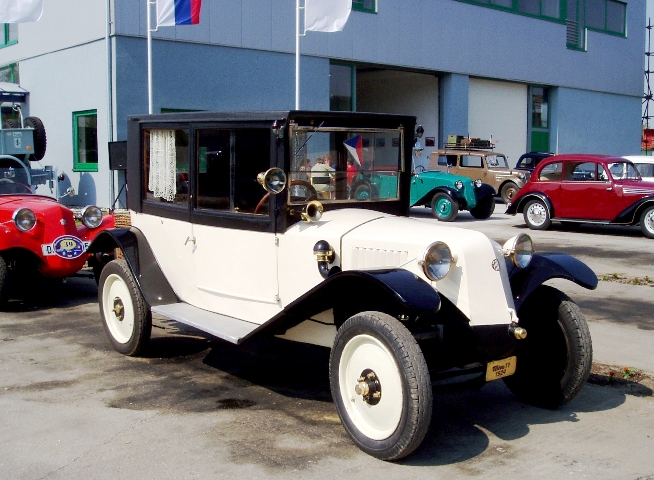
The Tatra T11[1] is an automobile that was produced from 1923 through 1927. It was the first Tatra model to use backbone tube chassis, swinging half-axles and air-cooled engine,[2][3] the development of which is still in use on the trucks produced by Tatra to this day.

Origins

[edit]

Hans Ledwinka created the design of the T11 while working for Steyr in Austria. He believed there was a need for a small car, and carried out the work in his own time. His design offered to the Steyr management was rejected. He left the company soon after to work for a previous employer, Nesseldorfer, in Moravia, which was soon to become Tatra. This was in 1921 and the development of the T11 started soon after. The T11 was produced between 1923 and 1927 with 3,847 examples made. It was then replaced by the T12, a development of the T11 design, with 7,222 being produced by 1936 when it was discontinued.

Specifications

[edit]

The Tatra T11 had its engine and gearbox in unit, bolted to the front of a tubular backbone with an integral propeller shaft that also served as the chassis. Bolted to the rear of the backbone is a final drive unit that, using an assembly of gears, not only changes the direction and speed of the drive, but facilitates the movement of swing axles without the need for flexible drive joints.

The T11's engine was an air-cooled horizontally opposed twin cylinder engine with overhead valves. It had a capacity of 1,057 cc (64.5 cu in) and was located above the front beam axle which was attached to it by a transverse semi-elliptical leaf spring.

Legacy

[edit]

From 1931 the T12 was joined by the T57 with a 1155 cc air-cooled flat four engine, and the T54 with a 1465 cc engine of the same configuration; both models were based on the original T11 format. Only 486 T54 models were produced by 1936 when production stopped.

The T57 was developed in T57A, T57B, and T57K versions, remaining in production until 1948, by which time over 27,000 had been produced, the later models having a 1256 cc engine.

References

[edit]
Revisions and contributorsEdit on WikipediaRead on Wikipedia
from Grokipedia
The Tatra 11 was a compact automobile produced by the Czechoslovak manufacturer Tatra from 1923 to 1926, marking the first vehicle entirely designed and built in-house by the company. Engineered by , it introduced groundbreaking features such as a central backbone tube chassis for enhanced rigidity and lightness, swing axle rear suspension for improved ride quality, and a front-mounted air-cooled two-cylinder boxer engine with overhead valves producing 12 horsepower. With a four-speed and a top speed of approximately 40 mph, the Tatra 11 was conceived as an affordable "people's car," achieving production of 3,687 units during its run. Ledwinka, who joined Tatra in after stints at other firms, drew on his earlier concepts to create the T11 as a departure from the company's prior models, which often relied on licensed designs. The T11's 1,056 cc engine—a horizontally opposed twin with a displacement of 64.6 cubic inches—emphasized , reliability, and low maintenance through its air-cooling system, eliminating the need for a . Its , combined with the innovative that housed components within a protective tube, minimized vibrations and weight, setting a technical benchmark for subsequent Tatra vehicles like the T12 and influencing broader trends. The Tatra 11 played a pivotal role in establishing Tatra's legacy of forward-thinking design in the , contributing to the firm's transition from coachbuilding to full-scale automobile production at its facility. Available in body styles including limousines and convertibles, it appealed to middle-class buyers in despite modest performance, with torque of 37 lb-ft supporting practical urban use. Ledwinka's work on the T11 foreshadowed Tatra's later aerodynamic masterpieces, such as the 1934 T77, and underscored the company's emphasis on engineering efficiency over luxury.

Background and Development

Historical Context

The Tatra company, originally known as Schustala & Company, was founded in 1850 by Ignác Šustala in Kopřivnice (then Nesselsdorf), Moravia, in what would become Czechoslovakia, initially focusing on the production of horse-drawn carriages and later expanding into railcar manufacturing. By the late 19th century, under the leadership of technical director Hugo Fischer, the firm began transitioning toward motorized vehicles, entering the automobile market with its first experimental cars around 1897. This shift aligned with the broader industrialization of Central Europe, where emerging nations like the newly formed Czechoslovakia sought to build domestic engineering capabilities following the Austro-Hungarian Empire's dissolution. In the aftermath of , Tatra grappled with economic instability in , including inflation and supply disruptions, which underscored the need for innovative, cost-effective vehicles to support national recovery. The company's early post-war model, the Type 20 (produced from 1919 to 1925), represented a continuation of conventional ladder-frame designs inherited from pre-war Nesselsdorfer models, but its modest sales highlighted the limitations of traditional engineering in a competitive market demanding efficiency and affordability. Renamed from the NW Type T upon the adoption of the Tatra brand in 1919, the Type 20 served as a bridge from wartime production to peacetime automotive ambitions, yet it failed to fully capitalize on Czechoslovakia's growing industrial base. A pivotal figure in Tatra's evolution was Austrian engineer , who joined as chief designer in 1921 after his innovative concept was rejected by , where he had previously worked on truck designs. Ledwinka's expertise in lightweight, tubular structures—gained from his early patents on swing axles and —positioned Tatra to pioneer advanced automotive architecture amid the era's push for modernization. His vision culminated in the Tatra 11, which debuted on April 28, 1923, at the 15th Motor Show, marking the company's first fully original passenger car and signaling a departure from conventional designs toward a more integrated, performance-oriented approach.

Design Innovations

The Tatra 11 marked a significant advancement through its adoption of a central backbone tube chassis, which served as the vehicle's primary structural spine while integrating the propeller shaft for . Designed by , this hollow tubular frame provided exceptional torsional rigidity and lightness, departing from the conventional ladder-frame constructions prevalent in automobiles of the early . By centralizing the driveline within the tube, the design minimized vibrations and allowed for a more compact overall structure, enhancing both durability and efficiency on varied road conditions. A key innovation was the implementation of swinging half-axles for independent rear suspension, a rarity among small of the era that typically relied on rigid axles, while the front employed a conventional rigid with a transverse . This system, where each rear wheel moved independently via pivoting half-axles attached to the ends, improved ride comfort, road-holding, and handling by isolating wheel movements and reducing unsprung mass. Compared to contemporaries like the with its beam axles, the Tatra 11's rear setup offered superior compliance over rough surfaces, contributing to its reputation for robustness in Central European terrains. The featured unit construction, with the engine and gearbox combined into a single assembly bolted directly to the front of the , effectively making it a stressed structural member. This integrated approach not only simplified assembly and maintenance but also enhanced the vehicle's overall stiffness by distributing loads across the power unit. The air-cooled , positioned at the front, drove power through the central tube to a gear-driven final drive mounted on the rear swing axles, ensuring efficient transmission to the rear wheels without universal joints. By placing the engine forward and channeling the drive rearward via the backbone, the Tatra 11 achieved better balance, promoting stability and traction while maintaining a low center of gravity for agile performance. These features collectively positioned the Tatra 11 as a technical milestone, influencing subsequent automotive engineering principles.

Technical Specifications

Chassis and Suspension

The Tatra 11 employed a pioneering tubular , featuring a central tube approximately 2,635 mm in length that enclosed the propeller shaft and formed the primary structural element spanning the . This design integrated the driveline within the itself, creating a compact and rigid framework that minimized weight while maximizing torsional strength. Outriggers extended perpendicularly from the central tube to support body mounting, allowing for a low floor pan and efficient packaging of components. The weighed around 500 kg, contributing to the vehicle's overall curb weight of 680–900 kg depending on the body configuration, which facilitated balanced weight distribution and reduced strain on suspension elements. The suspension system featured a rigid front with a transverse half-elliptic mounted directly to the , making it a stressed member, while the rear employed independent swing half-s pivoting from the differential housing for better compliance over uneven terrain. Transverse half-elliptic , positioned atop the s, handled primary load support for both ends, complemented by friction lever dampers at each wheel to dampen vibrations and enhance ride quality. This arrangement significantly reduced unsprung mass at the rear compared to rigid setups, improving roadholding and comfort on or rural roads common in . In contrast to the ladder-frame chassis of contemporaries like the Ford Model T, which relied on rigid beams and semi-elliptic longitudinal leaf springs for a beam axle, the Tatra 11's backbone and independent rear swing-axle design delivered superior stability and isolation from road imperfections. The backbone concept, originating from engineer Hans Ledwinka's earlier work, prioritized lightweight construction and dynamic handling, setting it apart from heavier, less compliant frames of the era.

Engine and Drivetrain

The Tatra 11 featured a compact 1,056 cc air-cooled with overhead valves (bore x stroke: 82 mm x 100 mm; 4.8:1), configured as a horizontally opposed two-cylinder unit that delivered 12 PS (8.8 kW) of power at 2,800 rpm. This powerplant was designed for efficiency in an , emphasizing reliability on varied Czech roads of the . The engine's was achieved through a fan integrated into the , which circulated air over the finned cylinders without the need for a liquid coolant system, reducing maintenance complexity for the era. A , standard for many designs, supplied lubricant to moving parts before expelling it, further simplifying upkeep in dusty or rough conditions. The fuel system employed a single fed by gravity from the rear-mounted tank, contributing to economical operation with a consumption rate of approximately 10 L/100 km under typical conditions. Power was routed through a 4-speed manual gearbox integrated directly with the engine into a single unit, a forward-thinking assembly that minimized and weight. From there, torque was transmitted via an enclosed propeller shaft housed within the central to a gear-driven differential at the rear, driving the swing axles in a rear-wheel-drive layout. This configuration provided balanced handling for the front-engine placement, enhancing the vehicle's stability despite the technological norms of the time.

Production and Reception

Manufacturing Details

The Tatra 11 was manufactured from 1923 to 1926 at the company's factory in , , marking the first model fully produced in-house by Tatra following the merger that formed the brand. A total of 3,687 units were built during this period, reflecting a modest production scale typical of early 20th-century European automakers focused on quality over mass output. Assembly emphasized hand-crafted construction to ensure high standards, leveraging the innovative as a modular foundation that simplified integration of the engine, drivetrain, and suspension compared to the more complex frames of preceding Tatra models. This approach allowed for efficient yet precise building in the workshops, where skilled workers assembled components like the air-cooled and independent rear suspension directly onto the central tube frame. Positioned as an affordable and reliable small car for the emerging , the Tatra 11 debuted at the 1923 Prague Motor Show and found its primary market in Czechoslovakia, with exports to other European countries such as and contributing to its appeal as a "people's car." Priced at approximately 39,600 for the (with variations by body style), it offered dependable performance for urban and light touring use. Production transitioned to the Tatra 12 starting in 1926, with full replacement by the end of 1926; the successor retained the core backbone design and mechanical layout but introduced four-wheel brakes for improved safety. The Tatra 11 received positive reception for its durability and innovative engineering, though its limited output constrained broader commercial impact.

Body Styles and Variants

The Tatra 11 was primarily offered as a 2-door (sedan) designed to seat four passengers, providing a practical enclosed body for everyday use. Optional open-top configurations included the cabriolet, a 2-door convertible also accommodating four, and the roadster, a lighter 2-seater variant suited for warmer climates or recreational driving. These body styles highlighted the model's versatility within the segment of the 1920s. No significant mechanical variants existed, but the central spine chassis design facilitated mounting of different body types without major alterations. All configurations shared a 2,645 mm , with overall lengths measuring approximately 3,420 mm for the and roadster, and up to 3,470 mm for the cabriolet; widths were consistently 1,480 mm, while heights ranged from 1,670 mm for the cabriolet to 1,720 mm for the others. Curb weights varied based on body construction, with open models like the roadster at around 680 kg and the enclosed closer to 700 kg, reflecting the added mass of closed panels and roofing. Interiors across variants featured simple bench seating for shared accommodations and basic instrumentation limited to essentials such as a and , emphasizing functionality over luxury in line with the era's economical designs. Customization options were available through third-party coachbuilders, allowing adaptations like enhanced lighting or demountable wheels, though factory offerings remained focused on the core passenger-oriented styles.

Legacy and Influence

Impact on Tatra Models

The Tatra 11's innovative backbone chassis and swing axle suspension directly influenced its immediate successor, the Tatra 12, produced from 1926 to 1936 with 7,222 units manufactured. The Tatra 12 retained the central backbone tube frame and independent swinging half-axles for rear suspension, providing enhanced durability and ride quality over traditional designs, while introducing four-wheel drum brakes and upgrading to a larger 1,050 cc air-cooled flat-twin engine for improved performance. This design lineage extended to further evolutions in the Tatra lineup, notably the Tatra 57 (1931–1938), which built on the Tatra 11's foundational concepts with refined and produced over 27,000 units, becoming one of Tatra's most successful pre-war models. The Tatra 54 (1932–1936), a sportier economy variant with 1,510 units built, also drew from the same and architecture, emphasizing lightweight construction for better handling in its four-cylinder configuration. The concept introduced by the Tatra 11 persisted across Tatra's passenger car models through the 1930s, including the aerodynamic , where it was adapted into a pressed box-section variant for greater rigidity. Post-World War II, this design was repurposed for Tatra's truck production, evolving into the central load-carrying tube with independent swinging half-axles that remains a hallmark of their heavy off-road vehicles today. The commercial success of the Tatra 11, with 3,847 units produced from to 1927, justified the completion of a new dedicated automobile factory in and enabled subsequent expansions that boosted overall production capacity for later models like the Tatra 12 and beyond.

Broader Automotive Significance

The Tatra 11's introduction of a central with swing half-axles provided one of the earliest practical implementations of independent rear suspension in a production automobile, enhancing ride quality and handling efficiency for its era. This design, pioneered by engineer , directly influenced subsequent European engineering, particularly in addressing weight distribution and off-road capability, though later adopters like the and 356 incorporated modifications such as stabilizer bars to mitigate the swing axle's tendency toward oversteer in high-speed corners. Ferdinand acknowledged Tatra's innovations in rear-mounted layouts and suspension geometry when developing the Beetle under Nazi Germany's KdF-Wagen program, leading to a 1961 settlement where paid Tatra 3 million Deutsche Marks for design similarities. The vehicle's air-cooled , with its overhead valves and horizontal-opposed configuration, exemplified efficient, low-maintenance propulsion suited to interwar Europe's resource constraints, prefiguring similar powertrains in compact cars like the and that prioritized simplicity over liquid cooling. This layout reduced mechanical complexity and improved reliability in varied climates, contributing to the Tatra 11's reputation for durability during a period when air-cooled designs were rare outside motorcycles. As one of the first automobiles fully designed and built in the newly independent , the Tatra 11 embodied the nation's emerging industrial strength and engineering ingenuity in the , a time of cultural and following the dissolution of the . With 3,847 units produced from 1923 to 1927, it helped establish Tatra as a symbol of Central European innovation amid rising regional tensions. Fewer than 50 Tatra 11 examples are estimated to survive today, underscoring their scarcity and historical value; notable preserved specimens include a 1923 model at the Lane Motor Museum in , where its original drivetrain and chassis demonstrate exceptional longevity. These rarities occasionally participate in vintage rallies, such as European events, affirming the model's enduring drivability despite its age. The Tatra 11's concept persists in contemporary applications, particularly in Tatra's heavy-duty trucks like the 2025 Phoenix and series, where variants of the central tube and swinging half-axles enable superior off-road performance in military and expedition vehicles. This enduring framework highlights the model's foundational role in modern rugged , bridging interwar passenger cars to today's specialized transport solutions.

References

Add your contribution
Related Hubs
User Avatar
No comments yet.