Hubbry Logo
Tatra 810Tatra 810Main
Open search
Tatra 810
Community hub
Tatra 810
logo
8 pages, 0 posts
0 subscribers
Be the first to start a discussion here.
Tatra 810
Tatra 810
from Wikipedia

Tatra T 810
Overview
ManufacturerTatra
Production2008-present
AssemblyKopřivnice, Moravia, Czech Republic
Body and chassis
ClassMedium truck
Body styleCOE
Powertrain
EngineDiesel
  • Renault DXi7 240 EC01 (Euro 3)
  • Renault Dxi 7 (Euro 5)
TransmissionZF 6 manual 6 speed + auxiliary gearbox Steyr VG750/270
Dimensions
Wheelbase3,150 mm (124.0 in) + 1,200 mm (47.2 in)
3,540 mm (139.4 in) + 1,200 mm (47.2 in)
Length7,420 mm (292.1 in)
Width2,550 mm (100.4 in)
Height3,065 mm (120.7 in)
Curb weight7,000 kg (15,000 lb) empty
15,500 kg (34,200 lb) loaded
Chronology
PredecessorPraga V3S
Renault DXi7
Overview
ManufacturerRenault
Layout
ConfigurationStraight six
Displacement7,145 cc
Cylinder bore108 mm (4.3 in)
Piston stroke130 mm (5.1 in)
Compression ratio18:1
Combustion
Fuel typeDiesel fuel
Cooling systemWater cooled
Output
Power output177 kW (237 hp) @ 2000 rpm
Torque output920 N⋅m (679 ft⋅lbf) @ 1300 rpm
Dimensions
Dry weight645 kg (1,422 lb)

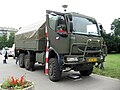
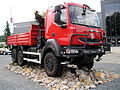
The Tatra T 810 (Tactic) is a medium truck made by Czech company Tatra; it replaced the popular Praga V3S which was introduced in the 1950s and served in the Army of the Czech Republic until 2008. Unlike other Tatra trucks, it does not use classic Tatra air-cooled engine and the traditional Tatra conception of backbone chassis and swinging half-axles, but the customary truck architecture with conventional frame. It is mainly intended for difficult terrain conditions. The civilian version T 810-C was introduced in 2010. In 2025, a modernized version of the 810 M was introduced.[1]

History

[edit]

In early 1990s the Czech Army was aiming to replace its aging fleet of medium trucks, which was represented by the Praga V3S model introduced into production as early as in 1953. The selection procedure was won the Roudnické slévárny a strojírny (Foundries And Machine-Works of Roudnice) with its ROSS R210 project. The R210 was outsourcing many components from Renault. Since 1996 the company delivered 15 vehicles for the testing purposes, after which the delivery of serial vehicles was supposed to start, however in 1998 the Czech Army canceled the contract. The company has invested a lot into the development of the truck and subsequently it bankrupted.[2][3]

In 2002 the Tatra company bought the documentation and rights to the R210 truck in order to enter the market of medium trucks (from 3,5 tons to 12 tons), as all the models the company offered were in the class of heavy trucks. It intended to modernize the original project, and it also hoped that the Czech Army will finally undertake the replacement of its fleet of 4000 Praga V3s (while Tatra was supplying the Army with heavy trucks since World War I). Tatra created alliance with other companies to work on the project together; for example the Praga was supposed to deliver gear boxes and portal axle. Other components were to be delivered by Renault (engine, cab).[4]

In 2005 the Czech government approved acquisition of the T810 trucks in August 2005, while deliveries were scheduled to start in April 2008.[5]

The civilian version T 810-C was introduced in 2010, with Tatra claiming it is the only truck with maximum weight of 15,5 tons that has three driven axles, which together with its portal architecture is supposed to give it advantage over the competition in terrain.[6]

In 2017, Tatra 810 4×4 has created the world record, the vehicle crossed the highest artificially created obstacle by the truck, artificial barrier called Brut Monster is one of the most extreme artificial barriers of its kind. Tatra has managed to climb and descent 146%, respectively to surpass inclination of 55°, of 7.5-meter-high obstacle.[7][8]

Operators

[edit]

References

[edit]
Revisions and contributorsEdit on WikipediaRead on Wikipedia
from Grokipedia
The Tatra 810 (also known as Tatra Tactic) is a medium-duty off-road manufactured by the Czech company Tatra Trucks, featuring a robust ladder frame chassis and distinctive TATRA rigid portal axles for superior terrain mobility. Introduced in 2008 for military applications, it serves as a key logistics vehicle in the Czech Armed Forces, replacing the aging V3S from the 1950s, with initial deliveries of 556 units beginning that year. The civilian variant, designated T 810-C, entered production in 2010, targeting commercial uses with a maximum gross of 15.5 tons across three driven axles. Designed for demanding environments, the Tatra 810 typically employs a 6x6 all-wheel-drive layout, though 4x4 configurations are available, with a ground clearance of 460 mm and options for central and systems. Its standard includes a water-cooled, turbocharged 6.2-liter 6-cylinder DXi7 producing 177 kW (240 hp) and 920 Nm of , compliant with Euro 3 emissions standards, paired with a 6-speed ZF and a 2-speed auxiliary gearbox. The suspension combines coil springs on the front and springs on the rear, supporting payloads up to 5,500 kg in configurations and gross weights of 13,000 kg, while enabling a maximum speed of around 106 km/h. The truck's cab is a modern, tiltable three-seater with optional ballistic protection (Level 1), armored flooring, and a roof hatch for mounting weapons, enhancing its suitability for defense operations worldwide. Variants include troop carriers, cargo trucks, hook loaders, tippers, and shelter bodies, with superstructures mounted via a three-point system for versatility. In military service, it excels in rough terrain due to its independently swinging half-axles and hub reduction gears (ratio 2.437). In May 2025, Tatra unveiled the modernized Tatra 810 M at the IDET exhibition, featuring a with updated portal axles, disc brakes with EBS, and a increased to 5.2 tons. This upgrade incorporates a more powerful / DTI 8 6-cylinder engine delivering 206 kW (280 hp) from a 7.7-liter displacement, retaining the 6-speed ZF while improving total permissible weight to 14 tons and trailer towing to 12 tons. The revised cab offers enhanced ergonomics, a new front grille, and over 90% parts compatibility with the original model for easier maintenance, ensuring continued reliability in both and roles.

Development

Origins

The development of the Tatra 810 originated in the mid- as part of efforts to replace the aging V3S, a multi-purpose off-road truck introduced in 1953 and widely used by the Czech Army since the 1950s for its rugged capabilities in . The V3S, produced initially by and later by Avia until the late 1980s, had become outdated by the , prompting the Czech military to seek a modern successor with improved off-road performance and logistical efficiency to meet contemporary operational demands. In response, the Czech company ROSS, in partnership with , initiated the R210 project around 1997 to develop a 6x6 medium off-road tailored for the Czech Army's needs, incorporating outsourced components for reliability and cost-effectiveness. However, ROSS encountered financial difficulties and declared in 1998, halting the project before full production. In 2002, Tatra Trucks acquired the , rights, and technical documentation for the R210 from ROSS, adapting and modernizing it into the Tatra 810 concept to leverage the existing design while integrating Tatra's expertise in heavy-duty components. Following evaluations of prototypes that demonstrated strong off-road capabilities and alignment with logistics requirements, the Czech government approved the acquisition of Tatra 810 trucks on September 21, 2005, marking a key milestone in the vehicle's path to production. A pivotal design decision during Tatra's adaptation was the retention and refinement of the R210's conventional ladder frame chassis, diverging from Tatra's traditional backbone tube design to enhance versatility for diverse body configurations and reduce manufacturing and lifecycle costs. This shift allowed for greater modularity and easier integration of military-specific superstructures, while still incorporating Tatra's technology for superior terrain handling.

Production History

Production of the Tatra 810 began at the company's facility in , , , with the first deliveries to the Czech Armed Forces occurring in April 2008. These initial vehicles fulfilled a 2006 order for 556 units, serving as a replacement for the aging V3S military truck. By 2015, the Czech military had received over 500 Tatra 810 units, establishing it as a core vehicle in the nation's fleet. In 2010, Tatra introduced the civilian variant, designated T 810-C, to expand market access beyond military applications. This version maintained the core off-road capabilities of the military model while adapting for commercial use, with production continuing alongside military output. Throughout its production run, the Tatra 810 faced challenges in adapting to evolving , starting with Euro 3 compliance in initial models equipped with engines. Later iterations incorporated upgrades to meet Euro 5 and Euro 6 requirements, often on request, to ensure and broader export viability. A significant milestone came in May 2025 with the premiere of the modernized T 810 M at the IDET exhibition in , featuring a more powerful /Volvo DTI 8 6-cylinder engine delivering 206 kW (280 hp) from a 7.7-liter displacement and retaining the 6-speed ZF for improved efficiency and increased capacity to 5.2 tons. This update maintains over 90% compatibility with prior versions, facilitating seamless integration for existing operators.

Design

Chassis and Suspension

The Tatra 810 features a conventional ladder frame , constructed with bolted side members welded to cross members at the front and rear, which provides a robust foundation for medium-duty off-road applications. This design differs from the backbone tube chassis used in Tatra's heavier models like the T815 series, allowing for easier adaptation to various superstructures while maintaining structural integrity under load. The frame supports a payload capacity of up to 5.5 tons in its 4x4 configuration and integrates seamlessly with the vehicle's all-wheel-drive components. Central to the Tatra 810's off-road capability are its TATRA Rigid , which employ hub reduction gears to elevate the above ground level, enhancing durability and traction on uneven . The front includes a gear ratio of 2.294 and a hub reduction of 2.437, while the rear tandem feature electro-pneumatically controlled cross- differential locks on all and an inter- lock between the rear pair for maximum torque distribution. These rigid , equipped with disc brakes, contribute to the vehicle's superior ground clearance of 480 mm under the , enabling it to navigate rough and obstructed paths effectively. The suspension system prioritizes load distribution and ride stability, with the front mechanically suspended by coil springs, a torsion stabilizer, and telescopic shock absorbers to handle and dynamic loads. The rear axles utilize a rocker setup, guided by six longitudinal rods anchored to the frame and supported by pairs of sixteen-s, which evenly distributes weight across the pair during heavy payloads or off-road maneuvers. This combination ensures progressive and minimal vibration transfer to the . The all-wheel-drive system provides permanent engagement on the rear s with a shift-on-the-fly mechanism for the front , optimizing power delivery for varied conditions. A standard allows on-the-fly pressure adjustments to improve flotation on soft surfaces, while an optional further aids in recovery operations. In May 2025, Tatra introduced the modernized Tatra 810 M with updated portal axles, disc brakes featuring electronic brake system (EBS), and an increased capacity of 5.2 tons, while retaining core and suspension elements for compatibility.

Cab and Body

The Tatra 810 employs a cab-over-engine (COE) design, positioning the cab directly above the engine to optimize space and maneuverability in off-road conditions. This configuration includes a modern three-seat interior (1+2 seating) designed for crew comfort during extended operations, featuring a sprung and adjustable driver's seat with seat belts, alongside a double co-driver's bench. The cab is constructed from all-steel with a straight, reinforced structure that facilitates easy maintenance and customization for applications. For occupant protection, the standard cab includes an armored floor providing Level 1 ballistic protection according to , specifically reinforced against hand grenade fragments and blasts. An optional fully armored cab variant offers enhanced ballistic resistance, including a hermetically sealed option for contaminated environments, and incorporates a hatch equipped for mounting to support defensive operations. The cab's tilt mechanism, operated hydraulically, allows forward tilting for improved access to components during servicing. Ergonomic features prioritize driver efficiency and comfort, with an adjustable steering wheel, air-cushioned seating options, and integrated dashboard controls for military systems such as the central tire inflation system. Climate control is provided via an HVAC unit with air conditioning and independent heating, ensuring operability in diverse environmental conditions. The overall cab contributes to the vehicle's low silhouette enhanced by portal axles for air transport compatibility. Body configurations emphasize versatility for logistical and tactical roles, including an open cargo platform suitable for general freight, a troop carrier variant with cover and foldable benches accommodating up to 16 personnel, and a shelter carrier option for mounting specialized enclosures or standard containers. These bodies utilize a three-point mounting on the frame, enabling quick adaptation to mission requirements without compromising the vehicle's off-road capability. The Tatra 810 M features a revised cab with enhanced , a new front grille, and redesigned accessory boxes, maintaining over 90% parts compatibility with the original model.

Powertrain

Engine

The Tatra 810 employs a liquid-cooled, turbocharged, inline-six from , marking a departure from Tatra's traditional air-cooled designs to meet modern emission standards and operational demands. The initial military variant utilizes the DXi7 engine, featuring a displacement of 7,145 cc, with output of 177 kW (237 hp) at 2,300 rpm and maximum torque of 920 N⋅m between 1,200 and 1,700 rpm, while complying with Euro 3 emissions. This configuration provides reliable power for off-road logistics in 4x4 and 6x6 configurations. Subsequent updates introduced the Euro 5-compliant Renault DXi7 240 EC01 variant, which boosts performance to 198 kW (270 hp) at 2,300 rpm and 1,000 N⋅m of torque in the same rpm range, incorporating (SCR) technology with AdBlue for reduced emissions. This engine maintains the straight-six layout and direct injection for enhanced efficiency in demanding environments. The 2025 modernized T 810 M model features a / DTI 8 with 7.7-liter displacement, delivering 206 kW (280 hp) at 2,100 rpm and maximum of 1,050 N⋅m from 950 to 1,600 rpm, compliant with Euro 3 emissions. This upgrade supports increased capacity up to 5.2 tons while retaining compatibility with existing fleet components. Across variants, the connects to a ZF 6-speed via a single-plate for robust power delivery.

Transmission and Drivetrain

The Tatra 810 employs a ZF 6S 1000 T0 six-speed manual gearbox as its primary transmission, operated via bowden cables augmented by a booster for precise and reliable shifting under demanding conditions. This setup is complemented by a VG750/270 dual-range auxiliary , which incorporates high and low gear ranges along with a divider to optimize power delivery and traction in varied terrains. The vehicle's drivetrain supports selectable 4x4 or 6x6 all-wheel drive configurations, enabling operators to adapt to on-road efficiency or off-road demands as needed. All axles are fitted with differential locks, managed through an Automatic Drivetrain Management (ADM) system that automatically engages them for maximum grip during challenging maneuvers. The torque divider in the transfer case facilitates even distribution across the driven axles, promoting stability and control in off-road applications. Optional pneumatic shifting enhancements further refine gear changes, while a transmission-mounted power take-off (PTO) allows for the integration of auxiliary equipment, with up to three outlets available through the rear face of the gearbox.

Specifications

Dimensions and Weights

The Tatra 810 is available in 4×4 and 6×6 configurations, with dimensions varying slightly by variant and . The overall measures 7,420 mm, while the width is consistently 2,550 mm across models. The for the 6×6 variant is either 3,150 mm + 1,200 mm or 3,540 mm + 1,200 mm, depending on the specific , whereas the 4×4 model features a of approximately 3,900 mm optimized for medium-duty logistics. Curb weight ranges from 7,500 kg for the 4×4 cargo truck to 8,300 kg for the 6×6 cargo carrier, with gross (GVW) rated at 13,000 kg for lighter configurations and up to 15,500 kg for heavier 6×6 models. capacity reaches up to 5,500 kg in the 4×4 variant and 4,700 kg in the 6×6 cargo version, though the recent T 810 M modernization offers 5,200 kg at a GVW of 14,000 kg. Off-road capabilities are supported by a ground clearance of 460–480 mm under the axles and approach/departure angles of 37°/35° in standard 6×6 setups. The turning circle diameter is 16.5 m (curb-to-curb) for both 4×4 and 6×6 variants, enabling maneuverability in confined terrains. capacity is 320 liters standard, with options from 220 to 420 liters available to extend operational range.

Performance

The Tatra 810 demonstrates robust on-road performance suitable for military logistics, achieving a top speed of 85 km/h when equipped with a speed limiter, which is standard for operational safety and compliance. Off-road, the Tatra 810 excels due to its portal axles and all-wheel-drive configurations, enabling exceptional terrain negotiation. In 2017, a 4×4 variant set a world record by climbing a 55° (146%) incline over a 7.5-meter obstacle known as the "Brutt Monster," highlighting its extreme angle-climbing ability under prototype testing conditions. The vehicle's gradeability reaches 100% when fully laden at gross vehicle weight, allowing it to ascend steep slopes while carrying payloads up to several tons. Additionally, it maintains operational integrity in water up to 1,200 mm deep, supporting amphibious-like crossings in tactical environments. Towing capacity extends up to 12,000 kg for braked trailers in standard 4×4 and 6×6 setups, enabling the transport of additional equipment or recovery operations. These capabilities are underpinned by the drivetrain's central differential lock and , which distribute power effectively across axles for superior traction.

Variants

Military Variants

The Tatra 810 serves as a versatile base for military configurations, primarily developed to meet the needs of the Czech Armed Forces for off-road and tactical operations. The standard military variant is the T 810-1R3R32 in a 6x6 configuration, functioning as a and troop carrier with a capacity of up to 5,100 kg. This model features a reinforced with on portal axles, enabling high ground clearance of 460 mm and fording depth of 1,200 mm, making it suitable for transporting supplies, , or up to 16 troops in roles. Powered by a DXi7 producing 177 kW (240 hp), it achieves a maximum speed of 106 km/h while maintaining operational reliability in temperatures from -32°C to +49°C. A lighter 4x4 variant, designated T 810-1R3R22, offers enhanced maneuverability for , command, or liaison duties, with a comparable of 5,500 kg but reduced overall and footprint compared to the 6x6 model. This configuration retains the core Tatra system and all-wheel drive with central tire inflation, allowing deployment in tighter terrains or as a forward command vehicle. Armored adaptations of the Tatra 810 enhance survivability in combat zones, with options for ballistic protection meeting Level 1 standards on the cab and underbody, including reinforced floors to resist mines and IEDs; higher Level 2 protection is available for select configurations via add-on kits. These variants incorporate integrated weapon mounts, such as a roof hatch for machine guns, enabling defensive during transport missions. The T 810-1R3R32 6x6 also supports shelter carrier roles, with a reduced of around 2,850 kg to accommodate specialized bodies for mobile command posts, units, or C4I systems, often using ISO 1D transporters or loaders for rapid module exchange. These setups prioritize , allowing integration of NATO-standard equipment for communication and . Military deliveries of the Tatra 810 have been primarily to the Czech Army, with more than 600 units in service as of 2017, following initial testing in 2007 and phased rollouts starting in 2008 to replace aging V3S trucks. Additional contracts, such as 34 units in 2020-2021 and ongoing procurements, continue to bolster the fleet for and tactical support.

Civilian Variants

The Tatra 810 civilian variants, primarily the T 810-C model introduced in , provide a de-militarized platform for commercial operations, featuring a universal -cab configuration suitable for 4x4 and 6x6 drive layouts with permanent rear drive and optional shift-on-the-fly front engagement. This allows for flexible body installations, including hook-lift systems for handling or flatbed setups for general , with a capacity of up to 8.5 tons and a gross vehicle weight of 15.5 tons. Specialized and adaptations of the T 810 equip the 6x6 with water pumps, foam systems, and tanks integrated into a , supporting payloads of up to 7.6 tons for emergency response in rugged terrains. Utility-oriented models extend to dump trucks with three-way tipping bodies for and recovery vehicles fitted with PTO-driven winches, such as the Ramsey RE 12,000 model, enabling towing and extraction tasks in demanding environments. These variants incorporate liquid-cooled six-cylinder engines compliant with Euro 5 emissions standards via SCR technology, along with disc brakes on all axles and a three-point body mounting system to meet civilian road regulations while retaining high ground clearance from rigid portal axles. The 2025 modernized T 810 M version enhances payload to 5.2 tons and for improved in commercial duties. Exports target Europe's and sectors, where the vehicle's off-road prowess supports heavy-duty applications like site transport and excavation support. The shared backbone tube and design ensure durability across these non-military uses.

Operational Use

Military Applications

The Tatra 810 primarily functions as a logistics support vehicle within the Czech Army, replacing the legacy V3S truck for essential roles in troop transport, supply delivery, and cargo hauling across diverse terrains. With a capacity of 5.5 tons and the ability to tow 10-ton trailers, it supports expeditionary operations by carrying bulk materials, shelters, containers, and personnel, forming a core component of the army's medium-duty fleet. Over 600 units are currently in service, underscoring its widespread adoption for reliable all-wheel-drive performance in off-road conditions. In operational deployments, the Tatra 810 has been utilized in various military missions, demonstrating versatility in hostile environments through its , protection kit, and extended cruising range of 800 km. Domestically, it participates in rigorous training exercises, such as nighttime safe-driving drills that test its capabilities alongside other vehicles in demanding scenarios. The truck is frequently integrated with the heavier in combined logistics operations, enabling efficient handling of varied load requirements within the Czech Army's unified ecosystem, where approximately 3,000 Tatra vehicles of both types are deployed. The Tatra 810's design emphasizes high reliability in extreme conditions, operating effectively from -32°C to +49°C with exceptional ground clearance of 470 mm and modular components that facilitate field repairs and minimize downtime. Its low life-cycle costs and straightforward , which supports armoring, contribute to sustained operational readiness during prolonged missions. While primarily used by the Czech Armed Forces, the Tatra 810 has been offered to foreign militaries, as evidenced by its promotion at international exhibitions like IDET 2025. Looking ahead, the upgraded Tatra 810 variant is slated for integration into Czech forces after 2025, offering enhanced mobility through modernized features while building on the original's proven platform.

Civilian Applications

The Tatra 810's dump and mixer variants are widely employed in for handling materials on rough sites, such as three-way tippers that facilitate efficient loading and unloading in challenging terrains. With a payload capacity of up to 8.5 tons and a total gross weight of 15.5 tons, these configurations enable robust performance in building infrastructure like roads and bridges, where the vehicle's off-road capabilities minimize operational disruptions. In emergency services, the Tatra 810 serves as a base for ambulances and fire trucks, capitalizing on its all-wheel-drive system and high ground clearance of 480 mm to access remote or disaster-stricken areas. Adaptable superstructures, including high assembly platforms and cranes, support rapid deployment for and operations, enhanced by a comfortable three-seat cab that improves crew efficiency during extended missions. For utilities, particularly in and , the Tatra 810 functions as a recovery and , equipped with a 4x4 or 6x6 configuration and a for extracting equipment from difficult spots. It can tow trailers up to 12 tons and demonstrates 100% climbing ability, making it ideal for hauling resources in rugged, forested environments or mine sites where standard trucks falter. Exports of the Tatra 810 have been prominent in for infrastructure projects, including road building in mountainous or rural regions of countries like , , and , where its versatility supports large-scale development initiatives. Historically, a significant portion of Tatra truck production has been exported, aiding in the modernization of networks in various markets. The vehicle's advantages in civilian roles stem from its exceptional durability, courtesy of TATRA RIGID portal axles, which provide stability across adverse weather and terrains, thereby reducing downtime compared to conventional trucks. This reliability, combined with a maximum speed of 106 km/h on roads, ensures consistent productivity in demanding conditions without frequent maintenance interventions.

References

Add your contribution
Related Hubs
User Avatar
No comments yet.