


Community hub
Recent from talks
Contribute something
Nothing was collected or created yet.
Tatra 600
View on Wikipedia| Tatra 600 Tatraplan | |
|---|---|
 | |
| Overview | |
| Manufacturer | Tatra, a. s. |
| Production |
|
| Assembly |
|
| Designer |
|
| Body and chassis | |
| Class | Large family car (D) |
| Body style | 4-door fastback saloon |
| Layout | RR layout |
| Powertrain | |
| Engine | 1952 cc (2.0L) Tatra 600 Flat-4 |
| Transmission | 4-speed manual[1] |
| Dimensions | |
| Wheelbase | 2,700 mm (106.3 in) |
| Length | 4,540 mm (178.7 in) |
| Chronology | |
| Predecessor | Tatra 97 |
| Successor | Tatra 603 |
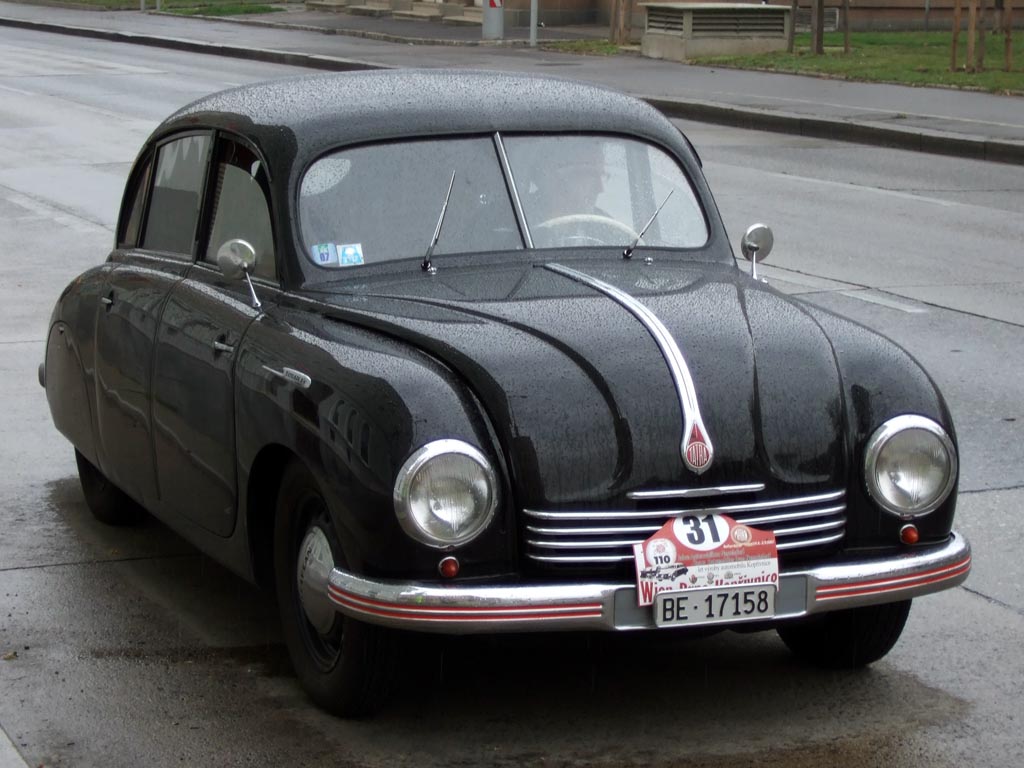
The Tatra 600, named the Tatraplan, was a rear-engined large family car (D-segment in Europe) produced from 1948 to 1952 by the Czech manufacturer Tatra. The prototype was finished in 1946.
History
[edit]After World War II, Tatra continued its pre-war business of building passenger cars in addition to commercial vehicles and military vehicles. The factory was nationalised in 1946, two years before the Communist takeover. Although production of pre-war models continued, a new model, the Tatra 600 Tatraplan, was designed in 1946-47 by Josef Chalupa, Vladimír Popelář, František Kardaus, and Hans Ledwinka. The name of the car celebrated the new Communist planned economy but also referred to aeroplane inspiration ('éroplan' means aeroplane in colloquial Czech).
Originally, the 600 was known as the Tatra 107,[2] continuing from Tatra's previous aerodynamic cars- the 77, 87, and 97- as it was intended as a newer, smaller, and cheaper version to replace the outdated Tatra 57. Tatra switched to a new numbering system after WWII, with all car model codes beginning with 600; as a result, the Tatra 107 became the Tatra 600.
After two prototypes, "Ambrož" (December 1946) and "Josef" (March 1947), the 600 went into mass production in 1948. In 1951, the state planning department decided that the Tatraplan should henceforth be built at the Skoda Auto plant in Mladá Boleslav, leaving Tatra to concentrate on truck assembly. This was quite unpopular with the workforce at both plants: as a result, Skoda built Tatraplans for one year only before the model was discontinued in 1952.[3]
The Tatraplan had a monocoque streamlined ponton-styled 6-seat fastback saloon body with front suicide doors and a drag coefficient (Cd) of just 0.32.[3][4][5] It was powered by an air-cooled flat-four cylinder, 1,952 cc rear-mounted engine. 6,342 were made, 2,100 of them in Mladá Boleslav. In 2010, in the UK, the Tatraplan won the 'Classic Car of the Year' competition in the 1940s category.
A modified 600 convertible with a Sodomka-built body was presented to Josef Stalin by Antonin Zapototsky on 22 December, 1949. As of 2019 it was on display in the Technicke Muzeum Tatra in Koprivnice.[6]
Models
[edit]- Tatra 107 - original designation of 600.
- Tatra 201 - commercial version of 600, four built (a pickup truck, a panel van, and two ambulances) in 1947. Unlike the 600, the 201 was front-engined.
- Tatra 600 Diesel - similar to 600 but with 2.0L diesel engine, three prototypes built in 1949.
- Tatra 601 Monte Carlo - a 2-door sports car based on the 600, one (possibly two) built in 1949.
- Tatra 602 Tatraplan Sports - a racing car based on the 600, 2 built in 1949.
Gallery
[edit]-
 Tatra 600 Tatraplan in an exhibition
 -
 Tatra 600
 -
 Tatra 600 engine-bay
 -
 Tatra 600 at the Tampa Bay Automobile Museum


Notes
[edit].JPG)
Streamlined Tatras
- Tatra V570 1931, 1933
- Tatra 77 1933-1938
- Tatra 87 1936-1950
- Tatra 97 1936-1939
- Tatra 600 1946-1952
- Tatra 603 1956-1975
- ^ Gloor, Roger (2007). Alle Autos der 50er Jahre 1945 - 1960 (1. ed.). Stuttgart: Motorbuch Verlag. ISBN 978-3-613-02808-1.
- ^ https://www.curbsideclassic.com/curbside-classics-european/museum-classics-twofer-1949-and-1952-tatra-t600-tatraplan-two-halves-almost-make-a-whole/
- ^ a b "Tatra T600 Tatraplan". Tatra T600 Tatraplan.
- ^ Rosenkranz, Karel (2002), Tatra, Autoalbum (in Czech), Brno: MS Press, p. 107, ISBN 978-80-900915-9-7
- ^ Janik, Martin (2004), Tatra (in Czech), Brno: Computer Press, p. 76, ISBN 80-7226-573-3
- ^ https://www.hooniverse.com/one-of-a-kind-stalins-tatraplan-600-convertible/
References
[edit]- Margolius, Ivan: 'Tatra T600 – Tatraplan', Architectural Design, vol. 71, no. 5, September 2001, London, pp. 84–88.
- Field, Ben: 'Smooth Operator', Classic Cars magazine, May 2010, pp. 88–92
- Margolius, Ivan and Henry, John G: Tatra - The Legacy of Hans Ledwinka, SAF Publishing, Harrow 1990, ISBN 0-946719-06-3
- Margolius, Ivan and Henry, John G: Tatra - The Legacy of Hans Ledwinka, Veloce Publishing, Dorchester 2015, ISBN 978-1-845847-99-9
- Margolius, Ivan: 'Cold War Streamliner', The Automobile, vol. 42, no. 9, November 2024, pp. 48-54.
External links
[edit] Media related to Tatra 600 Tatraplan at Wikimedia Commons
| Authority control databases: National |
|---|

Tatra 600
View on GrokipediaDevelopment and Design
Pre-War Influences and Post-War Restart
The Tatra 600 drew directly from pre-World War II innovations pioneered by Tatra, particularly the T97 compact car introduced in 1937, which featured a rear-mounted air-cooled flat-four engine, central backbone chassis, and fully independent suspension all around.[9][10] These elements, developed under chief designer Hans Ledwinka and collaborators Erich Ledwinka and Erich Übelacker, emphasized lightweight construction, aerodynamic efficiency, and engineering simplicity, principles that informed the Tatra 600's layout as a scalable evolution for post-war civilian use.[11] The T97's streamlined teardrop shape and swing-axle rear suspension further echoed Tatra's earlier streamliners like the T77 and T87, prioritizing low drag coefficients over conventional boxy forms.[12][13] World War II severely disrupted Tatra's operations, with the Kopřivnice factory repurposed for German military production, including modified T87 staff cars for the Wehrmacht, while sustaining bomb damage that halted regular output.[14] Post-liberation in 1945, Ledwinka faced accusations of Nazi collaboration due to Tatra's wartime contracts and his consultations with Ferdinand Porsche, leading to his arrest and imprisonment by Czechoslovak authorities until 1951, despite earlier acquittals.[15][16] This purged key expertise, though Ledwinka reportedly sketched T600 concepts adapting the T97 platform from confinement.[11] Development restarted in 1946 under Erich Übelacker, who led the adaptation of pre-war streamlined designs into a practical four-door family sedan to address civilian shortages amid reconstruction.[7][17] The prototype emphasized rear-engine placement for balanced weight distribution and space efficiency, retaining Tatra's commitment to air-cooled power and minimal mechanical complexity for reliability in austere conditions.[9] Following the February 1948 communist coup d'état, which installed a one-party regime under Klement Gottwald, Tatra was fully nationalized as a state enterprise, and the T600 received the propagandistic moniker "Tatraplán" to evoke centralized planning and socialist progress, masking the continuity of private-era engineering heritage.[18][19] This renaming aligned with the regime's narrative of industrial renewal, even as design work predated the seizure of power.[7]Aerodynamic and Structural Innovations
The Tatra 600 incorporated advanced aerodynamic features, including a teardrop-shaped fastback body with recessed headlights, flush-mounted door handles, and concealed hinges, resulting in a drag coefficient of 0.32—a value derived from empirical testing and building on the streamlined designs of pre-war Tatra models such as the T77 and T87.[7][20] This coefficient reflected causal priorities in reducing air resistance through smooth contours and minimal protrusions, prioritizing efficiency over ornamental elements common in 1940s automobiles.[21] Structurally, the Tatra 600 employed a self-supporting steel monocoque body with integrated fenders and minimal timber reinforcement, an evolution from Tatra's traditional separate chassis approaches that optimized weight distribution for the rear-engine layout.[22][23] A central B-pillar provided key rigidity, with front doors hinged rearward in a suicide-style configuration to leverage the pillar's strength for better load distribution during impacts or torsion, while rear doors opened conventionally onto the same pillar for improved access.[24][25] Complementing this, a front luggage compartment housed the spare tire and additional storage, countering rear weight bias to enhance balance and handling.[24] The chassis featured a lightweight backbone frame, a Tatra staple pioneered by Hans Ledwinka, which integrated with the monocoque for torsional stiffness while supporting independent rear suspension via swinging half-axles—a pendular arm derivative that allowed greater wheel articulation and superior ride quality over rigid axles in peer vehicles.[7][26][17] This setup emphasized first-principles engineering for dynamic performance, distributing unsprung mass effectively to minimize road imperfections' impact.Engineering Philosophy and Key Features
The Tatra 600 reflected Tatra's engineering philosophy of deriving vehicle dynamics from empirical prototype testing and functional imperatives, rather than conforming to standardized mass-production templates that prioritized simplicity at the expense of performance. Influenced by Hans Ledwinka's pre-war innovations, such as backbone chassis and independent suspension, the design integrated aerodynamic efficiency with mechanical robustness to suit post-war operational demands, including limited maintenance infrastructure. This data-informed approach, validated through road and competition testing, emphasized causal factors like weight distribution and airflow over arbitrary conventions.[7][27] Central to this was the selection of an air-cooled, rear-mounted flat-four engine, a 1,952 cc OHV unit with aluminum hemispherical combustion chambers, chosen for its inherent simplicity and resilience against cooling system failures common in water-cooled alternatives during resource shortages and variable climates. By eschewing radiators, hoses, and coolant, the configuration reduced vulnerability to freezing or leaks, while the opposed-cylinder layout inherently balanced vibrations for smoother operation without complex countermeasures. This aligned with Tatra's prioritization of verifiable reliability over higher output from liquid-cooled rivals.[2][8] The rear-engine placement lowered the center of gravity, promoting stability in corners, though it induced oversteer tendencies inherent to the swing-axle rear suspension; these were mitigated through iterative road testing to achieve predictable self-correcting behavior under load, distinguishing it from front-engine norms that often sacrificed agility for understeer predictability. The central backbone chassis with independent suspension—transverse leaf springs at the front and torsion bars at the rear—facilitated modular adaptability for potential variants, enabling scalable powertrain integration while maintaining structural integrity.[7] Hydraulic drum brakes on all four wheels provided consistent actuation independent of engine vacuum, enhancing control in diverse conditions compared to mechanical linkages in many peers. Overall, these elements underscored a first-principles derivation of features from observed causal mechanisms, such as airflow reduction via a 0.32 drag coefficient body, rather than emulating prevailing frontal-engine orthodoxy.[28][8][7]Technical Specifications
Powertrain and Engine Details
The Tatra 600 featured a rear-mounted, air-cooled, overhead-valve flat-four engine with a displacement of 1,952 cc, achieved via a bore of 85 mm and stroke of 86 mm.[8][29] This short-stroke design yielded a specific power output of approximately 26 hp per liter.[8] The engine produced 52 PS (51 hp or 38.2 kW) at 4,000 rpm and 118-120 Nm of torque at 2,000 rpm across production models from 1948 to 1952.[29][30] Early units employed a single carburetor with an axial fan for cooling, while later examples incorporated two single-barrel carburetors—one per cylinder bank—for improved mixture distribution, though overall power remained consistent.[8][31] Power was delivered through a four-speed manual transaxle integrated with the engine, driving the rear wheels; the gearbox omitted synchromesh on first gear to prioritize component longevity in the resource-constrained postwar environment.[2] Fuel consumption averaged 10.4-11 L/100 km in period estimates, reflecting trade-offs between the air-cooling system's efficiency demands and modest output for reliable operation under communist-era material limitations.[29][8]Chassis, Suspension, and Drivetrain
The Tatra 600 utilized a streamlined, self-supporting steel monocoque body shell with an integrated central backbone girder welded into the floor structure, enhancing torsional rigidity while supporting the rear-engine configuration and independent suspension components. This hybrid approach adapted Tatra's longstanding backbone chassis philosophy—originally developed for pre-war models—to a unibody design, reducing overall weight and improving packaging efficiency for the vehicle's 1,200 kg curb mass.[8][32] Suspension was fully independent, featuring torsion bars at the front paired with parallelogram linkages for controlled wheel movement, and swinging half-axles at the rear to minimize unsprung weight and enhance ride compliance over uneven surfaces. This setup prioritized family-oriented comfort through softer spring rates without sacrificing directional stability, as the rear half-axles' equal-length design distributed loads evenly, fostering neutral handling tendencies that transitioned predictably to mild oversteer under load. Telescopic hydraulic shock absorbers complemented the system front and rear, damping oscillations effectively for the era.[24][33][34] Drivetrain configuration was rear-engine, rear-wheel drive, with power delivered via a four-speed manual transmission and equal-length half-axles that inherently promoted balanced torque distribution, exhibiting limited-slip characteristics during acceleration on low-grip surfaces due to the rigid backbone's constraint on differential yaw. Braking relied on hydraulic drum units at all four wheels, providing adequate stopping power for the 1,200 kg vehicle within the constraints of 1940s tire compounds and bias-ply construction, though fade could occur under repeated hard use.[2][32][7]Dimensions, Performance, and Safety Elements
The Tatra 600 measured 4,540 mm in overall length, 1,670 mm in width, and 1,520 mm in height, with a wheelbase of 2,700 mm.[29][32] Its curb weight ranged from 1,170 to 1,200 kg, accommodating five passengers in a two-door fastback configuration with combined front and rear trunk capacity supporting practical luggage needs for the era, though exact volume figures like 600 liters appear in secondary accounts without primary verification.[35][8] Performance testing yielded a top speed of approximately 130 km/h, limited by the 38.2 kW (52 PS) air-cooled flat-four engine's output relative to the vehicle's mass, resulting in a power-to-weight ratio of about 43 PS per tonne.[32][36] Acceleration from 0 to 100 km/h took 25-30 seconds, reflecting the modest torque and four-speed manual transmission without overdrive.[37] Fuel consumption averaged 11 liters per 100 km under factory conditions, with a 40-liter tank providing an estimated range of 350-360 km on highways.[37][8] Safety elements relied on passive design principles, including a rigid passenger compartment integrated with the central backbone chassis and low center of gravity from the rear-mounted boxer engine, which contributed to directional stability during contemporary road tests.[38] No active safety systems like disc brakes or anti-lock mechanisms were present, and verifiable crash test data remains unavailable due to the pre-standardization era of production from 1948 to 1952.[39] The low-profile aerodynamics and mass distribution likely mitigated rollover risks in period accidents compared to taller sedans, though empirical evidence is anecdotal from user reports rather than controlled studies.[3]Production History
Manufacturing Challenges Under Communism
Following the February 1948 communist coup in Czechoslovakia, the new regime reoriented the nationalized Tatra works in Kopřivnice toward heavy industry and truck manufacturing, subordinating passenger car projects like the Tatra 600 to broader economic directives favoring military and industrial vehicles.[40] This shift reflected central planning's emphasis on utilitarian output over consumer goods, diverting materials and labor from the Tatraplán's assembly despite completed prototypes in late 1946 and early 1947.[41] [8] Serial production commenced on June 24, 1948, but remained severely constrained by state quotas and resource allocation, yielding only limited runs that prioritized elite access over mass demand.[8] [42] The government's push to consolidate passenger vehicle manufacturing under Škoda exacerbated bottlenecks, as Tatra faced competition for approvals and facilities, including a temporary relocation of later assembly to Škoda's Mladá Boleslav plant for rationalization.[3] [7] Central planning inefficiencies manifested in chronic underutilization of Tatra's skilled engineering workforce, which operated under demoralizing quotas and ideological oversight, contrasting with pre-nationalization efficiencies and resulting in output far below potential—fewer than 7,000 units over four years despite the model's advanced design.[40] [41] By 1951, state directives further curtailed the program, redirecting focus to trucks amid post-war reconstruction priorities.[42]Output, Variants, and Cessation
Production of the Tatra 600 totaled 6,342 units between 1947 and 1952, with initial assembly at the Tatra factory in Kopřivnice before transfer to Škoda's Mladá Boleslav plant to accommodate Tatra's reorientation toward heavy truck manufacturing.[43][41][44] All units were four-door sedans without distinct body variants, reflecting centralized planning constraints that precluded export models or adaptations for foreign markets amid Iron Curtain restrictions on trade.[41] Minor refinements appeared in 1952 production, including enhanced instrumentation such as fuel and oil temperature gauges and optional equipment like a radio and heater, while the core air-cooled 1,952 cc flat-four engine maintained its 32 horsepower output without significant powertrain variants.[8] Cessation stemmed from a 1951 directive by the supreme economic council, which eliminated passenger car development at Tatra—including the ongoing T600—to prioritize truck output like the T111 series, with temporary production oversight shifted to Škoda before full termination in 1952.[45] Post-1952, tooling and assembly lines were dismantled under state orders, curtailing any capacity for resumed or expanded volumes despite the model's technical viability.[44]Resource Allocation and Economic Context
Following the 1948 communist coup in Czechoslovakia, central planning directives reoriented Tatra's production toward heavy industry, assigning the company primary responsibility for military trucks, trams, and railcars at the expense of passenger vehicles. This shift starved the Tatra 600 line of factory capacity and materials such as steel and aluminum, as resources were funneled into fulfilling state quotas for industrial output.[14] By 1951, explicit government decrees mandated Tatra's focus on trucks, prompting partial relocation of Tatra 600 assembly away from the Kopřivnice plant to liberate space for heavier vehicles, a move that empirically capped total output at 6,342 units from 1947 to 1952. Hand-assembly methods persisted without state subsidies for tooling or automation, yielding just 5-6 cars per day and underscoring labor inefficiencies traceable to uncoordinated planning rather than engineering constraints.[24][7][3] Priced at 130,000 Czechoslovak crowns initially—escalating to 140,000—the Tatra 600 remained prohibitive for ordinary workers, confining distribution to administrative elites even as its four-door configuration targeted family use. Pre-war Tatra operations, unconstrained by such mandates, sustained models like the T87 with 3,056 units produced from 1936 to 1950 under market-responsive allocation, evidencing how central prioritization of military needs over consumer goods directly curtailed scaling and viability.[8][46]Reception and Legacy
Contemporary Market Response and Criticisms
Upon its introduction, the Tatra 600 Tatraplan garnered positive attention in Czechoslovak automotive publications for its advanced aerodynamic styling and exceptional ride quality, attributed to the independent suspension system that provided superior comfort over uneven surfaces compared to mass-produced alternatives like Škoda sedans.[47] Period road tests emphasized the vehicle's quiet cabin and stable high-speed behavior, with a reported top speed of 130 km/h despite its size, positioning it as a symbol of technical sophistication for elite users.[48] However, the 2.0-liter flat-four engine's output of 52 horsepower drew consistent criticism for inadequacy, with reviewers noting sluggish acceleration and insufficient power for overtaking or loaded conditions, particularly in undulating terrain where the rear-mounted weight exacerbated climbing difficulties.[49] Export markets, including limited shipments to Western Europe and North America, echoed these concerns in user accounts, where the vehicle's performance fell short against competitors like the Volkswagen Beetle in dynamic scenarios.[3] Production constraints and prioritization for state officials fostered an aura of exclusivity but also fueled reports of build quality issues from accelerated manufacturing, including early cooling system vulnerabilities in warmer climates that strained the air-cooled design under prolonged loads.[50] With only approximately 2,100 units assembled by 1951 before relocation to Škoda facilities, domestic registrations remained sparse amid fuel rationing, preventing widespread market penetration and reinforcing perceptions of unreliability in everyday use.[51]Engineering Achievements Versus Practical Limitations
The Tatra 600's air-cooled flat-four engine, displacing 1,952 cc and producing 32 kW (43 kW in later variants), exhibited robust reliability attributable to the absence of water-cooling components, reducing maintenance demands and enhancing operational longevity in varied conditions.[27] Independent suspension on all wheels, featuring transverse leaf springs, provided effective absorption of road irregularities, aligning with Tatra's established engineering for terrain compliance.[7] However, the rear-engine, rear-wheel-drive configuration inherent to the design predisposed the vehicle to oversteer, particularly under reduced traction such as wet surfaces, a characteristic shared with predecessor models like the Tatra 87 where abrupt rear-end breakaway could occur even at moderate speeds.[52] Empirical fuel consumption averaged 10.4–11 liters per 100 km (approximately 21–23 mpg US), lagging behind contemporaries like the Volkswagen Beetle's 7–8 liters per 100 km due to the engine's displacement and aerodynamic priorities over efficiency optimization.[29][34] Post-production parts scarcity, stemming from limited output of 6,342 units between 1947 and 1952, exacerbated wear-related issues despite the absence of formal recalls typical of the era, compelling owners to source custom fabrications for components like seals and hoses.[53] While no comprehensive period accident data isolates the Tatra 600, the layout's handling traits contributed to higher rollover risks relative to front-engine sedans of comparable wheelbase, as evidenced by analogous rear-engine designs.[54]Collectibility, Restorations, and Historical Appraisal
The Tatra 600's limited production run of 6,342 units from 1947 to 1952, combined with postwar material shortages and Eastern Bloc attrition, has resulted in relatively few surviving examples, estimated at under 200 worldwide, which significantly bolsters its appeal among collectors of prewar-inspired postwar European automobiles.[6] [7] Restored examples in drivable condition command market values typically ranging from $30,000 to $80,000 USD in 2020s sales and listings, driven by rarity and the model's aerodynamic monocoque body with rear-mounted air-cooled flat-four engine; for instance, Hagerty valuations place a good-condition 1949 model at around $31,000, while private sales have reached $78,000.[33] [55] Unrestored project cars, often requiring comprehensive bodywork and mechanical rebuilds, sell for $10,000 to $20,000, reflecting the effort needed to return them to roadworthy standards.[56] [57] Restoration presents notable challenges, particularly sourcing components for the air-cooled 1,954 cc engine and unique suspension, as original parts are scarce outside Czechoslovakia's former supply chains; enthusiasts often fabricate replicas or adapt compatible Tatra pieces, with processes documented in specialist projects spanning years.[58] Organizations like the Tatra Owners Club in Europe facilitate support through forums, parts advisories, and shared expertise, aiding preservation in the Czech Republic and beyond.[59] [60] Historians appraise the Tatra 600 as a forward-thinking design that pioneered affordable rear-engine family sedans with low-drag aerodynamics, predating and technically influencing mass-market layouts like the Volkswagen Beetle, though its development was curtailed by communist resource redirection toward trucks, limiting broader impact.[3] Museums such as the Tatra Museum in Kopřivnice and the Tampa Bay Automobile Museum preserve exemplars to highlight these engineering merits, underscoring the model's status as an underappreciated bridge between interwar innovation and Cold War constraints.[24]References
- https://commons.wikimedia.org/wiki/File:The_chassis_of_Tatra_T600_Tatraplan%2C_with_rear-mounted_flat-4_engine.jpg