


Community hub
Recent from talks
Contribute something
Nothing was collected or created yet.
The Cornfield
View on Wikipedia
| The Cornfield | |
|---|---|
 | |
| Artist | John Constable |
| Year | 1826 |
| Medium | Oil on canvas |
| Dimensions | 143 cm × 122 cm (56 in × 48 in) |
| Location | National Gallery, London |
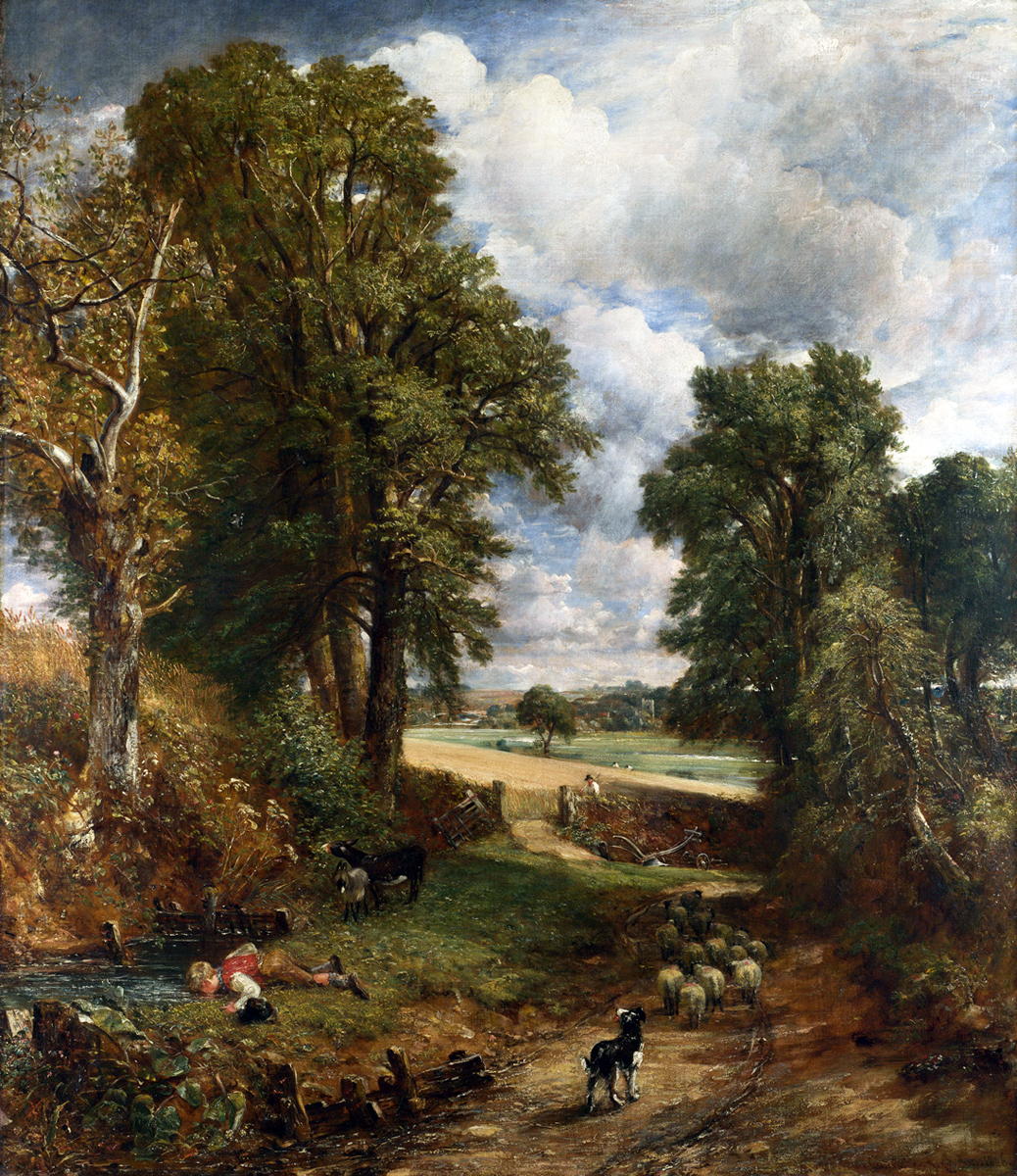
The Cornfield is an oil painting by the English artist John Constable, completed from January to March 1826 in the artist’s studio. The painting shows a lane leading from East Bergholt toward Dedham, Essex, and depicts a young shepherd boy drinking from a pool in the heat of summer. The location is along Fen Lane, which the artist knew well. Constable referred to the piece as The Drinking Boy.
On the advice of Constable's friend, the botanist Henry Phillips, The Cornfield was painted with the trees and plants depicted as accurately as possible. Constable commissioned the engraver David Lucas to produce the plates of the painting for a book, Various Subjects of Landscape, Characteristic of English Scenery, first published in July 1830. The art historian Anthony Bailey considers The Cornfield to have "opened the gate through which a great number of people were to pass into Constable's country". It was exhibited at the Royal Academy of Arts in April 1826, under the title Landscape: Noon, and shown in Paris from early November to the spring of 1828. The painting was praised but Constable did not find a buyer. After the artist’s death, funds were raised to purchase the work for the National Gallery.
Background
[edit]John Constable was born in 1776 in the Suffolk village of East Bergholt, to Golding Constable and his wife Ann. His father was a corn merchant, who owned Flatford Mill in the village and a mill in Dedham, Essex; Constable was expected to succeed his father in the business. After his education at schools in Lavenham and Dedham, Constable worked in his father's corn business, but his younger brother Abram eventually took over the running of the mills.[1]
In 1799, the 19-year-old Constable persuaded his father to let him pursue a career in art, and Golding granted him a small allowance to allow him to train. He entered the Royal Academy Schools as a probationer.[2] Following his marriage to Maria Bicknell In 1816, Constable lived in Bloomsbury in central London,[3] before his family settled in Hampstead, where they lived permanently from 1827 onwards.[4] The year The Cornfield was painted, Constable was 50 and had not yet been accepted as a full member of the Royal Academy of Arts, despite having sought election since the early 1820s.[5]
Composition
[edit]
Constable's painting The Cornfield, painted in oil on canvas,[6] depicts a young shepherd. The boy, wearing a red waistcoat, is drinking from a pool as he rests from his work at noon in the heat of summer. He has removed his hat.[7][8] The painting is a view of Fen Lane, which Constable knew well. As a schoolboy he had regularly walked along the lane, which was the shortest way from East Bergholt and over New Fen Bridge across to the River Stour toward his school in Dedham.[9]
The painting was completed from January to March 1826 in Constable's London studio.[7] Constable himself called it The Drinking Boy,[10][note 1] and he intended it to be his most important exhibited work of that year.[11] The work is similar in size to The Lock,[8] a painting that was originally planned as a pendant to The Cornfield.[9]
Constable produced a smaller preparatory oil sketch, which has survived, and which shows how the work was developed over time.[11] In the background of the sketch, the figure of the boy and his animals are not depicted. None of the trees in the sketch are dead, unlike the trees painted in the final work.[12] He produced a study for the donkey and her foal, now in the Victoria and Albert Museum in London.[6] No sketches made at the scene are known.[9]
Constable made The Cornfield as botanically accurate as possible.[13] On 1 March 1826, his friend Henry Phillips, a botanist, wrote to Constable with advice about how the plants should be painted.[6][note 2] Phillips commented: "I think it is July in your green lane. At this season all the tall grasses are in flower, bogrush, bullrush, teasel. The white bindwind now hangs in flowers over the branches of the hedge; the wild carrot and hemlock flower in banks of hedges, cow parsley, water plantain, etc.... bramble is now in flower, poppy, mallow, thistle, hop, etc.." The trees were also carefully depicted.[8] He was preoccupied by his work on the painting, writing to his friend John Fisher, "I could think of and speak to no-one. I was like a friend of mine in the battle of Waterloo—he said he dared not turn his head to the right or left—but always kept it straight forward—thinking of himself alone."[8]
The village of Higham, shown in the distance, is not actually visible from the lane;[13] Constable's son Charles Golding Constable stated after his father's death that the view of Higham church did not exist.[15] The crop in the field is probably meant to be wheat, depicted at full height and as tall as the gate at the end of the lane.[16] To the public seeing Constable's painting during his lifetime, the wheat would have been a representation of peace, fertility and wealth.[17] Constable appears to have borrowed objects from his other paintings and drawings to include in The Cornfield; a tree in the painting bears a strong resemblance to another specimen in his Edge of a Wood (c. 1816), and the boy—with his blue neck scarf, black hat and red waistcoat—is also depicted in Constable's A Lane near Flatford (c. 1810).[6]
According to the art historian Michael Rosenthal, The Cornfield typifies Constable's picturesque phase, which culminated in 1828. After 1822 Constable's was mainly done in his London studio, which led to him being more concerned with the effect of his painting on the senses, and less about realism. The work reflected Constable's nostalgia for the rural Suffolk he recalled from his youth, considered by him to be lost.[18]
Engraving by Lucas
[edit].jpg)
Constable commissioned the engraver David Lucas to produce the plates of the painting for a book, Various Subjects of Landscape, Characteristic of English Scenery. The book was published in July 1830.[19] After seeing prints of The Cornfield and The Lock produced by Lucas, Constable told him, "Now... is every bit of sunshine clouded over in me. I can never look at these two flattering testimonies of the result of my singularly marked life... without the most painful emotions."[20]
in 1834, when suffering from depression and seemingly jealous of the success the prints of The Lock and The Cornfield were attracting, Constable argued with Lucas, and complained his works were no longer giving him pleasure. He told his friend Leslie, "The two beautiful prints by Lucas are in the [shop] windows, but every gleam of sunshine is blighted to me in the art at least. Can it... therefore be wondered at that I paint continual storms?" He later apologised to Lucas.[21]
After Constable's death, James Brook Pulham, a former pupil, borrowed Lucas's prints of The Cornfield and The Lock without permission from the home of the artist. This caused considerable distress to the family.[22] The prints became well-known during the Victorian era, being images that the public had access to, in contrast with the original oil paintings at the National Gallery.[23]
Exhibitions and reception
[edit]On 8 April 1826, Constable wrote to his friend Fisher that The Cornfield had been sent to the Royal Academy to be exhibited.[6][note 3] When on display at the Royal Academy that year, the painting was shown under the title Landscape: Noon.[7] When being shown, the painting was altered by another artist, the sculptor Francis Chantrey, who joked, "Why Constable, all your sheep have got the rot—give me the palette—I must cure them." Chantrey tried unsuccessfully to amend the appearance of the sheep in the foreground.[24] In September 1827, it went to the Paris Salon,[25] where it was shown to the public from early November to the spring of 1828 under the title Paysage avec figures et animaux. It was returned to England the following September.[6] In Paris, it failed to receive the same acclaim given to his previous works.[26] It was praised by the critics but never managed to find a seller at any of the five exhibitions where it was shown.[7] Constable had hoped for a sale, telling Fisher, "I do hope to sell this present picture—as it has certainly got a little more eye-salve than I usually condescend to give to them."[27]
When the work was exhibited in London at the British Institution in 1827, Constable included a quotation from a poem by the Scottish poet James Thomson:[9][note 4]
A fresher gale
Begins to wave the woods and stir the stream,
Sweeping with shadowy gust the fields of corn.
— James Thomson, "Summer", The Seasons
The Times described the painting as "singularly beautiful, and not inferior to some of Hobbema's most admired works".[16]
The Cornfield was shown by Constable at the Birmingham Society of Arts exhibition in 1829, and by the Worcester Institution in 1835.[6]
The English author William Thackeray, writing in 1850, described the painting as "under the influence of a late shower; the shrubs, trees and distance are saturated with it... One cannot but admire the manner in which the specific character of every object is made out: the undulations of the ripe-corn, the chequered light on the road, the freshness of the banks, the trees and their leafage, the brilliant clouds artfully contrasted against the trees, and here and there broken by azure."[16] The miniaturist Andrew Robertson described the work as having "all the truth of conception, with les of the manner that was objected to" in works such as Constable's Salisbury Cathedral from the Meadows.[13] The art historian Anthony Bailey considers the work to have "opened the gate through which a great number of people were to pass into Constable's country".[16]
Acquisition by the National Gallery
[edit]
In 1837, Constable's friend Charles Robert Leslie began working on the purchase of one of Constable's works for the nation, to be bought by a body of subscribers,[note 5] The Committee of Friends and Admirers, chaired by the portraitist William Beechey.[7][27] The committee had initially considered purchasing Constable's Salisbury Cathedral from the Meadows, but this work was rejected after it was thought to be "too boldly executed". The Cornfield was valued at 300 guineas, £315 (1837) (equivalent to £37,999.29 in 2023)[28]. The funds were raised, and the National Gallery accepted the painting in December 1837.[7][29]
The Cornfield was the first work to be sold following Constable's death in 1837, and for 10 years, until the National Gallery acquired The Valley Farm from Robert Vernon, it was the only painting by Constable in a national collection.[30] As of February 2022[update], the work is not on public display in the galleries.[7]
Notes
[edit]- ^ The painting's current title was used from 1838.[8]
- ^ Constable and Phillips were good friends; they had met in 1824 in the countryside outside Brighton when painting and collecting specimens respectively. A list of flowering plants Constable was sent by his friend, some of which were included in The Cornfield.[14]
- ^ Constable's letter to Fisher mentioned details of his work on The Cornfield: "I have dispatched a large landscape to the Academy, upright, the size of my Lock—but a subject of a very different nature—inland—cornfields—a close lane, kind of thing—but it is not neglected in any part. The trees are more than usually studied and the extremities well defined—as well as their species—they are shaken by a pleasant and healthfull [sic] breeze—at noon...."[6]
- ^ The painting depicts a scene at midday, but Constable—perhaps without realising—used lines by Thomson that are a description of the end of the day.[6]
- ^ Subscribers included the scientist Michael Faraday, the poet William Wordsworth, and Constable's friends and fellow artists.[27]
References
[edit]- ^ Bailey 2006, pp. 1–10, 17.
- ^ Bailey 2006, pp. 17, 18.
- ^ Bailey 2006, pp. 91, 96.
- ^ Bailey 2006, pp. 108, 175.
- ^ Bailey 2006, pp. 124, 173.
- ^ a b c d e f g h i Parris, Fleming-Williams & Shields 1976, p. 145.
- ^ a b c d e f g "The Cornfield (John Constable)". The National Gallery. Retrieved 16 January 2022.
- ^ a b c d e Bailey 2006, p. 170.
- ^ a b c d Reynolds 1983, p. 76.
- ^ Richens 2012, p. 166.
- ^ a b Reynolds 1983, p. 26.
- ^ Reynolds 1983, p. 74.
- ^ a b c Charles 2015, p. 172.
- ^ Dauncey 2017.
- ^ Bailey 2006, pp. 170–171.
- ^ a b c d Bailey 2006, p. 171.
- ^ Bailey 2006, p. 172.
- ^ Thornes 1999, p. 131.
- ^ Bailey 2006, pp. 210, 214.
- ^ Bailey 2006, p. 217.
- ^ Bailey 2006, pp. 261–262.
- ^ Fleming-Williams & Parris 1984, p. 11.
- ^ Fleming-Williams & Parris 1984, pp. 36–37.
- ^ Bailey 2006, pp. 171, 193.
- ^ Charles 2015, p. 78.
- ^ Bailey 2006, p. 180.
- ^ a b c Parris, Fleming-Williams & Shields 1976, p. 146.
- ^ United Kingdom Gross Domestic Product deflator figures follow the MeasuringWorth "consistent series" supplied in Thomas, Ryland; Williamson, Samuel H. (2024). "What Was the U.K. GDP Then?". MeasuringWorth. Retrieved 15 July 2024.
- ^ Bailey 2006, p. 306.
- ^ Fleming-Williams & Parris 1984, pp. 9, 46–47.
Sources
[edit]- Bailey, Anthony (2006). John Constable: A Kingdom of His Own. London: Vintage Books. ISBN 978-14481-3-771-8.
- Charles, Victoria (2015). Constable. New York: Parkstone International. ISBN 978-1-78042-954-0.
- Dauncey, Pat (2017). "A re-evaluation of the work of Henry Phillips, botanist, garden designer and writer, 1779–1840". Garden History. 45 (2): 256–266. JSTOR 44987964.
- Fleming-Williams, Ian; Parris, Leslie (1984). The Discovery of Constable. London: Hamish Hamilton. ISBN 978-02411-1-248-9.
- Parris, Leslie; Fleming-Williams, Ian; Shields, Conal (1976). Constable: Paintings, Watercolours & Drawings. London: The Tate Gallery. ISBN 978-0-905005-00-3.
- Reynolds, Graham (1983). Constable's England. New York: Metropolitan Museum of Art. ISBN 978-08709-9-335-0 – via Internet Archive.
- Richens, Richard Hook (2012). Elm. Cambridge: Cambridge University Press. ISBN 978-05212-9-462-1.
- Thornes, John E. (1999). John Constable's Skies: A Fusion of Art and Science. University of Birmingham Press. ISBN 978-19024-5-902-8.
Further reading
[edit]- Helsinger, Elizabeth (1989). "Constable: The Making of a National Painter". Critical Inquiry. 15 (2). The University of Chicago Press: 253–279. doi:10.1086/448484. ISSN 0093-1896. JSTOR 1343585. S2CID 161841254.
- Kroeber, Karl (1972). "'Tintern Abbey' and the Cornfield: Serendipity as a Method of Intermedia Criticism". The Journal of Aesthetics and Art Criticism. 31 (1): 67–77. doi:10.2307/429613. ISSN 0021-8529. JSTOR 429613.
External links
[edit]
- A high quality image of The Cornfield from the National Gallery, London
- Information about Lucas's original engraving of The Cornfield from The Royal Academy of Arts
.jpeg)
,_c.1826,_790-1888.jpg)


The Cornfield
View on GrokipediaBackground and Creation
John Constable's Career Context
John Constable was born on June 11, 1776, in East Bergholt, Suffolk, to Golding Constable, a prosperous miller and corn merchant, and his wife Ann Watts; the family's wealth from the milling business and local trade allowed young John early immersion in the surrounding rural landscape, which profoundly shaped his artistic sensibility.[3][4] As the second son, he initially worked in the family enterprise from 1792, sketching the Suffolk countryside in his spare time, but his passion for art led him to pursue formal training despite familial reservations.[5] In 1799, at age 23, Constable entered the Royal Academy Schools in London as a probationer, studying under established figures while supporting himself through irregular commissions; his early career was marked by financial instability and critical indifference to his innovative landscape approach, as the Academy favored historical and idealized subjects over direct nature studies.[6][7] Constable's personal life intersected with his professional trajectory in 1816, when, after a protracted courtship opposed by her grandfather, he married Maria Elizabeth Bicknell, daughter of a London solicitor, on October 2 at St. Martin-in-the-Fields; the couple settled in Bloomsbury the following year, where Constable maintained a studio amid the demands of raising a growing family.[4] This period saw gradual career advancement: he was elected an Associate of the Royal Academy (ARA) in November 1819, recognizing his persistence in exhibiting Suffolk-inspired works, though full membership as a Royal Academician (RA) eluded him until February 10, 1829.[6] By 1827, seeking healthier air for Maria's fragile health and respite from urban life, the family relocated permanently to Hampstead, north of London, where Constable continued painting while grappling with personal hardships, including the births of seven children and mounting debts.[7] Throughout his career, Constable remained devoted to depicting the unvarnished beauty of his native Suffolk landscapes, often returning there for inspiration even as London commitments grew, a focus intensified by personal losses such as the death of his wife Maria from tuberculosis on November 23, 1828, which left him a widower at 52 and deepened his emotional investment in rural themes.[3][8] At age 49–50, during the winter of 1825–1826, he worked in his London studio on mature compositions that exemplified his evolved style, prioritizing empirical observation and atmospheric naturalism over the romantic idealization prevalent in contemporary art.[1] This phase reflected his lifelong commitment to authentic representation, honed through decades of sketching en plein air and resisting commercial pressures to "finish" his canvases in a polished manner.[9]Inspiration and Subject Matter
"The Cornfield" draws its primary inspiration from Fen Lane, a rural path connecting East Bergholt to Dedham in Suffolk, England, which the artist frequently traversed as a child en route to school.[1] This location, observed during Constable's youth near his family home in East Bergholt, served as the basis for the winding lane depicted, evoking his nostalgic recollections of the Suffolk countryside.[10] The painting's central motif—a shepherd boy resting against a stile to drink from a roadside pool, accompanied by his dog and flock—captures the essence of everyday rural labor and Constable's personal memories of similar youthful experiences in the unspoiled landscape.[10] Constable's depiction reflects the influence of Suffolk's local weather patterns and seasonal rhythms, portraying a breezy midsummer noon scene typically associated with mid-to-late August, despite the work being completed in his London studio during the winter months of January to March 1826.[10] This choice underscores his intimate familiarity with the region's transient atmospheric conditions, drawn from lifelong observations.[1] The lane's proximity to Constable's family home in East Bergholt imbued the subject with profound personal significance, symbolizing an idealized vision of the English countryside before the encroachments of industrialization altered rural life.[10] Through this motif, the painting represents a poignant tribute to the pre-industrial harmony of agrarian existence, rooted in the artist's Suffolk heritage.[11]Artistic Description
Composition and Visual Elements
The Cornfield measures 143 cm × 122 cm and is executed in oil on canvas in a landscape orientation, creating a wide, immersive view of a rural summer scene. The composition centers on a winding lane that draws the viewer's eye from the foreground into the depth of the image, flanked by a dense cornfield on the left and open meadows on the right, evoking a sense of progression through the Suffolk countryside. This layout balances expansive natural forms with intimate details, emphasizing horizontal breadth to convey the vastness of the English landscape.[1][10] In the foreground, the cornfield dominates with tall, detailed ears of wheat rendered in varying shades of gold and green, interspersed with wildflowers such as poppies and cow parsley, adding texture and vibrancy to the scene. A wooden stile crosses the lane, beside which a shepherd boy reclines to drink from a shallow pool, his relaxed pose captured with naturalistic accuracy; nearby, a black-and-white sheepdog herds a flock of sheep, their woolly textures and alert postures contributing to the lifelike depiction of rural life. Further along, donkeys and a plough appear near a gate, enhancing the sense of everyday agricultural activity.[10] The midground features the curving path leading to the gate, bordered by brushwood and a mix of trees including a prominent dying oak on the left, elms, and silver birches, which frame the composition and add vertical contrast to the horizontal expanse. In the background, an open sky occupies roughly two-thirds of the canvas, filled with voluminous cumulus clouds that suggest a gentle breeze, while subtle outlines of a village with red-roofed houses, a church tower, and a meandering river provide distant depth without overwhelming the natural foreground.[1][10] Light and shadow play a crucial role in establishing depth and atmosphere, with noon sunlight filtering through the foliage to cast dappled patterns on the path and soft shadows across the corn, creating a realistic interplay of illumination that heightens the painting's breezy freshness. The warm, golden tones of the vegetation contrast with the cooler blues and silvers of the sky, fostering a cheerful yet serene mood that underscores Constable's commitment to realism in portraying natural elements like the boy's fluid gesture, the animals' detailed fur and forms, and the varied botanical details.[10]Interpretations and Symbolism
The Cornfield embodies a pastoral idyll juxtaposed against the encroaching forces of modernity, capturing the timeless beauty of rural Suffolk while hinting at inevitable change through elements like the dying oak on the left, which symbolizes decay and the transient nature of the landscape.[10] The central figure of the boy, pausing to drink at a pool along the winding lane, represents the innocence of rural childhood and traditional agrarian life, evoking Constable's own memories of boyhood rambles in East Bergholt.[10] The lane itself, stretching from the foreground into the distant cornfield, suggests a journey through life or the fleeting passage of time, reinforcing themes of nostalgia and impermanence in Constable's work.[10] The painting layers emotional depth, serving as a nostalgic tribute to the vanishing agrarian world of Suffolk amid early industrial pressures.[10] This "great reserve of emotion" underscores a profound attachment to the countryside as a source of solace and identity, reflecting broader environmental concerns about the fragility of natural harmony in the face of human progress.[10] Scholarly analyses highlight The Cornfield's proto-Impressionist qualities, particularly in its innovative rendering of natural light and atmospheric effects, which prioritize fleeting outdoor conditions over idealized classical compositions, influencing later French artists through exhibitions at the Paris Salon.[10] In the 21st century, discussions have increasingly emphasized its ecological symbolism, interpreting the balanced yet vulnerable depiction of flora and sky as an early meditation on nature's resilience, with the dying tree evoking concerns over environmental degradation that resonate in contemporary climate aesthetics.[10] A 2023 National Gallery talk by Dr. Mary McMahon further explores this tension between realism and idealization, questioning whether the scene's idyllic harmony idealizes a rapidly changing rural England.[12] Debates persist on the painting's topographical accuracy, with scholars noting that Constable selectively composed the vista for emotional impact rather than strict fidelity; for instance, the distant village, suggested to represent Higham, is inaccurately placed, as it lies about two miles from the actual lane near East Bergholt and would not be visible from that vantage.[10] This creative liberty, as analyzed by Alastair Smart and Ian Brooks, underscores Constable's prioritization of poetic resonance over literal geography, blending observed details with imaginative synthesis to heighten the work's affective power.[10]Production Techniques
Studio Process and Preparatory Works
John Constable completed The Cornfield between January and March 1826 in his Charlotte Street studio in London, drawing on on-site sketches made during visits to Suffolk to capture the essence of a rural lane in high summer.[1] The painting measures 143 × 122 cm in oil on canvas, reflecting the artist's methodical translation of outdoor observations into a studio-finished work.[1] Constable's preparatory process relied on a series of oil sketches and studies conducted in the field and studio, which informed the composition's key elements, including a free oil sketch now in the Indianapolis Museum of Art (33 × 20.8 cm) and a studio study in Birmingham Museums (59.7 × 49.2 cm).[10] A notable preparatory work is an oil sketch of a donkey with its foal, dated circa 1825–1826 and held at the Victoria and Albert Museum, which directly informed the grazing animals along the hedgerow in the final painting.[13] He also produced field studies of clouds and foliage to achieve atmospheric depth and natural detail; these plein-air efforts, including cloud studies from his Hampstead series, allowed Constable to adapt transient natural effects to the controlled studio environment.[10] In the studio, Constable followed a structured workflow beginning with an underdrawing to outline the composition, followed by successive layers of paint to build luminosity and depth, culminating in fine details for figures and foliage.[10] This approach adapted his plein-air influences, where rapid sketches captured light and movement, into a more deliberate layering technique that enhanced the painting's vibrant, glowing quality.[14] Correspondence from the period provides insight into Constable's progress and attention to detail. On March 1, 1826, botanist Henry Phillips wrote to Constable in London, offering advice on the accurate depiction of plants in the composition, which the artist incorporated during the final stages.[15] Letters to friends further documented his iterative refinements, underscoring the painting's evolution from sketch to exhibition-ready canvas.[10]Materials and Botanical Accuracy
The Cornfield is an oil painting executed on canvas, measuring 143 × 122 cm, with Constable employing his signature approach of thick impasto to render the textured foliage and a more fluid application of washes for the expansive sky.[10] This medium allowed for the dynamic layering characteristic of his landscapes, where preliminary underlayers establish composition before subsequent builds add depth and luminosity.[14] Constable's palette featured lead white for the luminous clouds, earth tones such as ochres and umbers for the fields, and vibrant accents like chrome yellow and emerald green for vegetation, all mixed primarily with poppyseed oil to maintain fluidity and minimize cracking over time.[16] He utilized custom-made brushes and palette knives to achieve varied textures, with technical examinations of his works revealing multi-layered applications that build from broad underpainting to fine details.[14] In depicting the natural elements, Constable sought botanical precision, accurately rendering wheat stalks, oak leaves on the prominent pollard tree, and wildflowers including poppies (Papaver rhoeas), wild rose, and cow parsley, drawing on advice from his botanist friend Henry Phillips to ensure seasonal and regional authenticity for a Suffolk summer scene.[1][15] This attention to detail contrasted with the more stylized, idealized flora in contemporary landscapes by artists like J.M.W. Turner, emphasizing Constable's commitment to empirical observation over romantic exaggeration.[16] Among his technical innovations, Constable's use of broken color—small dabs of pure pigment to suggest vibrating light and texture—prefigured Impressionist methods, while his choice of thin, translucent varnishes preserved the painting's fresh appearance without altering color saturation.[14] These approaches, evident in the interplay of light on the cornfield, contributed to the work's enduring vibrancy and scientific realism in capturing natural phenomena.[10]Reproductions
Engraving by David Lucas
The engraving of The Cornfield represents the primary early reproduction of John Constable's 1826 painting, produced through an intensive collaboration between the artist and engraver David Lucas. The mezzotint was created around 1832 during Constable's collaboration with engraver David Lucas on his English Landscape Scenery project—a collection of prints intended to showcase characteristic English rural scenes—which was later retitled Various Subjects of Landscape Characteristic of English Landscape Scenery and published from 1830 to 1832.[17][18] Lucas employed the mezzotint process, a technique involving roughening a copper plate with a rocker tool to create a uniform dark tone, then scraping and burnishing to produce highlights, thereby capturing the painting's subtle tonal range, soft lighting, and textural depth in the cornfield and surrounding landscape. Constable played a pivotal role in the production, supplying detailed corrections and instructions to Lucas throughout the engraving process to maintain the naturalistic quality and atmospheric fidelity of the original composition, where a boy pauses to drink from a pool while herding sheep amid a sunlit harvest scene.[17][19] Early proofs of the engraving were presented to Constable for review and refinement before publication. The main series edition comprised around 100 sets priced at 10 guineas, facilitating broader distribution; the 1834 publication of The Cornfield helped extend Constable's reach through such reproductions.[18][20] Constable's letters reveal a complex attitude toward the print: he commended its overall fidelity and successful translation of the painting's effects in contemporary correspondence, yet in 1834 he voiced criticism regarding an over-idealization in the rendering, which he felt softened the raw, authentic realism central to his artistic philosophy.[17][21]Later Reproductions and Prints
Following the initial engravings by David Lucas, Victorian-era reprints of The Cornfield gained widespread popularity, with publisher Henry G. Bohn reissuing the mezzotint plates in a comprehensive 1855 edition that included 40 works after Constable, emphasizing their scarcity and artistic value to appeal to collectors.[17] These reissues, produced through the mid-19th century, helped sustain interest in Constable's landscapes amid growing appreciation for English romanticism, often distributed in bound volumes for broader access.[22] In the 20th century, reproductions shifted toward photomechanical processes, such as the gravure print of The Cornfield featured in the 1934 publication The World's Greatest Paintings, which captured the painting's tonal depth for exhibition catalogs and art books.[23] Post-1980s, the National Gallery produced high-quality facsimiles through its shop, offering archival prints on paper and canvas that faithfully replicate the original's scale and color for public and educational use.[24] Digital reproductions emerged prominently with the high-resolution scan of The Cornfield uploaded to Wikimedia Commons in 2005, sourced directly from the National Gallery, enabling free global access and scholarly analysis.[25] Contemporary options include limited-edition giclée prints, such as hand-numbered editions on archival paper, marketed to collectors for their precise color fidelity and durability.[26] In 2023, the National Gallery's "Constable Visits" tour featured pop-up replicas of The Cornfield in unexpected public locations across England, including high streets and libraries, to engage diverse audiences.[27] These reproductions have significantly democratized access to The Cornfield, integrating it into art education curricula through affordable prints and digital resources, while merchandise like posters and framed copies extends its presence into homes and classrooms, fostering wider appreciation of Constable's work.[1]Exhibitions and Reception
Initial Exhibitions and Contemporary Response
The Cornfield debuted at the Royal Academy of Arts in London, where it was exhibited in the annual summer exhibition that opened to the public in May 1826 under the title Landscape: Noon. This large-scale oil painting, one of Constable's celebrated "six-footers," garnered critical praise in contemporary British reviews for its luminous depiction of rural light and atmospheric effects, though it failed to attract a buyer despite being offered for sale.[1] The work received further international exposure at the Paris Salon of 1827–1828, displayed from early November 1827 until the spring of 1828 in a group of Constable's paintings hung in a peripheral location at the Louvre. Titled Paysage aux animaux in the exhibition catalogue, it elicited a largely indifferent or hostile response from French critics, who debated its rough execution and departure from classical ideals; for instance, Étienne-Jean Delécluze critiqued it briefly as "weak" in the Journal des Débats, while others like Auguste Jal described it as "worse than mediocre" with a "trivial nature" lacking charm.[28] Despite the acclaim in some British periodicals, such as positive notes on its glowing sunlight in The Literary Gazette that year, The Cornfield drew comparisons to the idyllic landscapes of Claude Lorrain for its balanced composition and pastoral harmony, yet it remained unsold and stayed in Constable's studio collection until his death on 31 March 1837.[1]Modern Tours and Exhibitions
In the 20th century, The Cornfield featured prominently in key retrospectives dedicated to John Constable's oeuvre. It was included in the Tate Gallery's centenary exhibition marking the 100th anniversary of the artist's death, held from May to August 1937, which showcased paintings and watercolours from public and private collections to highlight his enduring influence on British landscape art.[29] It also formed a centerpiece of the Tate Gallery's 1976 bicentenary exhibition celebrating Constable's birth, drawing large crowds to explore his sketches, oils, and prints in a comprehensive survey of his career.[30] Entering the 21st century, The Cornfield has continued to engage diverse audiences through innovative display programs. In summer 2023, the National Gallery launched the "Constable Visits" initiative, temporarily loaning the painting to five unconventional venues across the UK, including libraries, shopping centres, and community centres in locations such as Croydon, Dudley, and the Isle of Wight.[31] This tour aimed to bring the artwork into everyday public spaces, fostering community interaction through free admissions, local performances, and sensory activities that connected Constable's rural scene to contemporary life.[31] Scholarly engagement with The Cornfield has intensified in recent years, underscoring its artistic and historical significance. In June 2023, Dr. Mary McMahon, the National Gallery's Bernays Curatorial Fellow of British Paintings, delivered a talk examining the painting's authenticity, questioning whether its idyllic lane and stream represent a real Suffolk location or an idealized composition drawn from Constable's sketches.[32] Preparations are underway as of 2025 for 2026 celebrations marking the bicentenary of the painting's completion, integrated into the broader "Constable 250" program commemorating 250 years since the artist's birth; this includes planned exhibitions at Christchurch Mansion in Ipswich, Suffolk, to explore Constable's ties to the region's landscape heritage.[33][34] Modern reception of The Cornfield has evolved to emphasize its environmental resonance, portraying the painting as a poignant depiction of harmony between human activity and nature in an era of ecological awareness. Unlike its initial 1826 exhibition at the Royal Academy, where it remained unsold despite praise for its realism, the work now attracts substantial viewership as part of the National Gallery's collection. The Gallery recorded over four million in-person visits globally in 2024 as part of its bicentenary initiatives.[35]Acquisition and Preservation
Purchase by the National Gallery
Following John Constable's death on 31 March 1837, The Cornfield remained part of his estate, unsold during his lifetime. A committee of friends and admirers, chaired by the painter William Beechey and initiated by Constable's friend William Purton, organized a public subscription campaign with 113 contributors—including writers William Wordsworth and Michael Faraday, sculptor Francis Chantrey, and painter Charles Eastlake—to acquire the work for the National Gallery. The painting was purchased from the administrators of Constable's estate for 300 guineas (£315), equivalent to £37,999 in 2023 terms.[36][10] This acquisition, recommended in part by Eastlake (who became the Gallery's Director in 1855), formed a key element in the young institution's drive to assemble a representative national collection of British art, established just over a decade earlier in 1824. The subscription effort reflected growing recognition of Constable's contributions to landscape painting amid campaigns to secure major British works for public access.[10][5] Presented to the National Gallery later that year, The Cornfield was cataloged as NG130 and installed for display in the institution's new premises at Trafalgar Square upon its public opening in 1838. With no previous public ownership, the purchase cemented the painting's status as a cornerstone British landscape in the collection.[1]Condition and Restorations
Upon its acquisition by the National Gallery in 1837, The Cornfield was in very good condition, with slight abrasion in the sky noted later. Evidence of an earlier cleaning and restoration was found during a cleaning in 1941. The canvas was lined in 1967 due to fragility, retaining its original turnover edges.[10] In 1985, the frame paired with the painting underwent restoration, including new gilding, to address wear from display and handling.[1] As of 2023, the painting remains stable with no significant losses. No major restorations have occurred since the 2000s, though it is routinely monitored for potential humidity impacts on the canvas support.[10] Conservation practices for The Cornfield emphasize reversible synthetic varnishes and climate-controlled gallery environments to mitigate degradation from environmental factors.[1]Legacy
Influence on Landscape Art
The Cornfield exemplifies John Constable's pivotal role in advancing realism within British landscape painting, marking a departure from the idealized classical compositions of the Grand Manner toward more authentic portrayals of everyday rural scenes. By focusing on the natural details of Suffolk's countryside, such as the sunlit lane and accurate botanical elements, the painting emphasized direct observation over stylized grandeur, influencing the genre's evolution in the 19th century.[37][1] This shift is evident in how The Cornfield helped solidify a tradition of naturalistic landscapes that prioritized atmospheric effects and local specificity, inspiring subsequent British artists to depict ordinary environments with heightened fidelity. Constable's approach, seen in the painting's depiction of fleeting light and textured foliage, contributed to a broader reevaluation of landscape as a legitimate subject for serious art, moving away from allegorical or heroic themes. The work's innovative handling of clouds and light directly influenced the Impressionists, particularly in their emphasis on transient natural phenomena; for instance, Claude Monet's series of haystack paintings in the 1890s echoed Constable's techniques for capturing shifting sunlight and atmospheric depth, as adapted from his English predecessors.[38] In scholarly analyses, The Cornfield has been recognized as a cornerstone of Romantic realism, with art historian Graham Reynolds highlighting its synthesis of emotional resonance and precise observation in his comprehensive studies of Constable's oeuvre during the mid-20th century. More recently, 21st-century digital humanities projects have referenced the painting's compositional structure—such as its balanced recession of space and focal points—in algorithms for analyzing cloud formations and landscape dynamics in historical art.[39] Comparatively, while sharing thematic parallels with Constable's earlier The Hay Wain (1821) in its celebration of rural England, The Cornfield distinguishes itself through a more intimate scale and enclosed composition, focusing on a narrow lane rather than the expansive river scene of the former, thereby intensifying the viewer's immersion in the everyday pastoral.[1][40]Cultural Impact and Bicentenary
The Cornfield has permeated popular culture through its appearances in documentaries exploring John Constable's oeuvre and British landscape painting traditions. For instance, the BBC's 2014 film Constable: A Country Rebel, directed by Spike Geilinger, highlights Constable's revolutionary approach to rural scenes, featuring The Cornfield as an exemplar of his naturalistic style and emotional depth.[41] Additionally, the painting has been integrated into UK heritage campaigns, such as the National Gallery's 2023 "Constable Visits" initiative, which displayed it in unexpected public locations like shopping centers and parks to broaden access beyond traditional museum settings.[27] Although no dedicated postage stamps depicted The Cornfield in the 1976 bicentenary of Constable's birth, his iconic works like The Hay Wain appeared on earlier Royal Mail issues commemorating British art, underscoring the enduring national symbolism of his landscapes.[42] In education, The Cornfield serves as a key resource for teaching naturalism and the Romantic emphasis on everyday rural life, often integrated into art curricula to illustrate Constable's plein air influences and emotional connection to the Suffolk countryside. The National Gallery has prominently featured the painting in outreach programs, including guided meditations and school workshops that encourage students to observe light, texture, and narrative elements, fostering critical thinking and creativity.[43] Through initiatives like the 2023 touring program, which partnered with local museums and community groups, the Gallery engaged diverse audiences, including thousands of young people, in hands-on activities such as poetry and sensory explorations derived from the painting's motifs.[27] These efforts build on broader educational strategies, like the Gallery's Take One Picture scheme, which has inspired cross-curricular projects in UK schools since the early 2000s, using Constable's works to connect art with history and environmental themes.[44] Modern interpretations increasingly view The Cornfield through an environmental lens, symbolizing a pre-industrial harmony now threatened by climate change, with its depiction of abundant, sunlit fields evoking nostalgia for sustainable landscapes. In a 2024 Smithsonian article, landscape artists like Constable are discussed as early documenters of environmental shifts, their idyllic scenes contrasting with industrialization's encroaching impacts and informing contemporary dialogues on ecological loss.[45] Scholarly essays from the 2020s, such as those examining Constable's cloud studies alongside meteorologist Luke Howard, highlight how the painting's atmospheric realism anticipates aesthetic responses to climate variability, blending Romantic idealism with scientific observation.[46] These readings position The Cornfield as a touchstone in 2020s discussions on heritage conservation amid global warming, emphasizing its role in advocating for preserved natural spaces. The painting's bicentenary in 2026 coincides with Constable's 250th birth anniversary, prompting a series of national commemorations that amplify its cultural resonance. Ipswich, Constable's birthplace region, will host major exhibitions at Christchurch Mansion, including Constable: Walking the Landscape (July–October 2026), which will showcase works inspired by Suffolk's countryside and feature rare loans to contextualize The Cornfield's motifs. In November 2025, it was announced that Constable's The Hay Wain (1821) will be loaned to Christchurch Mansion for the first time in Suffolk as part of these celebrations, expected to draw significant crowds.[47][48] National tours, such as the ACE Cultural Tours' Suffolk itinerary, will trace Constable's paths, incorporating The Cornfield in guided explorations of sites like Fen Lane.[49] Accompanying publications, including Constable 250: A Cast of Characters by Emma Roodhouse, will delve into the painting's personal and historical significance, with projections anticipating heightened visitor numbers at venues like Christchurch Mansion due to expanded access and promotional efforts.[50] These events aim to draw diverse audiences, reinforcing The Cornfield's status as a symbol of British identity and environmental stewardship.References
- https://commons.wikimedia.org/wiki/File:Constable_-_The_Cornfield.jpg