Hubbry Logo
StudioStudioMain
Open search
Studio
Community hub
Studio
logo
8 pages, 0 posts
0 subscribers
Be the first to start a discussion here.
Contribute something
Studio
Studio
from Wikipedia
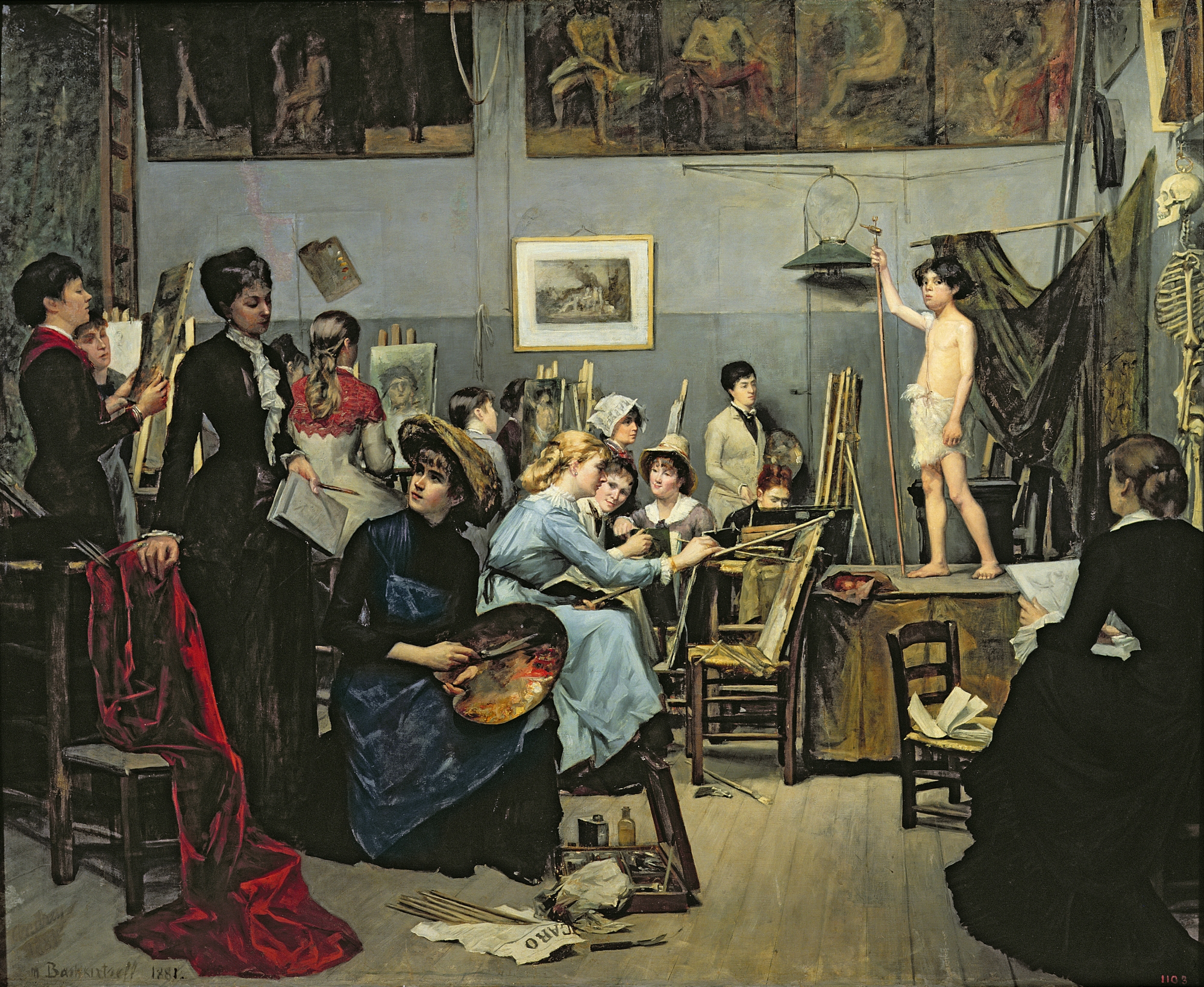
In the Studio, by Marie Bashkirtseff, 1881, oil on canvas, Dnipro State Art Museum, Dnipro, Ukraine[1]

A studio is a space set aside for creative work of any kind, including art, dance, music and theater.

The word studio is derived from the Italian: studio, from Latin: studium, from studere, meaning to study or zeal.

Types

[edit]

Art

[edit]
L'Atelier by Horace Vernet, 1821
Artist Jane Frank in her studio, 1960s or 1970s
Ingo Kühl at his Berlin studio 2015

The studio of any artist, especially from the 15th to the 19th centuries, characterized all the assistants, thus the designation of paintings as "from the workshop of..." or "studio of..."

An art studio is sometimes called an "atelier", especially in earlier eras. In contemporary, English language use, "atelier" can also refer to the Atelier Method, a training method for artists that usually takes place in a professional artist's studio.

The above-mentioned "method" calls upon that zeal for study to play a significant role in the production which occurs in a studio space. A studio is more or less artful to the degree that the artist who occupies it is committed to the continuing education in their formal discipline. Academic curricula categorize studio classes in order to prepare students for the rigors of building sets of skills which require a continuity of practice in order to achieve growth and mastery of their artistic expression. A versatile and creative mind will embrace the opportunity of such practice to innovate and experiment, which develops uniquely individual qualities of each artist's expression. Thus the method raises and maintains an art studio space above the level of a mere production facility or workshop.

Safety is or may be a concern in studios, with some painting materials required to be handled, stored, or used properly to prevent poisoning, chemical burns, or fire.[2]

Dance Studio

[edit]
Dance studio with barre rails, mirrors, and mounted speakers

Educational

[edit]

In educational studios, students learn to develop skills related to design, ranging from architecture to product design. In specific, educational studios are studio settings where large numbers of students learn to draft and design with instructional help at a college. Educational studios are colloquially referred to as "studio" by students, who are known for staying up late hours into the night doing projects and socializing.

The studio environment is characterized by two types in education:

  1. The workspace where students do usually visually-centered work in an open environment. This time and space is beyond that of instructional time and faculty guidance is not available. It allows for students to engage each other, help each other, and inspire each other while working.
  2. A type of class that takes the above-mentioned workshop space, and recreates its core component of an open working environment. It differentiates itself based on a topic of instruction, isolated space, instructor led/included, and an added focus of directed criticism.[3]

Pottery

[edit]

Studio pottery is made by an individual potter working on his own in his studio, rather than in a ceramics factory (although there may be a design studio within a larger manufacturing site).

Production

[edit]

Production studios are those studios which act as centres for the production in any of the arts; alternatively they can also be the financial and commercial entity behind such endeavours. In radio and television production studio is the place where programs and radio commercial and television advertising are recorded for further emission.

Animation

[edit]

Animation studios, like movie studios, may be production facilities, or financial entities. In some cases, especially in anime, they continue the tradition of a studio where a master or group of talented individuals oversee the work of lesser artists and crafts persons in realising their vision. Animation studios are a fast rising entity and they include established firms such as Walt Disney and Pixar.

Comics

[edit]

A comics studio is a workroom or entertainment company that makes comics. Comics creators, employ small studios of staff to assist in the creation of a comic strip, comic book or graphic novel.

In the early days of "Dan Dare", Frank Hampson employed a number of staff at his studio to help with the production of the strip. Eddie Campbell is another creator who has assembled a small studio of colleagues to help him in his art, and the comic book industry in the United States has based its production methods upon the studio system employed at its beginnings.

Another type of studio, common for instance in Spain, would produce work for-hire on license, with prospective buyers bringing in their own franchises for artwork and occasionally new stories.

Instructional

[edit]
Student using a laptop in an instructional studio.

Many universities are creating studio settings for courses outside the artist's realm. There are several different projects along these lines, most notably the SCALE-UP (Student-Centered Active Learning Environment for Undergraduate Programs) initiated at NC State.

Mastering

[edit]

In audio, a mastering studio is a facility specialised in audio mastering. Tasks may include but not be limited to audio restoration, corrective and tone-shaping EQ, dynamic control, stereo or 5.1 surround editing, vinyl and tape transfers, vinyl cutting, and CD compilation. Depending on the quality of the original mix, the mastering engineer's role can change from small corrections to improving the overall sound of a mix drastically. Typically studios contain a combination of high-end analogue equipment with low-noise circuitry and digital hardware and plug-ins. Some may contain tape machines and disc cutting lathes. They may also contain full-range monitoring systems and be acoustically tuned to provide an accurate reproduction of the sound information contained in the original medium. The mastering engineer must prepare the file for its intended destination, which may be radio, CD, vinyl or digital distribution.

In video production, a mastering studio is a facility specialized in the post-production of video recordings. Tasks may include but not be limited to: video editing, colour grading correction, mixing, DVD authoring and audio mastering. The mastering engineer must prepare the file for its intended destination, which may be broadcast, DVD or digital distribution.

Acting

[edit]

An "acting studio" is an institution or workspace (similar to a dance studio) in which actors rehearse and refine their craft. The Neighborhood Playhouse and Actors Studio are legendary acting studios in New York.

Movie

[edit]

A movie studio is a company which develops, equips and maintains a controlled environment for filmmaking. This environment may be interior (sound stage), exterior (backlot) or both.

Photographic

[edit]

A photographic studio is both a workspace and a corporate body. As a workspace it provides space to take, develop, print and duplicate photographs.

Radio

[edit]

A radio studio is a room in which a radio program or show is produced, either for live broadcast or for recording for a later broadcast. The room is soundproofed to avoid unwanted noise being mixed into the broadcast.

Recording

[edit]

A recording studio is a facility for sound recording which generally consists of at least two rooms: the studio or live room, and the control room, where the sound from the studio is recorded and manipulated. They are designed so that they have good acoustics and so that there is good isolation between the rooms.

Television

[edit]

A television studio is an installation in which television or video productions take place, for live television, for recording video tape, or for the acquisition of raw footage for post-production. The design of a studio is similar to, and derived from, movie studios, with a few amendments for the special requirements of television production. A professional television studio generally has several rooms, which are kept separate for noise and practicality reasons.

Zen, Yoga and martial arts

[edit]

Many healing arts and activities such as zen, yoga, judo and karate are "studied" in a studio. It is widespread to see yoga studios and martial arts studios established in settings that might previously have been for other uses, described as studios. These are not recreational centers or gyms in the traditional sense, but places where students of these activities practice or study their art.

See also

[edit]

Sources

[edit]
  1. ^ Morrill, Rebecca (2019). Great Women Artists. Phaidon. p. 53. ISBN 978-0-7148-7877-5.
  2. ^ Friel, Michael (2010). Still Life Painting Atelier: An Introduction to Oil Painting, p.20. ISBN 978-0-8230-3408-6.
  3. ^ "What is studio teaching?". Retrieved 23 July 2011.
[edit]
Revisions and contributorsEdit on WikipediaRead on Wikipedia
from Grokipedia
A studio is a dedicated workspace or facility designed for the creation, practice, or production of artistic, performative, or media works, such as , music recording, or . Originating from the Italian word for "study," it typically provides an environment equipped with specialized tools and acoustics to support creative processes. Studios encompass a diverse range of types tailored to specific disciplines within and industries. Art studios function as personal or shared spaces for visual artists, including painters, sculptors, and photographers, where they conceptualize, execute, and refine their creations amid supplies like canvases, easels, and lighting setups. Recording studios are acoustically treated rooms or complexes outfitted with , mixing consoles, and workstations to capture, edit, and master sound recordings, such as music tracks or voiceovers. studios, by contrast, often combine physical soundstages and backlots for on-site shooting with broader corporate structures that handle financing, distribution, and post-production for motion pictures. Beyond these core forms, studios play a pivotal role in fostering innovation and collaboration across creative fields, evolving from modest individual ateliers in the Renaissance era to modern multifunctional hubs integrated with digital technologies. Their design emphasizes functionality, isolation from external noise, and adaptability, influencing everything from artistic output to industry economics in global entertainment markets.

Overview

Definition

A studio is a dedicated room or building serving as a workspace for artists, performers, photographers, or producers engaged in creative, technical, or instructional activities, typically equipped with specialized tools and features to support focused production processes. This space facilitates the creation of works such as paintings, sculptures, music recordings, or performances, emphasizing an environment tailored to the demands of the specific discipline. The term "studio" originates from the Italian studio, borrowed in the late , which itself derives from the Latin studium meaning "study," "eagerness," or "zeal." By the early , it had evolved in English to specifically denote a well-lit or used by painters and sculptors for their practice, reflecting a shift from general scholarly pursuit to a practical creative workspace. The first known English use in this sense dates to around 1800. Key characteristics of a studio include its role as a controlled, distraction-minimized setting that promotes concentration and experimentation, often with adjustable , ventilation, and storage to optimize —distinguishing it from more generalized workshops or offices that lack such specialized adaptations. This intentional design fosters a sense of isolation from external interruptions, enabling sustained creative output. Studios find broad application across domains: in creative fields like or , where they serve as personal ateliers for ideation and execution; in technical contexts such as sound recording studios, optimized for audio capture and mixing with acoustic treatments; and in instructional settings like or studios, which provide mirrored walls and for practice and teaching.

Historical Development

The concept of the studio as a dedicated workspace for creative production traces its roots to the period in , where workshops known as botteghe or ateliers served as centers for artists. These collaborative environments combined artistic , production, and , with master artists overseeing teams of apprentices who contributed to large-scale projects. A prominent example is Leonardo da Vinci's in the workshop of starting around 1466, where young artists learned techniques in , , and through hands-on collaboration on commissions like altarpieces and public monuments. By the , during the , the studio evolved into more individualized spaces, reflecting the Romantic movement's emphasis on personal expression and the artist's inner world. Urbanization and technological advances allowed artists to establish private ateliers separate from systems, enabling focused away from industrial noise. This shift was influenced by Romantic ideals that celebrated nature, emotion, and genius, prompting figures like to studios as personal sanctuaries for uninterrupted inspiration. The introduction of electric in the further transformed these spaces by extending workable hours beyond daylight, reducing reliance on dim gas lamps and facilitating detailed work into the evening. The marked the expansion of studios into media production, driven by the film and recording industries. In the 1910s, Hollywood emerged as a hub for motion picture studios, with the first feature-length film, The Squaw Man, shot there in 1914 and permanent lots established by 1911, attracting companies like Universal and talent due to favorable weather and distance from East Coast patent disputes. Simultaneously, dedicated recording studios proliferated; , opened in November 1931 by in , pioneered purpose-built facilities for classical and orchestral recordings using advanced acoustic techniques. Post-World War II, studios became institutionalized in education and broadcasting, supporting and learning. The expanded its television and radio facilities in the 1950s, with studios like those at Lime Grove hosting educational programs that reached schools nationwide, integrating broadcasts into curricula for subjects like and amid reconstruction efforts. This period solidified studios as essential infrastructure for media, blending artistic production with societal outreach.

Design and Operation

Architectural Features

Architectural features of studios prioritize functionality to support creative processes, often incorporating open floor plans that enhance flexibility and . These layouts typically feature expansive, undivided spaces divided into functional zones for creation, storage, and , allowing artists and makers to adapt the environment to diverse projects without fixed barriers. For instance, in compact creative studios, an open-concept overlaps zones to maximize usable area, fostering seamless transitions between work areas. Studio sizes vary widely to accommodate different scales of operation, ranging from small personal spaces around 50-150 square feet for individual artists to larger production facilities exceeding 5,000 square feet, such as those in or media studios, ensuring adequate room for movement and equipment. Materials and construction in studios emphasize durability, environmental control, and sensory optimization to preserve works and sustain productivity. elements, like panels, are commonly integrated in media or performance-oriented spaces to minimize external interference. is facilitated through skylights or north-facing windows in art studios, providing consistent, diffused illumination that reduces color and enhances visibility for detailed work. Climate control systems, including HVAC units for and regulation, protect sensitive materials from degradation, maintaining stable conditions essential for preservation in creative environments. Safety and form core structural considerations, with ventilation systems designed to extract fumes and particulates from activities like or , promoting air quality and reducing health risks. Fire-resistant materials, such as treated panels or insulation, are used in walls and ceilings to mitigate fire hazards from flammable solvents or tools common in studio settings. Adjustable lighting fixtures, often layered with dimmable LEDs and task-specific lamps, help prevent by allowing users to customize illumination levels for prolonged sessions. These safety measures must comply with regulations such as the U.S. (OSHA) standards for hazard communication and ventilation in art and craft environments. Adaptations in studio increasingly favor modular designs for easy reconfiguration, enabling spaces to evolve with changing creative needs. Post- industrial conversions, such as former factories repurposed into artist lofts and workspaces, exemplify this approach by retaining exposed structural elements like beams and brick while adding flexible partitions and movable fixtures. Contemporary adaptations as of 2025 increasingly incorporate sustainable practices, such as biophilic elements and eco-friendly materials, alongside modular designs. These transformations, prominent in urban revitalization projects since the , support multifunctional use in shared creative hubs.

Equipment and Technology

Studios rely on core categories of equipment to support creative and production activities, including lighting rigs for controlled illumination, workbenches for stable working surfaces, storage solutions for material organization, and basic utilities such as ample power outlets to power tools and devices. Lighting rigs, often consisting of adjustable stands and lamps, ensure even lighting to reduce shadows and enhance detail work across various studio tasks. Workbenches provide durable, ergonomic surfaces tailored to specific needs, such as height-adjustable models for prolonged use. Storage solutions, including shelves, cabinets, and pegboards, help maintain an orderly environment by categorizing supplies and tools efficiently. These utilities, like multiple grounded outlets and ventilation systems, form the foundational infrastructure enabling seamless operations. The technological evolution in studios has shifted from analog tools dominant in the , such as wooden easels and manual presses used for and , to digital interfaces emerging in the late , including computers and software for and since the . This transition has streamlined workflows by integrating computational power for tasks like digital sketching and prototyping, while preserving analog elements for tactile creativity in hybrid setups. Early analog equipment emphasized manual precision, whereas modern digital tools offer and precision through software-driven processes. Common features in studio equipment emphasize versatility and safety, with multi-purpose items like adjustable stands allowing reconfiguration for different projects and safety gear such as respirators protecting users from dust, fumes, and particulates in craft-intensive environments. These stands, often made of sturdy metal, support , tools, or displays and can extend from 4 to for adaptability. Respirators, gloves, and protective are standard to mitigate risks associated with materials like paints, clays, or solvents. Maintenance is crucial for longevity and performance, involving regular calibration routines for lighting and stands to ensure stability and accuracy, alongside software updates for digital interfaces to address security and functionality issues. Dust removal using compressed air and contact cleaners prevents buildup on surfaces and connectors, while proper storage in climate-controlled conditions avoids degradation. These practices, applied routinely, minimize downtime and extend equipment life in demanding studio settings. Cost considerations vary widely between entry-level and professional-grade options, reflecting differences in durability and features; for instance, basic lighting kits suitable for small studios start around $100–$300 as of 2025, while advanced rigs with trussing and multiple fixtures can exceed $5,000. Simple workbenches begin at $50 for basic tables, escalating to $500 or more for ergonomic, adjustable professional models with integrated storage. Such ranges allow creators to scale investments based on needs, with entry-level setups enabling initial experimentation and professional gear supporting high-volume production.

Types of Studios

Artistic and Craft Studios

Artistic and craft studios serve as dedicated workspaces where creators engage in the production of visual and , emphasizing hands-on processes and individual expression. An artist's studio, historically known as an , functions as the private workshop of a professional in or , providing a for ideation, experimentation, and execution of works such as paintings, sculptures, and prints. In contrast, craft studios focus on functional and decorative objects made from materials like clay, , metal, wood, and , where the maker often unites design and fabrication in a single process. These studios distinguish themselves from industrial production by prioritizing artisanal techniques and personal authorship, fostering environments that blend with technical skill. The evolution of artistic studios traces back to the Renaissance bottega, collaborative workshops in and where master artists trained apprentices through practical instruction and shared labor, producing both commissioned works and innovative pieces. By the , amid Romantic ideals of individual genius, studios shifted toward more solitary, performative spaces that symbolized the artist's inner world, as exemplified in Gustave Courbet's 1855 painting , which portrays the workspace as a microcosm of society and creativity. In the 20th century, this model expanded with modernist influences, leading to large-scale operations like Andy Warhol's in 1960s New York, which integrated mechanized production and social interaction, reflecting the growing commercialization of art. Craft studios, meanwhile, gained prominence through the post-World War II studio craft movement in the United States, which reacted against by reviving handmade traditions and encouraging experimentation with form and material. This movement, flourishing internationally from the 1950s onward, drew from earlier Arts and Crafts ideals but emphasized abstract and sculptural outcomes alongside utilitarian items, with artists like Ken Price pushing boundaries in ceramics. Key features of these studios include adaptable layouts with ample natural lighting, ventilation for materials like paints or glazes, and specialized equipment such as easels, , or looms tailored to the medium. Artistic studios often incorporate display areas for ongoing works and references, serving not only as production sites but also as inspirational retreats that influence the final output. Craft studios, by extension, prioritize durable workbenches, storage for raw materials, and tools that enable precise manipulation, underscoring the tactile nature of creation. In contemporary practice, both types have adapted to , with some evolving into hybrid spaces that accommodate digital tools or collaborative teams, yet they retain their core role as sanctuaries for authentic, maker-driven . As of 2025, integration of AI-assisted has become common in craft studios for prototyping.

Art Studio

An art studio serves as a dedicated personal workspace for visual artists engaged in creating paintings, drawings, sculptures, and other forms, providing an environment for ideation, experimentation, and execution of medium-specific techniques such as or . This space facilitates the transition from conceptual brainstorming to tangible artworks, allowing artists to sketch initial ideas, refine compositions, and apply materials like pigments, canvases, or armatures without external interruptions. Unlike communal or commercial settings, the art studio emphasizes and control, enabling focused work on two- and three-dimensional pieces that explore personal themes and techniques. Key architectural and functional features of an art studio include north-facing windows to capture diffuse, consistent that minimizes harsh shadows and color distortion, ideal for accurate rendering in and . Essential equipment encompasses adjustable easels for supporting canvases at optimal angles, drying racks for oil paintings to prevent sticking during curing, and robust ventilation systems—such as exhaust fans or fume hoods—to safely remove hazardous vapors from solvents and resins used in oil-based or sculptural processes. These elements ensure a safe, ergonomic environment that supports prolonged creative sessions, with durable flooring and organized storage for tools like brushes, palettes, and modeling tools. Historically, Pablo Picasso's studio at 7 Rue des Grands Augustins in , occupied from 1936 through 1955, exemplified the art studio as a hub of during his Cubist and Surrealist periods, where he produced iconic works like (1937) amid wartime constraints. The space featured high ceilings for large-scale canvases, natural light from skylights, and cluttered yet functional areas for sketches and sculptures, reflecting the chaotic yet productive nature of artistic creation in mid-20th-century . In studios, traditional tools coexist with digital adaptations, such as graphics tablets like models integrated alongside easels for hybrid workflows that blend analog sketching with digital refinement using software like . This evolution allows artists to scan sketches for digital layering or prototyping sculptures via before physical execution, enhancing precision without supplanting tactile media. As of 2025, AI tools for assistance are increasingly used in ideation phases. The typical in an art studio begins with ideation through loose sketches or maquettes to capture concepts, progressing to detailed underdrawings or armatures for . Artists then block in forms and colors—using broad brushes for paintings or building clay layers for sculptures—followed by iterative refinement of details, textures, and finishes over days or weeks. Storage solutions, such as shelving for unfinished pieces and archival bins for sketches, enable pausing and resuming projects, preserving momentum in the creative process.

Pottery Studio

A pottery studio is a specialized workspace dedicated to the creation of objects through clay manipulation and thermal processing. It typically features essential equipment such as potter's wheels for rotational shaping, —either electric for precise control or gas for higher temperatures—slab rollers for flattening clay sheets, and designated glazing areas with spray booths or application tables to apply vitreous coatings. These setups enable potters to produce items ranging from utilitarian vessels to artistic forms, with dedicated spaces for drying unfired "greenware" on shelves or racks to prevent warping during the moisture phase. The core processes in a pottery studio revolve around forming and firing clay. Throwing involves centering clay on a to pull up symmetrical shapes like or vases, while hand-building techniques such as or pinching allow for more organic constructions. Once formed, pieces undergo bisque firing in a at temperatures between 900°C and 1060°C (approximately 06 to 04), which vitrifies the clay into a porous, durable bisqueware suitable for glazing. Subsequent glaze firing reaches up to 1300°C (around 9-10) to fuse the decorative or protective coating, maturing the work into or . These stages require controlled atmospheres to avoid defects like cracking or bloating. Safety is paramount in pottery studios due to hazards from fine particulates and high heat. extraction systems, including local exhaust ventilation at clay mixers and wheels, are essential to capture respirable crystalline silica, which can cause upon prolonged inhalation; workers must wear NIOSH-approved respirators during dry tasks like sanding or sweeping. Heat-resistant gloves and protective clothing are required near to guard against burns, with studios often incorporating fire suppression and proper electrical grounding for . Regular of surfaces minimizes airborne accumulation. Historically, pottery workshops originated in ancient Mesopotamian temple complexes around 3000 BCE, where artisans used early and potter's wheels to produce standardized vessels for daily and ritual use. This craft evolved through millennia, but modern community pottery studios emerged prominently in the as part of the broader studio crafts movement, fostering accessible spaces for hobbyists and professionals amid a backlash against industrial . These venues emphasized and experimentation, often in urban or educational settings. Pottery studios support the production of both functional and decorative works, with the former prioritizing durability for items like tableware that withstand repeated use, and the latter focusing on aesthetic expression through intricate glazes or sculptural forms for display. Functional pieces emphasize balanced proportions and food-safe materials, while decorative ones allow greater artistic liberty, though both benefit from the studio's drying areas to ensure structural integrity before firing. As of 2025, 3D-printed molds are increasingly used for prototyping complex forms.

Dance Studio

A is a specialized designed for the practice, , and instruction of , emphasizing floor surfaces that support dynamic movement and spatial layouts that facilitate fluid motion and group coordination. These studios prioritize and technical precision, accommodating various dance forms through adaptable features that enhance both individual and work. The historical development of dance studios traces back to the , when academies formalized dedicated training environments amid the Romantic era's emphasis on expressive and technical rigor. Institutions like the Paris Opéra Ballet School, operational since the late 18th century but significantly expanded in the early 19th, exemplified this evolution by incorporating structured spaces for daily classes and rehearsals, influencing global standards for dance facilities. Core elements of a dance studio include sprung floors, which consist of flexible substructures beneath a resilient surface to absorb impact and return energy, thereby reducing joint stress and enhancing jump height and control during . Full-length mirrors along walls enable dancers to self-correct alignment, posture, and form through immediate visual feedback, a integral to technical refinement. Ballet barres, typically mounted at waist height along mirror-lined walls, provide essential support for warm-up exercises that build , balance, and turnout while allowing controlled execution of foundational movements. Dance studios support diverse styles such as , with its emphasis on classical technique; contemporary, blending fluid expression and improvisation; and hip-hop, featuring rhythmic isolations and freestyle elements, often through versatile setups like adjustable that alters intensity and color to match the mood—from soft illumination for lyrical pieces to vibrant, dynamic effects for urban genres. Typical sizes range from 500 to 2,000 square feet, scaling with class capacity to allow unobstructed movement for groups of 10 to 30 participants. Usage centers on rehearsals for development, instructional classes for skill-building, and auditions for selection, with sessions structured to progress from barre work to center-floor combinations. Accessories enhance functionality, including high-fidelity sound systems with amplifiers and speakers delivering clear audio for synchronized movement to , essential across all styles. Changing areas, often adjacent to the main space, offer private lockers and benches for quick attire transitions, promoting efficiency during multi-class schedules. As of 2025, systems are used for remote rehearsal and analysis.

Acting Studio

Acting studios serve as dedicated spaces for training and rehearsing performers in theater and , fostering immersive environments that emphasize emotional depth and realistic portrayal. These facilities enable to develop skills through structured exercises, allowing them to inhabit characters convincingly in controlled settings. Typical setups in acting studios include theaters, which provide flexible, minimalist spaces with black walls and movable seating to simulate various staging configurations without distractions. For -oriented training, green screens are incorporated to allow to rehearse against chroma-key backdrops, simulating virtual environments and preparing for integration. Adjacent props storage areas, often organized with shelving, bins, and labeled categories, ensure quick access to items like furniture replicas or handheld objects to enhance scene authenticity during practice. Acting techniques in these studios draw heavily from Konstantin Stanislavski's system, developed in the late 19th century, which prioritizes psychological realism and "living the part" through internal processes. Method acting spaces, inspired by this foundation, focus on sensory and emotional recall exercises to access personal experiences, while dedicated areas encourage spontaneous interactions to uncover character subtext and natural responses. Group dynamics revolve around collaborative practice, including scene work where pair to explore and relational tensions, monologue delivery for refining solo emotional arcs, and structured feedback sessions in designated zones for peer and instructor observations to refine . Modern tools such as video recording for playback and self-review have become integral since the , coinciding with the rise of accessible digital cameras that allow to analyze gestures, timing, and expressions immediately after sessions. As of 2025, AI-driven feedback software analyzes for emotional authenticity. A prominent example is The Actors Studio in New York, founded in 1947 by , , and Robert Lewis, with joining as director in 1948 to emphasize techniques in a workshop-style environment.

Yoga, Zen, and Martial Arts Studio

, , and studios provide dedicated spaces for mind-body disciplines that emphasize physical postures, seated , and disciplined movement forms, fostering personal discipline and inner calm. These studios typically incorporate serene, uncluttered environments to support focused practice, drawing from traditional Eastern architectural principles adapted for contemporary use. Unlike more performative spaces, they prioritize quiet introspection and gradual progression in techniques like asanas (postures), zazen (seated ), and katas (prearranged forms). The design of these studios often features mats as a foundational element, providing a soft, natural surface made from woven igusa grass that evokes a connection to nature and supports comfortable kneeling or lying positions during and practice. Minimalistic decor, characterized by neutral tones, natural wood accents, and sparse furnishings, creates an atmosphere of simplicity and tranquility, aligning with principles of that value imperfection and restraint. Ambient lighting, such as soft paper lanterns or diffused , enhances the calming ambiance, while dedicated quiet zones—often screened alcoves or dimly lit corners—allow for undisturbed sessions without external distractions. Ventilation systems are essential, particularly in areas, to manage airflow during vigorous katas and ensure fresh air circulation for sustained sessions. Practices in these studios trace their roots to ancient traditions, with yoga originating in India around 1500 BCE as referenced in the Rig Veda, where it initially focused on meditative union rather than physical postures, evolving over millennia through Vedic and Upanishadic texts. Zen zazen emerged from Chinese Chan Buddhism in the 6th century CE, transmitted to Japan during the Kamakura period (1185–1333), emphasizing "just sitting" to cultivate mindfulness without rituals. Martial arts katas developed in ancient China during the Zhou dynasty (1046–256 BCE), serving as structured sequences to build combat skills, balance, and mental focus, later influencing styles like karate. In studios, these are taught progressively: asanas for flexibility and breath awareness, zazen for mental clarity, and katas for coordinated power and precision. Essential equipment includes yoga mats for grip and cushioning during asanas, wooden or foam blocks and bolsters to aid alignment and support in restorative poses, and cylindrical bolsters for reclined or gentle stretches. For , freestanding or hanging punching bags facilitate striking drills within katas, building endurance and technique. High ceilings and open layouts accommodate dynamic movements, with ventilation ensuring air quality during intense, sweat-inducing sessions that can last up to 90 minutes. Props like bolsters are particularly valued for their role in maintaining spinal alignment, reducing strain, and enabling modifications for practitioners of varying abilities. These studios thrive on community engagement through group classes, where participants share energy in synchronized asanas or katas, and immersive retreats that extend practices over weekends or weeks, promoting deeper bonding and collective growth. The expansion in Western countries accelerated post-1960s , as and gained traction among seekers influenced by Eastern spirituality and figures like , who introduced in 1968, leading to widespread studio proliferation by the 1970s. As of 2025, hybrid online-offline classes using VR for guided have become standard. Health benefits are supported by the use of props to enhance postural alignment, with asanas and shown to improve flexibility, reduce stress, and bolster mental through mind-body integration. katas contribute to cardiovascular health and coordination, while the overall studio environment facilitates these outcomes by providing stable support for precise movements.

Media Production Studios

Media production studios are specialized physical facilities equipped for the creation, recording, and post-production of various forms of media content, including , television, radio, and . These studios typically feature controlled environments such as soundstages, backlots, editing suites, and technical infrastructure to support creative processes while minimizing external interference like noise or weather. Unlike production companies, which focus on business operations, financing, and distribution, media production studios emphasize the tangible spaces and equipment necessary for hands-on . The historical development of media production studios began in the early alongside the rise of the motion picture industry. The first dedicated studio in Hollywood was established by Nestor Studios in 1911, marking the shift from to controlled indoor facilities in , chosen for its favorable climate and distance from patent disputes on the East Coast. By the 1920s, the Hollywood studio system had emerged, with major players like (founded 1924), (1912), and Warner Bros. (1918) building expansive complexes that integrated production capabilities. This era, peaking from 1930 to 1945, saw studios produce over 7,500 feature films through a vertically integrated model controlling all stages from scripting to exhibition. Key features of media production studios include soundproofed stages for filming and recording, advanced lighting and camera systems, green screens for integration, and audio control rooms equipped with mixing consoles. Post-World War II, the decline of the due to antitrust rulings in led to more independent productions, but facilities evolved with technological advancements, such as the transition from reels to digital workflows and, more recently, from (SDI) cabling to (IP)-based systems for scalable, high-bandwidth in control rooms and editing bays. These adaptations have enabled studios to handle the explosion of demands, supporting formats from 4K video to productions. As of 2025, AI-assisted editing and virtual production tools are standard in many facilities. In contemporary practice, media production studios facilitate diverse outputs, from live television broadcasts to animated content, often incorporating sustainable designs and remote collaboration tools. Iconic examples include the historic backlots at Universal Studios (founded 1912) and modern facilities like those at in the UK, which have hosted international blockbusters since the 1930s. These studios remain essential for achieving professional-grade media, providing the infrastructure that underpins global entertainment industries.

Animation Studio

Animation studios specialize in the production of animated content, primarily through hand-drawn or early computer-assisted techniques that bring static designs to life via sequential motion. These facilities emerged as dedicated spaces in the early , evolving from rudimentary workshops to structured environments supporting collaborative workflows. Traditional animation, dominant until the late 1990s, relied on manual drawing and physical media, while early digital methods introduced software for refinement without fully replacing analog foundations. As of 2025, AI tools for and rendering accelerate production. Central to the animation process is storyboarding, where artists sketch sequential panels to visualize the narrative, camera angles, and character actions, serving as a blueprint for the entire production. This is followed by keyframing, in which senior animators create primary poses that define the extremes of movement, emphasizing principles like timing, squash-and-stretch, and to convey and physics. Inbetweening then fills the gaps between keyframes with intermediate drawings to achieve fluid motion, often at 12 or 24 frames per second, ensuring seamless transitions. Essential tools include light tables for backlighting paper to trace and align layers, and rotoscopes, which project live-action footage for tracing realistic gestures onto animation cels. These steps form a labor-intensive pipeline that prioritizes artistic precision over speed. Historically, Walt Disney Studios exemplified pioneering practices, beginning operations in 1923 and innovating cel in the 1930s to enable multi-plane layering for depth and color efficiency. The studio relocated to its Burbank facility in 1940, designed specifically around the workflow with expanded rooms for drawing and inking, supporting the production of landmark features like and the Seven Dwarfs (1937). This setup allowed Disney to scale from short films in the to full-length animated movies, establishing industry standards for quality and narrative depth. Team structures in traditional animation studios typically feature a hierarchy led by directors who oversee creative vision and pacing, collaborating with lead animators responsible for key poses. Supporting roles include inbetweeners for transitional frames, inkers who outline drawings on transparent cels with steady lines, and painters who apply vibrant colors to those cels, often women dominating the ink-and-paint department for their detail-oriented skills. The pipeline progresses from concept sketches through animation, inking, painting, and compositing, culminating in the final reel assembly by editors, with each stage reviewed for consistency. Space requirements emphasize functionality for iterative drawing and review, with rows of adjustable drawing tables equipped with peg bars to secure animation paper in precise registration holes, preventing misalignment across frames. Light tables integrate into these desks for illumination, while dedicated film editing bays house sprocketed reels and splicing equipment to sequence cels into test footage, or "pencil tests," for playback on modified projectors. These layouts foster a linear , minimizing movement between stations to maintain momentum in production. Outputs from these studios include classic 2D films using cel overlays for layered scenes, as seen in Disney's golden age productions, and early 3D works that built on traditional principles with computer modeling. Pixar's pre-2010 setups, for instance, combined storyboarding and keyframing with proprietary software like RenderMan for rendering complex 3D models in films such as Toy Story (1995) and Finding Nemo (2003), marking the transition to digital pipelines while retaining hand-drawn concept roots. These efforts produced enduring animated features that emphasized storytelling through innovative motion.

Comics Studio

A comics studio serves as a dedicated workspace for the creation of comic books and graphic novels, emphasizing collaborative processes between writers, pencillers, inkers, and letterers to produce . These studios facilitate the transformation of scripts into visual stories, often blending with structured production pipelines. Historically rooted in the mid-20th century publishing industry, they evolved from informal gatherings to specialized environments supporting both traditional and emerging . As of 2025, platforms enable remote team workflows. The core workflow in a comics studio begins with scripting, where writers outline the plot, character arcs, and , often using the Marvel Method—a technique popularized in the that provides a loose synopsis allowing artists significant input on panel layout and pacing. Penciling follows, with artists sketching rough layouts on paper to establish composition and action flow across pages. Inking refines these pencils into bold, definitive lines using specialized tools, enhancing contrast and detail for reproduction. integrates text, including dialogue balloons and sound effects, typically added last to avoid interference with artwork. This sequential process ensures narrative clarity while allowing iterative feedback among team members. Traditional tools dominate comics studio production, with serving as the preferred substrate due to its smooth, durable surface that resists ink bleeding and supports precise line work—common brands include Strathmore and , with weights of 250-400 gsm ideal for pen and ink. Dip pens, featuring flexible nibs like the Hunt #102 quill, enable artists to vary line thickness for dynamic expressions of motion and , dipped into for archival quality. Brushes, such as Winsor & Newton Series 7, complement these for broader strokes in backgrounds or shading. These analog implements prioritize tactile control, fostering the hand-drawn aesthetic central to the medium. In the 1960s, Marvel Comics exemplified the Bullpen era, a collaborative model where artists and writers worked in shared office spaces at 625 Madison Avenue, New York, fostering rapid idea exchange amid tight deadlines for titles like The Fantastic Four. This "Bullpen" environment, promoted by editor Stan Lee, encouraged camaraderie among creators, though it was often more freelance-driven than a literal open-plan office. Jack Kirby, a pivotal figure in this period, operated from a modest home studio setup in New York, equipped with drafting tables and reference materials to produce iconic penciled pages for Marvel's superhero lineup, reflecting the era's emphasis on high-volume output. Collaborative spaces in comics studios typically feature bullpens—communal areas with clustered desks for teams to discuss scripts and review progress—or individual workstations for focused illustration, balancing group synergy with personal creativity. These layouts, inherited from the Marvel model, promote real-time adjustments to , such as refining panel transitions during penciling sessions. The digital transition in the introduced scanners for digitizing traditional artwork, enabling easier editing and color separation without altering core hand-drawn methods, though studios maintained emphasis on analog tools to preserve the organic line quality of penciling and inking. Software like facilitated post-production tweaks, but full digital creation remained secondary until the 2000s. Studio output ranges from individual panels—capturing key action beats—to complete issues of 20-24 pages, compiled for or , with original artwork archived in acid-free portfolios or mylar sleeves to prevent degradation from light, humidity, or acidity. These originals, valued for their , are stored flat in climate-controlled environments to maintain integrity for potential resale or .

Recording Studio

A is a specialized facility designed for capturing high-fidelity audio, primarily for , sound effects, and voice work, featuring distinct spatial divisions to optimize performance and monitoring. The core layout includes a live room, where musicians and performers play instruments together to capture natural interaction and ambiance; a , equipped for the recording to monitor and operate equipment without acoustic interference; and isolation booths, smaller enclosed spaces for vocals, , or amplified instruments to minimize sound bleed between tracks. is essential to prevent external noise intrusion and internal sound leakage, typically achieved through double-wall construction with an air gap filled with absorptive materials, which decouples the inner and outer structures to block low-frequency transmission effectively. Essential equipment in a recording studio revolves around signal capture and processing, including for converting sound to electrical signals, preamplifiers to boost those signals without adding noise, and multi-track recorders to layer multiple audio sources independently. In the , studios predominantly used mono recording on single-track machines with or dynamic and tube preamps, limiting productions to basic live takes due to the inability to overdub extensively. The shift to multi-track recording accelerated in the late with two-track systems pioneered by artists like , evolving to four- and eight-track analog tape in the 1960s and 1970s using reel-to-reel machines from brands like and , paired with condenser and solid-state preamps for greater clarity and flexibility. By the 1980s, transformed the industry with (PCM) systems and early digital audio workstations (DAWs), enabling 24-track or more with nonlinear editing, though analog gear remained prevalent for its warmth until digital tape formats like became standard. As of 2025, cloud-based DAWs enable remote collaboration. The recording process in a studio begins with tracking, where foundational elements like rhythm sections are captured live in the live room to preserve ensemble feel, followed by overdubbing to add solo instruments, harmonies, or effects on separate tracks for precise control. Basic mixing then balances levels, panning, and effects like reverb or compression in the control room to create a cohesive stereo image before export. A seminal example is Records' Hitsville U.S.A. studio in the 1960s, where producers like tracked full bands live on four-track machines using a modified 1939 mixer, then overdubbed intricate vocal stacks by groups like , and mixed to mono for radio play, yielding hits like "My Girl" through tight, punchy arrangements. Acoustic treatments are critical for managing room reflections and ensuring accurate capture, with bass traps—broadband absorbers placed in corners—targeting low-frequency buildup to eliminate standing waves and muddiness, while diffusers, often or skyline designs on rear walls, scatter mid- and high-frequency reflections to reduce flutter and create a balanced reverb tail without deadening the space. These elements allow engineers to tailor the room's response time, typically aiming for 0.2-0.5 seconds of reverb in live areas for natural sound. Studios adapt their design and techniques to specific genres for optimal results; rock productions favor large, lively live rooms with minimal absorption to capture and guitar energy, often using close-miking and isolation for amps to handle high volumes. recording emphasizes natural acoustics, employing larger halls or treated rooms with diffusers and longer reverb times to preserve orchestral blend and spatial depth, sometimes recording sections separately for editing. studios prioritize vocal clarity in compact, heavily absorbed isolation with to eliminate room tone, focusing on dry, intelligible speech capture via cardioid microphones rather than multi-track layering.

Movie Studio

A movie studio, also known as a , serves as a dedicated facility for the production and initial of feature-length films, encompassing physical spaces for constructing sets, filming scenes, and reviewing footage. These studios typically include soundstages—large, enclosed areas designed to eliminate external noise and control environmental factors for controlled shooting—and backlots, which are outdoor areas featuring permanent or semi-permanent structures mimicking urban or rural environments. Editing suites within the studio allow for on-site assembly of footage during production, facilitating quick adjustments before full . Key technical components enhance filming efficiency, such as overhead lighting grids installed in soundstages to support adjustable lights, reflectors, and diffusion materials for precise illumination of scenes. Cranes and dollies provide dynamic camera movements, enabling sweeping shots over sets without disrupting the controlled environment. Historically, emerged as an iconic studio in the , acquiring a 62-acre lot originally developed by in 1926, where it produced up to 80 films annually by the decade's end, pioneering sound films like in 1927. However, backlot filming declined post-1970s due to rising costs, the preference for authentic enabled by improved transportation, and the advent of that reduced the need for expansive physical sets, as exemplified by MGM's sale and demolition of its backlot in the mid-1970s. The typical workflow in a movie studio begins with planning, where directors, cinematographers, and production designers create storyboards, shot lists, and schedules to map out scenes on soundstages or backlots. During principal , crews capture over days or weeks, adhering to these plans while adapting to on-set challenges like weather on backlots. review follows each day's shoot, involving the projection or digital playback of raw, unedited in editing suites or screening rooms to assess performance, lighting, and technical quality, allowing immediate feedback to refine subsequent takes. As of 2025, virtual production using LED walls has reduced reliance on physical backlots. Major movie studios operate on vast scales, with lots exceeding 100 acres to accommodate multiple productions simultaneously; for instance, spans approximately 415 acres, including over 30 soundstages, while features 110 acres of backlots and Paramount covers 65 acres with 30 stages. In contrast, independent setups are often smaller, renting single soundstages or using modular facilities under 10 acres for low-budget films. Safety protocols are integral, with for requiring daily inspections of harnesses, cables, and anchors to prevent falls, coordinated by certified stunt coordinators per industry guidelines. , including automatic sprinklers in soundstages and strategically placed extinguishers, mitigate risks from hot lights and , ensuring clear emergency exits and compliance with production safety manuals.

Photographic Studio

A photographic studio is a controlled environment designed for capturing still images, featuring specialized setups to manipulate lighting and backgrounds for precise results. These spaces emerged in the 1830s following the invention of the by Louis-Jacques-Mandé Daguerre, with the first known studio, Alexander Wolcott's "Daguerrean Parlor," opening in in March 1840 to produce portraits using the new process. By 1850, over 70 such studios operated in New York alone, catering to a growing demand for affordable likenesses among the . The 1920s saw further evolution with the rise of fashion studios, driven by magazines like Vogue and , where photographers such as employed innovative lighting to showcase , increasing photographic in print from 15% in the early to 80% by 1933. Typical studio setups include cyclorama walls—curved, seamless backdrops that eliminate edges for an infinite appearance—often paired with strobe lights for flash illumination, reflectors to bounce and soften light, and interchangeable backdrops like muslin or paper for portraits and product shots. These elements allow photographers to create consistent, professional images by controlling shadows and highlights, essential for genres requiring uniformity. Processes in photographic studios contrast with location shoots: studio work offers full environmental control, enabling repeatable setups without weather interference, while location photography relies on natural light and ambient conditions, often introducing variables like time constraints. The transition from film to digital in the 1990s revolutionized these processes, with Kodak releasing the first professional digital camera in 1991 and sales of digital models surpassing film by the early 2000s, allowing instant review and editing that streamlined studio workflows. As of 2025, AI-enhanced lighting simulation software optimizes setups. Essential equipment in modern photographic studios includes high-resolution cameras such as DSLRs or mirrorless models for capturing detailed images, sturdy tripods to stabilize shots during long exposures, and stations that connect cameras to computers for real-time viewing and adjustments on large screens. These tools facilitate precise composition and immediate feedback, enhancing efficiency in controlled settings. Studios often specialize in areas like , which emphasizes dynamic poses and lighting to highlight clothing textures; product photography, focusing on even illumination to showcase items without distractions; and portraiture, prioritizing subject interaction with soft lighting to convey emotion and personality.

Radio Studio

A radio studio serves as the core facility for live audio broadcasting, enabling the real-time transmission of spoken content, music, and information to listeners via radio frequencies. The origins of such studios trace back to November 2, 1920, when Westinghouse's KDKA in conducted the world's first scheduled commercial broadcast from a rudimentary setup in a shed atop its factory building, featuring a 100-watt transmitter and basic announcing equipment for delivering Harding-Cox election results over 18 hours. This marked the birth of organized , evolving from experimental amateur transmissions like those by Frank Conrad's 8XK station in 1916. By , studios had become more structured under regulatory oversight, with the issuing guidelines for operations and facilities, later formalized by the FCC's creation in 1934 through the Communications Act, which mandated licensing, , and content standards to prevent interference and ensure . The saw a pivotal shift to (FM) technology, with the FCC authorizing experimental FM broadcasts in 1936 and reallocating the band to 88-108 MHz in 1946 to accommodate higher-fidelity audio and expand channel availability, leading to 22 commercial FM stations by 1941. As of 2025, podcasting integration has expanded studio capabilities for on-demand content. In terms of design, a typical radio studio comprises an on-air booth—a soundproofed, acoustically treated room equipped with directional fitted with pop filters to minimize breath pops and plosives during live speech—and an adjacent production room for scripting, editing, and pre-broadcast preparation. Central to the setup is the audio console, or mixing board, which integrates multiple inputs from , playback devices, and remote lines while allowing operators to balance levels and apply effects like equalization for clear transmission. These spaces prioritize noise isolation through double-glazed windows, , and diffusion panels to eliminate echoes and external sounds, ensuring high-quality output compliant with FCC technical standards established in for signal clarity and power limits. Operations in a radio studio center on real-time activities such as live DJing, where announcers and transition between tracks while interacting with audiences via calls or dedications, and reading, involving scripted delivery of updates from wire services or on-site reports. Remote feeds enable live connections from external locations like events or field correspondents, using dedicated lines to integrate external audio without delay, a practice regulated by FCC rules since that require stations to maintain emergency alert systems and adhere to equal-time provisions for political content. These workflows demand seamless coordination to meet broadcast schedules, with assisting in non-live segments to sustain 24/7 programming. Technologically, radio studios rely on automation software that schedules and cues playlists, automating cart playback and to streamline operations and comply with FCC logging requirements for air checks and commercials. Integrated Services Digital Network (ISDN) technology, developed in the 1980s, facilitated high-bitrate audio syndication by enabling uncompressed remote contributions and program distribution across affiliate stations, though it has largely been supplanted by IP-based alternatives in recent years. Key staff roles include announcers, who handle on-air delivery of content with engaging vocal styles and timing precision, often multitasking in smaller stations with production duties, and broadcast engineers, who install, monitor, and troubleshoot consoles, transmitters, and feeds to maintain and FCC-mandated equipment performance. Engineers also conduct routine tests and upgrades, ensuring minimal during live operations.

Television Studio

A is a controlled environment designed for the production of video content, typically featuring a multi-camera setup to capture live or taped broadcasts. The core layout includes the studio floor, where the action unfolds, equipped with cameras mounted on pedestals or dollies for smooth movement and precise positioning to achieve varied shots. These cameras often integrate teleprompters, which use beam-splitter glass to display scrolling scripts directly in front of the lens, allowing performers to read lines while maintaining with the . Adjacent to the floor are green rooms, comfortable waiting areas for talent to prepare, relax, and receive briefings away from the production chaos. Overseeing operations is the gallery or , a separate space housing technical equipment for directing, switching, and audio management, ensuring seamless coordination between the floor and broadcast output. Television studios emerged from experimental broadcasts in the 1930s, when networks like and the tested live transmissions using rudimentary electronic systems, often adapting radio facilities for visual content. By the 1950s, during the "," major U.S. networks such as , , and ABC expanded into full-scale production, dominating with live formats that included programs, sitcoms, and talk shows. Live pioneered real-time reporting from studio sets, while sitcoms like (1951) blended scripted comedy with multi-camera taping for audience engagement, and talk shows such as (1954) featured host-guest interactions in a conversational style. These formats emphasized immediacy and theatricality, with most programming originating live from New York studios until adoption in the late 1950s reduced logistical challenges. As of 2025, IP-based remote production allows hybrid live-virtual broadcasts. The production workflow in a television studio revolves around multi-camera coordination, beginning with rehearsals where cast and crew run through the script to identify timing and movements, followed by blocking to assign precise positions for actors and cameras. This leads to taping or live airing, where a video switcher in the gallery allows the director to select and transition between camera feeds in real time, creating a dynamic edit without post-production cuts. Essential equipment includes chroma key systems, which digitally replace a solid-color background (typically green or blue) with virtual sets or effects, a technique first tested on air in 1957 for shows like The Invisible Man to enable seamless compositing. Complementing this are audio mixers, consoles that balance microphone inputs, sound effects, and music from multiple sources to produce a clear, immersive soundtrack synchronized with visuals. A seminal example is NBC's Studio 8H in , originally constructed in 1933 as a radio auditorium but repurposed for television in 1951, hosting early live dramas like Robert Montgomery Presents and later iconic programs that exemplified multi-camera studio techniques. Its large 8,000-square-foot space accommodated orchestral setups adapted for TV, marking a transition from experimental broadcasts to the network era's polished productions.

Mastering Studio

A mastering studio serves as a dedicated facility where engineers refine final mixes into release-ready masters, focusing on precision equalization to achieve tonal balance and clarity across playback systems. Unlike initial recording stages, this process polishes mixes by addressing subtle imperfections, ensuring the track translates effectively from monitors to consumer devices. The emphasis on equalization allows for targeted adjustments, enhancing warmth, sparkle, or overall cohesion without altering the mix's artistic intent. As of 2025, automated AI mastering tools complement human oversight for efficiency. The core mastering process begins with balancing overall levels to prevent clipping, followed by equalization to correct imbalances, compression to control dynamics, and limiting to maximize without . Engineers rely on tools like analyzers for visualizing content and monitors for critical , often comparing against industry benchmarks to maintain transparency and depth. These steps ensure the master retains the mix's emotional impact while preparing it for diverse distribution channels. Industry standards guide these adjustments, including loudness normalization to -14 LUFS for streaming services to comply with platform algorithms that prevent volume fluctuations. Dithering is applied during bit-depth reduction, such as from 24-bit to 16-bit, to minimize quantization noise and preserve audio fidelity in the final export. Adherence to these norms, established by organizations like the EBU and AES, ensures consistent playback volume and quality across ecosystems. Historically, analog mastering took shape in the amid the transition to LPs, relying on cutting and tape manipulation for vinyl preparation. The 1980s marked the shift to digital with the advent of compact discs, enabling non-destructive editing; software like , released in , further revolutionized workflows by integrating precise digital processing. This evolution expanded creative possibilities while maintaining the engineer's role as the final sonic arbiter. Mastering studios feature acoustically treated rooms with , diffusers, and absorbers to eliminate reflections and provide a neutral environment, free from external distractions for focused . High-end monitors, often calibrated for flat response, pair with software to verify adjustments in real-time, simulating various playback scenarios. This controlled setup is essential for decisions that affect global distribution. Final outputs are tailored masters for specific formats: high-resolution files for digital streaming and downloads, DDP images for replication, and analog-compatible cuts for vinyl pressing, accounting for each medium's physical limitations like groove spacing. Prominent examples include Sterling Sound, founded in 1968 as one of the first U.S. facilities for stereo disc cutting, which has mastered thousands of albums for artists across genres, exemplifying enduring expertise in format-specific optimization.

Educational and Specialized Studios

Educational studios represent innovative learning environments designed to foster active, collaborative, and hands-on , diverging from traditional lecture-based classrooms. These spaces emphasize student-centered approaches where instructors act as facilitators, encouraging problem-solving, experimentation, and peer interaction to develop 21st-century skills such as , , and . Originating from professional practices in fields like and , educational studios adapt studio-based models to academic settings, allowing learners to engage in iterative projects that mirror real-world workflows. As of 2025, integration of VR simulations enhances . In higher education, particularly in disciplines like , , and , studios serve as flexible spaces equipped with and modular furniture to support diverse styles, from group collaborations to tinkering. For instance, university programs often incorporate studio to promote , where students tackle complex projects in dedicated environments that integrate digital tools and physical prototyping. This model has been shown to enhance student engagement and retention by shifting focus from passive absorption to active application of knowledge. Specialized studios extend this concept by tailoring environments to specific educational or professional needs, such as media innovation labs or spaces for vocational . In and curricula, these studios provide advanced facilities for focused topics like sustainable building or digital fabrication, enabling students to build expertise through guided, discipline-specific projects. Similarly, in K-12 settings, specialized educational studios might include areas for STEM experimentation or arts production, designed to integrate technology and promote inclusive learning for diverse student needs. Such studios prioritize adaptability and resource integration to prepare learners for specialized careers, often drawing on interdisciplinary resources like print materials, software, and collaborative tools.

Educational Studio

Educational studios function as dedicated teaching environments within schools and universities, providing supervised access to hands-on learning in and media to foster creative skills, problem-solving, and collaborative practice integrated into formal curricula. These spaces emphasize studio-based , where students engage in active experimentation and work under instructor guidance, promoting social interaction and peer feedback to build professional competencies in and design. For instance, at institutions like the Massachusetts College of Art and Design, art education students utilize studios and shops to explore paths and gain practical experience in educating pre-K through 12th-grade learners. Typical setups include shared equipment such as tools, workstations, and digital fabrication labs, alongside dedicated spaces for group discussions and exhibitions to encourage iterative development of student work. Universities often provide extensive communal areas; for example, Syracuse University's College of Visual and Performing Arts offers students 70,000 square feet of shared facilities for production, , and display. A historical exemplar is the (RISD), founded in 1877 as one of the first independent art colleges , where studios have anchored advanced, hands-on education in art and design since its inception, evolving into comprehensive bachelor's programs by the 1930s. These studios support disciplines including fine arts, , , and , often through that applies theoretical concepts to tangible outcomes like collaborative installations or short films. In and programs, for instance, students undertake real-world projects that integrate interdisciplinary elements, enhancing skills in and communication across media. To ensure student safety, educational studios enforce protocols such as using non-toxic materials, maintaining ventilation during hazardous activities, requiring protective gear like gloves and masks, and supervising the operation of sharp tools or . Inventory management involves categorizing and labeling supplies in locked cabinets, conducting regular inspections of equipment, tracking consumption for reordering, and safely disposing of wastes to prevent hazards. The evolution of educational studios traces from pre-modern apprenticeships in artist workshops, where learners mastered skills through direct , to structured 19th-century academies like those influenced by the Beaux-Arts model. Post-1960s reforms marked a pivotal shift, expanding studio practices to incorporate , , and interdisciplinary approaches, transforming traditional ateliers into modern labs that prioritize innovative, student-centered experimentation amid broader cultural changes.

Instructional Studio

Instructional studios serve as dedicated spaces for professional training in creative fields, offering short-term workshops and masterclasses designed for adults pursuing skill-building or career changes in and media. These environments emphasize practical demonstrations using specialized tools, such as scene props in or digital software in media production, to facilitate immediate application of techniques. Unlike formal academic programs, instructional studios prioritize flexible, non-degree pathways that culminate in recognizing proficiency in targeted skills. As of 2025, online certification platforms have expanded access. The rise of instructional studios paralleled the movement of the 1920s, which sought to extend learning beyond traditional schooling to diverse populations. A key example was the assemblies, traveling and permanent gatherings that provided lectures, musical performances, and interactive sessions on arts, , and theater to thousands across rural America. By the mid-1920s, these assemblies had influenced the establishment of community-based workshops, fostering a culture of in creative disciplines. Typically structured around instructor-led sessions, these studios guide participants through hands-on projects that build foundational and advanced competencies. For instance, acting workshops at facilities like Michael Howard Studios in New York involve intensive, multi-day classes where professionals lead exercises in improvisation and monologue delivery, often resulting in certification for audition readiness. Similarly, music instruction studios host masterclasses focused on vocal techniques or composition, using demonstration tools like recording equipment to enable real-time feedback and project-based outcomes, such as portfolio recordings. Certification programs in these settings validate acquired skills through assessments, enhancing employability in media and performance sectors. Since the , instructional studios have increasingly adopted hybrid models, blending in-person gatherings with online platforms to accommodate remote learners while preserving collaborative elements like live critiques. This adaptation, evident in design and training, allows for synchronous sessions where participants engage in virtual hands-on projects alongside physical demonstrations, broadening access without diminishing interactive depth.

Production Studio

A production studio serves as a general-purpose facility dedicated to the end-to-end creation of media content, such as advertisements, corporate videos, and promotional materials, often operating on an or rental basis for diverse client projects rather than specializing in a single medium. These studios provide flexible spaces that support multiple stages of production, enabling clients to handle everything from initial concept development to final delivery without owning specialized equipment. Unlike in-house operations at major studios, production studios typically cater to independent producers, agencies, and small teams seeking cost-effective access to professional environments. As of 2025, sustainable production practices, including green energy use, are increasingly mandated. Typical setups in production studios emphasize versatility to accommodate various shoots, featuring sound stages for controlled filming, green screens for effects, and on-site editing bays for immediate work. Sound stages often include walls for seamless backdrops, while green screen areas are equipped with even lighting rigs to minimize shadows and ensure clean keying during integration. Editing bays are outfitted with high-end workstations running software like Adobe Premiere or , allowing teams to transition quickly from capture to refinement. This modular design supports rapid reconfiguration for different project needs, such as product demos or narrative videos. The in a production studio begins with client briefs, where creative directors outline objectives, storyboards, and timelines, followed by planning including and within the facility. Shooting occurs on the stages, with agile teams—comprising directors, cinematographers, and technicians—adapting in real-time to feedback for efficient captures. Post-shooting, content moves to editing bays for assembly, , and , culminating in client reviews and delivery in formats like MP4 or broadcast-ready files. This streamlined process, often employing agile methodologies for iterative adjustments, ensures timely project completion. Historically, production studios proliferated in the post-1990s era amid a freelance boom driven by technological advancements in and editing software, which lowered barriers for independent operators. The saw a surge in independent video houses, fueled by consolidation in services and tighter budgets that encouraged to agile, cost-competitive facilities. This shift empowered freelance creators to access professional-grade setups without major studio affiliations, marking a transition from rigid Hollywood models to more democratized production ecosystems. Economically, production studios operate primarily on rental models, charging hourly rates that vary by size and location—for instance, spaces under 1,000 square feet typically range from $50 to $60 per hour, with smaller venues as low as $25 per hour. Equipment packages bundle cameras, lights, and grip gear for flat fees, often adding $100–$500 daily depending on specifications, while full-day or project-based rates provide discounts for extended use. These structures reflect operational costs like and utilities, enabling profitability through high turnover and customization for client budgets.

Modern Developments

Digital Studios

Digital studios represent computer-based workspaces dedicated to creative production, leveraging integrated software and hardware to facilitate tasks in , audio engineering, and multimedia design since the early 2000s. Central to these environments are software suites such as , which provides tools like Photoshop for editing and for vector-based design, enabling seamless workflows across devices. Digital Audio Workstations (DAWs), including Avid for professional recording and mixing, and for spectral editing, form the backbone of audio-focused studios. Hardware typically involves high-performance personal computers with GPUs, such as the RTX series, which accelerate rendering and real-time previews through CUDA-optimized drivers essential for compute-intensive tasks. These studios support diverse applications, including digital painting where artists employ stylus-enabled interfaces with software like Photoshop to layer colors and textures non-destructively; using to construct and animate virtual geometries for film and gaming; and the creation of virtual soundscapes in DAWs, where spatial audio plugins simulate immersive environments by positioning sounds in 3D space. The evolution of digital studios began in the 1990s with the integration of protocols into early computer-based DAWs like Steinberg Cubase, which allowed sequencing of virtual instruments on affordable PCs, marking a shift from analog tape to digital multitrack recording. By the , falling hardware costs and improved audio interfaces expanded accessibility, while the introduced AI-assisted tools, such as latent diffusion models in , enabling from text prompts to inspire rapid ideation in visual and audio creation. Key advantages include remote access via cloud synchronization in platforms like Creative Cloud, allowing collaborators to edit files from any location, and features like infinite undo in editing software, which permit extensive experimentation without permanent loss. For instance, Industrial Light & Magic (ILM) utilizes digital pipelines with GPU-accelerated rendering to produce photorealistic effects, as seen in their StageCraft technology for real-time virtual production in films like The Mandalorian. However, challenges persist in file management, where version control across large assets can lead to disorganization without robust systems, and frequent hardware upgrades are required to keep pace with software demands for higher resolutions and AI processing.

Virtual and Remote Studios

Virtual and remote studios represent a shift toward location-independent production environments, leveraging networked technologies to enable collaborative , television, and audio work without traditional physical . This evolution gained momentum post-2020, driven by the need for distributed workflows during the , which halted on-site productions and prompted rapid adoption of cloud-based and immersive tools. In , the global virtual production market was valued at USD 3.37 billion and is projected to grow to USD 3.83 billion in 2025, reflecting accelerated growth in these decentralized setups. Key technologies powering virtual and remote studios include cloud rendering services, which offload computationally intensive tasks like and scene generation to scalable online platforms. (AWS), for instance, supports virtual production through its cloud infrastructure, enabling studios like Grup Mediapro to render high-quality images in real-time while reducing on-premises hardware needs. Similarly, VR headsets enhance immersion by allowing creators to visualize and interact with digital environments during pre-production and review stages; devices like the Pro 2 provide high-resolution (5K) displays and wide fields of view for precise in film workflows. Tools such as Frame.io facilitate remote review by centralizing media files, feedback, and annotations on a secure cloud platform, streamlining asynchronous collaboration for video projects across global teams. Core processes in these studios emphasize virtual production techniques and real-time . Virtual production integrates LED walls to project dynamic, computer-generated backgrounds directly on set, as pioneered in (2019), where Industrial Light & Magic's used a 270-degree semicircular LED to create immersive environments, minimizing fixes and enhancing actor performance through visible scenery. Real-time occurs via integrated software that synchronizes edits, audio, and visuals; for example, platforms enable multiple users to co-edit timelines and share live previews, reducing iteration times in distributed . The benefits of virtual and remote studios include access to global talent pools and significant cost efficiencies, further propelled by the 2020 pandemic. These setups allow teams from diverse locations to contribute without travel, fostering inclusive production while cutting expenses on physical facilities and equipment—studies indicate remote work can save companies up to $37,000 per employee annually through reduced overhead and turnover. The COVID-19 lockdowns specifically accelerated this transition, with studios adopting remote tools to resume operations, leading to leaner, tech-driven pipelines that persisted beyond the crisis. Representative examples illustrate practical applications. Unity-based virtual sets, powered by the Unity game engine, enable creators to build interactive 3D environments for live streams and films, such as custom podcast stages with dynamic lighting and real-time adjustments. For remote audio, Source-Connect provides low-latency internet recording, allowing voice actors and engineers to capture professional-grade sessions globally, with features like Remote Transport Sync ensuring timeline-locked dubbing and mix reviews. Looking ahead, AI integration promises to automate aspects of , such as generative scene creation and asset optimization, enhancing efficiency in immersive workflows. As of 2025, platforms such as , , and The Sandbox are hosting networked , with AI-driven tools enabling collaborative production in persistent virtual worlds that blend real-time rendering with intelligent . Recent trends include AI-powered environment , affordable LED volumes for smaller-scale productions, expansive virtual set libraries, and expanded applications in live events, further democratizing access to advanced production techniques.

References

Add your contribution
Related Hubs
Contribute something
User Avatar
No comments yet.