Hubbry Logo
The Viper RoomThe Viper RoomMain
Open search
The Viper Room
Community hub
The Viper Room
logo
8 pages, 0 posts
0 subscribers
Be the first to start a discussion here.
The Viper Room
The Viper Room
from Wikipedia

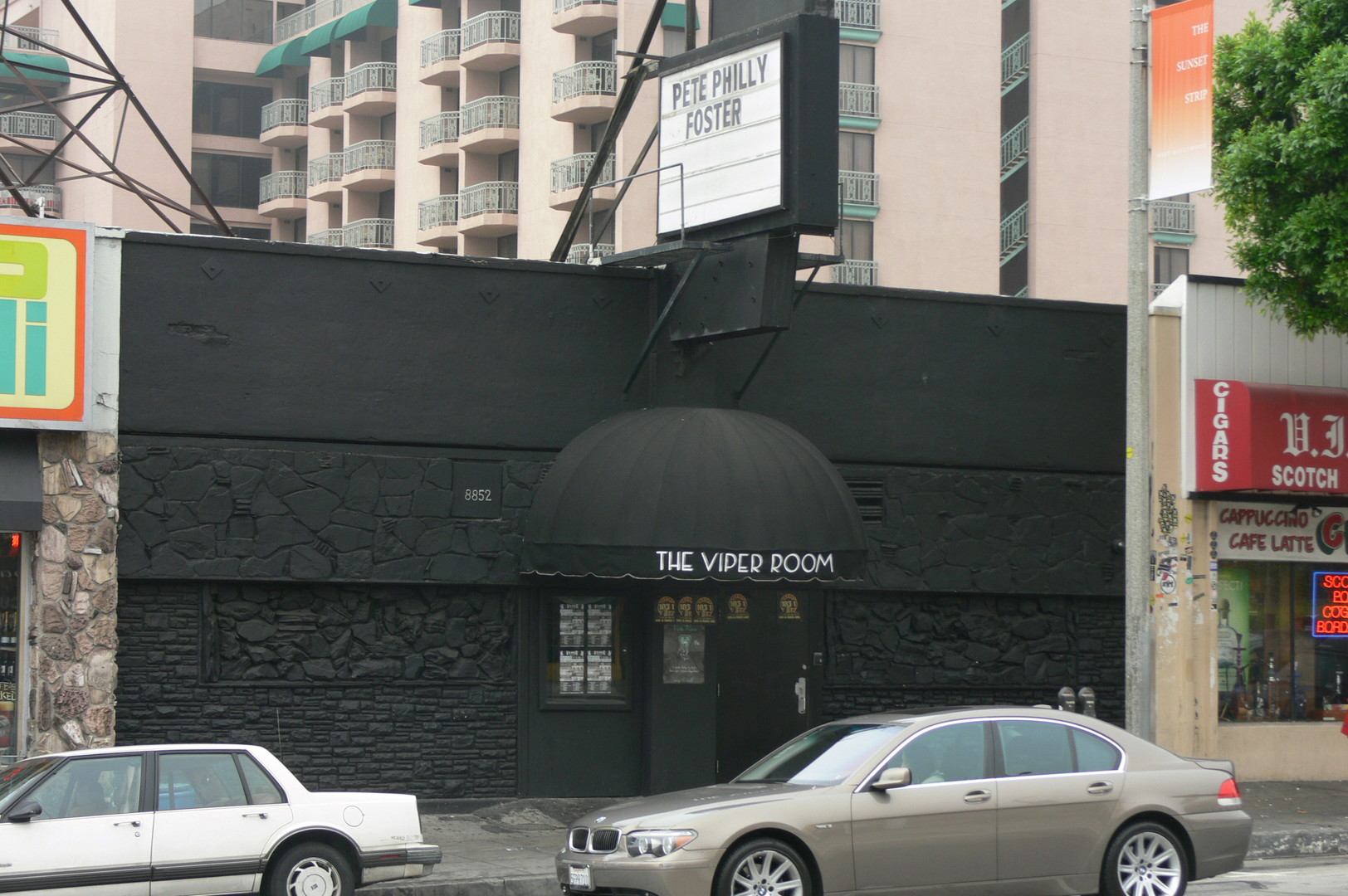
The Viper Room is a nightclub and live music venue located on the Sunset Strip in West Hollywood, California, United States. It was established under that name on August 14, 1993,[1] then co-owned by actors and 21 Jump Street co-stars Johnny Depp and Sal Jenco.[2] The Viper Room has undergone several changes in ownership. The latest owner is Viper Holdings, Ltd CEO James Cooper. It continues to host music of multiple genres, including metal, punk, and alternative rock. While predominantly known as a music venue, the Viper Room also has a lower level which is home to a large whiskey bar.

Key Information

The club became known as a hangout for the young Hollywood elite, and gained infamy for its drug-related incidents; actor River Phoenix had a fatal drug overdose in 1993, actor Jason Donovan suffered a drug-induced seizure in 1995 but survived, and singer Courtney Love survived an overdose in 1995 after Depp gave her CPR.[3] In 1997, singer Michael Hutchence played his last public performance in the Viper Room before taking his own life a week later.

History

[edit]

The location was originally a grocery store from 1921 into the 1940s. In the 1940s, it was converted into a nightclub called the "Cotton Club", entirely unrelated to the Harlem original. This was soon replaced by "The Greenwich Village Inn", the "Rue Angel" and finally "The Last Call" during the 1940s. From 1951 to 1969, the location was a bar called "The Melody Lounge". In 1969, it became "Filthy McNasty's".[4] and in the 1980s, a jazz club called "The Central".[5][6]

"The Central" was best known for its Tuesday jam nights where various well-known musicians such as Joe Cocker, Brian Setzer and Jeff Baxter performed and hung out along with others in the music industry.[7] It also hosted many local music acts such as Chuck E. Weiss who was frequently accompanied by the Goddamn Liars.[8] In 1993, the club was close to shutting down when Weiss suggested to Depp that he should revitalize the spot and rename it "The Viper Room".[9] Tom Waits also had a hand in redeveloping the spot.[10]

The venue

[edit]

Despite the death of River Phoenix the year the venue opened, the club became and remained a hangout for Hollywood's most popular young actors and musicians. Adam Duritz, the lead singer of Counting Crows, worked as a Viper Room bartender in late 1994 and early 1995 to escape his newfound fame.[11]

Ownership

[edit]

As part of the settlement of a lawsuit against Johnny Depp and four others, involving allegations of mismanagement of profits, Depp relinquished his ownership of the Viper Room in 2004.[12] The club changed hands multiple times between 2004 and 2016; the club is currently owned by Viper Room Holdings, Ltd. CEO James Cooper.[13][14]

Intellectual property and lawsuits

[edit]

A nightclub formerly called "The Viper Room" exists in Cincinnati. The club changed its name to "The Poison Room" on January 1, 2006, after they were told by the West Hollywood Viper Room to stop using the name.[15] Another "Viper Room" in Portland was also told to stop using the name under threat of a trademark lawsuit, with the Viper Room's former owner claiming that "every dollar they make is the result of using our name".[16] Abroad, there is also a legal brothel in Brisbane called "The Viper Room" and nightclubs boasting the name (or a similar one) in Harrogate, Sheffield, Stockholm, and Vienna.

Until February 2009, there was a nightclub with the same name in Melbourne; it was closed down due to a spate of violent incidents that included two shootings as well as license breaches and the arrest of a co-owner on drug charges.[17] On April 16, 2011, a nightclub named "The Viper Room" opened its doors in the city of Nijmegen in the Netherlands. The club is named after the club in Hollywood and is decorated in the same style as the American club.[18] In 2016, The Viper Room began issuing cease and desist notices to bootleg merchandise sellers on eBay and other online storefronts.

The original building where the club is currently located is slated to be demolished by 2024, to make way for a replacement club, retail and a five star hotel tower.[19][needs update]

Performers

[edit]

At Depp's request, Tom Petty and the Heartbreakers performed on the club's opening night.[20]

Johnny Cash performed at the venue, debuting material that would later appear on American Recordings (1994).[21] In 1997, the Viper Room was also a place of a few early solo live performances by John Frusciante at the time of his bad physical condition caused by drug abuse.

Other performers include Hot Mom, Avril Lavigne, Neurotic Outsiders (featuring Duff McKagan, Steve Jones and John Taylor), The Penfifteen Club, Keanu Reeves (who performed there with his band Dogstar in 1997), The Cult, Slash, X, Julliette and the Licks, Concrete Blonde, Green Day, Courtney Love, Hole, Joey Ramone, Tenacious D,[22] The Strokes,[23] and Cher.[24]

[edit]

See also

[edit]

References

[edit]
[edit]
Revisions and contributorsEdit on WikipediaRead on Wikipedia
from Grokipedia
The Viper Room is an iconic live and situated at 8852 West on the in . Opened on August 14, 1993, by actor along with partners including producer Sal Jenco and musician , the club quickly established itself as a premier destination, featuring intimate performances in a single-room setting that emphasized raw energy and celebrity allure. Its debut night headlined , setting a tone for hosting influential acts such as , , and throughout its history. The venue gained tragic notoriety just months after opening when actor died of a on October 31, 1993, collapsing outside the club during a performance by the band P, which featured members of the ; the incident, witnessed by Phoenix's siblings Joaquin and , amplified the Viper Room's reputation as a symbol of Hollywood excess and angst. Despite this shadow, the club endured as a cultural , with Depp selling his stake in 2004 and subsequent ownership passing to figures like restaurateur Harry Morton, who revitalized its programming in the . By 2018, the property was sold for $80 million to developers, sparking concerns over its future amid plans for mixed-use redevelopment on the . As of 2025, the Viper Room continues to operate as a 21-and-over venue, maintaining its focus on rock, indie, and emerging artists while navigating ongoing development proposals that include demolishing the original building to integrate a relocated club space into an 11-story project featuring a , apartments, and restaurants. This evolution underscores its lasting significance as a resilient hub of , blending historical grit with modern adaptability.

Venue Background

Architectural origins

The building at 8852 Sunset Boulevard, which later became home to The Viper Room, was constructed in 1921 as one of the earliest commercial structures on the . Originally designed to serve the residents of the nearby Sherman industrial village, it functioned primarily as a small neighborhood . Property records confirm the construction date, highlighting its status as among the oldest surviving buildings in the area amid the rapid urbanization of West Hollywood. Architecturally, the single-story edifice features a exterior typical of early 20th-century commercial buildings, paired with a flat roof that provided practical utility for the era's modest-scale developments. The interior underwent alterations and expansion around to accommodate growing commercial needs, though original details such as basic partitioning for retail display were retained. These elements reflect the straightforward, functional design suited to a burgeoning suburban outpost rather than ornate venues. From its opening as Young's Market in 1924, the site operated continuously as a grocery through the 1930s and into the early 1940s, evolving under chains like MacMarr Stores by 1932 and by 1942. This period aligned with the Sunset Strip's transformation from a dusty into a more developed commercial corridor, prompting the building's shift away from pure retail toward mixed light industrial and other retail uses by the mid-1940s. The structure's adaptability during this foundational phase laid the groundwork for its later repurposing, though it remained far removed from the entertainment hub it would become.

Pre-Viper Room history

In the mid-1940s, the site at 8852 was transformed from a into the , a that positioned itself as "Harlem in Hollywood" and served as a venue during the height of in the United States. Unrelated to the iconic establishment, this West Coast iteration catered primarily to white patrons while featuring live performances, contributing to the Sunset Strip's emerging role as a diverse destination amid Jim Crow-era restrictions; it was among the venues that helped break the color line by showcasing Black performers for integrated audiences in a time when such opportunities were limited. The club operated through the late 1940s before transitioning to other short-lived names like the Greenwich Village Inn and Rue Angel, reflecting the Strip's post-Prohibition boom in entertainment spots. A fire damaged the building on January 9, 1950, while it was operating as Rue Angel, causing approximately $10,000 in damage. It briefly became the strip club in September 1950 before closing in April 1951 due to new local ordinances. By 1951, the location had become the Melody Room (also known as the Melody Lounge), a cabaret-style venue run by brothers Pete and Billy Snyder that hosted a mix of and emerging rock acts through the , solidifying the site's place in the evolving rock 'n' roll scene on the . Performers included rock groups such as in the mid-1960s, drawing crowds eager for the blend of musical genres that defined the era's shift. The Melody Room endured for nearly two decades, fostering the Strip's transition from swing and to harder-edged rock sounds amid the broader cultural upheavals of the period. In the , the venue pivoted to rock-focused programming under the name Filthy McNasty's, opening in 1973 and becoming a hub for the Sunset Strip's burgeoning heavy metal and punk scenes, with owners including the club's namesake, Wilfried Bartsch (known as Filthy McNasty). This period coincided with the expansion of the local stand-up comedy scene, as nearby establishments like —founded in 1972 by —gained prominence, though the site itself emphasized live rock acts that attracted a rowdy, youthful crowd. By the , after a brief stint as The Central (a jazz-oriented spot with notable jam sessions), the location remained embedded in the Strip's notorious , where heavy metal bands and partygoers fueled an atmosphere of excess, including cocaine-fueled nights and high-stakes socializing that mirrored the era's decadence; Filthy McNasty's influence lingered into this decade before the site's 1993 rebranding.

Establishment and Operations

Founding and initial setup

The Viper Room was co-founded in 1993 by actor , his former co-star Sal Jenco, and musician , who acquired the lease for the venue at 8852 West in , transforming it into a dedicated live music space. Depp envisioned the spot as an intimate hub for rock performances, drawing on the Sunset Strip's legacy of music venues to create a raw, unpretentious atmosphere for artists and audiences alike. The club's name was suggested by musician to Depp during discussions about revitalizing the struggling location, with "Viper" referencing and 1930s jazz-era slang for marijuana users—known as "vipers" for the hissing sound of inhaling the substance—evoking a gritty, countercultural vibe tied to musical history. The interior was renovated with a focus on functionality for live shows, featuring a central stage and a simple bar setup to prioritize the music over elaborate design. The Viper Room officially opened on August 14, 1993, with a headline performance by , marking an energetic launch that drew immediate attention from the music scene. Initial programming emphasized , punk, and performances by both established acts and emerging talents, establishing the venue as a key spot on the for underground and mainstream crossover music.

Facilities and programming

The Viper Room maintains an intimate interior layout designed for close-up performances, with a capacity of approximately 250 patrons across its main floor, an elevated stage, bar areas, and an upstairs section offering additional seating and views. The venue includes a prominent downstairs whiskey bar and lounge space, fostering an atmosphere reminiscent of 1920s jazz clubs, while the overall structure has seen no major alterations since its 1993 opening, though redevelopment plans for a new mixed-use site including a relocated Viper Room have been proposed and advanced in the 2020s. Programming at the Viper Room centers on live music performances held most nights, featuring genres such as rock, punk, alternative, and emerging artists, alongside special events like product launches, shoots, and film-related gatherings. The venue enforces a 21+ entry policy, typically with cover charges varying by event, emphasizing its role as a premier music spot. Sound system enhancements, including installations of dBTechnologies VIO L208 line arrays in 2020 and VIO C12 loudspeakers in 2024, have improved audio quality for these ongoing shows. As of 2025, the Viper Room remains fully operational, with event bookings managed through its official website, viperroom.com, and offerings that include a curated whiskey selection at the downstairs bar alongside merchandise sales such as apparel and memorabilia. The venue hosts a steady stream of concerts and themed nights, adapting to contemporary demands while preserving its legacy as an accessible live music hub on the .

Ownership transitions

The Viper Room was co-owned by actor , his former co-star Sal Jenco, and Anthony Fox, among others, from its opening in 1993 until Depp's departure in 2004. In 2004, Depp transferred his stake to the daughter of Anthony Fox amid a Fox had filed in 1999 accusing Depp of diverting millions in club profits; Fox disappeared in 2001. Following Depp's departure, ownership transitioned through several parties between 2004 and 2016, reflecting the venue's turbulent financial history. In 2004, Blackhawk Capital Partners reportedly acquired the club from Fox's estate. The property later passed to restaurateur Harry Morton in , who became the majority owner and focused on maintaining its live music programming while expanding his hospitality portfolio. Ownership changed hands several times during this period, driven by operational challenges and market shifts on the . In 2016, Viper Room Holdings, Ltd., under CEO James Cooper, purchased the venue, prioritizing the preservation of its cultural status amid growing development pressures in West Hollywood. Under Cooper's leadership, the focus shifted toward sustainable operations while navigating proposals for site redevelopment. In 2022, the owners secured a $62 million construction loan to explore transforming the property into a mixed-use complex featuring a hotel, residential units, retail, and a reimagined Viper Room club. However, as of November 2025, the redevelopment plans have encountered significant delays, including a near-foreclosure in early 2025 that was averted by a $71 million refinancing from Centennial Bank and Crestline Investors in July; the original Viper Room continues to operate as a live music venue.

Intellectual property disputes

The 'Viper Room' name was first used in commerce on August 14, 1993. The trademark was registered on August 12, 2008, by Viper Room IP Holdings, Inc., for entertainment services, with first use dated August 14, 1993. This registration, covering categories including restaurant and bar services, as well as live performances, was later managed by Viper Room IP Holdings, Inc. Early disputes arose in the 1990s as other venues adopted similar branding; a nightclub in Cincinnati, Ohio, operated under the name "The Viper Room" starting around 1994 but rebranded to "The Poison Room" in 2006 following pressure from the Los Angeles owners to cease use of the mark. Similarly, a Portland, Oregon, club faced trademark infringement claims, leading to a lawsuit filed by the Viper Room against its operators (doing business as Black Square Pants) for dilution and confusion in the entertainment services sector. In the 2000s, internal conflicts over the Viper Room's intensified, culminating in a 2004 lawsuit between Depp and co-owner Anthony Fox, who alleged mismanagement and diversion of profits, including disputes over licensing fees charged by a related entity, , to the operating company. The litigation, which also involved Sal Jenco, centered on ownership of the "Viper Room" and led to Depp relinquishing his stake in the club. Successful outcomes preserved U.S. exclusivity, with courts granting injunctions against unauthorized uses and affirming the original 's priority. During the 2000s and 2010s, the Viper Room pursued actions against international imitators, issuing cease-and-desist letters to venues in locations including and the that mimicked its branding for operations. In , Viper Room IP Holdings enforced its rights domestically by targeting bootleg merchandise sellers on platforms like , resulting in takedown notices for unauthorized apparel and memorabilia exploiting the club's fame. These efforts, including U.S. Trademark Registration No. 3483878 for the stylized mark, underscore ongoing global enforcement by Viper Holdings to maintain against copycats.

Notable Incidents

River Phoenix overdose

On October 31, 1993—Halloween night—23-year-old actor collapsed on the sidewalk outside The Viper Room nightclub on the in , following a speedball overdose involving and . Phoenix had arrived at the club earlier in the evening with his brother , girlfriend , and other friends, including Red Hot Chili Peppers bassist , where he appeared to be in distress inside before being led out to the adjacent parking area. He suffered severe seizures and lost consciousness around 1:00 a.m., prompting Joaquin to call 911 as bystanders attempted to assist. Paramedics arrived quickly and found Phoenix in full cardiac arrest with no pulse or blood pressure; he was transported to approximately two miles away, where resuscitation efforts failed, and he was pronounced dead at 1:51 a.m. The death certificate was issued the following day, November 1, 1993. Initial reports noted possible involvement of Valium or other sedatives based on the 911 call, but toxicological testing later clarified the substances. The Los Angeles County coroner's autopsy, performed on November 1 and with toxicology results released on November 13, confirmed the cause as acute multiple drug intoxication due to lethal concentrations of and (a of ) in Phoenix's system, alongside lower levels of Valium, marijuana, and from an over-the-counter medication. No needle marks or signs of injection were found, indicating the drugs were likely snorted or ingested, and the death was ruled accidental with no evidence of foul play. The investigation concluded similarly, leading to no criminal charges against anyone present or associated with the club. In the immediate aftermath, The Viper Room—opened just months earlier in August 1993—was voluntarily closed for one week out of respect for Phoenix and his family, reopening on November 8 amid a media frenzy that included fan vigils with flowers and candles at the site. The intense coverage amplified the club's reputation as a Hollywood hotspot for excess, drawing crowds of mourners, tourists, and reporters to the scene. In 1995, Australian actor and singer suffered a cocaine-induced inside The Viper Room during a party celebrating Kate Moss's 21st birthday, hosted by ; he collapsed on the dance floor and was rushed to , where he recovered after treatment. Later that same year, musician experienced a outside the venue, prompting Depp to perform CPR on her until paramedics arrived; Love survived the incident and later publicly credited Depp with saving her life. Throughout the and , The Viper Room maintained its association with Hollywood's , attracting patrons linked to substance-related arrests and incidents, though specific high-profile cases at the venue itself became less documented compared to the 1990s. The club's reputation for facilitating a scene of excess persisted into the , even as ownership changes and rumored security enhancements aimed to modernize operations, underscoring its enduring legacy as a site of 1990s-style nightlife risks. No fatal drug overdoses were reported at or near the venue following the high-profile events of the mid-1990s.

Entertainment Legacy

Key performers

The Viper Room has served as a pivotal intimate venue for rock and alternative music acts since its 1993 opening, hosting over 100 notable performers who leveraged its 250-person capacity for raw, career-defining shows that often showcased emerging talents or marked turning points for established artists. In the 1990s, the club quickly established itself as a Sunset Strip hotspot for influential rock performances, beginning with Tom Petty and the Heartbreakers headlining the opening night on August 14, 1993, which drew a star-studded crowd and set the tone for the venue's rock legacy. Johnny Cash's acoustic set on December 3, 1993, was a landmark event, featuring solo guitar performances of tracks like "Tennessee Stud" and "The Man Who Couldn't Cry" that were later included on his 1994 album American Recordings, revitalizing his career during a period of commercial decline. The venue's small stage favored such unplugged sessions, allowing artists like Oasis to deliver a surprise 1995 show after mingling with owner Johnny Depp, and Green Day to perform in 1997 as "The Nimrods," blending hits with covers to connect with fans in an up-close setting. John Frusciante's solo appearance on January 20, 1997, during his hiatus from the Red Hot Chili Peppers, highlighted experimental tracks from Niandra LaDes and Usually Just a T-Shirt, underscoring the club's role in nurturing personal artistic explorations. Keanu Reeves' band Dogstar also played multiple times in the late 1990s, including a 1997 gig that blended post-grunge with the actor's rising fame, attracting celebrity audiences while honing the group's live dynamic. The 2000s and 2010s saw the Viper Room continue to launch and alternative careers, with making her U.S. live debut on June 13, 2002, performing early cuts from Let Go like "Complicated" to a packed house, helping propel her from Canadian newcomer to global star. Queens of the Stone Age returned for a surprise 2005 set during their tour, delivering a 40-minute, 10-song performance of staples that reinforced the venue's appeal for unannounced, high-energy rock outings. Dogstar's sporadic appearances extended into the 2000s, including a 2002 show, providing Reeves and bandmates a low-pressure space to evolve their sound amid Hollywood scrutiny. In the 2020s, the Viper Room has sustained its reputation for drawing provocative and emerging acts, exemplified by joining James Hall onstage on October 23, 2025, for acoustic renditions of "You Want Love" and "So Precious," marking a rare collaborative appearance amid the artist's ongoing controversies and the venue's enduring draw for . The club has also hosted numerous indie and alternative up-and-comers, maintaining its function as a launchpad for artists seeking intimate exposure in an era of larger arenas.

Cultural significance

The Viper Room has left an indelible mark on , particularly as a symbol of the rock and scene's hedonistic underbelly, where celebrity excess and musical innovation intersected on the . Its notoriety was amplified by the tragic death of outside the venue in 1993, an event that galvanized public discourse on Hollywood's and contributed to broader anti-drug awareness efforts, including campaigns highlighting the perils of among young stars. This incident, combined with the club's raw, intimate atmosphere, cemented its status as a cultural touchstone for the era's blend of glamour and peril, often referenced in media retrospectives on nightlife. In film and television, the Viper Room has served as a recurring backdrop, embodying the gritty allure of West Hollywood. It appeared in the 2005 crime comedy , directed by , where it hosted key scenes amid the story's music industry intrigue. The venue was also featured in episodes of the paranormal series , notably a 2017 investigation exploring its haunted reputation tied to historical tragedies. More recently, it starred in the 2019 for Ed Sheeran's "Blow," featuring and , which depicted an all-female rock band performing on its stage, flipping gender norms in a nod to the club's rock heritage. These portrayals have perpetuated its image as a nexus of fame, rebellion, and mystery in visual media. Documentaries and journalistic features have further enshrined the Viper Room in Sunset Strip lore, portraying it as a pivotal site in the evolution of Los Angeles rock culture. The 2012 film Sunset Strip, directed by Hans Fjellestad, chronicles the boulevard's musical history, with the Viper Room highlighted as a modern anchor amid tales of excess and innovation. A 2018 LA Weekly article marking the club's 25th anniversary reflected on its role in launching alternative acts and surviving scandals, underscoring its resilience as a live music hub. In 2023, a Los Angeles magazine retrospective delved into its 1990s dominance, featuring anecdotes from insiders that illustrated its influence on intimate venue programming. Beyond direct representations, the Viper Room's legacy extends to inspiring a wave of smaller, artist-focused nightspots that prioritize raw performances over spectacle, echoing its jazz club aesthetic adapted for contemporary rock. As of 2025, despite ongoing pressures—including a proposed mixed-use high-rise that threatened demolition—the venue endures as a preserved cultural landmark, with plans to relocate and revitalize it within a new structure, ensuring its continued role in West Hollywood's entertainment ecosystem. This evolution reflects its broader impact: a blueprint for venues blending historical grit with modern viability.

References

Add your contribution
Related Hubs
User Avatar
No comments yet.