Hubbry Logo
Theme of ExodusTheme of ExodusMain
Open search
Theme of Exodus
Community hub
Theme of Exodus
logo
7 pages, 0 posts
0 subscribers
Be the first to start a discussion here.
Theme of Exodus
Theme of Exodus
from Wikipedia
"Theme of Exodus"
Single by Ernest Gold
from the album Exodus
B-side"Summer In Cyprus"
Released1960
GenreEpic, film score
Length2:45
LabelRCA Victor
SongwriterErnest Gold
ProducerErnest Gold
"Theme of Exodus"
Single by Ferrante & Teicher
from the album Golden Piano Hits
B-side"Twilight"
ReleasedOctober 1960
GenreEasy listening, film score
Length2:54
LabelUnited Artists
SongwriterErnest Gold
ProducerDon Costa
Ferrante & Teicher singles chronology
"Theme from The Apartment"
(1960)
"Theme of Exodus"
(1960)
"Love Theme from One Eyed Jack"
(1961)

"Theme of Exodus", also known as "This land is mine" through its chorus, is a song composed and performed by Ernest Gold. It serves as the main theme song to Otto Preminger's epic film Exodus, based on the 1958 novel of the same name by Leon Uris, which tells the story of founding of the modern State of Israel.[1][2]

The song was released on the soundtrack album for the picture. All music was written by Gold, who won both Best Soundtrack Album and Song of the Year at the 1961 Grammy Awards for the soundtrack and theme to Exodus respectively.[3] It is the only instrumental song to ever receive that award.[citation needed]

Following its initial film appearance, the theme has been recorded by many artists in both instrumental and vocal versions, and has also appeared in a number of subsequent films and television programs. The best-known cover version of the theme is an instrumental version.[citation needed] This version was accompanied by the Sinfonia of London orchestra.[citation needed] Bob Marley incorporated portions of the theme into his song "Exodus".[4]

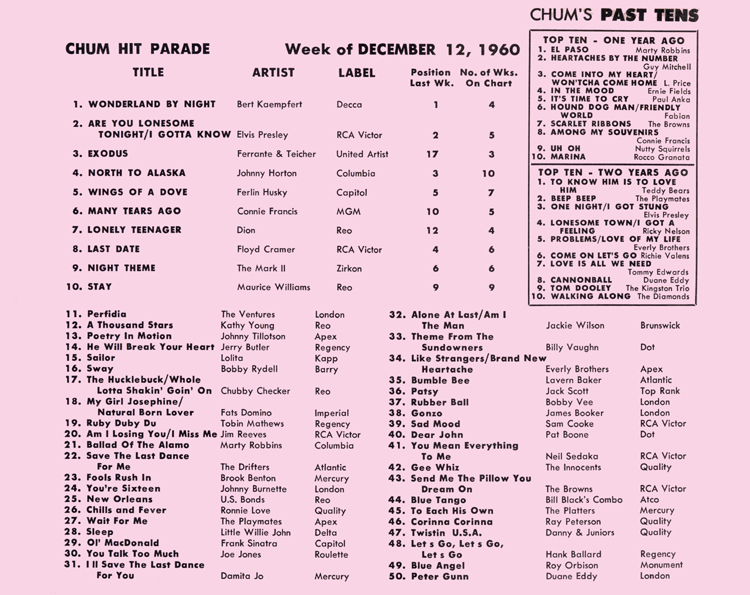
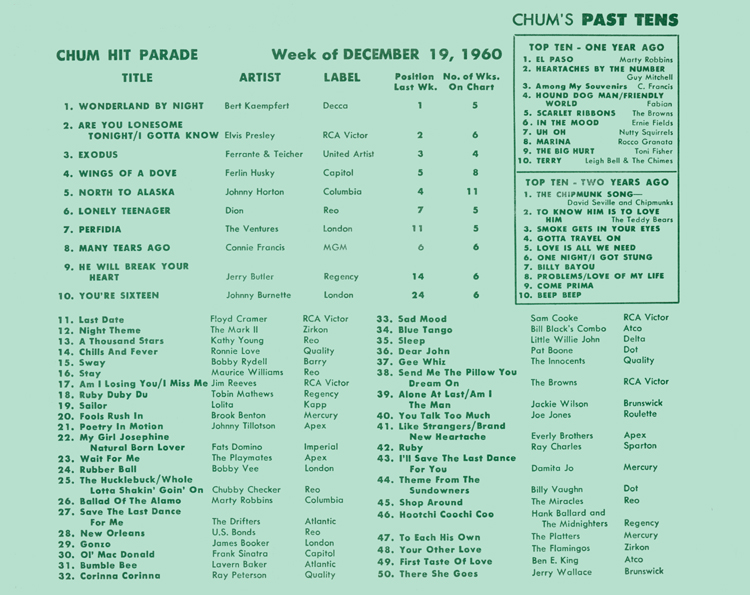
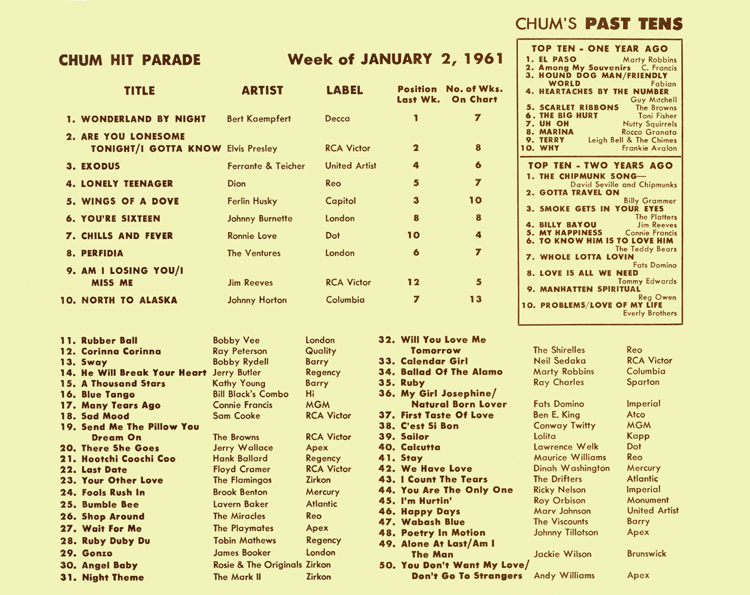
An instrumental version of the song by Ferrante & Teicher made No. 3 in Canada in December 1960,[5][6][7] No. 1 on the Cashbox Top 100 and No. 2 on the Billboard Hot 100 in January 1961,[8] No. 6 in the UK in April 1961[9] and No. 2 on the Australian Kent Music Report charts also in April 1961.[10] It reached No. 1 in New Zealand.[11]

A jazz version by Eddie Harris hit the pop and R&B charts in 1961. There is a doowop group vocal version of the song on The Duprees' 1963 album, Have You Heard.

Swedish pop band the Hounds released a cover of "Theme of Exodus", retitled "Exodus".[12] Initially released by record label Gazell on 14 July 1966 with "Sloop John B" as the B-side, it was re-issued on 6 October 1966 with "A Car, A Boat, A House, A Girl Like You" on the B-side.[13] Their rendition reached No. 3 on Tio i Topp and No. 11 on Kvällstoppen in Sweden,[14][15] becoming their first major hit single.[12]

References

[edit]
Revisions and contributorsEdit on WikipediaRead on Wikipedia
from Grokipedia
The theme of Exodus constitutes a core narrative motif in the , centered on the ' emancipation from Egyptian enslavement under ' guidance, marked by divine plagues, the crossing, the Sinai covenant including the Decalogue, and forty years of desert peregrinations toward . This account, spanning Exodus chapters 1–18 for the departure and 19–40 for the and , underscores motifs of redemption from , Yahweh's supremacy over pharaonic powers, and the formation of a priestly nation through law and ritual. Theologically, it exemplifies causal divine agency in historical rupture, fulfilling patriarchal promises amid empirical adversity like forced labor demographics in the , though textual composition likely amalgamates oral traditions from the late second millennium BCE onward. Beyond scriptural bounds, the motif recurs in prophetic literature as a for eschatological restoration and permeates intertestamental, , and later religious exegeses, analogizing spiritual deliverance—yet its invocation in modern liberation ideologies and territorial disputations often amplifies interpretive variances, with academic questioning mass-migration feasibility due to scant extrabiblical artifacts or Egyptian records. Scholarly analyses, frequently shaped by methodological naturalism in secular institutions, prioritize etiological functions over literal chronology, positing redactional layers from monarchic or exilic eras to forge communal identity amid geopolitical flux.

Origins and Composition

Development for the Film Exodus

Otto Preminger selected to compose the score for his 1960 epic film Exodus at the outset of production, departing from the conventional practice of engaging composers post-editing. This early involvement afforded Gold an extended preparatory phase, enabling immersion in the project's thematic and cultural elements prior to . Gold conducted fieldwork in and from April to June, documenting motifs from Israeli folk music and traditions to inform an authentic sound palette; he amassed a folder of notes approximately 1.5 to 2 inches thick. Returning to , he composed roughly 1.5 hours of music over four weeks, with handled by Gerard Schurmann. During this period, Gold generated 33 distinct themes, though only six were ultimately incorporated into the film. The principal "Theme of Exodus" emerged as the 33rd composition, conceived casually after exhausting initial ideas, as had surplus time on the project. This theme synthesized elements from prior motifs, undergoing over 18 days of iterative revisions to refine its structure and emotional resonance. Preminger's on-site adjustments during the recording sessions with the Sinfonia of London enhanced its dramatic efficacy, overriding Gold's initial reservations. The resulting piece, devoid of lyrics at the film's , underscored the narrative's themes of struggle and hope in the establishment of modern .

Ernest Gold's Background and Creative Process

Ernest Gold, born Ernst Siegmund Goldner on July 13, 1921, in Vienna, Austria, grew up in a secular Jewish family with musical influences, as his family included professional musicians. A child prodigy, he began composing short pieces at age five, wrote his first song at eight, and completed a full-length opera by age thirteen. He studied piano, violin, and composition at the Vienna State Academy of Music starting at age six but interrupted his studies in 1938 following the Nazi annexation of Austria, emigrating to New York City later that year to escape persecution. In the United States, initially worked as a accompanist and songwriter in New York before moving to Hollywood in 1946, where he began as an orchestrator and conductor on low-budget films. He composed nearly 100 scores for films and television between 1945 and 1992, collaborating frequently with producer on nine projects, including On the Beach (1959), which earned an Academy Award nomination. His style often featured sweeping, emotional melodies suited to epic dramas, drawing from his classical training and European roots. For the 1960 film Exodus, directed by and depicting the post-World War II struggle for 's founding, Gold was hired early in production. He conducted extensive research from April to June in and , immersing himself in local Israeli and folk music to inform an authentic pseudo-Hebraic sound, amassing a thick folder of melodic notes and motifs. This fieldwork shaped the score's ethnic flavor, blending modal scales and rhythms evocative of the region's musical traditions without direct quotation. Gold's composition process yielded 33 distinct themes, though only six were ultimately used in the film; he spent 18 days refining the main theme alone. The iconic "Theme of Exodus," an instrumental melody in a minor key with a rising, resolute contour, emerged as the 33rd theme, composed as an afterthought when he had extra time: "I wrote simply because I had more time and nothing to do," Gold recalled, noting it synthesized small motives from his earlier sketches into the score's emotional core. He sketched core material by , 1960, completing about 1.5 hours of music over four weeks, with orchestrations handled by Schurmann to evoke vastness through strings and brass. Gold later expressed surprise at its popular resonance, deeming it "too serious and too longhair for popular appeal." The theme's variations underpin the film's 220-minute runtime, underscoring themes of struggle and hope.

Musical Structure and Style

Key Elements of the Melody and Orchestration

The primary melody of the Exodus theme, composed by Ernest Gold, exhibits a majestic and inspirational character, structured around an A phrase delivered with lush strings and contrapuntal French horns, followed by a B phrase featuring strings in a sofferenza (suffering) style alongside continued horn counterpoint to convey emotional struggle and spiritual depth. This horn-rich, string-laden motif builds a sense of hope amid tension, often introduced in the film's prelude as a preview of unfolding narrative resolve. Integral to the score is the Jewish theme, a poignant five-note ostinato rendered with brilliant simplicity; it cycles without achieving full resolution, evoking the persistent historical longing and unresolved plight of the Jewish people. In orchestration, Gold employed a traditional Western symphony orchestra, as mandated by director , with the original recording performed by the Sinfonia of London to achieve broad emotional sweep. The main theme opens with a haunting melody entrusted to strings for intimate expressiveness, progressively layered with woodwinds and sections to expand into a rich, textured fullness that underscores dramatic intensity. For cultural authenticity, selective ethnic instrumentation includes bongos and for rhythmic propulsion, alongside and treble recorder to infuse Middle Eastern inflections without overpowering the symphonic core. French horns provide contrapuntal support throughout the primary motifs, while tremolo strings and woodwinds accentuate subsidiary themes, such as the stark six-note figure, ensuring dynamic contrast across cues.

Comparisons to Other Film Scores

The main theme from Exodus, composed by , shares melodic and emotional contours with Miklós Rózsa's score for the 1959 epic Ben-Hur, particularly in the tender, ascending phrases evoking Jewish heritage and personal struggle, as noted in analyses of both works' lyrical . Rózsa's theme for the character , featuring a rising fourth followed by expansive intervals and lush string , parallels the Exodus theme's noble A phrase (forthright and heroic via six French horns) and B phrase (introspective and anguished), both drawing on symphonic traditions to underscore resilience amid historical turmoil. This similarity reflects a shared stylistic lineage in late-1950s Hollywood biblical epics, where composers employed Western orchestras augmented with subtle ethnic timbres—such as Rózsa's glissandi for Hebraic flavor versus Gold's and for Mediterranean authenticity—to blend universality with cultural specificity. In contrast to more rhythmically driven scores like Alex North's for Spartacus (1960), which competed against Exodus for the Academy Award for Best Original Score and emphasized percussive intensity for gladiatorial action, Gold's work prioritizes melodic synthesis and thematic interplay across seven distinct motifs (e.g., Ari's trumpet-led march and the Cyprus dance's exotic pulse), fostering emotional cohesion over spectacle. This approach aligns Exodus with Rózsa's leitmotif-driven structure in Ben-Hur, where recurring themes transform to mirror narrative arcs, rather than the motif-sparse, atmospheric minimalism emerging in later scores like Maurice Jarre's for Lawrence of Arabia (1962), which favored modal ambiguity and solo instrumentation for desert vastness. Gold's orchestration, insisting on a full symphony sans overt exoticism per director Otto Preminger's directive, thus positions Exodus as a bridge between golden-age romanticism and the transitional modernism of the early 1960s, its enduring simplicity amplifying thematic impact without reliance on complex counterpoint.

Awards and Commercial Success

Academy and Grammy Recognition

Ernest Gold's score for the 1960 film Exodus, which prominently features the "Theme of Exodus," earned the Academy Award for Best Scoring of a Dramatic or Comedy Picture at the 33rd Academy Awards on April 17, 1961. The award recognized the full orchestral score's dramatic intensity and thematic cohesion, outperforming nominees such as Dimitri Tiomkin's work for The Alamo, André Previn's for Elmer Gantry, Elmer Bernstein's for The Magnificent Seven, and Alex North's for Spartacus. This victory marked Gold's sole Oscar win, following prior nominations for films like On the Beach (1959). At the in 1961, the "Theme from Exodus"—an composition by —won Song of the Year, an typically reserved for vocal works but awarded here for its evocative melody and cultural resonance as a songwriter's achievement. The also secured the Grammy for Best Sound Track Album or Best Sound Track – Original or Sound Track – From Motion Picture or Television, highlighting the theme's commercial viability and orchestral execution by the Sinfonia of London under Gold's direction. These wins underscored the theme's instrumental prominence without lyrics at the time, distinguishing it from vocal adaptations that followed. No further or Grammy nominations were recorded for the theme itself, though the score's influence persisted in subsequent film music discussions.

Chart Performance and Sales

The instrumental "Theme of Exodus," composed and conducted by for the 1960 film Exodus, peaked at number 2 on the chart in January 1961, marking a major commercial breakthrough for an original film score track. This position reflected its broad appeal beyond theatrical audiences, driven by radio play and RCA Victor's single release. The full Exodus soundtrack album, also by Gold and released by RCA Victor in late , ascended to number 1 on the Top LPs chart on January 23, 1961, where it held the top spot for four weeks. The album's success was bolstered by the title track's prominence and the film's critical acclaim, contributing to over 500,000 units shipped in the United States as implied by contemporaneous gold-level benchmarks for similar hits, though no formal was issued for the original release. Subsequent reissues and compilations, such as MCA Classics editions in the , sustained modest catalog sales, but primary commercial metrics remain tied to the early 1960s peaks without detailed global sales breakdowns available from primary industry records.

Instrumental Recordings

The original recording of the "Theme from Exodus" was composed and conducted by with the Sinfonia of orchestra for the 1960 film soundtrack, released by RCA Victor as part of the album Exodus - An Original Soundtrack Recording. This version features a sweeping orchestral emphasizing strings and brass to evoke the film's themes of struggle and triumph, and it earned Gold the Grammy Award for Song of the Year in 1961—the only composition to achieve this distinction—as well as Best . Among subsequent instrumental covers, the most commercially successful was by the piano duo , whose version—arranged with dual pianos and orchestral backing—entered the on November 14, 1960, peaked at number 2 for one week on January 23, 1961, and remained on the chart for 21 weeks total, also reaching number 1 on the Cash Box Top 100. Their rendition, produced by , highlighted the melody's lyrical quality through intricate piano interplay, contributing to its broad appeal in easy-listening formats. Other notable instrumental interpretations include orchestral versions by and His Orchestra, which employed signature cascading strings for a lush, romantic texture; the London Philharmonic Orchestra's rendition emphasizing dramatic swells; and Si Zentner and His Orchestra's brass-heavy adaptation released in 1965. Jazz-inflected covers, such as saxophonist Eddie Harris's improvisational take, further diversified the theme's instrumental legacy, while organist Grant offered a variation in 1961. These recordings, often released as singles or album tracks in the early 1960s, underscored the theme's versatility across classical, pop-orchestral, and genres, with many appearing on compilation albums of film scores and easy-listening hits.

Addition of Lyrics and Vocal Hits

The instrumental "Theme of Exodus" composed by for the 1960 film was first adapted into a vocal piece through lyrics written by , resulting in "The Exodus Song (This Land Is Mine)". Boone's English lyrics, which emphasize a biblical claim to the land—"This land is mine, God gave this land to me"—were added to Gold's melody to evoke themes of inheritance and struggle central to the film's narrative. Boone's recording, the earliest vocal version, was released as a single on January 23, 1961, by and entered the , maintaining a chart presence for six weeks. This adaptation transformed the orchestral theme into a pop-oriented hit, broadening its appeal beyond film audiences and establishing it as a standalone song in American music charts. Subsequent vocal renditions amplified its commercial success, including ' version from his 1962 album Moon River and Other Great Movie Themes, which featured a smooth, orchestral arrangement and contributed to the song's enduring radio play. Other artists such as , , and also recorded Boone's lyrically enhanced take, with these covers appearing in various compilations and reinforcing the theme's vocal legacy through diverse stylistic interpretations. In 2012, animator created an alternative lyrical version for her project, overlaying new words onto the melody to critique cycles of , though this did not achieve mainstream chart success and diverged from the original's assertive tone. These vocal additions collectively shifted the piece from cinematic to a culturally resonant , with Boone's providing the foundational text for most hit iterations.

Cultural and Historical Impact

Role in Shaping Perceptions of Israel's Founding

The instrumental Theme of Exodus, composed by Ernest Gold for the 1960 film Exodus, became a powerful auditory symbol of the Zionist struggle leading to Israel's establishment in 1948, evoking images of Jewish refugees defying British mandates and Arab opposition to achieve statehood. The film's narrative, drawn from Leon Uris's 1958 novel, dramatized events like the 1947 Exodus ship incident involving 4,500 Holocaust survivors intercepted by British forces, framing Israel's founding as a triumphant liberation akin to the biblical Exodus. Gold's score, with its soaring strings and horn motifs reminiscent of a shofar, underscored scenes of resolve and victory, such as refugees rallying for aliyah (immigration to Palestine), thereby associating the melody indelibly with themes of perseverance and divine entitlement to the land. This musical motif rapidly permeated Western cultural consciousness, peaking in popularity after the film's release on December 15, 1960, and Gold's Academy Award win for Best Original Score on April 9, 1961, which amplified its reach through radio broadcasts and orchestral performances. , where the film grossed over $20 million domestically, the theme influenced public sentiment by romanticizing the 's guerrilla tactics and the 1948 Arab-Israeli War as a moral crusade against and annihilation, shaping a narrative that emphasized Jewish agency over partition complexities outlined in UN Resolution 181 (November 29, 1947). American Jewish organizations and diaspora communities adopted it for fundraising and advocacy events, reinforcing perceptions of Israel's birth as an inevitable redemption from diaspora vulnerability rather than a contested colonial enterprise. The theme's adaptation into vocal versions, notably Pat Boone's 1961 rendition with lyrics "This land is mine, God gave this land to me," further entrenched a providential interpretation of Israel's founding, aligning it with biblical claims in Genesis 15:18–21 and portraying the 1948 events as fulfillment of ancient promises amid post-Holocaust urgency. This lyrical framing, which sold millions and topped charts in multiple countries, countered contemporaneous Arab narratives of Nakba (catastrophe) displacement affecting 700,000 Palestinians by prioritizing Jewish historical trauma and self-determination, thus tilting international discourse toward sympathy for Israel during its early statehood phase. While critics later argued the score propagated a selective Zionist historiography—omitting intra-Jewish debates over partition acceptance and Arab agency—its emotional resonance endured, evidenced by persistent use in documentaries and memorials framing 1948 as heroic genesis.

Usage in Jewish and Zionist Contexts

The "Theme of Exodus," composed by for the 1960 film depicting the establishment of the State of Israel, has been widely adopted in Jewish communal events symbolizing the return to and national rebirth. In Jewish communities, it is frequently performed at celebrations of Israel's Independence Day, known as Yom HaAtzmaut, which commemorates the declaration of independence on May 14, 1948. For instance, radio broadcasts and community gatherings dedicated to Yom HaAtzmaut have featured the theme alongside other Israeli anthems like "." In Reform synagogues, the piece, often with lyrics adapted as "This Land Is Mine" ("This land is mine; God gave this land to me"), is sung during processions (hakkafot), linking the biblical Exodus narrative to modern Zionist fulfillment. Zionist-oriented events, such as annual Israel Day concerts in New York City's following the Israel Day Parade, regularly include renditions by performers emphasizing Jewish historical claims to the land, with audiences numbering in the tens of thousands. These performances underscore the theme's role in reinforcing Zionist narratives of perseverance and sovereignty amid post-Holocaust Jewish state-building. The melody's instrumental form evokes the film's portrayal of Jewish immigrants' struggles against British mandates and Arab opposition, resonating in contexts like community center tributes to Jewish composers or wartime remembrances tied to Israel's defense. Its enduring presence in these settings, from the onward, stems from the film's commercial success and Oscar-winning score, which amplified sympathy for Zionist aspirations in Western audiences.

Controversies and Critical Reception

Opposition from Arab States and Boycotts

The production and release of the 1960 film Exodus, including its acclaimed theme composed by , encountered anticipated and actual resistance from states due to the project's perceived promotion of Zionist narratives surrounding Israel's establishment. , who produced and directed independently to circumvent studio hesitations, navigated concerns over potential economic repercussions in markets, where the film's sympathetic depiction of Jewish statehood clashed with prevailing opposition to partition and the 1948 war outcomes. This independent approach minimized the impact of any boycott, as major studios like had earlier demurred on Uris's original script citing fears of backlash against its handling of Jewish- conflicts. The broader context involved the Arab League's longstanding of , initiated in 1945 and encompassing secondary sanctions against entities facilitating trade, investment, or cultural exchanges with the . This framework extended to media products; films utilizing Israeli locations—as Exodus did extensively—or endorsing narratives of Jewish immigration and independence were effectively barred from distribution in League member states, including , , and . Producers incorporated feedback from Arab sources during scripting to temper portrayals, yet the final product retained elements viewed as propagandistic, such as idealized operations and limited agency for Arab characters, prompting diplomatic murmurs and non-distribution rather than formal bans in most cases. The theme's instrumental version, which earned Gold an Academy Award for Best Original Score on April 9, 1961, and later vocal adaptations like Pat Boone's 1961 rendition, faced similar exclusion from Arab airwaves and performances under cultural protocols, associating the melody with Israeli symbolism. No widespread recordings or broadcasts occurred in the region during the , reflecting state-controlled media's alignment with anti-Zionist stances; for instance, Egyptian radio and Lebanese outlets avoided programming linked to the film amid heightened sensitivities post-1948 and 1956 . This opposition underscored causal tensions: the soundtrack's evocation of resilience and homeland claim directly countered Arab states' rejection of refugee ships like Exodus 1947 vessel, intercepted and returned by British forces under pressure from regional actors.

Modern Satirical Uses and Debates

In 2012, animator produced "This Land Is Mine," a three-minute short parodying the "This Land Is Mine" from the 1960 Exodus. The video features a lone character morphing through historical figures—including Canaanites, , Romans, Crusaders, and modern and —each claiming divine or historical right to the land amid cycles of violence and displacement. Paley described it as a commentary on the futility of exclusive territorial claims in the region. The explicitly references the original 's while subverting its Zionist undertones to highlight perpetual conflict rather than triumphant return. The short achieved viral status, amassing millions of views, particularly during flare-ups in the Israeli-Palestinian conflict, such as the , when it was shared widely on as a succinct critique of and mutual victimhood narratives. Paley integrated an expanded version into her 2018 animated feature , a broader satirical retelling of the and from a feminist perspective, portraying the Hebrew as a domineering patriarch and emphasizing matriarchal alternatives in ancient mythology. The film uses musical numbers, including Exodus-inspired sequences, to question authoritarian religious structures underlying territorial disputes. These works have fueled debates over their portrayal of Jewish history and the Israeli-Palestinian conflict. Supporters, including some progressive Jewish audiences, praise the animations for advocating shared stewardship of the land and challenging dogmatic interpretations of biblical narratives. Critics, however, argue that the satire equates aggressors and victims across eras, downplaying specific historical contexts like Jewish indigenous ties or Arab rejectionism, and potentially reinforcing anti-Zionist tropes amid ongoing security threats to . Paley's self-identification as culturally Jewish but critical of religious has led to accusations of internalized bias, though she maintains the intent is anti-war rather than partisan. Reception varies by source ideology, with left-leaning outlets often highlighting its message while conservative commentators view it as ahistorical provocation. Beyond Paley's contributions, sporadic satirical references to theme appear in online discourse and media critiquing migration policies or land disputes, but none have matched its cultural footprint. For instance, during U.S. debates on , parallels to the biblical Exodus have been invoked satirically to mock selective historical analogies in political , though these lack the song's direct . Overall, modern satires leveraging the Exodus motif underscore tensions between its inspirational role in and perceptions of it as exclusionary in Palestinian narratives.

References

Add your contribution
Related Hubs
User Avatar
No comments yet.