Recent from talks
Contribute something
Nothing was collected or created yet.
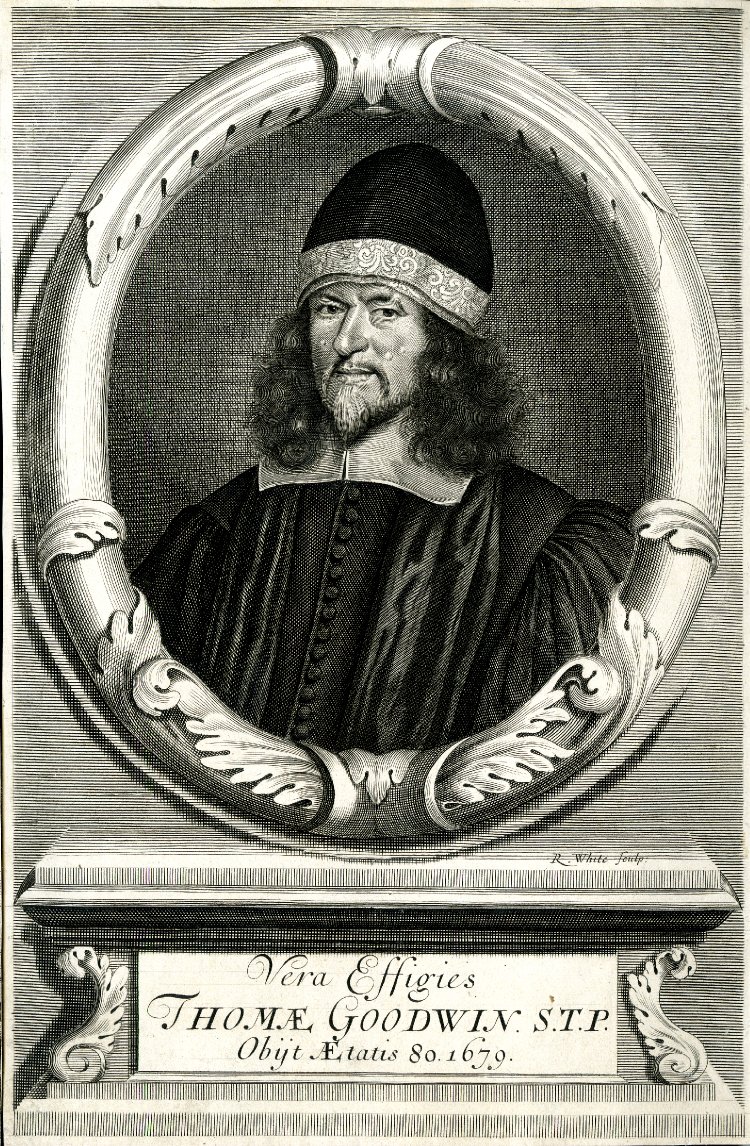
Thomas Goodwin
View on Wikipedia

Thomas Goodwin (Rollesby, Norfolk, 5 October 1600 – 23 February 1680), known as "the Elder", was an English Puritan theologian and preacher, and an important leader of religious Independents. He served as chaplain to Oliver Cromwell, and was appointed by Parliament as President of Magdalen College, Oxford, in 1650. Christopher Hill[1] places Goodwin in the "main stream of Puritan thought".
Early life
[edit]He studied at Cambridge from August 1613.[2] He was an undergraduate of Christ's College, Cambridge, graduating with a B.A. in 1616.[3]
In 1619 he removed to Catharine Hall, where in 1620 he was elected fellow.[4] At this time he was influenced by John Rogers of Dedham. Goodwin rode 35 miles from Cambridge to Dedham to hear this Puritan preacher. In 1625 he was licensed a preacher of the university; and three years afterwards he became lecturer of Holy Trinity Church, Cambridge, successor to John Preston, to the vicarage of which he was presented by the king in 1632.[5]
Dissenter
[edit]Worried by his bishop, who was a zealous adherent of William Laud, he resigned all his preferments and left the university in 1634; he became a Congregationalist. He lived for some time in London, where in 1638 he married the daughter of an alderman. In 1639 he fled to Holland to escape persecution. For some time he was pastor of a small congregation of English merchants and refugees at Arnhem. He returned shortly after the inception of the Long Parliament. He ministered for some years to the Independent congregation meeting at Paved Alley Church, Lime Street, in the parish of St Dunstans-in-the-East, and rapidly rose to considerable eminence as a preacher.[6]
Puritan leader
[edit]In 1643 he was chosen a member of the Westminster Assembly, and at once identified himself with the Independent party, generally referred to in contemporary documents as the "dissenting brethren" and was one of the authors of An Apologeticall Narration. He frequently preached by appointment before the Commons, and in January 1650 his talents and learning were rewarded by the House with the presidency of Magdalen College, Oxford, a post which he held until the Restoration of 1660.[7]
In December 1655 Goodwin attended the Whitehall Conference on the resettlement on the Jews, where he (with fellow Independent Philip Nye) argued for readmittance on the grounds that England was being punished by God for not readmitting the Jews, which was necessary for their conversion.[8] He was chaplain to Oliver Cromwell from 1656.[citation needed] He rose into high favour with Cromwell, and was one of his intimate advisers, attending him on his death-bed.[7]
He was also a commissioner for the inventory of the Westminster Assembly, 1650, and for the approbation of preachers, 1653, and together with John Owen led a committee of six that drew up the Savoy Declaration, an amended form of Westminster Confession in 1658.[7]
From 1660 until his death, he lived in London, in the parish of St Bartholomew-the-Great, and devoted himself exclusively to theological study and to the pastoral charge of the Fetter Lane Independent Church.[7] By the early 1670s he was in poor health, and he eventually died on 23 February 1680 ["An Exposition of Ephesians, Chapter 1 to 2:10"]. He was buried in Bunhill Fields burial ground: the Latin epitaph for his tomb, composed by Thomas Gilbert, was censored.
Works
[edit]The works published by Goodwin during his lifetime consist chiefly of sermons printed by order of the House of Commons. He was also associated with Philip Nye and others[9] in the preparation of the Apologeticall Narration (1643).[7]
In 1645 Goodwin published his treatise The Heart of Christ in Heaven towards Sinners on Earth, which was quickly reprinted, and translated into German. This work has been claimed to be an inspiration for the Roman Catholic devotion to the Sacred Heart.[10]
Five volumes of his sermons and other works were published from 1682 to 1704. They have been reprinted at least 47 times.[citation needed] His collected writings, which include expositions of the Epistle to the Ephesians and of the Apocalypse, were published in five folio volumes between 1681 and 1704, and were reprinted in twelve 8vo volumes (Edinburgh, 1861–1866).[7]
Edmund Calamy the Elder's estimated Goodwin's qualities as "a considerable scholar and an eminent divine, and had a very happy faculty in descanting upon Scripture so as to bring forth surprising remarks, which yet generally tended to illustration."[7]
A memoir, derived from his own papers, by his son Thomas Goodwin the Younger, Independent minister and author of the History of the Reign of Henry V, is prefixed to the fifth volume of his collected works. As a patriarch and Atlas of Independency he is also noticed by Anthony Wood in the Athenae Oxonienses.[7]
An amusing sketch, from Joseph Addison's point of view, of the austere and somewhat fanatical president of Magdalen, is preserved in No. 494 of The Spectator.[7]
References
[edit]- ^ Society and Puritanism in Pre-Revolutionary England (1969 edition), p. 30.
- ^ PDF Archived 2007-09-27 at the Wayback Machine, p. 4. "Thomas Goodwin (GDWN614T)". A Cambridge Alumni Database. University of Cambridge. has Goodwin matriculating in April 1614
- ^ Concise Dictionary of National Biography
- ^ "Thomas Goodwin (GDWN614T)". A Cambridge Alumni Database. University of Cambridge.
- ^ Chisholm 1911, p. 239.
- ^ Chisholm 1911, pp. 239–240.
- ^ a b c d e f g h i Chisholm 1911, p. 240.
- ^ Marshall, John (2006). John Locke, Toleration and Early Enlightenment Culture. CUP. p.382 ISBN 9780521651141
- ^ Sidrach Simpson, Jeremiah Burroughs, William Bridge.[1]
- ^ Cook, P. Thomas Goodwin - Mystic? in Diversities of Gifts Westminster Conference 1980, pp45-56
Attribution:
- This article incorporates text from a publication now in the public domain: Chisholm, Hugh, ed. (1911). "Goodwin, Thomas". Encyclopædia Britannica. Vol. 12 (11th ed.). Cambridge University Press. pp. 239–240.
Further reading
[edit]- Carter, Jonathan M. (2022), Thomas Goodwin on Union with Christ: The Indwelling of the Spirit, Participation in Christ and the Defence of Reformed Soteriology (London: T&T Clark), pp. v + 275. ISBN 978-0-567-70491-7.
- Jones, Mark (2010). Why Heaven Kissed Earth: The Christology of the Puritan Reformed Orthodox theologian, Thomas Goodwin (1600-1680). Göttingen: Vandenhoeck & Ruprecht. ISBN 978-3525569054.
- Lawrence, T. M. (2008) [2004]. "Goodwin, Thomas (1600–1680)". Oxford Dictionary of National Biography (online ed.). Oxford University Press. doi:10.1093/ref:odnb/10996. (subscription required)
External links
[edit]- Works by Thomas Goodwin at Post-Reformation Digital Library
- Sermons by Thomas Goodwin
- Works by Thomas Goodwin at LibriVox (public domain audiobooks)

- Biography from puritansermons.com, also [2]
- A blog devoted to Thomas Goodwin's writings and thought
- An index to literature by and about Goodwin from newble.co.uk
Thomas Goodwin
View on GrokipediaEarly Life and Education
Birth and Family Background
Thomas Goodwin was born on 5 October 1600 in the rural village of Rollesby, Norfolk, England.[3][7] His family resided in the Norfolk Broads region, an area known during the early 17th century for its strong Puritan influences amid the broader religious ferment in England.[1] Goodwin's parents were devout Protestants who prioritized religious instruction in the household, reflecting the Puritan emphasis on personal piety and scriptural fidelity prevalent among nonconformist families of the era. They exercised careful oversight of his early upbringing, fostering an environment conducive to moral and spiritual development, though specific details about their occupations or social standing remain sparse in historical records. This background positioned Goodwin within a tradition of godly domestic life that shaped many future Puritan leaders.[4][3]University Years at Cambridge
Thomas Goodwin matriculated at Christ's College, Cambridge, on 25 August 1613, at the age of twelve.[7] During his undergraduate studies, he pursued a classical education typical of the era, focusing on rhetoric, logic, and theology amid the intellectual ferment of early Jacobean Cambridge.[1] He graduated with a Bachelor of Arts degree in 1617.[8] [9] In 1619, Goodwin transferred to St Catharine's College to advance his studies.[6] He completed his Master of Arts degree there by 1620 and was promptly elected a fellow of the college on 21 March of that year, along with appointment as college lecturer.[8] [9] These early academic roles positioned him within Cambridge's scholarly community, where he delivered lectures on theological and philosophical topics, though his personal inclinations at the time leaned toward pursuing renown as a debater and scholar rather than deep spiritual engagement.[1] By 1625, Goodwin had advanced to the role of university preacher at St Andrew the Great, Cambridge, reflecting his growing prominence in ecclesiastical circles while still affiliated with the university.[8] His exposure to Puritan preaching during these years, including instruction in the Heidelberg Catechism, shaped his intellectual development, even as he initially regarded such emphases with disdain in favor of Arminian-influenced scholasticism.[10]Spiritual Development and Nonconformity
Period of Doubt and Conversion
During his time at Christ's College, Cambridge, starting in 1616, Goodwin initially experienced religious stirrings but soon entered a phase of spiritual doubt and conformity to the Church of England's liturgical practices, including ceremonies he later regarded as superstitious. Influenced by Arminian doctrines then circulating in academic circles, he underwent an early form of conversion emphasizing human cooperation in salvation, which proved unsatisfying and led to two years of internal conflict and hardening of heart against stricter Puritan convictions.[11][12] This period of doubt culminated in a profound conviction of sin, triggered by sermons and personal reflection, resulting in his decisive conversion on October 2, 1620, in the afternoon following a church service. God applied to Goodwin's conscience the dramatic conversion narratives of the Apostle Paul in Acts 9 and the Puritan minister Mr. Price, whose experience mirrored his own struggles, granting him assurance of electing grace and a rejection of Arminian soteriology in favor of Calvinist emphases on divine sovereignty.[13][12][14] The conversion marked a turning point, prompting Goodwin to openly identify with the Puritan party at Cambridge, resign ceremonial observances, and pursue a ministry grounded in experiential piety and nonconformity, though he retained no detailed autobiographical record beyond allusions in his sermons.[3][4]Separation from the Established Church
Following his spiritual conversion around 1630, Goodwin developed increasing scruples regarding the ceremonies and imposed uniformity of the Church of England, particularly under the high-church policies of Archbishop William Laud.[7] These concerns culminated in his resignation as vicar of Holy Trinity Church in Cambridge in 1634, a position he had held since 1632, due to his inability to conform to the required liturgical practices.[7][15] Influenced by the exiled Puritan John Cotton, whom he encountered in June 1633, Goodwin embraced Independent ecclesiology, rejecting the hierarchical structure and state-enforced rituals of the established church in favor of congregational autonomy governed by Scripture.[7] After resigning, Goodwin succeeded Richard Sibbes in the Cambridge lectureship briefly before fully withdrawing from university and church offices, transitioning to preaching as a separatist in London from 1634 to 1639.[7] This period marked his formal separation, as he gathered like-minded believers outside the parish system, emphasizing voluntary church covenants over compulsory national membership.[15] His nonconformity drew scrutiny amid Laud's campaign against Puritans, leading to threats of arrest; in 1639, shortly after marrying Elizabeth Prescott in 1638, Goodwin fled to the Netherlands, where he pastored an English Independent congregation in Arnhem.[7][15] Goodwin's separation reflected broader Puritan resistance to what he viewed as unbiblical innovations, prioritizing scriptural purity in worship and discipline over episcopal authority.[3] He later articulated these convictions in works defending congregational polity, arguing that true churches formed independently of state compulsion.[7] This stance positioned him among the Dissenting Brethren, advocating separation to preserve doctrinal integrity against perceived Arminian and ceremonial corruptions in the established church.[15]Ministry During Exile and Return
Pastorate in the Netherlands
In 1639, amid intensifying persecution of nonconformists under Archbishop William Laud, Thomas Goodwin fled England with his wife, Elizabeth Prescott, and settled in the Dutch Republic, where religious toleration allowed English exiles greater freedom for Independent worship.[1][16] He assumed the pastorate of an English-speaking Congregationalist congregation in Arnhem, a church of approximately 100 members previously led by Philip Nye, emphasizing gathered church principles over episcopal oversight.[7][12] Goodwin's ministry in Arnhem, lasting nearly two years until early 1641, focused on pastoral care, preaching, and fostering congregational autonomy amid the exile community of English separatists.[17] This period allowed him to refine his ecclesiological views, drawing on Dutch Reformed influences while maintaining Puritan commitments to experimental piety and covenantal discipline.[18] His tenure ended with the Long Parliament's invitation for nonconformists to return, signaling a shift in England's political climate under reduced Laudian enforcement.[1]Establishment in London
Upon his return to England in late 1640, coinciding with the convening of the Long Parliament on November 3, Thomas Goodwin established an Independent congregation in the parish of St. Dunstan-in-the-East in London.[19][7] This move followed years of exile in the Netherlands, where he had pastored an English-speaking church in Arnhem, and reflected his commitment to Congregationalist principles as a middle path between Presbyterianism and separatism.[20] The congregation met at Paved Alley Church on Lime Street, emphasizing autonomous church governance with lay eldership and congregational discipline.[6] Goodwin's ministry in London quickly attracted adherents, including former associates from his Cambridge and Dutch periods, fostering a community focused on Puritan piety and scriptural exposition.[12] He remained pastor there for approximately ten years, during which the church promoted religious edification and scholarly pursuits amid the escalating political and ecclesiastical upheavals of the 1640s.[12] This establishment solidified Goodwin's role as a leading Independent voice in England, bridging continental Reformed influences with domestic reform efforts.[4]Engagement in the Westminster Assembly
Representation of Independents
Thomas Goodwin was nominated to the Westminster Assembly on June 12, 1643, as a divine representing Cambridgeshire, where he immediately identified with the Independent faction advocating congregational church polity over the Presbyterian model favored by the majority.[8][17] As one of the five leading "Dissenting Brethren"—alongside Philip Nye, Jeremiah Burroughs, William Bridge, and Sidrach Simpson—Goodwin emerged as the chief spokesman for Independents, defending local church autonomy while seeking doctrinal unity across Reformed churches.[17][21] In the Assembly's debates on ecclesiology, particularly from late 1643 onward, Goodwin resisted proposals for a centralized presbyterian hierarchy, arguing instead for a flexible system permitting independent congregations to govern themselves under elder rule without coercive national oversight.[8][22] He emphasized that such independence aligned with New Testament patterns, avoiding both separatist isolation and erastian state domination, positions rooted in experiences from his Dutch exile.[17] A pivotal act of representation occurred on January 3 or 4, 1644, when the Dissenting Brethren, including Goodwin, submitted the Apologetical Narration to Parliament, co-authored by the group to justify their views and recount their continental ministries.[17][23] The document advocated a "middle way" tolerating diverse polities—independent and presbyterian—within a broader national church framework, warning against Presbyterian exclusivity that could foster conformity or division.[17][21] Despite parliamentary printing and debate, the Assembly's majority advanced presbyterian ordinances, such as the 1645 Form of Church Government, prompting ongoing dissent from Goodwin and his allies.[22] Goodwin's influence persisted through committee work and oral arguments, where he reportedly maintained detailed handwritten notes of proceedings, underscoring his commitment to Independent principles amid prolonged negotiations.[24] Though the Assembly's final standards reflected presbyterianism, Goodwin's representation preserved Independent ecclesiology as a viable Reformed alternative, later formalized in the 1658 Savoy Declaration under his involvement.[25][17] His approach balanced theological rigor with pragmatic accommodation, prioritizing scriptural fidelity over institutional uniformity.[8]Contributions to Doctrinal Standards
Thomas Goodwin actively participated in the Westminster Assembly's doctrinal deliberations from 1643 to 1649, delivering approximately 400 speeches and serving on 35 committees, with his influence most evident in soteriological and covenantal matters rather than church polity.[26][11] His advocacy for Reformed positions helped shape the consensus on core doctrines, including the instrumental role of faith in salvation, the structure of justification, and the perseverance of the saints, as articulated in the Westminster Confession of Faith (WCF) and catechisms.[11] In debates on soteriology, Goodwin defended justification by faith alone as a forensic declaration encompassing Christ's active obedience (fulfillment of the law) alongside passive obedience (satisfaction for sin), rejecting views like that of Ludovicus Piscator which limited it to the latter.[11] He posited union with Christ—described as substantial and mystical—as the foundational reality from which justification, adoption, sanctification, and glorification flow, with sanctification entailing progressive mortification of sin and vivification toward conformity to God's image through the Holy Spirit's work.[11] These emphases aligned with and informed WCF chapters 11 (justification) and 13 (sanctification), as well as Larger Catechism question 31 on effectual calling and union.[11] Goodwin's covenant theology further contributed to the standards' formulation, framing the covenant of works as a natural-law arrangement with Adam (and angels) predicated on obedience, violated by unbelief, in contrast to the covenant of grace as a supernatural restoration mediated by Christ, conditioned on faith as determined in the eternal pactum salutis (covenant of redemption) between Father and Son.[11] He integrated a Trinitarian soteriology, delineating the Father's election, Son's mediation, and Spirit's application, which reinforced WCF chapter 7 on the covenants and chapter 8 on Christ the mediator.[11] On perseverance, he argued it stems from divine preservation, distinguishing general historical faith from saving trust, supporting WCF chapter 17.[11] Though the Independents, including Goodwin, dissented from the Presbyterian church government in the Assembly's output, they affirmed the doctrinal standards, which Goodwin later adapted for Congregationalists in the 1658 Savoy Declaration—a revision retaining Westminster's soteriology while adjusting ecclesiological elements.[25][11] His positions countered Arminian, Antinomian, and Socinian deviations, promoting a balance of divine sovereignty and covenantal conditions that bolstered the standards' Reformed orthodoxy.[11]Association with the Commonwealth Regime
Chaplaincy to Oliver Cromwell
Thomas Goodwin was appointed chaplain to Oliver Cromwell in 1656, serving in this capacity until the Lord Protector's death in 1658.[6][27] In this role, he provided spiritual guidance, preached sermons aligned with Independent ecclesiology, and acted as one of Cromwell's intimate advisers, enjoying significant favor due to his advocacy for congregational church models that resonated with the regime's religious policies.[6][27] Goodwin's chaplaincy involved direct personal ministry to Cromwell, including consolation during illness with assurances of divine grace and confident prayers for recovery.[27] He attended Cromwell on his deathbed on September 2–3, 1658, amid the Protector's final hours marked by fever and delirium.[6][27] Following Cromwell's passing on September 3, Goodwin preached before Parliament the next day, September 4, 1658, emphasizing themes of providence and national deliverance, and later delivered a funeral sermon drawing on Psalm 85:10 to mourn the loss while supporting the succession of Richard Cromwell.[27][28] This position underscored Goodwin's influence within the Commonwealth's religious establishment, bridging his theological commitments to practical counsel for the head of state, though his Independent leanings prioritized voluntary church associations over state-imposed uniformity.[27]Presidency of Magdalen College, Oxford
Thomas Goodwin was appointed President of Magdalen College, Oxford, by parliamentary ordinance on 11 January 1650, following the ejection of the incumbent president, Henry Tozer, who refused to subscribe to the Engagement oath affirming the Commonwealth's authority.[17][29] This appointment reflected Parliament's broader efforts to purge royalist and episcopalian elements from Oxford's colleges amid the post-Civil War reconfiguration of university governance.[1] Goodwin, as a prominent Independent divine and chaplain to the Council of State since November 1649, was selected to instill Reformed principles in the institution.[17] During his decade-long tenure until the Restoration in 1660, Goodwin prioritized the advancement of piety alongside academic rigor, seeking to cultivate godly scholarship in a college recovering from wartime disruptions.[29] He oversaw the replacement of non-conforming fellows with Puritan-aligned scholars, aligning Magdalen with the Independent ecclesiology he championed, and emphasized scriptural exposition in college worship and lectures.[6] His leadership coincided with the Puritan ascendancy in Oxford, where contemporaries like John Owen as dean of Christ Church implemented similar reforms, fostering an environment of intense theological inquiry and moral discipline.[1] Goodwin's presidency ended abruptly with the return of Charles II; on 20 May 1660, he was deprived of the office by royal commission, which restored Anglican loyalists and reversed Commonwealth-era appointments across the university.[19] Despite the brevity of his formal role post-Restoration, his influence lingered through former students and publications, though the college reverted to pre-Interregnum structures emphasizing liturgical conformity over Puritan experimental divinity.[29]Theological Doctrines
Union with Christ and Soteriology
Thomas Goodwin placed union with Christ at the center of his soteriology, viewing it as the mystical and real incorporation of believers into Christ through the indwelling of the Holy Spirit, which serves as the foundation for the application of all salvific benefits.[30] This union, he argued, precedes justification and other graces in the ordo salutis, enabling the imputation of Christ's righteousness and the believer's participation in divine life.[11] Goodwin emphasized its experiential reality, forged not merely by decree but by the Spirit's active presence, countering views that diminished the Spirit's role in favor of abstract federal relations.[31] He delineated a threefold union with Christ: a relative union, whereby believers are legally reckoned as Christ's through imputation; a substantial or mystical union, involving the intimate indwelling of Christ's person via the Spirit; and an objective or federal union, accomplished instrumentally by faith as the soul's act of cleaving to Christ. In works such as his exposition on Ephesians 3:17, Goodwin described this mystical indwelling as transformative, allowing believers to partake of Christ's divine nature and benefits, akin to a marital bond where the believer receives Christ's fullness.[32] The Holy Spirit effects this union eternally in the covenant of redemption, transiently in Christ's mediatorial work, and applicatively in regeneration, ensuring perseverance and growth in holiness.[11] Within soteriology, Goodwin maintained that justification—a forensic declaration of righteousness based on Christ's active and passive obedience imputed to the believer—flows directly from this prior union, with faith serving solely as the receptive instrument rather than a meritorious cause.[33] He rejected eternal justification as actualized apart from faith, insisting it occurs upon believing, though decreed eternally, and defended sola fide against Arminian conditionalism and antinomian laxity by rooting it in covenantal grace.[11] Sanctification and glorification similarly derive from union, progressing through the Spirit's renewing work, with faith encompassing notitia, assensus, and fiducia to apprehend Christ as both object and cause of salvation.[33] This framework, articulated in treatises like Christ Set Forth (1642), underscores salvation's Trinitarian structure, where the Father's election, Son's mediation, and Spirit's application converge in Christ's person.[34]Covenant Theology and Ecclesiology
Thomas Goodwin developed a covenant theology rooted in federalism, positing Adam as the federal head under the covenant of works, which promised eternal life upon perfect obedience to God's law, a condition forfeited through Adam's sin.[35] This covenant's demands were vicariously fulfilled by Christ, the second Adam, who secured redemption through his obedience, thereby establishing the covenant of grace as its antitype.[36] Goodwin emphasized the covenant of redemption in eternity among the Trinity as the foundation for the covenant of grace, wherein God the Father appoints the Son as mediator to apply salvation to the elect through faith. In Goodwin's framework, faith serves as the sole instrumental condition of the covenant of grace, distinguishing it from the works principle and enabling believers to partake in its promises of justification, sanctification, and perseverance.[37] He integrated Old Testament administrations—such as those with Abraham and David—into the covenant of grace's unity, viewing their "seed" promises as typological extensions pointing to Christ, while maintaining continuity in substance despite progressive revelation and differing external forms.[38] The Mosaic covenant, for instance, blended elements of works and grace but ultimately subserved the gracious economy, with Israel's failures underscoring humanity's need for Christ's mediation.[39] Goodwin's ecclesiology aligned with Independent principles, advocating congregational polity as Christ's divinely instituted pattern for church governance, wherein each local assembly constitutes a complete, autonomous body of visible saints gathered by covenant. In his 1644 treatise Of the Constitution, Right Order, and Government of the Churches of Christ, he delineated church officers—primarily teaching and ruling elders, with deacons for mercy ministry—but vested disciplinary and doctrinal authority in the congregation as a whole, rejecting coercive hierarchies.[40] This model derived from New Testament examples, such as the Jerusalem church's consensual decisions, prioritizing voluntary association over presbyterian classes or synods that imposed jurisdiction beyond persuasion.[41] During Westminster Assembly debates from 1643 onward, Goodwin, as a Dissenting Brethren spokesman, contested presbyterian ecclesiology by appealing to scriptural precedents, including Old Testament assemblies, to affirm local church independence while permitting voluntary councils for advisory concord, not binding adjudication.[42] He maintained that true church unity arises organically from shared faith and mutual recognition among sister congregations, safeguarding against Erastian state control or papal-like centralization, though critics like George Gillespie charged his view undervalued synodical order.[43] Goodwin's ecclesiology thus intertwined with covenantal themes, portraying the visible church as a covenant community under Christ's headship, distinct from the invisible elect yet marked by disciplined profession of grace.[44]Literary Output
Principal Works and Sermons
Thomas Goodwin's principal works, published during his lifetime, consisted chiefly of sermon collections and treatises expanded from his preaching ministry, often printed by order of the House of Commons or Parliament to address contemporary religious and political concerns.[7] He began issuing these in 1636 with A Child of Light Walking in Darknesse, a series of sermons on Isaiah 50:10-11 delivered during his early pastoral tenure, emphasizing assurance amid spiritual trials.[7] By the 1640s, amid the English Civil War, Goodwin produced influential Christ-centered expositions, including The Returne of Prayers (1641), a treatise on intercession drawn from sermons, and Christ Set Forth in His Death, Resurrection, Ascension, Sitting at Gods Right Hand, Intercession, Judicial and Final Coming (1642), a comprehensive series on Romans 8:34 highlighting Christ's mediatorial offices as the ground of justification.[45][7] Among his most enduring sermons was The Heart of Christ in Heaven Towards Sinners on Earth (first edition 1642, expanded 1651), based on John 13:1 and Hebrews 4:15, which expounded Christ's compassionate intercession for believers, portraying it as an unchangeable affection rooted in his divine-human nature.[3][7] This work, comprising multiple sermons, gained wide circulation for its pastoral depth and theological precision, influencing subsequent Puritan devotional literature. Goodwin also delivered and published parliamentary sermons, such as those on national repentance and covenanting, reflecting his Independent ecclesiology and commitment to Reformed soteriology.[45] Overall, these publications—numbering at least twelve by his death in 1680—demonstrated his expository style, blending scriptural exegesis with practical divinity, though many remained in sermon form rather than systematic treatises.[45][46]Posthumous Publications and Editions
Following Goodwin's death on 23 February 1680, the bulk of his major theological writings—primarily mature treatises and sermon collections—appeared in print posthumously, reflecting the editorial efforts of associates to preserve his Puritan expositions on doctrines such as justification, the person of Christ, and ecclesiology.[13] The initial comprehensive collection, The Works of Thomas Goodwin, comprised five folio volumes issued in London from 1681 to 1704 under the editorship of Thankful Owen, Thomas Baron, and Goodwin's son, Thomas Goodwin the younger; these gathered previously unpublished or scattered materials, including detailed commentaries on Ephesians and Revelation, alongside treatises like "Christ Set Forth" and "The Heart of Christ in Heaven Towards Sinners on Earth."[7] [47] Individual posthumous titles supplemented this effort, such as Most Holy and Profitable Sayings (1680), a compilation of devotional excerpts likely finalized shortly after his passing, and Of the Constitution, Right Order, and Government of the Churches of Christ (1696), which articulated Independent ecclesiological principles amid Restoration-era constraints on nonconformist publishing.[7] Later 18th- and 19th-century editions expanded accessibility; an abridged four-volume set edited by J. Rabb appeared in London from 1847 to 1850, while the standard reference remains James Nichol's twelve-volume edition (Edinburgh, 1861–1866), part of the Nichol's Series of Standard Divines, which reprinted and indexed the original folios with minor textual updates for broader readership.[47] These editions prioritized fidelity to Goodwin's manuscripts, though editorial interpolations in early volumes occasionally introduced minor interpretive glosses favoring Reformed orthodoxy.[7] 20th-century reprints, such as those by Banner of Truth Trust and Reformation Heritage Books, have sustained availability without substantive alterations, ensuring Goodwin's emphasis on experiential piety and covenantal soteriology endures in Reformed circles, though scholarly critiques note the collections' uneven sourcing from shorthand sermon notes.[3]Final Years and Ejection
Impact of the Restoration
The Restoration of the monarchy under Charles II in May 1660 directly led to Goodwin's deprivation from the presidency of Magdalen College, Oxford, on 18 May 1660, by a royalist convention that reversed Commonwealth-era appointments.[7] This ouster ended his formal academic leadership, which had flourished under the protectorate, and symbolized the broader dismantling of Puritan influence in institutions following the collapse of the republican regime.[12] Goodwin, as a prominent Independent, viewed the political shift as a profound setback, akin to the "killing of the witnesses" in apocalyptic terms, reflecting his eschatological hopes for a sustained godly commonwealth now dashed.[48] In response, Goodwin relocated to London in 1660, where he gathered a substantial portion of his Oxford congregation to establish an Independent church, enabling him to continue pastoral and theological labors outside state-sanctioned structures.[49] This move preserved his ministry amid rising Anglican dominance, though it exposed him to nonconformist vulnerabilities; he publicly distanced himself from radical actions like Venner's Fifth Monarchist uprising in January 1661 by signing a renunciation, signaling pragmatic adaptation to avert further reprisals against the godly remnant.[50] The Act of Uniformity, enacted on 19 May 1662 and enforced from St. Bartholomew's Day (24 August 1662), intensified pressures by requiring episcopal ordination and subscription to the Book of Common Prayer, resulting in the ejection of over 2,000 nonconformist ministers from Anglican livings.[51][11] Although Goodwin had already lost his Oxford post, the legislation curtailed public preaching opportunities for Independents like him, confining his work to private conventicles and manuscript circulation, yet he persisted in London until his death, undeterred by intermittent persecution under the Clarendon Code.[52] This era marked Goodwin's transition from institutional prominence to resilient dissent, underscoring the Restoration's causal role in segregating Puritan theology from established ecclesiastical power.[53]Death and Immediate Aftermath
Thomas Goodwin died on 23 February 1680 in London at the age of 79, succumbing to a fever after a brief illness.[7] His last words, uttered with calm assurance, reflected a Puritan confidence in the face of mortality: "Ah, is this dying? How I have dreaded as an enemy this smiling friend."[54] Goodwin was interred in Bunhill Fields, the principal burial ground for Protestant nonconformists in London, at the east end of the cemetery beneath a low altar tomb.%20Ind%20Titles/%5BTG%5D%20A%20Memoir%20of%20Thomas%20Goodwin%20(Robert%20Halley).pdf) The Latin epitaph, composed by fellow nonconformist Thomas Gilbert, extolled Goodwin's profound scriptural erudition, mastery of Gospel doctrines, and endurance through service and persecution, concluding that he "gently fell asleep in Jesus" after fulfilling his divine course.[3] Certain phrases in the inscription—likely those emphasizing his dissenting legacy—were excised by official censor, underscoring the lingering restrictions on nonconformist expressions under the Restoration regime despite the 1672 Declaration of Indulgence having lapsed.%20Ind%20Titles/%5BTG%5D%20A%20Memoir%20of%20Thomas%20Goodwin%20(Robert%20Halley).pdf) No public funeral orations are recorded, consistent with the subdued circumstances of ejected ministers amid ongoing penal laws, though Goodwin's passing marked the end of a pivotal figure in Independent theology whose unpublished manuscripts would soon circulate among sympathizers.[3]Enduring Influence and Assessment
Impact on Reformed and Congregational Traditions
Thomas Goodwin exerted significant influence on the Reformed tradition through his robust defense of Calvinistic soteriology, particularly his emphasis on the believer's union with Christ and the assurance of salvation, which became hallmarks of Puritan experiential theology. His multi-volume Exposition of the Epistle to the Ephesians (published posthumously in 1640s-1680s editions) articulated assurance not as an optional appendage to faith but as an integral outgrowth, attainable through evidences of grace and the Spirit's witness, shaping subsequent Reformed pastoral counseling on doubts and perseverance.[55][56] This framework, drawn from meticulous exegesis, reinforced Reformed orthodoxy's focus on experimental religion amid the era's antinomian controversies, influencing figures like John Owen and later divines in the tradition's emphasis on vital piety over mere doctrinal assent.[17] In the Congregational tradition, Goodwin's leadership as a principal architect of independent ecclesiology left an enduring mark, particularly through his role in the Westminster Assembly (1643–1652), where as chief spokesman for the Dissenting Brethren—alongside Philip Nye, Jeremiah Burroughs, William Bridge, and Sidrach Simpson—he opposed rigid presbyterianism in favor of autonomous gathered congregations governed by plurality of elders and congregational consent.[17][1] Their 1644 An Apologetical Narration defended this polity as biblically primitive, arguing for local church independence under Christ's headship while upholding Reformed confessional standards, thereby legitimizing Congregationalism as a viable expression within broader Protestantism rather than separatism.[1] Goodwin's involvement in the 1658 Savoy Assembly further solidified this impact, as he co-drafted the Savoy Declaration, which retained the Westminster Confession's doctrinal substance—affirming predestination, justification by faith, and sacraments—while revising chapters on church government to endorse congregational discipline, officer election by members, and associations of churches without hierarchical oversight.[25][17] This document served as a confessional anchor for English Congregationalists post-Restoration, confirming compatibility with Reformed theology and countering accusations of doctrinal laxity, thus enabling the tradition's survival amid persecution; its platform influenced American Congregational bodies, such as those in New England, by modeling disciplined liberty in church order.[25] His presidency of Magdalen College, Oxford (1649–1660), where he instituted an independent church model, extended Congregational principles into academic spheres, fostering a generation of ministers trained in both Reformed doctrine and independent practice, though ejection under the Restoration curtailed immediate institutional gains.[4] Posthumously, Goodwin's collected works (12 volumes, 1680s onward, reprinted by Reformed presses like Banner of Truth in the 20th–21st centuries) bridged the traditions, commending his Christ-centered expositions to Presbyterian and Baptist heirs alike, while underscoring Congregationalism's adherence to soteriological rigor against later liberal drifts.[1][44]Criticisms from Opponents and Modern Evaluations
Goodwin's advocacy for Congregationalist church polity during the Westminster Assembly drew sharp rebukes from Presbyterian members, who argued that his Independency undermined scriptural presbytery and risked ecclesiastical anarchy by prioritizing congregational autonomy over hierarchical oversight. George Gillespie, a leading Scottish commissioner, contested Goodwin's interpretations of Old Testament temple practices, insisting that national church structures mandated broader synodal authority rather than isolated gathered churches. Presbyterian responses to the Dissenting Brethren's An Apologetical Narration (1644), co-authored by Goodwin and four others, labeled their position as innovative and separatist, potentially fostering division akin to early English nonconformists.[17] Fellow Independent John Owen critiqued Goodwin's formulation of Christ's heavenly intercession in The Intercession of Christ for His People (1684), charging that Goodwin erroneously emphasized its applicatory role in sustaining saints' perseverance over its meritorious foundation in federal theology, thereby inadvertently bolstering antinomian or Arminian assaults on assurance.[57] Owen contended this view weakened the covenant of redemption by subordinating intercession to execution rather than viewing it as co-essential with Christ's obedience.[57] Post-Restoration Anglican authorities viewed Goodwin's nonconformity and prior service as Cromwell's chaplain with suspicion, associating his theology with regicidal republicanism and insufficient episcopal loyalty, though specific doctrinal attacks were muted amid broader suppression of Dissenters under the Act of Uniformity (1662).[7] In contemporary Reformed scholarship, Goodwin receives acclaim for doctrinal depth and pastoral insight, with Joel Beeke highlighting his Trinitarian soteriology as exemplary for experiential Calvinism.[58] Modern evaluators, including those in Baptist and Presbyterian traditions, praise his supralapsarian framework and emphasis on union with Christ as philosophically rigorous, positioning him alongside Owen as a pinnacle of Puritan intellect, though some note his voluminous style demands disciplined reading.[47] Assessments underscore his enduring appeal in evangelical circles for balancing orthodoxy with piety, evidenced by renewed editions of his works since the 19th-century reprints.[59]References
- https://en.wikisource.org/wiki/Dictionary_of_National_Biography%2C_1885-1900/Goodwin%2C_Thomas
