Hubbry Logo
Samuel RutherfordSamuel RutherfordMain
Open search
Samuel Rutherford
Community hub
Samuel Rutherford
logo
8 pages, 0 posts
0 subscribers
Be the first to start a discussion here.
Samuel Rutherford
Samuel Rutherford
from Wikipedia

The Signing of the National Covenant. The Victorian painter William Hole places Henderson (standing on the gravestone) at the centre of events in 1638. Archibald Johnston is on the left and Samuel Rutherford is also depicted.[1]

Key Information

Rutherford's Monument, Anworth[2]
Rutherford's Monument
The inscription stone on Rutherford's Monument
Anwoth Old Kirk and Kirkyard[2]
Memorial plaque to Samuel Rutherford
The grave of Master Samuel Rutherford, St Andrews Cathedral churchyard[3]

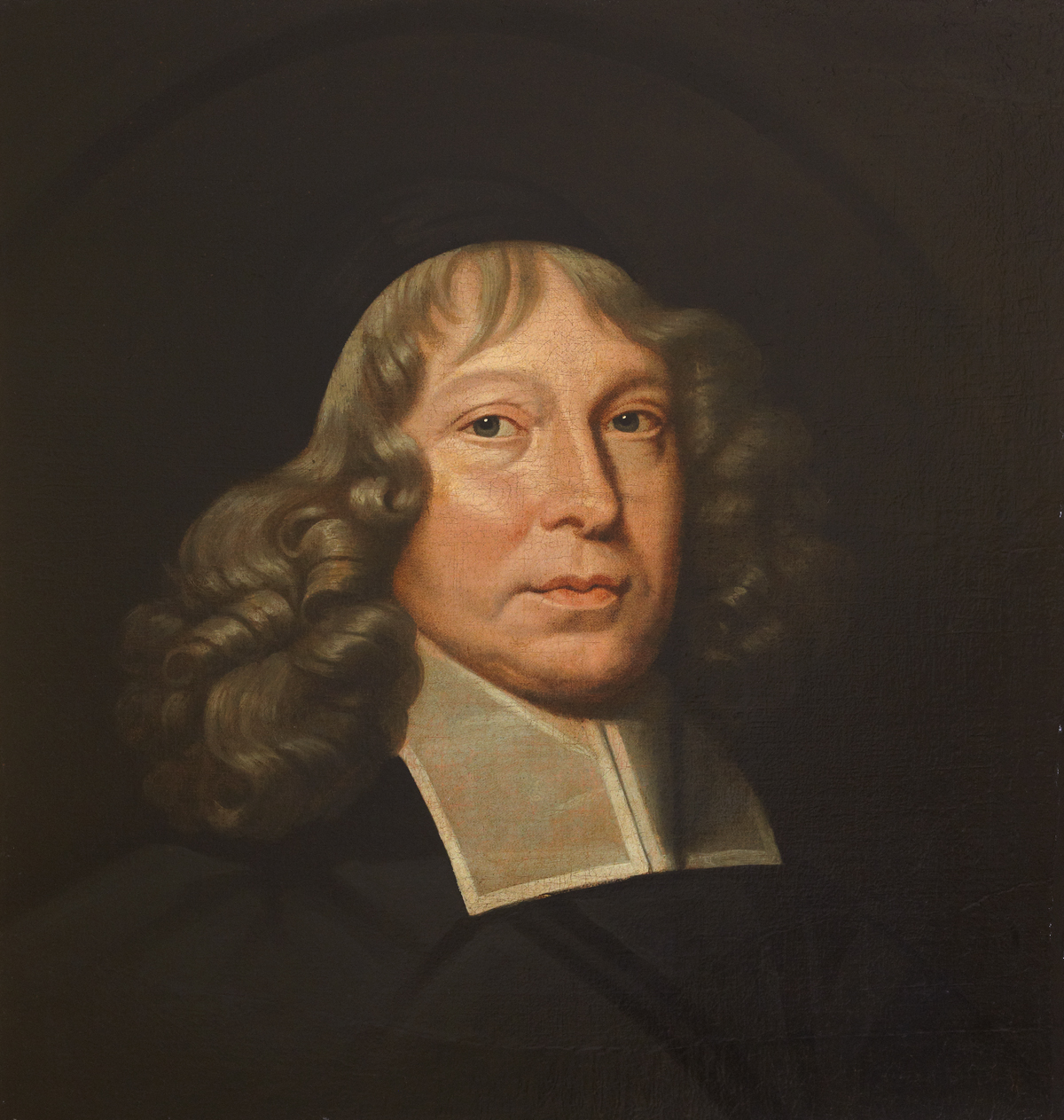
Samuel Rutherford (also Rutherfurd or Rutherfoord; c. 1600 – 29 March 1661) was a Scottish Presbyterian minister and theologian and one of the Scottish Commissioners to the Westminster Assembly.

Life

[edit]

Samuel Rutherford was born in the parish of Nisbet (now part of Crailing),[4] Roxburghshire, in the Scottish Borders, about 1600. Nothing certain is known as to his parentage, but he belonged to the same line as the Roxburghs of Hunthill (from whom Sir Walter Scott was descended)[5] and his father is believed to have been a farmer or miller. A brother was school-master of Kirkcudbright, and was a Bible Reader there, and another brother was an officer in the Dutch army.

Rutherford was educated at Jedburgh Grammar School and the University of Edinburgh. After graduating with an M.A. in 1621, he was appointed regent of Humanity at Edinburgh in 1623.[6] He demitted that office in 1626 because of an accusation of immoral conduct with Euphame Hamilton, whom he had married earlier that year. The accusation may have actually been motivated by Rutherford marrying without episcopal or academic authority.[7][8] He was admitted to Anwoth Kirkcudbrightshire, Galloway in 1627, probably without Episcopal sanction. It was said of him there that "he was always praying, always preaching, always visiting the sick, always catechising, always writing and studying".[9][4] One of his patrons in Galloway was John Gordon, 1st Viscount of Kenmure who died in 1644. His wife, Jane Campbell, Viscountess Kenmure, was a regular correspendent[10] and a continuing supporter of him and his work.[11]

In 1630 he was summoned before the Court of High Commission, but the charge of non-conformity was not persisted in. Mainly for his publication of a work against Arminianism he was again accused in 1636 by Bishop Sydserff, and after proceedings at Wigtown, was cited before the Commission and prohibited, 27 July, from exercising ministerial office, and ordered to reside in Aberdeen during the King's pleasure. During this period he wrote most of his well-known Letters. His writing desk there was said to be, "perhaps the most effective and widely resounding pulpit then in old Christendom."[12]

In February 1638 Rutherford returned to Anwoth and attended the Glasgow Assembly that year as one of two commissioners from his Presbytery. Shortly afterwards he was elected one of the ministers of Edinburgh, but the Commission of Assembly appointed him, in preference, Professor of Divinity at St Andrews, which office he only accepted on condition that he should be allowed to act as colleague with Robert Blair, one of the ministers of St Andrews, 7 January 1639. He was a member of succeeding Assemblies and consistently supported the Covenanting Party therein. In 1643 he was appointed one of the four main Commissioners of the Church of Scotland to the Westminster Assembly and preached several times before Parliament, remaining in London for four years.[6]

Rutherford was appointed to Principalship of St Mary's College in St Andrews (later merging to become St Andrews University) in 1647 in place of Robert Howie.[13] He was offered in 1648 a Divinity Professorship at Harderwyck in Holland, in 1649 the chair at Edinburgh, and in 1651 he was twice elected to a Professorship at Utrecht, but all these he declined. In 1643, 1644, 1650, and 1651 he was elected rector of the university, and in 1650 on Charles II.'s visit to St Andrews, he made a Latin speech to him on the duty of Kings. Rutherford was a staunch Protester during the controversy in the Scottish Presbyterian church between the Resolutioners and Protesters in the 1650s.

After the Restoration he was one of the first marked out for persecution: his work Lex, Rex was ordered by the Committee of Estates to be burnt at the Crosses of Edinburgh and St Andrews by the hand of the common hangman, while the "Drunken Parliament" deprived him of all his offices[6] and voted that he not be permitted to die in the college.[14] He was cited to appear before Parliament on a charge of treason, but he died 29 March 1661 [the date — 20th — on his tombstone is an error]. He is buried in the churchyard of St Andrews Cathedral just west of the bell tower. The epitaph on his tombstone includes 'Acquainted with Emmanuel's Love'.[15]

Legacy

[edit]

One of the classical figures of the Church of Scotland, Rutherford's influence during his lifetime, as scholar, preacher, and writer, was profound and wide, and after his death his name received a popular canonisation which it retains to this day. Some forty editions of his Letters have been reprinted (Bonar's edition contains 365), and innumerable anecdotes of his sayings and doings are enshrined in, and constitute no inconsiderable part of the Scottish tradition. Among his last words were: "Glory shines in Immanuel's Land," on which Mrs Anne Boss Cousin founded her hymn, "The Sands of Time are sinking."

There is also a monument to Rutherford, a Category B listed granite obelisk erected in 1842 on the hilltop overlooking his former parish at Anwoth, in the village of Gatehouse of Fleet, southwest Scotland.[16]

Family

[edit]

He married firstly in 1626, Euphame Hamilton, who died June 1630, and had issue — Marie, baptised 14 April 1628. He later married again on 24 March 1640, Jean M'Math, who was buried in Greyfriars Churchyard on 15 May 1675, and had issue — Agnes (married William Chiesley, W.S.), died 29 July 1694, and six others who predeceased him. He is known to have been friendly with James Guthrie.[17]

Writings

[edit]

Rutherford's Letters have been both lionized and criticized. His English contemporary, Richard Baxter remarked that except for the Bible, “such a book as Mr. Rutherford’s Letters, the world never saw the like” while nineteenth-century Baptist theologian Charles Haddon Spurgeon commented on Rutherford's posthumously published "Letters" (1664) by saying, 'when we are dead and gone let the world know that Spurgeon held Rutherford's Letters to be the nearest thing to inspiration which can be found in all the writings of mere men'.[18][page needed][19] Andrew Thomson, a Scottish minister, in a 19th-century biography observed "the letters flash upon the reader with original thoughts and abound in lofty feeling clothed in the radiant garb of imagination in which there is everything of poetry but the form."[20] He continues describing: "individual sentences that supplied the germ-thought of some of the most beautiful spiritual in modern poetry".[20] Elsewhere he talks of "a bundle of myrrh whose ointment and perfume would revive and gladden the hearts of many generations".[12] He also quotes that "each letter, full of hope and yet of heartbreak, full of tender pathos of the here and the hereafter.'[21] Rutherford was also known for other spiritual and devotional works, such as Christ Dying and drawing Sinners to Himself, "The Trial and Triumph of Faith".

Rutherford's political book Lex, Rex, or The Law and the Prince (1644)[22] was written in response to John Maxwell's Sacro-Sanctum Regum Majestas (1644) and raised Rutherford to eminence as a political thinker. It justified defensive wars and active resistance to lawfully constituted authority, and presented a theory of limited government and constitutionalism.[23] After the Restoration, it was burned at Edinburgh and St. Andrews by the hand of the common hangman, and after his death it was put on the University of Oxford's list of prohibited books.

"Lex Rex" has sometimes confused commentators into thinking that Rutherford was in favour of civil liberty. Instead, Rutherford advocated the Two Kingdoms ideal of Church and State popularized in Scotland by Andrew Melville. This occurs in a number of his works, but can be seen most easily in the second half of his "Due Right of Presbyteries" (1644). While it forbade the king from holding an office in the Church, it also made him responsible for overseeing and enforcing the true religion.

Not surprisingly, Rutherford was vehemently opposed to liberty of conscience. His A Free Disputation against Pretended Liberty of Conscience (1649) opposed the views of Roger Williams and others, and has been described as "perhaps the ablest defence of persecution ever to appear in a protestant nation"[24] and as "the ablest defence of persecution during the seventeenth century."[25] It raised the ire of John Milton, who named Rutherford in his sonnet on the forcers of conscience in the Long Parliament.

Rutherford was also a strong supporter of the divine right Presbyterianism (the idea that the Presbyterian form of church government is mandated in the Bible). He was involved in written controversies over church government with the New England Independents (or Congregationalists). His works in this area were A Peaceable Plea for Paul's Presbytery in Scotland (1642), followed by the Due Right of Presbyteries (1644), the Divine Right of Church Government and Excommunication (1648) and A Survey of 'A Survey of that Sum of Church Discipline' penned by Thomas Hooker (1655). New England Congregationalists responding to Rutherford included not only Thomas Hooker but also John Cotton and Richard Mather.

List of works

[edit]
  1. Exercitationes pro Divina Gratia Amsterdam 1636
  2. A Peaceable and Temperate Plea for Paul's Presbytery in Scotland London 1642
  3. A Sermon before the House of Commons, on Daniel, London 1644
  4. The Due Right of Presbyteries London 1644
  5. Lex Rex, or The Law and the Prince London 1644
  6. A Sermon before the House of Lords on Luke 7:22 London 1645
  7. The Trial and Triumph of Faith London 1645
  8. The Divine Right Of Church Government and Excommunication London 1646
  9. Christ Dying and Drawing Sinners to Himself London 1647[26]
  10. A Survey of the Spiritual Antichrist London 1648
  11. A Free Disputation against Pretended Liberty of Conscience London 1649
  12. The Last and Heavenly Speech and Glorious Departure of John, Viscount Kenmure Edinburgh 1649
  13. Disputatio Scholastica de Divina Providentia Edinburgh 1649
  14. The Covenant of Life Opened Edinburgh 1655
  15. A Survey of 'The Survey of that Sum of Church Discipline' penned by Mr. Thomas Hooker London 1658
  16. Influences of the Life of Grace London 1659
  17. Joshua Redivivus, or Mr Rutherford's Letters 1664
  18. Examen Arminianismi Utrecht 1668
  19. A Testimony left by Mr. S. Rutherford to the Work of Reformation uncertain date
  20. A Treatise on Prayer 1713
  21. The Cruel Watchman, The Door of Salvation Opened Edinburgh 1735
  22. Twelve Communion Sermons Glasgow 1876
  23. Quaint Sermons Hodder & Stoughton, London 1885
  24. Rutherford’s Catechism: Containing the Sum of Christian Religion. London, 1886
  25. A discussing of some arguments against Cannons and ceremonies in God’s worship in David G. Mullan (ed.) Religious Controversy in Scotland 1625–1639. (Edinburgh: Scottish Historical Society, 1998), pp. 82–99

Initially sourced from Andrew Bonar's Letters of Samuel Rutherford,[27] with updates and corrections.

See also

[edit]

References

[edit]

Sources

[edit]

Attribution

Further reading

[edit]
[edit]
Revisions and contributorsEdit on WikipediaRead on Wikipedia
from Grokipedia
Samuel Rutherford (c. 1600 – 30 March 1661) was a Scottish Presbyterian theologian, , and author renowned for his defenses of Reformed doctrine and advocacy of constitutional limits on monarchical power. Born in Nisbet, , Rutherford studied at the , earning his in 1621, before serving as regent of humanity there and then as minister of Anwoth parish from 1627 to 1636. In 1636, he was deprived of his ministry and exiled to for nonconformity to the episcopal policies of Charles I and for opposing Arminian tendencies in the church, during which period he composed many of his famous pastoral letters expressing deep spiritual devotion and theological insight. Returning after the 1638 Glasgow Assembly, Rutherford became professor of divinity at , later principal and rector of the , and in 1643 served as a Scottish commissioner to the , contributing significantly to its debates on and the Shorter Catechism. His 1644 treatise argued from biblical principles that the law precedes and binds the king, justifying resistance to tyrannical rule and influencing later concepts of and . Following the Restoration, was publicly burned by order of , and Rutherford was charged with , but he died before facing trial.

Early Life and Education

Birth and Family Background

Samuel Rutherford was born circa 1600 in the of Nisbet, , in the region, a now part of the of Crailing. He was the eldest son of a well-to-do , with historical accounts describing the as respectable and comfortably situated in their agricultural pursuits, though specific names of his parents are not recorded in surviving contemporary records. Rutherford had two younger brothers, James and George, and early biographers note that his parents identified his precocious intellectual abilities, facilitating opportunities beyond typical rural expectations, amid a environment shaped by the modest of lowland Scottish farming communities during the late post-Reformation era.

Academic Preparation and Influences

Rutherford attended Jedburgh Grammar School for his initial education before entering the in 1617, where he pursued studies in , , and physics over four years. He demonstrated particular proficiency in Latin and Greek during this period, reflecting the rigorous humanistic curriculum typical of Scottish universities at the time. In 1621, Rutherford earned his degree from , marking the completion of his undergraduate arts education. Shortly thereafter, from 1623 to 1626, he was appointed as regent of humanity—a professorial role focused on teaching Latin and —which underscored his emerging academic reputation despite internal university tensions that may have influenced his later career shift. Rutherford's preparation for ministry involved further theological study in 1625 under Andrew Ramsay, a prominent Edinburgh professor, aligning his intellectual formation with the Reformed dominant in Scottish Presbyterian circles. This phase exposed him to and anti-Arminian polemics, key influences shaping his later writings, though his primary academic grounding remained in the classical languages and logic that facilitated precise exegetical and argumentative rigor in Reformed thought.

Ministerial Beginnings

Ordination at Anwoth

Following his academic preparation at the and licensing to preach the gospel, Samuel Rutherford was called to serve the rural parish of Anwoth in , , in 1627. The invitation stemmed from the parishioners' desire, prompted by the counsel of Sir John Gordon of Kenmure, to have Rutherford as their spiritual guide. At approximately 27 years of age, Rutherford relocated to the parish manse at Bushy Beild with his wife, Eupham McLauchlane. Amid Scotland's episcopal church government established under King James VI and I, Rutherford's ordination proceeded with tacit consent from James Lamb, Bishop of Galloway, but aligned with presbyterial practices rather than strict episcopal ritual. This settlement reflected early tensions between emerging presbyterian sentiments and royal ecclesiastical policies, though Rutherford initially complied without formal acknowledgment to the bishop in some accounts. Anwoth, situated by the Solway Firth with its scattered farmsteads, provided the setting for Rutherford's induction into pastoral oversight of a community marked by prior Reformation influences from figures like John Welsh and John Mackgill.

Pastoral Ministry and Personal Afflictions

In 1627, Samuel Rutherford was ordained and settled as the minister of Anwoth, a rural parish in , , where parishioners were dispersed across farms and hillsides. He entered his pastoral responsibilities with vigor, conducting regular house visitations, catechizing families, and preaching sermons that drew hearers from distant regions due to his reputation for faithful exposition of Reformed doctrine. His nine-year tenure emphasized personal soul-care, reflecting a deep pastoral heart amid the challenges of a scattered flock. Rutherford's ministry at Anwoth coincided with profound personal trials that tested his faith and informed his later writings. Shortly after assuming his post, he married Euphame McPhelips, but their two young children predeceased her, followed by Euphame's own death in 1630 after a protracted and agonizing illness lasting thirteen months. Rutherford himself endured a severe fever mere months before her passing, compounding his grief and physical exhaustion. These losses, occurring when Rutherford was approximately thirty years old, forged his empathy in consoling others, as evidenced in his correspondence, yet did not deter his diligent service to the parish. Despite these afflictions, Rutherford continued his labors, publishing early works such as Exercitationes Apologeticae pro Divina Gratia in 1630, which addressed controversies while rooted in his Anwoth context. His experiences of bereavement underscored a as refining, aligning with scriptural motifs of as a means of spiritual growth, though contemporary accounts note his unyielding commitment to preaching and visitation even amid sorrow.

Conflict with Episcopal Authority

Publication Against Arminianism

In 1636, Samuel Rutherford published Exercitationes Apologeticae pro Divina Gratia, a substantial Latin scholastic treatise that mounted a vigorous defense of Reformed orthodoxy concerning divine grace against the doctrines propounded by Jacobus Arminius and his followers. The 558-page work, printed in Amsterdam, targeted Arminian positions on predestination, divine foreknowledge, human free will, and the efficient causes of conversion, contending that these undermined the sovereignty of God in salvation by introducing conditional elements dependent on human cooperation. Rutherford drew on scriptural exegesis, logical argumentation, and engagements with patristic and medieval sources to affirm unconditional divine decrees, efficacious grace, and the non-indifferent nature of the human will under sin, rejecting Arminian synergism as akin to semi-Pelagianism. The treatise emerged during Rutherford's pastorate at Anwoth, when Arminian leanings were gaining traction in the through episcopal appointments and liturgical impositions favored by King Charles I and Archbishop , which Presbyterians viewed as eroding confessional established at the 1616 Perth Assembly. Rutherford's anonymous or pseudonymous release of the book—its full title specifying opposition not only to Arminians but also Socinians, Pelagians, and Catholic theologians like Robert —reflected his commitment to scholastic precision in refuting perceived theological innovations that prioritized human agency over divine . Publication elicited swift ecclesiastical reprisal, with Bishop Thomas Sydserf of summoning Rutherford before the High Commission Court at on charges tied to the anti-Arminian content, interpreting it as seditious against prevailing hierarchies. Though not formally convicted on doctrinal grounds alone, the proceedings amplified scrutiny of Rutherford's nonconformist preaching, culminating in his 1636 deposition and banishment to , where he continued intellectual resistance through disputations with local doctors. The work solidified Rutherford's early reputation as a defender of strict , influencing later Presbyterian polemics despite its limited immediate circulation due to Latin's scholarly audience.

Banishment to Aberdeen and Intellectual Resistance

In July 1636, Samuel Rutherford was summoned before the Court of High Commission in for his nonconformity to the Perth Assembly's articles and his publication of Exercitationes Apologeticae pro Divina Gratia, a critique of that challenged episcopal doctrines on grace and ceremonies. After a three-day , the court deprived him of his ministerial office at Anwoth, prohibited him from preaching or exercising any pastoral functions throughout , and banished him to , an episcopal stronghold intended to isolate and potentially influence him through its moderate divines. Rutherford arrived in around September 1636, residing in a borrowed house under but without formal , where he received a hostile reception from and academic authorities while experiencing limited from some townsfolk. Despite the restrictions, Rutherford sustained his theological output through extensive correspondence, composing approximately 220 of his 365 surviving letters during the exile, which spanned until his recall in 1638 following the General Assembly's rejection of episcopacy. These letters, addressed to parishioners, friends, and figures like Lady Kenmure, offered doctrinal exhortations on divine sovereignty, personal , and perseverance amid affliction, effectively circumventing the preaching ban by disseminating Reformed teaching through personal networks. Rutherford framed his confinement as a divine privilege, writing of it as entry into "His King's palace" and an honor prayed for, thereby reframing enforced silence as an opportunity for deeper communion with God. Intellectually, Rutherford resisted assimilation by engaging in direct disputes with Aberdeen's theologians, particularly Dr. Robert Barron, a prominent defender of Arminian views and liturgical ceremonies. These encounters, described by Rutherford as troubling yet invigorating, involved oral and written arguments on Arminianism's implications for and the lawfulness of imposed rituals, where he reportedly prevailed through rigorous scriptural and logical rebuttals. Accompanied initially by supporters from Anwoth, he maintained presbyterian convictions against the local "great doctors," contributing to his enduring reputation as a formidable polemicist even in isolation, though the debates did not immediately alter Aberdeen's episcopal alignment. His efforts underscored a broader pattern of nonconformist resilience, preserving covenantal amid suppression until political shifts enabled his restoration.

Engagement in National Crises

Adherence to the National Covenant

The National Covenant, renewed on 28 February 1638 at Greyfriars Kirkyard in Edinburgh, represented a collective pledge by Scottish nobles, ministers, and laity to uphold the Presbyterian constitution of the Church of Scotland against King Charles I's imposition of episcopal governance, liturgical innovations, and the Book of Common Prayer. This document, building on the 1581 Negative Confession, explicitly rejected any alterations to worship or church polity without the consent of the General Assembly and Parliament, framing resistance as a defense of religious liberty rooted in prior Reformation oaths. Samuel Rutherford, still under banishment in for his 1636 treatise Exercitationes Apologeticae pro Divina Gratia against , adhered to the Covenant as it gained momentum across . He signed the in 1638, publicly committing to its terms alongside other Presbyterian and opposed to Anglican encroachments on Scottish independence. This act of subscription aligned Rutherford with the burgeoning Covenanter movement, which viewed the king's policies as tyrannical violations of divine and , necessitating sworn defense of the Kirk's purity. Rutherford's adherence directly precipitated the lifting of his , enabling his return to pastoral duties at Anwoth in June 1638, where he resumed preaching amid the Covenant's widespread ratification by tables across the realm. The Covenant's influence extended to the of 1638, which abolished episcopacy, further vindicating Rutherford's prior stance against hierarchical prelacy and paving the way for his elevation to theological prominence. In subsequent writings, Rutherford testified to the Covenant's validity as a biblically warranted bulwark against Erastian overreach, arguing it preserved Christ's crown rights over the church against civil absolutism.

Rise to Prominence in Church and Academy

Following the renewal of the National Covenant in February 1638, which precipitated the end of Rutherford's banishment to Aberdeen, he returned to his pastoral charge at Anwoth. His intellectual defense of orthodox Calvinism during exile, including public disputations with Arminian-leaning Aberdeen divines, had already garnered attention among Covenanters. Rutherford served as one of two commissioners from the presbytery of to the , held from November 21 to December 20, 1638. This assembly, the first since the ' resistance to Charles I's policies, condemned the and Book of Canons, ratified the as national law, abolished episcopacy, and reasserted and the church's spiritual independence from civil interference. Rutherford's participation in these proceedings underscored his emerging leadership within the restored . A commission appointed by the Assembly, recognizing Rutherford's doctrinal rigor, unanimously recommended him for the professorship of divinity at St Mary's College, ; this was formalized by the subsequent in 1639. Though reluctant to relinquish hands-on ministry at Anwoth, Rutherford accepted on condition of retaining preaching responsibilities, serving as colleague to Robert Blair in the parish kirk at least once weekly. This academic post elevated him to a position of influence in Scottish theological education, where he lectured on systematic divinity, training ministers amid the Presbyterian resurgence. His tenure at St Andrews, spanning over two decades until 1661, combined with ongoing kirk commissions, cemented Rutherford's prominence as a bridge between pastoral piety, ecclesiastical governance, and scholarly disputation. Later advancements, such as principalship of St Mary's in 1647 and rectorship of the university in 1651, further attested to his stature, though these built directly on the 1639 foundation.

Westminster Assembly Participation

Doctrinal Contributions

Rutherford served as one of the five Scottish commissioners to the , convened in 1643, where he actively participated in debates shaping the doctrinal standards, including the and Catechisms. His interventions emphasized a rigorous Calvinist orthodoxy, defending the doctrines of grace against latent Arminian influences and antinomian tendencies prevalent in some English circles. A key contribution was Rutherford's advocacy for supralapsarian , positing that God's eternal decree of election logically precedes the decree of the fall, thereby underscoring divine sovereignty in salvation over human contingency. This position, which he championed amid debates on the order of God's decrees, reinforced the Assembly's confessional commitment to while allowing infralapsarian views; it aligned with his pre-Assembly polemics in Examen Arminianismi (c. 1630s), where he systematically refuted Arminian errors on and grace. Rutherford also bolstered soteriological precision, particularly on particular redemption, arguing that Christ's was definite and efficacious solely for the , countering universalist interpretations that diluted its intent. His influence extended to the Shorter Catechism (1647), traditionally attributed in part to him, which succinctly articulates doctrines of , justification by , and the , grounding assurance in God's immutable promises rather than subjective experience alone. In sacramental theology, Rutherford contributed to chapters affirming baptism and the Lord's Supper as effectual signs and seals of the covenant of grace, efficacious through the Spirit for believers' union with Christ, not mere memorials or ex opere operato operations. Against antinomianism, he stressed the moral law's role in sanctification as a means of conformity to Christ, integrating justification and progressive holiness without merit-based works. These positions ensured the Standards' balance of grace and obedience, influencing Presbyterian confessionalism enduringly.

Shaping Confessional Standards

Samuel Rutherford, as one of the five Scottish commissioners to the convened in 1643, played a pivotal role in the formulation of its confessional documents, including the (WCF), the Larger and Shorter Catechisms, and supporting standards on worship and government. His extensive participation in debates—speaking more frequently than nearly any other member—ensured Scottish Presbyterian perspectives shaped the doctrinal framework, emphasizing covenantal uniformity across Britain as per the of 1643. Rutherford remained in until 1647, contributing until the core standards neared completion, including revisions to the Catechisms finalized shortly after his departure on October 23, 1647. Rutherford vigorously advocated for Presbyterian church polity in the Form of Presbyterian Church-Government (1645), arguing against episcopacy and independency by grounding ecclesiastical authority in Scripture's presbyterial model, which influenced the WCF's chapters on the church (25) and civil magistrate's relation to it (23, 31). His supralapsarian theology—positing God's decree of and prior to the fall—permeated discussions on (WCF 3), effectual calling (10), and perseverance (17), countering infralapsarian and Arminian views prevalent among some English divines. This stance reinforced the standards' commitment to and , aligning with Rutherford's pre-Assembly treatises like Christ Dying and Declining to All (1647), though he conceded to compromises for broader consensus. In sacramental theology, Rutherford defended a Reformed paedobaptist view with spiritual presence in the Lord's Supper (WCF 27–29), critiquing both Roman transubstantiation and radical spiritualism, while insisting on worthy reception to avoid profanation—a position echoed in the Catechisms' Q&A on sacraments as signs and seals of grace. He influenced the standards' stance on liberty of conscience (WCF 20), limiting toleration to orthodox bounds and rejecting indifferentism, drawing from his broader polemics against sects, though this provoked dissent from Independents like John Goodwin. Rutherford's testimony later affirmed the Assembly's work as a covenanted reformation, crediting its standards with preserving biblical orthodoxy amid Erastian pressures from Parliament. The resulting documents, ratified by the in 1647, reflected Rutherford's emphasis on confessional precision for ecclesiastical discipline and national piety, with his interventions ensuring safeguards against in assurance (WCF 18) and law-gospel distinctions (19). Despite compromises, such as moderated language on the magistrate's ecclesiastical role to appease English Parliament, Rutherford viewed the standards as a bulwark for Reformed , influencing subsequent Presbyterian confessions.

Political Philosophy and Lex, Rex

Arguments Against Absolutism

In Lex, Rex (1644), Samuel Rutherford refuted absolutism by asserting that royal power, while divinely ordained in its abstract office, is concretely constituted by the through covenantal , rendering the king a conditional rather than an absolute . He distinguished God's immediate of from its mediate form, where the hold the "fountain-power" and delegate it to magistrates, who remain accountable to preexisting laws. Rutherford argued that no individual possesses absolute by nature, as such power corrupts and contradicts the rational order of creation, where serves communal good under divine constraints. Central to his critique was the inversion of "rex lex" (king as law) to "lex rex" (law as king), positing that fundamental laws—divine, natural, and positive—bind the , who acts as a fiduciary minister of God rather than proprietor of the realm. Rutherford drew on Deuteronomy 17:18–20, requiring Israelite kings to study and obey God's law to avert self-exaltation, and historical precedents like prophetic confrontations with tyrannical rulers, to demonstrate that absolutism forfeits legitimacy when it violates covenantal oaths for the people's welfare. He rejected the divine right doctrine's claim of irrevocable power, noting that Scripture depicts kings as deposable for covenant-breaking, with the people's will serving as God's instrument for accountability. Rutherford further undermined absolutism by reinterpreting :1–7 to mandate submission only to lawful powers ordained by "in abstracto," not to who pervert their office into satanic opposition to divine order. He permitted defensive resistance by inferior magistrates or when a king acts as a private —usurping law, invading liberties, or commanding —distinguishing this from against the office itself, as in Acts 5:29's priority of obedience to . Such resistance restores covenantal fidelity, as nullifies the conditional grant of power, empowering the constituent people to reclaim it without divine sanction's breach. This framework, grounded in biblical , positioned limited, lawful as the bulwark against arbitrary rule, influencing later constitutional thought.

Biblical Foundations for Resistance to Tyranny

Samuel Rutherford argued that derives from but is inherently limited by , rendering resistance to tyranny not only permissible but a when rulers exceed their mandate as God's ministers for good. In Lex, Rex, he contended that tyranny constitutes a satanic deviation from God's ordinance, as "tyranny being a work of Satan, is not from God, because … is not from God," thereby obligating subjects to resist in loyalty to divine sovereignty rather than human excess. This framework privileges God's ultimate kingship, where human rulers serve as stewards accountable to scriptural covenants, not absolute lords. Central to Rutherford's exegesis was :1–7, which he interpreted as mandating submission to powers "ordained of " only insofar as they function justly as "ministers for good" (:3–4), punishing evil and rewarding righteousness. He rejected absolutist readings by distinguishing the royal office in abstracto—divinely instituted for lawful governance—from the person in concreto, whose tyrannical acts forfeit divine sanction and invite opposition as mere human sin, not ordained authority. Thus, "resistance is against the judge, as a man exceeding the limits of his office," aligning with Acts 5:29's imperative to obey over men when commands contravene His law. Rutherford emphasized that subjection applies to as but not to his of , underscoring conditional obedience tied to covenantal fidelity. Deuteronomy 17:14–20 further buttressed this view by depicting kingship as elective by the people under God's oversight, with explicit curbs: rulers must transcribe and heed the , avoiding multiplication of horses, wives, or to prevent self-elevation above subjects or deity. Violation invites and popular resumption of power, as the people's role in kings (e.g., 2 5:1–3) implies retained to enforce conditions, including resistance to breaches. Rutherford invoked 1 8:9–14 to highlight Saul's warned-of oppressions, affirming that foreknowledge of potential tyranny does not preclude remedial action. Scriptural precedents reinforced these principles through historical instances of justified defiance. The Israelites' resistance to Pharaoh exemplified opposition to idolatrous oppression, as God hardened his heart for judgment yet sanctioned deliverance (Exodus 9:17; Romans 9). Similarly, Jehoiada's overthrow of Athaliah (2 Kings 11:17) demonstrated estates' license to excise tyrants violating covenants; priests' rebuff of Uzziah's unlawful temple intrusion (2 Chronicles 26:18) validated inferior magistrates' defensive stands; and David's evasion of Saul or Elisha's defiance of Joram (2 Kings 6:32) illustrated self-preservation against unjust violence as consonant with piety. In each, resistance targeted personal malfeasance, not the office, preserving "innocent acts of self-preservation" as biblically warranted. Rutherford thus framed tyranny's dissolution of society—rendering the ruler an "open enemy"—as dissolving claims to obedience, empowering the community to execute God's judgment when magistrates fail.

Comprehensive Writings

Theological and Polemical Works

Rutherford's early polemical engagement with culminated in Exercitationes Apologeticae pro Divina Gratia, published in 1636 in , a Latin defending Reformed against Jacob Arminius by vindicating doctrines of divine decrees, efficient grace, and human under divine sovereignty. This work, comprising systematic , provoked ecclesiastical opposition in , contributing to Rutherford's 1636 to for non-conformity. His later, more comprehensive critique, Examen Arminianismi, drawn from lecture notes at University, systematically refuted Arminian positions across theology—including , extent, and perseverance—emphasizing God's absolute and the inefficiency of human will apart from ; published posthumously in in 1668 under Robert MacWard. These polemics underscored Rutherford's commitment to scholastic precision in upholding Calvinist against perceived semi-Pelagian errors. In theological exposition, Rutherford advanced in The Covenant of Life Opened (1655, ), a delineating the covenant of works' probationary nature under , contrasted with the covenant of grace's eternal administration through Christ's mediation, including discussions on divine sovereignty, Christ's death's sufficiency for the , and infants' baptismal rights as covenant signs. This work integrated federal theology with practical divinity, arguing God's electing purpose undergirds redemptive history without conditioning on foreseen . Complementing this, Christ Dying and Drawing Sinners to Himself (1647, ), a series of sermons, expounded Christ's vicarious sufferings and triumphant , asserting the atonement's particular efficacy in irresistibly drawing the to amid their natural aversion. Rutherford further defended divine providence scholastically in Disputatio Scholastica de Divina Providentia (1649, ), polemically countering Jesuit, Arminian, and Socinian views by affirming God's exhaustive foreordination and dominion over secondary causes, rejecting libertarian as incompatible with infallible decrees. These writings collectively reinforced Reformed confessional standards, prioritizing scriptural and logical rigor over speculative concessions, influencing subsequent Presbyterian despite Rutherford's era of ecclesiastical turmoil.

Political Treatises and Catechisms

Samuel Rutherford's most prominent political treatise, Lex, Rex (Latin for "The Law and the King"), was published in 1644 amid the Wars of the Three Kingdoms, directly responding to John Maxwell's Sacro-Sanctum Regus Majestas, which defended absolute royal authority. Structured as responses to 44 questions drawn from Scripture, classical sources, and Reformed , the work asserts that the —rooted in God's covenantal order—precedes and limits the sovereign, rejecting divine-right absolutism in favor of constitutional constraints where rulers are accountable to fundamental laws and the people's representatives. Rutherford argued that kings derive authority from God through the people's consent under , permitting defensive resistance, including popular uprisings or lesser magistrates' intervention, against tyrants who violate covenants or issue sinful commands, while prohibiting private or . This framework influenced later resistance theories, emphasizing biblical precedents like the Hebrew midwives' defiance of and the Reformation's magisterial critiques of papal overreach. Rutherford extended political themes in works addressing church-state relations, such as his opposition to Erastianism—the subordination of ecclesiastical authority to civil power—which he critiqued in treatises like The Due Right of Presbyteries (1644), insisting on the independent spiritual jurisdiction of the church under Christ's headship to prevent state tyranny over conscience. In A Free Disputation Against Pretended Liberty of Conscience (1649), he rejected broad religious as conducive to societal disorder, advocating instead for covenantal uniformity enforced by magistrates to preserve against , while distinguishing civil from . Complementing his political writings, Rutherford composed Rutherford's , or The Sum of Christian Religion, a concise question-and-answer exposition of Reformed doctrine intended for pastoral instruction, family devotions, and catechetical teaching of youth and . Covering topics from the and to the covenants and sacraments, its answers draw directly from Scripture, emphasizing God's , human depravity, and justification by faith alone, with pithy formulations to aid memorization and doctrinal clarity. Though primarily theological, the catechism reinforces covenantal ethics that underpin Rutherford's political resistance theory, portraying as derivative from and subject to moral accountability.

Epistolary Legacy

Samuel Rutherford's epistolary output, primarily composed during his enforced exile in from 1637 to 1641, consists of personal correspondence addressed to ministers, parishioners, , and family members across . These letters, numbering over 300 in surviving collections, emphasize themes of divine sovereignty amid affliction, intimate communion with Christ, and perseverance in faith under persecution, often employing vivid biblical metaphors of spiritual illness and divine remedy to console recipients. Forbidden from preaching, Rutherford utilized letter-writing to exhort and galvanize Covenanter sympathizers, fostering resilience against and political opposition. The first compilation appeared posthumously in 1664, edited by Rutherford's friend Robert McWard under the title Joshua Redivivus, containing letters from his Aberdeen confinement and reflecting their immediate value to contemporaries. A more comprehensive edition, prepared by Andrew Bonar in , includes 365 letters with biographical notices of correspondents, establishing the corpus as a devotional standard; Bonar noted their self-evident profundity, requiring no elaborate preface. Subsequent reprints, such as those by Banner of Truth, preserve this arrangement, highlighting letters on , Christian , and eschatological hope. Theologically, these works reinforce Rutherford's covenantal framework by portraying trials as providential means for soul-purification, countering despair with assurances of Christ's affections, and modeling through scriptural exposition rather than abstract . Their enduring influence stems from this experiential , commending them as resources for personal edification and preaching; 19th-century figures like reportedly kept them at hand for spiritual counsel. Unlike Rutherford's treatises, the letters prioritize relational encouragement over systematic argumentation, yet they substantiate his broader resistance to Arminian laxity by urging rigorous self-examination and reliance on grace. This accessibility across social strata—addressing both and common folk—underscores their role in sustaining Presbyterian morale during turbulent decades.

Final Years and Persecution

Protester Stance and Cromwell Era

Following the Scottish defeat at the Battle of Dunbar on September 3, 1650, the General Assembly of the convened in November 1650 and passed resolutions permitting former royalists—derisively termed "malignants" by strict covenanters—who had supported the 1648 with Charles I to hold civil and military offices, provided they renounced the Engagement and subscribed to the and . Samuel Rutherford, viewing these measures as a dangerous dilution of covenantal purity and an accommodation with those who had previously opposed presbyterian reforms, led a group of 22 ministers in tabling a formal against the resolutions during the assembly proceedings. This act formalized the emergence of the Protesters, a faction committed to uncompromising adherence to the covenants without concessions to former adversaries, in opposition to the more pragmatic Resolutioners who prioritized national defense against English forces. Rutherford's protester stance emphasized the indivisibility of ecclesiastical and civil magistracy under covenantal law, arguing that admitting unrepentant malignants risked sectarian infiltration and undermined the Solemn League's aims of uniform across the . As principal of St. Mary's College at the —appointed in 1651—he used his platform to advocate for protester principles, convening synods and issuing declarations that rejected Resolutioner assemblies as unlawful. In 1652, Rutherford subscribed to a protestation by 63 ministers challenging a Resolutioner gathering as illegitimate, reinforcing the Protesters' claim to represent the true continuity of reformed governance. Under Oliver Cromwell's , which occupied from 1651 onward, Rutherford maintained his protester opposition to both royalist Restoration efforts and the English regime's promotion of religious toleration for independents and sects. While some Protesters pragmatically engaged with Cromwell's administration—such as accepting commissions for kirk sessions in 1653–1654 to administer civil affairs under the English —Rutherford resisted such accommodations, prioritizing the recovery of presbyterian uniformity over temporary alliances. Cromwell's forces dissolved the General Assembly in 1653, suppressing both factions, yet Rutherford continued lecturing on divinity and corresponding with covenanters, framing the era's upheavals as divine judgment on covenant breaches rather than opportunities for compromise. His stance isolated the Protesters numerically—reducing their ministerial adherents to a minority—but preserved a rigorous covenantal witness amid the interregnum's political flux.

Restoration Backlash and Death

Following the Restoration of Charles II to the throne in May 1660, Scottish authorities initiated a crackdown on former supporters of the Cromwellian regime and advocates of covenanting principles, targeting Rutherford due to his prominent role in opposing royal absolutism. In early 1661, the Committee of Estates decreed that Rutherford's treatise Lex, Rex—which argued for the subordination of kings to fundamental law—be publicly burned by the hand of the common hangman at the Mercat Cross in Edinburgh and at St Andrews, symbolizing official repudiation of its resistance theory. Rutherford was simultaneously deprived of his professorship in divinity at St Mary's College, , where he had served since 1651, and removed from his position as rector of the , stripping him of institutional influence amid the reimposition of episcopacy. He was then cited for high by the , primarily on account of Lex, Rex, and summoned to appear before the bar to answer charges that could have resulted in execution. Confined to his bed by prolonged illness, Rutherford declined to attend, reportedly instructing messengers: "Go, tell them from me that I have got a summons already before a superior Judge and Judicatory, and that I dare not wrong that by coming here." He died in St Andrews on 29 March 1661, at approximately age 61, evading formal trial and conviction; contemporaries viewed his passing as providential deliverance from earthly persecution. On his deathbed, he expressed regret over unfulfilled desires to further oppose perceived errors like Arminianism and prelacy, affirming his steadfast covenanting convictions to the end.

Personal Life

Marriages and Family

Samuel Rutherford married his first wife, Eupham Hamilton, prior to his settlement as minister at Anwoth in 1627. She endured a prolonged and painful illness before her death in 1630. The couple had two children, both of whom died in infancy during Rutherford's early years at Anwoth. Rutherford remained a widower for approximately a decade before marrying Jean M'Math in 1640. Jean was characterized in contemporary accounts as a woman of notable and personal worth. Their union produced seven children, six of whom predeceased Rutherford, leaving only a daughter, Agnes, who survived him. Agnes accompanied her parents during Rutherford's later travels, including to in the 1640s.

Character and Daily Piety


Samuel Rutherford exemplified profound piety through disciplined daily practices during his pastorate in Anwoth from 1627 to 1636, rising at 3 a.m. for extended prayer and meditation while fostering constant communion with Christ, even in dreams. His pastoral routine involved tireless preaching twice weekly, often straining his health, alongside regular home visits to catechize youth, counsel all social classes, and attend the sick, demonstrating zealous care for souls' eternal welfare.
Rutherford's character blended affectionate tenderness with resilient , as contemporaries described him as godly, sympathetic, and unwearyingly devoted, though occasionally emotional or depressive, which deepened his for others' trials. In correspondence, he expressed self-critical humility over personal failings like ministerial neglects, yet rejoiced in Christ's surpassing comforts, declaring afflictions "sweet, sweet" and a prayed-for honor. This spiritual intensity—wrestling in for his flock and feasting on divine promises—sustained him through losses, such as his wife's in 1630, and exile, where he penned over 220 letters overflowing with Christ-centered longing. His emphasized scriptural reflection and private duties, urging believers to "watch over grace" amid daily ups and downs, reflecting a rooted in omnipotent promises rather than . Rutherford's shone in disclaiming his writings as "defiled and imperfect" near death in 1661, prioritizing holiness over achievement.

Theological Influence

Advancements in

Rutherford advanced Reformed covenant theology through his systematic exposition of the covenants of works and grace, most notably in his treatise The Covenant of Life Opened, published posthumously in 1655. This work delineates the covenant of works as a prelapsarian arrangement conditioned on perfect obedience to divine law, contrasted with the covenant of grace, which rests on divine sovereignty and mercy extended to the elect through Christ's mediation. Rutherford emphasized God's absolute prerogative in initiating and fulfilling covenants, rejecting any human merit as contributory to salvific standing, thereby reinforcing federal theology's emphasis on unconditional election and imputed righteousness. A distinctive advancement lay in Rutherford's elevation of the eternal covenant of redemption as the intra-Trinitarian foundation for the covenant of grace, portraying it as an unchanging pact between , , and Spirit to secure the of the from . This framework integrated divine decrees with covenantal administration, underscoring that the Son's obedience actively satisfied the covenant of works' demands on behalf of believers, thus preserving the harmony between . Rutherford's formulation countered tendencies to subordinate redemption to grace by making it the covenantal , influencing subsequent Reformed thinkers to prioritize this eternal dimension in federal theology. Rutherford maintained the covenant of grace's substantial unity across dispensations—Abrahamic, , and New—while distinguishing their external administrations, such as versus , as signs sealing the same spiritual realities to believers and their seed. He argued that covenant obligations bind both individuals and communities, extending to familial and responsibilities, though this ecclesial application remained secondary to his soteriological focus. These elements, grounded in scriptural rather than speculative philosophy, fortified against antinomian dilutions of law's role and Arminian conditionalism.

Critiques of Arminianism and Antinomianism

Rutherford's primary critique of appears in his Latin treatise Examen Arminianismi (Examination of Arminianism), composed during his tenure as professor of divinity at University in the 1630s and published in expanded form around 1651, where he systematically dismantled Arminian doctrines on , , and grace as incompatible with Reformed . He argued that Arminian conditional election—based on foreseen rather than God's sovereign decree—reduces divine to a mere permission of , thereby elevating creaturely will over God's eternal purpose and opening the door to Pelagian self-salvation. Rutherford contended that Arminian grace is resistible and cooperative, rendering it inefficacious and dependent on cooperation, which he viewed as a fundamental denial of and , essential to ; he supported this by exegeting passages like Romans 9 and Ephesians 1 to affirm unconditional election and perseverance as biblically grounded in God's immutable decree, not merit or foresight. This work, his nearest equivalent to a , spans hundreds of pages refuting Arminian errors across , , and , insisting that such views erode the Protestant emphasis on justification by alone by introducing works or conditional elements into . Rutherford extended his opposition to in polemics against Scottish episcopal figures like the Aberdeen Doctors, whom he accused of Arminian leanings that undermined Presbyterian covenantalism and promoted hierarchical absolutism; his 1638 A Peaceable and Temperate Plea for Paul's Presbyterie linked Arminian free-will theology to episcopal tyranny, arguing both exalted human autonomy against divine order. He rejected Arminian claims to Protestant identity, labeling their grace doctrines as akin to , a position echoed in his contributions where he defended strict against latent Arminian influences. Turning to antinomianism, Rutherford targeted English sectarians like John Saltmarsh, William Dell, and Tobias Crisp in his 1648 A Survey of the Spiritual Antichrist, portraying their rejection of the moral law's binding authority on regenerate believers as a covert form of Familism that dissolved ethical distinctions between saints and the world. He defined antinomianism as the assertion that the Decalogue holds no directive force for Christians, whose obedience stems solely from gospel promises without legal compulsion, which Rutherford countered by upholding the law's threefold use: civil restraint, conviction of sin, and rule of life for sanctification, drawing on Mosaic typology and New Testament imperatives like Matthew 5:17-19 to insist believers remain debtors to do the whole law through union with Christ. In Christ Dying, and Drawing Sinners to Himself (1647), he refuted antinomian overemphasis on Christ's active obedience imputing perfect holiness without ongoing personal holiness, arguing this bifurcates justification from sanctification and fosters license; Rutherford maintained that true faith evidences itself in law-keeping, as grace enables—not excuses—conformity to God's moral will, lest assurance devolve into presumption. These critiques preserved covenant theology's balance, warning that antinomian extremes mirrored Arminian synergism in subordinating divine imperatives to human experience.

Political and Historical Legacy

Impact on Constitutionalism

Samuel Rutherford's Lex, Rex (1644) articulated a foundational argument for constitutional limitations on monarchical power, positing that "the is king" rather than the inverse, with deriving from and the people rather than residing absolutely in the ruler. Rutherford maintained that kings are bound by , , and the fundamental positive laws of the realm, which originate in popular consent through pacts or covenants, thereby establishing a framework where rulers hold authority as trustees accountable to these higher norms. He distinguished between constituent power (held by the people or their representatives) and constituted power (delegated to magistrates), asserting that the former remains superior and can reclaim authority if the latter becomes tyrannical by exceeding lawful bounds. This theologico-political framework advanced resistance theory by justifying defensive resistance—first by lesser , then potentially by the people—against rulers who violate covenantal oaths or enact unjust laws, provided such actions align with scriptural precedents like the . Rutherford grounded these limits in Reformed , viewing civil government as a conditional covenant mirroring divine-human relations, where breach by the magistrate forfeits legitimacy without endorsing or private . His 44 structured questions in Lex, Rex systematically dismantled absolutist claims, influencing Presbyterian resistance during the Wars of the Three Kingdoms and providing intellectual ammunition against Charles I's perceived divine-right pretensions. Rutherford's ideas permeated subsequent constitutional developments, particularly in Anglo-American thought, by reinforcing the rule of law over arbitrary will and popular sovereignty as a check on executive overreach. In the American context, Lex, Rex informed framers' views on limited government and the right to alter destructive regimes, as echoed in the Declaration of Independence's assertion that governments derive powers from the consent of the governed and may be dissolved upon repeated usurpations. Colonial ministers and theorists, drawing on Reformed traditions, cited Rutherford to justify resistance to British policies, linking his covenantal federalism to federal structures in the U.S. Constitution that subordinate rulers to enumerated powers and checks. Though suppressed post-Restoration—Rutherford's works were burned by Parliament in 1661—Lex, Rex endured as a precursor to Lockean contract theory, albeit with a more explicitly biblical emphasis on lawful magistracy over individualistic appeals.

Modern Applications in Resistance Theory

Rutherford's articulation in Lex, Rex (1644) of lawful resistance to rulers who exceed their God-ordained authority—grounded in , , and the superiority of over persons—has informed modern interpretations of constitutional limits on state power, particularly in Anglo-American traditions emphasizing and defensive rights. In 20th- and 21st-century scholarship on the U.S. Second Amendment, his arguments for subjects' moral duty to employ force against tyrannical oppression, derived from biblical precedents like Israelite resistance to , underpin claims that the right to bear arms serves as a bulwark against unlawful , extending to collective political action. This framework has appeared in legal analyses linking Reformed resistance theory to foundational American documents, where Rutherford's insistence that "a power ethical, politic, or moral, to oppress, is not from " justifies armed preparedness as a check on executive overreach, influencing debates on federal gun regulations post-1934 and beyond. In contemporary , the "Rutherford Option"—coined in 2023—adapts his views to advocate piety-infused against perceived erosions of ordered , rejecting withdrawal in favor of defending divine institutions like the state when they align with higher , as opposed to passive submission under misreadings. Such applications caution against absolutist interpretations of , echoing Rutherford's 44-question dissection of kingly duties, to critique modern expansions of executive or administrative power absent covenantal consent.

References

  1. https://en.wikisource.org/wiki/Dictionary_of_National_Biography%2C_1885-1900/Rutherford%2C_Samuel
Add your contribution
Related Hubs
User Avatar
No comments yet.