Hubbry Logo
ThyreosThyreosMain
Open search
Thyreos
Community hub
Thyreos
logo
8 pages, 0 posts
0 subscribers
Be the first to start a discussion here.
Thyreos
Thyreos
from Wikipedia

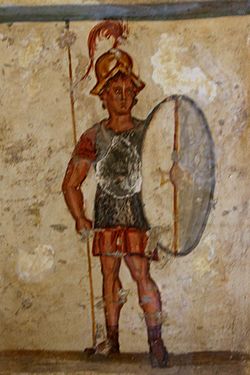
Fresco of an ancient Macedonian soldier bearing a thyreos shield. Archeological museum in Istanbul.

A thyreos or thureos (Ancient Greek: θυρεός) was a large oval shield which was commonly used in Hellenistic armies from the 3rd century BC onwards. It was adopted from the Galatians, probably first by the Illyrians, then by the Thracians before becoming common in ancient Greece. Troops who carried it were known as thyreophoroi. It was made of wood covered with leather and had a spined boss. It was carried using a central handgrip. Some variants of the shield were nearly rectangular: the name thyreos derives from the word thyra (θύρα), "door", reflecting its oblong shape.[1]

See also

[edit]

References

[edit]
Revisions and contributorsEdit on WikipediaRead on Wikipedia
from Grokipedia
The thyreos (: θυρεός) was a large, oval-shaped used primarily by units known as thureophoroi in beginning in the BCE. Adopted by the Greeks following Celtic invasions in the 270s BCE, it replaced smaller shields like the pelta and provided enhanced protection against missile weapons due to its size, typically measuring around 120–128 cm in height and 60–65 cm in width. Constructed from layered wooden laths forming a lightweight yet sturdy frame, the thyreos was covered in or felt for durability and often featured a central iron boss to deflect blows, along with a leather carrying strap and handgrip. Its slightly concave design and Celtic-inspired form made it versatile for mobile troops, who paired it with javelins, spears, or swords, though these soldiers often lacked or helmets unless personally equipped. Surviving examples, such as one from late 2nd-century BCE , suggest its use in Ptolemaic and Seleucid forces, highlighting its role in the evolving tactics of post-Alexandrian warfare. Etymologically, thyreos derives from the Greek word for "door" (thyra), reflecting the shield's oblong, door-like shape in early forms, and it later influenced medical terminology, such as "thyroid," named for the gland's shield-resembling structure. In the , particularly Ephesians 6:16, it metaphorically represents the "shield of faith" as a protective emblem.

Etymology and Terminology

Linguistic Origins

The term thyreos (Ancient Greek: θυρεός) derives from the Greek word thyra (θύρα), meaning "door," reflecting the shield's large, rectangular or oblong shape that resembled a door or protective barrier. This etymological connection emphasizes the shield's function as a full-body defense, akin to a sturdy portal warding off intruders, with early usages linking it to both literal doors and metaphorical protections. The term appears in from the 3rd century BCE, including in the where it translates Hebrew words for "," and is notably used in a military context in the 2nd century BCE Histories of , where it describes large used by various Hellenistic and Roman forces, including the oblong Roman scutum as a thyreos. ' accounts, drawing on 3rd-century BCE military contexts, highlight its adoption for that provided extensive coverage in formations. In Latin transcriptions, the term appears as thureos, adapting the Greek phonetics while retaining the door-like connotation for large shields. This variation underscores the word's transmission across Greco-Roman texts, where it denoted protective gear beyond Greek borders. The linguistic influence extends to , as the and cartilage were named for their shield-like, door-shaped structure, with the term thyreoeidēs (θυρεοειδής, "shield-shaped") coined in the 17th century by anatomist Thomas Wharton based on the root. The thyreos shield's terminology demonstrates cross-cultural linguistic adaptations, particularly through its adoption by Celtic groups like the Galatians, who settled in around the following migrations from . These Galatians employed a large Celtic-style shield with a distinctive central boss and horizontal grip, which served as an ethnic identifier for their mercenaries in , including those in Ptolemaic , where it contrasted with local Greek and Egyptian designs. Thracian and Illyrian warriors in the incorporated similar oblong shields prior to their widespread use among , reflecting early regional influences from Celtic interactions during the late 4th and early 3rd centuries BC. Archaeological depictions from these areas show the shield's integration into local infantry equipment, suggesting terminological borrowings or equivalents in non-Greek Indo-European dialects, though surviving inscriptions provide limited direct lexical evidence. In Biblical Greek, the term "thyreos" appears solely in Ephesians 6:16 of the , where it metaphorically denotes the " of " capable of extinguishing "all the flaming arrows of the evil one." This usage draws on the shield's door-like (from Greek θύρα, "door") oblong form, symbolizing comprehensive spiritual protection akin to the full-body coverage provided by a soldier's large ; the emphasizes as an active, encompassing defense against doubt, temptation, and satanic assaults, rooted in reliance on divine promises. Roman Latin sources adapted "thyreos" to describe Hellenistic shields resembling the indigenous , a large, rectangular, curved shield used by legionaries for formation-based protection. Early Christian texts, such as those referencing Ephesians, explicitly link the Greek "thyreos" to the Latin scutum to evoke Roman imagery, highlighting the shield's role in orderly, collective defense.

Design and Construction

Materials and Manufacturing

The thyreos shield was primarily constructed from a wooden core assembled from layered laths, typically three layers each 2–3 mm thick, forming a lightweight yet sturdy frame. This wooden structure was then covered with felt or for durability and resistance to impacts. A central boss, usually made of iron or bronze and featuring a long vertical spine for reinforcement, was attached to the front to protect the handgrip and deflect blows. Some versions included bronze edging along the rim to enhance durability against edged weapons. The manufacturing process involved shaping the wood, applying glue to laminate the layers, and then binding the covering with stitching or adhesive, often followed by drying to ensure tautness. A surviving example from late 2nd-century BCE Egypt exemplifies this construction. Variations in quality distinguished elite from standard troop equipment; higher-end thyreoi featured an inner lining of or for added strength and comfort, along with painted designs or symbols for unit identification and intimidation. Basic versions for regular infantry omitted these embellishments, relying on simpler coverings to minimize production time and cost. These construction techniques contributed to the shield's overall weight of approximately 5–7 kg, balancing portability with the robustness needed for extended combat engagements. The combination of materials ensured the thyreos could withstand repeated strikes in dense formations without splintering easily, though organic components required regular maintenance to prevent cracking.

Shape, Size, and Features

The thyreos was a large, flat typically characterized by an or semi-rectangular shape with rounded ends, designed to provide extensive body coverage for Hellenistic . Its standard dimensions measured approximately 1.2 meters in height and 0.6–0.65 meters in width, as seen in a surviving example measuring 128 high and 63.5 wide, allowing it to protect the user from the neck to the knees during combat. This form derived its name from word for "," reflecting its broad, door-like profile that enhanced defensive utility in mobile formations. Key ergonomic features included a single central handgrip, often a recessed horizontal positioned for support, which differed from the dual-grip system of earlier shields and allowed for greater maneuverability. Some variants incorporated an optional shoulder strap, known as a , to facilitate carrying and quick repositioning during extended marches or skirmishes. A prominent central boss, or umbo, protruded from the face, serving to deflect incoming blows, while a reinforcing spine ran vertically down the center to structural against impacts. Regional adaptations influenced the thyreos's design, with Thracian styles favoring a more rectangular outline for enhanced stability in close-quarters fighting, whereas Greek Hellenistic versions emphasized the elongated oval contour for versatility in phalanx-integrated tactics. These variations ensured the shield's slight concavity, which improved glancing deflection of projectiles and strikes, covering a surface area sufficient to shield the and lower limbs without impeding or sword use. Archaeological depictions from Hellenistic sites, such as reliefs and vase paintings, corroborate this protective scope, noting the shield's narrower profile compared to Celtic prototypes, which prevented full-body but promoted agility.

Historical Origins and Adoption

Early Influences from Celtic and Thracian Cultures

The thyreos, a large oval shield, traces its origins to Celtic designs introduced to the by migrating Galatian tribes around 279 BC during their expansive movements into southeastern Europe. These , originating from , carried oblong wooden shields reinforced with metal bosses, which served as a hallmark of their warfare style emphasizing mobility and close-quarters combat. Archaeological evidence from , including bronze coinage issued by the Celtic kingdom of (or Tyle) in eastern during the mid-3rd century BC, depicts such oval shields, confirming their presence and cultural significance in the region shortly after the migrations. Thracian warriors quickly adopted and adapted these Celtic shield forms, modifying them to suit their traditional skirmishing tactics as similar to peltasts. The larger size and curved profile of the thyreos provided enhanced protection for javelin-throwing fighters, allowing greater versatility in uneven terrain compared to the smaller crescent-shaped pelta. and were among the first to adopt the Celtic-style oval shield in the early , preceding its broader integration into Greek forces. Parallel developments occurred among Illyrian groups, where similar large oval shields emerged in artifacts from Dalmatian sites, reflecting Celtic influences around the early 3rd century BC, concurrent with initial Greek adoption. These shields, often covered in and featuring central bosses, highlight a shared adaptation across Balkan cultures before the design proliferated southward. (Note: While is not cited, the underlying reference is to Wilkes 1992 for Illyrian weaponry.) The Celtic invasions of , culminating in the in 279 BC, acted as a primary vector for the diffusion of the thyreos shield design into southern regions. Led by , these raids exposed Greek forces to Celtic weaponry, prompting initial adoptions among border peoples and facilitating cultural exchanges that shaped early equipment. Historical accounts, corroborated by numismatic evidence from post-invasion settlements, underscore how battlefield encounters accelerated the shield's integration into non-Celtic arsenals.

Spread in the Hellenistic World

The thyreos shield saw initial adoption in Greek armies during the early , facilitated by the Galatian invasions of 281 BC, which introduced Celtic-style oval shields to the region and prompted their integration into Hellenistic military equipment as a lighter alternative to the traditional round . This shift was evident in the armies of the successor states, where the thyreos-equipped thureophoroi began replacing heavier gear to enhance mobility in diverse terrains. In the of , the thyreos was incorporated into infantry units by the mid-3rd century BC, as seen in the equipment of thureophoroi who served as versatile light troops alongside phalangites, reflecting adaptations to the kingdom's multicultural forces. Similarly, the employed thureophoroi bearing thyreoi during key engagements, such as the in 217 BC, where Greek mercenaries wielded them in flanking roles against Ptolemaic lines. played a notable role in its dissemination during his Italian campaigns of 280–275 BC, potentially introducing variants influenced by Oscan or Roman allies, which he later brought back to upon his return in 274 BC. The shield proliferated across the Hellenistic world, reaching Antigonid Macedonia where it became widespread among by the late , supporting the kingdom's flexible battle formations. In Asia Minor, evidence from Pergamene reliefs depicts thyreoi in use among Attalid forces, illustrating their adoption in local Greek defenses against Gallic threats during the 3rd and 2nd centuries BC. From proper—where leagues like the Achaean and Boeotian adopted it in the 270s BC—to and the , the thyreos enabled standardized equipment for mercenaries and native troops alike. Usage peaked through the 3rd and early 2nd centuries BC, as documented in Delphic inventories from 156/5 BC recording captured thyreoi, but began declining thereafter amid growing Roman military dominance, which introduced rectangular scuta and tactics that overshadowed the oval design in successor states.

Military Role and Usage

Infantry

The , or thureophoroi, represented a class of light to medium that emerged prominently in the from the 3rd century BCE onward, specializing in flexible formations that allowed for both skirmishing and engagement. Unlike the rigid, heavily armored hoplites or sarissa-wielding phalangites, thyreophoroi emphasized mobility and adaptability, serving as versatile troops capable of harassing enemies at range before closing for combat. This role positioned them as a bridge between unarmored skirmishers and the main battle line, enabling to respond to diverse tactical needs in uneven terrain or against irregular foes. Their armament typically included a bundle of javelins for initial ranged attacks, paired with a short thrusting for melee and a straight-bladed or curved machaira as a secondary weapon. Protective gear focused on mobility, often featuring lighter armor such as corslets () reinforced with scales, along with a simple and occasional greaves, though many soldiers lacked body armor or helmets. The thyreos shield itself, an oval wooden frame covered in hide or , provided sufficient protection without encumbering speed, allowing to maneuver effectively in support of heavier units. Recruitment for thyreophoroi drew heavily from mercenary pools, particularly and whose native warfare styles influenced the unit's design, with these fighters integrated into Hellenistic phalanxes primarily as flank guards or rapid-response elements. In states like the Seleucid and Ptolemaic empires, as well as Greek leagues, they supplemented citizen levies through professional contracts, undergoing training that emphasized accuracy, handling, and coordinated advances to exploit battlefield gaps. Examples from the illustrate their use of local recruits trained in these tactics to bolster defensive lines against Macedonian incursions. Socially, thyreophoroi occupied a mid-tier status within Hellenistic forces, ranking above expendable skirmishers but below , often comprising professional soldiers who received pay and provisions that reflected their specialized skills. This positioning made them a reliable core for armies reliant on mixed troop compositions, as seen in formations where they formed a substantial portion of the , blending citizen and elements to maintain operational flexibility.

Tactical Applications in Battle

The thyreos shield allowed thureophoroi to adopt versatile formations, including loose-order lines for skirmishing with javelins and close-order arrangements resembling a variant to safeguard missile troops like archers and slingers from direct assaults. This adaptability bridged the gap between light skirmishers and heavier , enabling rapid shifts between harassing enemy lines at range and consolidating for defensive stands. Hellenistic commanders valued this flexibility, as it permitted thureophoroi to support the without the constraints of rigid spacing. In combat, the thyreos conferred key advantages through its lighter construction compared to the , enhancing mobility for pursuits, retreats, and flanking maneuvers that outpaced the cumbersome . Its oval shape and moderate size also proved effective against charges, where thureophoroi could form interlocking shields to blunt mounted impacts while maintaining enough agility to or reposition. These traits made the shield particularly suited to the fluid battlefields of the Hellenistic era, where tactics demanded quick responses to threats from horse or foot. Notable applications occurred in major engagements, such as the in 217 BC, where Ptolemaic thureophoroi—likely numbering among the 5,000 Greek mercenaries—anchored the right flank, shielding the from Seleucid envelopment and aiding in the decisive push that secured victory for Ptolemy IV. Similarly, during the Galatian wars of the early , Hellenistic forces under leaders like employed the thyreos defensively against Galatian raiders, using its protective coverage to repel aggressive Celtic charges in . Despite these strengths, the thyreos-bearing formations showed limitations against the Roman manipular legion's adaptability, as demonstrated at the in 190 BC, where Seleucid thureophoroi on the flanks were outflanked and disordered by legionary and exploiting gaps in the line. This vulnerability to piecemeal engagements contributed to the broader decline of thureophoroi tactics following the Roman victories in Minor, as struggled to integrate the shield effectively against more dynamic foes.

Comparisons and Legacy

Differences from Other Ancient Shields

The thyreos shield differed markedly from the traditional Greek hoplon in both form and tactical application. While the hoplon was a large, round, and concave bronze-faced shield approximately 90-100 cm in diameter, designed primarily for the rigid close-order formations of heavy , the thyreos was typically oval, measuring around 110–120 cm in height and 55–65 cm in width, and constructed from lighter wood layered with leather or for greater mobility among medium units. This shape and reduced weight allowed thyreophoroi to maneuver more freely in looser Hellenistic battle lines, shifting emphasis from cohesion to individual versatility. In comparison to Celtic oval shields, such as those used by and other La Tène warriors, the thyreos represented a more standardized design adapted for Greek and Macedonian forces. Celtic shields were often highly decorated with intricate metalwork, swirling motifs, and elongated spindle-shaped bosses extending along the spine, reflecting tribal artistry and varying regional styles, whereas the thyreos featured a simpler central boss (umbo) for offensive bashing and deflection, with minimal ornamentation to prioritize uniformity in mass-produced . This standardization facilitated broader adoption across diverse troop types, contrasting the bespoke, culturally symbolic nature of Celtic versions. The thyreos also contrasted with the Roman scutum in profile and doctrinal use. The scutum was a distinctly rectangular shield with straight vertical sides and a pronounced semi-cylindrical curve, typically 105–120 cm tall and 40–60 cm wide, optimized for interlocking in the testudo formation and heavy close combat, while the thyreos' more gently curved, oval contours and lighter build emphasized Hellenistic mobility for thrusting or work in fluid engagements. Roman adoption of scutum-like designs later evolved from thyreos influences but prioritized formation density over the thyreos' individual agility. Functionally, the thyreos stressed balanced individual protection and offensive capability through its central boss, setting it apart from the lighter pelte used by Greek skirmishers. The pelte, a small crescent-shaped or hide shield about 60-70 cm across without a prominent boss, was tailored for javelin-throwing peltasts who relied on speed and evasion rather than sustained , whereas the thyreos' larger coverage and reinforced boss enabled thyreophoroi to engage in closer-quarters fighting while maintaining offensive potential. This made the thyreos ideal for the hybrid medium roles that emerged in the Hellenistic era.

Influence on Subsequent Armors and Modern Reconstructions

The thyreos shield exerted a notable influence on later shield designs in the Eastern , where the term "thyreos" continued to denote oblong or kite-shaped shields in military treatises from the , reflecting its adaptation into Byzantine defensive equipment alongside round skoutarion variants. This legacy extended to Eastern European medieval armors, with Byzantine influences potentially contributing to the adoption of elongated shields among Ottonian forces as early as the , emphasizing mobility for units. By the AD, the thyreos had largely been phased out in favor of the Roman rectangular for formations, though it persisted as a shield among Thracian and Gallic auxiliaries in the due to its lightweight construction suited to skirmishing tactics. In modern times, archaeological replicas of the thyreos have been produced based on 20th-century excavations of Hellenistic sites, with institutions like the displaying related oval shield artifacts from Roman contexts. These reconstructions are actively used in historical reenactments by various groups to demonstrate ancient tactics. The thyreos has also appeared in cultural depictions, notably in the Total War: Rome II series, where units like Thureos Spears employ accurate representations of the oval shield for Hellenistic factions such as Macedon and . Similarly, films portraying , including the 2004 production directed by , featured props inspired by thyreos designs for Thracian and auxiliary troops, contributing to public awareness of Hellenistic military equipment despite some anachronisms in the portrayal.

References

Add your contribution
Related Hubs
User Avatar
No comments yet.