


Community hub
Recent from talks
Contribute something
Nothing was collected or created yet.
Central Time Zone
View on Wikipedia
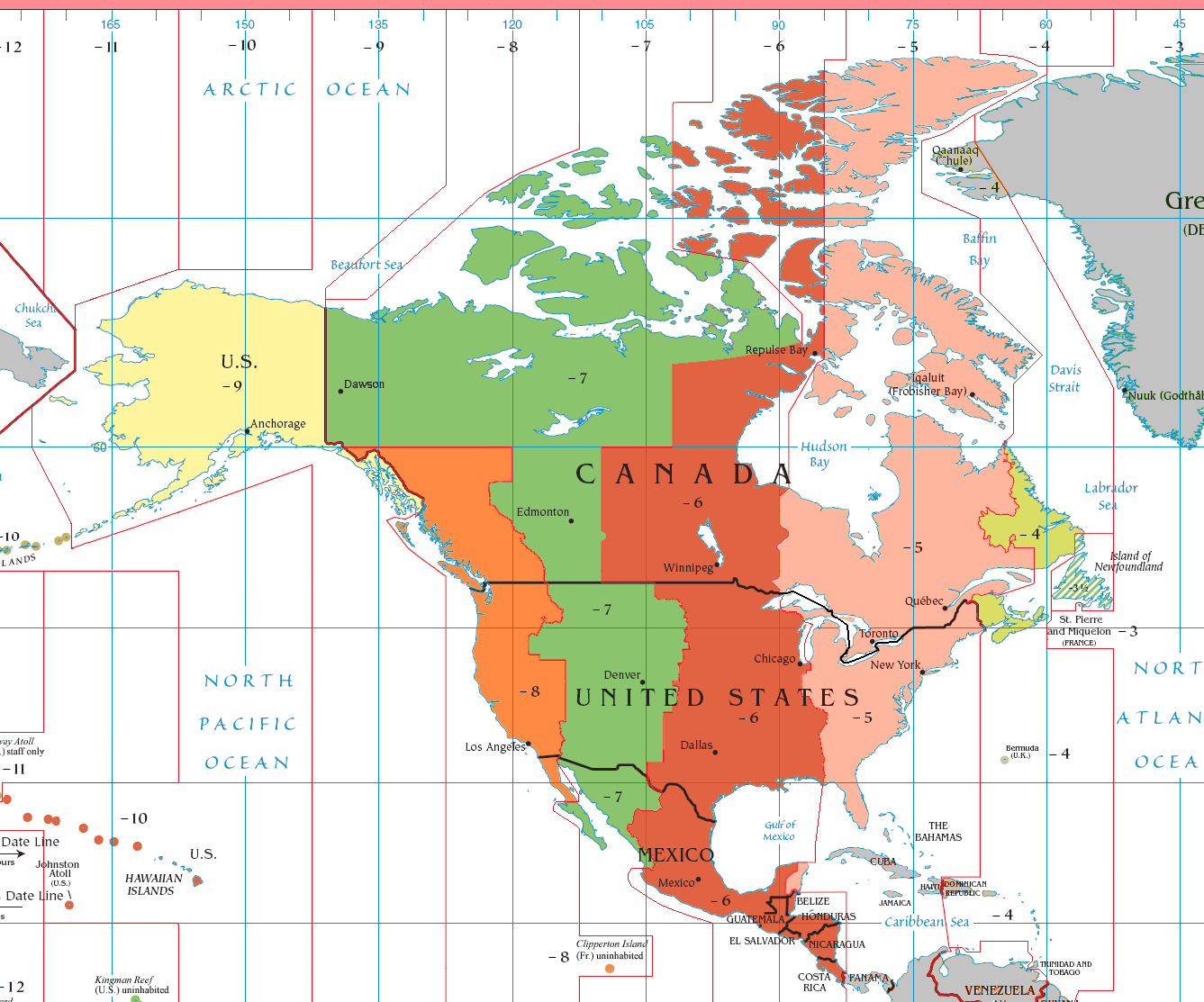
The Central Time Zone is a time zone in parts of Canada, the United States, Mexico, Central America, and a few Caribbean islands.[1] It is one hour behind the Eastern Time Zone.
Key Information


Daylight saving time is observed in most parts of that zone (20 states in the US, three provinces or territories in Canada, and several border municipalities in Mexico): Central Standard Time (CST) is observed from the first Sunday in November to the second Sunday in March. It is six hours behind Coordinated Universal Time (UTC) and designated internationally as UTC−6.[2] From the second Sunday in March to the first Sunday in November the same areas observe daylight saving time (DST), creating the designation of Central Daylight Time (CDT), which is five hours behind UTC and known internationally as UTC−5.[3]
Regions using Central Time (CT)
[edit]Canada
[edit]The province of Manitoba is the only province or territory in Canada that observes Central Time in all areas.
The following Canadian provinces and territories observe Central Time in the areas noted, while their other areas observe Eastern Time:
- Nunavut (territory): western areas (most of Kivalliq Region and part of Qikiqtaaluk Region)
- Ontario (province): a portion of the northwest bordering southeastern Manitoba, in and around Kenora.
Also, most of the province of Saskatchewan is on Central Standard Time year-round, never adjusting for Daylight Saving Time. One major exception includes Lloydminster, a city whose borders overlap both Alberta and Saskatchewan. The city charter[4] stipulates that it shall observe Mountain Time and DST, putting the community on the same time as all of Alberta (UTC−7) in the winter, and in time with Saskatchewan (UTC−6) during the summer.
United States
[edit]Ten states are contained entirely in the Central Time Zone:
Five states are split between the Central Time Zone and the Mountain Time Zone:
- Kansas: all except for Sherman, Wallace, Greeley, and Hamilton counties
- Nebraska: eastern two thirds including the east part of Cherry County
- North Dakota: all except for southwest regions, south part of McKenzie County, and the majority of Dunn County and far western Sioux County
- South Dakota: eastern half including part of Stanley County
- Texas: all except for El Paso, Hudspeth, and northwestern Culberson counties
Five states are split between the Central Time Zone and the Eastern Time Zone:
- Florida: Florida panhandle west of the Apalachicola River; Franklin County west of the Apalachicola River and the northern parts of Gulf County are in the Central Time Zone
- Indiana: Northwest Indiana and most of Southwestern Indiana, including the Evansville metropolitan area
- Kentucky: the western portion of the state, including its three major cities: Bowling Green, Owensboro and Paducah
- Michigan: The four Upper Peninsula counties bordering Wisconsin: Gogebic, Iron, Dickinson, and Menominee counties
- Tennessee: West Tennessee and Middle Tennessee, including the major cities of Nashville, Memphis, and Clarksville
Additionally, Phenix City, Alabama, and several nearby communities in Russell County, Alabama, unofficially observe Eastern Time. This is due to their close proximity to Columbus, Georgia, which is on Eastern Time.[5]
Although legally located within the Central Time Zone, Kenton, Oklahoma—located to the adjacent east of the defined border of the Central and Mountain time zones (at the Oklahoma−New Mexico state line)—unofficially observes Mountain Time.[6] This is reportedly because most people who interact with the town reside in either New Mexico or Colorado.[6][7]
Mexico
[edit]Most of Mexico—roughly the eastern three-fourths—lies in the Central Time Zone, except for five northwestern states (Baja California, Baja California Sur, Sinaloa, Sonora, and most of Nayarit) and one southeastern state (Quintana Roo). It is known locally as the Zona Centro.[8]
The federal entities of Mexico that observe Central Time:
- Aguascalientes
- Campeche
- Chihuahua[9] – Excluding the municipalities of Janos, Ascensión, Juárez, Guadalupe, and Práxedis Gilberto Guerrero, which observe Mountain Time with DST. Additionally, counties east of Guadalupe observe Daylight Savings in Central Time.
- Coahuila
- Colima – except for the Revillagigedo Islands, in which the inner islands use UTC−7 and the outer island uses UTC−8
- Chiapas
- Durango
- Guanajuato
- Guerrero
- Hidalgo
- Jalisco
- Mexico City
- Michoacán
- Morelos
- Nayarit – *only the municipality of Bahía de Banderas, rest of the state uses UTC−7
- Nuevo León
- Oaxaca
- Puebla
- Querétaro
- San Luis Potosí
- State of Mexico
- Tabasco
- Tamaulipas
- Tlaxcala
- Veracruz
- Yucatán
- Zacatecas
Central America
[edit]Out of the seven countries comprising Central America, all but one use Central Standard Time year-round:
- Belize, Costa Rica, El Salvador, Guatemala, Honduras, and Nicaragua.[10]
Panama, which recognizes Eastern Standard Time (UTC−5) year round, is the exception.[10]
Central Daylight Time
[edit]Daylight saving time (DST) is in effect in much of the Central time zone between mid-March and early November. The modified time is called "Central Daylight Time" (CDT) and is UTC−05:00.[citation needed]
In the United States, all time zones that observe DST were effectively changed by the Energy Policy Act of 2005. Beginning in 2007, DST would now begin at 2 a.m. (02:00) on the second Sunday in March instead of the first Sunday in April, moving the time from 2 to 3 a.m. (i.e., from 02:00 to 03:00). Additionally, DST would end at 2 a.m. (02:00) on the first Sunday in November instead of the last Sunday in October, moving the time from 2 to 1 a.m. (i.e., from 02:00 to 01:00).[citation needed]
At the time, Mexico decided not to go along with this change and observed their horario de verano ("summer schedule") from the first Sunday in April to the last Sunday in October. In December 2009, the Mexican Congress allowed ten border cities, eight of which are in states that observe Central Time, to adopt the US daylight time schedule effective in 2010. In October 2022, however, CDT was used in Mexico for the last time after DST was abolished. The US is also seeing traction in the same direction, with the Sunshine Protection Act that proposes legislation that would permanently end the switching of times and make daylight saving time permanent.[11]
Alphabetical list of major Central Time Zone metropolitan areas
[edit]- Acapulco, Guerrero
- Aguascalientes, Aguascalientes
- Amarillo, Texas
- Antigua Guatemala
- Austin, Texas
- Baton Rouge, Louisiana
- Beaumont/Port Arthur, Texas
- Belize City, Belize
- Belmopan, Belize
- Birmingham, Alabama
- Bismarck, North Dakota
- Bloomington, Illinois
- Bowling Green, Kentucky
- Brandon, Manitoba
- Cedar Rapids, Iowa
- Champaign, Illinois
- Chicago, Illinois
- Clarksville, Tennessee
- Comarca Lagunera (Torreón, Gómez Palacio, Lerdo)
- Columbia, Missouri
- Cuernavaca, Morelos
- Dallas–Fort Worth, Texas
- Davenport, Iowa
- Des Moines, Iowa
- Enid, Oklahoma
- Evansville, Indiana
- Fargo, North Dakota
- Fort Smith, Arkansas
- Fort Walton Beach, Florida
- Grand Forks, North Dakota
- Grand Rapids, Manitoba
- Green Bay, Wisconsin
- Guadalajara, Jalisco
- Guatemala City, Guatemala
- Houston, Texas
- Huntsville, Alabama
- Iowa City, Iowa
- Jackson, Mississippi
- Jackson, Tennessee
- Janesville, Wisconsin
- Jonesboro, Arkansas
- Joplin, Missouri
- Kansas City, Missouri/Kansas
- Killeen–Temple–Fort Hood, Texas
- Lafayette, Louisiana
- Lawrence, Kansas
- León, Guanajuato
- Lincoln, Nebraska
- Little Rock, Arkansas
- Lubbock, Texas
- Madison, Wisconsin
- Managua, Nicaragua
- Memphis, Tennessee
- Mérida, Yucatán
- Mexico City
- Midland/Odessa, Texas
- Milwaukee, Wisconsin
- Minneapolis–Saint Paul, Minnesota
- Mobile, Alabama
- Monroe, Louisiana
- Monterrey, Nuevo León
- Montgomery, Alabama
- Morelia, Michoacán
- Nashville, Tennessee
- New Orleans, Louisiana
- Normal, Illinois
- Northwest Arkansas
- Oklahoma City, Oklahoma
- Omaha, Nebraska
- Owensboro, Kentucky
- Paducah, Kentucky
- Panama City, Florida
- Pensacola, Florida
- Peoria, Illinois
- Puebla, Puebla
- Quad Cities, Iowa/Illinois
- Racine, Wisconsin
- Red Lake, Ontario
- Regina, Saskatchewan
- Rockford, Illinois
- Rochester, Minnesota
- Sioux City, Iowa
- Sioux Falls, South Dakota
- St. Louis, Missouri
- San Antonio, Texas
- San José, Costa Rica
- San Luis Potosí, San Luis Potosí
- San Pedro Sula, Honduras
- San Salvador, El Salvador
- Santiago de Querétaro, Querétaro
- Saskatoon, Saskatchewan
- Shreveport–Bossier City, Louisiana
- Springfield, Illinois
- Springfield, Missouri
- Tampico, Tamaulipas
- Tegucigalpa, Honduras
- Thompson, Manitoba
- Toluca, Estado de México
- Topeka, Kansas
- Tuscaloosa, Alabama
- Tulsa, Oklahoma
- Wichita, Kansas
- Wichita Falls, Texas
- Winnipeg, Manitoba
- Zacatecas, Zacatecas
See also
[edit]References
[edit]- ^ "Central Time – CT Time Zone". timeanddate.com. Retrieved November 22, 2023.
- ^ "History of Time Zones and Daylight Saving Time (DST)". United States Department of Transportation Bureau of Transportation Statistics. January 17, 2023. Retrieved December 28, 2023.
- ^ "Central Time (CST/CDT) | GMT". greenwichmeantime.com. Retrieved May 22, 2020.
- ^ The Lloydminster Charter. lloydminster.ca
- ^ "Parts of Eastern Alabama split between 2 time zones". Archived from the original on March 10, 2016. Retrieved March 22, 2009.
- ^ a b Young, Norma Gene. "Cimarron County". Encyclopedia of Oklahoma History and Culture. Oklahoma Historical Society. Retrieved June 30, 2015.
- ^ Bright, Sheilah (September 12, 2012). "The Last of Kenton". This Land Press. Archived from the original on September 27, 2020. Retrieved September 9, 2020.
- ^ "Ley de los husos horarios en los Estados Unidos Mexicanos" (PDF) (in Spanish). Chamber of Deputies of Mexico. November 2, 2022.
- ^ "Leyes Bibliography" (PDF). Archived from the original (PDF) on November 2, 2022. Retrieved November 8, 2022.
- ^ a b "Panama", The World Factbook, Central Intelligence Agency, November 14, 2023, retrieved November 22, 2023
- ^ "S.623 - Sunshine Protection Act of 2021". US Congress. March 16, 2022.
External links
[edit]- "Hismaime zones C conversion". Archived from the original on August 8, 2011.
Central Time Zone
View on GrokipediaDefinition and Technical Details
Standard Time Offset
The standard time offset for the Central Time Zone is six hours behind Coordinated Universal Time, denoted as UTC−06:00 and referred to as Central Standard Time (CST).[3][1] This offset positions the zone longitudinally between approximately 90° and 97.5° west of the Prime Meridian, aligning with solar noon occurring around local 12:00 during standard time periods.[6] Clocks in this zone display 6:00 a.m. local time when it is 12:00 UTC, facilitating synchronization for regions spanning parts of the United States, Canada, Mexico, and Central America.[7] This fixed offset serves as the baseline for civil timekeeping in the zone, independent of seasonal adjustments, and is maintained by atomic clocks referenced to UTC as disseminated by institutions like the U.S. Naval Observatory.[3] The designation UTC−06:00 ensures interoperability with global standards, where UTC acts as the reference timescale derived from International Atomic Time (TAI) with leap second adjustments.[1] In practice, this results in a consistent 360-minute lag from UTC, supporting precise scheduling for transportation, broadcasting, and international commerce across the zone's coverage.[6]Daylight Saving Time Provisions
In regions of the Central Time Zone that observe daylight saving time (DST), clocks are advanced one hour from Central Standard Time (CST, UTC-6) to Central Daylight Time (CDT, UTC-5) during the DST period, effectively shifting the zone forward to align with solar noon later in the day.[2][1] In the United States, DST observance in Central Time areas follows the schedule established by the Energy Policy Act of 2005, which extended the period effective March 2007: it begins at 2:00 a.m. local time on the second Sunday in March and ends at 2:00 a.m. local time on the first Sunday in November, when clocks are set back one hour.[8][9] This applies uniformly to states such as Illinois, Iowa, Louisiana, Minnesota, Missouri, Wisconsin, and parts of others like Kansas and Texas within the zone, with no major exemptions specific to Central Time; exemptions elsewhere (e.g., Hawaii or Arizona) affect Pacific or Mountain zones.[10] In Canada, most Central Time areas, including Manitoba, Nunavut (central portions), and Ontario (northwestern parts), observe DST on the same March-to-November schedule as the U.S., synchronized for cross-border consistency.[11] However, Saskatchewan largely remains on CST (UTC-6) year-round without DST, a policy adopted since 1912 and reaffirmed in referendums, though border communities like Lloydminster follow Mountain Time and observe DST to align with Alberta.[12][11] This creates a de facto year-round "daylight" alignment in Saskatchewan during standard time periods elsewhere.[13] Mexico, where much of the country falls in the Central Time Zone (e.g., Mexico City and surrounding states), abolished DST nationwide on October 30, 2022, via congressional decree, reverting to permanent standard time (UTC-6) to reduce energy use discrepancies and health impacts from clock shifts; exceptions persist only in Baja California (Pacific alignment) and select U.S. border municipalities, but not broadly in Central Time areas.[14][15] Central American countries in the zone, such as Belize, Costa Rica, El Salvador, Guatemala, Honduras, and Nicaragua, do not observe DST and maintain UTC-6 year-round, prioritizing stability for agriculture and trade.[16] Some Caribbean territories (e.g., Cayman Islands, Jamaica) also forgo DST, staying on UTC-5 or -6 equivalents without shifts, though observance varies by jurisdiction like Cuba's occasional trials.[17]Historical Development
Origins in Railroad Standardization
Prior to the widespread adoption of standard time zones, timekeeping in North America relied on local solar time, resulting in significant discrepancies that complicated railroad operations. In the mid-19th century, as rail networks expanded rapidly, schedules were based on hundreds of local times, with some cities observing multiple standards simultaneously; for instance, timetables in major hubs like Chicago listed dozens of varying arrival and departure times for the same trains.[18] [19] This fragmentation, exacerbated by the fact that each community often set its clocks to local noon, led to scheduling errors, safety risks from misaligned signals, and economic inefficiencies in coordinating transcontinental freight and passenger services.[20] [4] The push for standardization originated from railroad executives seeking practical synchronization for timetables and telegraph communications. Canadian engineer Sir Sandford Fleming advocated for global time zones based on 15-degree meridians in the 1870s, influencing North American discussions, while American educator Charles Dowd proposed a U.S.-specific system of four zones in 1872, initially anchored to the 69th meridian west for Eastern time but revised to align with key rail centers.[21] [22] At the railroads' General Time Convention in 1883, operators agreed to implement Dowd's revised framework, defining the Central Time Zone along the 90th meridian west—passing through Chicago, a pivotal rail junction—which equated to six hours behind Greenwich Mean Time (or 90 degrees of longitude, each representing one hour).[23] [4] This meridian was selected for its alignment with major Central U.S. rail corridors, facilitating consistent operations from the Mississippi River valley westward. On November 18, 1883, at precisely 12:00 noon along the Eastern meridian (75°W), U.S. and Canadian railroads simultaneously switched to the new "railroad standard time," dividing the continent into Eastern, Central, Mountain, and Pacific zones without federal mandate.[18] [20] The Central zone initially encompassed states like Illinois, Iowa, Missouri, and parts of Texas and Louisiana, with railroads enforcing adherence through their dominance in commerce and communication, though some communities resisted and retained local times for years.[19] [21] This voluntary industry-led reform marked the practical genesis of the Central Time Zone, prioritizing operational efficiency over astronomical purity, as boundaries were adjusted pragmatically to follow rail lines rather than strict longitudinal lines.[4]20th Century Formalization and Wars
The Standard Time Act of 1918, also known as the Calder Act, formally established the Central Time Zone as one of five continental U.S. standard time zones, defining its boundaries to encompass regions approximately 15 degrees of longitude wide and setting Central Standard Time at six hours behind Greenwich Mean Time (UTC-6).[4][24] Enacted on March 19, 1918, amid U.S. involvement in World War I, the legislation standardized timekeeping nationwide to support wartime coordination, including rail and telegraph operations, building on voluntary railroad adoption from 1883.[4] The act also mandated Daylight Saving Time (DST) from the last Sunday in March to the last Sunday in October, advancing clocks by one hour in affected zones, including Central, to conserve fuel for lighting and extend evening daylight for industrial productivity.[25] Post-World War I opposition from agricultural and business interests led to the repeal of the DST provision in 1919 over President Woodrow Wilson's veto, reverting Central Time observance to standard time year-round under local discretion.[4] During World War II, Congress reimposed nationwide time adjustments via a February 9, 1942, law instituting year-round "War Time," which advanced all U.S. clocks by one hour continuously until September 30, 1945, effectively shifting Central Standard Time to UTC-5 (equivalent to permanent DST) to prioritize energy savings for defense manufacturing and reduce blackout risks.[26][27] This measure applied uniformly across the Central Time Zone without altering its geographical boundaries, though some localities petitioned for exemptions, highlighting tensions between national security needs and regional economic disruptions.[27] Canada's provinces in the Central Time Zone, such as Manitoba and parts of Ontario, aligned with U.S. wartime policies, adopting similar DST extensions to facilitate cross-border commerce and military logistics, while Mexico introduced comparable adjustments in its central regions during the same period.[4] These war-driven changes underscored the zone's role in North American synchronization but ended with peacetime reversion to standard time, paving the way for later decentralized DST practices.[26]Late 20th and 21st Century Adjustments
In 2005, the United States Congress passed the Energy Policy Act, which extended Daylight Saving Time (DST) by approximately one month, effective from March 2007 onward; the start shifted to the second Sunday in March and the end to the first Sunday in November. This change applied uniformly to Central Time Zone areas observing DST, prolonging the Central Daylight Time (CDT, UTC-5) period and aligning it with extended daylight in spring and fall, ostensibly to conserve energy though subsequent studies showed minimal or negligible net savings in electricity consumption.[9][28] Concurrent with DST adoption across Indiana in 2006, the U.S. Department of Transportation approved boundary adjustments, reassigning eight counties—Daviess, Dubois, Knox, Martin, Perry, Pike, Pulaski, and Starke—from Eastern Time to Central Time, effective April 2, 2006; these counties, primarily in the southwest, better aligned geographically and economically with Central Time regions like Kentucky and Illinois. This realignment resolved long-standing discrepancies in Indiana, where most of the state transitioned to Eastern Time with DST observance, reducing intra-state time splits from three effective zones to two.[29][30] Canada synchronized its DST schedule with the United States starting in 2007, adopting the extended March-to-November period for provinces in the Central Time Zone, such as Manitoba, Saskatchewan (which largely forgoes DST), and parts of Ontario and Nunavut; this harmonization facilitated cross-border commerce and travel without altering standard offsets.[11] In Mexico, the Central Time Zone (Zona Centro), encompassing most of the country's population including Mexico City, discontinued DST on October 30, 2022, fixing the offset at UTC-6 year-round to simplify daily life and reduce energy use shifts, though northern border areas retained DST observance to match U.S. schedules; this divergence means Mexican Central Time lags one hour behind U.S. CDT during the latter's observance, complicating trade and coordination.[31][32]Geographical Coverage
United States
The Central Time Zone encompasses the entirety of ten U.S. states: Alabama, Arkansas, Illinois, Iowa, Louisiana, Minnesota, Mississippi, Missouri, Oklahoma, and Wisconsin.[1] [33] These states lie primarily in the Midwest and South, with boundaries generally following state lines or major geographical features such as rivers.[1] Portions of ten additional states observe Central Time, often divided by county lines established through state legislation or federal approval to align with economic ties, such as proximity to railroads or major cities in adjacent states.[34] These include:- The northwestern panhandle of Florida (e.g., Pensacola and surrounding counties west of the Apalachicola River).[1]
- Northwestern counties of Indiana (e.g., Lake, Newton, and Porter counties bordering Illinois).[1]
- The eastern two-thirds of Kansas (western counties observe Mountain Time).[33]
- The western portion of Kentucky (primarily the Jackson Purchase region west of the Tennessee River, including Paducah).[1]
- Four counties in Michigan's Upper Peninsula (Dickinson, Gogebic, Iron, and Menominee, due to historical railroad standardization and local economic links to Wisconsin).[33]
- Most of Nebraska (excluding the western panhandle).[1]
- The eastern two-thirds of North Dakota (excluding far northwestern areas).[33]
- The eastern three-quarters of South Dakota (western counties observe Mountain Time).[1]
- The western third of Tennessee (west of the Tennessee River, including Memphis).[1]
- The majority of Texas (excluding the western Panhandle and El Paso area, which observe Mountain Time).[33]