Hubbry Logo
Time travel in fictionTime travel in fictionMain
Open search
Time travel in fiction
Community hub
Time travel in fiction
logo
8 pages, 0 posts
0 subscribers
Be the first to start a discussion here.
Time travel in fiction
from Wikipedia
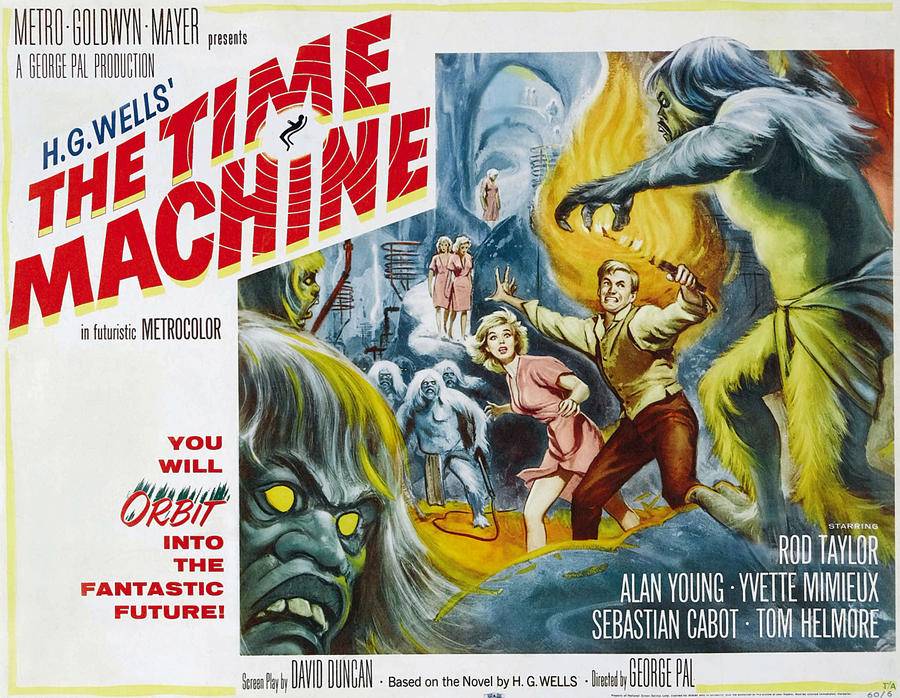
Poster for the 1960 film adaptation of H. G. Wells' 1895 novella The Time Machine

Time travel is a common theme in fiction, mainly since the late 19th century, and has been depicted in a variety of media, such as literature, television, and film.[1][2]

The concept of time travel by mechanical means was popularized in H. G. Wells' 1895 story, The Time Machine.[3][4] In general, time travel stories focus on the consequences of traveling into the past or the future.[3][5][6] The premise for these stories often involves changing history, either intentionally or by accident, and the ways by which altering the past changes the future and creates an altered present or future for the time traveler upon their return.[3][6] In other instances, the premise is that the past cannot be changed or that the future is determined, and the protagonist's actions turn out to be inconsequential or intrinsic to events as they originally unfolded.[7] Some stories focus solely on the paradoxes and alternate timelines that come with time travel, rather than time traveling.[5] They often provide some sort of social commentary, as time travel provides a "necessary distancing effect" that allows science fiction to address contemporary issues in metaphorical ways.[8]

Mechanisms

[edit]

Time travel in modern fiction is sometimes achieved by space and time warps, stemming from the scientific theory of general relativity.[9] Stories from antiquity often featured time travel into the future through a time slip brought on by traveling or sleeping, in other cases, time travel into the past through supernatural means, for example brought on by angels or spirits.[10][4][11]

Time slip

[edit]

A time slip is a plot device in fantasy and science fiction in which a person, or group of people, seem to travel through time by unknown means.[12][13] The idea of a time slip has been used in 19th century fantasy, an early example being Washington Irving's 1819 Rip Van Winkle, where the mechanism of time travel is an extraordinarily long sleep.[14] Mark Twain's 1889 A Connecticut Yankee in King Arthur's Court had considerable influence on later writers.[15] The first novel to include both travel to the past and travel to the future and return to the present is the Charles Dickens 1843 novel A Christmas Carol.[citation needed]

Time slip is one of the main plot devices of time travel stories, another being a time machine. The difference is that in time slip stories, the protagonist typically has no control and no understanding of the process (which is often never explained at all) and is either left marooned in a past or future time and must make the best of it, or is eventually returned by a process as unpredictable and uncontrolled as the journey out.[16] The plot device is also popular in children's literature.[17][18] The 2011 film, Midnight in Paris similarly presents time travel as occurring without explanation, as the director "eschews a 'realist' internal logic that might explain the time travel, while also foregoing experimental time Distortion techniques, in favor of straightforward editing and a fantastical narrative set-up".[19]

Time portal

[edit]

A time portal or a time gate is a doorway in time, employed in various fiction genres, especially science fiction and fantasy, to transport characters to the past or future. They differ from time machines in being a permanent or semi-permanent fixture, often linking specific points in time. An influential example of such a work is the short story, "By His Bootstraps", by Robert A. Heinlein, which features a time gate built by aliens and plays with some of the inherent paradoxes that would be caused by time travel.[20]

Communication from the future

[edit]

In literature, communication from the future is a plot device in some science fiction and fantasy stories. Forrest J. Ackerman noted in his 1973 anthology of the best fiction of the year that "the theme of getting hold of tomorrow's newspaper is a recurrent one".[21] An early example of this device can be found in H. G. Wells's 1932 short story "The Queer Story of Brownlow's Newspaper", which tells the tale of a man who receives such a paper from 40 years in the future.[21][22] The 1944 film It Happened Tomorrow also employs this device, with the protagonist receiving the next day's newspaper from an elderly colleague (who is possibly a ghost).[21] Ackerman's anthology also highlights a 1972 short story by Robert Silverberg, "What We Learned from this Morning's Newspaper".[21] In that story, a block of homeowners wake to discover that on November 22, they have received The New York Times for the coming December 1.[1]: 38  As characters learn of future events affecting them through a newspaper delivered a week early, the ultimate effect is that this "so upsets the future that spacetime is destroyed".[1]: 165  The television series Early Edition, similar to the film It Happened Tomorrow, also revolved around a character who daily received the next day's newspaper, and sought to change some event therein forecast to happen.[23][1]: 235 

A newspaper from the future can be a fictional edition of a real newspaper, or an entirely fictional newspaper. John Buchan's 1932 novel The Gap in the Curtain, is similarly premised on a group of people being enabled to see, for a moment, an item in The Times newspaper from one year in the future. During the Swedish general election of 2006, the Swedish liberal party used election posters which looked like news items, called Framtidens nyheter ("News of the future"), featuring a future Sweden that had become what the party wanted.[24]

A communication from the future raises questions about the ability of humans to control their destiny.[1]: 165  The visual novel Steins;Gate features characters sending short text messages backwards in time to avert disaster, only to find their problems are exacerbated due to not knowing how individuals in the past will actually utilize the information.[25][26][27]

Precognition

[edit]

Precognition has been explored as a form of time travel in fiction. Author J. B. Priestley wrote of it both in fiction and non-fiction, analysing testimonials of precognition and other "temporal anomalies" in his book Man and Time. His books include time travel to the future through dreaming, which upon waking up results in memories from the future. Such memories, he writes, may also lead to the feeling of déjà vu, that the present events have already been experienced, and are now being re-experienced.[28] Infallible precognition, which describes the future as it truly is, may lead to causal loops, one form of which is explored in Newcomb's paradox.[29][30] The film 12 Monkeys heavily deals with themes of predestination and the Cassandra complex, where the protagonist who travels back in time explains that he can't change the past.[31]

The protagonist of the short story Story of Your Life, later adapted into the film, Arrival, experiences life as a superimposition of the present and the totality of her life, future included, as a consequence of learning an alien language. The mental faculty is speculation based on the Sapir–Whorf hypothesis.[32]

Time loop

[edit]

A "time loop" or "temporal loop" is a plot device in which periods of time are repeated and re-experienced by the characters, and there is often some hope of breaking out of the cycle of repetition.[33] Time loops are sometimes referred to as causal loops,[31][33] but these two concepts are distinct. Although similar, causal loops are unchanging and self-originating, whereas time loops are constantly resetting. In a time loop when a certain condition is met, such as a death of a character or a clock reaching a certain time, the loop starts again, with one or more characters retaining the memories from the previous loop.[34] Stories with time loops commonly center on the character learning from each successive loop through time.[33]

Experiencing time in reverse

[edit]

In some media, certain characters are presented as moving through time backwards. This is a very old concept, with some accounts asserting that English mythological figure Merlin lived backwards, and appeared to be able to prophesy the future because for him it was a memory. This tradition has been reflected in certain modern fictional accounts of the character.[35] In the Piers Anthony book Bearing an Hourglass, the second of eight books in the Incarnations of Immortality series, the character of Norton becomes the incarnation of Time and continues his life living backwards in time.[36] The 2016 film Doctor Strange has the character use the Time Stone, one of the Infinity Stones in the Marvel Cinematic Universe, to reverse time, experiencing time backwards while so doing.[37][page needed]

In the film Tenet, characters time travel without jumping back, but by experiencing past reality in reverse, and at the same speed, after going through a 'turnstile' device and until they revert to normal time flow by going through such a device again.[38] In the meantime, two versions of the time traveller coexist (and must not meet, lest they mutually destruct): the one that had been 'traveling forward' (existing normally) until entering a turnstile and the one traveling backward from the turnstile.[citation needed] The laws of thermodynamics are reversed for time traveling people and objects, so that for example backward travel requires the use of a respirator. Objects left behind by time travellers obey 'reverse thermodynamics;' for example, bullets shot or even simply deposited while traveling backward fly back into (forward traveling) guns.[citation needed]

Themes

[edit]

Time paradox

[edit]

The idea of changing the past is logically contradictory, creating situations like the grandfather paradox, where time travellers go back in time and change the past in a way that affects their future in a way that could be seen as paradoxical or illogical, such as by killing their grandparents.[39][40] The engineer Paul J. Nahin states that "even though the consensus today is that the past cannot be changed, science fiction writers have used the idea of changing the past for good story effect".[1]: 267  Time travel to the past and precognition without the ability to change events may result in causal loops.[31]

The possibility of characters changing the past gave rise to the idea of "time police", people who prevent such changes from occurring by engaging in time travel to reverse the changes.[41]

Alternative future, history, timelines, and dimensions

[edit]

An alternative future or alternate future is a possible future that never comes to pass, typically when someone travels into the past and alters it so that the events of the alternative future cannot occur or when a communication from the future to the past effected a change that alters the future.[42][1]: 165  Alternative histories may exist "side by side", with the time traveller arriving at different dimensions as he changes time.[43]

Butterfly effect

[edit]

The butterfly effect is the notion that small events can have large, widespread consequences. The term describes events observed in chaos theory where a very small change in initial conditions has vastly different results. The term was coined by mathematician Edward Lorenz years after the phenomenon was first described.[44]

The butterfly effect has found its way into popular imagination. For example, in Ray Bradbury's 1952 short story A Sound of Thunder, the killing of an insect millions of years in the past drastically changes the world and in the 2004 film The Butterfly Effect, the protagonist's small changes to his past results in extreme consequences.[45]

Time tourism

[edit]

A "distinct subgenre" of stories explore time travel as a means of tourism,[4] with travelers curious to visit periods or events such as the Victorian Era or the Crucifixion of Christ, or to meet historical figures such as Abraham Lincoln or Ludwig van Beethoven.[41] This theme can be addressed from two or three directions. An early example of present-day tourists travelling back to the past is Ray Bradbury's 1952 A Sound of Thunder, in which the protagonists are big game hunters who travel to the distant past to hunt dinosaurs.[4] An early example of another type, in which tourists from the future visit the present, is Catherine L. Moore and Henry Kuttner's 1946 Vintage Season.[46] The final type in which there are people time-traveling to the future is experienced in the second book of Douglas Adams' The Hitchhiker's Guide to the Galaxy series, The Restaurant at the End of the Universe, which, as the title indicates, includes a restaurant that exists at the end of the universe. In the restaurant, people time-traveling from all over the space-time continuum (especially the rich) came to the restaurant to view the explosion of the universe put on repeat.[citation needed]

Time war

[edit]

The Encyclopedia of Science Fiction describes a time war as a fictional war that is "fought across time, usually with each side knowingly using time travel ... to establish the ascendancy of one or another version of history". Time wars are also known as "change wars" and "temporal wars".[47] Examples include Clifford D. Simak's 1951 Time and Again, Russell T. Davies' 2005 revival of Doctor Who, Barrington J. Bayley's 1974 The Fall of Chronopolis, Matthew Costello's 1990 Time of the Fox, and the central premise of Star Trek: Enterprise.[48][1]: 267 [47]

Ghost story

[edit]

Researcher Barbara Bronlow wrote that traditional ghost stories are in effect an early form of time travel, since they depict living people of the present interacting with (dead) people of the past. She noted as an instance that Christopher Marlow's Doctor Faustus called up Helen of Troy and met her arising from her grave.[49]

See also

[edit]

References

[edit]

Further reading

[edit]
[edit]
Revisions and contributorsEdit on WikipediaRead on Wikipedia
from Grokipedia
Time travel in fiction encompasses speculative narratives across , , and other media in which characters or entities displace through temporal dimensions, usually via invented apparatuses or anomalous events, to past or future epochs. The motif gained prominence with H. G. Wells's (1895), which depicted a mechanical contrivance enabling deliberate forward progression through millennia, predating formal relativity theory yet anticipating notions of variable temporal flow. Such depictions routinely invoke logical conundrums inherent to , notably the grandfather paradox—wherein a traveler's act to eliminate an precludes their own —and the bootstrap paradox, featuring or artifacts originating from self-referential loops devoid of initial provenance. These elements underscore philosophical inquiries into causation, , and contingency, often manifesting as alternate timelines or self-consistent loops that preserve narrative coherence despite apparent contradictions. In many science fiction narratives, particularly those involving cosmic-level temporal manipulation powers, such actions frequently lead to severe physical consequences beyond logical inconsistencies alone. These include timeline branches, personal or universal erasures from existence (often termed "RetGone"), rifts or tears in the space-time continuum, spatial distortions and anomalies, reality collapse, or universe-ending events arising from over-manipulation or breaking the continuum, with excessive use sometimes causing reality to become fluid or "break." Influential exemplars include Ray Bradbury's "" (1952), which illustrated how minor interventions in amplify into drastic historical divergences via a "," highlighting perils of inadvertent temporal meddling. Beyond mechanical voyages, variants employ timeslips, cryogenic suspension, or involuntary displacements, facilitating examinations of human agency against inexorable , ethical quandaries of intervention, and speculative reinterpretations of pivotal events from antiquity to dystopian futures. While fictional constructs liberally disregard empirical constraints from —such as closed timelike curves permitting theoretical backward traversal only under improbable conditions—the trope endures for its utility in probing existential themes unbound by physical verifiability.

Historical Origins and Evolution

Ancient and Pre-Modern

In ancient mythologies, narratives featuring pronounced temporal displacement—where characters experience minimal subjective time while vast periods elapse in the mundane world—served as early conceptual precursors to deliberate in later . These stories, often involving journeys to divine or otherworldly realms, illustrate relativistic time flows akin to forward time leaps, without mechanical devices or scientific rationales. Such motifs appear across Indo-European, East Asian, and other traditions, predating Enlightenment-era by millennia. A prominent example from Hindu scriptures is the tale of King (also Raivata Kakudmi) and his daughter , recounted in the (circa 8th–10th century CE, drawing on older Vedic traditions). Seeking a suitable groom for Revati, Kakudmi travels to , the abode of the creator god . While they wait briefly for an audience—perceived as mere moments—a cosmic cycle equivalent to 27 chatur-yugas (approximately 116.64 million years by traditional reckoning) passes on Earth due to differing temporal scales between realms. Upon returning, Kakudmi finds his city vanished, his lineage extinct, and humanity diminished in stature and lifespan owing to the transition to the . Brahma advises wedding Revati to , the brother of Krishna, whose taller frame reflects the yuga's changes; Revati is depicted as needing her form adjusted to match. This narrative demonstrates time dilation via interdimensional transit, mirroring later scientific concepts like , though rooted in cosmological . Similarly, the Japanese folktale of , with origins traceable to 8th-century texts like the and , features a fisherman who rescues a and is rewarded with a visit to the undersea palace of Ryūgū, domain of the . There, Urashima spends what feels like days or months in revelry with the princess , only to return home after receiving a forbidden jeweled box as a parting gift. Upon opening it in grief—defying warnings—puffs of smoke age him instantly to dust, revealing that 300 years had elapsed; his village, family, and era are gone. This legend, emphasizing irreversible forward displacement and the peril of tampering with temporal boundaries, parallels motifs of faerie otherworlds in European lore and underscores consequences of breaching other-realm time. Medieval European traditions yield further variants, such as the backward-aging wizard in Arthurian cycles, first elaborated in Geoffrey of Monmouth's Vita Merlini (circa 1150 CE). Born an elderly man due to his demonic father's influence, Merlin grows younger as historical events progress, effectively inverting temporal progression and hinting at non-linear personal timelines. Celtic myths, like the Fenian Cycle's account of warrior (recorded in 17th–19th-century manuscripts but oral earlier), depict a hero visiting , the land of ; returning after perceived short absence, he finds centuries passed and ages rapidly upon touching Irish soil. These pre-modern tales, while not featuring bidirectional or intentional travel, laid groundwork for fiction by exploring causality disruptions, lost eras, and the psychological toll of temporal mismatch, often framed through causation rather than empirical mechanics.

19th-Century Foundations

In the early , depictions of time displacement in often relied on supernatural or dream-like mechanisms rather than deliberate mechanical means. Washington Irving's (1819) features a who awakens after a 20-year , effectively skipping forward in time due to enchantment, though lacking intentional control or return capability. Similarly, ' (1843) employs ghosts to convey to his past Christmases and a potential future, framing time viewing as a moral intervention rather than physical translocation, which some scholars identify as an early narrative device for temporal exploration. By mid-century, fiction began incorporating more structured anomalies, such as Edward Page Mitchell's short story "The Clock That Went Backward" (1881), published in The Sun newspaper, where a malfunctioning clock reverses its owners' experiences to earlier points in their lives, introducing causality reversal without advanced technology. Mark Twain's A Connecticut Yankee in King Arthur's Court (1889) advanced the trope by sending a 19th-century engineer back to 6th-century England via a head injury-induced blackout, emphasizing cultural clash and technological superiority over paradox resolution, though the mechanism remains accidental and unidirectional. The late 19th century marked a pivotal shift toward scientific rationales for time travel, influenced by emerging physics concepts like the fourth dimension. ' serial "The Chronic Argonauts" (1888), published in Science Schools Journal, depicted inventors using a machine to traverse time via altered spatial dimensions, predating and prototyping his more famous work. Wells' (1895) crystallized these foundations by portraying a purpose-built device enabling forward leaps to a distant future, where devolved human descendants inhabit a decaying world, grounding the narrative in evolutionary theory and social critique rather than . This novella established conventions like the time machine as a and time as a navigable axis, profoundly shaping subsequent by replacing vague visions with causal, technology-driven journeys.

20th-Century Popularization

The 20th century marked the widespread popularization of time travel as a central trope in science fiction, evolving from H.G. Wells's foundational 1895 novel into a recurring motif across literature, film, and television, driven by advances in physics and the expansion of pulp magazines. Albert Einstein's 1905 theory of special relativity, which conceptualized time as a fourth dimension intertwined with space, provided a scientific rationale that encouraged writers to explore traversable timelines and relativistic effects, shifting depictions from purely fantastical to pseudo-scientific. This theoretical framework, combined with the proliferation of science fiction pulps like Astounding Science Fiction in the 1930s and 1940s, embedded time travel in serial stories, making it accessible to growing readerships interested in speculative futures and paradoxes. Key literary works in the mid-century amplified the trope's complexity and appeal. Robert A. Heinlein's "," published in the October 1941 issue of Astounding , introduced the bootstrap paradox, wherein a time traveler inadvertently becomes the origin of their own information, exemplifying self-consistent loops without external causation. Ray Bradbury's short story "" (1952) popularized , illustrating how a minor alteration in the prehistoric past—stepping on a butterfly—cascades into drastic changes in the present, emphasizing causal sensitivity in mutable timelines. Isaac Asimov's novel (1955) depicted an elite group of "Eternals" systematically editing history to avert disasters, probing ethical dilemmas of and intervention across centuries. Visual media further propelled time travel into mainstream consciousness. George Pal's 1960 film adaptation of The Time Machine, starring , won an Academy Award for its innovative time-lapse effects depicting rapid societal evolution and decay, imprinting the sleek time machine design as a and broadening the trope's reach beyond print. The BBC television series , debuting on November 23, 1963, featured the Doctor's enabling adventures through time and space, serializing historical and futuristic escapades for family audiences and sustaining popularity over 26 seasons with 694 episodes by 1989. Kurt Vonnegut's (1969) innovated by portraying involuntary, non-linear time shifts as a psychological response to war trauma, blending anti-war critique with Tralfamadorian philosophy of simultaneous temporal existence, thus humanizing the concept. These developments transformed time travel from esoteric speculation into a versatile narrative device for exploring , human agency, and historical contingency, setting the stage for its dominance in later genres while grounding stories in emerging scientific paradigms rather than mere whimsy. The witnessed a proliferation of time travel narratives in cinema and television, with over one hundred films and shows incorporating the motif, reflecting a shift toward character-driven explorations of personal agency amid societal anxieties such as rising rates. Exemplary is (1985), where protagonist uses a plutonium-powered DeLorean to travel from 1985 to 1955, intervening in family dynamics to avert personal misfortunes, thereby underscoring themes of and for a perceived . Similarly, (1984) depicted a post-apocalyptic sending cybernetic killers back to 1984 to assassinate a resistance leader's mother, introducing bootstrap paradoxes and the tension between predestination and mutable events in a fixed timeline. Subsequent decades innovated by emphasizing emotional and relational consequences over mechanical invention, often blending time travel with romance or multigenerational sagas. Audrey Niffenegger's The Time Traveler's Wife (2003) portrayed involuntary leaps caused by a genetic anomaly, framing time displacement as a tragic impediment to human connection rather than a tool for adventure, which resonated widely as a bestseller adapted into film in 2009. David Mitchell's Cloud Atlas (2004) advanced narrative structure through six interconnected tales spanning from the 19th century to a post-apocalyptic future, linked by recurring souls and artifacts, thus rejecting strict linearity in favor of cyclical causality and genre hybridization. Contemporary works further integrate quantum mechanics and relativity-inspired mechanisms, while critiquing deterministic tropes through alternate timelines and loops. J.J. Abrams' Star Trek (2009) employed a temporal incursion creating a divergent reality, allowing reconfiguration of canon events to explore inherited legacies and ethical interventions. Animated series like Futurama (1999–2003, revived 2008–present) parodied dystopian futures via cryogenic suspension and probability devices, satirizing modern technological hubris and consumer culture. These evolutions reveal a broader trend toward using time travel not merely for escapism, but to probe existential regrets and the illusion of control over historical contingencies.

Mechanisms of Time Travel

Fixed-Timeline Devices and Methods

In fixed-timeline depictions of time travel, the chronology remains immutable, with travelers' actions integrated as predestined components that sustain historical consistency rather than disrupt it. This mechanism precludes alterations to established events, often manifesting through self-fulfilling loops or ontological paradoxes where causes and effects circularly reinforce one another. Devices in such narratives typically involve mechanical apparatuses designed for precise temporal displacement, ensuring that journeys align with preexisting causal chains. ' The Time Machine (1895) introduced one of the earliest examples, featuring a vehicular contraption with levers and rotating bars that propels the unnamed protagonist forward to the year 802,701 AD, where observed societal decay forms an unalterable progression. In cinematic adaptations and sequels, similar principles apply; the 1960 film version of , directed by , replicates Wells' device as a brass-framed machine with crystalline controls, emphasizing observational travel without retroactive changes. Later employs advanced technology for backward displacement within fixed loops. The franchise (1984 onward) utilizes Cyberdyne's Time Displacement Equipment, a spherical energy field that transmits nude human subjects to targeted past eras, as seen when a T-800 unit arrives in 1984 , its subsequent defeat yielding CPU fragments that accelerate Skynet's development—thus originating the AI threat the resistance seeks to avert. Other methods include portable or supernatural aids that enforce timeline rigidity. J.K. Rowling's Harry Potter and the Prisoner of Azkaban (1999) incorporates the Time-Turner, a gold hourglass necklace granting limited backward jumps of hours, employed by Hermione Granger in 1993 to attend classes; its use resolves the plot via a predestination loop where future Harry and Hermione witness and replicate their own earlier actions to save Sirius Black and Buckbeak. In Twelve Monkeys (1995), a cryogenic suspension pod paired with temporal projection sends virologist Cole from 1996 to 1990 and 1912, inadvertently fulfilling the Army of the 12 Monkeys' plague-release plan, underscoring how observational missions precipitate the queried catastrophe. These fixed-timeline approaches highlight narrative reliance on inevitability, with devices like energy spheres, vehicular platforms, or enchanted artifacts serving as conduits for actions that paradoxically both query and affirm historical outcomes, as explored in analyses of self-consistent chronologies.

Mutable-Timeline Approaches

In mutable-timeline approaches to time travel in fiction, interventions in the past by travelers propagate causal changes that alter the subsequent timeline, often overwriting the original history or spawning divergent branches, thereby enabling narratives of historical revision and unintended consequences. This contrasts with fixed-timeline depictions by emphasizing contingency and agency, where the future is not predestined but responsive to modifications, frequently drawing on chaos theory's butterfly effect for amplification of minor events into major divergences. Such mechanisms facilitate plot resolutions like averting catastrophes but introduce risks of paradoxes, such as the grandfather paradox, which fiction often resolves through narrative conventions like timeline resets or traveler exemptions from causal loops. A common subtype involves a single mutable timeline, where changes directly supplant the prior reality upon the traveler's return, erasing or modifying the original future. Ray Bradbury's short story "," published June 28, 1952, exemplifies this through a hunter's inadvertent killing of a prehistoric butterfly, which upon return transforms a democratic 2055 into a fascist marked by linguistic and societal shifts. The film trilogy (1985–1990), directed by , employs a flux capacitor-equipped DeLorean for similar overwrites; protagonist Marty McFly's 1955 interventions improve his family's and prevent his own erasure via predestined events, with visual cues like fading photographs signaling impending changes. Stephen King's novel (2011) portrays a "" portal to 1958 enabling attempts to thwart John F. Kennedy's assassination, but temporal "resistance" manifests as escalating obstacles, underscoring the approach's dramatic tension between intent and recalcitrant . Branching mutable timelines, inspired by quantum many-worlds interpretations, posit that alterations fracture reality into parallel histories, preserving the original while creating alternatives accessible via subsequent travel. David Gerrold's novel (1973) illustrates this through a protagonist's self-interactions generating infinite variant selves across splintered paths, exploring identity fragmentation without paradox via endless proliferation. Stephen Baxter's (1995), a to ' , extends mutable dynamics into multiversal branches, where the time traveler's 802,701 CE interventions spawn divergent and war-torn futures, navigated through higher-dimensional manifolds. In contemporary media, the Marvel Cinematic Universe's Avengers: Endgame (2019) deploys "time heists" yielding branches pruned by oversight, as articulated by Bruce Banner: "If you travel to the past, that past becomes your future, and your former present becomes the past, which can't now be changed by your new future," allowing incursions without overwriting the primary continuum. These approaches dominate popular fiction for their narrative flexibility, permitting heroic agency and "what if" explorations, though critics note their departure from physical realism, as permits closed timelike curves but not retrocausal alterations without energy violations. Empirical constraints from physics, such as the proposed by in 1992, render mutable models speculative, yet they persist in fiction for underscoring human impact on history's fragility.

Non-Physical and Anomalous Phenomena

In certain works of fiction, time travel manifests through non-physical means, including perceptions, interventions, or anomalous perceptual shifts, eschewing mechanical or technological apparatuses in favor of inexplicable or metaphysical processes. These depictions often emphasize the involuntary or uncontrollable nature of the , highlighting themes of fate, trauma, or cosmic indifference rather than human ingenuity. Such approaches draw from literary traditions blending speculative elements with psychological or realism, where appears disrupted without discernible physical cause. One prominent example is Kurt Vonnegut's (1969), in which protagonist Billy Pilgrim becomes "unstuck in time" following his abduction by the extraterrestrial Tralfamadorians, experiencing his life events in a non-linear sequence as a form of anomalous perception rather than deliberate navigation. This mechanism serves as a for trauma-induced dissociation, with Pilgrim reliving moments from his experiences, optometry career, and future imprisonment without any device or volition, underscoring a deterministic view of time where all moments coexist eternally. Similarly, Octavia E. Butler's Kindred (1979) portrays time travel as an unexplained anomalous pull, transporting modern African-American writer Dana Franklin from 1976 to 1815 antebellum plantation life, triggered by her white ancestor's mortal peril. The process leaves physical scars on Dana upon return and operates bidirectionally without portals or gadgets, possibly tied to emotional kinship or latent genetic imperatives, though Butler deliberately withholds a scientific rationale to foreground the visceral horrors of over mechanistic explanation. Ken Grimwood's Replay (1986) exemplifies cyclical anomalous resets, where Jeff Winston, upon dying of a heart attack at age 43 in 1988, awakens in his 18-year-old body in 1963 with full memories intact, repeating decades of life until the next death initiates another loop. The origin remains undisclosed, rendering it a purely anomalous event that allows Winston to amass wealth, relationships, and regrets across iterations, exploring probabilistic life paths without resolution to its cause. Audrey Niffenegger's (2003) attributes involuntary displacements to "Chrono-Impairment," a hereditary anomaly causing Henry DeTamble to phase through time unpredictably, often to emotionally charged destinations, arriving unclothed and unable to alter fixed outcomes. This genetic quirk blends biological anomaly with , as Henry receives clues from his future selves, emphasizing relational inevitability over control. In fantasy literature, supernatural or magical variants include time slips or disparities, as in C.S. Lewis's The Lion, the Witch and the Wardrobe (1950), where children experience years in Narnia but return to England with mere hours elapsed, attributable to the realm's enchanted temporal fabric rather than artifacts. Mark Twain's A Connecticut Yankee in King Arthur's Court (1889) features a similar anomaly: 19th-century engineer Hank Morgan is hurled to 6th-century Britain via a head injury during an eclipse, enabling cultural intervention through innate knowledge without mystical invocation. These non-physical phenomena often invoke folklore-inspired slips, where thresholds like ancient sites or altered consciousness precipitate shifts, prioritizing narrative wonder over causal mechanics.

Narrative Themes and Motifs

Temporal Paradoxes and Resolutions

The grandfather paradox illustrates a core logical inconsistency in backward time travel: a person journeys to the past and kills their grandfather prior to the birth of their parent, thereby preventing their own existence and the originating time journey. This concept first appeared in science fiction in René Barjavel's 1943 novel Le Voyageur Imprudent, where the protagonist inadvertently erases his lineage, leading to his own dissolution from history. Closely related is the bootstrap paradox, or ontological paradox, involving closed causal loops without initial origin, such as a time traveler delivering a future-invented device to its past inventor, who then creates it based on that delivery. Robert A. Heinlein prominently featured this in his 1941 novella "By His Bootstraps," where the protagonist encounters multiple versions of himself in a self-reinforcing cycle that originates a book and political movement from nowhere. Authors resolve these paradoxes through mechanisms that preserve causal coherence or sidestep contradictions altogether. One approach employs fixed timelines governed by self-consistency, where any attempted change is already embedded in history, rendering paradoxes impossible as the universe enforces probabilistic consistency. This draws from physicist Igor Novikov's principle, which posits zero probability for paradox-inducing events, and manifests in fiction via predestination loops; for instance, Heinlein's works depict travelers whose interventions unwittingly fulfill the very events motivating their journeys, as analyzed in examinations of logic. In Kage Baker's series (1997–2006), cyborg operatives navigate immutable pasts where interventions reinforce corporate timelines without alteration, emphasizing ironic inevitability over agency. Mutable timelines allow changes but mitigate paradoxes by branching into parallel realities, where alterations spawn new histories while the original persists. This resolution, rooted in quantum interpretations of diverging possibilities, enables narrative flexibility; Stephen Baxter's (1995), a to H.G. Wells's , incorporates branching universes to explore how interventions ripple into alternate continua without retroactively nullifying the traveler's origin. Such structures avoid single-timeline inconsistencies by treating each change as a , though they complicate identity and continuity, as the traveler may strand original selves in unaltered branches. Other resolutions include restricting travel to uninhabited futures or employing safeguards like memory wipes, but fixed and branching models dominate for their compatibility with dramatic tension and logical closure. These devices, as Paul J. Nahin details, reflect fiction's interplay with physics, prioritizing plot viability over strict realism while highlighting causality's fragility. In depictions of cosmic-level temporal manipulation—often involving powerful entities, advanced technologies, or god-like powers—the consequences frequently extend beyond logical paradoxes to severe physical and ontological disruptions. These include timeline branches leading to alternate realities, retroactive erasures from existence (commonly termed "RetGone"), rifts or tears in the space-time continuum, spatial distortions and anomalies, reality collapse, and potential universe-ending events triggered by over-manipulation or breaching the temporal continuum. Excessive or reckless use of such powers can render reality unstable, fluid, or "broken," resulting in catastrophic outcomes such as world destruction or existential disintegration beyond simple non-existence.

Alternate Histories and Causal Chains

Alternate histories in time travel fiction depict scenarios where interventions in the past—such as preventing an or altering a pivotal event—branch off into divergent timelines, often through amplified causal chains that transform societal, political, or technological trajectories. This narrative device underscores the sensitivity of historical development to initial conditions, akin to chaos theory's , where trivial actions yield profound divergences. In Ray Bradbury's "A Sound of Thunder," published in 1952, a hunter's deviation from protocol in the era crushes a butterfly, upon return altering the 2055 election to favor a totalitarian regime and reshaping language and culture, illustrating how ecosystems and elections hinge on minuscule contingencies. Similarly, Stephen King's 2011 novel portrays attempts to avert John F. Kennedy's 1963 spawning resistant "past" forces and alternate presents, including nuclear war averted at the cost of personal erasure, emphasizing causal resilience and ethical trade-offs in timeline manipulation. Causal chains extend this by forming interlocking sequences where future events necessitate past ones, often resolving or exploiting paradoxes without external origins. Closed causal loops, a staple, feature self-sustaining cycles immune to linear beginnings, as in the bootstrap paradox, where information or artifacts circulate eternally without creation. H.G. Wells's (1895), while primarily forward-directed, implies deterministic chains through the Time Traveller's observations of evolutionary divergence into and Morlocks, driven by class-based societal causes projected into the year 802,701 AD, probing inevitability over agency. In Robert A. Heinlein's " (1941), the protagonist Bob Wilson receives a note from his future self, uses it to invent time travel, and delivers it backward, forming a loop where the message—and the technology—originates from nowhere, highlighting acausal information transfer. These motifs intersect in works blending divergence with loops, such as the Terminator franchise (starting ), where Skynet's 1997 emergence prompts a 2029 resistance to dispatch a assassin to 1984, impregnating Sarah Connor with , whose future leadership closes the chain by enabling the send-back—yet potential divergences arise from failed missions, yielding hybrid timelines. Such constructions test causal realism, revealing fiction's reliance on consistent to avert inconsistencies, though critics note loops risk narrative stagnation by predetermining outcomes. Empirical analogs in physics, like closed timelike curves in , inform these depictions but remain speculative, as no verified backward causation exists.

Moral and Existential Dilemmas

Time travel in fiction often centers moral dilemmas around the of historical intervention, where protagonists grapple with the responsibility to avert known tragedies versus the peril of unintended cascades of change. For instance, altering a single event to prevent personal loss or societal catastrophe risks erasing subsequent positive developments or creating worse timelines, as explored through counterfactual reasoning in narrative scenarios that test theories of . Such stories highlight conflicts of , where time travelers impose changes on unaware individuals across eras, raising questions of and the moral permissibility of non-consensual alterations to others' lives. Philosophers analyzing these plots argue that time travel amplifies moral risk, as agents bear accountability for probabilistic outcomes in branching or fixed timelines, complicating deontological prohibitions against . Existential dilemmas in these narratives probe the fragility of and the illusion of agency when time proves malleable or predetermined. Characters frequently confront the absurdity of linear , questioning whether persists if past actions can be undone or if all events form an immutable block universe, leading to themes of and the devaluation of individual striving. In indeterministic frameworks depicted in , the possibility of multiple selves or erased histories evokes dread over self-continuity, as a traveler's choices might nullify their own origins, underscoring causal loops that undermine notions of authentic . These motifs extend to broader ontological unease, where manipulating time reveals lives as contingent threads, prompting reflections on purpose amid potential infinite regressions of cause and effect.

Scientific and Philosophical Underpinnings

Inspirations from Physics and Cosmology

, developed by and published in 1915, underpins many fictional time travel mechanisms by revealing as a flexible fabric warped by mass and energy, leading to effects where clocks tick slower in strong gravitational fields or at near-light speeds. , introduced in 1905, predicts forward through velocity-induced dilation: an observer accelerating to 99% of light speed experiences mere days while centuries pass externally, a principle dramatized in science fiction narratives emphasizing relativistic journeys. This concept directly informed depictions in films like Interstellar (2014), where proximity to a black hole's causes extreme gravitational dilation, compressing decades into hours for travelers, as calculated using Einstein's equations by Kip . Wormholes, first theorized as Einstein-Rosen bridges in a 1935 paper by Einstein and , represent topological shortcuts through spacetime that, in principle, could connect distant points or epochs if rendered traversable. By accelerating one mouth to relativistic speeds and reuniting it with the stationary end, a time differential arises, potentially enabling backward travel via the mouths' relative aging, though this requires negative-energy to prevent collapse—a substance unobserved in nature. Such ideas, explored in Thorne's 1994 analysis of solutions, have permeated fiction as engineered portals, blending spatial and temporal displacement while highlighting relativity's permission for closed timelike curves (CTCs) under specific conditions. In cosmology, Kurt Gödel's 1949 solution to Einstein's field equations describes a rotating permeated by CTCs—worldlines forming loops that permit return to any past moment without local —challenging linear in eternal, homogeneous spacetimes. This model, though incompatible with observed cosmic expansion, inspires fictional cosmologies with embedded temporal cycles or inescapable loops, as in narratives exploiting global spacetime topology for paradox-free . Counterarguments, like Stephen Hawking's 1992 chronology protection conjecture, invoke quantum vacuum fluctuations to destabilize CTCs, averting paradoxes such as the grandfather variety, yet these defenses remain unproven and fuel speculative plots questioning cosmic safeguards against self-inconsistency.

Debates on Logical Consistency and Realism

Debates in physics and center on whether time travel narratives in fiction can align with causal logic and empirical constraints from and . The grandfather , where a time traveler prevents their own birth by killing an ancestor, exemplifies challenges to logical consistency, as it implies a causal loop incompatible with linear event sequences. Physicists like Igor Novikov proposed the self-consistency principle in the 1980s, positing that any paradox-inducing event carries zero probability, ensuring the past remains unaltered and consistent with observed history. This aligns with fixed-timeline depictions in fiction but requires probabilistic constraints that fiction often sidesteps for dramatic effect. Quantum simulations, such as those using photons to model time loops, suggest resolutions where inconsistencies self-correct via superposition, avoiding outright paradoxes. A 2014 study demonstrated this mechanism, where attempted changes to the past reinforce the original timeline through quantum interference, supporting consistency without branching realities. However, critics argue such models assume idealized conditions absent in macroscopic human-scale travel, rendering them philosophically unconvincing for broader causal realism. On realism, general relativity permits closed timelike curves (CTCs) via solutions like rotating universes or traversable wormholes, as explored by Kip Thorne in 1988 analyses requiring exotic negative-energy matter to stabilize portals. Thorne's work, influencing fictional wormhole concepts, indicates theoretical feasibility for backward travel but demands unattainable energy densities exceeding planetary scales. Stephen Hawking countered with the 1992 chronology protection conjecture, asserting quantum vacuum fluctuations amplify near CTCs, generating infinite energy densities that collapse potential time machines and preserve causality. This conjecture, supported by semiclassical gravity calculations, implies nature forbids macroscopic time travel to avert paradoxes, challenging optimistic fictional portrayals. Philosophical critiques, such as those in the Stanford Encyclopedia, highlight that even paradox-free CTCs undermine under , as events loop eternally without alternative outcomes. Fiction's mutable timelines evade this by invoking multiverses, akin to Everett's , but lack empirical validation beyond speculative . Empirical absence of time travelers, per Hawking's 2009 party experiment yielding no visitors despite publicity, bolsters skepticism toward realism. These debates underscore fiction's tension between narrative liberty and physics' causal safeguards.

Representations in Media

Literature and Short Fiction

The earliest recorded fictional depiction of time travel involves the receipt of information from the future, as in Samuel Madden's 1733 satirical Memoirs of the Twentieth Century, where a delivers diplomatic letters from 1997 and 1998 to warn of geopolitical dangers. Another early example from the 19th century is Pierre Boitard's Paris avant les hommes (1861), in which a demon guides the protagonist through a metaphorical time travel to prehistoric eras, allowing observation of evolutionary precursors to humanity, including ape-like cultures. This non-physical form preceded mechanical devices, which emerged in the late with Enrique Gaspar y Rimbau's 1887 Spanish El Anacronópete, featuring the first explicit time machine—a steam-powered enabling backward travel that culminates in a crash at the biblical moment of creation. Mark Twain's 1889 novel A Yankee in King Arthur's Court employed a form of accidental time displacement, with a 19th-century engineer awakening in 6th-century Britain and applying modern to reshape medieval in a satirical of war and . H.G. Wells's (1895), however, established the modern genre's conventions, depicting a using a mechanical device to journey to the year 802,701 AD, where he encounters the divided human descendants and Morlocks, symbolizing class degeneration. This work shifted from mere displacement to deliberate, machine-facilitated exploration of evolutionary futures, influencing subsequent literature by integrating scientific speculation with . In the , novels expanded time travel's scope to philosophical and historical manipulations. An early Polish example is Antoni Słonimski's Torpeda czasu (1924), a satirical novel in which characters use a "time torpedo" to travel back and attempt to alter history by preventing the Napoleonic wars with modern technologies. Isaac Asimov's (1955) portrayed "Eternals" who alter timelines across centuries using advanced physics to enforce an optimal human history, raising questions of versus . Kurt Vonnegut's (1969) fragmented protagonist Billy Pilgrim's experiences via involuntary shifts to alien abductions and events, rejecting linear in favor of a static, four-dimensional "Tralfamadorian" view of time. Janusz A. Zajdel's Cylinder van Troffa (1980) features astronomers returning from a two-century space voyage to a dystopian Earth and Moon, incorporating time capsule elements to critique social degeneration under oppressive regimes. Later works like Audrey Niffenegger's (2003) grounded the trope in genetic anomalies, chronicling a man's involuntary leaps that strain his marriage through predestined encounters. Short fiction in the often probed paradoxes and consequences with concise precision. Ray Bradbury's "" (1952), a tale of big-game hunters in the prehistoric past, demonstrated the "butterfly effect" when a stepped-on ripples into drastic present-day alterations, underscoring causal fragility. Robert A. Heinlein's "—All You Zombies—" (1959) constructed a closed causal loop wherein a single individual, through self-interaction across timelines, becomes their own parents and recruiter, exemplifying bootstrap paradoxes without external origins. These stories prioritized logical puzzles over expansive world-building, highlighting time travel's potential for self-referential inconsistencies resolvable only through predestination.

Film, Television, and Serialized Narratives

Time travel depictions in film began gaining prominence with George Pal's 1960 adaptation of ' The Time Machine, where an inventor uses a brass-and-crystal machine to traverse millennia, encountering a future society stratified into passive surface-dwellers and subterranean predators. Released on December 7, 1960, the film employed groundbreaking and stop-motion animation to visualize temporal progression, earning an Academy Award for Best in 1961. This portrayal emphasized unidirectional forward travel with fixed outcomes, reflecting early 20th-century anxieties about technological and societal decay. The 1980s marked a surge in action-oriented time travel films, exemplified by James Cameron's (1984), in which a cybernetic assassin from a 2029 machine-dominated future travels to 1984 to eliminate Connor before she births resistance leader , creating a self-perpetuating causal loop reliant on the assassination attempt's failure. Released October 26, 1984, the film grossed over $78 million worldwide on a $6.4 million budget and spawned sequels reinforcing paradoxes, where events must occur to enable the time travel itself. ' (1985), released July 3, 1985, shifted toward lighter, multiverse-adjacent mechanics, with teenager accidentally transported from 1985 to 1955 via a plutonium-powered DeLorean requiring 1.21 gigawatts for activation at 88 mph, necessitating timeline corrections to preserve his existence. The trilogy, concluding in 1990, earned $563 million globally and popularized branching timelines resolvable through deliberate interventions. Later films explored psychological and deterministic angles, such as Terry Gilliam's (1995), released December 29, 1995, where a convict from a post-apocalyptic 2035 is sent back to 1990 and 1996 to gather data on a plague's origins, drawing from Chris Marker's 1962 short and grappling with fatalistic loops where foreknowledge precludes alteration. Rian Johnson's Looper (2012), released September 28, 2012, depicted assassins eliminating future targets sent from 2074 to 2044, until one confronts his older self, illustrating bootstrap paradoxes and the ethical costs of closed causal chains. In television, , debuting November 23, 1963, on , centers on the Doctor, an alien piloting the —a dimensionally transcendental ship disguised as a 1960s British police box—for voyages through time and , often resolving threats via relative and fixed points in history immune to change. Spanning 39 seasons and over 900 episodes by 2025, with revivals in 2005, the series has influenced depictions by blending adventure with moral quandaries over timeline interference. Quantum Leap (1989–1993), airing on , followed physicist Sam Beckett leaping into past individuals' lives to avert historical tragedies, bounded by "quantum observers" preventing paradox via non-interaction rules, across 97 episodes emphasizing ethical rectification without overwriting reality. Serialized narratives intensified complexity in the , as in the series Dark (2017–2020), a German production spanning three seasons from December 1, 2017, to June 27, 2020, interweaving four families across 1888–2053 via nuclear plant-induced wormholes cycling every 33 years, enforcing deterministic loops where actions predetermine origins, critiquing amid inescapable . Similarly, Marvel's Loki (2021–2023), with seasons premiering June 9, 2021, and October 5, 2023, on Disney+, portrayed a bureaucratic pruning multiversal branches to maintain a "Sacred Timeline," challenging linear through variant incursions and infinite realities. These formats allow extended exploration of bootstrap and paradoxes, contrasting films' self-contained resolutions.

Video Games, Comics, and Interactive Media

In video games, time travel frequently serves as a central mechanic, enabling puzzle-solving, narrative branching, and exploration of alternate timelines. Chrono Trigger (1995), developed by Square for the , features traversing eras from prehistory to the post-apocalyptic future via a time machine, with player choices influencing multiple endings and resolving temporal paradoxes through convergent timelines. Similarly, (2008), an indie puzzle-platformer by , employs rewindable time manipulation to navigate levels, emphasizing personal regret and causality in a non-linear structure. (2016), created by , integrates live-action episodes with where the wields time-stutter powers amid a fractured chronology, blending shooter elements with deliberate timeline alterations. Other titles explore time loops and rewinds for emergent storytelling. (2015), from Dontnod Entertainment, grants the teenage protagonist Max the ability to rewind time, allowing players to experiment with consequences in a choice-driven focused on interpersonal and butterfly effects. (2019), developed by Mobius Digital, traps players in a 22-minute solar system time loop, requiring knowledge accumulation across resets to unravel cosmic mysteries without direct forward travel. These mechanics often draw from physics-inspired concepts like closed timelike curves but prioritize ludological engagement over strict realism, sometimes glossing over paradoxes for accessibility. In comics, time travel manifests through superhero lore, facilitating multiverse expansions and character backstories. DC Comics' Flashpoint (2011), written by Geoff Johns, depicts Barry Allen accelerating to alter the timeline, resulting in a dystopian alternate history that reboots the DC Universe, highlighting the risks of hubristic interventions. The Legion of Super-Heroes series, originating in 1958, routinely involves 30th-century youths accessing the 21st century via time bubbles, exploring predestination paradoxes in arcs like those by Keith Giffen and Tom Peyer. Marvel Comics employs time travel via entities like Kang the Conqueror, who conquers eras using stolen technology, as seen in Avengers storylines; Bishop, a mutant from a dystopian future, time-slides to prevent catastrophes in X-Men tales such as Age of Apocalypse (1995), where Legion's assassination of Magneto spawns a divergent reality. These narratives often invoke fixed timelines or self-correcting branches to sustain continuity, though editorial resets reveal inconsistencies in causal logic. Interactive media, encompassing choice-based fiction and early digital experiments, less commonly centers time travel but integrates it for replayability. Visual novels like (2009, adapted from a 2004 light novel by Chiyomaru Shikura), available in interactive ports, simulate timeline divergence through phone-triggered world lines, with player decisions averting disasters via D-mail messages, emphasizing information causality over physical displacement. Such works, while rooted in game-like interfaces, prioritize dialogue trees and visual storytelling akin to comics, using time leaps to probe ethical dilemmas without full player agency over physics.

Criticisms, Challenges, and Cultural Impact

Narrative Flaws and Overuse Concerns

Time travel narratives often suffer from inherent logical inconsistencies, particularly in handling paradoxes such as the grandfather paradox, where a traveler's intervention prevents their own existence, creating irresolvable causal loops unless contrived resolutions like parallel timelines are invoked inconsistently. In ' The Time Machine (1895), the protagonist's forward journey avoids direct paradoxes but glosses over backward travel's implications, prioritizing adventure over rigorous . Films like (1985) exemplify execution flaws: Marty McFly's alterations spawn alternate histories upon return, yet the film's rules shift arbitrarily—initially suggesting fixed timelines, then branching ones—leading to plot holes, such as unchanged family dynamics despite erased original events. These flaws arise from time travel's tension with linear causation: altering the past demands retroactive consistency, but most stories prioritize spectacle, resulting in bootstrap paradoxes (self-causing events) or loops that strain credulity without internal rules. For instance, in Audrey Niffenegger's (2003), involuntary leaps create emotional resonance but falter logically, as Henry's foreknowledge of meetings undermines without reconciling predetermination. Authors mitigate this via "soft" rules—like single mutable timelines in Stephen King's (2011)—yet even these invite scrutiny for selective enforcement, where changes propagate unevenly. Overuse concerns stem from time travel's ubiquity as a plot accelerator, fostering trope fatigue and predictability across media. Ranked third among overused devices after alien invasions and rogue AI, it enables easy resolutions like undoing tragedies, diluting stakes and encouraging formulaic "fix-it" arcs. In serialized formats like , repeated excursions—over 800 episodes since 1963—have led to viewer complaints of narrative exhaustion, with time travel invoked for resets that evade consequences. Critics note its deployment as erodes tension, as in franchises where temporal agencies resolve crises predictably, contributing to perceptions of genre stagnation. This saturation, evident in over 100 major films since 1980, prompts calls for restraint, arguing it supplants character-driven conflict with mechanistic intervention.

Ideological Manipulations and Viewer Skepticism

Time travel narratives in science fiction frequently serve as vehicles for ideological assertions, with two primary structural variants identified by scholar : the "temporal picaresque," which emphasizes individual agency and episodic adventures through time, aligning with liberal ideologies of personal and ; and the "closed temporal loop," which enforces deterministic cycles, resonating with conservative views on the inescapability of historical . These forms allow authors to manipulate timelines to endorse specific political outcomes, such as averting perceived historical injustices or reinforcing narratives of inevitable societal , often prioritizing didactic messaging over narrative coherence. In contemporary media, such manipulations manifest in episodes where time travel mechanisms are deployed to address modern political controversies, as seen in The Orville Season 3, where writers' evident biases toward progressive stances on issues like identity and governance undermined the story's internal logic and moral exploration, prompting critiques that the device became a proxy for real-world advocacy rather than speculative inquiry. Similarly, broader science fiction trends, including time travel tales, have drawn accusations of veiled propaganda, where altering past events symbolizes interventions against "regressive" forces, identifiable through anachronistic impositions of current ethical frameworks that disrupt causal realism. Viewer and reader skepticism has intensified in response, particularly since the mid-2010s, as audiences reject narratives perceived as subordinating entertainment and logical consistency to ideological agendas, exemplified by the campaign's 2013–2017 protests against selections dominated by "message fiction" that embedded themes at the expense of plot-driven storytelling. This backlash reflects a demand for causal fidelity in time travel depictions, where manipulations—such as retroactively "correcting" historical figures or events through modern lenses—evoke distrust, especially given institutional biases in publishing and media that favor left-leaning perspectives, as evidenced by award gatekeeping and homogenized thematic outputs. Empirical audience metrics, including declining viewership for heavily politicized series and surges in support for apolitical alternatives, underscore this shift toward prioritizing empirical narrative plausibility over prescriptive ideology.

References

Add your contribution
Related Hubs
User Avatar
No comments yet.