Hubbry Logo
TiniaTiniaMain
Open search
Tinia
Community hub
Tinia
logo
8 pages, 0 posts
0 subscribers
Be the first to start a discussion here.
Tinia
Tinia
from Wikipedia
Tinia
Terracotta bust of Tinia from 300–250 BCE
SymbolThunderbolt
Genealogy
ConsortUni
ChildrenHercle and Menrva
Equivalents
GreekZeus
RomanJupiter
EgyptianAmun
Etruscan inscription TINIA on an altar stone from Volsinii

Tinia (also Tin, Tinh, Tins or Tina) was the sky god and the highest deity in Etruscan religion, equivalent to the Roman Jupiter and the Greek Zeus.[1]

However, a primary source from the Roman Varro states that Veltha, not Tins, was the supreme deity of the Etruscans.[2] This has led some scholars to conclude that they were assimilated, but this is speculation.[3]

Tinia was the husband of Uni and the father of Hercle.[4]

The Etruscans had a group of nine gods who had the power of hurling thunderbolts; they were called Novensiles by the Romans.[5] Of thunderbolts there were eleven sorts, of which Tinia wielded three.[5]

Tinia was sometimes represented with a beard or sometimes as youthful and beardless.[3] In terms of symbolism, Tinia has the thunderbolt.[3][4] Tinia's thunderbolts could be red or blood coloured.[6]

Like Selvans[3] and possibly Laran,[7] Tinia also protected boundaries. His name appears as the guarantor on three boundary stones with identical inscriptions found in Tunisia, originally placed there by the Etruscan colonists.[3]

Some of Tinia's possible epithets are detailed on the Piacenza Liver, a bronze model of a liver used for haruspicy. These inscriptions have been transcribed as Tin Cilens, Tin Θuf and Tinś Θne. There have been a number of suggestions as to their meaning, but the Etruscan language is poorly understood and there is no scholarly consensus for the translation.

Inscriptions

[edit]

Tinia appears in several inscriptions, including:

  • Kylix painted by Oltos (c. 500 BC):
    • Itun turuce venel atelinas Tinas cliniiaras.
    • This has given Venel Atelinas for the sons of Tin (ie: The Dioscuri[8])
  • On the bronze Chimera of Arezzo:
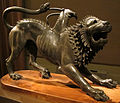
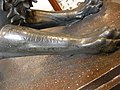
    • Tinscvil
    • A gift to Tins

See also

[edit]

References

[edit]
Revisions and contributorsEdit on WikipediaRead on Wikipedia
from Grokipedia
Tinia (also known as Tin, Tinh, Tins, or ) was the supreme sky god and central of the Etruscan pantheon, serving as the highest authority among the gods and wielding power over weather, justice, and cosmic order. His name derives from the Indo-European root diie-, meaning "bright day" or "sky," reflecting his association with daylight and the heavens. Tinia was equated by the Romans with Iuppiter and by the with , a evident in and inscriptions from the 6th century BCE onward. As the protector of boundaries and maintainer of peace among the known as the dii consentes, he required their consent to unleash his most potent thunderbolts, symbolizing his role in balanced governance. Tinia's primary attributes included the —a he hurled in three forms, from mild to devastating—and a scepter denoting sovereignty, often depicted in votive offerings and mythological scenes such as the judgment over Achilles and . He was the consort of Uni (the Etruscan Juno) and father to the Tinas Clenar (Castur and Pultuce, equivalents of the Dioscuri), with a grandson in , the prophetic figure who revealed Etruscan religious rites. In Etruscan , Tinia played a pivotal role through haruspicy and the Brontoscopic Calendar, where thunder and lightning from his domain were interpreted as omens by priests to guide societal and religious decisions. Artistically, Tinia appeared in two main forms: as an older, bearded figure following Zeus's in earlier periods, or as a youthful, clean-shaven god in later representations up to the 1st century BCE. A notable example is the cult statue crafted by the Etruscan artist Vulca for Rome's Temple of Capitolinus around the late 6th century BCE, marking one of the earliest documented instances of his worship outside . The first epigraphic evidence of his cult appears on a from in the early 5th century BCE, underscoring his enduring prominence in Etruscan religious life until the Roman assimilation of .

Name and Etymology

Linguistic Origins

The name Tinia derives from the Etruscan root tin-, which signifies "day" or "heaven," underscoring the deity's dominion over the celestial realm and daylight. This adaptation appears in various inscriptions, where tin- functions as a core element in divine nomenclature, distinct from but conceptually aligned with broader sky god traditions. Scholars link tin- to possible pre-Indo-European substrates influencing Etruscan vocabulary, while noting its parallels to the Proto-Indo-European reconstructed form *dyēus, denoting the daylight-sky deity and root for terms meaning "day" and "sky" across Indo-European languages. Historical linguistic analyses, such as those by Nancy Thomson de Grummond, highlight Tinia's organic development within Etruscan without reliance on direct Greek or Roman borrowings, preserving its indigenous etymological integrity amid cultural exchanges. This evolution positions Tinia as a native expression of sky divinity, briefly comparable to equivalents like Jupiter or Zeus.

Variant Forms

The name of the Etruscan sky god is attested in various orthographic forms across inscriptions and religious artifacts, reflecting the language's non-standardized spelling conventions. Common variants include Tin, Tinia, Tina, and Tins, with Tin appearing frequently in abbreviated dedications and Tinia in more formal or extended contexts. For instance, the bronze Chimera of Arezzo (ca. 4th century BCE) bears the inscription tinścvil, a form combining the base name with an epithet denoting thunderbolt associations. Epithets often modify these variants to specify divine attributes or roles in contexts. On the Liver, a model used for hepatoscopy (ca. 100 BCE), Tinia appears as Tin Cilens (meaning "Tinia of Boundaries"), inscribed in one of the liver's sections to denote protective oversight of territorial limits. Another , Tin Thufltha, links Tinia to the fury-like Thufltha, suggesting punitive or celestial enforcement, and is positioned in the liver's outer compartments alongside other sky-related gods. The form Tins Cvil (" Tinia") recurs in religious dedications, such as on a lamp from and the Chimera, where it invokes the god's lightning-wielding power in votive offerings. These s are typically embedded in texts for or dedications, emphasizing Tinia's supremacy in cosmic order. Regional variations in naming are observable between northern and southern , influenced by local scribal practices and inscription types. In northern sites like and , abbreviated forms such as Tin or Tins predominate in concise votive and divinatory texts, as seen on the Piacenza Liver and boundary markers. Southern , including Tarquinii and , favors longer compounds like Tinas Cliniar ("Tinia the Thunderer") on painted or Tinia Calusna (associating Tinia with the underworld god Calu) in temple inscriptions, reflecting more elaborate ritual expressions. Even extramural evidence, such as Tunisian boundary stones (Tinś Φ), shows abbreviated northern-style forms adapted for protective oaths abroad.

Role in Etruscan Mythology

Supreme Deity Status

Tinia held the position of the supreme deity within the Etruscan pantheon, serving as the central figure of the divine realm and the sky god analogous to the Greek Zeus and Roman Jupiter. As the highest authority among the gods, Tinia was regarded as the power who spoke through thunder and maintained overarching control over celestial affairs, though his major decisions, such as the issuance of the most potent thunderbolts, required the consent of a divine council known as the dii consentes. This hierarchical supremacy is evidenced in Etruscan religious artifacts, particularly the bronze model of a sheep's liver from , dated to the BCE, which divides the sky into sixteen regions inscribed with deities. On this divinatory tool, Tinia occupies prominent positions in three outer compartments and two inner fields, underscoring his role in cosmic order and the arbitration of peace among the gods, often in association with figures like Cilensle and Veltha. However, ancient Roman sources introduce debates regarding Tinia's unchallenged primacy, with (116–27 BCE) describing (also Veltha or ) as the "deus Etruriae princeps," or chief god of , potentially positioning this chthonic deity above Tinia, who was more specifically the ruler of the sky. Scholars interpret this as possibly representing a collective or overarching supreme aspect assimilated to Tinia in later traditions, highlighting the fluid nature of Etruscan divine hierarchy as transmitted through .

Powers and Domains

Tinia, as the supreme deity in Etruscan religion, held dominion over the sky, thunder, lightning, and storms, wielding thunderbolts as primary instruments of divine will and celestial authority. These thunderbolts served not merely as weapons but as signs of cosmic order, with Tinia capable of hurling three distinct types: a benign warning bolt at his discretion, a bolt of good or harm requiring approval from the Dii Consentes (the council of twelve major gods), and a fully destructive bolt necessitating permission from the superior Dii Involuti. This structured use of thunderbolts underscored Tinia's role in maintaining harmony among the gods and interpreting omens through the Etruscan disciplina, where lightning strikes were divined across a sky divided into sixteen regions. As one of the Novensiles—the group of nine thunderbolt-hurling deities that included alongside figures like Uni (Juno) and (Minerva)—Tinia exercised authority over eleven recognized types of thunderbolts, personally controlling three while sharing the rest with his divine peers. This collective yet hierarchical power distinguished Etruscan theology from more unilateral Greco-Roman models, emphasizing Tinia's mediation within divine councils to enact celestial judgments. His name, derived from the Etruscan tin meaning "day," further linked him to diurnal cycles and the broader temporal aspects of the heavens, reflecting a unique emphasis on structured cosmic timing in Etruscan belief. Tinia's domains extended to justice, oaths, and boundaries, where he enforced divine law and territorial integrity, often in tandem with Selvans, the specialized protector of limits. He regarded boundaries as sacred, overseeing their inviolability to prevent human greed and chaos, as evidenced in prophetic texts like the Libri Vegoici, which warned of natural disasters for violators under Tinia's purview. Thunderbolts thus functioned as enforcers of oaths and retribution, signaling prosperity for the just and hardship for oath-breakers, thereby upholding both earthly and cosmic order.

Iconography and Attributes

Physical Depictions

Tinia is frequently represented in as a mature, bearded male figure, embodying authority and power, often standing in a rigid, frontal pose with one arm extended to grasp attributes such as a scepter or . This depiction, seen in bronze statuettes from northern around 480 BCE, emphasizes naturalistic facial features and musculature while incorporating stylized elements typical of the period's votive offerings. In contrast, Tinia also appears as a youthful, beardless god, a variation that highlights the fluid and indigenous aspects of Etruscan divine distinct from stricter Greek prototypes. Common postures include enthronement, symbolizing his role as supreme deity, or standing with arms raised or extended, as in scenes where he presides over divine gatherings. On engraved bronze mirrors, Tinia is shown with figures such as Uni and , underscoring his central position in the pantheon. Similar representations occur on vases and mirrors depicting him in dynamic interactions, including hurling thunderbolts in mythological narratives adapted to Etruscan contexts. Regional and temporal variations in Tinia's depictions emerged prominently from the late Archaic period onward, around 500 BCE, as Greek artistic influences introduced greater and realism. Earlier, more stylized portrayals from the BCE gave way to more humanized forms in southern , where interactions with Greek colonists led to refined proportions and expressive gestures in sculptures and reliefs. These evolutions are evident in artifacts from and , where Tinia's figure blends indigenous traditions with Hellenic ideals, such as idealized youthful vitality or dignified maturity.

Symbols and Thunderbolts

Tinia's primary symbol is the , embodying his dominion over the sky, storms, and divine authority as the supreme Etruscan . This attribute, often depicted in as a stylized weapon wielded in his hand, underscores his role as a storm capable of unleashing celestial power to enforce order or punish transgressions. In Etruscan , the thunderbolt evokes associations with violence, , and warfare, which align with Tinia's protective yet destructive aspects in mythological narratives. Etruscan lore classifies into eleven distinct types, dispatched by nine gods, with Tinia—equivalent to —mastering the three most potent varieties, including the swift (celer), the mild (mitis), and the thunderous (tonans), in forked and linear forms that signify varying degrees of severity and intent. These forms were not merely symbolic but integral to practices, where the shape, direction, and sky region of a thunderbolt served as omens interpreted by priests to predict events or divine the gods' will. Scholarly analysis, such as that by Nancy T. de Grummond, highlights how these thunderbolts differentiated between (fulgur, a targeted sign from specific deities like Tinia) and thunder (brontes, a broader portent), emphasizing their role in fulgural divination rather than conflating them with haruspical methods. Complementing the thunderbolt, Tinia's other key attributes include the eagle, symbolizing his over the heavens and swift enforcement of , and the scepter, often crowned with an eagle or thunderbolt motif, denoting royal authority and cosmic rule. These elements, drawn from Etruscan artistic representations, parallel the of his Greco-Roman counterparts while affirming Tinia's unique position as the pantheon's ruler. In depictions, he is occasionally shown holding these symbols alongside the , reinforcing his multifaceted identity as both benevolent overseer and formidable .

Family and Pantheon

Consort and Offspring

Tinia's primary consort was Uni, the supreme goddess of the Etruscan pantheon, who served as his divine counterpart and was equated with the Roman Juno and Greek . Together, Tinia and Uni formed the ruling couple overseeing celestial and terrestrial domains, symbolizing the balance of divine authority in marriage, fertility, and protection. Uni's role extended to nurturing aspects, as seen in inscriptions and votive offerings where she appears alongside Tinia in harmonious union. Tinia and Uni were parents to the divine twins Castur and Pultuce, equivalents of the Roman Dioscuri (), who represented protection and horsemanship. Tinia was also the grandfather of , a prophetic child figure who emerged from the earth and revealed Etruscan religious rites. , embodying wisdom, strategy, and craftsmanship in parallel to the Roman and Greek , formed part of the core triad with Tinia and Uni, highlighting her integral status in the pantheon. , the hero-god akin to , was a son of Tinia and the mortal Alchumena, frequently depicted as a muscular protector in Etruscan lore; Uni often appeared as his antagonist. In some traditions, , the god of wine and vitality equivalent to , was regarded as Tinia's son through the mortal , reflecting themes of divine intervention in birth myths. Familial dynamics in Etruscan mythology emphasized protective bonds, with Tinia portrayed in —such as engraved mirrors—as the authoritative safeguarding his progeny during heroic trials, contrasting with more adversarial Greek parallels. For instance, scenes show receiving aid from Tinia, underscoring the god's role in empowering his offspring against threats. These representations, often found in tomb furnishings, illustrate a cohesive divine family unit central to Etruscan cosmological narratives.

Position Among Other Gods

Tinia occupied the paramount position in the Etruscan pantheon as the supreme sky god and leader of the divine triad comprising Tinia, Uni, and Menrva, which functioned as the core of Etruscan religious authority in cities and served as poliad deities. This triad, with Tinia at its apex wielding thunderbolts and overseeing heavenly order, influenced the Roman Capitoline Triad of Jupiter, Juno, and Minerva, though the Etruscan configuration emphasized a more collaborative yet hierarchically topped structure among the three, distinct from the Roman emphasis on Jupiter's singular dominance. Within the broader pantheon, Tinia presided over a council of twelve major deities known as the , six male and six female gods who advised him impartially on cosmic and divine governance, akin to a senatorial assembly of immortals. Tinia's alliances extended to figures like , the winged messenger god equivalent to Hermes, who relayed Tinia's directives and facilitated inter-deity communications, underscoring Tinia's central coordinating role. In terms of hierarchy, Tinia exerted authority over subordinate deities such as Nethuns, the bearded sea god with , whose domain of waters and wells fell under the overarching sky rule without evidence of rivalry. Tinia's influence on pantheon structure manifested in divination artifacts like the Piacenza bronze liver model, where his name appears in multiple prominent zones, positioning him as the arbiter for interpreting divine intentions and resolving celestial disputes through haruspical readings that mapped godly realms onto the organ's sections.

Worship and Cult Practices

Rituals and Dedications

In Etruscan religion, rituals dedicated to Tinia emphasized divination to discern the god's will, particularly through the interpretation of thunderbolts and animal entrails. Thunderbolts were categorized into three types—advisory, confirming, and conditional—wielded by Tinia as signs from the divine realm, with the sky divided into 16 regions to determine their auspicious or ominous directions. Haruspices, specialized priests, conducted haruspicy by examining the livers of sacrificed sheep, using models like the Piacenza Liver to interpret omens related to Tinia's favor in matters of weather, warfare, and state affairs. These practices formed part of the Etrusca disciplina, a codified system of religious knowledge. Animal sacrifices were central to invoking Tinia's benevolence, typically involving the slaughter of such as sheep, with and liquid offerings poured into conduits to reach the or chthonic aspects of the deity. Such rites sought Tinia's intervention for favorable weather or victory in battle, aligning with his domain over storms and the heavens. While specific dedications to Tinia often featured votive statues and inscriptions, examples include the Chimera of Arezzo, inscribed tinścvil ("gift to Tinia"), offered as a for divine protection. Other dedications encompassed statuettes, mirrors, and terracotta elements placed in sanctuaries to honor the god. Annual rites were guided by the Brontoscopic Calendar, a liturgical text attributing omens to thunder on specific days, such as blessings from Tinia on , tying rituals to celestial events like storms for agricultural and political prognostication. Priests played a pivotal role in these observances, with haruspices not only performing sacrifices but also advising on Tinia's interpretations, sometimes depicted in wearing caps and holding temple keys. Votive inscriptions briefly reference such dedications, as seen in artifacts like the Tinas Cliniar on an Oltos cup.

Cult Centers and Temples

The worship of Tinia, the supreme Etruscan sky god, was prominently featured in major urban centers across , where temples dedicated to him as part of the divine triad with Uni and formed the core of religious architecture. Every significant Etruscan city, including and , maintained such temples, reflecting Tinia's central role in civic and federal cult practices. In , one of Etruria's most influential religious hubs, monumental structures like the Ara della Regina complex—dating to the 4th century BCE—featured altars and sacred spaces aligned for celestial observations integral to Etruscan practices. At , the Portonaccio Temple (ca. 510–500 BCE) exemplifies this tradition, with its triple-cella layout explicitly accommodating the triad of , Uni, and , though the central dedication leaned toward ; the structure's high podium and frontal altar facilitated communal rites tied to Tinia's domain. The temple's design, including a deep porch supported by Tuscan columns, allowed for open-air ceremonies where priests could observe celestial signs, a practice integral to Tinia's cult as the ruler of lightning and . Archaeological evidence from these 6th–4th century BCE sites reveals consistent use of foundations and terracotta decorations, emphasizing visibility toward the sky for thunder observation. Beyond urban cores, the Fanum Voltumnae sanctuary near served as a potential supreme federal temple for , identified through graffiti and structural analysis as possibly dedicated to Tinia Veltumne, blending his attributes with the league's patron deity . Spanning over 40 hectares, this extra-urban complex included multiple temples (e.g., Temple A) with altars suited for league-wide god invocations, active from the 6th century BCE. Regional variations in Tinia's cult emerged through trade networks, extending Etruscan religious influence to distant areas like , where artifacts indicate syncretic practices post-7th century BCE commerce. Following Roman conquest in the 4th–3rd centuries BCE, Tinia's sites were integrated into Jupiter's worship, as seen in Veii's adaptation into Roman sacred landscapes, preserving altars for continued thunder-related observances.

Archaeological and Historical Evidence

Key Inscriptions

The earliest epigraphic evidence of Tinia's cult appears on the Tabula Capuana, a terracotta slab from dated to around 470 BCE. This inscribed ritual calendar in Etruscan contains references to Tinia, underscoring his role in religious practices from the early BCE. One of the most significant inscriptions mentioning Tinia appears on the Piacenza Liver, a model of a sheep's liver used for divinatory purposes in Etruscan haruspicy, dated to approximately 300 BC. This artifact features the epithet "Tin Cilens" in one of its sections, interpreted as referring to Tinia in a protective role associated with boundaries, reflecting his overarching authority in Etruscan cosmology. Other notable inscriptions invoking Tinia include "Tinscvil" on the , a bronze statue dated to the , where it signifies a votive dedication "gift to Tinia," underscoring the god's prominence in offerings. Epithets such as "cvil" in compounds like "Tinscvil" mean "gift to Tinia," indicating a votive dedication rather than a reference to thunder. Similarly, an red-figure attributed to the painter Oltos, around 500 BC, bears an Etruscan dedication "itum turuce venel apelinas tinas cliniiaras," translating to a from Venel Apelinas to the sons of Tinia, highlighting familial aspects of the in votive contexts. These inscriptions provide crucial insights into Tinia's multifaceted attributes, yet gaps in the decipherment of the Etruscan language limit full comprehension of their theological nuances, as ongoing scholarly analysis reveals ambiguities in etymology and ritual implications.

Artifacts and Representations

One of the most notable artifacts associated with Tinia is the Bronze Chimera of Arezzo, a dynamic bronze sculpture measuring approximately 129 cm in length and dating to around 400 BCE. This hybrid creature, combining elements of a lion, goat, and serpent, was crafted as a votive offering and bears an inscription on its right foreleg dedicating it to Tinia, the Etruscan sky god. The piece symbolizes Tinia's dominion over storms and natural forces, reflecting the Etruscan tradition of presenting elaborate animal figures to divine patrons for protection or favor. Discovered in 1553 near Arezzo, Italy, it exemplifies the technical mastery of Etruscan bronze casting during the late Archaic period and is now housed in the National Archaeological Museum of Florence. Etruscan bronze mirrors frequently depict Tinia in mythological scenes, often wielding a thunderbolt to emphasize his role as a thunder god. For instance, a circular bronze mirror from the 6th to 3rd century BCE shows Tinia embracing Semla (Semele), with the god nude, wreathed, and grasping a thunderbolt in one hand while a winged Semla stands beside him, accompanied by a flute-playing satyr. These mirrors, typically used by women and deposited as grave goods, feature incised engravings on the non-reflective side, blending Greek influences with Etruscan iconography. Similarly, cinerary urns from Volterra tombs, dating to the 4th and 3rd centuries BCE, portray Tinia in reliefs atop lids or on friezes, such as scenes with the god alongside his divine family or in cosmic narratives, underscoring his central place in funerary art. These urns, carved from local tufa or alabaster, served to house cremated remains and evoke eternal themes tied to Tinia's authority. Boundary markers known as cippi and various votive figures further illustrate the widespread cult of Tinia across and beyond. Cippi, often cylindrical or rectangular or stones used to delineate or boundaries from the 6th to 3rd centuries BCE, were sometimes dedicated to Tinia as protectors of sacred limits. Votive bronzes and terracottas, including small statuettes of the god or symbolic offerings like motifs, have been recovered from sanctuaries in , reflecting personal devotions for divine intervention. Evidence of the cult's spread appears in isolated Etruscan imports found in , such as bronze votives from Punic sites linked to trade networks with , indicating Tinia's veneration extended through Mediterranean commerce by the 6th century BCE. Post-3rd century BCE, these representations influenced Roman depictions of , with Etruscan thunderbolt-wielding figures informing temple sculptures and coinage in the emerging Roman pantheon.

References

Add your contribution
Related Hubs
User Avatar
No comments yet.