Hubbry Logo
SemlaSemlaMain
Open search
Semla
Community hub
Semla
logo
8 pages, 0 posts
0 subscribers
Be the first to start a discussion here.
Semla
Semla
from Wikipedia
Semla
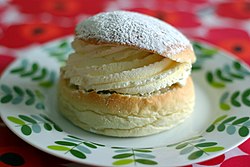
Traditional Swedish semla
Alternative namesLaskiaispulla and Lent buns
TypeSweet roll
CourseDessert
Place of originSweden
Region or stateNorthern Europe
Associated cuisineSweden
Invented1500s
Serving temperatureMedium
Main ingredientsWheat bread, whipped cream, and almond paste or jam.
Ingredients generally usedIcing sugar
VariationsHetvägg
Food energy
(per serving)
412 kcal (1,720 kJ)
Nutritional value
(per serving)
Protein5.7 g
Fat17 g
Carbohydrate40 g
Similar dishesPulla and cardamom bread
  •   Media: Semla

A semla, laskiaispulla, Swedish eclair, fastlagsbulle /fastelavnsbolle, vastlakukkel, or vēja kūkas is a traditional sweet roll made in various forms in Sweden,[1] Finland, Estonia, Denmark, the Faroe Islands, Iceland, Norway,[2] and Latvia, associated with Lent and especially Shrove Tuesday in most countries, Shrove Monday in Denmark, parts of southern Sweden, Iceland and Faroe Islands or Sunday of Fastelavn in Norway. In Sweden it is most commonly known as just semla (plural: semlor), but is also known as fettisdagsbulle, lit.'Fat Tuesday bun' or 'Shrove Tuesday bun'. In the southern parts of Sweden, as well as in Swedish-speaking Finland, it is known as fastlagsbulle (plural: fastlagsbullar; semla on the other hand means a plain wheat bun with butter, called bulle in Swedish). In Poland it is known as ptyś. In Estonia it is called vastlakukkel. In Norway and Denmark it is called fastelavnsbolle. In Iceland, it is known as a bolla and served on Bolludagur. In Faroe Islands it is called Føstulávintsbolli, and is served on Føstulávintsmánadagur. In Latvia, it is called vēja kūkas. Semla served in a bowl of hot milk is hetvägg.

Etymology

[edit]

The name semla (plural: semlor) is a loan word from Middle Low German semmel, originally deriving from the Latin simila, meaning 'flour', itself a borrowing from Greek σεμίδαλις (semidalis), which was the name used for the finest quality wheat flour.[3] In the southernmost part of Sweden (Scania) and by the Swedish-speaking population in Finland, they are known as fastlagsbulle. In Denmark and Norway they are known as fastelavnsbolle (fastlagen and fastelavn being the equivalent of Shrove Tuesday). In Scanian, the feast is also called fastelann. In Finnish they are known as laskiaispulla (which refers to the Finnish laskiainen), in Latvian as vēja kūkas, and in Estonian as vastlakukkel.

Sweden/Finland/Estonia

[edit]

Today, the Swedish-Finnish semla consists of a cardamom-spiced wheat bun which has its top cut off, and is then filled with a mix of milk and almond paste, topped with whipped cream. The cut-off top serves as a lid and is dusted with powdered sugar. Today it is often eaten on its own, with coffee or tea. Some prefer to eat it in a bowl of hot milk.

In Finland, the bun is often filled with strawberry or raspberry jam instead of almond paste, and bakeries in Finland usually offer both versions. (Many bakeries distinguish between the two by decorating the traditional bun with almonds on top, whereas the jam-filled version has powdered sugar on top). Opinions on which of the two is the "correct" filling are divided, and it is a common topic of contention (similar to e.g. the matter of pineapple on pizza, i.e. usually not taken too seriously).[4] In Finland-Swedish, semla means a plain wheat bun, used for bread and butter, and not a sweet bun.

At some point Swedes grew tired of the strict observance of Lent, added cream and almond paste to the mix and started eating semla every Tuesday between Shrove Tuesday and Easter. Every year, at around the same time that the Swedish bakeries fill with semlor, local newspapers start to fill with semla taste tests. Panels of 'experts' dissect and inspect tables full of semlor to find the best in town.[5][6]

Some bakeries have created alternative forms of the pastry, such as the "semmelwrap" formed as a wrap rather than the traditional bun, while others have added e.g. chocolate, marzipan, or pistachios to the recipe.[7]

In Finland and Estonia the traditional dessert predates Christian influences.[citation needed] Laskiaissunnuntai and laskiaistiistai, both days included in laskiainen, were festivals when children and youth would go sledding or downhill sliding on a hill or a slope to determine how the crop would yield in the coming year. Those who slid the farthest were going to get the best crop. Hence the festival is named after the act of sliding or sledding downhill, laskea. Nowadays laskiainen has been integrated into Christian customs as the beginning of lent before Easter.[8]

In Estonia, vastlakukkel is often a cardamom-spiced wheat bun with whipped cream only[2] or with jam or marzipan filling added. Similarly to Finland, vastlad or vastlapäev (Shrove Tuesday) involves sledding. Estonians believed that the one with the longest slide would have the best flax crop yield – specifically the longer the crop, the longer fiber which would mean a higher quality linen textile could be produced.

Norway

[edit]
Norwegian fastelavnsbolle with whipped cream, jam and powdered sugar

Fastelavnsbolle consists of a cardamom-spiced wheat bun which has its top cut off, and is then filled with whipped cream, topped with jam. The cut-off top serves as a lid and is dusted with powdered sugar. The buns are served at Sunday of Fastelavn (Shrove Sunday), but were previously associated with Shrove Tuesday.[9]

Denmark/Iceland/Faroe Islands

[edit]

The version sold in Danish bakeries on or around Shrove Monday is rather different, made from puff pastry and filled with whipped cream, a bit of jam and often with icing on top. At home people may bake a version more similar to a usual wheat roll, mixing plain yeast dough with raisins, succade and sometimes candied bitter orange peel.

In Iceland it is done in a similar way but in place of puff pastry more common is the choux pastry version.

In Icelandic, Shrove Monday is called bolludagur (bun day), named after the pastry.

In the Faroe Islands, it is done with choux pastry, and filled with vanilla cream, whipped cream and jam, and topped with chocolate icing.

History

[edit]

The oldest version of the semla was a plain bread bun, eaten in a bowl of warm milk. In Swedish this is known as hetvägg, from Middle Low German hete Weggen ('hot wedges') or German heisse Wecken ('hot buns') and falsely interpreted as "hotwall".[10][11]

The semla was originally eaten only on Shrove Tuesday, or all of the three days before Lent, as the last festive food before Lent. However, with the arrival of the Protestant Reformation, the Swedes stopped observing a strict fast for Lent. The semla in its bowl of warm milk became a traditional dessert every Tuesday between Shrove Tuesday and Easter. Today, semlor are available in shops and bakeries every day from shortly after Christmas until Easter. Each Swede consumes on average four to five bakery-produced semlor each year, in addition to any that are homemade.[12]

According to a popular myth, King Adolf Frederick of Sweden died of digestion problems on February 12, 1771, after consuming a hetvägg (semla), the king's favorite dessert, after a meal consisting of sauerkraut, turnips, caviar, smoked herring, and champagne.[13] In recent versions of the legend, the semla has turned into 14, and sometimes into cinnamon buns.[14]

This was the sweet chosen to represent Finland in the Café Europe initiative of the Austrian presidency of the European Union, on Europe Day 2006.

See also

[edit]

References

[edit]
Revisions and contributorsEdit on WikipediaRead on Wikipedia
from Grokipedia
A semla (plural: semlor) is a traditional Swedish pastry featuring a soft, cardamom-infused that is hollowed out, filled with a mixture of and the bun's own crumbs, topped with , and dusted with . It is primarily associated with the Christian observance of , especially (known as fettisdagen in Swedish), marking the last day of before the period begins. The origins of the semla trace back over 700 years to medieval , where it began as a simple plain (semla deriving from the German semel, meaning fine ) eaten with warm milk to provide sustenance before . By the 16th century, it had evolved into a more elaborate treat influenced by German traditions like Heisswecken, with the first documented Swedish reference appearing in a 1689 wedding poem. The modern form, incorporating and , emerged in the early specifically becoming popular in the and —transforming it from a basic roll into a luxurious dessert. Culturally, semlor hold a prominent place in Swedish winter traditions, with an estimated 5 to 6 million consumed annually on Fat Tuesday alone, generating over 100 million Swedish kronor in sales. Historically viewed as a rare luxury due to expensive ingredients like almonds, , and , it was once reserved for special occasions; during rationing, substitutions such as potatoes or gelatin were used in the filling. A famous surrounds King Adolf Frederick, who reportedly died in 1771 from digestive issues after consuming 14 semlor (served in warm as hetvägg) along with other rich foods, earning the pastry the nickname "kingslayer" in contemporary accounts. In contemporary Sweden, semlor are enjoyed from late autumn through early spring, far beyond their Lenten roots, with innovative variations like the semmelwrap (a flat, rolled dough filled like a , invented in 2015) and princess semla (layered with and fruit) reflecting ongoing culinary creativity. As of 2025, semlor continue to inspire creativity, gaining viral popularity on platforms like and featuring in innovative dishes at renowned restaurants such as Noma. Despite these modern twists, the classic version remains a beloved symbol of seasonal festivity and communal indulgence.

Description

Ingredients

The primary base of a traditional semla is a cardamom-spiced , enriched with eggs, , , , and to create a soft, slightly sweet crumb that provides structural support and subtle flavor. , a staple in Scandinavian traditions, imparts a distinctive aromatic warmth to the dough. The filling consists of almond paste prepared from blanched almonds ground with confectioners' sugar, combined with the moistened breadcrumbs scooped from the bun's interior and bound with milk for a creamy, nutty texture that contrasts the bun's lightness. The topping features whipped heavy cream, finished with a dusting of powdered sugar to enhance visual appeal and add a delicate sweetness. An optional traditional addition is hot milk, in which the assembled semla is served as hetvägg, allowing the to absorb the warm liquid for a softer, soup-like consistency. Semlor are indulgent due to rich ingredients like and .

Preparation

The preparation of a semla begins with making the cardamom-infused dough. To achieve the soft, slightly sweet texture characteristic of traditional semlor, combine , sugar, salt, ground , and in a , then incorporate warm and an , followed by softened . Knead the —either by hand for about 5 minutes or using a stand mixer on low speed for 3 minutes—until it forms a smooth, elastic that pulls away from the sides of the . Cover the and allow it to rise in a warm place for 40 to 90 minutes, or until it has doubled in volume. Once risen, divide the into 10 to 12 equal portions, shape each into a round ball, and place them on a parchment-lined sheet. Cover and let the shaped buns rise again for 30 to 40 minutes until puffy. Preheat the to 200°C (400°F). Bake the buns in the lower part of the for 15 to 20 minutes, or until they are on top. Cool the baked buns completely on a wire rack to prevent sogginess during filling. To hollow and fill the buns, slice off a thin from the top of each cooled and set aside. Gently remove the soft interior crumbs using a , taking care not to tear the outer shell. Crumble the removed bread and mix it with grated and a small amount of —typically about 100 ml for 12 buns—to create a thick, moist filling that binds together without becoming runny. Spoon or press this mixture back into the hollowed bun cavities, ensuring even distribution for balanced texture. Assembly involves whipping heavy cream to stiff peaks and piping or spooning a generous mound over the almond filling in each bun. Replace the reserved lid on top, pressing lightly to secure it. Finally, dust the entire semla liberally with powdered sugar for a snowy appearance and subtle sweetness that complements the cardamom and cream. This step enhances the classic presentation, with the cream providing airy contrast to the dense filling. Semlor can be served in traditional or modern styles. In the historic hetvägg method, place the assembled semla in a and pour hot milk around or over it, often dusted with , to soften the bun into a warm, pudding-like treat. Alternatively, modern preparations serve the semla dry on a plate, allowing the cream and filling to remain distinct. The total preparation time, including rising periods, is approximately 2 to 3 hours.

Name and Terminology

Etymology

The word semla derives from semmel, denoting a fine bun, which entered the Swedish lexicon around the as a during the period of extensive linguistic exchange facilitated by the . This term itself originates from Latin simila, referring to the finest quality flour, borrowed through the intermediary Greek semidalis (fine flour). In its early usage, semla broadly signified any made from refined , often a simple, plain roll without additional fillings. By the , the term had become associated with Lenten traditions in , though the modern fillings of (19th century) and (20th century) were introduced later, while retaining its core association with wheat-based . This narrowing reflects broader patterns of lexical in Nordic languages under German influence, where trade routes of the disseminated specialized vocabulary across .

Regional Names

In Sweden, the pastry is known as semla (plural semlor), a term borrowed from the German Semmel and widely used to denote the cardamom-spiced bun filled with almond paste and cream. An older name for it is fastlagsbulle. In Finland, it is referred to as laskiaispulla, combining laskiainen (referring to the Shrovetide season) with pulla (a sweet bun), reflecting the Finnish emphasis on the pre-Lenten festive period. Estonia calls it vastlakukkel, derived from vastla (Shrove Tuesday) and kukkel (bun), which underscores the connection to the specific day of celebration and local baking traditions. In and , the equivalent is termed fastelavnsbolle, formed from (Shrovetide or carnival season) and bolle (), highlighting the pastry's role in the broader carnivalesque of these countries. uses bolla or more specifically rjómabollur (), a simple designation tied to bolludagur ( Day), the Icelandic observance on that centers community feasting with these treats. In the [Faroe Islands](/page/Faroe Islands), it is known as fastelavnsbolle or Føstulávintsbolli, adapting the Danish nomenclature with Faroese orthography to align with the islands' linguistic heritage rooted in North Germanic traditions. These names share a distant etymological foundation in the Latin simila (fine flour), illustrating how regional identities have shaped the terminology while preserving the pastry's core association with Lenten .

History

Origins and Early Traditions

The semla originated in medieval as a simple wheat bun consumed during pre-Lent festivities, particularly on , known in Swedish as fettisdag, marking the final opportunity for indulgence before the period of fasting associated with . This emerged in the , with the earliest records indicating its popularity in around 1541, when it was documented as a basic, unenriched symbolizing abundance in the face of impending abstinence. The bun's modest form reflected the broader Catholic customs of the era, where enriched or spiced breads were prepared across to celebrate the end of the season and prepare the body for Lenten restrictions on dairy and fats. In , prior to the in the 1520s, the semla—initially called semmel—was typically served plain and soaked in warm milk, a preparation known as hetvägg, derived from hete wēg meaning "hot way," highlighting its German linguistic roots. This practice tied into the Hanseatic League's influence, as German merchants introduced similar bun traditions to Scandinavian ports during the , blending local baking with continental trade goods like and spices. First mentions appear in 16th-century Swedish texts, such as church records and ledgers, describing the semla as a Lenten precursor treat weighing about 53 grams and shaped modestly, underscoring its role in Catholic rituals before Sweden's shift to diminished such observances. An illustrative anecdote from early semla consumption underscores the risks of excess tied to these traditions: on February 12, 1771, King died of a stroke, reportedly following a feast that included 14 semlor served in hot milk (hetvägg), alongside other rich foods, as recorded in royal medical accounts. This event, while not altering the semla's basic form at the time, highlighted the cultural emphasis on hearty pre-Lent eating in 18th-century .

Evolution and Modern Developments

Following the Protestant in 1527, which relaxed strict Lenten fasting rules, the traditional plain wheat bun known as semla began to incorporate richer elements, evolving from a simple into a more indulgent treat over subsequent centuries. By the 18th century, bakers started filling the buns with —such as in Cajsa Warg's 1755 including ground almonds blended with cream and sugar—marking a significant shift toward the filled familiar today. In the , semlor were commonly served as hetvägg—hollowed out and soaked in hot milk—but this practice gradually gave way to the drier, standalone version topped with , which became popular in the 1920s and standard in the early as popularized the as a standalone accompaniment to beverages. A notable milestone in semla's history occurred in 1771, when King reportedly consumed 14 semlor (prepared as hetvägg) after a heavy meal, leading to severe digestive distress and his death from what was likely a exacerbated by . This incident, though possibly exaggerated in , served as a in Swedish culture, encouraging moderation during the indulgent pre-Lent period and influencing perceptions of the pastry's richness. In the , semla underwent further commercialization, with bakeries extending availability beyond (Fettisdagen) to the entire period from through , driven by rising consumption and demand for seasonal treats. By the early , annual per capita consumption in had reached approximately 4 to 5 semlor, reflecting the pastry's integration into everyday fika ( break) traditions amid broader and expansion. Modern developments since the have pushed semla beyond seasonal confines, with some Swedish bakeries offering it year-round to capitalize on its popularity, alongside innovative adaptations like vegan versions using plant-based whipped creams and nut-free alternatives, and gluten-free options made with alternative flours. These changes, emerging prominently around 2015 in response to dietary trends, have made the traditional more accessible while preserving its core cardamom-infused appeal.

Regional Variations

Swedish, Finnish, and Estonian Semlor

In , the traditional semla consists of a soft flavored with , hollowed out and filled with mandelmassa—a sweet made from ground almonds, , and sometimes whites—before being topped with generous amounts of lightly sweetened and dusted with . This version is most commonly enjoyed on Fettisdag, or Fat Tuesday, the day before , marking the height of the Lenten season celebrations. The buns typically measure 8-10 cm in diameter, providing a substantial, indulgent treat that balances the aromatic spice of the bun with the rich, nutty filling and airy cream. In , the equivalent is known as laskiaispulla, a wheat-based similar in structure to the Swedish semla but often featuring variations in the filling, such as or jam layered with , though is also used in some recipes. These buns are traditionally served during Laskiaissunnuntai, the Sunday before , as part of festivities that emphasize feasting before . Like their Swedish counterparts, Finnish laskiaispullas are dusted with and average 8-10 cm in , maintaining a shared emphasis on light, fluffy dough and creamy toppings. Estonia's vastlakukkel shares the wheat bun base and dusting of its Nordic-Baltic neighbors, typically filled with and —such as or —or occasionally , resulting in a simpler yet festive profile. These buns, also around 8-10 cm in diameter, are central to Vastlapäev celebrations on , where they accompany and are enjoyed amid outdoor traditions like down hills to promote good fortune and fertility for the coming year. While the core preparation involves slicing the bun to insert the fillings, Estonian variations highlight regional jams over nut-based pastes, distinguishing them subtly from the almond-centric Swedish style.

Norwegian and Danish Fastelavnsboller

In , the fastelavnsbolle is a soft, cardamom-spiced that is baked round and golden, then sliced horizontally to create a , with the interior filled with and sweetened before the top is replaced. The , enriched with , , sugar, and fresh , is kneaded thoroughly, allowed to rise, shaped into buns, and baked at around 200°C for 10-15 minutes to achieve a fluffy texture. These buns are typically dusted with for a simple finish, emphasizing the contrast between the warm spices, tart jam, and airy cream. Danish fastelavnsboller exhibit more variation, often prepared as a plain filled with remonce—a rich almond-butter paste made from , softened butter, and sugar—topped with or , or alternatively as a Berliner-style doughnut-like deep-fried or baked and injected with jam. Unlike the Norwegian version, Danish preparations frequently incorporate dough for added crispness and flakiness, especially in settings, while -based ones may be pre-filled before baking to encase the remonce or jam. These are commonly iced with a glaze of and water, sometimes flavored with cocoa, and served whole without slicing. The remonce filling shares a conceptual similarity to the used in Swedish semlor, providing a nutty sweetness. Both Norwegian and Danish fastelavnsboller are consumed during week, culminating on Fastelavn Sunday, a carnival-like celebration marking the approach of with costumes, games, and feasting. A key tradition in both countries involves children "clubbing the barrel"—striking a barrel (historically containing a , now filled with sweets and toys) with a to release treats, symbolizing the expulsion of winter and spirits, often accompanied by enjoying these indulgent buns as festive rewards.

Icelandic and Faroese Variants

In , the traditional semla variant is known as bollur, particularly associated with Bolludagur, or Bun Day, a playful pre-Lent celebration observed on the Monday seven weeks before . During this event, children awaken their parents by gently spanking them with decorated sticks called bolludagsvöndur, demanding the treats in a lighthearted ritual that emphasizes indulgence before the Lenten fast. Bollur differ from mainland Scandinavian versions by using (pâte à choux) instead of yeast dough, resulting in a lighter, airier texture. The preparation of Icelandic bollur involves baking the choux pastry shells hollow and filling them post-baking to preserve their structure. The shells are typically filled with and a touch of , then topped with a glaze for added richness. This method highlights the pastry's delicate crispness, contrasting with denser fillings in other Nordic traditions. In the , the semla equivalent, enjoyed during , also employs as its base, adapting the Danish style with distinct enhancements. The buns are filled with a combination of vanilla cream, , and , then finished with chocolate icing to create a more decadent profile. This variant emphasizes layered creaminess, often drawing on local dairy products for the fillings, though specifics vary by baker.

Cultural Significance

Traditional Role in Lent

The semla holds a central place in Nordic pre-Lenten celebrations, particularly as a "farewell to fat" treat consumed on to mark the end of before the 40 days of during . In , this day is known as fettisdag, where the semla serves as the primary delicacy, allowing people to fatten up in preparation for the austere period ahead. Historically rooted in medieval Christian practices, the tradition encouraged the use of rich ingredients like eggs, milk, and fats—typically forbidden during —to empty households of such items, with church customs permitting enriched breads and pastries on this final feast day as a form of controlled celebration before . Across Nordic regions, semla variants integrate into distinct rituals that blend festivity with symbolic preparation for the season. In and , during laskiaispäivä (), participants engage in sledding down hills, a practice believed to bring good luck for bountiful harvests, such as taller crops, often followed by enjoying laskiaispulla, the local semla filled with jam or and . In and , celebrations feature fastelavnsboller (semla equivalents) as rewards in games like "hitting the cat out of the barrel," where children club a candy-filled barrel decorated with a cat image until it breaks, spilling treats and naming a "cat queen" or "king," symbolizing the expulsion of winter's ills before . Iceland's bolludagur (Bun Day) involves children whipping parents awake with decorated sticks, each strike earning a cream-filled bolla, a evoking light-hearted to ready the spirit for . Symbolically, the semla embodies abundance and communal feasting, representing a last burst of richness and social gathering amid the impending Lenten restraint, with consumption peaking on Fat Tuesday across as families and communities share the in homes and churches. This role persisted even as religious observance declined in the , when Protestant reforms and secularization in relaxed strict rules, transforming the semla from a strictly Lenten precursor into enduring enjoyed year-round.

Contemporary Practices and Innovations

In contemporary Nordic society, semlor have extended beyond their traditional observance, with bakeries offering them from late through to capitalize on winter demand. This seasonal availability aligns with the shorter, darker days, providing a comforting treat during the pre-Lent period. In , annual consumption reaches approximately 50 million semlor, reflecting their widespread popularity and cultural embedding. Annual competitions, such as those judging the "best semla" in cities like and Göteborg, further highlight this enthusiasm, drawing public participation and media attention to showcase regional bakery excellence. Innovations in semla preparation have proliferated since the , introducing creative formats and flavors to appeal to modern palates. The semmelwrap, invented in 2015 by baker Mattias Ljungberg in , reimagines the bun by slicing it horizontally like a roll, filling it with and , and serving it wrap-style for easier eating. Experimental fillings have also emerged, including ganache, raspberry jam, and paste, often combined with traditional elements to create hybrid desserts that blend familiarity with novelty. These adaptations, such as raspberry-infused cream or pistachio- blends, have gained traction in urban bakeries, encouraging seasonal experimentation. Efforts toward inclusivity have led to adaptations like vegan semlor, which substitute dairy whipped cream with oat-based alternatives and almond paste with nut-free versions made from seeds or marzipan substitutes, becoming more common in response to growing plant-based diets. Gluten-free options, utilizing alternative flours such as rice or almond blends, have similarly risen in availability post-2020, allowing broader participation in the tradition amid increasing dietary restrictions. These modifications maintain the semla's cardamom-scented essence while accommodating diverse needs. Semlor have achieved global reach through exports to Swedish diaspora communities in places like the and , where cultural organizations and specialty bakeries recreate the treat for expatriates. Notably, the semla represented in the 2006 Café Europe initiative during the Austrian EU presidency, showcasing its Nordic significance on an international stage. Economically, the semla season serves as a vital boost for Nordic bakeries, acting as a "lifebuoy" during winter months when other sales may lag, with heightened demand helping sustain operations amid rising costs. Social media platforms, particularly , have amplified this by trending innovative flavors and presentations, inspiring bakers to experiment and driving further consumer engagement with viral recipes and reviews.

References

  1. https://en.wiktionary.org/wiki/semla
Add your contribution
Related Hubs
User Avatar
No comments yet.