Hubbry Logo
TitanopteraTitanopteraMain
Open search
Titanoptera
Community hub
Titanoptera
logo
8 pages, 0 posts
0 subscribers
Be the first to start a discussion here.
Titanoptera
Titanoptera
from Wikipedia

Titanoptera
Temporal range: Moscovian–Triassic
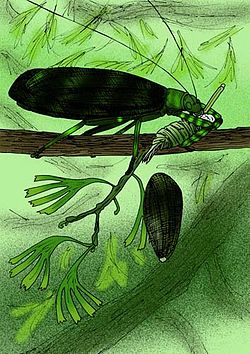
Reconstruction of Gigatitan
Scientific classification Edit this classification
Kingdom: Animalia
Phylum: Arthropoda
Class: Insecta
Infraclass: Neoptera
Cohort: Polyneoptera
Order: Titanoptera
Families

Mesotitanidae
Paratitanidae
Gigatitanidae
Theiatitanidae

Titanoptera (from Ancient Greek Τιτάν (Titán), meaning "Titan", and πτερόν (pterón), meaning "wing") is an extinct order of neopteran insects from late Carboniferous to Triassic periods.[1] Titanopterans were very large in comparison with modern insects, some having wingspans of up to 36 centimetres (14 in) or even 40 centimetres (16 in).[2][3]

Description

[edit]
Reconstruction of Gigatitan vulgaris, showing its large size

Titanopterans are related to modern grasshoppers, but were much larger, had proportionally weaker hindlegs that could not allow the animals to leap, and grasping forelegs and elongated mandibles. Another distinctive feature was the presence of prominent fluted regions on the forewings, which may have been used in stridulation. The general shape and anatomy of the titanopterans suggests that they were predators.[2]

An examination of a fossil of the oldest titanopteran genus, Theiatitan, seems to indicate that titanopterans did not utilize stridulation (unlike modern orthopterans), but rather used flashes of light from wing displays and crepitation, moving their wings to produce sound. The authors argue that stridulation, crepitation, castanet signaling or light flash alone do not fully explains the diversity of structures observed in Titanoptera, and note that both sexes seem to have the fluted region on the forewing. Theiatian is 50 Ma older than the previous oldest species of Titanoptera, and thus Theiatitan would be the oldest known insect with a wing structure specialized for communication.[1]

Pseudophyllanax imperialis, modern orthopteran with hind wing area close to that of Gigatitan

Some titanopterans may have been able to only glide, not fly, such as Gigatitan vulgaris. The hind wing area of it is almost the same as that of Pseudophyllanax imperialis, one of the largest modern Orthoptera, and a poor flier, but Gigatitan is larger in volume. All known hind wings of Titanoptera, whatever their sizes, have quite reduced vannus, while most extant flying Orthoptera have large ones.[1]

Other than Theiatitan, reliable records of titanopterans are known from Kyrgyzstan, Australia and South Korea. Considering some possible records from Russia as well, titanopterans possibly had a circum-Tethys distribution.[3]

Classification

[edit]
Forewing of Clatrotitan andersoni.

There is controversy regarding the classification of Titanoptera. Titanoptera was previously thought to be related to Geraridae (including Gerarus), but it is no longer supported.[4] Béthoux (2007) considered that genera in Titanoptera should be included in Orthoptera, and divided from extinct orthopteran family Tchomanvissidae.[5] But later study considered that the relationships between Titanoptera and Tcholmanvissiidae remain controversial.[1] Three genera known from Permian, Permotitan, Deinotitan, Monstrotitan possibly not belong to Titanoptera.[1] Although the genus Jubilaeus originally belonged to Mesotitanidae, but it is later considered to belong to Tcholmanvissiidae.[5][6] Steinhardtia was originally attributed to Titanoptera, but as fossil does not show the venational structures of the order Titanoptera, and it is even possible to be misidentification of plant fossil, possibly fern.[1]

Order Titanoptera

References

[edit]
[edit]
Revisions and contributorsEdit on WikipediaRead on Wikipedia
from Grokipedia
Titanoptera is an extinct order of giant, predatory neopteran insects belonging to the superorder Archaeorthoptera, known from the Late Carboniferous to the Triassic periods. These terrestrial insects were characterized by their enormous size, with some species exhibiting wingspans reaching up to 400 mm, far surpassing most modern insects, and raptorial forelegs equipped with stout spines for capturing prey. Titanopterans likely preyed on other insects, invertebrates, and possibly small tetrapods in Mesozoic and Paleozoic ecosystems, and they possessed specialized forewing structures suggestive of wing-based communication, potentially involving sound production or visual signals like light flashes. The order was first formally described by Aleksandr Grigorevich Sharov in 1968, encompassing six fossil families, 22 genera, and approximately 45 species, all known exclusively from fossil records. The oldest confirmed specimens date to the Moscovian stage of the Late (approximately 307–315 million years ago), with possible precursors in Carboniferous families like Geraridae or Permian groups such as Tcholmanvissiidae; their diversification peaked during the across regions including , , and the Korean Peninsula. Their extinction by the Triassic-Jurassic boundary may be linked to ecological shifts favoring smaller, more agile predators like early mantises. Phylogenetically, Titanoptera are positioned within the broader orthopteroid lineage, showing affinities to modern grasshoppers and katydids (Ensifera) due to shared wing venation and leg structures, though debates persist regarding their exact placement relative to other Archaeorthoptera groups. Notable genera include Gigatitan vulgaris, one of the largest known with a body volume 150% greater than the biggest extant orthopterans, and Theiatitan azari, representing the earliest record from the . Their study provides insights into and , particularly in terms of enabled by high atmospheric oxygen levels and early acoustic or visual signaling in arthropods.

Taxonomy and Phylogeny

Higher Classification

Titanoptera is an extinct order of insects classified within the kingdom Animalia, phylum Arthropoda, class Insecta, infraclass , and cohort . This placement reflects their neopteran characteristics, such as folded wings, and their affiliation with the polyneopteran lineage, which includes modern groups like and . The status of Titanoptera as a distinct order remains debated among paleontologists, with some researchers arguing it may instead represent a stem-group to rather than a separate . Proponents of the stem-group hypothesis point to shared features in forewing venation, such as the presence of a prominent radial sector, while noting differences in hindwing venation and leg stridulatory structures that distinguish them from crown-group orthopterans. These morphological traits suggest Titanoptera occupied an intermediate position in early polyneopteran evolution, potentially bridging primitive neopterans and more derived orthopteroids. In comparison to other extinct orders, Titanoptera shares affinities with Protorthoptera, a paraphyletic assemblage of to characterized by generalized orthopteroid wing patterns and body plans. Unlike earlier clades such as , which belong to more basal pterygote lineages outside , Titanoptera exhibits advanced polyneopteran traits, including enhanced wing folding and larger body sizes adapted to terrestrial environments. This positions Titanoptera as a key group in understanding the diversification of during the late and Permian periods.

Families and Genera

The order Titanoptera encompasses six families: Theiatitanidae, Tcholmanvissiidae, Tettoedischiidae, Mesotitanidae, Paratitanidae, and Gigatitanidae, established based on forewing venation and structural traits that differentiate them within the Archaeorthoptera superorder. These families reflect the group's diversity in size and morphology, with Titanoptera known from approximately 45 valid species across 22 genera, though the record remains incomplete due to limited preservation in specific depositional environments like the Madygen Formation in . The following table summarizes the families, including etymologies derived from type genera, temporal ranges, diagnostic features at the family level (primarily venation patterns), and representative key genera with type localities and notable details:
FamilyEtymologyTemporal RangeDiagnostic FeaturesKey Genera (with Type Locality and Notes)
TheiatitanidaeFrom type genus Theiatitan (Greek Theia, Titan goddess of light + titan)Late (Moscovian, ~307–315 Ma)Forewings with aligned small spines on longitudinal veins; broad, concave zones between RP and M, M and CuA, and CuA and posterior margin; numerous concave veinlets forming cells with convex surfacesTheiatitan azari (Avion, , ; oldest known Titanoptera, type species of family and genus)
TcholmanvissiidaeFrom type genus Tcholmanvissia (after Tcholman-Viss locality, + titan implied)PermianPrimitive orthopteroid venation with simple branching of RA and RP; lacking advanced speculum or stridulatory modifications; basal stem group to derived TitanopteraTcholmanvissia grandis (Upper Permian, ; type genus, precursor to Triassic titanopterans)
TettoedischiidaeFrom type genus Tettoedischia (Greek tettix + dischios disc-like)Permian (Kungurian, ~283–272 Ma)Forewings with fused ScP and RA basally, multiple RP branches; smaller body sizes; transitional venation patternsTettoedischia minuta (Middle Permian, ; type genus, early Permian representative)
MesotitanidaeFrom type genus Mesotitan (Greek mesos, middle + titan) (Middle to Upper)Moderate wing size (up to ~200 mm span); RA undivided or with few branches; RP with multiple pectinate branches; presence of a speculum (mirrored area) in some species for potential acoustic functionMesotitan ( of ; type genus); Mesotitanodes (, Madygen Formation); Prototitan (; includes subfamily Prototitaninae); Clatrotitan (synonym Clathrotitan; and , noted for large size up to 400 mm span)
ParatitanidaeFrom type genus Paratitan (Greek para, beside + titan) (Middle to Upper)Division of RA and RP beyond or near the distal half of the wing; ScP with numerous strong, dichotomously branching veinlets distally; short M stem with MP bifurcating into two branches; single anterior veinlet in RAParatitan (, Madygen Formation; type genus); Minititan (); Magnatitan jongheoni (Boryeong City, , Amisan Formation; newest genus, first East Asian record, no synonyms)
GigatitanidaeFrom type genus Gigatitan (Greek gigas, giant + titan) (Middle to Upper)Largest wingspans (up to 400 mm); prominent speculum area between RP and M for ; RA simple and long; RP with many parallel branches; overall robust venation supporting predatory lifestyleGigatitan vulgaris (, Madygen Formation; type species, largest known Titanoptera); Nanotitan (; smaller relative)
These families highlight the group's radiation during the , with Theiatitanidae, Tcholmanvissiidae, and Tettoedischiidae representing the basal and Permian stem. Most taxa are known from isolated wings, underscoring the fragmentary nature of the fossil record, which may underestimate true diversity.

Evolutionary Relationships

Titanoptera is hypothesized to be the to crown-group within the broader Archaeorthoptera, based on shared orthopteroid traits such as the structure of the and wing venation patterns indicative of stridulatory mechanisms. Recent phylogenetic analyses, including those utilizing cladotypic taxonomy, place Titanoptera as a stem-orthopteran lineage closely allied with the Permian family Tcholmanvissiidae, with cladograms supporting their inclusion within rather than as a separate order. For instance, a 2020 phylogenomic study of diversification reinforces this position by highlighting Titanoptera's modified forewing veins for sound production as a transitional feature linking them to modern orthopterans like and grasshoppers. The origins of Titanoptera trace back to the late Moscovian stage, approximately 310 million years ago, as a divergence from neopterans within the superorder Orthopteroidea. evidence from sites in northern , such as the Avion locality, documents the earliest known titanopterans, including genera like Theiatitan, confirming their presence during this period of high atmospheric oxygen that facilitated the of in arthropods. This hyperoxic environment, with oxygen levels peaking around 30-35% in the Permian, likely enabled the development of their large body sizes and wingspans exceeding 20 cm, distinguishing them from smaller contemporaries. Titanoptera became extinct by the end of the , around 201 million years ago, coinciding with the end- mass driven by massive volcanic activity from the , which caused rapid , , and habitat disruption. Hypotheses for their demise include competitive displacement by more agile crown-group , which evolved superior jumping and flight capabilities, as well as niche loss due to environmental shifts that reduced suitable predatory habitats. Unlike resilient orthopterans, Titanoptera's reliance on specific ecological roles, such as aerial predation, may have made them vulnerable to these pressures. In comparisons to modern , Titanoptera exhibits transitional features akin to those in extant groups like (ice crawlers), including reduced hindleg specialization for jumping and variable flight efficiency despite large wings, suggesting a primitive orthopteroid condition. These similarities highlight Titanoptera's role as an intermediate form in polyneopteran evolution, bridging neopterans with derived orthopterans through shared traits like ovipositor-based oviposition and wing-based signaling, though grylloblattids lack the gigantism seen in titanopterans.

Anatomy and Morphology

Body Structure

Titanoptera exhibited remarkable among , with some species achieving wingspans of up to 40 cm, such as Gigatitan vulgaris, making them among the largest predatory of the period. This large body size is estimated to have reached lengths of approximately 10-15 cm in major taxa, based on body volume reconstructions assuming a cylindrical form with minimal tapering from to . Their is attributed in part to elevated atmospheric oxygen levels during the late and early , which alleviated tracheal oxygen delivery constraints and enabled larger body sizes compared to later orthopteran relatives. However, knowledge of body structures beyond is limited, as most fossils consist of isolated impressions, with complete specimens being rare. The head of Titanoptera featured large compound eyes, adapted for detecting and tracking prey during , alongside mandibulate mouthparts equipped with strong, elongated mandibles suited for grasping and tearing soft-bodied prey. These predatory adaptations underscore their role as active carnivores, distinct from herbivorous orthopterans. The was robust, providing structural support for the attachment of powerful forelegs and accommodating the flight musculature integrated with the wings. The was segmented, typical of polyneopteran , facilitating flexibility and housing reproductive structures, including an in females as preserved in some taxa like . Leg morphology in Titanoptera emphasized predation over locomotion, with forelegs modified for prey capture, featuring stout spines on the tarsi and tibiae to secure struggling victims. In contrast, the mid- and hind legs were adapted for walking and stability, lacking the enlarged femora and tibiae characteristic of saltatorial () adaptations seen in modern .

Wing Characteristics

The forewings of Titanoptera are elongated and often exhibit a corrugated or fluted structure, characterized by alternating concave and convex veinlets that provide structural reinforcement while potentially enabling acoustic or optical signaling through light reflection or sound production. Venation patterns typically feature a long subcosta (Sc) vein that is markedly concave and nearly reaches the wing apex, subparallel to the , alongside a forked (R) with a simple anterior branch (RA) and a weakly concave posterior branch (RP) bearing several distal branches; the media (M) vein arises basally close to R, with its anterior branch (MA) forked subbasally, and the cubitus anterior (CuA) shows multiple distal branches from dual roots. These wings often include broadened zones, termed speculum-like areas, between major veins such as RP and M or M and CuA, filled with large transverse cells that occupy up to 25% of the wing surface and are subdivided by dense cross-veins. Hindwings in Titanoptera are generally smaller than the forewings, with a reduced vannal region and a fan-like shape that allows them to fold beneath the forewings at rest; they lack the specialized broadened structures seen in forewings but feature reinforcement through cross-veins connecting the main longitudinal veins. Venation in hindwings mirrors the forewings in key aspects, such as the concave Sc and branched CuA, but with simpler anal fan development, including a simple 1A and forked 2A branches, supporting overall wing stability during limited flight. Wing sizes vary significantly across Titanoptera taxa, with early forms like Theiatitan azari exhibiting relatively small wings based on preserved fragments, contrasting with the larger sizes of later giants such as Gigatitan vulgaris that reached up to 40 cm wingspans, reflecting evolutionary trends toward larger body plans in later representatives. Intermediate examples include Magnatitan jongheoni, with forewings measuring approximately 57 mm in length, highlighting diversity within the order. Fossil preservation of Titanoptera wings commonly occurs as detailed imprints in fine-grained sedimentary rocks from Lagerstätten, such as the Commentry site or Madygen Formation, where the delicate venation and corrugated surfaces are well-retained, facilitating taxonomic diagnosis and morphological analysis.

Sensory and Reproductive Features

Titanoptera exhibited specialized sensory structures adapted to their predatory lifestyle and environmental interactions. Fossil evidence indicates the presence of large compound eyes and ocelli, which likely facilitated light detection and essential for hunting prey. These eyes, inferred from preserved head impressions in rare complete specimens, suggest a reliance on visual cues for and predation. For communication, Titanoptera lacked stridulatory organs typical of related neopterans, potentially relying on visual signals or non-stridulatory sounds such as crepitation. Long, threadlike antennae, observed in genera such as , served primarily for chemoreception, enabling detection of chemical signals from prey or mates in their terrestrial habitats. Reproductive anatomy in Titanoptera is known from limited well-preserved fossils, revealing and structures suited to oviposition in soil or vegetation. Females possessed a prominent with sharp cutting ridges, as seen in , allowing eggs to be inserted into substrates for protection. Cerci were short and segmented, functioning in sensory roles during mating, while male genitalia featured symmetrical claspers for securing copulation. was evident in wing size, with males exhibiting larger forewings potentially used for visual display during courtship, based on Permian and specimens showing size disparities between sexes. This dimorphism underscores a reliance on visual and chemical communication over acoustic methods in reproduction.

Paleobiology and Ecology

Locomotion and Flight

Titanoptera exhibited limited flight capabilities, primarily constrained by their large body sizes and wing loadings, which suggest they were weak fliers or reliant on gliding rather than sustained powered flight. In the genus Gigatitan, for instance, the hindwing area was comparable to that of large modern orthopterans but with a body volume ~150% larger, indicating that active flight would have been inefficient due to excessive mass, making powered flapping unlikely. Instead, passive gliding may have been feasible for such large individuals, though the reduced vannus (fan-like region) in their hindwings limited aerodynamic efficiency compared to more agile palaeopteran insects like ancient dragonfly relatives. Smaller titanopterans with proportionally larger wings might have achieved limited active flight, but overall, their locomotion emphasized short bursts or descent rather than prolonged aerial maneuvers, resembling the inefficient flight of large modern moths more than the agile hovering of extant odonates. On the ground, Titanoptera relied on walking for , supported by forelegs adapted for grasping prey in an style, akin to those in modern mantises (Mantodea). These forelegs featured robust, spined structures for capturing and holding, enabling slow, deliberate movement through rather than rapid pursuit. Their hindlegs lacked the saltatorial modifications typical of jumping orthopterans, showing instead a reduction or absence of the jumping apparatus, which precluded leaping and reinforced a strategy of stationary waiting over active chasing. These adaptations aligned with the environmental contexts of their temporal range, from humid, dense forests where short glides could navigate swampy understories, to more open terrains that favored passive descent for escaping predators or reaching foraging sites. In the , their metabolic demands for occasional flight may have been supported by environmental conditions, but by the , drier conditions and competition likely further emphasized and terrestrial ambushes over energetic aerial activity.

Diet and Predatory Behavior

Titanoptera were carnivorous , preying primarily on smaller arthropods, as inferred from the morphology of their strong, incisiform mandibles adapted for piercing and tearing flesh. Their forelegs, characterized by elongate coxae, spined femora, and grasping tibiae, further support this predatory diet, enabling the capture and restraint of live prey. Although from gut contents is absent in known fossils, the overall mandibular structure aligns with that of modern carnivorous orthopteroids, reinforcing interpretations of a strictly insectivorous feeding ecology. Their hunting strategy involved predation, suggested by their grasping forelegs, where titanopterans likely waited motionless before striking to seize passing prey. This behavior positioned them as efficient predators in structurally complex habitats, minimizing energy expenditure while maximizing encounter rates with mobile prey. The recent discovery of Magnatitan jongheoni (2022) from the of the Korean Peninsula reinforces these predatory adaptations in East Asian environments. As top predators within and terrestrial ecosystems, titanopterans occupied high trophic levels, filling aerial and arboreal predatory niches prior to the diversification of birds and small mammals. Their large body sizes, often exceeding 200 mm in , allowed them to dominate insect food webs during the , coexisting with but distinct from odonatans as dominant flyers. This role underscores their ecological significance in pre-avian arthropod communities, where they exerted top-down pressure on herbivorous and smaller carnivorous insects.

Communication and Reproduction

Titanoptera likely utilized specialized wing structures for communication during , primarily through crepitation—sounds produced by air rushing over corrugated wing veins—or reflective light flashes from broadened forewing areas known as specula. These features, observed in Permian specimens from and Triassic fossils from and , suggest acoustic or visual signaling to attract mates, distinct from seen in modern . The oldest evidence comes from the Late Carboniferous species Theiatitan azari (approximately 310 million years old), indicating early of such intersexual interactions in the lineage. Mating rituals in Titanoptera are inferred from morphological adaptations, with males potentially performing visual displays by orienting their iridescent or patterned wings to produce flashes during flight or rest. Antennae, equipped for chemosensory detection, likely facilitated recognition of sex pheromones released by females, enabling close-range pairing without reliance on sound-producing organs like those in ensiferans. Unlike acoustically dominant orthopterans, Titanoptera lacked stridulatory files on legs or wings, emphasizing multimodal signaling combining visual, chemical, and possibly vibrational cues. Reproductive cycles followed a hemimetabolous pattern typical of neopteran relatives, involving egg, nymph, and adult stages, with nymphs inferred to be terrestrial based on the predatory adult ecology and lack of aquatic adaptations in preserved fossils. Females employed a serrated ovipositor to deposit eggs in moist plant tissues or substrates, protecting them from desiccation and predators in humid Permian-Triassic environments. Fossil evidence for direct mating behaviors is scarce, though the abundance of well-preserved adults in Triassic lagerstätten like the Madygen Formation implies gregarious assemblies potentially linked to courtship gatherings.

Fossil Record and Distribution

Temporal Range

The Titanoptera first appeared in the fossil record during the Late Carboniferous, with the earliest confirmed specimen, Theiatitan azari, described in 2021 from the Moscovian stage (approximately 310 million years ago; 307–315 Ma) at the ‘Terril N 7’ locality in Avion, , northern , extending the known temporal range of the order back by about 50 million years from prior estimates. This discovery predates previous records, which were primarily from the Permian and Triassic periods. The order achieved its peak diversity spanning the Permian (approximately 299–252 million years ago) through the (approximately 252–247 million years ago), with reliable fossils documented from diverse continental deposits during this interval, though putative Permian occurrences in suggest an earlier onset of radiation. Diversity began to decline following the Norian stage of the (approximately 227–208 million years ago), as evidenced by sparser records in later Late Triassic strata. The last known occurrences of Titanoptera date to the stage of the (approximately 208–201 million years ago), after which the order went extinct, likely influenced by the end-Triassic mass that disrupted terrestrial ecosystems through , shifts, and sea-level changes. No titanopteran fossils have been found beyond the Triassic-Jurassic boundary. Biostratigraphically, Titanoptera s are correlated with coal-bearing measures in and Permian sites, reflecting humid, vegetated swamp environments conducive to preservation, while records often occur in association with evaporite-influenced continental sequences indicative of more arid or fluctuating hydrological conditions. Taphonomic biases likely limit the record to these specific depositional environments.

Geographic Distribution

Titanoptera fossils are primarily known from , with the type locality in the Madygen Formation of southwestern , where the order was first described based on abundant specimens from this Middle to deposit. This formation represents a continental rift basin environment characterized by lacustrine and fluvial settings, indicative of tropical wetlands and forested habitats during a period of elevated atmospheric oxygen levels that supported large-bodied . Additional records extend the distribution to , notably the Nampo Group on the southwestern Korean Peninsula, where the genus Magnatitan was discovered in 2022, marking the first titanopteran outside and . The Nampo Group's depositional environment included alluvial fans, fluvial plains, and lakes, consistent with humid, tropical conditions similar to those in the Madygen Formation. In , titanopterans are represented by fragmentary remains, such as a hindwing base attributed to the order in the Hawkesbury Sandstone of , deposited in a fluvial-deltaic system within a subtropical to tropical coastal plain. These occurrences suggest a paleobiogeographic range circumscribing the , linking Laurasian landmasses in (Kyrgyzstan and Korea) with Gondwanan elements in , while the absence of fossils in the and points to dispersal barriers imposed by oceanic or climatic divides during the Triassic. Overall, titanopteran habitats were tied to warm, humid paleoenvironments with abundant vegetation and water bodies, facilitating their predatory lifestyle amid high-oxygen atmospheres.

Notable Discoveries

The order Titanoptera was established based on the initial discovery of Mesotitan, described by Aleksandr G. Sharov in 1968 from the Madygen Formation in . This specimen, featuring large forewings up to 17 cm in length with distinctive venation patterns including a broad anal area, provided the foundational for recognizing Titanoptera as a distinct group of giant, predatory related to early orthopterans. Among key subsequent finds, vulgaris stands out for its exceptional size, with forewings reaching approximately 40 cm in span, described from articulated specimens in the same Madygen Formation. These fossils, also initially noted by Sharov in but further detailed in later studies, reveal forelegs adapted for grasping prey and a body length exceeding 30 cm, highlighting the group's predatory adaptations during the . The discovery of Theiatitan azari in 2021 extended the temporal range of Titanoptera back to the Late Carboniferous, representing the oldest known member of the order from the ‘Terril N 7’ locality in Avion, , . This fragmentary forewing, approximately 5 cm long, exhibits early titanopteran traits such as a bifurcated anterior and specialized sound-producing structures, suggesting acoustic communication evolved earlier than previously thought. In 2022, Magnatitan jongheoni was described from the Amisan Formation in southwestern Korea, marking the first titanopteran fossil outside and . This specimen, with wings about 20 cm long, displays unique venation features including a divided radius anterior beyond the pterostigma and a new combination of traits leading to the establishment of the family Magnatitanidae, implying a broader circum-Tethys distribution for the group. Rare articulated fossils, such as those of Gigatitan vulgaris from the Madygen Formation and Clatrotitan andersoni from the Hawkesbury Sandstone in , preserve complete bodies with both wing pairs and thoraces intact, revealing disruptive coloration patterns on the tegmina—alternating dark and light bands likely used for or visual signaling during flight. These specimens occasionally show preserved soft tissues, though direct evidence of gut contents remains elusive, providing insights into body proportions and predatory morphology. Most Titanoptera fossils are compression specimens flattened in fine-grained sediments, which obscure three-dimensional internal structures like muscle attachments or genital morphology essential for understanding flight mechanics and reproduction. Recent applications of (micro-CT) scans on such fossils, including wing bases from Kyrgyz sites, have begun to reveal hidden vein origins and internal reinforcements, overcoming these limitations to refine phylogenetic placements.

History of Research

Initial Descriptions

The order Titanoptera was founded in 1968 by Soviet paleontologist Aleksandr Grigorevich Sharov, who established it based on exceptionally large insect fossils from deposits in Kyrgyzstan, particularly the Madygen Formation, naming the group for their gigantic wing spans that reached up to 400 mm in some species like Gigatitan vulgaris. Sharov's work, published in the Trudy Paleontologicheskogo Instituta, introduced Titanoptera as a distinct order within Orthopteroidea, encompassing three families: Mesotitanidae, Paratitanidae, and Gigatitanidae, all characterized by raptorial forelegs and broad, veined wings adapted for gliding or short flights. Early genera within Titanoptera, such as Paratitan (including species like P. ovalis and P. libelluloides) and Mesotitan (previously described from Australian material but reassigned here), were formally detailed in Sharov's 1968 monograph and subsequent Soviet publications through the early 1970s, emphasizing their morphological diversity from Central Asian lagerstätten. These descriptions highlighted the ' robust thoracic structures and spined legs, positioning them as apex predators in their ecosystems. Sharov's initial interpretations framed Titanoptera as primitive members of the , originating from Permian orthopteroid ancestors like the family Tcholmanvissiidae, with their enormous size representing a post- anomaly reminiscent of giants but persisting as relicts into the . This view underscored their evolutionary conservatism, linking forms to earlier radiations amid declining atmospheric oxygen levels. The foundational specimens were housed primarily in Soviet institutions, including the in (PIN) and collections in , , reflecting the regional focus of expeditions in the ; however, access to these archives remained restricted to international researchers before the due to War-era policies and logistical barriers.

Modern Revisions and Debates

In the late 20th and early 21st centuries, the of Titanoptera has undergone significant revisions, primarily driven by detailed analyses of venation and phylogenetic relationships within the broader group Panorthoptera. Early proposals by Sharov () suggested a close affinity to the Permian family Tcholmanvissiidae (), rendering the latter paraphyletic, but subsequent work by Gorochov (2001, 2007) posited the Carboniferous Geraridae as a potential , emphasizing differences in fore structure. These revisions highlighted the challenges in resolving Titanoptera's position due to the group's distinctive enlarged anal area and stridulatory modifications, which some researchers interpret as autapomorphies warranting ordinal status, while others view them as derived orthopteran traits. A key modern contribution came from Béthoux (2007), who applied cladotypic taxonomy to argue that Titanoptera should be nested within as a (Tcholmanvissiinae), based on shared forewing venation patterns such as the homology of CuPaα and CuPaβ branches and the separation of M + CuA into MA and MP + CuA. This reclassification rejected Gorochov's Geraridae linkage, proposing instead that Titanoptera evolved from Permian Tcholmanvissiinae ancestors, with evidence from specimens like AM F.36274 and PIN 2240/4593 supporting venation-derived morphology. Béthoux (2020) later reaffirmed this link through further comparative studies, emphasizing in unrelated groups as a complicating factor. Debates persist, particularly around vein homologies and the of Panorthoptera, which encompasses , Caloneurodea, and Titanoptera, defined by the basal bifurcation of the CuPa . Huang et al. (2020) challenged the Tcholmanvissiidae affinity, suggesting that similarities in veins may result from convergence rather than shared ancestry, and called for molecular and additional evidence to clarify relationships. Rasnitsyn (2007) and subsequent studies noted ongoing uncertainties in Archaeorthoptera interrelationships, including Titanoptera's placement, due to incomplete preservation and variable interpretations of stridulatory organs. These discussions underscore the need for integrated morphological and phylogenetic analyses to resolve whether Titanoptera represents a distinct lineage or a specialized orthopteran . Recent discoveries have further informed these debates by expanding the known distribution and diversity of Titanoptera. The 2022 description of Magnatitan jongheoni from the Amisan Formation in marks the first record outside and , implying a circum-Tethys distribution and supporting a diversification phase. Similarly, Shcherbakov (2011) reclassified the alleged palaeodictyopteran Liquia reliquia as Paratitan reliquia (Titanoptera: Paratitanidae), based on shared wing venation characters like a free CuA1 base and concave MA branches, confirming no palaeodictyopteroid survival into the and adding to the group's Middle- (Ladinian-Carnian) diversity; the order now encompasses 6 families, 22 genera, and 45 species as documented in current taxonomic databases. These findings bolster arguments for Titanoptera's role within Pan while highlighting gaps in early Permian origins and post- extinction patterns.

References

Add your contribution
Related Hubs
User Avatar
No comments yet.