


Community hub
Recent from talks
Contribute something
Nothing was collected or created yet.
Amphiesmenoptera
View on Wikipedia
| Amphiesmenoptera | |
|---|---|

| |
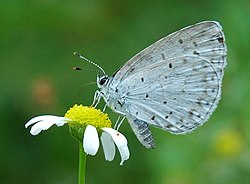
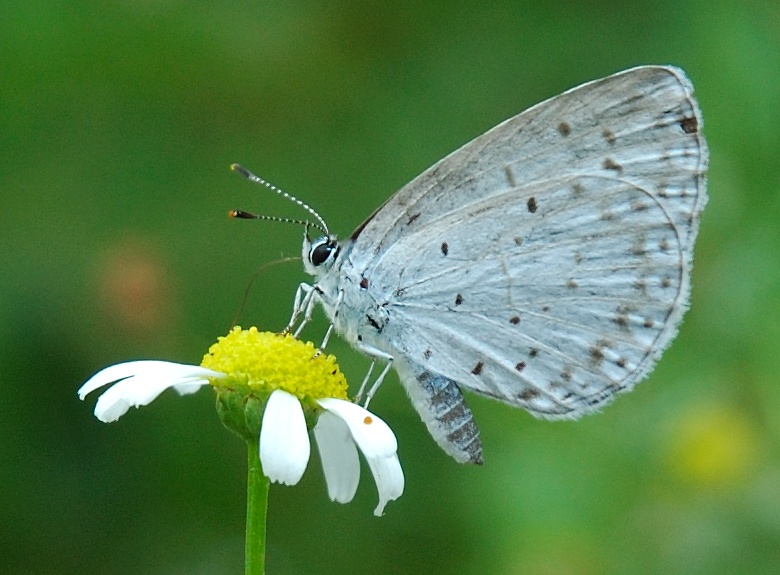
| Celastrina argiolus (Lepidoptera) | |

| |
| Chaetopteryx villosa (Trichoptera) | |
Scientific classification 
| |
| Kingdom: | Animalia |
| Phylum: | Arthropoda |
| Class: | Insecta |
| Superorder: | Panorpida |
| (unranked): | Amphiesmenoptera Kiriakoff, 1948 |
| Subgroups | |
Amphiesmenoptera is an insect superorder, established by S. G. Kiriakoff,[1] but often credited to Willi Hennig in his revision of insect taxonomy for two sister orders: Lepidoptera (butterflies and moths) and Trichoptera (caddisflies). In 2017, a third fossil order was added to the group, the Tarachoptera.[2]
Trichoptera and Lepidoptera share a number of derived characters (synapomorphies) which demonstrate their common descent:
- Females, rather than males, are heterogametic (i.e. their sex chromosomes differ).
- Dense setae are present in the wings (modified into scales in Lepidoptera).
- There is a particular venation pattern on the forewings (the double-looped anal veins).
- Larvae have mouth structures and glands to make and manipulate silk.[3]
Thus, these two extant orders are sisters, with Tarachoptera basal to both groups. Amphiesmenoptera probably evolved in the Jurassic.[3] Lepidoptera differ from the Trichoptera in several features, including wing venation, form of the scales on the wings, loss of the cerci, loss of an ocellus, and changes to the legs.[3]
Amphiesmenoptera are thought to be the sister group of Antliophora, a proposed superorder comprising Diptera (flies), Siphonaptera (fleas) and Mecoptera (scorpionflies). Together, Amphiesmenoptera and Antliophora compose the group Mecopterida.[4]
References
[edit]- ^ S. G. Kiriakoff (1948). "A classification of the Lepidoptera and related groups with some remarks on taxonomy". Biologisch Jaarboek. 15: 118–143.
- ^ Wolfram Mey; Wilfried Wichard; Patrick Müller; Bo Wang (2017). "The blueprint of the Amphiesmenoptera – Tarachoptera, a new order of insects from Burmese amber (Insecta, Amphiesmenoptera)". Fossil Record. 20 (2): 129–145. doi:10.5194/fr-20-129-2017.
- ^ a b c D. Grimaldi; M. S. Engel (2005). Evolution of the Insects. Cambridge University Press. ISBN 0-521-82149-5.
- ^ M. F. Whiting; J. C. Carpenter; Q. D. Wheeler; W. C. Wheeler (March 1997). "The Strepsiptera problem: phylogeny of the holometabolous insect orders inferred from 18S and 28S ribosomal DNA sequences and morphology". Systematic Biology. 46 (1): 1–68. doi:10.1093/sysbio/46.1.1. PMID 11975347.
| |||||||||||||||
| |||||||||||||||
| |||||||||||||||


Amphiesmenoptera
View on GrokipediaTaxonomy
Etymology and history
The name Amphiesmenoptera derives from Ancient Greek amphíēsmos (ἀμφίεσμος, meaning "garment" or "clothing") combined with pterá (πτερά, meaning "wings"), alluding to the scale-like coverings that adorn the wings of the taxa within this superorder.[8] The taxonomic concept of Amphiesmenoptera originated in the mid-20th century, building on earlier observations of morphological affinities between caddisflies (Trichoptera) and butterflies/moths (Lepidoptera). As early as 1922, entomologist Robin John Tillyard highlighted shared traits such as wing venation patterns and larval silk production in these groups, suggesting a close evolutionary relationship, though he did not formalize a higher taxon. These insights laid groundwork for later syntheses, but it was Sergei G. Kiriakoff who first established Amphiesmenoptera as a superorder in 1948, grouping Trichoptera and Lepidoptera based on synapomorphies like reduced mouthparts and scaled wings.[9] Kiriakoff's proposal, published in Biologisch Jaarboek, emphasized these orders' distinct yet allied position within holometabolous insects.[10] The concept gained prominence through Willi Hennig's cladistic framework in his seminal 1981 monograph Insect Phylogeny, where he refined Amphiesmenoptera as a monophyletic clade supported by autapomorphies including the presence of wing scales and specific genital structures in adults.[11] Hennig integrated it into broader insect systematics, positioning it within the larger assemblage Panorpida alongside scorpionflies (Mecoptera) and fleas (Siphonaptera). Subsequent morphological studies in the late 20th century reinforced this, but confirmation came decisively from molecular phylogenetics in the 1990s and 2000s; analyses of 18S ribosomal DNA sequences, for instance, consistently recovered Amphiesmenoptera as a robust clade with high support values, integrating it firmly into Panorpida via shared genetic markers.[12] These data, from studies like Whiting et al. (2002), resolved prior ambiguities and elevated the group's status in insect evolutionary history.[12]Classification
Amphiesmenoptera is classified as a superorder within the class Insecta of the phylum Arthropoda, positioned within the holometabolous insects known as Endopterygota (or Holometabola). This superorder forms part of the broader clade Panorpida (also referred to as Mecopterida in some classifications), which encompasses several holometabolous lineages including Mecoptera and Siphonaptera.[13] The superorder includes two extant orders: Lepidoptera, comprising butterflies and moths with approximately 180,000 described species (as of 2025), and Trichoptera, consisting of caddisflies with more than 17,000 described species (as of 2025).[14][15] An extinct order, Tarachoptera, is also recognized within Amphiesmenoptera; it was established in 2017 based on fossils from mid-Cretaceous Burmese amber, representing early amphiesmenopterans with scaled wings.[3] Higher-level subdivisions within Amphiesmenoptera include the clade Protomeroptera, which encompasses early-diverging fossil lineages, and Metamphiesmenoptera, which groups the more derived extant orders Lepidoptera and Trichoptera along with certain extinct relatives such as Cladochoroptera (Engel, 2022).[16] These clades provide a framework for understanding the evolutionary diversification above the family level without delving into finer taxonomic details. The taxonomic stability of Amphiesmenoptera as a monophyletic group has been affirmed since the 1980s through convergent evidence from morphological characters, such as shared larval and pupal traits, and molecular phylogenies based on ribosomal and mitochondrial genes.[13] Subsequent phylogenomic studies have further reinforced this monophyly, confirming the close sister-group relationship between Lepidoptera and Trichoptera.[17]Characteristics
Adult morphology
Adult insects in the superorder Amphiesmenoptera exhibit several shared morphological features that distinguish them from other insect groups. A key synapomorphy is the wing venation pattern, particularly in the forewings, where the anal veins form a double-looped or "double Y" configuration, with A1 and A2 fusing distally to A3. This structure is present in both Lepidoptera and Trichoptera, reinforcing their close phylogenetic relationship within the superorder. The wings are densely covered with setae, which are homologous structures providing camouflage, protection, or sensory functions. In Lepidoptera, these setae are modified into flattened, spindle-shaped scales that contribute to the characteristic iridescent or patterned appearance. In Trichoptera, the covering consists of hair-like setae rather than scales, giving adults a moth-like but duller appearance. Another derived trait is the haustellate mouthparts adapted for liquid feeding, formed by the fusion of the prelabium and hypopharynx into a proboscis-like haustellum, accompanied by vestigial mandibles reduced to small conical processes; maxillary palps are well-developed and 5-segmented in Trichoptera, serving sensory roles, while in Lepidoptera they are often greatly reduced or absent.[18][19] Antennae in adult Amphiesmenoptera are typically filiform but can vary to bipectinate forms, often scaled or setose, serving sensory roles in mate location and navigation. Sex determination follows a female-heterogametic system (ZW or ZO/ZZ), which is rare among insects and shared across the superorder, with females carrying the heteromorphic sex chromosomes while males are homogametic (ZZ). Sexual dimorphism manifests in general patterns of wing size, where males often have relatively larger wings for display or flight, and differences in coloration that aid in species recognition and mating.Immature stages
The larvae of Amphiesmenoptera exhibit an elongate, eruciform body plan, characterized by a well-sclerotized head capsule and an apodous trunk lacking true walking legs beyond the thorax. In Trichoptera, larvae possess three pairs of thoracic legs and a single pair of anal prolegs equipped with crochets for locomotion and case attachment, while Lepidoptera larvae feature three pairs of thoracic legs supplemented by multiple pairs of fleshy prolegs on the abdomen and anal segment, also bearing crochets for gripping substrates.[20][21] A defining synapomorphy of amphiesmenopteran larvae is the presence of specialized labial silk glands, which develop early in embryogenesis and produce silk via spinnerets located on the labium. This silk, composed primarily of heavy-chain (FibH) and light-chain (FibL) fibroins forming a fibrous core coated by sericin proteins, enables Trichoptera larvae to construct protective portable cases from environmental materials and both orders to form cocoons during pupation. The fibroin structure, rich in β-sheet motifs, provides mechanical strength adapted to aquatic (Trichoptera) or terrestrial (Lepidoptera) environments.[22][23][24] Pupae in Amphiesmenoptera are typically exarate in Trichoptera, with appendages free from the body and functional mandibles for emergence, enclosed within silken cocoons that offer protection during metamorphosis; in Lepidoptera, they are often obtect with appendages appressed to the body, though primitive forms are exarate, and pupae are terrestrial, often chrysalis-like in derived forms. Trichoptera pupae are typically aquatic within cases.[25][26] Larval feeding relies on mandibulate mouthparts suited for biting and chewing, with habits centered on detritivory in many Trichoptera species (e.g., shredding leaf litter or filtering organic particles in aquatic habitats) and herbivory in most Lepidoptera (e.g., consuming foliage), though some Trichoptera exhibit scraping or predatory behaviors. Habitats differ markedly, with Trichoptera larvae predominantly aquatic and Lepidoptera terrestrial, influencing resource access but sharing a detritus- or plant-based diet.[20][21] Developmental synapomorphies include shared embryonic features such as the early formation of well-developed silk glands and reductions in Malpighian tubule complexity, alongside specific gonadal configurations where primordial germ cells migrate similarly to form paired gonads. These traits underscore the monophyly of the clade during ontogeny.[22][27]Evolutionary history
Phylogenetic position
Amphiesmenoptera is a monophyletic superorder within the subclass Holometabola of insects, positioned as a key component of the larger clade Mecopterida.[11] Mecopterida itself encompasses Amphiesmenoptera and the clade Antliophora, the latter comprising the orders Mecoptera (scorpionflies), Siphonaptera (fleas), and Diptera (true flies).[28] This arrangement reflects a sister group relationship between Amphiesmenoptera and Antliophora, first proposed in modern cladistic terms by Hennig in 1981 and consistently upheld in subsequent analyses.[11] The monophyly of Mecopterida is robustly supported by both morphological and molecular evidence. Morphologically, key synapomorphies include the neotenic retention of larval traits in adults, such as functional silk-producing glands and certain abdominal structures, which are shared across Mecopterida lineages.[29] Within Amphiesmenoptera specifically, Kristensen (1984) identified approximately 20-21 synapomorphies uniting Trichoptera and Lepidoptera, including specialized wing scale precursors and modified larval mouthparts, further anchoring the clade's integrity. Molecular phylogenies from the 2000s onward, based on multi-gene datasets, have confirmed this topology with high bootstrap support, such as in analyses of 18S rRNA and nuclear protein-coding genes that place Amphiesmenoptera as the sister to Antliophora with posterior probabilities exceeding 0.95.[12][30] Prior to the cladistic framework established by Hennig (1981), alternative hypotheses occasionally positioned Lepidoptera closer to Hymenoptera, based on superficial similarities in pupal cases and metamorphic patterns observed in early 20th-century morphological comparisons.[31] These views have been definitively rejected by integrated morphological and phylogenomic data, which demonstrate no close affinity between these orders.[32] The phylogenetic stability of Amphiesmenoptera within Mecopterida has remained unchallenged since the 1980s, with no significant revisions in major studies from the 2010s, reinforcing its established position in holometabolan insect evolution.[33]Fossil record
The earliest known fossil of a stem-group Amphiesmenoptera is a caddisfly-like insect from the Pennsylvanian (Moscovian stage, approximately 307 million years ago) Piesberg quarry in Germany, exhibiting primitive traits such as reduced wing venation and silk gland precursors characteristic of the clade.[4] Subsequent evidence includes isolated wing scales recovered from Upper Triassic (Norian stage, approximately 220 million years ago) sediments in northern Germany, suggesting the presence of scale-covered wings in early members of the clade before the evolution of fully scaled lepidopteran wings. These scales exhibit lepidopteran-like microstructures, including microtrichia and trabeculae.[34] Definitive body fossils of Amphiesmenoptera appear in the Middle Jurassic (approximately 165 million years ago) from the Jiulongshan Formation in northeastern China, where compression fossils preserve details of wing venation and body structures in early lepidopterans.[35] Key fossil sites include Jurassic deposits in the Karatau region of southern Kazakhstan and the aforementioned Chinese formations, which have yielded impressions of primitive Lepidoptera and Trichoptera with reduced wing scales and archaic venation patterns.[36] In the Cretaceous period, Burmese amber from Myanmar (approximately 99 million years ago) has preserved exceptionally detailed inclusions of the extinct order Tarachoptera, a stem-group taxon within Amphiesmenoptera sharing seven synapomorphies with Trichoptera and Lepidoptera, such as bifurcate maxillary palpi, pilose wings, and a reduced anal area in the hindwing.[37] Tarachoptera specimens, including genera like Tarachocelis and Electrocashma, display a mix of trichopteran-like setose wings and lepidopteran-like scale precursors, highlighting transitional morphologies in the clade's evolution.[37] Other notable extinct taxa include members of the family Eolepidopterigidae, an early lepidopteran group from Middle Jurassic Chinese deposits, characterized by homoneurous wings (similar fore- and hindwing venation) and scale coverage, representing basal divergences within Lepidoptera.[35] The family Necrotauliidae, known from Triassic sites such as the Madygen Formation in Kyrgyzstan (Ladinian-Carnian stages, approximately 240-230 million years ago), comprises stem-Amphiesmenoptera with elongated wings and sparse setae, providing evidence of pre-Jurassic diversification.[38] The fossil record of Amphiesmenoptera is marked by gaps due to poor preservation of delicate scales and soft bodies, particularly in pre-Mesozoic strata, which complicates precise timelines.[39] The clade originated in the late Paleozoic, with radiation and significant diversification accelerating during the Mesozoic era, particularly following the end-Permian mass extinction around 252 million years ago, as evidenced by increasing taxonomic diversity in Jurassic and Cretaceous deposits.[39] Recent discoveries from 2022 include the first New World Necrotaulius from the Late Triassic (Norian) Solite deposit in Virginia and North Carolina, USA, reinforcing Laurasian origins of the family and suggesting early diversification across Laurasian landmasses.[40]References
- https://en.wiktionary.org/wiki/Amphiesmenoptera