Hubbry Logo
Disney Resort LineDisney Resort LineMain
Open search
Disney Resort Line
Community hub
Disney Resort Line
logo
8 pages, 0 posts
0 subscribers
Be the first to start a discussion here.
Disney Resort Line
Disney Resort Line
from Wikipedia

Disney Resort Line
Disney Resort Line train, February 2021
Overview
OwnerMaihama Resort Line Co., Ltd. (The Oriental Land Company)
LocaleTokyo Disney Resort, Urayasu, Chiba
Transit typeAutomated straddle-beam monorail (Alweg‑type)
Number of stations4
Operation
Began operation27 July 2001; 24 years ago (2001-07-27)
Operator(s)Maihama Resort Line Co., Ltd.
CharacterElevated
Technical
System length5 km (3.1 mi)
No. of tracks1
ElectrificationContact rails, 1,500 V DC
Top speed50 km/h (31 mph)[1]
System map

Maihama
JE
Transfers
(via short walk)
Resort Gateway
Tokyo Disneyland
Tokyo DisneySea
Bayside

Handicapped/disabled access All stations are accessible

The Disney Resort Line[a] is an automated straddle-beam, Alweg-type monorail line serving the Tokyo Disney Resort in Urayasu, Chiba, Japan. Operated by Maihama Resort Line Co., Ltd.,[b] a subsidiary of the Oriental Land Company (OLC), the system connects Maihama Station to major resort destinations including Tokyo Disneyland, Tokyo DisneySea, hotels, and commercial facilities. Passenger service began on 27 July 2001, shortly before the opening of Tokyo DisneySea.[1]

History

[edit]

Plans for a monorail serving the Tokyo Disney Resort began to emerge in the 1990s as the resort expanded. While Tokyo Disneyland was within easy walking distance of Maihama Station, the development of Tokyo DisneySea and several large hotels made the area too large to navigate on foot. The monorail provided a transportation solution while also opening up more land for development, including additional resort hotels.

The project received government approval in 1997, and construction began the following year. Trial operations started in 2000, and the Disney Resort Line opened on 27 July 2001, just two months before DisneySea's opening.[1]

In the years after opening, the line saw steady ridership and several system upgrades. In 2009, the line began accepting IC cards including Pasmo and Suica, and tickets transitioned from magnetic stripe to QR codes in 2025. Fares have been revised periodically in line with changes to Japan’s consumption tax. A major modernization program began in 2019 with the introduction of the Type C fleet, which replaced the original Type X trains between 2020 and 2024.

Operations

[edit]

The Disney Resort Line is a single-track, counterclockwise loop linking Maihama Station with facilities throughout the resort. A complete circuit takes about 13 minutes, with travel times of two to four minutes between adjacent stations.[1] Up to four trains operate simultaneously, providing headways as short as 3.25 minutes.

Trains operate under an automatic train operation (ATO) system corresponding to Grades of Automation 3 (GoA3/DTO), with an onboard conductor responsible for door control and safety monitoring. Manual controls are located at both ends of each train; with the forward-facing operating area typically open to passengers with the master controller and instruments covered.

Safety features include platform screen doors at all stations and interlocked sensors on both car and platform doors that prevent departures unless all are fully secured. Station staff are present throughout most of the operating day to supervise boarding and ensure platform safety.

Although the line runs entirely on land owned by OLC and is sometimes mistaken for a park attraction due to its location within the resort, it is legally classified as a public railway. As such, standard fares are charged, IC cards are accepted, and season tickets are available.[1][2] This differs from most other Disney monorail systems, which typically operate fare-free or are included with theme-park admission.

Fares and ticketing

[edit]

A single journey costs ¥300 and is good for one entry and one exit, travelling up to one full loop. This can be paid for with an IC card. Multi-journey tickets are available as physical tickets only and priced as follows: [3]

Duration Fare
1 day ¥700
2 days ¥900
3 days ¥1200
4 days ¥1500
1 month ¥9000
3 months ¥25650
6 months ¥48600

Children aged 6-11 pay half fare. Babies aged under 1 year are free, and two children aged 1-5 ride free with every paying adult.[3]

Stations

[edit]

All stations on the line are located on OLC property and are not directly connected to public roads. Platform gates are installed systemwide. Tokyo DisneySea Station and Resort Gateway Station use a Spanish solution with separate platforms for boarding and alighting to manage peak crowds.

Station Image First train Last train Platform Connections
Resort Gateway 06:31 23:30 Dual JE Keiyō Line (Maihama: JE07), Ikspiari, Disney Ambassador Hotel, Hotel Dream Gate Maihama
Tokyo Disneyland 06:33 23:32 Side Tokyo Disneyland, Tokyo Disneyland Hotel
Bayside 06:36 23:34 Side Official Hotels (Fantasy Springs, Toy Story, Grand Nikko, Hilton, Hotel Okura, Sheraton, Sunroute Plaza, Tokyo Bay Maihama Hotel)
Tokyo DisneySea 06:40 23:39 Dual Tokyo DisneySea, Tokyo DisneySea Hotel MiraCosta

Rolling stock

[edit]
Type X train
Type C train

All rolling stock operated on the Disney Resort Line since its opening has been built by Hitachi Rail using the company’s proprietary Hitachi Monorail standard-size platform.

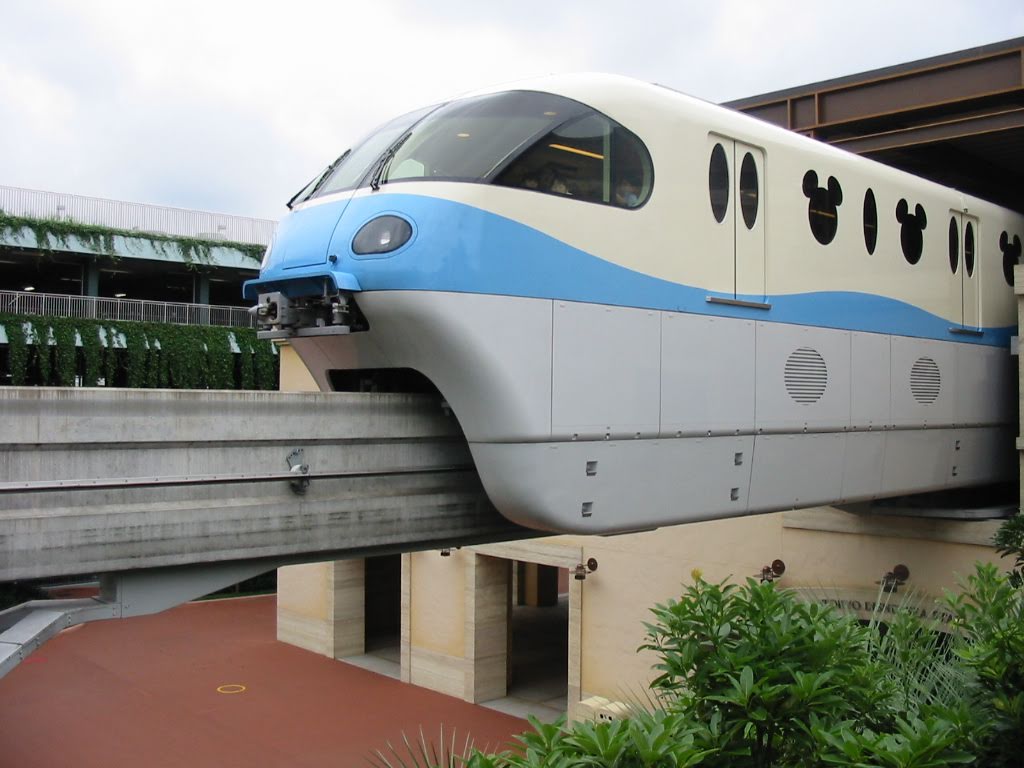
The line is operated with a fleet of five six-car Resort Liner trains,[1] based on Hitachi’s typical design but modified with Mickey Mouse–shaped windows. Each train is finished in a distinct wave-themed color scheme.[4] Although the trains are equipped for fully automatic operation, an employee rides in a cab at the rear of each train for safety monitoring.[5] Up to four trains operate on the loop simultaneously, with a minimum headway of approximately three minutes.[1]

Beginning in July 2020, the original Type X fleet was gradually replaced by Type C trainsets with similar exterior color schemes.[6] The transition was completed on 1 January 2024,[7] and a special “last ride” event for the retiring Type X trains was held on 1 September 2024.[8] The overall investment for the fleet replacement project, which also included upgrades to signaling systems, was approximately ¥12.5 billion.[9]

Externally, the Type C trains differ from the first-generation Type X through the removal of the front-window antenna, a revised two-tone livery, and significantly enlarged passenger windows—about 50% larger—to improve visibility.[9][10]

The Type C interior increases total capacity to 564 passengers, compared with 537 on the Type X.[11] Interior space is expanded in both height and width, and the bench seating has been redesigned to improve comfort and speed passenger flow. The design incorporates Mickey Mouse-themed upholstery and Mickey-shaped hand straps at three heights for children and adults. To enhance accessibility, wider free-space areas are provided in the third and fourth cars, and the forward observation area in the lead car has been redesigned.[8][9][10]

Type X (10 series)
Set Car No. Remarks
Blue (1) 11 12 13 14 15 16 Replaced 18 January 2022[12]
Yellow (2) 21 22 23 24 25 26 Replaced 3 July 2020[13]
Purple (3) 31 32 33 34 35 36 Replaced 18 November 2022[14]
Green (4) 41 42 43 44 45 46 Replaced 1 January 2024[7]
Peach (5) 51 52 53 54 55 56 Replaced 23 January 2021[15]
Type C (100 series)
Set Car No. Remarks
Yellow (1) 111 112 113 114 115 116 Introduced 3 July 2020
Pink (2) 121 122 123 124 125 126 Introduced 23 January 2021
Blue (3) 131 132 133 134 135 136 Introduced 18 January 2022[12]
Purple (4) 141 142 143 144 145 146 Introduced 18 November 2022[14]
Green (5) 151 152 153 154 155 156 Introduced 1 January 2024[7]

Ridership statistics

[edit]

The annual ridership figures for the line are as shown below.[1]

Fiscal year Passengers per year
2002 19,374,000
2007 15,370,000
2009 16,700,000

See also

[edit]

Notes

[edit]

References

[edit]
[edit]
Revisions and contributorsEdit on WikipediaRead on Wikipedia
from Grokipedia
The Disney Resort Line is a 5-kilometer automated system operating as an elevated single-track loop within the in , , , designed to provide convenient transportation between the resort's key attractions, including , , partner hotels, and the adjacent JR . The line features four stations—Resort Gateway Station (serving and Ikspiari shopping complex), Station, Bayside Station (for resort hotels), and Station—and utilizes six-car trains measuring 84 meters in length with a capacity of 564 passengers each, enhancing guest mobility while offering scenic views of the resort's themed landscapes. Opened on July 27, 2001, the Disney Resort Line was developed and is operated by Maihama Resort Line Co., Ltd., a subsidiary of , the entity managing , with total operating expenses of approximately 37 billion yen. Its trains incorporate playful Disney-themed elements, such as Mickey Mouse-shaped windows and strap handles adorned with colorful stripes in blue, yellow, green, purple, or peach, creating an immersive "fairytale" atmosphere for riders. Accessibility features include elevators, escalators, slanted ticket vending machines, baby seats on board, and restrooms equipped with diaper-changing tables at stations, ensuring inclusivity for all visitors. Fares are 300 yen for adults (ages 12 and over) and 150 yen for children (ages 6–11) per ride, with up to two children under age 6 riding free per paying adult; complimentary access is provided for guests staying at hotels and certain ticket holders, and the system supports contactless payments via IC cards or scannable QR code tickets introduced starting July 27, 2025. As a Type I railway business under Japanese regulations, the line runs frequent services without onboard staff, relying on for efficient operation, and contributes significantly to the resort's internal connectivity, transporting millions of guests annually amid Disney Resort's role as one of the world's most visited theme park destinations.

History

Planning and construction

The planning for the Disney Resort Line originated in 1988, when formed the Maihama Area Monorail Business Feasibility Research Project Team to assess the addition of a system to the . This initiative aimed to enhance internal transportation efficiency as the resort expanded beyond . In 1996, the project was formalized under the "Development of the Maihama Station Area Project," establishing a dedicated transportation network to connect key resort facilities. , the resort's operator, partnered with for licensing, design, and operational guidance to ensure alignment with Disney standards. The Maihama Resort Line Co., Ltd., a of , was incorporated in 1997 to manage the line's development and operations. Funding was provided through , the largest shareholder of which is (holding 20.06% as of May 2025). Construction of the approximately 5 km elevated circular track began shortly thereafter and was completed by mid-2001, integrating seamlessly with the resort's layout to facilitate access to major sites like the parks and hotels. The line's automated monorail design incorporated Disney-themed elements from inception, including vibrant, character-inspired train exteriors, to complement the resort's immersive environment while supporting the impending launch of .

Opening and expansions

The Disney Resort Line commenced passenger operations on July 27, 2001, approximately two months ahead of 's opening on September 4, 2001, to facilitate efficient transport within the expanding , including connections to the existing that debuted in 1983. The line's inaugural ceremony occurred the previous day, July 26, 2001, at the Station, where the Tokyo Disneyland Band performed, and made appearances to greet attendees, and executives, including President Toshio Kagami, participated in ribbon-cutting and photo opportunities before boarding the first official ride. This event highlighted the monorail's role in enhancing guest mobility across the resort's growing footprint. Since its launch, the Disney Resort Line has seen limited physical expansions, maintaining its original four-station loop without major route alterations. In 2022, service was extended to accommodate the newly opened Tokyo Disney Resort Toy Story Hotel via the existing Bayside Station, improving access for guests staying at this moderate-priced property inspired by Disney·Pixar's franchise. Minor operational upgrades in the focused on reliability and guest experience, though specific enhancements for the line itself remain integrated into broader resort-wide improvements. The line experienced a temporary shutdown from February 29, 2020, through July 1, 2020, as part of Tokyo Disney Resort's closure in response to the , during which maintenance and safety protocols were prioritized. Post-reopening, efficiency tweaks included adjusted service frequencies to align with reduced crowds and enhanced health measures. As of 2025, recent developments emphasize digital integration, with QR code-based tickets introduced starting July 27, 2025, allowing for contactless entry and phasing out traditional paper tickets by 2026 to streamline operations.

Route and infrastructure

Line layout

The Disney Resort Line operates as a 5-kilometer single-track circular loop that is fully elevated, linking the vicinity of JR Maihama Station to principal resort facilities including the theme parks and hotels. This configuration allows seamless circulation around the without the need for track switching, enabling continuous service in a counterclockwise direction. The system utilizes a straddle-beam monorail design within an automated guideway transit framework, eliminating the requirement for onboard drivers and relying instead on centralized computer control for operation. The track is engineered to support this driverless functionality, with the monorail vehicles straddling a central beam for stability and efficient navigation along the elevated guideway. The loop encompasses four primary stations—Resort Gateway, , Bayside, and —distributed along its path, with the full circuit traversable in approximately 13 minutes under normal conditions. Key segments include the stretch from Resort Gateway Station, adjacent to JR Maihama, through the central resort areas to Bayside Station near hotel clusters, before looping back via the theme park stations, providing direct access while minimizing ground-level interference with pedestrian and vehicular traffic. Technical integration features emphasize reliability and guest experience, with the elevated structure designed to blend into the resort's aesthetic environment for unobstructed views during transit. Safety measures incorporate barrier-free access throughout the guideway and stations, including provisions for emergency inspections and prohibitions on hazardous items to ensure secure operations. The system's capacity supports high-volume transport, with each train accommodating up to 564 passengers, facilitating efficient movement during peak periods.

Stations

The Disney Resort Line features four stations that connect key entry points and attractions within the : Resort Gateway Station (serving as the primary entry near JR Maihama Station), Tokyo Disneyland Station, Bayside Station (providing access to multiple hotels including the Toy Story Hotel, which opened in 2022), and Tokyo DisneySea Station. These stations form part of the monorail's circular route, facilitating efficient transfers to theme parks and accommodations. Each station incorporates Disney-inspired architectural themes tailored to its surroundings, with facilities designed for high-volume guest traffic and full accessibility. Resort Gateway Station, located a short two-minute walk from the south exit of JR Maihama Station, serves as the main gateway to the and connects to Ikspiari shopping complex, the Disney Ambassador Hotel, and the Bon Voyage shopping center. Its design evokes a tropical atmosphere through palm leaf motifs and expansive windows that create an airy, welcoming environment. Facilities include the primary Ticketing Center (open 7:30 a.m. to 8:00 p.m., accepting credit cards) and automatic ticket gates, with elevators measuring 160 cm wide, 135 cm deep, and 90 cm doorways to support smooth passenger flow. During peak hours, such as park opening times, the station manages crowds via wide pathways and frequent departures every four minutes, minimizing wait times for transfers to the parks. All stations, including this one, have been fully barrier-free since the line's opening in , featuring 120 cm doorway widths, portable slopes for any 3 cm height differences, multi-function restrooms, and AEDs. Tokyo Disneyland Station is positioned directly outside the main entrance to , with direct links to the Tokyo Disneyland Hotel and Bon Voyage. The station's Victorian-style architecture includes an ornate glass rooftop that illuminates magically at night, enhancing the whimsical theme park ambiance. Key facilities encompass automatic ticket gates and dual elevators—180 cm wide on the Bayside side (170 cm deep, 100 cm doorway) and 160 cm wide on the Resort Gateway side (135 cm deep, 90 cm doorway)—to accommodate users and strollers. To handle peak-hour surges, such as morning entries, the station employs spacious concourses and integration with park entry queues, allowing efficient guest distribution to the and walkways. Barrier-free elements, standard across all stations since , include low platform gaps of 5 cm and support for guests with disabilities. Bayside Station caters to hotel guests, including those at the Tokyo DisneySea Fantasy Springs Hotel, Tokyo Disney Resort Toy Story Hotel (with its toy-themed elements integrated into the surrounding area), Disney Ambassador Hotel, and partner hotels like Hilton Tokyo Bay, via covered walkways and a bus terminal. The station's contemporary architecture blends a bright, fresh maritime theme, highlighted by a large cutout of Mickey Mouse's face on its tower. Facilities feature automatic ticket gates and elevators sized 160 cm wide on the Tokyo Disneyland side (135 cm deep, 90 cm doorway) and 180 cm wide on the Tokyo DisneySea side (150 cm deep, 100 cm doorway). Peak-hour crowding, common during hotel check-ins or evening returns, is addressed through multiple access points and monorail frequencies as low as four minutes, ensuring quick dispersal to accommodations. Like the others, it has been barrier-free since 2001, with comprehensive accessibility provisions. Tokyo DisneySea Station stands adjacent to the main entrance of and provides seamless access to the Tokyo DisneySea Hotel MiraCosta via an elevated walkway. Its design draws from 18th- to 19th-century Mediterranean port architecture, harmoniously integrated with modern elements to evoke a sense of adventure. Amenities include automatic ticket gates and elevators—160 cm wide for platform boarding (140 cm deep, 80 cm doorway) and 160 cm wide for the MiraCosta walkway (135 cm deep, 90 cm doorway). For managing peak flows, particularly during DisneySea events, the station uses direct park alignments and elevated platforms to streamline transfers, supported by the line's rapid loop times. Barrier-free compliance has been in place since 2001, incorporating all standard features like minimal gaps and support amenities.

Rolling stock

Design and specifications

The Disney Resort Line's vehicles are manufactured by , with the design based on an (AGT) system adapted for the resort's needs. Each train consists of six cars, measuring approximately 84 meters in length overall, and offers a total capacity of 564 passengers, including 232 seated positions. These specifications enable efficient transport along the 5-kilometer loop while accommodating high volumes of guests in a compact formation. Key design elements emphasize a playful, Disney-themed aesthetic, featuring Mickey Mouse-shaped windows that provide unique views of the resort landscape—the Type C trains introduced from feature larger versions of these windows—and strap handles shaped like the iconic character. The interiors incorporate resort motifs through colorful upholstery and decorative panels evoking Tokyo Disney 's magical ambiance, complemented by fully air-conditioned cabins for guest comfort in Japan's varied climate. Exterior liveries add vibrancy with stripe patterns in blue, yellow, green, purple, or peach, enhancing the whimsical character of the line. Propulsion is provided by electric motors, allowing a top operating speed of 50 km/h to balance efficiency and safety on the curved track. The system achieves to 40 km/h in about 10 seconds, ensuring smooth starts and stops at stations. As a fully driverless operation, the trains rely on an automated train operation (ATO) system with central control for precise signaling, collision avoidance, and route management, minimizing human intervention while maintaining reliability.

Fleet and maintenance

The Disney Resort Line fleet consists of five six-car Type C Resort Liner trainsets, introduced starting in July 2020 to replace the original Type X trains that operated since the line's opening in 2001; the final Type X was retired in March 2025. These trainsets, painted in distinctive colors—, yellow, green, purple, and peach—operate in a continuous counterclockwise loop along the 5-kilometer route, serving all four stations. Daily deployment involves up to four trains in service simultaneously to maintain efficient circulation, with headways of 4-5 minutes during peak hours to handle high passenger volumes while completing the full loop in approximately 13 minutes. Maintenance procedures include overnight inspections conducted at the Maihama depot to verify mechanical and electrical systems, ensuring daily readiness. Annual overhauls are carried out by the manufacturer, incorporating software updates to the automated control systems for optimal performance. The line's automated systems contribute to its high reliability.

Operations

Service schedule

The Disney Resort Line operates daily from 6:03 a.m. to 11:30 p.m., providing consistent service throughout the year with both the first and last trains of the day departing from Resort Gateway Station. This schedule aligns with the opening and closing times of and , allowing guests to arrive early for park entry or depart after evening entertainment concludes. Trains run at varying frequencies depending on the time of day, season, and passenger demand, with departures every 4 to 13 minutes. During peak periods, such as morning hours from 7 to 9 a.m. and evening hours from 5 to 8 p.m., service operates approximately every 4 minutes to accommodate crowds entering or exiting the parks. Off-peak intervals extend to 8 to 10 minutes, balancing efficiency with operational needs. The line follows a continuous loop pattern, serving all four stations—Resort Gateway, , Bayside, and —in a single direction without express routes or reversals. A full circuit takes about 13 minutes, enabling quick circulation around the resort. Adjustments occur during holidays or special events, such as increased frequency for fireworks displays or parades to manage elevated ridership. In cases of severe weather like typhoons or for scheduled maintenance, service may be reduced, delayed, or temporarily suspended to ensure safety. The system integrates closely with park operations, with early morning trains supporting pre-opening access and late-night service facilitating post-closing exits. As an automated , the Disney Resort Line relies on a central dispatch system for control, maintaining precise intervals without onboard human intervention or drivers. This driverless operation, monitored from a remote facility, enhances reliability and allows for seamless adjustments to demand.

Fares and ticketing

The Disney Resort Line employs a flat-rate fare structure designed for convenience within the area. Single tickets, valid for one ride up to a full loop on the day of purchase and become invalid after exiting a station, cost ¥300 for adults (aged 12 and over) and ¥150 for children (aged 4 to 11). Infants under age 1 ride free. Up to two children under age 6 may ride free for every paying adult. For multiple rides, unlimited passes provide better value: a 1-day pass is ¥700 for adults and ¥350 for children, while multi-day options include 2-day passes at ¥900/¥450, 3-day at ¥1,200/¥600, and 4-day at ¥1,500/¥750. Tickets are primarily purchased at automated vending machines located inside each station, which accept cash and contactless IC cards such as , , , and other interoperable systems for seamless fare payment and entry. Credit cards are accepted at the Resort Gateway Station ticket center, particularly for commuter passes. Starting July 27, 2025, scannable tickets were introduced to modernize access, with a full transition planned for July 2026; these can be obtained via station machines but not directly through mobile apps, which focus on park admissions. Discounts emphasize accessibility for larger groups and families: groups of 25 or more receive a 10% reduction, while school groups qualify for 20% off, both arranged through the operator. Child rates apply universally, but while not bundled with park admission tickets, access is complimentary for guests staying at the three official Disney Hotels. Partner hotels offer shuttle services to Bayside Station. Commuter passes for frequent local users, priced at ¥9,000 for one month or ¥48,600 for six months (adult), provide further savings for residents. Operated by Maihama Resort Line Co., Ltd.—a subsidiary of —the line follows a cost-recovery model, with fare revenues forming a small but part of the parent company's consolidated net sales (about 2.5% in FY2024). To address and operational expenses, fares were adjusted upward in March 2024, raising single adult tickets from ¥260 to ¥300 and 1-day passes from ¥660 to ¥700; this marked the first significant change since earlier . Contactless IC card payments, already compatible since the line's , became the preferred standard post-2020 amid heightened health protocols.

Ridership and impact

Passenger statistics

The Disney Resort Line has experienced significant fluctuations in ridership influenced by global events and resort developments. In , annual passenger numbers reached approximately 22 million, reflecting peak pre-pandemic usage driven by high attendance at and . This figure represented a stable growth trend tied to expansions at , such as new attractions that increased internal transport demand. The caused a sharp decline, with ridership dropping to an estimated 2.4 million passengers in 2020 due to temporary closures and reduced visitor numbers across the . Recovery began in 2021, reaching about 8.7 million passengers, followed by further increases to 18.8 million in 2022 and approximately 22.4 million in 2023 (estimated) as tourism rebounded and restrictions eased. By 2024, ridership climbed to 24.01 million, boosted by the opening of the area at in June 2024, which enhanced connectivity needs within the .
Fiscal YearEstimated Annual Ridership (millions)Key Factors
201922.0Pre-pandemic peak; steady resort growth
20202.4 closures and restrictions
20218.7Partial recovery post-restrictions
202218.8Continued tourism rebound
202322.4Stable operations amid rising attendance (estimated)
202424.01 expansion impact
Daily averages vary by day type, typically ranging from 25,000 to 30,000 boardings on weekdays, escalating to around 50,000 on weekends and holidays when park crowds peak. Usage is highest in the evenings, particularly for transfers between and stations, as visitors move between parks and hotels after daytime activities. For fiscal year 2025, actual ridership data is not yet publicly available as of November 2025, though prior estimates suggested around 22.7 million, potentially higher with full-year operations of recent expansions. These trends underscore the line's integral role in facilitating resort movement, with data sourced primarily from Maihama Resort Line operations and Ministry of Land, Infrastructure, Transport and Tourism statistics.

Economic and cultural significance

The Disney Resort Line significantly contributes to the economic vitality of the by providing efficient intra-resort transportation that connects the theme parks, hotels, and , thereby supporting guest mobility and extending dwell time for increased spending on accommodations, dining, and attractions. This connectivity enhances hotel occupancy rates, which consistently exceed 95% at properties, and stimulates ancillary economic activity in the surrounding area through job creation and local supplier partnerships. The broader , bolstered by such infrastructure, generates substantial revenue—reaching 618.4 billion yen in fiscal year 2024—while fostering positive spillover effects like tourism-related for thousands in the region. In its role, the line enhances accessibility for international visitors, who comprised 17.2% of Disney Resort's total attendance in the first half of 2025, equating to approximately 2.11 million guests. By offering a seamless, English-friendly service integrated with the resort's multilingual and apps, it particularly benefits non-Japanese travelers navigating the expansive 200-hectare site, thereby amplifying the resort's appeal as a global destination and supporting Japan's inbound recovery. Culturally, the Disney Resort Line functions as a "gateway attraction," immersing passengers in a Disney-themed experience from the moment they board, with fairytale-inspired decor and large windows providing scenic views of the parks and resort landscape to evoke anticipation and wonder. This journey transforms routine transit into an extension of the magical narrative, complete with onboard videos portraying guests embarking on dreamlike adventures, reinforcing the resort's blend of Japanese hospitality and Disney . The line's sustainability features underscore its alignment with Oriental Land's environmental commitments, established since fiscal year 2010 through the Environmental Action Committee, which oversees energy efficiency under the Amended Act on the Rational Use of Energy. As a low-emission electric monorail, it reduces CO₂, NOx, and PM emissions while contributing to the company's FY 2022 Scope 1 and 2 greenhouse gas footprint of 162,000 t-CO₂, supported by renewable energy procurement equivalent to 166,000 GJ; these efforts target a 51% emissions reduction by FY 2030 (versus FY 2013) and net zero by FY 2050. Looking ahead, the line holds potential for technological enhancements, such as AI-powered crowd management systems to optimize passenger flow and reduce wait times, mirroring industry-wide innovations adopted by operators to improve guest experiences amid rising attendance.

References

Add your contribution
Related Hubs
User Avatar
No comments yet.