Hubbry Logo
Trans-Hudson orogenyTrans-Hudson orogenyMain
Open search
Trans-Hudson orogeny
Community hub
Trans-Hudson orogeny
logo
8 pages, 0 posts
0 subscribers
Be the first to start a discussion here.
Trans-Hudson orogeny
from Wikipedia
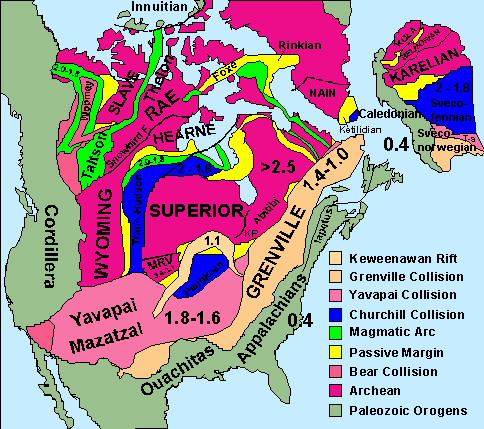
Trans-Hudson orogen (blue) surrounded by the Wyoming Hearne-Rae and Superior cratons (fuchsia) that constitute the central core of the North American Craton (Laurentia).
Trans-Hudson orogen and the Wyoming, Superior and Hearne cratons

The Trans-Hudson orogeny or Trans-Hudsonian orogeny was the major mountain building event (orogeny) that formed the Precambrian Canadian Shield and the North American Craton (also called Laurentia), forging the initial North American continent. It gave rise to the Trans-Hudson orogen (THO), or Trans-Hudson Orogen Transect (THOT), (also referred to as the Trans-Hudsonian Suture Zone (THSZ) or Trans-Hudson suture) which is the largest Paleoproterozoic orogenic belt in the world. It consists of a network of belts that were formed by Proterozoic crustal accretion and the collision of pre-existing Archean continents. The event occurred 2.0–1.8 billion years ago.

The Trans-Hudson orogen sutured together the Hearne-Rae, Superior, and Wyoming cratons to form the cratonic core of North America in a network of Paleoproterozoic orogenic belts. These orogenic belts include the margins of at least nine independent microcontinents that were themselves sections of at least three former major supercontinents, including Laurasia, Pangaea and Kenorland (ca. 2.7 Ga), and contain parts of some of the oldest cratonic continental crust on Earth. These old cratonic blocks, along with accreted island arc terranes and intraoceanic deposits from earlier Proterozoic and Mesozoic oceans and seaways, were sutured together in the Trans-Hudson Orogen (THO) and resulted in extensive folding and thrust faulting along with metamorphism and hundreds of huge granitic intrusions.[1]

The THO is a right-angled suture zone that extends eastward from Saskatchewan through collisional belts in the Churchill province, through northern Quebec, parts of Labrador and Baffin Island, and all the way to Greenland as the Rinkian belt and Nagssugtodidian Orogen. Westward it goes across Hudson Bay through Saskatchewan and then extends 90 degrees south through eastern Montana and the western Dakotas, downward through eastern Wyoming and western Nebraska, and is then cut off by the Cheyenne belt – the northern edge of the Yavapai province (see Trans-Hudson Orogen map[2] and the THOT Transect map).[3] To the south, the orogen contributed to the subsurface Phanerozoic strata in Montana and the Dakotas that created the Great Plains.

Overview

[edit]

The Trans-Hudson orogeny was the culminating event of the Paleoproterozoic Laurentian assembly, which occurred after the Wopmay orogeny (West of Hudson Bay, ca. 2.1–1.9 Ga.). The Trans-Hudson orogeny resulted from the collision of the Superior Craton of eastern Canada with the Hearne Craton in northern Saskatchewan and the Wyoming Craton of the western United States, with the Archean microcontinent Sask Craton trapped in the THO western interior. Similar to the Himalayas, the Trans-Hudson orogeny was also the result of continent-continent collision along a suture zone. Only the roots of this mountain chain remain, but these can be seen in northeastern Saskatchewan and in the Black Hills of South Dakota. The Trans-Hudson orogeny and the consequent upheaval of the continental crust in the middle Proterozoic eon caused the area around the Great Lakes to become a flattened plain, which in turn led to the creation of the intracontinental basin and the interior and central plains of the United States (the Great Plains are the westernmost portion of North America's Interior Plains, which extend east to the Appalachian Plateau).

The Black Hills of South Dakota is one of the few remaining exposed portions of the Trans-Hudson orogenic belt. The peaks of the Black Hills are 3,000–4,000 feet (910–1,220 m) above the surrounding plains, while Black Elk Peak – the highest point in South Dakota – has an altitude of 7,242 feet (2,207 m) above sea level.[4] These central spires and peaks all are carved from granite and other igneous and metamorphic rocks that form the core of the uplift. The nature and timing of this portion of the THO event in southern Laurentia is poorly understood, when compared to the exposed northern segments in Canada. The Black Hills offer the only surface exposure of the deformed and metamorphosed belt of Paleoproterozoic continental margin rocks in the collisional zone between the Archean Wyoming and Superior provinces. Based on geophysical evidence, this zone has been broadly interpreted to be the southern extension of the THO that was later truncated by the ~1.680 Ga. Central Plains orogen.[5]

Sequence of events

[edit]

Marine evidence indicates that the area initially opened to form an ocean called the Manikewan Ocean. Faulting, sedimentary and igneous rocks all indicate that divergence formed a rift valley that continued to spread until it resulted in a passive margin in which there was no tectonic activity. Shallow marine deposits formed on the continental shelves, and oceanic crust formed on the margins of the continental cratons as the divergence continued. Eventually the divergence stopped, then reversed direction, and a collision occurred between continental land masses. During the Wopmay orogeny, subduction occurred as oceanic crust of the Slave Craton was subducted beneath an eastward-moving continental plate. Likewise, during the Trans-Hudson orogeny, rifting at first separated the Superior craton from the rest of the continent. Then the Superior Craton reversed its direction and the ocean basin began to close. A subduction zone formed as the oceanic crust of the Superior Craton was subducted beneath the Hearne and Wyoming Cratons with the Sask Craton in the middle. Volcanic arcs developed as the cratons collided, eventually resulting in the THO mountain-building (orogeny).

Northwestern hinterland zone

[edit]

The Northwestern hinterland zone is a complex tectonically deformed region that includes the Peter Lake, Wollaston, and Seal River domains, and other parts of the Cree Lake Zone, now included in Hearne Province.

Reindeer zone

[edit]

The Reindeer zone to the north is a 500-kilometre-wide (310 mi) wide collage of Paleoproterozoic (1.92–1.83 Ga) arc volcanic rocks, plutons, volcanogenic sediments, and younger molasse, divisible into several lithostructural domains. Most of these rocks evolved in an oceanic to transitional, subduction-related arc setting, with increasing influence of Archean crustal components to the northwest. The zone overlies Archean basement exposed in structural windows that are now recognized as the Sask craton.

Wathaman-Chipewyan batholith

[edit]

The Wathaman-Chipewyan batholith is an Andean-type continental-margin, magmatic arc emplaced 1.86–1.85 Ga.

Flin Flon domain

[edit]

The Flin Flon domain is in the center of the Trans-Hudson Suture Zone and extends over the border of the Manitoba–Saskatchewan segment east and west. It is west of the Superior Craton, south of the Kisseynew Domain, and east of the Glennie Domain.

Superior Boundary zone

[edit]

The Superior Boundary zone is a narrow, southeastern, ensialic foreland zone bordering Superior Craton, comprising the Thompson Belt, Split Lake Block, and Fox River Belt.

Economic geology

[edit]

The Flin Flon greenstone belt is one of the largest Proterozoic volcanic-hosted massive sulfide (VMS) districts in the world, containing 27 Cu-Zn(-Au) deposits from which more than 183 million tonnes of ore have been mined. Most of mined VMS deposits in the Flin Flon belt are associated with juvenile arc volcanic rocks providing a powerful focus for future explorations. Gold mineralization has been less studied, but at Reed Lake has been shown to be associated with late brittle-ductile shear zones that follow peak tectonic and metamorphic activity within the Trans-Hudson Orogen. At Snow Lake, preliminary investigations suggest a long history of gold mineralization with at least some gold introduced prior to metamorphism.[6]

See also

[edit]

References

[edit]
Revisions and contributorsEdit on WikipediaRead on Wikipedia
from Grokipedia
The Trans-Hudson orogeny (THO) is a collisional orogenic event that occurred between approximately 1.92 and 1.80 billion years ago (Ga), marking the closure of the Manikewan Ocean and the accretion of juvenile arcs, microcontinents, and cratons to form a major segment of the North American continent. This mountain-building process exemplifies an early complete , involving ocean opening around 2.07–1.92 Ga, subduction initiation at 1.92 Ga, arc accretion from 1.92 to 1.85 Ga, and terminal collision between 1.83 and 1.80 Ga. The resulting orogen features highly metamorphosed volcanic arcs, granitoid batholiths, and folded gneisses, with crustal thickening to 60–70 km and partial eclogitization in the lower crust. The THO developed through a series of tectonic phases in a double-indentor , where the acted as the lower plate and the Churchill Province (including the Hearne, Sask, and Rae cratons) as the upper plate. Key events included the accretion of peri-Churchill microcontinents and arcs like the (1.92–1.89 Ga), the Reindeer Zone's oceanic arcs and back-arc basins (1.87–1.865 Ga), and peak metamorphism during final collision (1.82–1.79 Ga). Stabilization followed by 1.70–1.65 Ga, with post-orogenic granitoid intrusions and lower crustal flow preserving juvenile material amid recycled crust. Recent analyses of deeply buried rocks reveal juvenile isotopic signatures and continental arc-related , confirming complex mixing of mantle-derived and crustal components during orogenesis. Spanning over 3,000 km across central and northern , the THO extends from the Canadian Shield in and northeastward through , , and possibly into , with southern extensions buried under the to and the Dakotas. In alone, metamorphosed volcanic arcs exceed 10 km in thickness over more than 10,000 km², intruded by like the Wathaman (ca. 1.855 Ga). The orogen's structure includes the Reindeer Zone of accreted terranes and the highly deformed Wathaman-Chipewyan , now eroded to expose schists, gneisses, and faulted contacts. As a prototype for modern accretionary orogens, the THO contributed significantly to the assembly of the supercontinent and the stabilization of Laurentia's core, influencing subsequent Proterozoic tectonics like the . Its preserved high-velocity lower crust and seismic structure provide insights into deep crustal processes, such as channel flow, analogous to the Himalayan orogen. The THO's economic importance lies in hosting mineral deposits, including and , within its volcanic and sedimentary sequences.

Introduction and Overview

Definition and Timing

The Trans-Hudson orogeny is a collisional orogenic event (ca. 1.92–1.80 Ga) that records the closure of the Manikewan Ocean and the suturing of cratons, including the and the western margin of the Churchill Province, to form the core of the supercontinent. This mountain-building process exemplifies a complete in Earth's early history, involving rifting, ocean basin formation, , arc accretion, and . The commenced with initial rifting around 2.1 Ga, linked to the breakup of a supercraton and the opening of the Manikewan Ocean basin. initiation followed at approximately 1.92 Ga, as indicated by U-Pb ages from early oceanic arc assemblages and the onset of ocean closure. Intra-oceanic accretion of arc terranes occurred from 1.90 to 1.87 Ga, with peak collisional deformation and regional during final convergence between 1.83 and 1.80 Ga. Final stabilization and post-collisional adjustments took place between 1.84 and 1.80 Ga, with the cessation of arc around 1.83 Ga and peak regional at about 1.81 Ga. Geochronological constraints for this timeline derive primarily from U-Pb dating methods applied to crystals in igneous intrusions, volcanic rocks, and detrital grains within metasedimentary sequences. These techniques provide precise absolute ages that delineate the progression from extensional to compressional , with detrital U-Pb spectra revealing pre-orogenic source contributions and intrusive U-Pb ages dating deformational and magmatic pulses. Recent studies (as of 2025) on deeply buried confirm these timings with juvenile isotopic signatures.

Geographic Extent and Significance

The Trans-Hudson orogeny constitutes a vast north-trending collisional belt spanning over 4,600 km across central and eastern . It stretches from subsurface extensions in south-central regions, including , the Dakotas, , and , northward through , , , and , ultimately reaching and correlating with the Nagssugtoqidian orogen in . This extensive zone separates major , such as the Superior Province to the southeast and the composite Churchill Province (encompassing the Hearne, Rae, and ) to the northwest and southwest, and is truncated southward by the Cheyenne belt, marking the suture with the . The orogeny's significance lies in its representation of a complete Wilson Cycle during the Proterozoic, preserving evidence of initial rifting around 2.1–1.92 Ga, subsequent ocean basin development, subduction-accretion processes, and final continent-continent collision between 1.83 and 1.80 Ga. This tectonic event was instrumental in assembling the core of the Laurentia craton by amalgamating juvenile arcs and Archean blocks, thereby stabilizing much of the North American continental interior. The resulting mountain belt contributed fundamentally to the growth and stabilization of Precambrian North America, with its structural fabric influencing the foundational architecture of the continent. Although deeply eroded over billions of years, the Trans-Hudson orogen remains one of the best-preserved orogenic systems globally, owing to limited post-orogenic tectonism that avoided significant overprinting by later events like the . This preservation enables exceptional insights into early Earth and crustal evolution within the Canadian Shield, where the orogen's lithospheric roots continue to shape modern seismic and gravitational anomalies. A notable surface exposure is the uplift in southwestern , where Trans-Hudson-age rocks are exhumed along the Cheyenne belt, culminating in at an elevation of 7,242 feet (2,207 meters), the highest point east of the .

Geological Background

Involved Cratons

The Trans-Hudson orogeny involved the collision of several cratonic blocks, primarily the to the east, the composite Hearne-Rae Craton to the northwest, and the Wyoming Craton to the southwest, along with intervening juvenile microcontinents and volcanic arcs that were accreted during the assembly process. These cratons formed the stable margins of the ocean basin known as the Manikewan Ocean, which separated them prior to convergence around 1.9–1.8 Ga. The , positioned on the eastern margin of the , consists predominantly of crust formed between 3.6 and 2.6 Ga, featuring extensive greenstone-granite terranes with to volcanic sequences, tonalite-trondhjemite-granodiorite (TTG) intrusions, and migmatitic gneisses. Its western boundary was a convergent margin during the orogeny, marked by subduction-related and subsequent collision. In contrast, the Hearne-Rae to the northwest comprises basement rocks aged 2.8–2.7 Ga, characterized by banded gneisses, schists, and amphibolites, with the Hearne margin developing as a passive that accumulated quartzofeldspathic sediments and volcanic flows during pre-orogenic rifting. The , on the southwestern flank, preserves an core dating to 3.4–2.5 Ga, dominated by granite gneisses, leucogranites, greenstone belts with metabasalts and metasediments, and ultramafic complexes, though its exposed portions show later reworking. Between these major cratons, juvenile microcontinents and island arcs—such as those in the Reindeer Zone—formed from magmatic arcs (ca. 2.1–1.9 Ga) and were accreted to the cratonic margins, contributing significant volumes of new to the orogen. Paleomagnetic studies indicate that the Superior and Hearne-Rae cratons were separated by low-latitude positions prior to collision, with paleopoles from 1.87 Ga units showing relative motion consistent with closure of the Manikewan Ocean. Isotopic evidence, including Sm-Nd model ages (e.g., ~2.72 Ga for Superior and ~2.83 Ga for Hearne), further supports their independent evolutions and distinct pre-collisional configurations, with no shared juvenile sources until orogenic accretion.

Pre-Orogenic Rifting and Paleogeography

The pre-orogenic rifting phase preceding the Trans-Hudson orogeny involved the extensional breakup of cratonic blocks, leading to the formation of the Manikewan Ocean basin between approximately 2.2 and 2.0 Ga. This rifting primarily separated the southern margin of the from the northern margins of the Hearne and cratons, which were part of the broader Churchill Province assembly including the Rae craton. The process reflects an early stage in the , where initial continental extension created a divergent margin system that would later facilitate formation and eventual . Paleomagnetic data indicate differential rotation and separation of these cratons during this interval, with the drifting relative to the Hearne- block. Key evidence for this rifting comes from widespread igneous activity, including the Molson emplaced at approximately 2.08 Ga along the northwestern margin. These north-northeast-trending dikes, composed of , , and , record mantle-derived magmatism associated with lithospheric extension and thinning during the initial stages of ocean basin opening. Paleogeographic reconstructions of this period rely on integrated analyses of detrital zircon geochronology and paleomagnetism to delineate rift basin evolution and early passive margin configurations. Detrital zircons from rift-related sediments primarily source from Archean terranes of the Superior and Hearne cratons, with U-Pb ages clustering around 2.7–2.5 Ga, indicating proximal derivation and limited transport across the nascent Manikewan Ocean. Paleomagnetic poles from mafic intrusions and sedimentary units, such as those in the Molson swarm and Dubawnt Group, reveal a paleolatitude shift for the Superior craton from mid-latitudes to higher latitudes between 2.2 and 2.0 Ga, supporting models of oblique rifting and the establishment of opposing passive margins. These data collectively portray a fragmented Laurentian precursor with elongate rift basins accumulating clastic and volcanic debris prior to ocean floor spreading.

Tectonic Evolution

Early Subduction and Arc Formation

The onset of convergence in the Trans-Hudson orogeny commenced with subduction initiation along the margins of the Manikewan Ocean approximately 1.92 Ga, marking the transition from rifting to closure of this seaway. This process facilitated the development of intra-oceanic island and associated back-arc basins, as oceanic was consumed beneath overriding plates. Geochemical evidence from volcanic sequences indicates subduction-related magmatism, with tholeiitic basalts exhibiting mid-ocean ridge basalt-like affinities transitioning to arc signatures characterized by niobium depletion, light enrichment, and negative anomalies in Nb/Zr and Ti. A key repository of this early tectonic activity is the Reindeer Zone, where juvenile crust accreted between 1.92 and 1.87 Ga, comprising primitive to evolved volcanic arcs and back-arc assemblages. These arcs, such as the La Ronge–Lynn Lake system, formed through mantle-derived influenced by hydrous fluids from the subducting slab, as evidenced by εNd values ranging from -1.5 to +3.9, reflecting minimal crustal contamination in primitive units. The zone's lithologies include submarine volcanic piles and sedimentary basins that record episodic arc building prior to continental involvement. Convergence during this phase was characterized by oblique subduction, as indicated by seismic reflection profiles revealing west-dipping reflectors and structural evidence of northward translation of crustal fragments over distances exceeding 900 km. This transpressive regime promoted the accretion of microcontinents and arc terranes to the margins of the Hearne and Sask cratons, with blocks like the Dakota incorporated into the evolving orogen. Such oblique mechanics are further supported by high-conductivity belts in geophysical models, delineating paleo-subduction zones and transform faults reactivated as thrusts around 1.86 Ga.

Main Collision and Deformation

The main collision phase of the Trans-Hudson orogeny occurred between approximately 1.84 and 1.81 Ga, driven by the convergence of the with the Hearne craton (part of the broader Churchill Province), leading to the closure of the Manikewan Ocean basin. This convergence involved the final accretion of juvenile arc terranes onto the continental margins, culminating in continent-continent collision that generated extensive nappes and fold- belts, particularly evident in the Cape Smith and belts where south-verging structures dominate. Thin-skinned imbrication during early displaced supracrustal sequences southward by more than 100 km, while subsequent thick-skinned deformation incorporated deeper crustal levels. Deformation during this peak orogenic period was characterized by polyphase folding and penetrative east-dipping crustal structures, as revealed by LITHOPROBE seismic reflection profiles across the orogen. These profiles image shallowly east-dipping reflections extending from surface exposures to depths of up to 40 km, particularly in the Flin Flon Belt and Reindeer Zone, where juvenile arc rocks are stacked beneath a major detachment and soling into the mid-crust as west-verging thrust faults. The polyphase nature of the folding includes early recumbent isoclinal folds overprinted by upright structures with sub-vertical axial planar fabrics, reflecting progressive strain partitioning during crustal thickening. Kinematically, the collision featured oblique convergence, especially along the southern margin at the Cheyenne belt, where sinistral accommodated both and lateral displacement of crustal fragments, including elements of the . Overall crustal estimates range from 260 km in thick-skinned domains to potentially 300–500 km across the orogen, based on balanced cross-sections and geophysical modeling of thrust stacks.

Post-Collisional Magmatism and Extension

Following the main collisional phase of the Trans-Hudson orogeny, syn- to post-tectonic played a key role in crustal stabilization, with extensive emplacement occurring between approximately 1.87 and 1.84 Ga transitioning to post-collisional phases ~1.80–1.77 Ga. The Wathaman-Chipewyan , a voluminous composite intrusion spanning over 700 km along the eastern margin of the Cree Lake zone, exemplifies this phase, with U-Pb ages clustering at 1.865–1.850 Ga and indicating late syntectonic intrusion during terminal collision. Similarly, the Cumberland in the northeastern segment, dated to 1.865–1.845 Ga, includes post-collisional granites that reflect ongoing crustal reworking. These intrusions, often of monzogranitic to granodioritic composition, contributed to the thickening and of the lower crust, marking the transition from compressional to more relaxed tectonic regimes. A notable feature of this magmatism is the appearance of A-type granites, particularly within the Cumberland batholith, which signal the onset of extensional conditions by indicating within-plate or anorogenic settings rather than continued . These A-type varieties, characterized by high silica content, elevated alkali ratios, and enrichment in high-field-strength elements, intruded as the orogen shifted from arc-related to intraplate magmatism, likely driven by or slab break-off beneath the thickened crust. Such granites, emplaced around 1.85–1.84 Ga, are volumetrically minor compared to earlier I-type suites but underscore the rheological weakening that facilitated subsequent extension. Extension mechanisms dominated from approximately 1.80 Ga, primarily through of the overthickened orogenic crust, which had reached up to 50 km in places due to prior collisional stacking. This collapse was accommodated by low-angle extensional shear zones, such as those along the Baffin and Bergeron sutures, which exhumed mid-crustal levels and allowed for rapid cooling and isostatic rebound. Contemporaneous basin formation, including early deposits, recorded this extensional unroofing, with reflecting of the uplifting . The process stabilized the orogen by redistributing strain and promoting lateral flow in the ductile lower crust. Geochemically, the magmatic record documents a clear from calc-alkaline signatures in earlier arc-related plutons—marked by moderate silica and enrichment in large-ion lithophile elements—to more alkaline compositions in post-collisional phases, with higher alkali and contents indicative of in a non-subduction environment. This shift, evident in the A-type granites and leucogranitic dykes dated 1.80–1.74 Ga, reflects decreasing mantle input and increasing crustal recycling as extension progressed, ultimately contributing to the assembly of the .

Structural Zones

Western Zones (Hinterland and Reindeer)

The Northwestern Hinterland Zone forms the western foreland of the Trans-Hudson orogeny, comprising the deformed margin of the Rae-Hearne craton in northern , where basement rocks experienced relatively low-grade deformation during the main collisional phase around 1.83–1.80 Ga. This zone overlaps with the earlier Taltson-Thelon orogen (ca. 2.0–1.9 Ga), but Trans-Hudson tectonism primarily involved reactivation and minor reworking of the craton margin rather than intense overprinting, preserving much of the pre-existing crust with model ages up to 3.5 Ga. Structurally, it acts as a rigid block with thin-skinned deformation, including folds and thrusts that involve both basement and overlying metasedimentary cover, increasing in intensity eastward toward the orogenic core. In contrast, the adjacent Reindeer Zone to the east represents juvenile domains accreted during the orogeny's early stages, featuring 1.9 Ga oceanic arc s, back-arc basins, and ocean plateaus formed amid the closure of the Manikewan Ocean between 1.92 and 1.80 Ga. This zone includes extensive volcano-sedimentary belts, such as those in the Domain, a granite-greenstone with metavolcanic and metasedimentary sequences accreted to the margin around 1.87–1.86 Ga via subduction-related processes. High-strain zones, like the belt and the Duck Lake Shear Zone, record ductile shearing and nappe formation during the terminal collision at 1.83–1.80 Ga, with peak metamorphism reaching amphibolite facies (600–730 °C, 4.5–6.0 kbar) and localized post-orogenic cooling delays of 20–25 Ma near shear boundaries. The structural contrasts between the and zones highlight the orogeny's foreland-to-hinterland transition: the Rae-Hearne margin remained a stable, low-strain foreland with minimal juvenile input and primarily signatures, while the Zone underwent thick-skinned, ductile deformation of accreted arcs, incorporating significant mantle-derived material and forming imbricate stacks dipping northwest at 30–40°. This dichotomy reflects the collision's progressive incorporation of elements against more deformable juvenile terranes, with the Reindeer's high-strain fabrics—such as penetrative and oblique-slip shear zones—contrasting the Hinterland's brittle-ductile response.

Central Zones (Wathaman Batholith and Flin Flon Domain)

The Central Zones of the Trans-Hudson orogeny encompass the Wathaman-Chipewyan batholith and the Flin Flon Domain, which form the magmatic and supracrustal core of the orogenic belt's internal architecture. These zones represent a collage of juvenile arc terranes accreted along the margin of the Hearne craton during the , with the batholith serving as a syntectonic intrusive complex that stitched together earlier arc segments. The Wathaman-Chipewyan is a vast, northeast-trending plutonic complex dominated by calc-alkaline granites, granodiorites, and quartz monzonites, extending over 900 km from north-central to northeastern . Emplaced between approximately 1.865 and 1.850 Ga, it crystallized over a span of 15 to 25 million years, akin to modern continental magmatic arcs such as the or Sierra Nevada, through repeated pulses of magma intrusion in a convergent setting. As the largest known pluton, it intruded along the western margin of the Reindeer Zone, postdating the initial accretion of juvenile arcs at around 1.88 Ga and acting as a structural marker that bounds the orogenic internides to the east. Its emplacement mechanics involved mid-crustal magma chambers that facilitated ascent via tectonic weakening and of the lower crust during ongoing and collision. The Domain, situated within the Zone, comprises greenstone belts that preserve a record of intra-oceanic arc and development between 1.92 and 1.88 Ga. These belts feature bimodal volcanic sequences, including tholeiitic to calc-alkaline basalts and rhyolites, erupted in subaqueous environments and associated with ocean-floor and island-arc assemblages. Tectonic assembly involved thrusting and imbrication of these supracrustal rocks, with prominent shear-hosted structures such as the Northeast Arm, , and Meridian-West Arm shear zones that accommodated ductile deformation during accretionary phases around 1.88 to 1.87 Ga. The domain's greenstones host significant volcanogenic massive sulfide deposits, reflecting hydrothermal activity in extensional arc settings prior to regional metamorphism. Interactions between the Wathaman-Chipewyan and the Flin Flon Domain highlight the 's role as a mid-crustal feeder system that supported upper-level deformation and in the orogenic core. Intruding adjacent to and partially into the Flin Flon greenstones after their initial assembly, the provided a deep-seated source for syntectonic melts that influenced shear zone development and crustal thickening during the main collisional phase around 1.85 to 1.83 Ga. This relationship underscores the transition from arc accretion to , with the stabilizing the accreted terranes while channeling to fuel ongoing shortening in overlying supracrustal sequences.

Eastern Boundary Zone

The Eastern Boundary Zone, commonly referred to as the Superior Boundary Zone (SBZ), marks the sutural contact between the juvenile Paleoproterozoic crust of the Trans-Hudson Orogen (THO) and the foreland of the , characterized by intense deformation and during the terminal collision phase. This zone extends along the northwestern margin of the in and , where supracrustal sequences and intrusive rocks were thrust over basement, recording the closure of the Manikewan Ocean basin during the Hudsonian orogeny (1.84–1.77 Ga). The SBZ thus delineates a sharp transition from the internally deformed, juvenile arc and back-arc assemblages of the THO to the relatively undeformed, resistive crust of the craton, with seismic profiles revealing conductive lower-crustal layers of the THO extending eastward beneath the SBZ. Structural features in the SBZ are dominated by east-vergent thrust faults and associated folds that accommodated the convergence of the THO against the rigid , with deformation involving both cover rocks and basement gneisses. Prominent elements include the east-dipping Superior Boundary Fault, which separates the SBZ from the adjacent Reindeer Zone, and a series of nappes and shear zones that facilitated the imbrication of supracrustal units like the Paleoproterozoic Ospwagan Group onto Archean granulites. Gneiss domes and multiple generations of folding (F₁ to F₃) further attest to polyphase shortening, with F₃ folds exhibiting S-asymmetric geometries and forming at shallow crustal levels (less than 5–6 km depth) during the main collisional episode. Seismic reflection data from Lithoprobe transects image these structures as east-dipping, crustal-penetrating reflectors extending to depths of 14 seconds two-way time, indicative of underthrusting where Reindeer Zone rocks were emplaced beneath the SBZ at 15–45 km depth in the southern segments. Metamorphism within the SBZ reached high-grade to conditions, peaking at 700–775°C and 5–7 kbar pressures between approximately 1.84 and 1.77 Ga, synchronous with the Hudsonian and reflecting the thermal overprint of collisional thickening. This event retrogressed basement and imposed a penetrative fabric on the overlying sequences, with the thermal maximum occurring between F₂ and F₃ deformation phases around 1.82–1.79 Ga. The Thompson Nickel Belt exemplifies this deformational front, comprising a belt of -imbricated supracrustal rocks along the margin, where high-grade and east-vergent structures record the ~1.87 Ga collision signatures, including U-Pb ages from syntectonic intrusions and metamorphic minerals. Overall, the SBZ's tectonic evolution highlights a foreland belt that absorbed the final stages of THO-Superior convergence, contrasting with the more internal, juvenile domains to the west.

Petrology and Metamorphism

Igneous Suites

The igneous suites of the Trans-Hudson orogeny encompass a diverse array of volcanic and plutonic rocks formed primarily during arc-related and collisional phases between approximately 1.92 and 1.80 Ga. Volcanic sequences, particularly in the juvenile Reindeer Zone, include tholeiitic to calc-alkaline basalt-andesite assemblages that characterize early subduction-related magmatism. For instance, the Flin Flon features bimodal volcanic rocks with tholeiitic basalts dominant in older units (ca. 1.90 Ga) and calc-alkaline andesites in younger successions (ca. 1.87 Ga), reflecting evolution from immature to mature arc settings. Geochemically, these arc volcanics exhibit pronounced negative Nb-Ta anomalies on primitive mantle-normalized trace element diagrams, alongside enrichments in large ion lithophile elements (LILE) such as Ba, K, and Sr, indicative of subduction-modified mantle sources. Tholeiitic varieties display flat to slightly light (LREE)-enriched patterns with low heavy (HREE) abundances, while calc-alkaline rocks show steeper LREE enrichment and minor negative Eu anomalies, suggesting fractional in a thickening arc crust. Neodymium isotopic compositions (εNd from +2.3 to +4.8) further support derivation from depleted mantle with limited crustal contamination during early arc formation. Plutonic rocks dominate the orogeny's igneous record, with early tonalite-trondhjemite-granodiorite (TTG) suites emplaced between 1.90 and 1.88 Ga in arc terranes like the Flin Flon Belt. These metaluminous to slightly peraluminous intrusions are calc-alkaline, with high Sr/Y ratios (>40) and La/Yb (>20), characteristic of slab-derived melts or of metasomatized mantle wedge, accompanied by negative Nb-Ta-Ti anomalies. Subsequent potassic granites, intruded around 1.84 to 1.83 Ga during successor arc magmatism, exhibit higher K2O/Na2O ratios and more evolved compositions, marking a shift toward crustal involvement. Strontium-neodymium isotopic data (εNd from +4.3 to -6) across these suites reveal progressive mixing between juvenile mantle-derived magmas and crustal components, as evidenced by decreasing εNd values in later plutons. Late-stage A-type s, emplaced post-1.85 Ga (ca. 1.85-1.81 Ga for Hudson granitoids and ~1.75 Ga for Nueltin suite), display anorogenic affinities with peraluminous, ferroan compositions, high FeO/(FeO+MgO) ratios, and elevated Ga/Al values. These rocks, including rapakivi-textured varieties in the Nueltin , show LREE-enriched patterns without significant Nb-Ta depletion and negative εNd values (-7 to -13.5), pointing to melting of pre-existing crust in an extensional regime following main collision. Such suites briefly align with post-collisional and extension phases.

Metamorphic Assemblages

The Trans-Hudson orogeny records a progression of metamorphic grades from to , reflecting intense crustal thickening and heating during around 1.9–1.7 Ga. Peak conditions in the orogenic cores reached approximately 700–900+°C and 6–10 kbar, as determined by thermobarometric calculations on pelitic and assemblages. These high-grade conditions are particularly evident in the central and eastern zones, where upper to granulite-facies mineralogies dominate, contrasting with lower-grade marginal areas that preserve relics. Recent studies have identified ultra-high (UHT) metamorphism exceeding 900°C associated with extreme back-arc processes, providing new evidence for intense heating during late orogenic stages. Metamorphic assemblages exhibit Barrovian-type sequences in the boundary zones, characterized by progressive mineral zonation indicative of increasing pressure and temperature during burial. In the Thompson Belt, along the western margin, pelitic rocks display -sillimanite transitions, with in mafic granulites and dominating in metasediments, alongside --quartz and in upper amphibolite-facies domains. These assemblages, reaching 640–830°C and 3–7 kbar, suggest steep geothermal gradients of 33–51°C/km, with local indicating low-pressure components. Evidence of retrogression is widespread, including chloritization of and replacement of by and phyllosilicates, linked to post-peak exhumation and fluid infiltration around 1.72 Ga. Pressure-temperature paths reconstructed from thermobarometry reveal clockwise loops, commencing with prograde under increasing (6–12 kbar) and (up to 825°C) during initial collision phases (ca. 1.84–1.81 Ga), followed by isothermal decompression to 4.5–6 kbar. This trajectory, observed in the Wollaston-Mudjatik Transition Zone and Thompson Belt, underscores crustal thickening via nappe stacking and underthrusting, with subsequent exhumation driven by transpressional tectonics (ca. 1.81–1.77 Ga). Such paths align with collisional orogens, where peak correlates with maximum depths before tectonic unroofing.

Economic Geology

Key Mineral Deposits

The Trans-Hudson orogeny hosts significant volcanogenic massive (VMS) deposits, primarily syngenetic formations within greenstone belts associated with arc and seafloor hydrothermal systems around 1.9 Ga. These deposits formed in tectonostratigraphic sequences during intra-oceanic accretion, involving submarine exhalative processes that precipitated from hot, mineral-rich fluids on the seafloor, often in extensional or back-arc settings prior to . The camp in the central Trans-Hudson orogen exemplifies this, with the deposit comprising Cu-Zn-Au mineralization in deformed volcanic and volcano-sedimentary rocks of the Flin Flon Formation, dated to 1.90 to 1.88 Ga. Approximately 62.5 Mt of ore have been mined from the deposit, grading 2.2% Cu, 4.1% Zn, and 2.7 g/t Au, reflecting its role as a major syngenetic accumulation in a rifted arc environment. Nickel sulfide deposits occur in the Thompson Belt along the western margin of the orogen, where ultramafic intrusions and komatiitic flows within the Ospwagan Group interacted with sulfidic metasediments during the 1.85 Ga collisional phase. The Thompson Mine represents a key example, featuring stratabound Ni-Cu-Co sulfides (pyrrhotite-pentlandite-chalcopyrite) in lenses deformed into schists under amphibolite-facies conditions, with formation linked to magmatic segregation and from country rocks. More than 150 Mt of ore at 2.32% Ni, 0.16% Cu, and 0.046% Co have been delineated across the belt's deposits, underscoring their economic scale within the orogen's foreland deformation zone. Uranium deposits are prominent in the eastern segments of the orogen, particularly in the Wollaston Domain of the segment, where magmatic and metamorphic occurs in granitic pegmatites and metasedimentary rocks formed during peak thermal events (1.82–1.81 Ga) and post-peak phases (1.81–1.72 Ga). These deposits, including examples like the McArthur River and Cigar Lake (though primarily Athabasca Basin-hosted, with THO basement influence), represent significant resources, with high-grade vein and disseminated styles linked to orogenic fluids and of uranium-rich metasediments. Gold mineralization in the Trans-Hudson orogeny is predominantly orogenic-style, hosted in shear zones developed during late-stage deformation around 1.8 to 1.75 Ga. The Santoy Lake deposit in the eastern Glennie Domain illustrates this, with Au-bearing quartz veins and disseminated sulfides (, ) in calc-silicate altered metabasalts and schists of the , formed at depths of ~9 km under to conditions. Mineralization occurred syn- to late-D3 deformation via fluid-mediated remobilization in the Santoy shear system, a splay of the regional Tabbernor fault, yielding grades up to 10 g/t Au in structurally controlled zones.

Resource Exploitation and Potential

The Trans-Hudson orogen has been a significant source of base metals since the early , with operations in the -Snow Lake volcanic massive (VMS) camp commencing in the 1930s under Hudson Bay Mining and Smelting Co., Limited (now Minerals Inc.). The mine entered full production in 1930, initially focusing on high-grade - ores, and by the 1940s, the company had become Canada's second-largest producer and third-largest producer. Over the subsequent decades, the camp's 27 mines collectively produced more than 400 million tonnes of polymetallic ore, yielding substantial and outputs that supported regional economic development. Minerals operated 28 mines in the since 1928, with historical production exceeding 150 million tonnes of ore across the district. As of 2025, mining activities in are centered on Hudbay's Snow Lake operations, including the Lalor Mine, following the closure of the 777 Mine in in June 2022 after 18 years of production. The Snow Lake operations process ore through the New Britannia mill, recovering , , , and silver concentrates, with 2025 guidance projecting 9,000–11,000 tonnes of and 21,000–27,000 tonnes of from Canadian assets. The Lalor Mine has an optimized mine life extending to 2037, with average annual production exceeding 193,000 ounces over the next three years. In the Thompson Belt, Vale's operations, including the Thompson Mine, produced 10,500 tonnes of in the 12 months ending September 2024 but are under strategic review for potential sale, expected to conclude in the second half of 2025. In , the orogen's extensions host limited active production but ongoing exploration targets VMS deposits in the Flin Flon Domain. Efforts to access buried extensions under sedimentary cover, particularly in , employ geophysical methods such as and surveys to delineate hidden VMS systems analogous to exposed deposits. The orogen holds substantial untapped potential for VMS deposits in underexplored, cover-bound areas, where geophysical anomalies suggest extensions of known belts beyond current mine depths exceeding 1,000 meters. Additionally, batholiths, such as the Wathaman and Cumberland, exhibit elevated (REE) signatures in associated granitic and syenitic intrusions, prompting scoping studies for REE mineralization linked to post-orogenic magmatism. Economic viability is influenced by increasing mining depths, which raise extraction costs, and metallurgical complexities in processing polymetallic ores requiring sequential flotation to separate , , and precious metals. These factors, combined with fluctuating metal prices, underscore the need for advanced exploration technologies to unlock remaining resources.

Modern Research and Analogues

Recent Geochronological and Seismic Studies

Recent geochronological studies have employed high-precision U-Pb and Lu-Hf isotopic analyses to refine the timing of initiation and collisional events within the Trans-Hudson orogeny. A 2021 investigation using Lu-Hf garnet geochronology in the Southeastern Churchill Province dated prograde metamorphism and crustal thickening to approximately 1.885 Ga, supporting models of westward accretionary growth along the Churchill plate margin from circa 1.9 to 1.8 Ga. This work corroborates earlier evidence for onset in the Manikewan Ocean by 1.92 Ga, as indicated by magmatism and sedimentary records, thereby establishing a protracted collisional history beginning around this time. Seismic profiling has provided critical insights into the deep crustal architecture of the orogen, with LITHOPROBE reflection revealing pervasive east-dipping reflectors throughout the crust in the southeastern foreland zone adjacent to the . These features, unexpected in initial models that anticipated west-dipping structures, suggest oblique and imbrication of basement during orogenic assembly, extending from the internal Reindeer Zone to the hinterland. Recent integrations of these profiles with magnetotelluric from further delineate east-dipping slab remnants indicative of flat-slab beneath the Sask craton, enhancing understanding of lithospheric deformation. Paleomagnetic analyses have illuminated the kinematics of convergence, particularly along the southern margin. Data from the Lynn Lake belt record relative motions of the Superior and Slave cratons (30° northwest and 13° southeast, respectively) with respect to magmatic arcs, supporting an oblique convergence model for the docking of the Wyoming craton with the Superior margin around 1.83–1.80 Ga. This transpressive regime involved at least 900 km of northward translation of Wyoming fragments, embedding them within the orogen and contributing to its arcuate geometry. A 2025 geochronological update on deeply buried basement along the western Superior craton margin, using U-Pb zircon dating, reinforces these interpretations by identifying juvenile mafic gneisses at circa 1.83 Ga linked to subduction-related metamorphism.

Comparisons to Modern Orogenies

The Trans-Hudson orogeny exemplifies a complete , involving sequential rifting, , collision, and extension, much like the Appalachian and Himalayan orogenic systems. In the Trans-Hudson case, initial rifting around 2.07–1.92 Ga led to the opening of basins, followed by and arc accretion by 1.9 Ga, culminating in continent-continent collision between the Superior and Churchill cratons from 1.9 to 1.8 Ga, and subsequent extension that integrated the orogen into the supercontinent . This progression mirrors the Appalachian orogeny, where rifting of preceded and collision along the Laurentian margin, and the ongoing Himalayan cycle, initiated by the India-Asia collision around 50 Ma, which continues to exhibit active shortening and uplift. Such parallels underscore the orogeny's role as a prototype for modern plate-tectonic cycles, with preserved evidence of oceanic closure and assembly in both juvenile and reworked crustal domains. Oblique convergence during the Trans-Hudson orogeny drove significant lateral tectonics, analogous to the India-Asia collision forming the . The indentation of the into the Churchill plate around 1.83–1.795 Ga resulted in transpressional deformation, with dextral shear along boundaries like the Niagara fault zone and lateral escape of accreted terranes, similar to the extrusion of Tibetan crust along strike-slip faults in the modern Himalayan system. The Cheyenne belt, marking the southern margin of the Wyoming craton's involvement, functioned as a major collisional suture with ~260 km of shortening, comparable to the in the , which accommodates ongoing convergence through out-of-sequence thrusting. These features highlight how oblique plate motions in the Trans-Hudson orogeny facilitated crustal thickening and via sideways expulsion, a process central to the topographic evolution and seismicity of the present-day Himalayan belt. Proterozoic orogenies like the Trans-Hudson differed from counterparts due to elevated mantle temperatures and heat flow, fostering hotter, more magmatic conditions. At ~1.8 Ga, higher radiogenic heat production in the crust (about 1.5 times modern levels) combined with mantle heat flow estimates of 11–16 mW m⁻² to produce geothermal gradients that enabled widespread and Barrovian up to 720°C, exceeding typical values in stable cratons. This thermal regime supported extensive leucogranite intrusion and ductile crustal flow during collision, contrasting with cooler orogens like the , where lower mantle temperatures (~100–250°C cooler) limit to arc-related suites and promote brittle faulting. Such differences reflect a secular cooling of since the , influencing orogenic styles from more vertically extensive, magmatic belts to laterally focused, sediment-dominated systems today.

References

Add your contribution
Related Hubs
User Avatar
No comments yet.