Hubbry Logo
search
logo
1933310

Triangular prism

logo
Community Hub0 Subscribers
Read side by side
from Wikipedia
Triangular prism
TypePrism
Semiregular polyhedron
Uniform polyhedron
Faces2 triangles
3 squares
Edges9
Vertices6
Symmetry groupD3h
Dihedral angle (degrees)As a semi-regular:
  • square-to-square: 60°
  • square-to-triangle: 90°
Dual polyhedronTriangular bipyramid

In geometry, a triangular prism or trigonal prism[1] is a prism with two triangular bases. If the edges pair with each triangle's vertex and if they are perpendicular to the base, it is a right triangular prism. A right triangular prism may be both semiregular and uniform.

The triangular prism can be used in constructing another polyhedron. Examples are some of the Johnson solids, the truncated right triangular prism, and Schönhardt polyhedron.

Properties

[edit]

A triangular prism has six vertices, nine edges, and five faces. Every prism has 2 congruent faces known as its bases, and the bases of a triangular prism are triangles. The triangle has 3 vertices, each of which pairs with another triangle's vertex, making up another three edges. These edges form three parallelograms as other faces.[2] If the prism's edges are perpendicular to the base, the lateral faces are rectangles. The prism is called a right triangular prism.[3] This prism may also be considered a special case of a wedge.[4] Topologically a triangular frustum is the same polyhedron. Still, the two triangles are different sizes, and the sides are slanted trapezoids.

3D model of a (uniform) triangular prism

If the base is equilateral and the lateral faces are square, then the right triangular prism is semiregular. A semiregular prism means that the number of its polygonal base's edges equals the number of its square faces.[5] More generally, the triangular prism is uniform. This means that a triangular prism has regular faces and has an isogonal symmetry on vertices.[6] The three-dimensional symmetry group of a right triangular prism is dihedral group D3h of order 12: the appearance is unchanged if the triangular prism is rotated one- and two- thirds of a full angle around its axis of symmetry passing through the center's base, and reflecting across a horizontal plane. The dual polyhedron of a triangular prism is a triangular bipyramid. The triangular bipyramid has the same symmetry as the triangular prism.[1] The dihedral angle between two adjacent square faces is the internal angle of an equilateral triangle π/3 = 60°, and that between a square and a triangle is π/2 = 90°.[7]

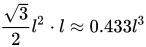
The volume of any prism is the product of the area of the base and the distance between the two bases.[8] In the case of a triangular prism, its base is a triangle, so its volume can be calculated by multiplying the area of a triangle with the length of the prism: where b is the length of one side of the triangle, h is the length of an altitude drawn to that side, and l is the distance between the triangular faces.[9] In the case of a right triangular prism, where all its edges are equal in length l, its volume can be calculated as the product of the equilateral triangle's area and length l:[10]

The triangular prism can be represented as the prism graph Π3. More generally, the prism graph Πn represents the n-sided prism.[11] It is an example of Halin graph.[12]

[edit]

In the construction of polyhedra

[edit]

Beyond the triangular bipyramid as its dual polyhedron, many other polyhedra are related to the triangular prism. A Johnson solid is a convex polyhedron with regular faces, and this definition sometimes omits uniform polyhedra such as Archimedean solids, Catalan solids, prisms, and antiprisms.[13] There are six Johnson solids with their construction involving the triangular prism: elongated triangular pyramid, elongated triangular bipyramid, gyrobifastigium, augmented triangular prism, biaugmented triangular prism, and triaugmented triangular prism. The elongated triangular pyramid and the gyroelongated triangular pyramid are constructed by attaching tetrahedron onto the base of a triangular prism. The augmented triangular prism, biaugmented triangular prism, and triaugmented triangular prism are constructed by attaching equilateral square pyramids onto the square face of the prism. The gyrobifastigium is constructed by attaching two triangular prisms along one of its square faces.[14]

Truncated right triangular prism

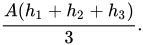
A truncated triangular prism is a triangular prism constructed by truncating its part at an oblique angle. As a result, the two bases are not parallel, and every height has a different edge length. If the edges connecting bases are perpendicular to one of its bases, the prism is called a truncated right triangular prism. Given that A is the area of the triangular prism's base, and the three heights h1, h2, and h3, its volume can be determined in the following formula:[15]
Schönhardt polyhedron

Schönhardt polyhedron is another polyhedron constructed from a triangular prism with equilateral triangle bases. This way, one of its bases rotates around the prism's centerline and breaks the square faces into skew polygons. Each square face can be re-triangulated with two triangles to form a non-convex dihedral angle.[16] As a result, the Schönhardt polyhedron cannot be triangulated by a partition into tetrahedra. It is also that the Schönhardt polyhedron has no internal diagonals.[17] It is named after German mathematician Erich Schönhardt, who described it in 1928, although artist Karlis Johansons exhibited the related structure in 1921.[18]

A crossed triangular antiprism shares its vertex arrangement with a triangular prism as a faceting, with lateral isosceles triangles.

There are 4 uniform compounds of triangular prisms. They are compound of four triangular prisms, compound of eight triangular prisms, compound of ten triangular prisms, compound of twenty triangular prisms.[19]

Honeycombs

[edit]

There are 9 uniform honeycombs that include triangular prism cells:

Gyroelongated alternated cubic honeycomb, elongated alternated cubic honeycomb, gyrated triangular prismatic honeycomb, snub square prismatic honeycomb, triangular prismatic honeycomb, triangular-hexagonal prismatic honeycomb, truncated hexagonal prismatic honeycomb, rhombitriangular-hexagonal prismatic honeycomb, snub triangular-hexagonal prismatic honeycomb, elongated triangular prismatic honeycomb
[edit]

The triangular prism is first in a dimensional series of semiregular polytopes. Each progressive uniform polytope is constructed vertex figure of the previous polytope. Thorold Gosset identified this series in 1900 as containing all regular polytope facets, containing all simplexes and orthoplexes (equilateral triangles and squares in the case of the triangular prism). In Coxeter's notation the triangular prism is given the symbol −121.

k21 figures in n dimensions
Space Finite Euclidean Hyperbolic
En 3 4 5 6 7 8 9 10
Coxeter
group
E3=A2A1 E4=A4 E5=D5 E6 E7 E8 E9 = = E8+ E10 = = E8++
Coxeter
diagram
Symmetry [3−1,2,1] [30,2,1] [31,2,1] [32,2,1] [33,2,1] [34,2,1] [35,2,1] [36,2,1]
Order 12 120 1,920 51,840 2,903,040 696,729,600
Graph - -
Name −121 021 121 221 321 421 521 621

Four dimensional space

[edit]

The triangular prism exists as cells of a number of four-dimensional uniform 4-polytopes, including:

References

[edit]
Revisions and contributorsEdit on WikipediaRead on Wikipedia
from Grokipedia
A triangular prism is a three-dimensional polyhedron with two congruent and parallel triangular bases connected by three parallelogram lateral faces.[1] It is classified as a pentahedron due to its five faces.[2] There are two main types: a right triangular prism, where the lateral faces are rectangles perpendicular to the bases, and an oblique triangular prism, where the lateral faces are parallelograms not perpendicular to the bases.[3] Triangular prisms are notable for their space-filling properties when regular and right, allowing tessellation of three-dimensional space.[2]

Definition and Classification

Basic Definition

A triangular prism is a polyhedron consisting of two parallel and congruent triangular bases connected by three lateral faces, each of which is a parallelogram.[4][5] This structure distinguishes it from other three-dimensional figures such as pyramids, which feature a single polygonal base with triangular faces converging to an apex rather than two parallel bases, and cylinders, which have curved lateral surfaces instead of flat polygonal faces.[6] One way to conceptualize the formation of a triangular prism is through the extrusion process, where a triangular polygon is translated along a straight-line axis to generate the solid.[1] When the translation direction is perpendicular to the plane of the triangle, the resulting figure is a right triangular prism with rectangular lateral faces; oblique variants occur when the translation is at an angle to the base plane.[7]

Types of Triangular Prisms

Triangular prisms are classified primarily based on the orientation of their lateral edges relative to the bases and the shape of the triangular bases themselves. In a right triangular prism, the lateral edges are perpendicular to the two parallel triangular bases, resulting in lateral faces that are rectangles. This configuration ensures that the prism has a uniform height equal to the length of the lateral edges.[8][1] In contrast, an oblique triangular prism features lateral edges that are not perpendicular to the bases, causing the prism to appear slanted. Here, the lateral faces form parallelograms rather than rectangles, while the bases remain parallel triangles. The height of such a prism is measured as the perpendicular distance between the bases, distinct from the length of the slanted lateral edges.[8][9] A regular triangular prism, also known as a uniform triangular prism, has equilateral triangular bases and square lateral faces, making it a uniform polyhedron where all faces are regular polygons and all edges are of equal length. This specific type is both semiregular and space-filling, allowing tessellations in three-dimensional space.[2][10][1] Non-regular variants of triangular prisms arise when the bases are not equilateral, such as isosceles or scalene triangles, paired with rectangular or parallelogram lateral faces depending on whether the prism is right or oblique. For instance, an isosceles triangular base with rectangular sides forms a non-regular right prism, while a scalene base in an oblique configuration yields parallelogram sides. These variations maintain the prismatic structure but lack the symmetry of the regular form.[11][12] Although non-convex triangular prisms are theoretically possible through deformations or non-planar faces, standard classifications and applications focus on convex forms, where the line segment between any two points within the prism lies entirely inside it. Convex triangular prisms, whether right, oblique, regular, or non-regular, form the basis for most geometric studies and practical uses.[2][13]

Geometric Properties

Faces, Edges, and Vertices

A triangular prism is a polyhedron with five faces, consisting of two parallel triangular bases and three quadrilateral lateral faces that connect the corresponding sides of the bases.[2] The bases are congruent equilateral triangles in the uniform case, while the lateral faces are rectangles for a right prism or parallelograms for an oblique prism.[14] The structure includes nine edges: six forming the outlines of the two triangular bases (three edges per base) and three additional edges that link the corresponding vertices between the bases. There are six vertices in total, with three vertices on each triangular base, where the lateral edges establish the connections between them.[15] Regarding connectivity, the graph of the triangular prism is 3-regular, meaning each of the six vertices has degree three—typically incident to two edges from the triangular base and one lateral edge.[15] Each edge is shared by precisely two faces, ensuring the polyhedron's closed surface topology. For the uniform triangular prism, the Schläfli symbol is denoted as {3} × {}, reflecting its prismatic construction from a triangular base.[16]

Surface Area and Volume

The volume VV of a triangular prism is given by the formula V=V = area of the triangular base ×\times height of the prism, where the height is the perpendicular distance between the two parallel bases./10%3A__Geometry/10.07%3A_Volume_and_Surface_Area) For a prism with a regular triangular base, this can equivalently be expressed as V=12×V = \frac{1}{2} \times perimeter of the base ×\times apothem of the base ×\times height, since the base area is 12×\frac{1}{2} \times perimeter ×\times apothem./10%3A_Solid_Geometry/10.02%3A_Prisms) The lateral surface area of a triangular prism is the product of the perimeter of the triangular base and the height of the prism.[17] The total surface area is then twice the area of the triangular base plus the lateral surface area./10%3A__Geometry/10.07%3A_Volume_and_Surface_Area) For a right triangular prism with an equilateral triangular base of side length aa and prism height hh, the area of each base is 34a2\frac{\sqrt{3}}{4} a^{2}.[18] The volume is therefore V=34a2hV = \frac{\sqrt{3}}{4} a^{2} h. The total surface area is 32a2+3ah\frac{\sqrt{3}}{2} a^{2} + 3 a h, derived from two bases each contributing 34a2\frac{\sqrt{3}}{4} a^{2} and the lateral area 3ah3 a h.[2] For oblique triangular prisms, the formulas for both volume and surface area use the perpendicular height between the bases rather than the length of the lateral edges.[19] This ensures the volume accounts for the actual space enclosed, and the lateral surface area reflects the areas of the parallelogram faces correctly as perimeter of base ×\times perpendicular height.[17]

Dihedral Angles and Symmetry

In a right triangular prism, the dihedral angles between the triangular bases and the adjacent rectangular lateral faces are all 90°, since the lateral faces are perpendicular to the bases. This right angle configuration arises from the definition of a right prism, where the lateral edges are orthogonal to the base planes.[20] The dihedral angles between adjacent lateral faces depend on the interior angles of the triangular bases. For a right prism with equilateral triangular bases, these dihedral angles measure 60° along each lateral edge, reflecting the 60° interior angles of the equilateral triangle. In general, for a right triangular prism, the dihedral angle between two adjacent lateral faces along a lateral edge above a base vertex equals the interior angle γ at that base vertex. To calculate this dihedral angle, one can determine the angle between the outward normals to the two lateral faces, which lie in the base plane and are perpendicular to the corresponding base edges; the internal dihedral angle θ satisfies θ = 180° minus the angle between the outward normals, yielding θ = γ for the right prism case.[20][21] The symmetry group of a right regular triangular prism (with equilateral bases and square lateral faces) is the dihedral group D3hD_{3h} of order 12. This group encompasses both rotational and reflectional symmetries, preserving the prism's structure. The rotational subgroup is D3D_3 of order 6, consisting of the identity, rotations by 120° and 240° about the principal axis passing through the centers of the two bases, and three 180° rotations about axes perpendicular to the principal axis and passing through the midpoints of pairs of opposite lateral edges.[22][23] The full D3hD_{3h} group includes six additional improper isometries: three reflections across vertical planes that contain the principal axis and bisect the bases (each passing through a vertex of one base and the midpoint of the opposite side of the other base), and three rotary reflections (or equivalently, reflections combined with 180° rotations) involving a horizontal mirror plane perpendicular to the principal axis and bisecting the prism's height. These symmetries highlight the prism's threefold rotational symmetry combined with mirror planes, distinguishing it from prisms with different base polygons.[22][24]

Constructions and Relations

Dual Polyhedron

The dual polyhedron of the triangular prism is the triangular bipyramid (also known as the triangular dipyramid), a convex polyhedron consisting of six triangular faces, nine edges, and five vertices.[25][26] This structure is one of the 92 Johnson solids, specifically J_{12}.[27] For the uniform case, it is classified as a deltahedron due to its composition of equilateral triangular faces.[25] The dual relationship arises because dipyramids are the reciprocals of prisms in general, with the triangular case preserving the combinatorial structure where the original prism's six vertices correspond to the six faces of the bipyramid, its five faces to the five vertices, and its nine edges to the nine edges.[25] In terms of geometric correspondence, the two triangular bases of the prism map to the two apical vertices of the bipyramid, while the three lateral (rectangular) faces map to the three vertices forming the equatorial triangle.[25] The six vertices of the prism, each incident to one triangular base and two lateral faces, become the six triangular faces of the bipyramid, with three faces meeting at each apex (corresponding to one base's vertices) and the remaining faces connecting to the equator. For the uniform triangular prism, where the lateral faces are squares, the dual is a regular-faced triangular bipyramid exhibiting D_{3h} point group symmetry, identical to that of the original prism, which includes rotations and reflections preserving the three-fold axis and horizontal mirror plane.[25][28] The triangular bipyramid is constructed as the polar reciprocal of the triangular prism with respect to a sphere centered at its centroid, a process where each face of the prism is replaced by a vertex at the center of its polar plane, and vice versa, ensuring incidence preservation between vertices, edges, and faces.[29] This duality is confirmed by the vertex figure of the bipyramid, which is triangular at every vertex—each apex connects to three equatorial vertices forming a triangular section, and each equatorial vertex links to two adjacent equatorial vertices and both apices, also yielding a triangle—mirroring the triangular vertex figures of the original prism and its mixed face types in the uniform case.[25]

In Polyhedral Compounds

Triangular prisms form polyhedral compounds with other instances of themselves or related polyhedra, often in uniform configurations where the components share a common center and exhibit high symmetry. In uniform polyhedron compounds, triangular prisms appear in several vertex-transitive arrangements where multiple copies interlock without face overlap, maintaining equal edge lengths across components. Examples include the compound of four triangular prisms with chiral octahedral symmetry (order 24), comprising 20 faces (8 triangles and 12 squares), 36 edges, and 24 vertices; the compound of eight triangular prisms, also octahedral but achiral, with 40 faces, 72 edges, and 48 vertices; the chiral compound of ten triangular prisms with icosahedral rotational symmetry (order 60), featuring 50 faces, 90 edges, and 60 vertices; and the achiral compound of twenty triangular prisms, likewise icosahedral, with 100 faces, 180 edges, and 120 vertices.[30][31] These icosahedral compounds possess the rotational symmetry of the regular dodecahedron and serve as components in constructions related to stellated dodecahedra, where triangular prisms contribute to the star polyhedra's edge frameworks.[32] Triangular prisms also participate in uniform compounds with antiprisms, extending the Archimedean series of prisms and antiprisms into interlocked forms. All such uniform compounds are vertex-transitive, ensuring every vertex environment is identical, and the components interlock seamlessly without volumetric overlap.[31] These polyhedral compounds were identified through systematic studies of uniform polyhedra initiated by H. S. M. Coxeter and collaborators, whose enumeration of symmetric arrangements laid the groundwork for later complete listings.[33]

Higher-Dimensional Analogues

In Honeycombs

The triangular prismatic honeycomb is a uniform space-filling tessellation of three-dimensional Euclidean space composed entirely of regular triangular prisms as cells, denoted as the product of the triangular tiling and a line, or {3,3} × {} in Schläfli notation. In this arrangement, twelve regular triangular prisms meet at each vertex, with the structure arising as the Cartesian product of a regular triangular tiling in one plane and an infinite line segment in the perpendicular direction, ensuring complete coverage without gaps or overlaps.[34] This honeycomb exemplifies efficient packing, achieving a space-filling density of 1 by design, as the equilateral triangular bases tile the plane seamlessly while the rectangular lateral faces align to form continuous columns. It relates to Voronoi diagrams of layered triangular lattices, where the dual structure corresponds to hexagonal prismatic cells bounding regions equidistant from lattice points arranged in triangular patterns across parallel planes. Non-uniform variants incorporate oblique triangular prisms within broader sets of parallelohedra, allowing flexible space-filling arrangements that deviate from right prisms while maintaining translational symmetry across the tiling. These oblique forms adjust the lateral edges to non-perpendicular angles, enabling compatibility with other polyhedra in composite honeycombs that still fill space completely.[35] In crystallography, triangular prisms serve as models for certain layered crystal structures, such as those in hard-particle systems where stacked two-dimensional layers of triangular prisms form honeycomb-like phases with distinct nucleation pathways and phase transitions. For instance, simulations of hard triangular prisms reveal stable crystal phases characterized by oriented stacking, mimicking behaviors observed in colloidal and molecular crystals.[36] The triangular prism extends to four-dimensional geometry through prismatic constructions, where it serves as the base polyhedron in the Cartesian product with a line segment, yielding the uniform triangular prismatic 4-polytope. This polychoron consists of seven cells: four triangular prisms and three cubes, derived from the two base triangular prisms and the lateral prisms over the base's faces (two additional triangular prisms from the triangular faces and three cubes from the square faces). Its vertex figure is a rectangular pyramid, and it belongs to the infinite family of prismatic uniform 4-polytopes classified by their disconnected Coxeter diagrams.[37] A closely analogous 4-polytope is the 3-4 duoprism, constructed as the Cartesian product of a triangle and a square, which features exactly four triangular prisms and three cubes as cells, mirroring the cell composition of the triangular prismatic 4-polytope while emphasizing the prismatic nature in a different product orientation. The tetrahedral prism provides another derivation, incorporating four triangular prisms alongside two regular tetrahedra as cells, with Schläfli symbol {3,3} × {4} in product notation. The dual of the tetrahedral prism is a 4-polytope whose cells are self-dual tetrahedra and triangular bipyramids (the dual of the triangular prism), illustrating faceting relations where the triangular prism's dual influences higher-dimensional vertex figures.[37] Schläfli symbols generalize the triangular prism's construction from its 3D form {3} × {4}—representing the product of a triangle and a square—to 4D analogues like {3} × {4} × {} for prismatic extensions or the duoprism {3,4}, encapsulating the recursive product structure across dimensions. In the enumeration of the 40 non-prismatic uniform 4-polytopes (beyond the six regular ones), plus the infinite prismatic family, the triangular prism appears as a cell in constructions such as the aforementioned duoprism and tetrahedral prism, and as a ridge figure (the 3D element transverse to ridges) in select uniform polychora with triangular symmetry.[37] The 4D analogue of the triangular prismatic honeycomb is the product of the 2D triangular tiling with a 2D apeirogon, or {3,3} × { } × { }, which tessellates Euclidean 4-space using triangular prismatic 4-polytopes as cells.[34]

References

User Avatar
No comments yet.