Hubbry Logo
logo
Trochlear nerve
Community hub

Trochlear nerve

logo
0 subscribers
Read side by side
from Wikipedia
Trochlear nerve
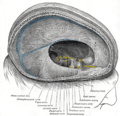
The trochlear nerve entering the orbit, seen from above, supplies the superior oblique muscle
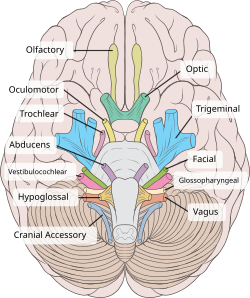
The trochlear nerve (CN IV) seen with other cranial nerves. It is the only cranial nerve to emerge from behind the brainstem, and curves around it to reach the front
Details
InnervatesSuperior oblique muscle
Identifiers
Latinnervus trochlearis
MeSHD014321
NeuroNames466
TA98A14.2.01.011
TA26191
FMA50865
Anatomical terms of neuroanatomy

The trochlear nerve (/ˈtrɒklɪər/),[1] (lit. pulley-like nerve) also known as the fourth cranial nerve, cranial nerve IV, or CN IV, is a cranial nerve that innervates a single muscle - the superior oblique muscle of the eye (which operates through the pulley-like trochlea). Unlike most other cranial nerves, the trochlear nerve is exclusively a motor nerve (somatic efferent nerve).

The trochlear nerve is unique among the cranial nerves in several respects:

  • It is the smallest nerve in terms of the number of axons it contains.
  • It has the greatest intracranial length.
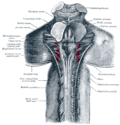
  • It is the only cranial nerve that exits from the dorsal (rear) aspect of the brainstem.
  • It innervates a muscle, the superior oblique muscle, on the opposite side (contralateral) from its nucleus. The trochlear nerve decussates within the brainstem before emerging on the contralateral side of the brainstem (at the level of the inferior colliculus). An injury to the trochlear nucleus in the brainstem will result in an contralateral superior oblique muscle palsy, whereas an injury to the trochlear nerve (after it has emerged from the brainstem) results in an ipsilateral superior oblique muscle palsy.

The superior oblique muscle which the trochlear nerve innervates ends in a tendon that passes through a fibrous loop, the trochlea, located anteriorly on the medial aspect of the orbit. Trochlea means “pulley” in Latin; the fourth nerve is thus also named after this structure. The words trochlea and trochlear (/ˈtrɒkliə/, /ˈtrɒkliər/) come from Ancient Greek τροχιλέα trokhiléa, “pulley; block-and-tackle equipment”.

Structure

[edit]

The trochlear nerve provides motor innervation to the superior oblique muscle of the eye,[2] a skeletal muscle; the trochlear nerve thus carries axons of general somatic efferent type.[citation needed]

Course

[edit]
The Cavernous Sinus

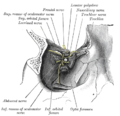
Each trochlear nerve originates from a trochlear nucleus in the medial midbrain. From their respective nuclei, the two trochlear nerves then travel dorsal-ward through the substance of the midbrain surrounded by the periaqueductal gray, crossing over (decussating) within the midbrain before emerging from the dorsal midbrain[3][4] just inferior to the inferior colliculus.[4] Each trochlear nerve thus comes to course on the contralateral side, first passing laterally (to the side) and then anteriorly around the pons,[3] then running forward toward the eye in the subarachnoid space. It passes between the posterior cerebral artery and the superior cerebellar artery. It then pierces the dura just under free margin of the tentorium cerebelli, close to the crossing of the attached margin of the tentorium and within millimeters of the posterior clinoid process.[5] It runs on the outer wall of the cavernous sinus.[2] Finally, it enters the orbit through the superior orbital fissure and to innervate the superior oblique muscle.[2]

Development

[edit]

The human trochlear nerve is derived from the basal plate of the embryonic midbrain.[citation needed]

Clinical significance

[edit]

Vertical diplopia

[edit]

Injury to the trochlear nerve cause weakness of downward eye movement with consequent vertical diplopia (double vision). The affected eye drifts upward relative to the normal eye, due to the unopposed actions of the remaining extraocular muscles. The patient sees two visual fields (one from each eye), separated vertically. To compensate for this, patients learn to tilt the head forward (tuck the chin in) in order to bring the fields back together—to fuse the two images into a single visual field. This accounts for the “dejected” appearance of patients with “pathetic nerve” palsies.

Torsional diplopia

[edit]

Trochlear nerve palsy also affects torsion (rotation of the eyeball in the plane of the face). Torsion is a normal response to tilting the head sideways. The eyes automatically rotate in an equal and opposite direction, so that the orientation of the environment remains unchanged—vertical things remain vertical.

Weakness of intorsion results in torsional diplopia, in which two different visual fields, tilted with respect to each other, are seen at the same time. To compensate for this, patients with trochlear nerve palsies tilt their heads to the opposite side, in order to fuse the two images into a single visual field.

The characteristic appearance of patients with fourth nerve palsies (head tilted to one side, chin tucked in) suggests the diagnosis, but other causes must be ruled out. For example, torticollis can produce a similar appearance.

Causes

[edit]

The clinical syndromes can originate from both peripheral and central lesions.

Peripheral lesion

[edit]

A peripheral lesion is damage to the bundle of nerves, in contrast to a central lesion, which is damage to the trochlear nucleus. Acute symptoms are probably a result of trauma or disease, while chronic symptoms probably are congenital.

Acute palsy
[edit]

The most common cause of acute fourth nerve palsy is head trauma.[6] Even relatively minor trauma can transiently stretch the fourth nerve (by transiently displacing the brainstem relative to the posterior clinoid process). Patients with minor damage to the fourth nerve will complain of “blurry” vision. Patients with more extensive damage will notice frank diplopia and rotational (torsional) disturbances of the visual fields. The usual clinical course is complete recovery within weeks to months.

Isolated injury to the fourth nerve can be caused by any process that stretches or compresses the nerve. A generalized increase in intracranial pressure—hydrocephalus, pseudotumor cerebri, hemorrhage, edema—will affect the fourth nerve, but the abducens nerve (VI) is usually affected first (producing horizontal diplopia, not vertical diplopia). Infections (meningitis, herpes zoster), demyelination (multiple sclerosis), diabetic neuropathy and cavernous sinus disease can affect the fourth nerve, as can orbital tumors and Tolosa–Hunt syndrome. In general, these diseases affect other cranial nerves as well. Isolated damage to the fourth nerve is uncommon in these settings.

Chronic palsy
[edit]

The most common cause of chronic fourth nerve palsy is a congenital defect, in which the development of the fourth nerve (or its nucleus) is abnormal or incomplete. Congenital defects may be noticed in childhood, but minor defects may not become evident until adult life, when compensatory mechanisms begin to fail. Congenital fourth nerve palsies are amenable to surgical treatment.

Central lesion

[edit]

Central damage is damage to the trochlear nucleus. It affects the contralateral eye. The nuclei of other cranial nerves generally affect ipsilateral structures (for example, the optic nerves - cranial nerves II - innervate both eyes).

The trochlear nucleus and its axons within the brainstem can be damaged by infarctions, hemorrhage, arteriovenous malformations, tumors and demyelination. Collateral damage to other structures will usually dominate the clinical picture.

The fourth nerve is one of the final common pathways for cortical systems that control eye movement in general. Cortical control of eye movement (saccades, smooth pursuit, accommodation) involves conjugate gaze, not unilateral eye movement.

Clinical assessment

[edit]

The trochlear nerve is tested by examining the action of its muscle, the superior oblique. When acting on its own this muscle depresses and abducts the eyeball. However, movements of the eye by the extraocular muscles are synergistic (working together). Therefore, the trochlear nerve is tested by asking the patient to look 'down and in' as the contribution of the superior oblique is greatest in this motion. Common activities requiring this type of convergent gaze are reading the newspaper and walking down stairs. Diplopia associated with these activities may be the initial symptom of a fourth nerve palsy.

Alfred Bielschowsky's head tilt test is a test for palsy of the superior oblique muscle caused by damage to cranial nerve IV (trochlear nerve).

Other animals

[edit]

Homologous trochlear nerves are found in all jawed vertebrates. The unique features of the trochlear nerve, including its dorsal exit from the brainstem and its contralateral innervation, are seen in the primitive brains of sharks.[7]

References

[edit]

Bibliography

[edit]

Additional images

[edit]
[edit]
Revisions and contributorsEdit on WikipediaRead on Wikipedia
from Grokipedia
The trochlear nerve, designated as cranial nerve IV (CN IV), is the smallest of the cranial nerves and serves as a purely motor nerve that innervates the superior oblique muscle of the eye, facilitating depression, abduction, and intorsion of the eyeball.[1] It is unique among the cranial nerves as the only one to emerge from the dorsal aspect of the brainstem and possesses the longest intracranial course, making it particularly susceptible to trauma.[1] Originating from the trochlear nuclei located in the medial aspect of the midbrain at the level of the inferior colliculus, its fibers decussate completely before exiting the brainstem posteriorly.[1] The nerve's pathway begins within the periaqueductal gray matter of the midbrain, where it courses dorsally and laterally around the cerebral peduncles and pons, entering the cavernous sinus lateral to the clinoid process and above the abducens nerve.[1] It then pierces the dura and travels forward in the subarachnoid space before entering the orbit through the superior orbital fissure, devoid of a dural sheath, to reach the superior oblique muscle on the medial orbital surface.[1] Lacking significant branches along its route, the trochlear nerve derives its blood supply primarily from the posterior cerebral, superior cerebellar, and basilar arteries.[1] Functionally, the trochlear nerve enables precise control of eye movement, particularly in coordinating vertical gaze and counteracting the actions of other extraocular muscles to prevent diplopia during head tilt or gaze deviation.[1] Clinically, trochlear nerve palsy is a common cause of vertical diplopia and often results from congenital factors, head trauma, or compressive lesions, leading to symptoms such as binocular vertical misalignment, head tilting toward the unaffected side (Bielschowsky head tilt), and torsional misalignment.[1][2] Diagnosis typically involves the three-step test, while management may include prisms, botulinum toxin, or surgical intervention for persistent cases.[1] Embryologically, it arises from the somatic efferent column of the brainstem during the fourth week of development.[1]

Anatomy

Origin and Nucleus

The trochlear nucleus, the origin of the trochlear nerve (cranial nerve IV), is located in the medial aspect of the midbrain at the level of the inferior colliculus. It lies within the periaqueductal gray matter, positioned dorsal to the medial longitudinal fasciculus and ventral to the cerebral aqueduct. This paired nucleus consists of motor neurons that provide somatic efferent innervation to the contralateral superior oblique muscle.[1][3] From the trochlear nucleus, axons course dorsally and laterally through the midbrain tegmentum before undergoing a unique contralateral decussation. Unlike other cranial nerves, the trochlear nerve fibers cross the midline immediately upon exiting the nucleus, forming the trochlear decussation within the superior medullary velum, the thin white matter sheet spanning the dorsal midbrain and forming the roof of the fourth ventricle just caudal to the inferior colliculus. Following decussation, the axons continue posteriorly to emerge from the dorsal surface of the midbrain, making the trochlear nerve the only cranial nerve to exit the brainstem posteriorly; this exit point is located just caudal to the inferior colliculus, adjacent to the midline.[2][4][5] Histologically, the trochlear nerve is composed primarily of myelinated somatic motor fibers originating from the trochlear nucleus, which constitute the general somatic efferent component responsible for innervating the superior oblique muscle.[1]

Course and Pathway

The trochlear nerve emerges from the dorsal surface of the midbrain at the level of the inferior colliculus, making it the only cranial nerve to exit the brainstem posteriorly.[1] Following this exit, the nerve courses ventrolaterally around the cerebral peduncle within the ambient cistern, then proceeds anteriorly through the prepontine cistern in the subarachnoid space.[5] During this cisternal segment, it travels alongside key vascular structures, including the superior cerebellar artery inferiorly and the posterior cerebral artery superiorly, before piercing the dura mater at the rostrolateral edge of the tentorium cerebelli.[6] Upon entering the cavernous sinus, the trochlear nerve runs anteriorly within the lateral wall of the sinus.[1] It lies lateral to the oculomotor nerve (cranial nerve III) and superior to the ophthalmic division (V1) of the trigeminal nerve, occasionally accompanied by sympathetic fibers and sensory branches from the trigeminal nerve.[1] A short trigonal segment, averaging 4 mm in length, precedes this cavernous portion, connecting the posterior wall of the cavernous sinus to the oculomotor trigone without notable vascular associations.[6] The trochlear nerve exits the anterior aspect of the cavernous sinus and enters the orbit via the superior orbital fissure, passing outside the tendinous ring (annulus of Zinn) in the superolateral quadrant, adjacent to the superior ophthalmic vein.[5] This extensive intracranial trajectory, the longest among cranial nerves at approximately 60 mm, renders it particularly vulnerable to compression from midbrain lesions, such as tumors or vascular malformations, as well as traction or shearing forces in the subarachnoid space and at the superior orbital fissure during trauma.[1][7]

Termination and Innervation

The trochlear nerve enters the orbit through the superior orbital fissure outside the tendinous ring and courses anteriorly and medially along the superior rectus muscle to reach the superior oblique muscle.[1] It penetrates the medial surface of the superior oblique muscle, where its branches distribute to innervate both the main muscle belly and the tendon.[8][9] The trochlear nerve provides exclusive somatic motor innervation to the superior oblique muscle, enabling its primary actions of intorsion and depression of the eye, particularly when the eye is adducted.[1] Unlike other cranial nerves involved in ocular motility, it contains no sensory or parasympathetic fibers, functioning solely as a general somatic efferent nerve.[1] Anatomically, the trochlear nerve possesses the longest intracranial course among the cranial nerves, spanning approximately 60 mm from its origin to entry into the orbit, with its peripheral segment within the orbit measuring about 20-25 mm.[10][11][7]

Function and Physiology

Role in Ocular Motility

The trochlear nerve, cranial nerve IV, provides motor innervation exclusively to the superior oblique muscle, the longest and thinnest of the extraocular muscles, enabling its contraction to facilitate targeted eye movements. This innervation supports the muscle's primary action of depressing the eyeball, most effectively when the eye is adducted, thereby producing downward and inward rotation of the gaze.[1] The superior oblique's fibers, guided by the trochlea, pull the eye in a manner that combines vertical depression with a torsional component, ensuring precise control over ocular positioning during various visual tasks.[12] A key function of the trochlear nerve is its role in intorsion, the inward rotation of the eyeball around its visual axis, which rotates the top of the eye toward the nose. This action is particularly prominent when the eye is abducted and serves to stabilize the visual field, compensating for head tilts by maintaining the orientation of the retinal image.[13] Through this mechanism, the nerve contributes to the vestibulo-ocular reflex, helping to keep the eyes level relative to the horizon during lateral head movements.[14] The trochlear nerve's unique contralateral organization, where its motor fibers decussate in the midbrain to innervate the superior oblique on the opposite side, allows for synergistic coordination with other extraocular muscles, such as the inferior rectus. This contralateral control ensures balanced torsional and vertical adjustments, working in concert with the inferior rectus for depression in the primary gaze position and overall harmonious eye motility.[15] Such integration is essential for conjugate eye movements, where the trochlear nerve's input fine-tunes the actions of muscles innervated by cranial nerves III and VI.[14] Biomechanically, the superior oblique muscle's tendon passes through the trochlea, a cartilaginous pulley anchored to the medial orbital wall, which redirects the force vector posteriorly and laterally to insert on the superolateral sclera. This pulley system enables the generation of precise, multi-directional forces, with the tendon's 51-degree angle of insertion optimizing both vertical depression and intorsion based on the eye's position in the orbit.[12] The trochlea's role in altering the muscle's line of pull thus amplifies the trochlear nerve's efficiency in producing torsional adjustments, distinguishing it from other extraocular muscles.[15]

Contributions to Eye Movements

The trochlear nerve plays a critical role in the vestibulo-ocular reflex (VOR), which stabilizes gaze during head movements by generating compensatory eye rotations. Through connections from vestibular nuclei to the trochlear nucleus via the medial longitudinal fasciculus (MLF), the superior oblique muscle, innervated by the trochlear nerve, contributes to vertical and torsional components of the VOR, ensuring retinal image stability across angular and linear accelerations.[16][17] In conjugate vertical gaze, the trochlear nerve facilitates coordinated downward and intorsional movements of both eyes, with coordinated contraction of the inferior rectus and superior oblique muscles of each eye to maintain binocular alignment during depression. This yoking is essential for smooth vertical saccades and pursuits, preventing diplopia. Additionally, during lateral head tilts, the trochlear nerve drives ocular counter-rolling, a torsional adjustment that counters head rotation to preserve visual orientation; this dynamic counter-roll, mediated by otolith inputs to the trochlear nucleus, is more pronounced than static components and integrates with intorsion mechanics for overall gaze stability.[18][19][20] Proprioceptive feedback from the superior oblique muscle provides sensory input that aids in fine-tuning ocular alignment, with myotendinous cylinders acting as potential receptors to monitor muscle length and tension, relaying signals via trigeminal pathways to influence trochlear motoneuron activity. This feedback loop supports adaptive adjustments in eye position, particularly for precise torsional control, though its exact contribution to central calibration remains under investigation.[21] The trochlear nerve interacts with the MLF to enable bilateral coordination, particularly with the contralateral superior rectus subnucleus in the oculomotor complex, allowing synchronized vertical actions across eyes during upgaze and downgaze. These internuclear connections ensure reciprocal inhibition and excitation, promoting conjugate movements and preventing dysmetria in response to supranuclear commands.[19][22]

Development

Embryonic Formation

The trochlear nerve originates from neuroblasts in the basal plate of the midbrain, specifically within the somatic efferent column, during early embryonic development around weeks 4 to 5 of gestation.[23][24] These neuroblasts differentiate into the trochlear nucleus, which first appears in the posterior region of the basal plate at Carnegie stage 13 (approximately 30-32 days post-fertilization).[24][25] A distinctive feature of trochlear nerve development is its early contralateral crossing, which occurs during neural tube closure and involves guidance by midline signaling molecules such as netrins. Netrin-1, expressed in the floor plate, acts as a chemorepellent to guide trochlear motor axons away from the ventral midline, supporting their dorsal trajectory and contralateral innervation of the superior oblique muscle.[26] This decussation is first evident around Carnegie stage 15 and is complete by stage 18 (approximately 44-48 days), with the nerve root and decussation fully evident at this point.[25][27] Following decussation, the trochlear nerve axons undergo migration and elongation, proceeding in parallel with the developing oculomotor nerve through the mesencephalon toward their peripheral targets. This coordinated pathway involves fasciculation and extension along shared routes in the brainstem, influenced by local guidance cues, to reach the superior oblique muscle primordium by Carnegie stage 18.[28][29]

Congenital Variations

Congenital variations of the trochlear nerve primarily involve agenesis or hypoplasia, which are frequently observed in cases of congenital superior oblique palsy (SOP). These anomalies result in underdevelopment or complete absence of the nerve, leading to impaired innervation of the superior oblique muscle and consequent ocular motility deficits. High-resolution magnetic resonance imaging (MRI) studies have demonstrated that approximately 60% to 73% of patients with congenital SOP exhibit ipsilateral trochlear nerve absence or hypoplasia, often accompanied by superior oblique muscle hypoplasia.[30][31][32] Such variations are commonly associated with congenital cranial dysinnervation disorders (CCDDs), a group of non-progressive developmental conditions arising from genetic defects in axon guidance and motor neuron specification. In CCDDs like congenital horizontal gaze palsy with progressive scoliosis (CHN1-related) and congenital fibrosis of the extraocular muscles type 3 (TUBB3-related), trochlear nerve hypoplasia or aberrant branching contributes to superior oblique underaction.[33] These genetic factors, including mutations in CHN1 and TUBB3 genes, disrupt normal trochlear axon pathfinding during embryogenesis, where the nerve fibers decussate in the anterior medullary velum. Familial patterns of congenital trochlear palsy have been reported, underscoring a heritable component in some cases.[34] The population-based annual incidence of isolated fourth cranial nerve palsy, with presumed congenital etiology accounting for about 49% of cases, is 5.73 per 100,000 individuals, though congenital presentations may manifest later due to decompensation.[35] In pediatric populations under 19 years, the incidence is approximately 3.4 per 100,000 annually. These variations often lead to early-onset compensatory head tilt and vertical diplopia, detectable through clinical examination and neuroimaging, highlighting their role in isolated or syndromic ocular dysmotility.[36]

Clinical Aspects

Symptoms of Dysfunction

Dysfunction of the trochlear nerve, which innervates the superior oblique muscle, leads to impaired eye movements characterized primarily by binocular vertical diplopia and torsional diplopia. Vertical diplopia manifests as double vision where one image appears higher than the other, resulting from the unopposed action of the inferior oblique muscle causing elevation of the affected eye. Torsional diplopia is perceived as tilting or rotation of the visual field due to extorsion (outward rotation) of the affected eye.[37][38] These symptoms are exacerbated in specific gaze directions and head positions. Vertical diplopia worsens during downward gaze, such as when reading, and in lateral gaze toward the contralateral side, where the affected eye's adduction and depression are required. Torsional diplopia intensifies with head tilts toward the affected side, as demonstrated in the Bielschowsky head-tilt test, where the misalignment becomes more pronounced.[37][38] Patients often adopt compensatory mechanisms to alleviate double vision, including a head tilt away from the affected side and chin depression to position the eyes in a gaze that minimizes misalignment. In the primary position, the affected eye exhibits hypertropia (upward deviation), extorsion greater than 10 degrees in some cases, and slight elevation due to superior oblique weakness. This misalignment disrupts the superior oblique's role in intorsion and depression, particularly in adduction.[37][38]

Etiology and Pathology

Lesions of the trochlear nerve (cranial nerve IV) are broadly categorized into peripheral and central origins, with peripheral lesions affecting the nerve along its extracranial or intracranial course outside the brainstem, and central lesions involving the trochlear nucleus or fascicles within the midbrain. The nerve's uniquely long intracranial pathway, spanning approximately 75 mm from the brainstem to the superior oblique muscle, renders it particularly susceptible to injury from compressive, traumatic, or ischemic mechanisms.[1][39] Peripheral lesions predominate in acquired trochlear nerve palsies, with trauma representing the most frequent cause, accounting for up to 18% of cases and often involving indirect injury from head impacts or orbital fractures that stretch or contuse the nerve. Microvascular ischemia constitutes another major peripheral etiology, typically in patients with diabetes or hypertension, where vasa nervorum occlusion leads to nerve infarction; this is especially prevalent in individuals aged 50 to 60 years. Iatrogenic injury during procedures such as endoscopic sinus surgery can also damage the nerve peripherally, particularly when instruments approach the orbital apex or superior orbital fissure.[37][35][40] Central lesions are less common but arise from intrinsic midbrain pathologies. Midbrain infarction or stroke, often due to small vessel occlusion or hemorrhage, can selectively affect the trochlear nucleus or decussating fibers in the anterior medullary velum, resulting in contralateral palsy. Tumors such as pinealomas may compress the nerve in the ambient or quadrigeminal cistern, disrupting its dorsal midbrain trajectory. Demyelinating diseases like multiple sclerosis occasionally involve central trochlear pathways through plaque formation in the midbrain tegmentum.[4][41][42][43] The underlying pathophysiology of trochlear nerve lesions generally involves axonal degeneration or mechanical compression, culminating in denervation of the superior oblique muscle and impaired intorsion and depression of the eye. In traumatic cases, shearing forces or contusions induce Wallerian degeneration distal to the injury site. Ischemic lesions cause hypoxic damage to nerve fibers via microvascular compromise, while compressive etiologies from tumors or edema impair axoplasmic flow and lead to progressive atrophy. Risk factors for these acquired pathologies include advancing age (particularly 50-60 years for ischemic events), vascular comorbidities such as hypertension and diabetes, and underlying congenital anatomical variations that may predispose to decompensation following minor trauma.[37][44]

Diagnosis and Management

Diagnosis of trochlear nerve palsy primarily relies on clinical evaluation to assess ocular motility and alignment. The Parks three-step test is a cornerstone for identifying the affected eye, involving sequential assessment of hypertropia in primary gaze, on gaze to the opposite side, and with head tilt to the same side, where hypertropia worsens in trochlear palsy.[37] The Bielschowsky head tilt test, integrated into this process, confirms the diagnosis by demonstrating increased vertical deviation on ipsilateral head tilt due to unopposed action of the inferior oblique muscle.[37] Additional tests include the Maddox rod for detecting subjective excyclotorsion and fundus photography to quantify objective torsional misalignment, aiding in distinguishing trochlear involvement from other causes of vertical diplopia.[37] Imaging modalities are selected based on suspected etiology to rule out structural lesions. Magnetic resonance imaging (MRI) is the preferred initial study for acquired non-traumatic cases or those with associated neurological signs, as it visualizes the trochlear nucleus, fascicles, and nerve pathway for central or peripheral lesions.[37] Computed tomography (CT) is utilized in traumatic settings to detect orbital fractures or vascular abnormalities that may mimic or cause palsy.[37] Management begins with conservative measures to alleviate symptoms and promote adaptation. Prism glasses are commonly prescribed to correct diplopia by optically aligning images, particularly effective for small-angle deviations in acute or mild cases.[37] Botulinum toxin injection into the antagonist inferior oblique muscle provides temporary relief in acute traumatic palsies by weakening overaction and improving binocular fusion.[37] For persistent or severe cases, strabismus surgery is indicated after a period of observation. Inferior oblique weakening procedures, such as myectomy or recession, are the most frequent interventions for hypertropia less than 15 prism diopters, achieving success in up to 90.6% of suitable patients.[45] In congenital cases with lax superior oblique tendons, tucking of the tendon restores function, while the Harada-Ito procedure addresses significant excyclotorsion exceeding 10 degrees in bilateral palsies.[37] Larger deviations may require combined surgeries, including ipsilateral superior rectus recession or contralateral inferior rectus recession.[46] Prognosis varies by etiology, with spontaneous recovery observed in approximately 80% of microvascular cases within 3 to 6 months due to resolution of ischemic compression.[37] Overall recovery rates reach 82.6% in non-surgical cohorts, though surgical outcomes yield 76-96% success, with better results for preoperative hypertropia ≤15 prism diopters and younger patients.[45][46]

Comparative Anatomy

Structure in Non-Human Mammals

The trochlear nerve (cranial nerve IV) in non-human mammals originates from the trochlear nucleus located in the caudal mesencephalon, ventral to the periaqueductal gray and caudal to the oculomotor nucleus.[47] The axons course dorsally around the mesencephalic aqueduct, decussate completely at the trochlear decussation in the rostral medullary velum, and emerge from the dorsal surface of the brainstem caudal to the inferior colliculus.[48] This contralateral decussation is a conserved feature across mammalian species, enabling innervation of the contralateral superior oblique muscle after the nerve passes through the cavernous sinus and enters the orbit via the superior orbital fissure.[49] The intracranial course is notably long, averaging approximately 60 mm, with an intracavernous segment of about 26.8 mm and an orbital portion of around 25 mm, though these dimensions scale with overall body size.[47] Structural variations in the trochlear nerve occur primarily in relation to orbital size and eye positioning among mammalian orders. In primates, the nerve exhibits the longest relative course due to expanded cranial dimensions and forward-facing orbits, with occasional ipsilateral contributions to the superior oblique muscle observed in up to 5% of cases.[47] Rodents, such as rats and mice, maintain the standard dorsal exit and decussation.[49] The trochlear nerve is homologous to cranial nerve IV across eutherian mammals, consistently providing somatic motor innervation to the superior oblique muscle, which is present in all placental species examined. This conservation underscores its role in eye intorsion and depression, with no major deviations in nuclear organization or primary trajectory reported in comparative studies.[47] In dogs, the trochlear nerve's dorsal emergence and extended intracranial path render it particularly vulnerable to head trauma, where lesions at the mesencephalon or orbital fissure can disrupt function.[48] Dysfunction often manifests as subtle ocular deviations, detectable via ophthalmoscopy showing lateral displacement of the superior retinal vein.[50] Similarly, in horses, trochlear nerve impairment is linked to strabismus syndromes, producing dorsolateral deviation of the globe and dorsal rotation of the pupil's medial aspect due to paralysis of the dorsal oblique muscle.[50]

Functional Adaptations in Vertebrates

The trochlear nerve, or cranial nerve IV, exhibits remarkable evolutionary conservation across jawed vertebrates (gnathostomes), where it consistently innervates the superior oblique muscle to facilitate vertical eye movements and intorsion, essential for precise gaze control during locomotion and environmental navigation.[51] This nerve's origin traces back to early gnathostome ancestors, with a distinctive dorsal decussation near the midbrain-hindbrain junction, enabling contralateral innervation that coordinates torsional adjustments in response to head tilts and vestibular inputs. Unlike the more variable oculomotor pathways, the trochlear system's core function in counter-rolling the eyes to stabilize vision has remained stable since the divergence of chondrichthyans and osteichthyans, underscoring its role in the vestibulo-ocular reflex (VOR) for maintaining visual acuity amid body perturbations.[52] In fish and amphibians, the trochlear nerve supports simpler intorsion mechanisms adapted to aquatic or semi-aquatic environments, where gaze stabilization prioritizes horizontal tracking over complex vertical torsion.[53] Bony fish exhibit a streamlined trochlear projection with minimal decussation variability, innervating a modestly sized superior oblique to enable subtle eye rotations for underwater prey detection and obstacle avoidance, without the elaborate contralateral dominance seen in tetrapods. Amphibians, such as frogs, display a transitional pattern with partial ipsilateral contributions in some species like Xenopus, facilitating basic intorsion for amphibious gaze shifts between air and water, though VOR integration remains less refined than in higher vertebrates.[54] Among reptiles and birds, the trochlear nerve assumes a more prominent role in head stabilization, particularly during dynamic activities like perching and flight, with the superior oblique muscle often enlarged relative to body size to enhance torsional control.[55] In reptiles such as turtles and alligators, the robust superior oblique, innervated contralaterally, aids in frontal vision and abduction during head movements on uneven terrain, contributing to VOR-mediated gaze locking.[56] Birds, with their laterally placed eyes and rapid head bobbing, rely on an amplified trochlear-superior oblique system for compensatory intorsion, stabilizing the visual field against flight-induced vibrations and perching adjustments, as evidenced by detailed dissections in species like the rock dove.[57] Functional adaptations in mammalian vertebrates highlight variations in VOR integration tied to eye position and ecology, with the trochlear nerve playing a key role in proprioceptive feedback via palisade endings in the superior oblique muscle.[58] Arboreal primates, featuring frontal-eyed configurations, show enhanced trochlear-mediated VOR through dense palisade endings that provide fine-tuned torsional signals for stereoscopic depth perception and branch navigation.[59] In contrast, lateral-eyed herbivores like horses and cows exhibit sparser or absent palisade endings, reflecting a reliance on broader panoramic vision with less emphasis on precise vertical-torsional coupling for predator evasion in open terrains.[59]

References

User Avatar
No comments yet.