Hubbry Logo
TroparionTroparionMain
Open search
Troparion
Community hub
Troparion
logo
8 pages, 0 posts
0 subscribers
Be the first to start a discussion here.
Troparion
Troparion
from Wikipedia
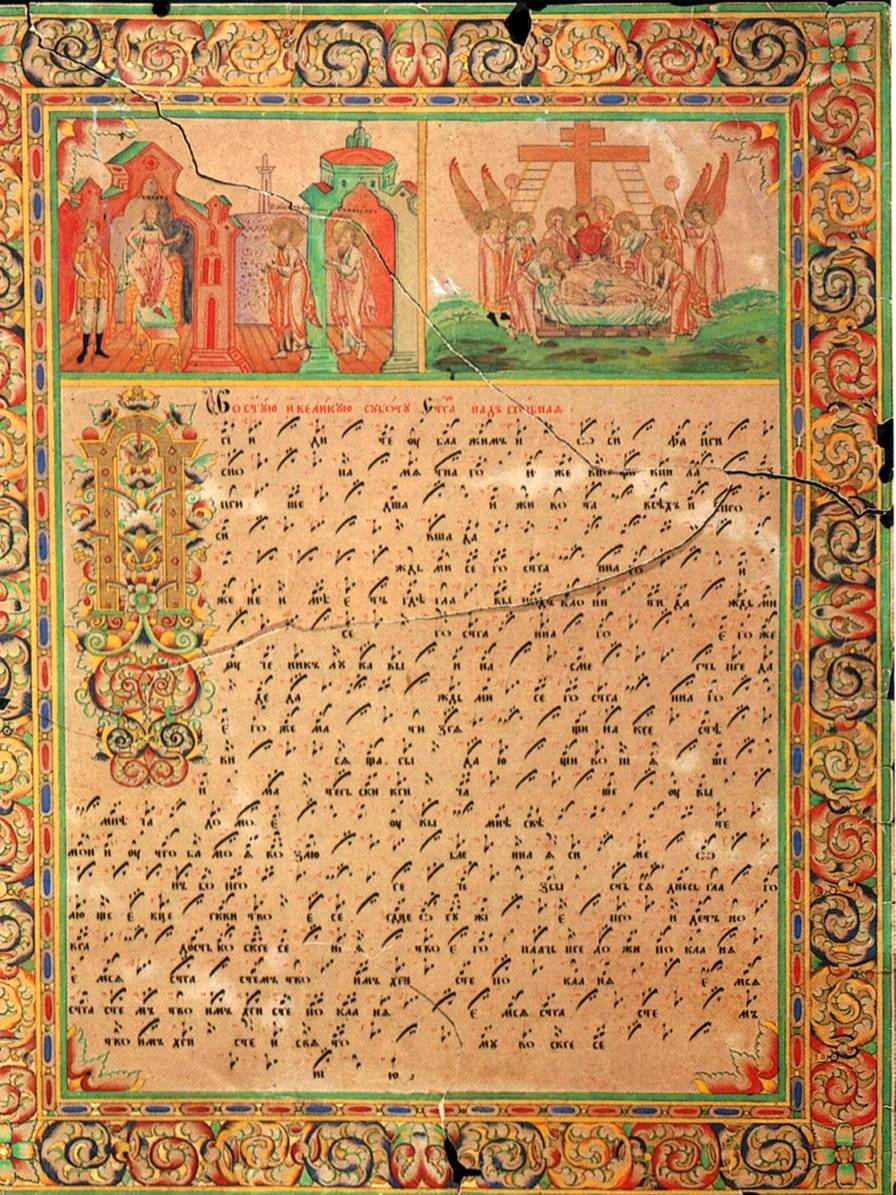
A hand-drawn Old Believer lubok featuring 'hook and banner notation'.

A troparion (Greek τροπάριον, plural: troparia, τροπάρια; Georgian: ტროპარი, tropari; Church Slavonic: тропа́рь, tropar) in Byzantine music and in the religious music of Eastern Orthodox Christianity is a short hymn of one stanza, or organised in more complex forms as series of stanzas.

The wider meaning of troparion

[edit]

The word probably derived from a diminutive of the Greek tropos ('something repeated', 'manner', 'fashion'), since the earliest function of the troparion was a refrain during the recitation of the cantica (biblical odes) and the psalms, as such the term was used as a synonym of hypakoe. The early meaning of troparion was related to the monastic hymn book Tropologion or Troparologion. Hence its forms were manifold, they could be simple stanzas like apolytikia, theotokia, but also more elaborated homiletic poems like stichera composed in psalmodic hexameters (probably from stichos, "verse"), or in a more complex meter like the odes composed in cycles called canon. Since these Tropologia in their earliest form were organised according to the Octoechos, troparia were always chanted according to a melos of one of the eight tones used in the Eastern liturgical tradition (Gr. echos, Sl. glas). Today, since the redefinition of the Octoechos according to the hyphos of Constantinople, the monodic form of Orthodox chant distincts the troparic (apolytikia, theotokia, kontakia, etc.), the heirmologic (related to the hymns of the Heirmologion), and the sticheraric melos (related to the hymns of the Sticherarion) according to its modal formulas and its tempo.[citation needed]

The different forms of troparia and their ritual function

[edit]

In casual, unqualified use, troparion usually refers to the apolytikion (Greek: ἀπολυτίκιον), or 'dismissal hymn', a troparion chanted near the end of Vespers which establishes the overall theme for the liturgical day, for which it is called the "troparion of the day". It is chanted again at the beginning of Matins, read at each of the Little Hours, and chanted at the Divine Liturgy following the Little Entrance.[citation needed]

A troparion in honor of the Trinity is called a Triadicon (Greek: Τριαδικόν, Slavonic: Troíchen). Often the penultimate in a series of troparia will be a triadicon, usually preceded by, "Glory to the Father, and to the Son, and to the Holy Spirit." There are also special Triadica ("Hymns to the Trinity") which are chanted after Alleluia at the beginning of Matins on weekdays of Great Lent, which differ according to the tone of the week and the day of the week.[citation needed]

A troparion to the Mother of God (Theotokos) is called a Theotokion (Greek: Θεοτοκίον, Slavonic: Bogoródichen); plural: Theotokia (Θεοτοκία). Theotokia will often occur at the end of a series of troparia, usually preceded by "Both now and ever, and unto the ages of ages. Amen." If a Theotokion makes reference to the Crucifixion of Jesus, it is called a stavrotheotokion (Greek: σταυροθεοτοκίον, Slavonic: krestobogoródichen).

The stanzas of a Canon are troparia, as are the verses interspersed between the Beatitudes at the Divine Liturgy.[citation needed]

History

[edit]

A famous example, whose existence is attested as early as the 4th century, is the Vespers hymn, Phos Hilaron, "Gladsome Light"; another, O Monogenes Yios, "Only Begotten Son", ascribed to Justinian I (527 - 565), occurs in the introductory portion of the Divine Liturgy. Perhaps the earliest set of troparia of known authorship are those of the monk Auxentios (first half of the 5th century), mentioned in his biography but not preserved in any later Byzantine order of service.[citation needed]

Occurrence

[edit]

At the present time, troparia occur at the following points in the Divine Services:

Vespers

[edit]

Matins

[edit]

Little Hours

[edit]
  • Apolytikion
  • (the Royal Hours have special troparia added to them)

Divine Liturgy

[edit]

Famous troparia

[edit]
Christ is risen from the dead,
trampling down death by death,
and upon those in the tombs bestowing life.

Troparion of the Holy Cross, Tone I

[edit]
O Lord, save Thy people,
and bless Thine inheritance!
Grant victory to the Orthodox Christians*
over their adversaries,
and by virtue of Thy cross,
preserve Thy habitation.

*In monarchies where Eastern Orthodoxy was the state religion, this troparion was often used as a national anthem with the name of the ruler occurring here.
The original Greek text at this point uses one of two alternative forms: tois basileusi kata barbaron, 'to the Emperors over the barbarians' when referring to an Orthodox Christian sovereign, or tois eusebesi kat' enantion, 'to the pious ones against their adversaries', otherwise.

Troparion of Holy Saturday (The Noble Joseph), Tone II

[edit]
The noble Joseph,
when he had taken down Thy most pure body from the Tree,
wrapped it in fine linen and anointed it with spices,
and placed it in a new tomb.

"Axion Estin", a theotokion

[edit]
It is truly meet to bless thee, O Theotokos,
ever blessed, and most pure, and the Mother of our God:
more honorable than the cherubim, and more glorious beyond compare than the seraphim.
Without corruption thou gavest birth to God, the Word.
True Theotokos, we magnify thee.

Troparion of Kassiani (Chanted during Holy Week on Great and Holy Tuesday)

[edit]
Sensing Thy divinity, O Lord,
a woman of many sins,
takes it upon herself
to become a myrrh-bearer
and in deep mourning
brings before Thee fragrant oil
in anticipation of Thy burial; crying:
"Woe to me! What night falls on me,
what dark and moonless madness
of wild-desire, this lust for sin.
Take my spring of tears
Thou Who drawest water from the clouds,
bend to me, to the sighing of my heart,
Thou who bendedst down the heavens
in Thy secret Incarnation,
I will wash Thine immaculate feet with kisses
and wipe them dry with the locks of my hair;
those very feet whose sound Eve heard
at the dusk in Paradise and hid herself in terror.
Who shall count the multitude of my sins
or the depth of Thy judgment,
O Saviour of my soul?
Do not ignore thy handmaiden,
O Thou whose mercy is endless".

Troparion of the Nativity (in Church Slavonic language)

[edit]

Your birth, O Christ our God,
dawned the light of knowledge upon the earth.
For by Your birth those who adored stars
were taught by a star
to worship You, the Sun of Justice,
and to know You, Orient from on High.
O Lord, glory to You.[1]

See also

[edit]

References

[edit]
[edit]
Revisions and contributorsEdit on WikipediaRead on Wikipedia
from Grokipedia
A troparion (Greek: Τροπάριον; : troparia) is a short consisting of a single or a series of stanzas in Byzantine , forming a fundamental element of liturgical poetry within the Eastern Orthodox Church and other Eastern Christian traditions employing the Byzantine Rite. Originating as refrains interpolated between verses of psalms or canticles, troparia evolved into concise expressions of theological praise directed toward Christ, the Virgin Mary (Theotokos), saints, or ecclesiastical feasts, often encapsulating the core theme of the day's observance. In structure, a troparion adheres to one of the eight melodic modes (tones) of , with texts composed in isosyllabic and accentual patterns to facilitate chanting, sometimes modeled on prototypes known as automela. It appears prominently in services such as , , and the —typically following the Small Entrance in the latter—where specific forms like the apolytikion serve as the hymn of dismissal, summarizing the liturgical focus. Notable examples include the ("Christ is risen from the dead, trampling down death by death"), which proclaims the Resurrection's victory over and is repeated throughout the season, underscoring troparia's role in doctrinal proclamation and communal worship. Through their rhythmic brevity and doctrinal precision, troparia preserve patristic theology in verse, influencing the rhythmic and thematic flow of Byzantine liturgical life across centuries.

Definition and Etymology

Core Definition

A troparion is a short liturgical , usually comprising a single in rhythmic , chanted during services in the and Byzantine-rite Eastern Catholic Churches. It functions as a concise poetic expression encapsulating the central theme of a feast, saint's commemoration, or scriptural event, often interpolated as a refrain between verses of or canticles. The term "troparion" (Greek: τροπάριον, plural τροπάρια) derives from Late Greek, as a diminutive of the ancient Greek τρόπος (trópos), denoting a "turn," "manner," or "trope," which in liturgical context refers to a melodic or textual interpolation added to psalmody. This etymological root underscores its historical evolution from simple refrains in early Byzantine chant to standalone hymns summarizing doctrinal truths. In usage, troparia are syllabic and melodic, adhering to one of the eight Byzantine tones (ēkhoi), with texts drawn from hymnographers like Romanos the Melodist or later compilers in the Octoechos. Distinct from longer forms like kontakia or kanons, the troparion prioritizes brevity and theological precision, appearing prominently after the Small Entrance in the or as the apolytikion concluding and . Its role emphasizes and victory motifs, as implied in some interpretations of the Greek root evoking a "sign of triumph."

Etymological Origins

The term troparion originates from Byzantine Greek τροπάριον (tropárion), a diminutive form of τρόπος (trópos), which denotes "turn," "manner," "mode," or "trope" in classical and ecclesiastical Greek. This linguistic root underscores the troparion's early function as a brief, repetitive melodic or textual insertion—often a single stanza—interpolated between verses of psalms or scriptural canticles in Byzantine liturgical practice, functioning analogously to a "turning" or variational phrase in chant. The suffix -άριον (-árion) implies a small-scale or specialized instance of the base concept, aligning with the troparion's concise structure compared to longer forms like odes. By the , as evidenced in the earliest surviving troparia from the Romanos the Melodist tradition (circa , with compilations postdating), the term had solidified in hymnographic texts to designate these self-contained units of praise, distinct from mere refrains yet derived from the improvisational "troping" evident in pre-iconoclastic Eastern worship. This reflects a continuity with broader Greco-Roman rhetorical and musical usages of trópos, where it signified figurative turns of phrase or melodic variations, adapted in to emphasize doctrinal themes without extending into elaborate narrative sequences.

Forms and Classifications

Standard Troparion Structure

The standard troparion consists of a single stanza of liturgical poetry, functioning as a concise hymn that encapsulates a specific theological theme, such as a feast's significance or a saint's commemoration. Unlike longer forms like kontakia or canons, it avoids multiple stanzas or refrains, emphasizing brevity to integrate seamlessly into services like Vespers or the Divine Liturgy. This form originated as a refrain interpolated between psalm verses but evolved into an independent unit by the early Byzantine period. Structurally, a typical troparion features 3 to 6 lines, with the exact number varying by composition and assigned tone (echos), though 4 lines predominate in common examples like festal apolytikia. Each line adheres to isosyllabic principles, matching the count and accentual pattern of a (automelon) from one of the eight Byzantine tones to ensure musical compatibility. Lines generally range from 8 to 15 s, often with 2-3 accents per line for rhythmic flow, though no universal metrical scheme exists; instead, the poetry employs accentual verse or rhythmic prose tailored to the chant's rather than classical quantitative meter. This prosodic alignment prioritizes textual intelligibility during chanting, as deviations in count disrupt the . For instance, the ("Christ is risen from the dead, trampling down death by death...") exemplifies a compact 3-line form in Tone V, with lines averaging 10-12 syllables to fit the mode's phrasing. Similarly, many Resurrectional troparia follow a 4-line pattern, where the first three lines build the narrative and the fourth resolves doxologically, maintaining homotony (consistent accentuation) across tones. Composers ensure doctrinal precision within these constraints, drawing from scriptural motifs without extending beyond the stanza's limits. In practice, this structure allows troparia to serve as "dismissal hymns" (apolytikia), summarizing the day's observance before the service concludes.

Specialized Variants

Sessional hymns, also known as sedalia, represent a specialized variant of troparia chanted after each (division) of the during , during which the faithful sit, and may include additional instances after the third ode of the canon; these typically comprise one to three stanzas tailored to the liturgical theme of the day. Theotokia constitute another variant, consisting of troparia dedicated to the that emphasize her intercessory role and divine motherhood, often concluding odes in canons or services; a subset, stavrotheotokia, specifically addresses her compassion at Christ's . Evlogitaria form a distinct series of troparia alternated with verses from Psalm 118 (119), sung at Sunday Matins to commemorate the Resurrection and myrrh-bearing women or at funeral Matins invoking saints' prayers for the departed. Exapostilaria, or hymns of light, are elongated troparia performed by a soloist following the Matins canon, evoking illumination from Christ's Resurrection or feast-specific revelations, and preceding the Matins Gospel. Stichera qualify as troparia adapted for alternation with psalm verses (stichoi), subdivided into idiomela—original compositions with unique melodies—and prosomoia, which conform metrically to established model hymns for compositional ; aposticha, a subtype of stichera, uniquely precede their accompanying verses rather than follow them, typically concluding . Troparia within kanons () follow the heirmos (model ) of each ode, replicating its meter and melody while developing thematic content, distinguishing them from independent troparia by their integrative role in longer poetic structures.

Historical Evolution

Early Development in Byzantine Liturgy

The troparion developed in the Byzantine liturgical context during the 4th and 5th centuries as a concise hymn serving as a refrain during psalmody in the canonical hours and processions. Originating partly as Orthodox counter-hymns to Arian and other heretical compositions, it adapted scriptural models like the Psalms and Magnificat into repeatable verses that fostered communal worship in urban cathedral settings and emerging monastic communities. The earliest documented authorship of troparia is attributed to the monk Auxentios in the first half of the , with sets mentioned in his biography, though no complete texts survive. By the 6th century, troparia integrated into longer forms like the , as seen in the works of St. Romanos the Melodist (c. 490–556), a in who composed rhythmic stanzas emphasizing Christological themes during feasts. This period marked troparia's shift from psalm adjuncts to standalone elements in , , and early usages, such as post-psalm responses or entrance hymns, reflecting monastic influences from that prioritized theological depth over syllabic simplicity. Examples like the ("Christ is risen from the dead...") were in established use by the late 5th or early 6th century, underscoring troparia's role in encapsulating core doctrines.

Expansion and Standardization

The expansion of troparia in Byzantine occurred primarily during the 8th and 9th centuries, transitioning from simple psalm refrains to independent hymns integral to , , and the . This period saw hymnographers such as St. John of Damascus (c. 675–749) and his foster brother St. Cosmas of Maiuma contribute numerous compositions, enriching the repertoire with troparia tailored to specific feasts, saints, and theological themes, including defenses against . By the mid-9th century, troparia had proliferated into specialized forms like the apolytikion—serving as dismissal hymns summarizing the day's commemoration—and were systematically assigned to liturgical positions, reflecting a broader hymnographic flourishing post-iconoclastic restoration in 843. Standardization emerged in the 9th–10th centuries through the codification of service books and typika, which fixed troparia texts, melodies, and sequences amid the growing complexity of overlapping feasts. The integration of the system, attributed to St. John of Damascus, assigned troparia to one of eight modal tones, ensuring melodic consistency across the . Typika from , such as the 10th-century typikon, prescribed rules for selecting and combining troparia on days with multiple commemorations, prioritizing principal feasts while subordinating others. This process, influenced by monastic reforms under St. (759–826), established troparia as canonical elements, with texts preserved in menaia and triodia, minimizing regional variations by the .

Post-Byzantine Adaptations

After the Ottoman conquest of in 1453, troparia persisted in Orthodox liturgical traditions across the Balkans, Russia, and other Slavic regions, where Byzantine melodic formulas were localized through translation into and adaptation to indigenous notations. In Russia, emerged as the dominant style for rendering troparia, employing a unique system of neumes known as kryuki or znamena arranged in stolp (pillar) notation, which preserved melismatic elaboration while developing distinct melodic contours suited to Slavonic prosody. This chant tradition, initially formed in Kievan Rus' by the 11th century under Byzantine influence, flourished in the era as the primary medium for troparia, kontakia, and irmoi during feasts and . The 17th-century liturgical reforms under Patriarch Nikon (1652–1666) sought alignment with contemporary Greek practices, critiquing Znamenny's complexity as divergent from Byzantine norms and promoting Kievan chant—a syllabic, style derived from Ukrainian and Greek models—as an alternative for troparion performance. Kievan chant simplified notation and emphasized textual clarity, influencing troparia in official Russian Orthodox services, though Znamenny endured among who rejected the reforms, maintaining traditional melismata and avoiding perceived Western corruptions. These adaptations reflected broader tensions between preservation of Slavic heritage and fidelity to post-Byzantine Greek standards. In Greek Orthodox contexts, post-Byzantine evolutions incorporated the ison—a sustained drone note providing tonal foundation—to support monophonic troparion chants, a practice documented from the that enhanced without altering core melodies. This harmonic element, absent in medieval Byzantine sources, facilitated communal singing and adaptation to varied ecclesiastical acoustics, influencing troparion renditions in regions like the and . Such modifications underscored continuity amid contextual pressures from Ottoman rule and emerging Western musical contacts.

Liturgical Functions

Role in Canonical Hours

In the Eastern Orthodox and Byzantine Rite Catholic traditions, troparia constitute essential components of the Canonical Hours, which form the daily cycle of prayer services including Vespers, Compline, the Midnight Office, Orthros (Matins), and the Little Hours (First, Third, Sixth, and Ninth). These short hymns encapsulate the theological theme of the commemorated saint, feast, or liturgical season, providing a succinct summary chanted or recited to orient the faithful toward the day's mystery. The primary troparion, termed the apolytikion (from Greek apolyseōs, "of the dismissal"), is assigned to each day from the festal, triodion, or pentecostarion cycles and recurs across services to unify the office thematically. During , the apolytikion is chanted once or thrice immediately preceding the final and dismissal, underscoring its role as the service's concluding acclamation; on days or vigils, it may be preceded by festal stichera or integrated with the aposticha. In , it follows the Great Doxology, often repeated three times with prostrations during certain periods like , and precedes the ektenia of supplication, thereby bridging the praise of the resurrection or with intercessory prayer. incorporate the apolytikion after the Psalms and kathismata, typically read in monastic settings or chanted in parish practice, where it affirms the hourly rhythm of psalmody with doctrinal focus—such as the troparion "O Virgin Theotokos" in Tone 4 for weekdays. Troparia also appear as refrains or odes within the polyeleos and canons of Orthros, where they alternate with biblical verses to expound scriptural typology, as in the nine odes of a canon each comprising multiple troparia expounding a model like Moses' canticle. This integration ensures troparia not only punctuate but thematically propel the hours, fostering continuous meditation on Christological or hagiographical motifs amid the psalmodic structure, with variations for rank of feast—e.g., resurrection troparia superseding saintly ones on Sundays per rubrics established in the Typikon of St. Sabas around 530 AD. In Compline and the Midnight Office, shorter troparia such as those to the Cross or guardian angel reinforce penitential or protective themes, recited post-psalms to conclude minor hours.

Integration in Divine Liturgy

In the of the , the troparion is sung immediately after the Small Entrance, during which the Gospel Book is processed from the altar to the ambo, symbolizing Christ's proclamation of . While the remain before the altar, the or congregation chants the troparion of the day, often followed by the , to invoke the spiritual theme of the celebration. This placement transitions from the antiphons—psalmic praises of Christ—to the variable hymns that contextualize the within the Church's festal calendar. The troparion of the day, also termed apolytikion, distills the essence of the commemorated event or saint, such as the on Sundays or the Nativity on December 25. On ordinary Sundays, it employs one of eight melodic tones assigned to the weekly cycle, emphasizing Christ's victory over death. For great feasts, the specific troparion supplants the one, as in the the Great where the apolytikion is repeated before additional troparia for the temple's dedication or . When multiple commemorations coincide, such as a Sunday with a saint's feast, the order prioritizes the Resurrection troparion, followed by "Glory to Thee" introducing the saint's troparion, and "Both now" a Theotokion concluding the set. This structured sequence ensures theological harmony, subordinating secondary honors to the paramount mystery of the while adapting the fixed to variable observances. Such integration reinforces the 's unity, linking daily worship to the paschal foundation of Orthodox theology.

Seasonal and Feast-Specific Applications

In the Byzantine liturgical tradition, troparia are assigned according to the hierarchical ranking of commemorations outlined in the , with the troparion of the principal feast or seasonal theme taking precedence during , , the Hours, and . For great feasts, the specific troparion encapsulates the event's theological significance and is sung repeatedly across services, often replacing or supplementing the daily or weekly troparia from the . Seasonal troparia, meanwhile, align with the Church's annual cycles, such as the penitential themes of or the triumphant motifs of Pascha, ensuring the hymns reflect the unfolding mystery of salvation history. During the Paschal season, spanning 50 days from Easter Sunday to the eve of Pentecost, the Paschal troparion—"Christ is risen from the dead, by death hath He trampled down death, and upon those in the tombs hath He bestowed life"—serves as the central hymn, sung at the beginning and conclusion of services to proclaim the Resurrection's victory over death. In the Pentecostarion period following Pascha, troparia emphasize the descent of the Holy Spirit, with Pentecost itself featuring hymns praising the "birthday of the Church" and the reversal of Babel's confusion. Great Lent, a 40-day preparatory fast, employs troparia tied to its Sundays: the First Sunday (Orthodoxy Sunday) honors the 843 restoration of icon veneration with a troparion invoking divine protection for the faithful; the Second Sunday commemorates St. Gregory Palamas (d. 1359), highlighting hesychastic theology through uncreated light. The Nativity Fast (November 15–December 24) incorporates preparatory troparia, culminating in the feast's own on December 25: "Thy Nativity, O Christ our God, hath shone upon the world with the light of knowledge; for by it, they that worshipped the stars were taught by a star to worship Thee, the Sun of Righteousness." Feast-specific troparia for the Twelve Great Feasts dominate their octaves or afterfeasts, overriding ordinary seasonal ones. Examples include (January 6), with "When Thou wast baptized in the , O Lord, the worship of the was made manifest"; Transfiguration (August 6), proclaiming "Thou wast transfigured on the Mount, O Christ God, revealing Thy glory to Thy disciples"; and Dormition (August 15), affirming "In giving birth thou didst preserve thy virginity; and in thy Dormition, thou didst not forsake the world, O ." These hymns, often in specific tones (e.g., Tone 1 for ), integrate scriptural allusions—such as 's baptism revealing the —and doctrinal truths, ensuring liturgical continuity across the calendar while adapting to fixed dates like September 8 for the Nativity of the or movable ones like . In cases of overlapping commemorations, such as a saint's feast during , the seasonal troparion may alternate with the festal one per rubrics.

Musical and Compositional Aspects

Tonal Modes and Chant Styles

The tonal framework of troparia is defined by the , an eight-mode system central to , where each mode—or echos—prescribes specific scales, cadences, and melodic formulae to ensure melodic coherence and variety across services. The modes comprise four authentic echoi (I–IV), built on principal tones with ascending ranges, and their plagal counterparts (V–VIII, or plagal I–IV), which emphasize lower registers and subsidiary tones; these incorporate diatonic intervals primarily, with chromatic and enharmonic variants in modes like III and IV for expressive depth. The operates on an eight-week cycle, assigning a mode to each week starting from Tone I after Pascha, with troparia for ordinary days drawn from the mode's repertoire unless overridden by feast-specific assignments, such as Tone VII for the Transfiguration troparion. Troparia are composed and chanted using heirmologic formulae, the predominant style for these short hymns, which adapt texts to concise, mostly syllabic melodies modeled on archetypal heirmoi from the Irmologion; this method prioritizes textual clarity and modal purity over ornamentation, with formulae selected from thousands of predefined gestures tailored to the echos, such as KE-to-PA cadences in Mode III. Less commonly, troparia employ sticheraric styles for slower, verse-like settings with held notes exceeding one beat per syllable, or rare papadic forms for processional emphasis, but heirmologic remains standard due to its efficiency in daily canons and services. Performance of troparia emphasizes monophonic texture, supported by the ison—a sustained pedal tone anchoring the mode's tonic—without polyphonic , preserving the chant's ancient modal essence against Western tonal influences. Neumatic notation guides chanters via interval indications rather than absolute pitches, demanding mastery of microtonal nuances (e.g., quarter-tones in plagal modes) through aural tradition; this results in a meditative, unaccompanied delivery by soloists or choirs, with rhythmic flow dictated by text prosody rather than strict meter.

Notation and Performance Practices

Troparia are primarily notated in the Byzantine neumatic system, where symbols known as neumes indicate melodic intervals relative to preceding tones rather than absolute pitches, facilitating oral transmission and improvisation within modal frameworks. This notation evolved from early ekphonetic signs for recitation to diastematic neumes by the 10th-11th centuries, appearing in manuscripts like the Coislin notation used in troparion collections. In the early , Chrysanthos of Madytos reformed the system into the "New Method" or Chrysanthine notation, introducing symbols for specific pitches and rhythms to standardize teaching and performance amid declining oral mastery, which remains standard in Greek Orthodox practice today. In Slavic Orthodox traditions, troparia adapted into employ stolp notation with kryuki—hook-like signs denoting pitches and melismas on a five-line staff derived from Byzantine modes but with indigenous developments. These notations, preserved in Russian handwritten and printed sources from the medieval period, encode , melismatic lines without harmony, as seen in examples like the Nativity troparion of . Modern publications often include Western staff notation transcriptions for accessibility, particularly in English-language service books. Performance of troparia occurs in monophonic style, adhering to the eight-mode system where each troparion aligns with a specific echoi (tone) dictating melodic formulas and cadences. Chanters, such as the protopsaltis or sections alternating between right and left sides, sustain an ison—a sustained base note—to anchor the mode, emphasizing textual clarity and modal color over instrumental accompaniment or . Rubrics prescribe syllabic or melismatic delivery based on feast gravity, with slower tempos for solemnity and formulaic repetition for sticheraric troparia, ensuring fidelity to liturgical context through trained vocal technique rather than fixed scores.

Notable Examples

Paschal and Resurrection Troparia

The Paschal troparion serves as the central hymn of the Paschal () celebration in the , proclaiming the Christ. Its text reads: "Christ is risen from the dead, by death trampling down death, and to those in the tombs bestowing life," originally composed in as "Christos anesti ek nekron, thanato thanaton patasas, kai tois en tois mnemaσι zōēn charisamenos." This troparion, of unknown authorship but dating to at least the fifth century, is chanted in Tone Five or special Paschal melodies and functions as a refrain throughout the Paschal canon attributed to Saint John of Damascus during the midnight Paschal service. It retains prominence during Bright Week and , underscoring the triumph over death as the core of in . Resurrection troparia, distinct from the , comprise a set of eight hymns, each corresponding to one of the eight tones in the Byzantine system, used in services on Saturdays and Sundays outside of and Pascha. These troparia narrate specific aspects of the Resurrection event, such as the or angelic announcements, with examples including Tone One's "The noble took down Thy most pure body from the tree..." and Tone Eight's "From the heights Thou didst descend...". Integrated into the weekly liturgical cycle established by Saint John of Damascus in the eighth century, they rotate according to the tone of the week, providing melodic variety while reinforcing the Resurrection's centrality to Orthodox worship. Chanted in Byzantine notation, these troparia emphasize Christ's victory over , aligning with patristic interpretations from figures like Saint Irenaeus, though their precise composition dates remain unattributed in historical records. Marian and Cross-related troparia constitute a subset of festal hymns in the Eastern Orthodox liturgical tradition, composed to commemorate key events involving the Virgin Mary () or the Holy Cross, emphasizing themes of salvation, intercession, and divine protection. These short stanzas, typically in one of the eight Byzantine tones, are chanted during , the , and other services on their respective feast days, encapsulating theological truths such as Mary's perpetual , her role in the , and the Cross's redemptive power. The Troparion of the Exaltation of the Holy Cross, sung on in Tone 1, invokes divine safeguarding: "O Lord, save Your people, and bless Your inheritance. Grant victories to the Orthodox Christians over their adversaries, and by virtue of Your , preserve Your habitation." This recalls the discovery of the by in 326 AD and its recovery from Persian captors in 628 AD, serving as a for victory against enemies and preservation of the faithful, often chanted during military conflicts or national perils in Orthodox history. It replaces the Hymn during the feast's , underscoring the as an invincible trophy of peace. Prominent Marian troparia include those for the Nativity of the on September 8 (Tone 4): "Your Nativity, O Virgin, has proclaimed joy to the whole universe! The Sun of Righteousness, Christ our , has shone from You, O . By annulling the curse, He bestowed a blessing. By destroying , He has granted us eternal ," highlighting Mary's birth as the dawn of redemption from . For the Entrance of the into the Temple on November 21 (Tone 4), the troparion states: "Today is the prelude of the good , of the preaching of the of mankind. The Virgin appears in the temple of , in anticipation proclaiming Christ to all," portraying her dedication at age three as foreshadowing the . The Dormition troparion on August 15 (Tone 1) affirms: "In giving birth, you preserved your virginity, and in falling asleep you did not forsake the world, O . You were translated to , O Mother of , and by your prayers you deliver our souls from ," affirming her Assumption and ongoing intercessory role without bodily . These hymns, rooted in patristic , integrate into the festal cycle to venerate Mary's cooperation in while directing praise to Christ.

Saint-Specific and Historical Troparia

Saint-specific troparia, also known as apolytikia when used as dismissal hymns, are concise liturgical compositions dedicated to individual saints, encapsulating their exemplary faith, ascetic struggles, martyrdom, or miraculous intercessions within the Eastern Orthodox tradition. These hymns are chanted during the saint's feast day in services such as Vespers, Matins, and the Divine Liturgy, serving to invoke the saint's patronage and exemplify Christian virtues for the faithful. Unlike generic troparia for classes of saints, such as martyrs or ascetics, these are tailored to the unique hagiographical details of the honoree, often drawing from their synaxarion accounts to emphasize causal links between their obedience to divine will and resultant graces. Historically, saint-specific troparia emerged in the Byzantine hymnographic tradition during the 5th to 9th centuries, evolving from psalm refrains into autonomous stanzas composed by monastic hymnographers to counter Arian and other heresies through orthodox poetry modeled on secular or heretical melodic patterns. Early examples include those attributed to Auxentios the Monk in the mid-5th century, though surviving texts proliferated under figures like St. Romanos the Melodist (c. 490–556), St. Andrew of Crete (c. 650–712), and St. Theophanes the Branded (c. 775–845), who integrated saintly narratives to reinforce doctrinal truths amid iconoclastic controversies. By the 9th century, the Menaion and other typika formalized these troparia, ensuring their liturgical stability across Orthodox jurisdictions. A representative example is the troparion for Saint Hypatius the Wonderworker, of Gangra (d. c. 326), commemorated on March 31: "In truth you were revealed to your flock as a , an and a teacher of ; your humility exalted you; your meekness won the things on high. O venerable Father Hypatius, beg Christ God to save our souls." This text highlights his episcopal guidance and ascetic model, rooted in empirical accounts of his endurance of persecution and pastoral labors. Similarly, for Venerable the Wonderworker of (d. c. 466), the troparion in Tone 8 reads: "The was truly preserved in you, O Father, for you took up the and followed Christ. By so doing you taught us to despise the flesh for it passes away but to care instead for the soul, since it is immortal. Therefore your spirit, Venerable Bessarion, rejoices with the angels." It underscores his monastic renunciation, reflecting historical evidence of Egyptian desert father practices. For classes of saints lacking unique compositions, generic troparia adapt to specifics, such as for prophets: "As we celebrate the memory of your Prophet [N], O Lord, we implore You to save our souls through his prayers." This flexibility arose from practical liturgical needs in the post-Iconoclastic era, prioritizing doctrinal fidelity over exhaustive originality. Such hymns maintain causal realism by linking saintly intercession to Christ's salvific work, avoiding unsubstantiated claims of autonomous power.

Variations Across Traditions

Eastern Orthodox Usage

In the , the troparion serves as a concise expressing the core theme of the day's commemoration, whether a feast, , or scriptural event, and is integral to the . It typically comprises a single stanza in iambic meter, often set to one of the eight liturgical tones cycling weekly. The troparion features prominently in Great Vespers as the apolytikion, chanted three times before the dismissal to encapsulate the service's purpose; its order varies by occasion, such as prioritizing the resurrection troparion on Sundays followed by saints' troparia on "Glory" and a Theotokion on "Now and ever." At , it succeeds the introductory troparia of " is the Lord" (Ho Theos Kyrios), where psalm verses from are interspersed with repetitions of the troparion to proclaim the day's significance. During the , the troparion of the day is sung immediately after the Small Entrance, alongside the , to honor the commemorated event or person before proceeding to the ; on festal days, it may replace or integrate with antiphonal psalmody in the third . This placement underscores its role in transitioning to the Eucharistic core, with texts drawn from service books like the Menaion for fixed dates or the Triodion for . Troparia also appear in other offices, such as at the conclusion of or in Hours services for major feasts, ensuring the liturgical rhythm reinforces Orthodox soteriology through repeated confessional summaries; for instance, the "Christ is risen from the dead, trampling down death by death" dominates services from Pascha to its leave-taking on the eve of Ascension. When multiple commemorations overlap, hierarchical precedence dictates selection, with temple patronal troparia or cross troparia (e.g., on Wednesdays and Fridays) taking priority as needed.

Eastern Catholic Adaptations

Eastern Catholic churches following the Byzantine Rite, such as the Ruthenian, Ukrainian Greek Catholic, and Melkite Greek Catholic Churches, incorporate troparia into their liturgical cycle in a manner closely paralleling Eastern Orthodox practice, utilizing these short hymns to encapsulate the theological essence of feasts, saints, and daily commemorations. Troparia appear at key moments, including the dismissal at Vespers, the opening and closing of Matins, the Little Entrance during the Divine Liturgy, and the Third Antiphon on major feasts, functioning as a unifying "thread" across services as prescribed by the Typikon. Standard texts, such as the Paschal troparion "Christ is risen from the dead, trampling down death by death," remain unchanged, reflecting shared Byzantine hymnographic heritage dating to early Christian usage. Key adaptations arise from the churches' union with Rome, emphasizing vernacular accessibility and integration of the universal Catholic sanctoral calendar. Following the Second Vatican Council's encouragement of mother-tongue liturgy in Eastern rites, troparia are frequently rendered in local languages like English, Ukrainian, or Arabic, diverging from the traditional exclusivity of Church Slavonic or Koine Greek in some Orthodox settings and enabling congregational singing without compromising doctrinal content. For Western saints added to Eastern Catholic calendars—such as Latin-rite figures canonized by papal authority—new troparia and kontakia are composed upon their liturgical inclusion, as automatic generation does not occur; examples include hymns for saints like Thérèse of Lisieux in Ruthenian or Russian Catholic contexts, blending Eastern poetic form with Roman hagiography. Musically, Eastern Catholic troparia often employ regional styles adapted for simplicity and textual fidelity, notably prostopinije in Carpatho-Rusyn traditions of the Ruthenian Church, where melodies flex to accommodate counts and phrasing, contrasting with more ornate Byzantine or Kievan notations. This plain, rooted in 16th-17th century Rusyn practices and refined in 20th-century reforms, prioritizes melodic adaptation over rigid formulaic modes, as seen in standardized tones for tones 1-8 used in the and offices. Such practices preserve Eastern authenticity while suiting smaller parish ensembles and vernacular texts, with resources like those from the Metropolitan Cantor Institute providing notation for these variants.

Modern Compositions and Reforms

In the 20th and 21st centuries, new troparia have been composed primarily to honor newly canonized saints, adhering to traditional Byzantine melodic formulas and tonal modes while incorporating texts that reflect the saint's life and intercessory role. For instance, troparia for St. Elizabeth the (canonized 1981) vary across traditions, with versions emphasizing her royal lineage and martyrdom alongside Nun-Martyr Barbara. Similarly, a troparion for St. Maria Skobtsova, canonized in 2004 for her work aiding Jews during , invokes her as a "New Martyr of " who sheltered the persecuted. Recent examples include troparia for the 14 new Romanian saints proclaimed in February 2025, marking the nation's Orthodox centennial, and St. Vissarion of Kavsokalyvia, canonized by the Ecumenical Patriarchate in 2022. These compositions maintain monophonic structure but are disseminated via modern liturgical calendars and hymnals from jurisdictions like the (OCA). Contemporary composers have extended troparion traditions through adaptations for vernacular languages and revived performance practices, particularly in diaspora communities. Gabriel Cremeens, active since 2011, has produced English-language settings of troparia and other hymns using traditional Byzantine notation, as featured in his A Sacrifice of Praise: A Hymnal for the Divine Liturgy (Volume 1, 2023), which includes first-mode compositions for the Divine Liturgy. These works draw on classical Greek composers while prioritizing oral tradition fidelity, supporting English-speaking Orthodox parishes in the United States. Other efforts, such as the English Analogion project, provide scores for troparia to facilitate authentic chant without Western harmonization. Michael Adamis (1929–2012), a Greek composer, integrated Byzantine elements into modern liturgical pieces, bridging ancient modes with 20th-century innovations. Reforms in troparion usage have focused on restoring pre-Ottoman Byzantine authenticity amid 20th-century liturgical renewal movements, countering earlier Western-influenced and harmonizations that proliferated in Russian and Greek traditions post-19th century. Initiatives like the Greek Orthodox Archdiocese's promotion of monophonic since the mid-20th century emphasize oral transmission over rigid notation, influenced by figures like Simon Karas (1903–1992), who recorded elders to preserve modal purity. The OCA's Divine Music Project selects and revives troparia from ancient sources, rejecting harmonized versions for ison-accompanied unison to align with patristic practices. While Orthodox synods resist substantive textual changes, these reforms prioritize empirical recovery of medieval performance—evidenced in recordings and scores—over innovation, with limited adoption of vernacular texts in some American and Australian parishes to enhance congregational participation without altering core melodies. Controversial proposals for broader liturgical shortening, including troparion cycles, have faced opposition for deviating from historical fullness, as noted in discussions among conservative hierarchs.

References

Add your contribution
Related Hubs
User Avatar
No comments yet.