Hubbry Logo
Tsing Ma BridgeTsing Ma BridgeMain
Open search
Tsing Ma Bridge
Community hub
Tsing Ma Bridge
logo
8 pages, 0 posts
0 subscribers
Be the first to start a discussion here.
Tsing Ma Bridge
Tsing Ma Bridge
from Wikipedia
Not found
Revisions and contributorsEdit on WikipediaRead on Wikipedia
from Grokipedia
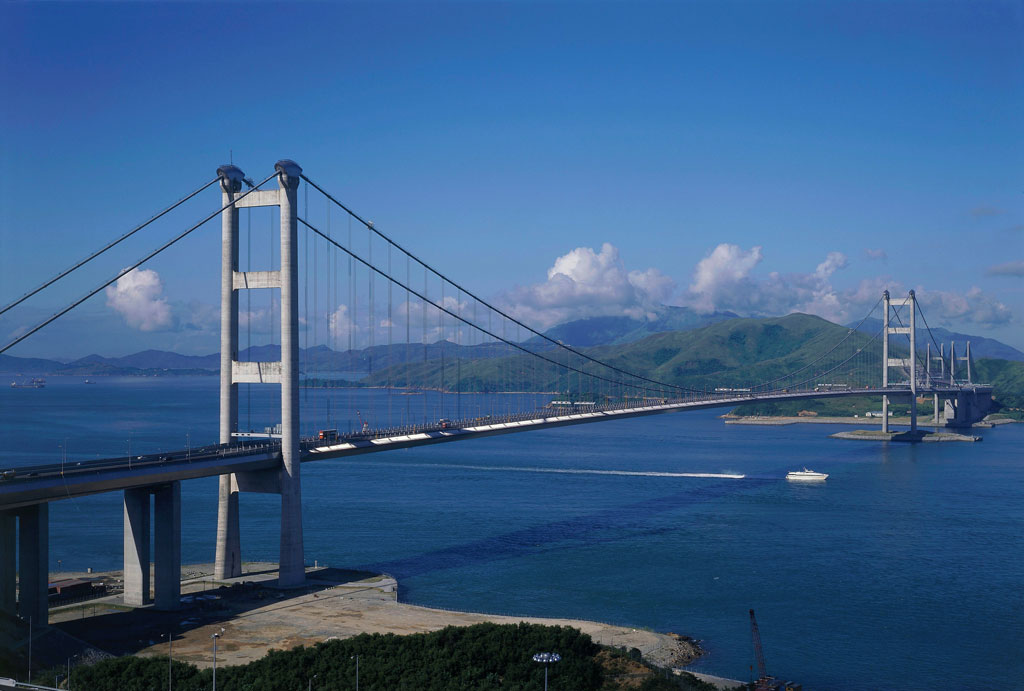
The Tsing Ma Bridge is a double-decked in that connects Island to Ma Wan Island across the Ma Wan Channel, forming a key segment of the Lantau Link roadway system that provides essential access to . With a total length of 2,160 meters and a main span of 1,377 meters, it was the longest in the world carrying both road and rail traffic upon its completion, a record it continues to hold. Opened to traffic in May 1997 after five years of construction that began in May 1992, the bridge cost approximately HK$7.2 billion to build and was designed to withstand typhoon-force winds through aerodynamic features, including a shaped and air gaps on the deck, validated by extensive testing. The upper deck accommodates a dual three-lane expressway for vehicular traffic, while the lower deck houses two railway tracks for the and , along with emergency and maintenance facilities. Its towers rise to 206 meters above , supported by massive cables composed of 27,000 tonnes of high-strength wire, underscoring its as a landmark of modern bridge design in a seismically and meteorologically challenging environment.

History

Planning and Background

The planning for the Tsing Ma Bridge emerged as a critical component of Hong Kong's infrastructure expansion in the late , driven by the need to establish a reliable connection between and the new Chek Lap Kok Airport on . This bridge, part of the broader Lantau Link project, addressed the isolation of and islands, which previously relied on ferries for access, and alleviated anticipated from the airport's development and regional growth. The rationale stemmed from the Port and Airport Development Strategy (), also known as the Rose Garden Project, which aimed to support Hong Kong's transition to a service-based by providing expressway and rail links to accommodate up to 260,000 future residents on Lantau and facilitate airport operations targeted for 1997. Conceptualization of the project began in the late 1980s, building on earlier feasibility studies from the 1970s that identified as the optimal airport site, though planning was paused during the 1983 economic recession before resuming in 1987. By 1989, formalized the Lantau Link as a 4 km corridor including the Tsing Ma suspension bridge over Ma Wan Channel, with route selections favoring bridges over tunnels for economic and operational reasons. Environmental impact assessments, evaluating air quality, noise, water, ecology, and , were completed by 1991, ensuring mitigation measures for the selected alignment spanning 5.2 km overall. Key stakeholders included the Government and its Highways Department, which sponsored the project through the New Airport Projects Coordination Office (NAPCO), alongside consultants for initial feasibility and design studies. The Highways Department, as the primary proponent, coordinated with engineering firms like & Partners for route evaluations. In 1991, the government approved an initial budget of HK$7.14 billion for the Tsing Ma Bridge, reflecting cost estimates for the 1,377 m main span structure integral to the Lantau Link.

Construction Process

The contract for the construction of the Tsing Ma Bridge was awarded on May 18, 1992, to the Anglo-Japanese Construction Joint Venture, comprising Trafalgar House Construction (Asia) Ltd., Costain Civil Engineering Ltd., and Mitsui & Co. Ltd., with construction commencing in late May 1992; subcontractors included Cleveland Bridge & Engineering Company for steelwork fabrication and Mitsui Engineering & Shipbuilding for specialized components. The project adhered to a stringent 60-month timeline, driven by the need to align with Hong Kong's airport development, culminating in the completion of the main structure by April 1997 and the bridge's opening to traffic in May 1997. The total cost reached approximately HK$7.2 billion, reflecting efficient management that kept expenditures under the original budget through proactive claims resolution and value engineering. Initial phases focused on foundation work in challenging typhoon-prone waters, where concrete caissons were sunk to support the piers, including one in shallow waters off Island to ensure stability against deep-sea currents and seismic activity. The 206-meter-high towers were then erected using slipforming techniques, a continuous pouring method that allowed rapid vertical over three months per tower, employing high-strength to withstand wind loads up to 180 km/h. Following tower completion, the main span cables—each 1.1 meters in diameter and comprising 27,000 tonnes of galvanized wire—were installed via aerial spinning from July 1994 to April 1995, a nine-month process involving over 15,000 individual wires pulled across the 1,377-meter span using specialized shuttles and tensioning equipment. Deck erection began in August 1995, with 50 prefabricated sections, each weighing around 1,000 tonnes and assembled in Shatian, , lifted into place by massive gantries over eight months, completing the double-deck structure by March 1996. Significant challenges arose from the site's environmental hazards, including frequent typhoons that necessitated robust weather monitoring and temporary halts during cable spinning to prevent wire or structural imbalance. The process also disrupted maritime navigation in the busy Tsing Ma Channel, requiring coordinated closures and safety protocols for over 1,000 workers operating at heights and over water. Just prior to completion, on April 21, 1997, the bridge was sabotaged when unidentified individuals cut the main cables in 32 places, causing minor delays that were swiftly addressed through repairs to meet the inauguration schedule. Adherence to the five-year schedule demanded rigorous , including the resolution of more than 370 claims and 15 disputes, while incorporating ship collision protections like fender systems to safeguard the piers. Steel fabrication occurred internationally, with components sourced from Britain, , and , adding logistical complexity but ensuring quality through international standards.

Inauguration and Early Operations

The Tsing Ma Bridge was ceremonially inaugurated on April 27, 1997, by former British Prime Minister , marking the completion of a key component of the Lantau Link infrastructure project. The event featured a grand fireworks display and was attended by an estimated 100,000 people, serving as one of the final major celebrations under British administration before Hong Kong's sovereignty to . The bridge was opened to public vehicular traffic on May 22, 1997, at 8:00 a.m., providing immediate connectivity between Island and Island as part of preparations for the July 1 . In its early operations, the bridge's upper deck supported dual three-lane carriageways for motor vehicles in each direction, while the lower deck was designated for rail transit and emergency purposes, facilitating the integration of road and rail networks. Rail services began with the in late June 1998 and the Airport Express in early July 1998, aligning with the opening of the new on July 6, 1998, and enabling seamless passenger transport to the facility. Initial vehicular use saw steady adoption, though the first recorded road accident occurred on May 23, 1997, involving a collision between motorcyclists and a lorry that injured two individuals. Early operations presented challenges related to the bridge's exposure to Hong Kong's typhoon-prone environment and its position over the busy Ma Wan shipping channel, necessitating adjustments for high winds and vessel clearances of up to 60 meters. In response, the Wind and System (WASHMS) was activated upon opening to track environmental loads and structural responses, with initial protocols for wind diversions and maintenance routines established between 1997 and 1998. Typhoon Victor, which struck in August 1997, tested these systems early on, confirming the bridge's resilience through real-time data analysis. Symbolically, the Tsing Ma Bridge featured prominently in the 1997 handover festivities, illuminated during ceremonial events and representing Hong Kong's modernized infrastructure ready for the post-colonial era and the new airport's operational demands. Its timely completion underscored the British colonial government's commitment to legacy projects, bridging urban with and symbolizing continuity amid political transition.

Technical Specifications

Dimensions and Capacity

The Tsing Ma Bridge spans a total length of 2,160 meters, featuring a main span of 1,377 meters between its towers. Upon its completion in 1997, this main span represented the longest worldwide for a accommodating both road and rail traffic; it currently holds this record. As of 2025, it ranks as the 11th longest span globally. The bridge's towers rise to a height of 206 meters above , supporting the structure's dual-deck configuration. The deck, measuring 41 meters in width, is elevated to provide a navigational clearance of 53 meters, enabling passage for large ships in Hong Kong's harbor. The upper deck supports six lanes of road traffic—three in each direction—while the lower deck includes two railway tracks flanked by emergency roadways. Designed for operational efficiency, the bridge accommodates rail speeds of up to 135 km/h and road speeds of 100 km/h, with the overall structure engineered to withstand winds reaching 300 km/h. The total weight of the bridge's exceeds 75,000 tonnes, including 49,000 tonnes for the deck and 27,000 tonnes for the main cables, underscoring its massive scale.

Materials and Construction Techniques

The Tsing Ma Bridge incorporates high-tensile galvanized wires for its main suspension cables, with each cable comprising approximately 33,400 individual wires of 5.38 mm , forming a 1.1 m capable of supporting loads up to 53,000 tonnes per cable. These wires, totaling 27,000 tonnes across both cables, provide essential flexibility and strength while resisting through in Hong Kong's saline marine environment. The for the , weighing 49,000 tonnes, was selected for its durability and lightweight properties, enabling the bridge to carry both vehicular and rail traffic on its double-deck configuration. Concrete forms the backbone of the bridge's foundations and anchorages, with the Tsing Yi anchorage utilizing 200,000 tonnes and the Ma Wan anchorage 250,000 tonnes to securely the main cables. The two 206 m high towers each required 52,000 tonnes of high-strength , constructed via slipforming techniques that allowed completion in just three months per tower. Foundations include caissons sunk onto rock for the offshore tower, protected by artificial islands and rock seawalls designed to withstand vessel impacts, ensuring stability in typhoon-prone waters. components, including the 500-tonne saddles atop the towers, were lifted using strand jacks for precise placement. Construction techniques emphasized and efficient assembly to minimize on-site risks. The main cables were erected using aerial spinning methods, where 160,000 km of wire was spun and adjusted over nine months, employing temporary saddles for aerodynamic control during installation. The consists of 50 prefabricated sections, each 36 m long and weighing about 1,000 tonnes, fabricated in , , and transported by before being lifted into position using floating cranes over eight months. techniques for joints incorporated high-strength methods to enhance resistance, with anti-corrosion measures including for cables and protective coatings integrated during assembly to combat marine exposure. sourcing involved fabrication in the UK, Dubai, and , combining international expertise for quality assurance.

Engineering Design

Structural Components

The Tsing Ma Bridge features a classic suspension design with key structural components including two main towers, paired main suspension cables, a double-deck stiffening , and massive gravity anchorages, all integrated to support both vehicular and rail traffic across its 1,377-meter main span. The towers serve as the primary vertical supports, while the cables and suspenders transfer loads to the anchorages, with the deck providing the horizontal platform resistant to dynamic forces through its truss framework. The two towers are portal-braced, structures, each rising 206 meters above and weighing approximately 52,000 tonnes. They adopt a two-legged configuration with horizontal trusses at intervals for stability, constructed using high-strength founded directly on . The eastern tower on Island and the three land-based piers rest on rock sockets, while the western Ma Wan tower in shallow water uses large caissons sunk onto the seabed and protected by an to resist scour and seismic events. The main cables consist of two parallel sets, each formed from 33,400 galvanized wires of 5.38 diameter, totaling 160,000 kilometers in and 26,700 tonnes in , spanning 1,377 meters between the towers. These cables are draped over the tower saddles and anchored at each end, with the deck suspended below via vertical hangers spaced at 18-meter intervals along the main span to distribute loads evenly. The bridge deck is a double-deck steel structure, 41 meters wide and 2.2 kilometers long overall, designed as a with longitudinal stiffening trusses and cross-frames to minimize vibrations from and . The upper level accommodates a six-lane (three lanes per direction), while the lower level houses twin tracks and two sheltered emergency lanes for maintenance and utilities. Anchorages at each end are gravity-type concrete blocks to secure the main cables, with the Tsing Yi anchorage weighing 200,000 tonnes and the Ma Wan anchorage 250,000 tonnes, both embedded in for uplift resistance. These foundations, along with the tower bases, incorporate marine protections against scour, ensuring the entire system withstands winds and seismic loads.

Aerodynamic and Environmental Protections

The Tsing Ma Bridge features a streamlined double-deck box girder design with faired leading edges, central air gaps, and non-structural edge fairings to mitigate aerodynamic instabilities such as and flutter, which are critical in Hong Kong's typhoon-prone environment. These elements reduce wind-induced vibrations by optimizing airflow around the deck, with the lower deck partially enclosed by cladding to shelter rail and highway traffic during high winds. Aerodynamic stability was rigorously validated through extensive testing during the design phase in the early 1990s, simulating conditions up to wind speeds of 350 km/h. Sectional and full aeroelastic models were used to assess vortex-induced oscillations and flutter derivatives, confirming the effectiveness of the faired edges in suppressing detrimental vibrations and ensuring the bridge's operational integrity under extreme gusts. The tests also evaluated skew wind effects, leading to refinements in deck geometry for enhanced torsional rigidity. The bridge's seismic design leverages its inherent flexibility as a suspension structure, with deep foundations and towers engineered to absorb and dissipate energy in line with Hong Kong's building standards. analyses were performed to evaluate behavior under rare seismic events, demonstrating low amplification of ground motions due to the long natural periods exceeding 5 seconds for the fundamental modes. To address marine hazards, the bridge incorporates protective measures against ship collisions and . Cellular fender systems surround the piers, designed to absorb impact energy from vessels, while the Ma Wan tower pier is shielded by an constructed from caissons in shallow waters. Breakwaters and navigational lighting enhance maritime safety, and corrosion-resistant coatings, including and barriers on elements, protect against saltwater exposure and atmospheric in the humid coastal setting. Environmental adaptations emphasize resilience to Hong Kong's subtropical , with the overall streamlined profile minimizing lateral sway and buffeting during typhoons, allowing continued operation of upper-deck in winds up to 95 m/s. Graduated wind shields near the towers further reduce localized , while the sheltered lower deck facilitates maintenance access and emergency diversions without full closure.

Operation and Maintenance

Daily Usage and Traffic Management

The Tsing Ma Bridge serves as a critical artery in Hong Kong's infrastructure, accommodating substantial vehicular and rail traffic on its dual-level deck. According to the Transport Department's 2016 Annual Traffic Census, the average annual daily (AADT) across the Lantau Link, encompassing the Tsing Ma Bridge, reached 88,640 vehicles, a figure that has shown relative stability post-2020 despite disruptions, with the 2023 census recording an AADT of 79,890 vehicles reflecting robust recovery. The lower deck supports rail operations for the Corporation's and , collectively handling over 100,000 passengers daily; for instance, the alone averaged 34,700 passengers per day in September 2025, while the contributed significantly to the domestic network's ridership. Management of the bridge falls under the Highways Department of the Government, with day-to-day operations in the Tsing Ma Control Area handled by contractors such as TIML MOM Limited. The design permits concurrent and rail usage, with vehicles traveling at speeds up to 80 km/h on the upper deck and trains reaching operational speeds of 135 km/h on the lower deck, ensuring efficient flow while adhering to structural limits. Tolls were implemented upon the bridge's opening in 1997 to offset construction costs and were set at levels such as HK$30 for private cars initially; however, they were fully waived starting , 2020, as part of measures to bolster post-pandemic economic recovery and reduce travel expenses. Heavy vehicles face weight restrictions, enforced via signage and monitoring, to safeguard the bridge's integrity under varying loads. As an integral segment of Route 8, the Tsing Ma Bridge enhances connectivity between , , and the , while linking to broader networks including the Hong Kong-Zhuhai-Macao Bridge for cross-border travel. Traffic management incorporates weather-responsive protocols; during Warning Signal No. 8 or higher, emergency measures such as partial lane closures and speed reductions are enacted to mitigate wind risks, prioritizing safety without full suspension unless conditions escalate.

Safety Measures and Upkeep

The Highways Department of oversees the maintenance of the Tsing Ma Bridge, incorporating regular visual inspections using small unmanned aircraft systems (drones) to assess highway structures, including hard-to-reach areas, alongside comprehensive . These practices are supported by the bridge's Wind and System (WASHMS), operational since 1997, which facilitates ongoing evaluation of structural integrity through data-driven insights. Acoustic monitoring on the main cables detects wire breaks via emission signals, aiding proactive upkeep without a specified replacement program detailed in public records. The WASHMS integrates approximately 283 sensors across various types, including anemometers for wind speeds, strain gauges for structural loads, weigh-in-motion sensors for traffic impacts, and thermometers for environmental conditions, enabling real-time alerts on potential issues. A ventilation and dehumidification system within the deck controls internal and to mitigate risks. While a dedicated system is not explicitly documented for this bridge, the monitoring framework processes data for automated health assessments, with upgrades including rehabilitated GPS and wireless transmission for enhanced reliability. The bridge has experienced minor operational disruptions due to typhoons, such as during Super in , when high winds exceeding 75 km/h triggered Stage 2 traffic management, suspending bus services and imposing restrictions to ensure safety, though no structural damage was reported. Similar protocols apply during other events, with no major structural failures recorded over 25 years of operation. Post-2020 enhancements focus on broader infrastructure, but specific electric vehicle charging upgrades on the Tsing Ma Bridge remain unverified in official sources. Maintenance adheres to international standards, with the Highways Department certified under ISO 9001 for in bridge operations. through WASHMS tracks factors like wind, temperature, and frequency since its , contributing to emissions and oversight in the Tsing Ma Control Area, though dedicated metrics for these began integrating around 2000.

Significance and Impact

Engineering and Technical Achievements

The Tsing Ma Bridge achieved several engineering milestones upon its completion in 1997, establishing it as a pioneering structure in design. It holds the World Record for the longest bridge span carrying both and rail , measuring 1,377 across its main span. At the time of opening, it ranked as the second-longest globally and was the first in to feature a double-deck configuration supporting multi-modal , with six lanes of roadway on the upper deck and dual railway tracks plus maintenance corridors on the lower deck. This innovative layout enabled efficient integration of expressway and rail systems while maintaining structural integrity under combined loads. Central to its technical achievements is the adoption of an orthotropic steel box-girder deck, which optimizes weight distribution and enhances for the 2,160-meter total length, using 49,000 tonnes of . The design incorporates advanced aerodynamic protections, including a streamlined and air gap in the deck cross-section, rigorously validated through testing to mitigate vortex-induced vibrations and ensure stability during typhoons with wind speeds up to 70 meters per second. These features addressed vulnerabilities seen in European long-span bridges, such as cable oscillations in the , by prioritizing torsional rigidity and cable damping from the outset. The bridge's engineering excellence earned it the British Construction Industry Supreme Award in 1997, recognizing its world-class execution in design and construction. It also received accolades from the International Association for Bridge and (IABSE), highlighting its contributions to global structural practices. Designed for a 120-year , the structure incorporates a load factor of 1.5 for ultimate strength, ensuring resilience against extreme environmental and traffic demands with minimal ecological disruption during its operational phase.

Economic and Social Contributions

The Tsing Ma Bridge, as a critical component of the Lantau Link, has significantly enhanced Hong Kong's economic landscape by providing essential connectivity to the (HKIA) at , facilitating the airport's operations since its opening in 1998. This infrastructure enabled the seamless integration of with urban networks, supporting aviation-related activities that contributed HK$94.2 billion to Hong Kong's GDP in 2012 through direct, indirect, and induced effects, representing 4.6% of the total GDP at the time. Including catalytic effects from inbound and , the overall impact reached up to HK$335.3 billion, or 16.5% of GDP, underscoring the bridge's role in bolstering sectors like and . For instance, aviation-supported alone generated USD 5.3 billion in GDP contributions and sustained 75,200 jobs, while HKIA's cargo handling—33% of Hong Kong's total value—strengthened ties with and global markets. The bridge has reduced travel times from to the airport to approximately 30 minutes by road, compared to longer ferry-dependent routes prior to its construction, thereby enhancing operational efficiency for passengers and freight. Socially, the bridge has improved accessibility for over 140,000 residents on Lantau Island by linking it directly to the mainland via Tsing Yi, reducing isolation and promoting daily commuting and essential services. This connectivity has supported urban development on Tsing Yi, home to around 200,000 residents with expanding residential and industrial areas, and on Ma Wan, where a population of about 14,000 benefits from easier access to employment and amenities despite prior vehicle restrictions. The waiver of tolls on the Lantau Link, effective from December 27, 2020, further alleviated financial burdens on commuters amid economic challenges, allowing vehicles to pass without payment and coinciding with the opening of the Tuen Mun–Chek Lap Kok Link to distribute traffic more evenly. This measure not only eased costs for transport operators and daily users but also contributed to smoother flows, with average daily vehicles on the link recovering from a COVID-19 low of 52,278 in September 2020 toward pre-pandemic levels of 97,427. In the broader context, the bridge has facilitated trade expansion with through HKIA's role as a key gateway, handling substantial volumes that integrate into regional supply chains. Environmentally, the improved road-rail integration has helped mitigate congestion in connecting corridors, indirectly supporting lower emissions by promoting efficient multi-modal transport, though specific quantitative reductions remain tied to overall network optimizations. Long-term, the Tsing Ma Bridge symbolizes 's integration into the Guangdong-Hong Kong-Macao Greater Bay Area, as highlighted in policy addresses linking it to enhanced cross-border connectivity and economic cooperation. During the post-2020 recovery, the bridge's infrastructure proved vital in restoring traffic and , aiding a rebound in aviation-related activities that bolstered regional economic resilience.

Tourism and Cultural Role

Visitor Experiences and Access

Visitors can access the Tsing Ma Bridge primarily through designated viewpoints rather than directly on the structure, as there is no pedestrian walkway available for walking across it. Key locations include the Lantau Link Viewing Platform on the northwest corner of Tsing Yi Island, offering panoramic vistas of the bridge and the adjacent Ting Kau Bridge; the Tsing Yi Promenade, which provides elevated views over the Rambler Channel; and Ma Wan Park on Ma Wan Island, featuring nature trails with bridge overlooks. To reach these sites via public transport, travelers can take the MTR Tung Chung Line or Airport Express to Tsing Yi Station (Exit A1), then board buses such as 248M or 279X to the Lantau Link Viewing Platform, or proceed to Sunny Bay Station for connections to Ma Wan Park via bus routes like 14 or the Ma Wan Promenade Shuttle. From Hong Kong International Airport, the A31 bus route crosses the bridge en route to Tsuen Wan, allowing passengers a drive-through experience, while taxis from Tsing Yi Station cost approximately HKD 45 and take about 15 minutes to the main viewpoint. Since December 27, 2020, the Lantau Link, including the Tsing Ma Bridge, has been toll-free for all vehicles, facilitating easier access for drivers heading to viewpoints. The primary attraction for visitors is the Lantau Link Visitors Centre, adjacent to the viewing platform, which features interactive exhibits, models, videos, and photographs detailing the bridge's and significance; entry is free and as of 2025, the centre is open 10 a.m. to 5 p.m. through (closed Wednesdays), while the platform operates 7:30 a.m. to 11 p.m. daily. Nighttime visits highlight the bridge's illumination system, which activates around 7 p.m. to create a striking visual display against the skyline, particularly effective from the viewing platform. Sunset timings, varying seasonally but typically around 6 p.m. in winter, offer dramatic golden-hour perspectives of the bridge spanning the water. The bridge formerly featured in the route until 2016, providing runners with iconic crossing experiences, though it was rerouted thereafter due to concerns. Practical considerations include ample parking at the Lantau Link Viewing Platform and Ma Wan Park for those arriving by car, though spaces can fill during peak hours. Access to viewpoints and bridge crossings is restricted during signal No. 8 or higher, when high winds exceeding 75 km/h trigger Stage 2 traffic management, suspending bus services and closing the structure to non-essential traffic for safety. Visitors should check weather alerts and plan accordingly, as the bridge's operational hours align with daily traffic patterns but may adjust for .

Representations in Media and Culture

The Tsing Ma Bridge has been prominently featured in international cinema, particularly in action sequences that highlight 's urban landscape. In the 2014 film Transformers: Age of Extinction, directed by , the bridge serves as a key backdrop during high-stakes chase scenes involving transforming robots and vehicles navigating its expansive span, emphasizing its role as a modern engineering icon in the city's skyline. The production utilized the structure's dramatic scale to underscore themes of technological advancement and global connectivity, with filming occurring at multiple sites including the bridge itself. Documentaries have also showcased the bridge's construction and significance, portraying it as a pinnacle of human ingenuity. Episodes in the series Megastructures detail the bridge's engineering challenges and completion in 1997, focusing on its dual road-rail design and typhoon-resistant features that make it a global benchmark for suspension bridges. These productions often frame the bridge as a testament to Hong Kong's rapid modernization, drawing millions of viewers to appreciate its technical and aesthetic marvels. As a cultural symbol, the Tsing Ma Bridge embodies Hong Kong's transition during the 1997 handover from British to Chinese sovereignty, representing optimism and progress amid political change. Opened by former British Prime Minister in April 1997, it was described as a profound emblem of the city's "boldness, vision, and energy," bridging the past colonial era with a future of . This symbolism extended to , with Post issuing a set of "Modern Landmarks" stamps on May 18, 1997, featuring the bridge to commemorate the Lantau Link's opening and evoke national pride in infrastructural achievements. The bridge has hosted notable events that reinforce its cultural stature, including a record-breaking fireworks display at its 1997 inauguration, which lit up the night sky in a HK$5 million spectacle attended by thousands, symbolizing a "gateway to the future" for Hong Kong's development. In contemporary narratives, it continues to inspire artistic expressions tied to the city's identity, often depicted in media as a literal and metaphorical portal connecting urban centers to emerging horizons like . Globally, the structure gained renewed attention in a 2025 CGTN feature, which highlighted it as both a vital artery and an enduring landmark of Hong Kong's resilience and innovation.

References

Add your contribution
Related Hubs
User Avatar
No comments yet.