Recent from talks
All channels
Be the first to start a discussion here.
Welcome to the community hub built to collect knowledge and have discussions related to Michael Bay.
Nothing was collected or created yet.
Michael Bay
View on Wikipediafrom Wikipedia
Not found
Michael Bay
View on Grokipediafrom Grokipedia
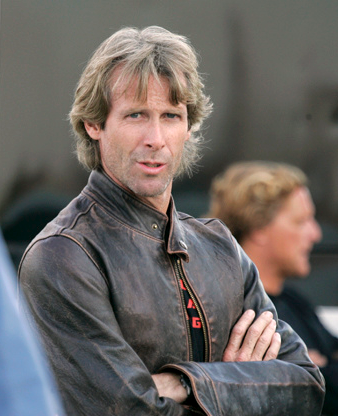
Michael Benjamin Bay (born February 17, 1965) is an American film director and producer recognized for helming high-budget action spectacles defined by explosive action sequences, rapid editing, and heavy reliance on practical and digital effects.[1][2]
A Wesleyan University graduate who honed his craft in commercials and music videos, Bay debuted in features with Bad Boys (1995), starring Will Smith and Martin Lawrence, which exceeded $160 million in global earnings despite modest origins.[3][1]
Subsequent hits like The Rock (1996), Armageddon (1998)—his highest-grossing non-franchise film at $553 million—and the first five Transformers entries propelled his films to over $6.5 billion in worldwide box office totals, underscoring his prowess in delivering audience-pleasing blockbusters amid often lukewarm critical reception.[4][5][6]
Bay's signature style, emphasizing visceral thrills over narrative depth, has fueled debates on cinematic quality, with detractors highlighting shaky camerawork, stereotypical portrayals, and exploitative elements in female characterizations, though empirical audience metrics affirm his commercial dominance.[7][8][9]
Early Life and Education
Childhood and Family Background
Michael Bay was born on February 17, 1965, in Los Angeles, California, and adopted as an infant by Jewish parents Harriet Bay, a child psychiatrist who also owned a bookstore, and Jim Bay, a certified public accountant.[2][10][11] He was raised in the Jewish faith, including participating in a bar mitzvah ceremony, and grew up in a middle-class household in the Los Angeles suburb of Westwood.[12][13] Bay had a younger sister, and the family maintained a stable dynamic centered on professional pursuits rather than entertainment industry ties, with no recorded relocations during his formative years.[10] His mother's background in child psychology and bookstore operations provided exposure to intellectual and narrative environments, while his father's accounting career emphasized financial practicality.[2][13] Bay later donated proceeds from his bar mitzvah gifts to an animal shelter, reflecting an early personal commitment to animal welfare amid the family's Jewish cultural framework.[12]Academic Training and Early Influences
Bay began experimenting with filmmaking during his high school years, producing short films using Super 8 cameras, including one alien invasion project that accidentally ignited a fire in his bedroom, prompting a visit from the fire department.[14] These early efforts demonstrated an innate interest in visual spectacle and action sequences, fostering hands-on technical skills outside formal instruction. After being rejected by the University of Southern California's prestigious film program, Bay enrolled at Wesleyan University, where he pursued a dual major in English and film, graduating in 1986.[10] His studies there emphasized film theory and production techniques, contributing to his later proficiency in rapid-cut editing and dynamic camera work central to his action-oriented style.[15] As a senior, Bay directed the short film My Brother Benjamin, which served as his thesis project and earned the Frank Capra Prize for best film upon graduation, recognizing its narrative and technical merits.[15] This accolade, awarded by Wesleyan faculty, underscored his emerging ability to blend storytelling with visual energy, influences that persisted in his professional output despite the program's relatively modest resources compared to elite film schools. The rejection from USC, in particular, highlighted Bay's self-reliant approach, compelling him to refine skills through practical application rather than relying on institutional prestige.[10]Early Professional Career
Work in Commercials and Music Videos
Bay began directing commercials shortly after graduating from Wesleyan University in 1986, joining Propaganda Films where he honed his craft in short-form advertising.[16][17] Over the late 1980s and early 1990s, he created spots for major brands including Pepsi, Miller, Coca-Cola, and Coors, often incorporating kinetic camera movements, explosive effects, and fast-paced editing to capture viewer attention within 30 seconds.[18][19] Notable examples include the Miller Lite "Lawyer Roundup" advertisement, which used humorous action sequences, and the 1993 "Aaron Burr" spot launching the Got Milk? campaign, featuring a historical reenactment interrupted by a milk-deprived fainting.[20][21] These efforts earned industry recognition, including a Gold Lion award at the Cannes Lions International Festival of Creativity for the Miller Lite beer campaign and a Silver Lion for the Got Milk? work.[22] Parallel to commercials, Bay directed music videos that showcased his emerging visual flair on constrained budgets, prototyping techniques like Dutch angles, quick cuts, and high-energy spectacle later refined in features.[23] Early credits include Donny Osmond's "Soldier of Love" in 1989, emphasizing rhythmic editing synced to pop rhythms, and the 1993 Meat Loaf epic "I'd Do Anything for Love (But I Won't Do That)," a 12-minute production with helicopter pursuits, gothic castle sets, and dramatic lighting effects involving a disfigured protagonist and levitating furniture.[24][20] Other videos, such as Chicago's "Chasin' the Wind" (1991) and Tina Turner's "Love Thing" (1991), further demonstrated his ability to blend narrative storytelling with visual bombast.[25] The revenue from these high-volume commercial assignments—conducted across agencies and brands—provided financial independence, enabling Bay to self-fund speculative projects and build a reel that attracted feature film opportunities.[18] In 1995, the Directors Guild of America named him Commercial Director of the Year, affirming his proficiency just prior to his transition to long-form directing.[3] This phase established core elements of his style, including aggressive pacing and pyrotechnic integration, tailored for mass-market appeal in time-limited formats.[20]Transition to Feature Films
Michael Bay's entry into feature filmmaking occurred through his recruitment by producers Don Simpson and Jerry Bruckheimer, who tapped him to direct the action comedy Bad Boys (1995) after his established reputation in commercials and music videos.[26] This debut project, developed amid studio skepticism and initial casting considerations for other actors, marked Bay's shift from short-form advertising to narrative features, emphasizing high-energy action sequences honed from prior visual effects experience.[27] Building on Bad Boys' commercial performance, Bay directed The Rock (1996), another collaboration with Bruckheimer following Simpson's death earlier that year, which further solidified his role in delivering studio-backed thrillers with explosive set pieces and ensemble casts. These initial productions demonstrated Bay's opportunistic alignment with influential producers, prioritizing budgets sufficient for elaborate stunts and effects over lower-stakes independent ventures. Armageddon (1998), produced by Bruckheimer and starring Bruce Willis, represented Bay's breakout in scope, grossing $553 million worldwide despite extensive on-set script revisions to enhance pacing and spectacle.[5] Bay's insistence on iterative changes, informed by production footage and narrative adjustments rather than traditional indie experimentation, underscored his empirical focus on audience-engaging bombast, foreshadowing a career defined by lucrative partnerships and aversion to non-commercial formats.[28]Directing Career
Breakthrough and Early Blockbusters (1990s–2005)
Michael Bay achieved his breakthrough with Bad Boys (1995), a buddy-cop action film starring Will Smith and Martin Lawrence as mismatched Miami detectives pursuing stolen drugs, which grossed $141.4 million worldwide against a $19 million production budget.[29][30] The film's success, yielding over seven times its cost, established Bay's formula for high-energy action paired with comedic banter and established him as a commercial director under producer Jerry Bruckheimer.[29] This was followed by The Rock (1996), a military thriller featuring Nicolas Cage as an FBI chemist and Sean Connery as an escaped convict teaming to stop rogue Marines from deploying nerve gas on San Francisco, earning $336.1 million globally on a $75 million budget.[31][32] The picture's emphasis on tense hostage scenarios and explosive set pieces reinforced Bay's viability for large-scale spectacles, grossing more than four times its investment.[31] Bay's momentum continued with Armageddon (1998), a disaster epic about oil drillers recruited by NASA to deflect an asteroid threatening Earth, starring Bruce Willis and Ben Affleck, which amassed $553.7 million worldwide despite a $140 million budget.[33][34] Produced nearly four times its cost, the film drew criticism for scientific inaccuracies—such as implausible drilling techniques and orbital mechanics—that prioritized visceral destruction over realism, yet its box office dominance underscored Bay's appeal in spectacle-driven narratives.[34] Similarly, Pearl Harbor (2001) blended historical action with romance, depicting U.S. pilots (Ben Affleck and Josh Hartnett) amid the 1941 Japanese attack, generating $449.2 million globally against an estimated $140 million outlay.[35][4] The production's recreation of the assault with practical effects and miniatures contributed to its commercial haul, exceeding three times the budget, though it faced detractors for melodramatic elements overshadowing factual precision.[35] The period culminated with The Island (2005), a dystopian sci-fi thriller involving clones (Ewan McGregor and Scarlett Johansson) escaping a facility harvesting organs for the elite, which underperformed with $163 million worldwide on a $126 million budget.[36][37] Despite aggressive marketing expenditures that amplified costs beyond production, the film's modest returns—barely covering expenses when factoring distribution and promotion—marked it as a relative disappointment, signaling a pivot from unbridled early successes amid shifting audience preferences for franchise-driven content.[36][38]Transformers Franchise Dominance (2007–2017)
Michael Bay initiated the live-action Transformers film series with the 2007 release of Transformers, a reboot of Hasbro's toy line that grossed $709 million worldwide on a $150 million budget, establishing the franchise's commercial viability through high-octane action sequences blending CGI from Industrial Light & Magic and practical effects for robot realism.[39][40] The film's success stemmed from Bay's emphasis on photorealistic transformations and destruction, iterated via close collaboration with Hasbro to align visuals with toy merchandising potential, drawing audiences with spectacle over narrative depth.[41] Subsequent entries amplified scale and revenue, with Transformers: Revenge of the Fallen (2009) earning $836 million, Transformers: Dark of the Moon (2011) peaking at $1.124 billion—the highest in the series—and Transformers: Age of Extinction (2014) matching closely at $1.105 billion, reflecting iterative enhancements in battle choreography and global marketing tailored to international markets like China.[42][43] These films responded to audience metrics by expanding runtime for extended action set pieces and incorporating feedback-driven tweaks, such as refined robot designs for better visibility amid chaos, prioritizing box office persistence over critical acclaim.[44] Bay's approach echoed escalating spectacle in contemporaries like The Dark Knight (2008), but grounded adjustments in empirical data from test screenings and overseas performance rather than consensus reviews.[39] Bay concluded his directorial tenure with Transformers: The Last Knight (2017), which underperformed at $605 million amid franchise fatigue, prompting his exit due to personal burnout after helming five installments exceeding initial trilogy plans, despite executive producer Steven Spielberg's earlier advice to stop post-third film.[45][46] This period solidified Bay's dominance in generating over $4.3 billion from the series alone, with revenue driven by merchandising synergies and repeat viewership for visual effects, underscoring a model of audience-validated iteration over artistic reinvention.[39]Diversification and Recent Directorial Efforts (2018–present)
Following the release of Transformers: The Last Knight in 2017, Michael Bay directed 6 Underground (2019), a Netflix action thriller starring Ryan Reynolds as the leader of a vigilante team faking their deaths to combat a dictator.[47] Produced on a $150 million budget, the film emphasized explosive set pieces and global stunts tailored for streaming consumption, marking Bay's entry into direct-to-platform releases amid theaters' declining dominance.[47] Netflix later described it as a creative shortfall despite its alignment with data showing action genres outperforming plot-intensive fare in viewer hours, as seen in similar titles dominating platform metrics.[48][49] In 2022, Bay returned to theatrical directing with Ambulance, a $40 million crime thriller inspired by a Danish film, featuring Jake Gyllenhaal and Yahya Abdul-Mateen II in a high-speed pursuit involving a hijacked emergency vehicle.[50] The production showcased innovative single-take sequences capturing chaotic chases through Los Angeles, executed with practical effects and minimal CGI to heighten realism.[51] Grossing $52 million worldwide against its budget, it underperformed at the box office due to post-pandemic audience habits favoring home viewing, but later achieved strong streaming engagement on platforms like Netflix.[50][52] Bay maintained franchise connections as executive producer and cameo actor in Bad Boys: Ride or Die (2024), appearing briefly as a Porsche driver in a chase scene, echoing his original direction of the 1995 series starter.[53] This role underscored a post-Transformers pivot toward production oversight for sustainability, as Bay has noted executive producer Steven Spielberg's advice to limit directing sequels after three installments, prompting selective project choices over exhaustive franchise commitments.[54] Diversifying further, Bay directed We Are Storror (2025), his first documentary, tracking the British parkour collective Storror through injury-plagued training and global feats, drawing on decades of their footage for immersive sequences.[55] Premiering at South by Southwest on March 9, 2025, the film earned a 90% Rotten Tomatoes score for its raw depiction of athletic risk, reflecting Bay's adaptation to non-fiction formats emphasizing spectacle over scripted narratives.[56] This output demonstrates Bay's responsiveness to market demands for visceral action across mediums, prioritizing empirical viewer preferences for high-energy content amid streaming's rise.[49]Upcoming Projects and Unrealized Ventures
In mid-2025, Michael Bay pitched an original live-action Transformers film to Paramount Pictures, sparking discussions for his potential return as director to the franchise he launched in 2007.[57] Reports indicated Paramount's interest amid recent franchise box office challenges, with scripts under review by August 2025, though no formal greenlight or production start date has been confirmed.[58] Bay expressed intent to helm the project, leveraging his history with the series' five prior entries, which grossed over $4.8 billion worldwide collectively.[59] Bay is attached to direct a feature adaptation of Sega's 1986 arcade racing video game OutRun at Universal Pictures, announced in April 2025, with Sydney Sweeney set to star and produce.[60] The project aims to capture the game's high-speed driving essence in a live-action format, though details on plot, budget, or release remain undeveloped as of October 2025.[61] In July 2024, Bay partnered with former Paramount executive Adam Goodman to develop film and television treatments for an adaptation of the viral YouTube series Skibidi Toilet, focusing on its surreal animated conflict between human-headed toilets and camera-headed humanoids.[62] Subsequent reports suggested production progress under Bay's involvement via Invisible Narratives, but he clarified in June 2025 that he would not direct, limiting his role to production oversight amid conflicting media claims.[63] Bay exited Netflix's Fast and Loose, an action-comedy starring Will Smith, in August 2025 over creative differences, with Bay favoring intensified action sequences against Smith's emphasis on humor.[64] The project, originally slated for a 2026 shoot, now seeks a replacement director, marking it as unrealized under Bay's direction.[65] Among Bay's shelved ventures, Robopocalypse—an adaptation of Daniel H. Wilson's 2011 novel about a robot uprising—was assigned to him in 2018 after Steven Spielberg's departure, but stalled indefinitely due to script revisions and escalating production costs estimated over $150 million. Similarly, Black Five, an original ensemble action thriller Bay conceived post-Armageddon (1998) and pitched to Sony in 2019, failed to advance by March 2025, with Bay citing industry-wide greenlight hesitancy amid economic pressures and risk aversion for high-budget spectacles.[66][67] These cancellations reflect broader challenges in securing financing for Bay's signature large-scale action concepts, often tied to unviable scripts or market saturation in sci-fi and disaster genres.Production and Business Ventures
Founding of Platinum Dunes
Platinum Dunes was established in November 2001 by Michael Bay, Andrew Form, and Brad Fuller as a film production company focused on horror genre projects, enabling Bay to expand his commercial footprint beyond action directing into lower-budget, high-return ventures.[68][69] The venture's breakthrough arrived with its debut feature, the 2003 remake of The Texas Chainsaw Massacre, produced on a budget of $9.5 million and generating $107 million in worldwide box office revenue, which validated the strategy of revitalizing 1970s horror icons for contemporary audiences drawn to amplified violence and production values.[70][71] Subsequent remakes followed this model, including the 2010 A Nightmare on Elm Street, budgeted at $35 million but limited to $63 million in U.S. earnings despite a $33 million opening weekend, marking it as a relative underperformer amid franchise expectations yet underscoring the risks of relying on nostalgia-driven IP where remake rights were more readily securable than developing originals from scratch.[72][73] Platinum Dunes achieved greater consistency with co-productions like the Purge series, beginning with the 2013 original that opened to $36.4 million on a sub-$10 million budget and spawned sequels collectively exceeding $500 million globally, profiting from accessible IP extensions and audience appetite for ritualistic horror themes rooted in socioeconomic commentary.[74][75] This emphasis on horror reboots reflected a pragmatic pivot toward properties with pre-existing fanbases and negotiable remake rights, fostering diversification through repeatable financial formulas rather than unproven concepts, though later shifts toward originals like A Quiet Place highlighted evolving market dynamics.[76]Involvement in Visual Effects and Other Entities
In 2006, Michael Bay, along with Wyndcrest Holdings, acquired Digital Domain, a visual effects studio originally founded in 1993 by James Cameron, Scott Ross, and Stan Winston.[77][78] Under Bay's partial ownership, the company continued delivering effects for high-profile projects, building on its prior achievements such as visual effects supervision for Armageddon (1998), which earned an Academy Award nomination for Best Visual Effects.[79][80] Digital Domain's work emphasized large-scale simulations, including destruction sequences like the demolition of Grand Central Terminal in Armageddon, contributing to industry standards for blending practical and digital elements in action spectacles.[79] The studio faced financial challenges, filing for bankruptcy in 2012 before its assets were sold for $30.2 million to China's Galloping Horse, marking a low valuation point amid broader VFX industry pressures from rising production costs and competition.[81][82] Bay also established The Institute in 2006 as a production entity focused on commercials, where visual effects played a central role in creating stylized, high-impact visuals akin to his feature film aesthetic.[83] Complementing this, he co-founded 451 Media Group around 2015 with Doug Nunes and the Gentile brothers, aiming to develop technology-driven intellectual property across media, including interactive publishing that merged graphic novels with digital video enhancements.[84][85] The venture secured strategic investment from China's Alpha Animation and Culture Co. that year, valued in the context of expanding trans-Pacific entertainment collaborations, though specific VFX patents or valuations remain undocumented in public records.[86] In 2016, Bay partnered with The Rogue Initiative, a VR startup, to produce original immersive content featuring "gritty, danger-close action" experiences, extending his effects-heavy style into augmented and virtual reality amid a post-2010s industry shift toward interactive media as practical effects budgets declined relative to digital scalability.[87][88] This collaboration highlighted Bay's push for effects realism in emerging formats, contrasting critiques of CGI overuse in traditional cinema, as he later expressed dissatisfaction with certain digital effects in his 2022 film Ambulance, advocating for hybrid approaches to maintain perceptual authenticity in explosions and destruction.[89] These entities collectively advanced Bay's influence on VFX pipelines, prioritizing simulation fidelity for dynamic sequences over unchecked digital proliferation.Directorial Style and Filmmaking Philosophy
Core Techniques in Action and Spectacle
Michael Bay's action sequences emphasize visceral spectacle through a combination of practical stunts, dynamic cinematography, and accelerated editing rhythms designed to mimic the disorienting physics of high-velocity impacts and destruction. In films like Bad Boys II (2003), Bay utilizes purpose-built vehicles such as the "Bay-buster," engineered to collide with other cars at speeds exceeding 60 miles per hour, capturing authentic crumpling metal and flying debris that adhere to principles of momentum conservation and structural failure under force.[90] These practical effects prioritize tangible kinetic energy over purely digital simulations, allowing audiences to perceive the causal chain of acceleration, collision, and fragmentation as governed by real-world inertia and gravity.[91] Central to Bay's visual grammar are orbiting camera movements, frequently executed via helicopter-mounted rigs or specialized cranes for 360-degree tracking shots that encircle subjects amid chaos. This technique, evident in sequences from Transformers (2007) onward, simulates the whirlwind disorientation of combat environments by maintaining a fixed orbital path around key action points, often threading the lens through architectural gaps for immersive proximity.[91] [92] Such shots leverage rotational dynamics to heighten spatial vertigo, where the camera's velocity relative to the subject amplifies perceived acceleration, drawing viewers into the relativistic blur of motion without violating observable laws of trajectory and perspective. Pyrotechnic elements, integral to these setups, involve controlled detonations that produce shockwaves and fireballs calibrated to expand at rates consistent with combustible gas mixtures, as seen in the expansive explosion rigs across his blockbusters.[41] Editing in Bay's work accelerates this spectacle with MTV-influenced rapid cuts, often exceeding standard Hollywood pacing to fragment action into micro-moments that prioritize sensory overload over continuous spatial coherence. In Transformers, sequences feature frenetic "chaos cinema" rhythms where cuts sync to the propagation of sound and light from impacts, exploiting the human eye's persistence of vision to fuse disjointed frames into a perceptual torrent of velocity and rupture.[41] Post-production color grading further intensifies this through hyper-saturated palettes, emphasizing complementary hues like teal shadows and orange highlights to boost contrast and mimic the heightened visibility of flares and sunlight on metallic surfaces during destruction.[93] This non-naturalistic boosting aligns with photochemical responses, where amplified chrominance stimulates adrenal-like arousal by exaggerating the eye's sensitivity to high-dynamic-range stimuli akin to real emergency lighting.[94]Approach to Storytelling and Character Development
Bay's storytelling emphasizes archetypal protagonists who embody relatable everyman qualities thrust into extraordinary conflicts, facilitating audience identification without requiring intricate backstories. In the Transformers films, Sam Witwicky serves as a quintessential example: an ordinary teenager and high school student who discovers his grandfather's connection to the alien artifacts, propelling him into battles against mechanical adversaries.[95] This archetype prioritizes direct causal progression—where personal stakes arise from immediate threats—over nuanced personal evolution, allowing heroism to emerge through decisive actions in crisis.[96] Dialogue construction favors quippy, rapid-fire exchanges that inject levity and memorability into tense sequences, tested for resonance during production. Bay has described favoring "vocal" films where characters deliver punchy lines amid action, as in the early Transformers entry, to maintain momentum and audience engagement.[97] These elements are refined iteratively; during shoots, Bay routinely reviews dailies and conducts on-set rewrites or improvisations to sharpen delivery, pulling actors aside to overhaul pages for better flow. In Transformers: Revenge of the Fallen (2009), this included improvising entire sequences on the Miami set to heighten comedic timing and narrative drive.[98] Narrative structures adopt minimalist plotting to subordinate character arcs to escalating set pieces, ensuring causal chains where individual agency triggers large-scale resolutions. This rejects subtlety in favor of overt, action-mediated heroism—rooted in the imperative to deliver commercially viable spectacle that sustains viewer investment through visceral cause-and-effect rather than introspective depth. Empirical adjustments, such as mid-production script tweaks informed by footage reviews, underscore a pragmatic focus on what propels box office performance over literary complexity.[98]Commercial Success and Economic Impact
Box Office Records and Franchise Revenue
Bay's directorial efforts have generated approximately $6.5 billion in worldwide theatrical grosses across his feature films.[4] This figure underscores a track record of consistent commercial viability in the action blockbuster genre, with multiple entries surpassing $1 billion individually and demonstrating strong international appeal, particularly in markets like China for later Transformers installments.[4] Adjusted for inflation, peaks such as Armageddon (1998), which earned $553 million worldwide on a $140 million budget, highlight early successes that established his formula's market resonance amid varying economic conditions.[34] The Transformers franchise represents the cornerstone of Bay's box office achievements, with his five directed films (Transformers , Transformers: Revenge of the Fallen , Transformers: Dark of the Moon , Transformers: Age of Extinction , and Transformers: The Last Knight ) cumulatively grossing $4.38 billion worldwide.[99] These entries frequently achieved returns exceeding production budgets by factors of 4-7 times before marketing and distribution costs, reflecting high operational efficiency in spectacle-driven productions.[39] The series' revenue extends beyond theaters through ancillary streams, including over $7 billion in global merchandising—primarily toys licensed by Hasbro—across the initial films, often rivaling or surpassing box office hauls and bolstering long-term franchise value.[100]| Film | Worldwide Gross (USD) | Production Budget (USD) |
|---|---|---|
| Transformers (2007) | $709 million | $150 million |
| Transformers: Revenge of the Fallen (2009) | $836 million | $200 million |
| Transformers: Dark of the Moon (2011) | $1.124 billion | $195 million |
| Transformers: Age of Extinction (2014) | $1.104 billion | $210 million |
| Transformers: The Last Knight (2017) | $605 million | $217 million |
Influence on Hollywood's Blockbuster Model
Michael Bay's direction of Armageddon (1998), produced on a $140 million budget, exemplified the escalation of spectacle-driven filmmaking, grossing $553 million worldwide and becoming the year's highest-earning film, which helped normalize budgets exceeding $100 million for action-disaster epics reliant on visual effects and high-stakes set pieces.[34][5] This success, amid competition from lower-budgeted rivals like Deep Impact ($75 million budget, $349 million gross), demonstrated studios' willingness to frontload investments in pyrotechnics and CGI to capture summer audiences, influencing subsequent productions to prioritize scale over restraint.[103] Bay's revival of the Transformers franchise in 2007 established a template for IP-driven blockbusters, where film releases synergized with toy merchandising to generate ancillary revenue streams; the first three entries alone amassed $2.6 billion in box office alongside substantial Hasbro toy sales, contributing to the toy company's market value tripling to $14 billion by 2018 through cross-promotional strategies with Paramount.[104][105] The overall series, under Bay's initial stewardship, exceeded $5.2 billion in theatrical earnings by 2024, prompting studios to adapt existing brands into high-octane spectacles, as evidenced by imitators like G.I. Joe and Battleship, which emulated the model's emphasis on explosive action to offset production costs via merchandise tie-ins.[106] In the streaming era, Bay's 6 Underground (2019), Netflix's then-largest original film investment at $150 million, signaled platforms' pivot toward big-budget action to compete with theatrical releases, achieving 83 million household views despite lacking a sequel.[107][108] This correlated with broader industry trends, including a post-2000s decline in mid-budget releases (films $20-80 million), as studios favored Bay-style tentpoles for global appeal; his films consistently outperformed narrative-focused alternatives in audience turnout, with Transformers entries routinely surpassing $1 billion thresholds where similar-scale non-IP vehicles faltered.[109] Such metrics underscore the economic viability of his approach, countering critiques of formulaic excess by evidencing sustained viewer preference for visceral spectacle over subdued alternatives.[110]Critical and Audience Reception
Prevalent Criticisms of Style and Substance
Critics have recurrently faulted Michael Bay's action sequences for employing hyper-kinetic editing that prioritizes sensory overload over spatial clarity, resulting in what many describe as incoherent visuals amid explosions and debris.[111] This technique, evident in the Transformers series from 2007 onward, amplifies confusion through rapid cuts—often exceeding 2-3 seconds per shot—and layered effects, compounded by the convoluted designs of transforming robots.[112] Reviewers argue this undermines viewer comprehension of choreography, prioritizing visceral impact at the expense of legibility.[113] On substance, Bay's narratives face accusations of pervasive plot holes and causal implausibilities that strain logical coherence, such as unresolved character motivations or contrived resolutions in films like Armageddon (1998), where actor Ben Affleck reportedly confronted Bay during production over glaring inconsistencies in the asteroid-deflection premise.[114] Scientific claims draw particular scrutiny; Armageddon features at least 168 factual errors per NASA analyses, including erroneous depictions of shuttle launches from asteroids without atmospheric resistance and infeasible drilling timelines that compress years of preparation into days.[115][116] Such inaccuracies extend to other works, where environmental physics—like improbable fire propagation in vacuum—or historical liberties in military portrayals are flagged as prioritizing spectacle over verisimilitude.[117] Portrayals of female characters elicit claims of sexist tropes, with critics and collaborators citing Bay's focus on lingering shots of bodies in lingerie or slow-motion physiques, often sidelining agency for decorative roles; Shia LaBeouf described the directorial gaze as tailored to "16-year-old sexuality," while Chris O'Dowd labeled Bay a "sexist" for such emphases in Pain & Gain (2013).[118][119] These elements appear across projects, from Transformers heroines defined by romantic subplots to Pearl Harbor (2001) nurses reduced to emotional props amid bombast. Rotten Tomatoes aggregates quantify these patterns, showing Bay's directed features averaging 38% critic approval as of 2014 data, with Transformers entries clustering below 60%—the 2007 film at 57%, dropping to 18% for Age of Extinction (2014) amid escalating lore and subplots.[120][121][7] Scores correlate inversely with narrative density, as simpler spectacle-driven entries like The Rock (1996) at 66% outperform later, more labyrinthine sequels by margins exceeding 40 percentage points, reflecting reviewer aversion to unchecked "dumb fun" absent rigorous plotting.[7][122]Audience Metrics and Fan Defenses
Michael Bay's films consistently earn high marks from audiences via exit polling, with CinemaScore grades averaging A- to B+ across his major releases, including A for Transformers (2007), B+ for Transformers: Revenge of the Fallen (2009), A for Transformers: Dark of the Moon (2011), and A- for Transformers: Age of Extinction (2014).[123] These figures reflect immediate viewer satisfaction focused on spectacle and entertainment value, often diverging from aggregated critic scores below 50% on platforms like Rotten Tomatoes. User-generated ratings on IMDb similarly hover around 6.5 or higher for Bay's action-oriented works, such as 7.4 for The Rock (1996) and 7.1 for Transformers (2007), indicating broad appeal among mass audiences for adrenaline-fueled sequences.[124][32] This audience loyalty manifests in repeat viewings and franchise endurance, as evidenced by the Transformers series grossing approximately $4.4 billion worldwide across five films despite critical pans, underscoring effective escapism over narrative depth.[125] Fans argue Bay's emphasis on visceral action delivers reliable thrills, with military depictions in titles like 13 Hours: The Secret Soldiers of Benghazi (2016) earning endorsements from veterans for authentic tactical portrayals, bolstered by Bay's consultations with active-duty personnel and on-set veteran advisors.[126][127][128] Defenses against dismissals of Bay's style as "lowbrow" highlight revenue persistence as empirical proof of cultural resonance, with supporters crediting him for revitalizing the Transformers franchise and introducing new generations of fans through high-stakes spectacle that sustains canon interest via blockbuster visibility.[129][130] Such advocacy counters elitist critiques by prioritizing measurable engagement metrics over subjective artistic standards.[131]Balanced Assessments of Strengths and Weaknesses
Michael Bay's filmmaking excels in delivering visceral spectacle through rapid-paced action sequences and innovative visual effects, creating a kinetic energy that captivates audiences with immediate thrills. His "Bayhem" style, marked by quick cuts, sweeping camera movements, and explosive set pieces, prioritizes sensory overload to evoke adrenaline rushes, as seen in the technical mastery of large-scale destruction and choreography that demands high viewer engagement.[91][132] This approach has driven advancements in CGI integration, pushing visual effects boundaries to make photorealistic robot transformations and environmental chaos feasible on blockbuster scales, thereby influencing industry standards for action spectacle.[133] Critics highlight weaknesses in narrative construction, where character development often yields to plot contrivances and archetypal tropes, resulting in films that prioritize visual bombast over coherent arcs or thematic depth.[124][134] The frenetic editing in action scenes, while immersive, can obscure spatial coherence, potentially disorienting viewers and underscoring a trade-off between exhilaration and intelligibility.[93] Mentorship from Steven Spielberg, who guided Bay alongside Jerry Bruckheimer, validates his populist efficacy, with Spielberg advising on franchise pacing and recognizing his raw directorial vigor as a strength for mass entertainment.[135][136] Bay's legacy thus balances empirical entertainment delivery—sustained by repeat spectacle appeal—against prestige-oriented critiques, affirming a causal emphasis on joy induction over intellectual layering, as his techniques endure in emulating directors seeking visceral impact.[137][138]Controversies and Public Scrutiny
On-Set Behavior and Production Incidents
Michael Bay has been described as a demanding director who maintains intense control over his productions, often employing high-pressure tactics to meet rigorous deadlines on large-scale action sequences. Reports from set visits to films like Transformers: Dark of the Moon (2011) note frequent yelling directed at crew members to expedite setups amid complex shoots involving practical effects and stunts.[139] Similarly, during filming of Transformers: The Last Knight (2017), Bay was observed yelling when equipment such as prop guns malfunctioned, reflecting a stress-response approach to troubleshooting under time constraints.[140] These incidents underscore a production style prioritizing rapid iteration, with eyewitness accounts indicating that such urgency contributed to executing intricate scenes efficiently despite logistical challenges. A notable clash occurred with actress Megan Fox during the Transformers franchise. In a 2009 Wonderland magazine interview, Fox characterized Bay as a "nightmare to work with," likening his on-set authority to Hitler and Napoleon for fostering a dictatorial environment.[141] This led to her exclusion from Transformers: Dark of the Moon, with Bay recasting the role with Rosie Huntington-Whiteley; crew members responded with a public letter decrying Fox's "prima donna behavior" and defending Bay's leadership.[142] Bay later collaborated with Fox on Teenage Mutant Ninja Turtles (2014), suggesting the rift was resolved without long-term disruption.[143] Empirical outcomes demonstrate that Bay's methods facilitated timely delivery and commercial viability. The Transformers series consistently met scheduled release dates—such as Dark of the Moon on June 29, 2011—despite reported chaos, cumulatively grossing over $5 billion worldwide.[144] This intensity aligns with practices among action genre directors like Ridley Scott, who has faced similar criticisms for volatile on-set interactions, including clashes with actors over reshoots and vision enforcement, yet consistently produced high-stakes films under deadline pressure.[145] Such approaches, while contentious, have enabled the completion of technically demanding projects yielding substantial returns.Political Interpretations and Real-World Events Depictions
Michael Bay's 13 Hours: The Secret Soldiers of Benghazi (2016) depicts the September 11, 2012, attack on U.S. diplomatic facilities in Benghazi, Libya, drawing from the nonfiction account by Mitchell Zuckoff and members of the CIA annex security team. The film emphasizes the heroism of six American contractors who defended the compound against overwhelming odds, portraying delays in military response and a disputed "stand-down" order from higher authorities as central to the narrative's tension.[146] Bay has insisted the project focuses solely on the contractors' experiences and sacrifices, derived from eyewitness testimonies, rather than partisan critique.[147] Despite this, left-leaning outlets have characterized it as embedding anti-Obama administration messaging, aligning with Republican claims of negligence during the incident, though the film omits explicit policy indictments or references to subsequent investigations.[148] The production grossed $52.9 million domestically against a $50 million budget, with marketing efforts directed toward conservative viewers via outlets like Breitbart, reflecting anticipated resonance with audiences skeptical of official Benghazi accounts.[149][150] In the Transformers series, Bay integrates real-world military elements, such as U.S. armed forces collaborating with autonomous Autobots against bureaucratic inertia and external threats, which some analysts interpret as subtle endorsements of decisive action over institutional gridlock.[151] Proponents of this view cite recurring motifs of patriotic individualism triumphing over faceless government inefficiency, as in Transformers: Revenge of the Fallen (2009), where military valor overrides political equivocation.[152] Conversely, defenders frame these as apolitical populism, prioritizing visceral heroism and spectacle to engage mass audiences without alienating demographics; exit polling and viewership data for Bay's blockbusters indicate broad appeal, including higher turnout among male and rural viewers who favor unvarnished depictions of American strength, yet without polarizing mainstream success.[137] Accusations of conservative "dogwhistles"—such as valorizing soldiers over diplomats—persist in progressive critiques, but empirical box office performance, exceeding $3.7 billion across five films, underscores commercial viability transcending ideological divides.[153] Bay's handling of historical events, as in Pearl Harbor (2001), similarly prioritizes individual valor amid real crises like the 1941 Japanese attack, framing U.S. response through lenses of resilience and technological ingenuity rather than geopolitical nuance.[151] While interpretations often project contemporary politics onto these portrayals—labeling them as neoconservative paeans to exceptionalism—Bay's oeuvre consistently avoids overt endorsements, maintaining that storytelling serves truth-to-life heroism over agenda-driven revisionism. This approach has drawn fire from academia-influenced critics for purportedly reinforcing militaristic realism, yet audience metrics reveal sustained popularity among self-identified conservatives without forfeiting crossover profitability, as evidenced by franchise expansions amid diverse voter alignments.[154][155]Personal Life
Relationships and Private Matters
Bay has never married and has no children, maintaining a deliberate low profile on such matters amid his high-visibility career. He was previously in a relationship with sportscaster and model Lisa Dergan, with whom he appeared at events including the 2001 Pearl Harbor promotions and a 2010 Los Angeles nightclub outing.[156][157] Adopted as an infant by Jewish parents Harriet (a child psychiatrist and bookstore owner) and Jim Bay, he was raised in a Jewish household in Los Angeles and underwent a bar mitzvah ceremony, donating the associated gifts to an animal shelter. While his heritage is acknowledged in biographical accounts, Bay has not proselytized or centered public discourse around religious practice.[12][2] Bay owns residences in both Los Angeles—a 30,000-square-foot Bel Air estate designed with panoramic city views—and Miami Beach, a minimalist property emphasizing serenity and waterfront access, allowing flexibility between Hollywood production hubs and Florida's favorable tax structure.[158][159] This reticence extends to broader media avoidance; Bay rarely grants interviews delving into personal affairs, resulting in scant verified details beyond confirmed properties and past companionships, a choice aligned with shielding non-professional life from scrutiny.[10]Philanthropy, Hobbies, and Lifestyle
Bay has engaged in targeted philanthropic efforts, including a $100,000 donation in September 2017 to support Hurricane Harvey victims in Texas, specifically aiding animal shelters and affected residents.[160] [161] He has also participated in high-profile charity events, such as a January 2015 pre-Super Bowl fundraiser with Mark Wahlberg that raised over $1 million for unspecified causes.[162] Bay supports organizations like the Boys & Girls Clubs of America through endorsements and awareness efforts, though detailed donation records remain limited.[163] Relative to his estimated net worth of $450 million, derived primarily from blockbuster directing and producing fees, these contributions represent modest public giving, emphasizing direct disaster response over expansive foundational commitments.[99] In hobbies, Bay maintains an avid interest in high-performance automobiles, amassing a personal collection that includes vehicles from his Transformers films, such as customized Chevrolet Camaros, Ford Mustangs, Mercedes-Benz SLS AMGs, and Lamborghini Aventadors; he offered this assortment for sale in 2021 at a $2 million valuation.[164] [165] His enthusiasm extends to classic models like Porsche 911s and Ferraris, some of which have appeared in his productions, reflecting a hands-on approach to automotive culture that occasionally involves high-risk driving documented in personal footage.[166] Bay's lifestyle prioritizes physical endurance for the rigors of directing action-heavy shoots, incorporating fitness routines to sustain long production days amid practical stunts and explosive sequences.[167] He favors practical, in-camera stunt execution over heavy reliance on CGI, a preference that ties his professional pursuits to a hobbyist appreciation for coordinated high-stakes physical feats, as seen in his oversight of elaborate set pieces across films.[144] This action-oriented regimen underscores a focus on tangible execution rather than sedentary or performative activities.Filmography and Accolades
Comprehensive Directorial Credits
Michael Bay's directorial career features 16 credited films, beginning with the action comedy Bad Boys in 1995 and culminating in the documentary We Are Storror in 2025. These works, predominantly high-octane action spectacles with substantial budgets, have generated collective worldwide box office earnings exceeding $6.5 billion for theatrical releases, yielding an average gross per qualifying film of roughly $500 million when excluding streaming-exclusive titles.[4] Bay frequently incorporates personal cameos into his productions, such as appearing as a scientist in Armageddon (1998) or a passerby in various Transformers entries, while early in his career he handled second-unit direction on films like Point Break (1991) without principal directing credit.[3] Producer-only roles, such as on Bumblebee (2018), are excluded here.| Year | Title | Budget (USD) | Worldwide Gross (USD) |
|---|---|---|---|
| 1995 | Bad Boys | $19 million | $141 million |
| 1996 | The Rock | $75 million | $335 million |
| 1998 | Armageddon | $140 million | $553 million[34] |
| 2001 | Pearl Harbor | $140 million | $449 million |
| 2003 | Bad Boys II | $130 million | $273 million |
| 2005 | The Island | $126 million | $163 million |
| 2007 | Transformers | $150 million | $709 million) |
| 2009 | Transformers: Revenge of the Fallen | $200 million | $836 million |
| 2011 | Transformers: Dark of the Moon | $195 million | $1,124 million) |
| 2013 | Pain & Gain | $25 million | $81 million |
| 2014 | Transformers: Age of Extinction | $210 million | $1,104 million) |
| 2016 | 13 Hours: The Secret Soldiers of Benghazi | $50 million | $69 million[149] |
| 2017 | Transformers: The Last Knight | $217 million | $605 million) |
| 2019 | 6 Underground | $150 million | N/A (Netflix streaming)) |
| 2022 | Ambulance | $40 million | $52 million) |
| 2025 | We Are Storror | Undisclosed | Limited release (no major theatrical gross reported)[168] |
