Hubbry Logo
USS PinckneyUSS PinckneyMain
Open search
USS Pinckney
Community hub
USS Pinckney
logo
8 pages, 0 posts
0 subscribers
Be the first to start a discussion here.
USS Pinckney
USS Pinckney
from Wikipedia

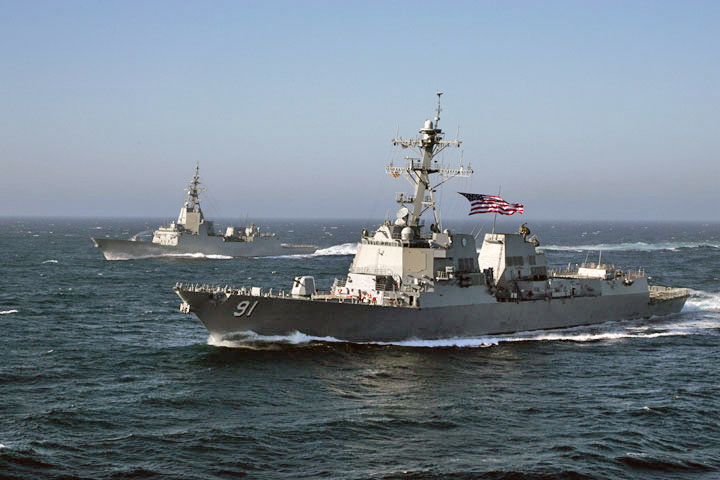
USS Pinckney in 2007
History
United States
NamePinckney
NamesakeWilliam Pinckney
Ordered6 March 1998
BuilderIngalls Shipbuilding
Laid down16 July 2001
Launched26 June 2002
Commissioned29 May 2004
Home portSan Diego
Identification
MottoProud to Serve
Honors and
awards
See Awards
Statusin active service
Badge
General characteristics
Class & typeArleigh Burke-class destroyer
Displacement9,200 long tons (9,300 t)
Length509 ft 6 in (155.30 m)
Beam66 ft (20 m)
Draft31 ft (9.4 m)
Propulsion4 × General Electric LM2500-30 gas turbines, 2 shafts, 100,000 shp (75 MW)
Speed>30 kn (56 km/h; 35 mph)
Complement380 officers and enlisted
Electronic warfare
& decoys
SLQ-32(V)7 (SEWIP Block 3)
Armament
Aircraft carried2 × MH-60R Seahawk helicopters

USS Pinckney (DDG-91) is an Arleigh Burke-class (Flight IIA) Aegis guided missile destroyer in the United States Navy. She is named for African American Ship's Cook First Class William Pinckney (1915–1976),[1] who received the Navy Cross for his courageous rescue of a fellow crewmember on board the aircraft carrier Enterprise (CV-6) during the Battle of Santa Cruz.

Pinckney was laid down on 16 July 2001 by Ingalls Shipbuilding, at Pascagoula, Mississippi; launched on 26 June 2002; and commissioned on 29 May 2004 at Naval Construction Battalion Center Port Hueneme. She is the first Arleigh Burke-class destroyer to be equipped with the AN/SPY-1D(V) Littoral Warfare Radar upgrade, which was fitted to all subsequent Flight IIA Arleigh Burkes.[2]

As of January 2018, Pinckney is homeported at NS San Diego, and assigned to Destroyer Squadron 23.[3]

Service history

[edit]
Pinckney and USCGC Northland train in the Pacific, April 2020

Pinckney made her maiden deployment September 2005. During this deployment, she made port visits to Guam, Singapore, Australia, Fiji and Hawaii. During this deployment, Pinckney became the first ever guided missile destroyer to refuel and replenish the Mark Five (MK V) high-performance combatant craft. She returned home after five months underway on 24 February 2006.[4]

On 16 February 2007, Pinckney was awarded the 2006 Battle "E" award.[5]

Pinckney departed San Diego on 2 April 2007 along with the aircraft carrier USS Nimitz for a 6-month deployment. She returned home on 30 September 2007.[6]

On 8 March 2014, Pinckney was diverted from a training mission in the South China Sea, to the southern coast of Vietnam, to help search for the missing Malaysia Airlines Flight 370.[7]

On November 7 2023, Pinckney was spotted in the San Diego harbor en-route to sea trials with the SEWIP Block 3 EW suite fitted to both sides of her superstructure after spending two years docked at the General Dynamics NASSCO shipyard in the San Diego Harbor.[8][9][10][11]

In March 2025, Pinckney participated in Flight Test Other-40 (FTX-40), codenamed Stellar Banshee, in which a virtualized SM-6 Block IAU interceptor was tested against a live multi-stage MRBM test target that utilized a new and previously untested type of hypersonic warhead, designated HTV-1.[12] The threat missile was air-launched by parachute drop from a C-17 Globemaster III transport, and was successfully detected and tracked by Pickney, though no actual physical interceptor missile was fired. The test validated a variety of systems, including modern hypersonic missile tracking satellites, the Block IAU version of SM-6, and the ability of the Aegis Weapon System to track hypersonic targets, and a new type of hypersonic test target.[13]

Deployments

[edit]
  • September 2005-24 February 2006 Maiden deployment[4]
  • 2 April 2007 – 30 September 2007 Western Pacific
  • 17 January 2020 – 5 October 2020 4th fleet

Awards

[edit]

Coat of arms

[edit]
Shield

Gules, on a grid shaped as an Aegis shield Sable the head of a trident issuing from base Argent (Silver Gray); overall a bald eagle's head erased Proper.

Gules (Scarlet) denotes courage and sacrifice. The black grid shaped like an Aegis shield refers to the destroyer class to which the Pinckney belongs and its state-of-the-art equipment and armament. It also suggests a mess grill, symbolizing the duties of William Pinckney as Navy Cook Third Class aboard the USS Enterprise at the time of his heroic act in saving his shipmate. The trident symbolizes authority at sea. The eagle's head denotes vigilance, resolve and seagoing defense of the United States. White (Argent) indicates integrity; black (Sable) signifies strength and fortitude.

Crest

On a wreath Argent and Gules a laurel wreath Proper surmounted by a demi-compass rose Celeste; overall a stylized Navy Cross.

The Navy Cross indicates the award for heroism made to William Pinckney for his exemplary actions under fire in saving the life of a fellow sailor during the battle of Santa Cruz. The compass-rose signifies navigational expertise and global action during World War II. The wreath of laurel represents honor and achievement.[16]

Motto

A scroll Azure fimbriated and inscribed "PROUD TO SERVE".

Seal

The arms as blazoned in full color upon a white oval enclosed within a dark blue collar edged on the outside with a gold chain of ninety-one links and one locking link (a canting reference to the ship's designation as DDG 91) with the name "USS PINCKNEY" above and "DDG 91" below in gold letters.

References

[edit]
[edit]
Revisions and contributorsEdit on WikipediaRead on Wikipedia
from Grokipedia
USS Pinckney (DDG-91) is an Arleigh Burke-class of the Flight IIA variant serving in the United States . Named for Navy Cook Third Class William Pinckney, an African American sailor who earned the for heroism during , the ship was built by in . Commissioned on May 29, 2004, at , Pinckney is homeported at and operates under the U.S. Pacific Fleet as part of 3. The namesake, William Pinckney, demonstrated extraordinary courage on October 26, 1942, during the Battle of the Santa Cruz Islands aboard USS Enterprise (CV-6). When an explosion in an ammunition handling room left a fellow sailor unconscious amid flames, smoke, and gasoline fumes, Pinckney entered the compartment and carried the man to safety through a hatch, saving his life at great personal risk. For this act, he was awarded the and , becoming one of only four to receive the in . Pinckney's motto, "Proud to Serve," reflects the legacy of resilience and service embodied by its namesake. Since entering service, Pinckney has conducted multiple deployments supporting U.S. national security interests in the and regions. In 2007, the destroyer deployed with the to the western Pacific and , participating in multinational exercises such as Valiant Shield 2007, the largest joint exercise in recent history at the time, involving 30 ships and over 22,000 personnel. Subsequent deployments included a 2017 six-month operation in the U.S. 7th Fleet, with port visits to , , , and , enhancing partnerships and . In 2020, Pinckney completed a nearly nine-month extended deployment focused on and presence operations. More recently, in March 2025, the ship participated in Flight Test Other-40 (FTX-40), codenamed Stellar , successfully testing a virtual SM-6 Block IAU variant. Equipped with combat systems, vertical launch systems for missiles, and advanced sensors, Pinckney plays a critical role in multi-mission capabilities including air defense, , and defense.

Namesake and Background

Namesake

William Pinckney was born on April 27, 1915, in Dale, South Carolina, to parents Renty and Jenny Pinckney. As an African American from a rural background, he enlisted in the United States Navy on August 3, 1938, seeking broader opportunities, and completed boot camp at Naval Station Great Lakes, Illinois. He was assigned as a ship's cook third class aboard the aircraft carrier USS Enterprise (CV-6), where he served during the early stages of World War II. Pinckney's heroism was demonstrated on October 26, 1942, during the Battle of the Santa Cruz Islands, when Japanese aircraft struck the Enterprise with two 550-pound bombs, causing extensive damage and killing 44 crew members while wounding 75 others. At his battle station in an ammunition handling room below the hangar deck, Pinckney was knocked unconscious by the explosion that wrecked several compartments and killed four of his five comrades. Regaining consciousness amid flames and smoke, he navigated through the burning wreckage to an open hangar deck hatch, where he discovered a surviving shipmate who had collapsed from wounds and . Despite his own injuries, Pinckney hoisted the unconscious man to safety before escaping the compartment himself. For this act of extraordinary heroism and devotion to duty, he was awarded the , the second African American to receive the honor during and one of only four overall. He also received . Following the battle, Pinckney was evacuated to for treatment of shrapnel wounds and third-degree burns sustained in the explosion. He spent the remainder of his eight-year naval enlistment at , , before being honorably discharged in 1946. After leaving the service, Pinckney returned to civilian life in , where he worked as a cook on Merchant Marine vessels. He passed away on July 21, 1976, at his home after battling spinal cancer for two years and is buried at . Pinckney's legacy endures as a symbol of and service, particularly for African American sailors facing segregation in the pre-civil Navy. When reflecting on his experiences, he often became emotional, stating simply that he was "proud to serve," a phrase that became the motto of the USS Pinckney upon its naming in his honor during a 2002 ceremony.

Ship Class and Capabilities

The Arleigh Burke-class destroyers represent a cornerstone of the U.S. Navy's surface fleet, designed as multi-mission platforms capable of conducting anti-air warfare (AAW), (ASW), (ASuW), and strike warfare operations. These guided-missile destroyers integrate advanced sensors and weapons to provide layered defense for carrier strike groups and independent , drawing on a hull form that incorporates propulsion elements from the earlier Spruance-class while emphasizing survivability through stealth features and compartmentalization. USS Pinckney (DDG-91) belongs to the Flight IIA variant of this class, which features enhanced capabilities over earlier flights, including increased displacement of approximately 9,200 long tons at full load, a length of 509 feet 6 inches, a beam of 66 feet, a draft of 31 feet, a maximum speed exceeding 30 knots, and a complement of about 380 personnel including air detachment. These specifications enable greater and support, with hangars for two SH-60 Seahawk helicopters for ASW and search-and-rescue roles. The Flight IIA's larger size and refined power plant—four LM2500-30 gas turbines—support extended deployments while maintaining high maneuverability in diverse maritime environments. A distinctive feature of USS Pinckney is its status as the first Arleigh Burke-class destroyer equipped with the AN/SPY-1D(V) Littoral Warfare , an upgrade to the standard SPY-1D system that improves performance in coastal and near-shore operations by enhancing clutter rejection and electronic counter-countermeasure capabilities. This radar variant, integrated into the Aegis Weapon System, allows for more effective detection and tracking of low-altitude threats amid littoral interference, marking a significant advancement for operations in confined waters. Pinckney's armament underscores its versatile combat role, featuring 96-cell Mk 41 Vertical Launching Systems (VLS) capable of deploying land-attack cruise missiles for long-range strikes, SM-2, SM-3, and SM-6 surface-to-air missiles for air and defense, and Vertical Launch Anti-Submarine Rockets (VLA) for ASW. Additional weaponry includes Mk 46 or Mk 50 torpedoes from two triple-tube Mk 32 launchers, a 5-inch/54-caliber Mk 45 gun for surface engagements, anti-ship missiles, and Close-In Weapon Systems (CIWS) for point defense. The integration of the with these elements enables simultaneous engagement of multiple threats, supported by for networked warfare. As an -guided missile , USS Pinckney plays a critical role in the U.S. Navy's for fleet defense, defense, and global , often serving as a forward-deployed asset to deter aggression and support allied operations in high-threat areas.

Construction and Commissioning

Construction Process

The contract for USS Pinckney (DDG-91) was awarded on March 6, 1998, as part of the U.S. Navy's Arleigh Burke-class program to enhance multi-mission surface combat capabilities. Construction took place at in , a facility known for building advanced guided-missile destroyers with integrated combat systems. The was laid down on July 16, 2001, marking the formal start of hull assembly using modular construction techniques that allowed for efficient integration of the ship's steel and internal compartments. The ship was launched on June 26, 2002, from a floating drydock, with Ms. Henrietta Middleton Pinckney, widow of the ship's namesake Cook First Class William Pinckney, serving as sponsor during the christening ceremony. A key innovation during construction was the integration of the AN/SPY-1D(V) radar, the first such installation on an Arleigh Burke-class , which improved performance through enhanced clutter rejection and adaptive modes without requiring major redesigns. This upgrade was incorporated directly into the build process starting with Pinckney, setting the standard for subsequent Flight IIA ships. Following launch, the ship entered a multi-year outfitting phase where weapons systems, , and electronics were installed and tested dockside to ensure compliance with specifications. Pre-commissioning activities included builder's sea trials, during which the vessel demonstrated operational readiness before final acceptance by the . These trials confirmed the ship's structural integrity and system .

Commissioning Ceremony

The USS Pinckney (DDG-91) was officially commissioned into the on May 29, 2004, during a held at 11 a.m. at Wharf 3, , . The event marked the ship's formal activation as a combat-ready unit, with approximately 334 sailors in dress whites manning the railings in a traditional display of readiness. The principal address was delivered by the Honorable John J. Young Jr., for Research, Development and Acquisition, who emphasized the destroyer's advanced and its role in enhancing naval capabilities. Symbolic elements included the playing of "" by the band and the ship's adoption of the motto "Proud to Serve," reflecting the humility of its namesake, Navy Cook First Class William Pinckney. Henrietta Middleton Pinckney, the widow of the ship's , served as sponsor and delivered the commissioning directive, ordering the to "man our ship and bring her to life!" Her participation, along with other family members and descendants of sailors connected to William Pinckney's heroism, underscored the ceremony's ties to his Navy Cross-awarded legacy of courage during . Robert M. Byron assumed duties as the first , leading a diverse drawn from 46 states and several countries. The commissioning highlighted the 's formation as a cohesive unit, prepared for operational service. Following the ceremony, Pinckney transited from Port Hueneme to its initial homeport at Naval Station , , departing on June 17, 2004. The ship then conducted shakedown cruises and trials to test systems and train the crew, ensuring full integration into the Pacific Fleet as an Arleigh Burke-class . These activities finalized the vessel's readiness for fleet operations under Commander, Naval Surface Force, U.S. Pacific Fleet.

Operational History

Maiden and Early Deployments

Following its commissioning on May 29, 2004, USS Pinckney (DDG-91) underwent post-delivery shakedown and basic unit-level certifications in the Pacific Fleet through 2004 and 2005, preparing the crew for operational readiness. These workups included initial sea trials and integrated training to validate the ship's Arleigh Burke-class systems and capabilities. The ship's maiden deployment began in September 2005 as part of the Nimitz Carrier Strike Group, operating in the Western Pacific and South Pacific until returning to on February 24, 2006. During this five-month voyage, Pinckney made port visits to in , , and in , , and in , fostering bilateral naval engagements. A notable achievement occurred in , where Pinckney became the first to refuel and replenish a at sea, demonstrating enhanced support for high-speed combatant vessels. The deployment also featured embarked assets, including two HH-60H Seahawk helicopters, Marine Corps Fleet Antiterrorism Security Team personnel, and a surgical team for an afloat forward staging base exercise in support of the global war on terrorism. Pinckney's second deployment commenced on April 2, 2007, alongside and the aircraft carrier USS Nimitz (CVN-68), focusing on the Western Pacific and U.S. Central Command area of responsibility until September 30, 2007. Ports visited included , India, and , , where the ship participated in bilateral exercises such as Cooperation Afloat Readiness and Training (CARAT) 2007 Phase IV. Under the command of Cmdr. Chris Peterschmidt, Pinckney contributed to multinational operations, including Valiant Shield 2007 off , emphasizing coalition interoperability. Throughout these early deployments, Pinckney conducted routine operations such as fleet exercises, patrols, and bilateral engagements to promote regional stability and . The ship's was utilized in these exercises to enhance capabilities.

Mid-Career Operations

Following its early deployments, USS Pinckney maintained a robust operational in the Pacific Fleet from 2008 to 2019, conducting multiple rotations to support carrier strike groups and enhance . In 2009, the destroyer departed for an eight-month western Pacific and deployment as part of the Nimitz , focusing on theater security cooperation and presence missions across the U.S. 5th and 7th Fleet areas of responsibility. Similarly, in 2011, Pinckney joined the for a seven-month deployment to the western Pacific and Arabian Gulf, where it contributed to counter-piracy efforts as part of , including the disruption of a suspected pirate group south of on December 19. The ship also participated in multinational exercises, such as the 2016 Rim of the Pacific (RIMPAC) exercise off , honing interoperability with allied navies through simulated combat scenarios involving air defense and . In 2017, Pinckney deployed for six months with the Nimitz , engaging in operations across the , including Exercise Malabar with , , and in the to strengthen regional partnerships. These deployments underscored the destroyer's role in routine patrols, anti-piracy operations, and joint training to deter threats and ensure open sea lanes. Between deployments, USS Pinckney conducted essential homeport operations at , including regular maintenance cycles and training evolutions to sustain readiness. Following its deployment, the ship entered a three-month Selected Restricted in April 2012 for upgrades and repairs, followed by combat systems assessments and ammunition onload at local facilities like . In 2015, Pinckney underwent a Docking Selected Restricted at (NASSCO) in , addressing structural and systems enhancements before resuming operations. Routine training in the operating area, such as Composite Training Unit Exercise (COMPTUEX) in and post-maintenance drills in 2016, focused on crew proficiency in operations, damage control, and visit, board, search, and seizure tactics. These intervals also included community outreach, like hosting civilian leaders during the Leaders to Sea program in March 2008, fostering public understanding of naval roles. The ship's persistent presence in the during this period bolstered U.S. commitments to regional security, countering coercive influences through forward operations and principles inherent in its patrols and exercises. By operating routinely in contested areas like the and , Pinckney helped maintain stability and deter aggression, aligning with broader Navy strategies for a . Crew rotations and command changes supported this continuity; for instance, Cmdr. Errin P. Armstrong assumed command in May 2009, followed by Cmdr. Ryan J. Blazevich in February 2015 and Cmdr. Benjamin W. Oakes in January 2018, each leading through successive cycles of deployment and upkeep to preserve operational effectiveness. These mid-career activities built momentum toward the ship's extended 2020 deployment spanning the U.S. Fourth and Seventh Fleets.

Notable Incidents and Missions

On March 8, 2014, USS Pinckney was diverted from its routine operations to the southern waters off , specifically the , to assist in the multinational search for , which had disappeared earlier that day with 239 people on board. The , equipped with MH-60R Seahawk helicopters, conducted aerial search patterns and coordinated with international assets, including Australian and Malaysian forces, covering thousands of square miles in the initial phase of the effort. Pinckney remained active in the search until March 13, when it was redirected to other duties as the focus shifted southward toward the . In support of counter-terrorism operations, USS Pinckney participated in during its 2011-2012 deployment to the U.S. 5th Fleet area. On December 19, 2011, the ship's and boarding team disrupted a suspected pirate attack on the tanker MV Nordic Apollo in the south of , forcing the pirates to discard their weapons and flee, thereby protecting merchant shipping in a high-risk corridor. This action contributed to broader multinational efforts to counter linked to regional instability and . From January 17 to October 5, 2020, USS Pinckney deployed to the U.S. 7th and 4th Fleet areas of operations, focusing on counter-narcotics interdictions in partnership with the and Joint Interagency Task Force South. The ship conducted multiple vessel boardings, seizing over 9,800 kilograms of and 1,270 kilograms of marijuana with a wholesale value exceeding $720 million, including a notable operation that netted more than $28 million in from a self-propelled . Additionally, the deployment included humanitarian support missions, such as operations challenging excessive maritime claims by on July 15, 2020, to uphold and regional stability. Following the 2020 deployment, USS Pinckney underwent maintenance periods, including a Selected Restricted Availability and systems upgrades. In 2024, the ship completed the first phase of its DDG Modernization 2.0 upgrade, enhancing combat capabilities with advanced electronics and weapons systems. As of August 2025, Pinckney is operating with in the , conducting routine operations and training exercises.

Modernization and Recent Developments

Upgrades and Refits

Following its commissioning in 2004, USS Pinckney (DDG-91) has undergone scheduled maintenance cycles at dry docks in , , to ensure operational readiness and incorporate incremental improvements. These overhauls, beginning around 2008 as part of standard Arleigh Burke-class sustainment, have included hull, mechanical, and electrical repairs, as well as selected restricted availabilities for refreshes. For instance, after a 2014 deployment to the Western Pacific, the ship entered a dry-docking selected restricted availability in to address wear from extended operations. In 2021, NASSCO received a $121 million for comprehensive maintenance, modernization, and repairs on Pinckney, focusing on combat systems and engineering upgrades during a multi-month availability at the San Diego facility. A major milestone came during the ship's Depot Modernization Period (DMP) from 2021 to 2023 at NASSCO in , a two-year effort under the DDG MOD 2.0 program valued at over $121 million for this phase. This refit installed the AN/SLQ-32(V)7 Surface Electronic Warfare Improvement Program (SEWIP) Block 3 system, making Pinckney the first Arleigh Burke-class Flight IIA to receive this upgrade. The SEWIP Block 3 enhances electronic warfare capabilities with advanced passive detection, multi-target electronic attacks, and radar jamming to counter sophisticated threats, including anti-ship missiles from peer adversaries. Visible changes included the addition of large sponsons—each approximately 22 feet tall—on both sides of the to house the system's antennas, significantly altering the ship's profile. Other refits during mid-life extensions have integrated updates to support the ship's Aegis combat system, such as radar enhancements and combat management software refreshes, without altering core missile launchers. The 2023 DMP also encompassed broader hull, mechanical, and engineering work alongside the SEWIP installation, ensuring compatibility with existing vertical launch systems for missiles like the SM-6 and Tomahawk. These modifications were completed when Pinckney emerged from the shipyard on November 7, 2023, allowing a swift return to fleet operations. Post-refit, the ship conducted sea trials and at-sea testing to certify the upgrades, restoring full readiness for surface warfare tasks and bolstering its role in integrated air and missile defense.

Advanced Testing and Capabilities

In March 2025, USS Pinckney participated in Other-40 (FTX-40), also known as Stellar Banshee, conducted off the coast of Kauai, , where it successfully detected, tracked, and simulated engagement against a hypersonic target using its upgraded capabilities. This test, a collaboration between the and the U.S. Navy, validated the ship's ability to counter advanced maneuvering hypersonic threats in a realistic operational environment. Following its integration of the SEWIP Block 3 upgrade, USS Pinckney underwent validation testing in 2025 to confirm enhanced detection and electronic attack countermeasures against hypersonic and radio frequency-guided threats, including jamming of enemy targeting radars and missile guidance systems. These evaluations demonstrated improved signal analysis and threat warning for anti-ship missiles, building on the system's technology. In July 2025, Pinckney participated in At-Sea Demonstration 3 with the National Space Defense Center, demonstrating defense and capabilities in coordination with U.S. Space Command. As part of post-2023 refit certifications extending into 2025, USS Pinckney completed sea trials and weapon system qualifications, focusing on operational validation of upgraded systems in fleet conditions. These ongoing efforts ensure the ship's readiness for missions. The successful outcomes from these tests position USS Pinckney as a key asset in the U.S. Navy's evolving hypersonic defense strategies as of 2025, contributing to broader advancements in countering peer adversary threats through enhanced and electronic warfare integration.

Awards and Insignia

Unit Awards

The USS Pinckney (DDG-91) earned the Battle Efficiency "E" on February 16, 2007, recognizing the 's superior performance during 2006 operations, including excellence in and mission accomplishment as part of the ship's maiden deployment. This unit award, presented annually to ships and squadrons, evaluates performance across key areas such as , air warfare, undersea warfare, mobility, and , with recipients demonstrating proficiency in at least four of five categories. The commendation was highlighted during a recognition event honoring the entire for their contributions to operational efficiency. In addition to the 2006 award, Pinckney received another Battle "E" in 2017 for outstanding battle effectiveness achieved in 2016, reflecting sustained high standards in warfare excellence and crew preparedness during operations. The criteria for this iteration emphasized the ship's ability to execute missions in dynamic environments, including and . The crew of Pinckney qualified for the Global War on Terrorism Expeditionary Medal based on the ship's 2007 deployment to the U.S. 5th Fleet area, where it supported counter-terrorism operations from to 2007. This , authorized for service in designated combat zones or contiguous waters for 30 consecutive days or 60 non-consecutive days after , 2001, acknowledges participation in direct support of global counter-terrorism efforts. Similar eligibility extended to subsequent deployments, such as those in 2011-2013, potentially earning campaign stars for multiple periods of service. Pinckney has earned additional unit awards, including the for deployments from July 2009 to March 2010, September 2011 to January 2012, and July 2012 to May 2013; the for operations from December 10-21, 2011; and multiple Sea Service Deployment Ribbons for periods including 2005-2006, 2007-2008, 2011-2013, and 2017.

Coat of Arms

The coat of arms of USS Pinckney (DDG-91) features a shield on a scarlet (gules) field, symbolizing courage and sacrifice, with a black grid shaped as an shield representing the destroyer's advanced defense capabilities and the namesake's service as a cook aboard USS Enterprise. Issuing from the base is a silver-gray head denoting and authority, while an overall bald eagle's head erased proper signifies vigilance and defensive resolve. White elements indicate integrity, and black conveys strength and fortitude. The crest, mounted on a wreath of white and scarlet, includes a proper for victory and honor, surmounted by a demi-compass rose in (celeste) symbolizing navigational expertise and global reach. Over all is a stylized , honoring the heroism of the ship's namesake, William Pinckney, who received the award for his actions during the Battle of the Santa Cruz Islands. A blue (azure) scroll fimbriated bears the motto "PROUD TO SERVE," reflecting the ethos of dedicated naval service. The full seal displays the blazoned arms in color upon a white oval, enclosed by a dark blue collar edged with a gold chain of ninety-one links signifying the hull number DDG-91, with "USS PINCKNEY" arched above and "DDG 91" below in gold lettering. Designed in accordance with naval heraldry standards, the coat of arms is used in official ceremonies, publications, and command identifications.

References

Add your contribution
Related Hubs
User Avatar
No comments yet.