


Community hub
Recent from talks
Contribute something
Nothing was collected or created yet.
Cliff Edwards
View on Wikipedia | This article includes a list of general references, but it lacks sufficient corresponding inline citations. (August 2019) |
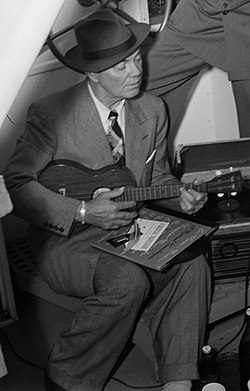
Clifton Avon "Cliff" Edwards (June 14, 1895 – July 17, 1971), nicknamed "Ukulele Ike"[1], was an American pop singer, musician and actor. He enjoyed considerable popularity in the 1920s and early 1930s, specializing in jazzy renditions of pop standards and novelty tunes, including "Singin' in the Rain" in 1929. Later in his career, he appeared in films and did voices for animated cartoons, and is well-remembered as the voice of Jiminy Cricket in Walt Disney's Pinocchio (1940)[2] (introducing the standard "When You Wish Upon a Star") and Fun and Fancy Free (1947), and Dandy Crow in Walt Disney's Dumbo (1941).[3]
Key Information


Early life and musical career
[edit]Edwards was born in Hannibal, Missouri. He left school at age 14 and soon moved to St. Louis, Missouri, and Saint Charles, Missouri, where he entertained as a singer in saloons. As many places had pianos in bad shape or none at all, Edwards taught himself to play ʻukulele to serve as his own accompanist (choosing it because it was the cheapest instrument in the music shop). He was nicknamed "Ukulele Ike" by a club owner who could never remember his name. He got his first break in 1918 at the Arsonia Cafe in Chicago, Illinois, where he performed a song called "Ja-Da", written by the club's pianist, Bob Carleton. Edwards and Carleton made it a hit on the vaudeville circuit. Vaudeville headliner Joe Frisco hired Edwards as part of his act, which was featured at the Palace in New York City—the most prestigious vaudeville theater—and later in the Ziegfeld Follies.[4] [5]
Edwards made his first phonograph records in 1919. He recorded early examples of jazz scat singing in 1922. The following year he signed a contract with Pathé Records. He became one of the most popular singers of the 1920s, appearing in several Broadway shows. He recorded many of the pop and novelty hits of the day, including "California, Here I Come", "Hard Hearted Hannah", "Yes Sir, That's My Baby", and "I'll See You in My Dreams". Some of the labels of Edwards' early recordings identify him as "Ukelele Ike," a then common misspelling of "ukulele."
In 1924, Edwards performed as the headliner at the Palace, the pinnacle of his vaudeville success. That year he also featured in George and Ira Gershwin's first Broadway musical Lady Be Good, alongside Fred and Adele Astaire. As a recording artist, his hits included "Paddlin’ Madeleine Home" (1925), "I Can't Give You Anything but Love" (1928), and the classic "Singin' in the Rain" (1929), which he introduced. Edwards's own compositions included "(I'm Cryin' 'Cause I Know I'm) Losing You", "You're So Cute (Mama o' Mine)", "Little Somebody of Mine", and "I Want to Call You 'Sweet Mama'". He also recorded a few "off-color" novelty songs for under-the-counter sales, including "I'm a Bear in a Lady's Boudoir", "Mr. Insurance Man", and "Give It to Mary with Love".
Edwards, more than any other performer, was responsible for the soaring popularity of the ʻukulele.[6] Millions of ʻukuleles were sold during the decade, and Tin Pan Alley publishers added ʻukulele chords to standard sheet music. Edwards always played American Martin ukuleles, favoring the small soprano model in his early career. In his later years, he moved to the larger tenor ʻukulele, which was becoming popular in the 1930s.
Edwards continued to record until shortly before his death in 1971. His last record album, Ukulele Ike, was released posthumously on the independent Glendale label. He reprised many of his 1920s hits; his failing health was however evident in the recordings.[7]
Film, radio, and television
[edit]In 1929, Cliff Edwards was playing at the Orpheum Theater in Los Angeles where he caught the attention of movie producer-director Irving Thalberg. His film company Metro-Goldwyn-Mayer hired Edwards to appear in early sound movies. After performing in some short films, Edwards was one of the stars in the feature The Hollywood Revue of 1929, doing some comic bits and singing some numbers, including the film debut of his hit "Singin' in the Rain". He appeared in a total of 33 films for MGM through 1933. He had a small role as Mike, playing a ʻukulele very briefly at the beginning of the 1931 movie Laughing Sinners (1931), starring Joan Crawford.
Edwards had a friendly working relationship with MGM's comedy star Buster Keaton, who featured Edwards in three of his films. Keaton, himself a former vaudevillian, enjoyed singing and harmonized with Edwards between takes. One of these casual jam sessions was captured on film, in Doughboys (1930), in which Keaton and Edwards scat-sing their way through "You Never Did That Before".
Edwards was also an occasional supporting player in feature films and short subjects at Warner Bros. and RKO Radio Pictures. He played a wisecracking sidekick to Western star George O'Brien, and he filled in for Allen Jenkins as "Goldie" opposite Tom Conway in The Falcon Strikes Back. In a 1940 short, he led a cowboy chorus in Cliff Edwards and His Buckaroos. Throughout the 1940s he appeared in a number of "B" Westerns playing the comic, singing sidekick to the hero, seven times with Charles Starrett and six with Tim Holt.
| External image | |
|---|---|
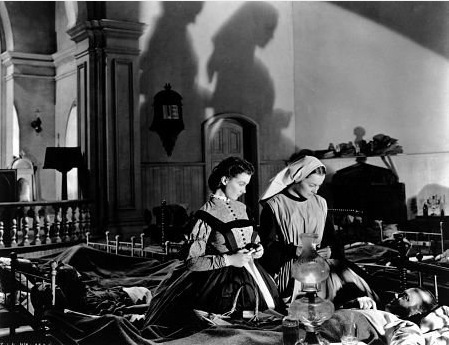
 Cliff Edwards as a wounded soldier in Gone With the Wind (1939), with Vivien Leigh and Olivia de Havilland. (In the final film, Edwards is not visible.) Cliff Edwards as a wounded soldier in Gone With the Wind (1939), with Vivien Leigh and Olivia de Havilland. (In the final film, Edwards is not visible.) |
Edwards appeared in the darkly sardonic Western comedy The Bad Man of Brimstone (1937), and he played the character "Endicott" in the screwball comedy film His Girl Friday (1940). In 1939, he voiced the off-screen wounded Confederate soldier in Gone with the Wind in a hospital scene with Vivien Leigh and Olivia de Havilland.
His most famous voice role was as Jiminy Cricket in Walt Disney's Pinocchio (1940), where he sings "Give a Little Whistle" and "When You Wish Upon a Star". Edwards's rendition of "When You Wish Upon a Star" is probably his most familiar recorded legacy. He voiced the head crow in Disney's Dumbo (1941) and sang "When I See an Elephant Fly".
In 1932, Edwards had his first national radio show on CBS Radio. He continued hosting network radio shows through 1946. In the early 1930s, however, Edwards' popularity faded as public taste shifted to crooners such as Russ Columbo, Rudy Vallee, and Bing Crosby.
Arthur Godfrey's use of the ʻukulele spurred a surge in its popularity and those that played it, including Edwards. Like many vaudeville stars, Edwards was an early arrival on television. In the 1949 season, he starred in The Cliff Edwards Show, a three-days-a-week (Monday, Wednesday, and Friday evenings) TV variety show on CBS. In the 1950s and early 1960s, he made appearances on The Mickey Mouse Club, in addition to performing his Jiminy Cricket voice for various Disney shorts and the Disney Christmas spectacular, From All of Us to All of You.[8]
Personal life
[edit]Edwards was careless with the money he made in the 1920s, always trying to sustain his expensive habits and lifestyle. He continued working during the Great Depression, but never again enjoyed his former prosperity. Most of his income went to alimony for his three former wives, and paying debts, and he declared bankruptcy four times during the 1930s and early 1940s. Edwards married his first wife Gertrude (Benson) Ryrholm in 1917. Their marriage ended in divorce four years later.[9] He married Irene Wylie in 1923; they divorced in 1931. In 1932, he married his third and final wife, actress Judith Barrett.[10] They divorced in 1936.[10]
As well as being a lifelong heavy tobacco smoker,[11] Edwards also was an alcoholic, a drug addict and a gambler for much of his career.[12]

Later years and death
[edit]In his final years, Edwards lived in a home for indigent actors and often spent his time at the Walt Disney Studios to be available any time he could get voice work. He was sometimes taken to lunch by animators whom he befriended and told stories of his days in vaudeville.
Edwards died on July 17, 1971, at the age of 76 from a cardiac arrest brought on by arteriosclerosis.[13] At the time of his death, Edwards was a penniless charity patient at the Virgil Convalescent Hospital in Hollywood, California. His body was unclaimed and was donated to the University of California, Los Angeles medical school. When Walt Disney Productions, which had been quietly paying many of his medical expenses, discovered this, they offered to purchase his remains and pay for the burial[14]. Instead, it was done by the Actors' Fund of America (which had also aided Edwards) and the Motion Picture and Television Relief Fund. Disney paid for his grave marker.[15]
Honors
[edit] |
In 2000, Edwards was awarded as a Disney Legend for voice-acting. In 2002, Edwards' 1940 recording on Victor, Victor 26477, "When You Wish Upon a Star", was inducted into the Grammy Hall of Fame.
Compilation Discography
[edit]- Ukulele Ike Sings Again (Disneyland, 1956)
- A Day at Disneyland with Walt Disney and Jiminy Cricket (Disneyland, 1957)
- The Story of Walt Disney's Cinderella (Disneyland, 1957)
- Songs, Games & Fun (RCA Victor, 1958)
- I'm a Bear in a Lady's Boudoir (Yazoo, 1975)
- Ukulele Ike (Glendale, 1978)
- Cliff Edwards and His Hot Combination 1925–1926 (Retrieval, 1978)
- The Vintage Recordings of Cliff Edwards (Ukulele Ike) (Take Two, 1979)
- The Musical Score of The Wizard of Oz/The Song Hits from Walt Disney's Pinocchio (MCA, 1980)
- Ukulele Ike 1930's Radio Transcriptions: Live June 1947 (Collectors' Choice, 1996)
- I Did it With My Little Ukulele (Upbeat Jazz, 2013)
Partial filmography
[edit]- Marianne (1929) as Soapy
- So This Is College (1929) as Windy
- The Hollywood Revue of 1929 (1929) as Himself
- They Learned About Women (1930) as Singer in Harlem Madness number (uncredited)
- Lord Byron of Broadway (1930) as Joe
- Crazy House (1930, Short) as Writer
- Doughboys (1930) as Nescopeck
- Montana Moon (1930) as Froggy
- Children of Pleasure (1930) as Cliff - Radio Performer (uncredited)
- Way Out West (1930) as Trilby
- Good News (1930) as Kearney
- Those Three French Girls (1930) as Owly
- Remote Control (1930) as Hog Caller (uncredited)
- Dance, Fools, Dance (1931) as Bert Scranton
- The Prodigal (1931) as Snipe, a Tramp
- Parlor, Bedroom and Bath (1931) as Bell Hop
- Stepping Out (1931) as Paul Perkins
- Shipmates (1931) as Bilge
- Laughing Sinners (1931) as Mike
- The Great Lover (1931) as Finny
- Sidewalks of New York (1931) as Poggle
- The Sin of Madelon Claudet (1931) as Victor Lebeau
- Hell Divers (1931) as "Baldy"
- Young Bride (1932) as Pete
- Fast Life (1932) as Bumpy
- Flying Devils (1933) as 'Screwy' Edwards
- Take a Chance (1933) as Louie Webb
- George White's Scandals (1934) as Stew Hart
- George White's 1935 Scandals (1935) as Dude
- Red Salute (1935) as P.J. Rooney
- The Man I Marry (1936) as Jerry Ridgeway
- They Gave Him a Gun (1937) as Laro
- Between Two Women (1937) as Snoopy
- Saratoga (1937) as Tip
- Bad Guy (1937) as 'Hi-Line'
- The Women Men Marry (1937) as Jerry Little
- The Bad Man of Brimstone (1937) as 'Buzz' McCreedy
- Big City (1937)
- The Girl of the Golden West (1938) as Minstrel Joe
- The Little Adventuress (1938) as Handy
- Maisie (1939) as 'Shorty' Miller
- Smuggled Cargo (1939) as Professor
- Gone with the Wind (1939) as Reminiscent Soldier
- His Girl Friday (1940) as Reporter Endicott
- High School (1940) as Jeff Jefferson
- Pinocchio (1940) as Jiminy Cricket (voice, uncredited)
- Millionaires in Prison (1940) as Happy
- Flowing Gold (1940) as 'Hot Rocks' Harris
- Cliff Edwards and His Buckaroos (1940) as "Mr. Cliff" (Western short)
- Friendly Neighbors (1940) as Notes
- She Couldn't Say No (1940) as Banjo Page
- The Monster and the Girl (1941) as Leon Beecher 'Tips' Stokes
- Knockout (1941) as Pinky (credits) / Sleepy
- Power Dive (1941) as Squid Watkins
- International Squadron (1941) as Omaha McGrath
- Dumbo (1941) as Dandy Crow (voice, uncredited)
- West of Tombstone (1942) as Harmony Haines
- Sundown Jim (1942) as Stable proprietor
- Bandit Ranger (1942) as Ike
- Red River Robin Hood (1942) as Ike
- Seven Miles from Alcatraz (1942) as Stormy
- Pirates of the Prairie (1942) as Ike
- American Empire (1942) as Runty
- Der Fuehrer's Face (1943) as Nazi lead singer[16]
- Fighting Frontier (1943) as Ike
- Salute for Three (1943) as Foggy
- The Falcon Strikes Back (1943) as Goldie Locke
- Sagebrush Law (1943) as Ike
- The Avenging Rider (1943) as Ike
- Fun and Fancy Free (1947) as Jiminy Cricket (voice)
- Bat Masterson (1959) as AJ Mulvaney - Town Undertaker
- Platinum High School (1960) as Frank (uncredited)
- The Man from Button Willow (1965) as Doc / The Whip (voice, uncredited)
- That's Entertainment! (1974) as himself in clip from The Hollywood Revue of 1929
- Once Upon a Studio (2023) as Jiminy Cricket (voice, archive audio)
References
[edit]- ^ "Cliff Edwards - Biography". IMDb. Retrieved 2025-08-09.
- ^ "Pinocchio (film)". D23. Retrieved 2021-11-28.
- ^ "Dumbo (film)". D23. Retrieved 2021-11-28.
- ^ Tranquada, Jim (2012). The Ukulele: a History. University of Hawaii Press. pp. 121–3. ISBN 978-0-8248-3544-6.
- ^ Whitcomb, Ian (2012). Ukulele Heroes: The Golden Age. Milwaukee, Wisconsin: Hal Leonard Books. ISBN 978-1-4584-1654-4.
- ^ Tranquada, Jim (2012). The Ukulele: a History. University of Hawaii Press. pp. 122–3. ISBN 978-0-8248-3544-6.
- ^ Glendale Records GL-6011 LP, 1978
- ^ Tranquada, Jim (2012). The Ukulele: a History. University of Hawaii Press. p. 148. ISBN 978-0-8248-3544-6.
- ^ Cullen, Frank; Hackman, Florence; McNeilly, Donald (2007). Vaudeville old & new: an encyclopedia of variety performances in America. Psychology Press. p. 347. ISBN 978-0-415-93853-2.
- ^ a b "Judith Barrett Weds". The Brownsville Herald. Texas, Brownsville. Associated Press. March 23, 1940. p. 2. Retrieved July 12, 2017 – via Newspapers.com.

- ^ "Cliff Edwards: The Voice of Disney's Jiminy Cricket by David Soren | The American Vaudeville Museum". Vaudeville.sites.arizona.edu. Retrieved 25 August 2021.
- ^ "Disney's forgotten genius". Independent.ie. 12 May 2006. Retrieved 25 August 2021.
- ^ New York Times (July 22, 1971). "Cliff Edwards, 76, 'Ukulele Ike' Of Stage and Film, Dies on Coast". nytimes.com. Retrieved March 31, 2020.
- ^ "Cliff Edwards - Biography". IMDb. Retrieved 2025-08-09.
- ^ "Disney First Christmas Special". Tvparty.com. Retrieved 8 August 2019.
- ^ Scott, Keith (3 October 2022). Cartoon Voices of the Golden Age, Vol. 2. BearManor Media.

Further reading
[edit]- The Cliff Edwards Discography by Larry F. Kiner, Greenwood Press, New York, 1987. ISBN 0-313-25719-1 Contains a short biography, an extensive discography, and listing of his film, radio, and television appearances.
External links
[edit]

- Cliff Edwards at IMDb
- Cliff Edwards at the Internet Broadway Database
- Cliff Edwards extensive fan site by David Garrick
- Clifton Avon "Cliff" Edwards bio on ragtimepiano.com
- Cliff Edwards "Ukulele Ike" on RedHotJazz.com, with .ram files of his vintage recordings.

Cliff Edwards
View on GrokipediaEarly life
Childhood and family
Clifton Avon Edwards, known professionally as Cliff Edwards, was born on June 14, 1895, in Hannibal, Missouri, to Edward Edwards, a conductor on freight trains for the Missouri Pacific Railroad, and Nellie M. Edwards (née Farnum).[2][4] He was one of four children in the family, growing up in a modest household in the river town famously associated with Mark Twain.[2][5] In the early 1900s, the family faced severe financial hardship when Edward Edwards became too ill to work, prompting a relocation to St. Louis, Missouri, around 1909.[4][6] At approximately age 14, Edwards dropped out of school to contribute to the household, taking on odd jobs such as selling newspapers as a newsboy—often singing to attract customers—painting railroad freight cars, and laboring in a shoe factory.[4][6] These experiences amid poverty shaped his resilient early environment, exposing him to the working-class rhythms of Midwestern life. Edwards' initial foray into music occurred around 1916–1917, when he taught himself to play the ukulele on a borrowed instrument, drawn to its affordability and portability.[6] Influenced by local street performers, black blues and jazz musicians in Hannibal, and the burgeoning ragtime scene, he began incorporating the instrument into informal singing while working, honing a style that blended novelty vocals with rhythmic strumming.[4][6] This self-directed exposure laid the groundwork for his musical interests, though it remained separate from any formal pursuits at the time.Entry into entertainment
At the age of 14, following his father's illness and the family's financial struggles, Edwards left school and began working odd jobs in St. Louis, where he soon entered show business by singing in saloons and silent movie theaters to earn tips, often performing ragtime and popular songs while accompanying himself on the ukulele he had recently learned to play.[2][7][6] In 1917, Edwards moved to Chicago seeking better opportunities and secured his first significant nightclub engagement at the Arsonia Cafe on West Madison Street, where he entertained patrons by wandering table-to-table, singing and strumming his ukulele for tips.[2][7][6] There, he collaborated with the cafe's pianist, Bob Carleton, to perform Carleton's novelty tune "Ja-Da" (composed 1918), which quickly became a local sensation and helped Edwards refine his distinctive falsetto and scat-like "effin'" vocal style.[2][7][6] The club's staff, unable to consistently recall his real name, began calling him "Ukulele Ike" after his instrument—a moniker originating from a waiter named Spot—and Edwards adopted it as his stage persona to capitalize on its folksy appeal.[2][7][6] By 1918, Edwards transitioned into vaudeville, joining the act of headliner Joe Frisco, a stuttering comedian and dancer, and touring Midwest circuits while possibly appearing in the Ziegfeld Follies, where he honed his ukulele technique and novelty singing amid the era's fast-paced entertainment demands.[2][1][6] Later that year, after Frisco's act, he partnered with vocalist Pierce Keegan to form the duo Jazz Az Iz, further developing his playful, improvisational stage presence.[6][4] Edwards' recording career began in 1919 with sessions for Columbia Records in New York, where he cut several sides, including tracks like "Poor Little Butterfly Is a Fly Gal Now," though most were ultimately unissued; these efforts, alongside his live performances of "Ja-Da," marked his emergence as a pioneer of novelty jazz vocals and helped solidify his reputation in the industry.[2][5][1]Professional career
Vaudeville and musical rise
By the early 1920s, Cliff Edwards had risen to vaudeville stardom, headlining acts across the United States and touring with major orchestras, building on his ukulele novelty performances that earned him the nickname "Ukulele Ike."[1] His act combined ukulele playing with humorous songs and vocal improvisations, captivating audiences at top venues like the Palace Theatre in New York, where he performed as early as 1918 and achieved top billing by 1920.[1] This period marked the height of his live performance popularity, culminating in an appearance in the Ziegfeld Follies of 1927, where he showcased his versatile talents in lavish revues.[1] Edwards' musical style featured innovative use of falsetto and scat singing, techniques he pioneered in recordings as early as 1922, predating similar efforts by other artists like Louis Armstrong.[1] His signature "eefing"—a high-pitched, falsetto scat—added a playful, jazz-inflected energy to novelty tunes and pop standards, influencing the era's vocal jazz trends.[8] Key hits from this time included "Toot, Toot, Tootsie" in 1922, and "Singin' in the Rain" in 1929, each highlighting his lighthearted delivery and ukulele accompaniment.[9][10] His recording career peaked in the 1920s, with over 100 sides released for labels including Brunswick and Victor, capturing his rising fame through solo efforts and ensemble work.[11] Edwards formed his own group, Cliff Edwards and His Hot Combination, in the mid-1920s, producing jazz-oriented tracks with musicians like Joe Venuti and Eddie Lang that blended hot jazz rhythms with his vocal style.[12] These recordings, starting from his 1922 debut, solidified his status as a top-selling artist of the decade.[1] On Broadway, Edwards appeared in Lady Be Good (1924), where he introduced "Fascinating Rhythm" and stole scenes with his energetic performance, and Sunny (1925), further enhancing his stage reputation through song-and-dance numbers.[1] These roles, alongside his Ziegfeld commitments, positioned him as a leading entertainer in New York's theater scene, bridging vaudeville's improvisational flair with scripted musical comedy.[13]Film and stage roles
Cliff Edwards began his transition to film in the late 1920s amid the advent of sound cinema, marking a shift from his established stage and vaudeville performances to scripted screen roles. His major breakthrough came with the MGM all-star revue The Hollywood Revue of 1929, where he appeared as himself and delivered the film's Technicolor highlight by performing "Singin' in the Rain," introducing the standard to movie audiences for the first time.[14] This appearance capitalized on his ukulele expertise and jazzy vocal style, positioning him as a key figure in early musical talkies.[15] Securing a contract with MGM shortly thereafter, Edwards starred in over 30 films for the studio through 1933, often in lighthearted musical comedies that showcased his comedic timing and musical talents. Notable examples include Good News (1930), where he played the wisecracking Kearney O'Shea alongside Mary Lawlor, and Montana Moon (1930), portraying the affable Froggy in a Western musical romance with Joan Crawford. He also ventured into Paramount productions, co-starring as the bumbling singer in the comedy Half Shot at Sunrise (1930) with the popular duo Bert Wheeler and Robert Woolsey, contributing songs and slapstick to the film's wartime hijinks. These roles solidified his presence in Hollywood's burgeoning sound era, blending his stage-honed charisma with cinematic spectacle. In the mid-1930s, Edwards expanded into adaptations of his stage successes and character parts in diverse genres, reflecting the evolving demands of the industry. He reprised elements of his Broadway experience in the film version of George White's Scandals (1934), playing the entertaining Stew Hart in the Fox musical revue that echoed the Ziegfeld-style extravaganzas where he had previously shone, such as the 1927 Ziegfeld Follies. Other highlights included a supporting role in the MGM extravaganza Hollywood Party (1934), featuring Jimmy Durante, where Edwards performed novelty numbers amid the film's chaotic Hollywood satire. As leading musical roles diminished by the late 1930s due to shifting preferences toward more narrative-driven talkies, he took on character actor duties in prestige pictures like The Plainsman (1936), appearing as the comic-relief gambler in Cecil B. DeMille's epic Western starring Gary Cooper.[15] Overall, Edwards contributed to more than 50 films during this period, emphasizing his versatility across musicals, comedies, and Westerns while drawing from his theatrical roots in shows like Lady Be Good (1924), where he had introduced Gershwin's "Fascinating Rhythm" alongside the Astaires.[1]Radio, television, and voice acting
Cliff Edwards began his radio career in earnest during the early 1930s, hosting his first national program on CBS in 1932 and continuing to lead various network shows intermittently through 1946.[1] These broadcasts often featured his signature ukulele playing and "eefing"—a distinctive falsetto vocal technique that added a whimsical scat-like quality to his performances.[17] He frequently guested on popular programs such as The Rudy Vallee Show during the 1930s and The Harry Richman Show from 1934 to 1935, where his lighthearted musical numbers and comic timing endeared him to audiences across major networks.[18][19] Edwards maintained a steady presence on radio into the 1940s, appearing on numerous variety shows that capitalized on his vaudeville-honed charisma.[2] Edwards' voice acting career reached its pinnacle with his casting as Jiminy Cricket in Walt Disney's Pinocchio (1940), where he provided the character's warm, folksy narration and sang the iconic ballad "When You Wish Upon a Star," which won the Academy Award for Best Original Song.[3] His expressive delivery, blending spoken dialogue with melodic phrasing, brought moral guidance and charm to the animated conscience, making the role a defining highlight of his broadcast work.[1] He reprised Jiminy Cricket as a narrator in Fun and Fancy Free (1947), further solidifying his association with Disney animation.[3] Edwards also lent his voice to Jim Crow, one of the gossipy crows in Dumbo (1941), delivering the playful group song "When I See an Elephant Fly" with rhythmic eefing that enhanced the scene's lively humor.[18] Over the course of the 1940s and 1950s, he contributed voices to several Disney shorts and features, totaling appearances in at least three major animated films centered on his versatile vocal style.[2] Edwards transitioned to television in the late 1940s, starring as the host of The Cliff Edwards Show, a 15-minute variety program that aired on CBS from 1949 to 1950, showcasing his ukulele routines and songs in a format suited to the emerging medium.[18] He also served as a regular performer on the CBS variety series Fifty-Fourth Street Revue in 1949, where his energetic musical segments appealed to early TV viewers.[19] Throughout the 1950s, Edwards made guest appearances on programs like The Red Skelton Show, blending his radio-era appeal with visual performance.[17] His Disney ties extended to television, including voicing Jiminy Cricket for The Mickey Mouse Club of the Air on ABC from 1955 to 1959 and live guest spots on The Mickey Mouse Club, where he performed songs like "Give a Little Whistle" and interacted with child audiences, often receiving thousands of fan letters weekly.[19][2] These roles highlighted his enduring popularity in broadcast entertainment, particularly in family-oriented variety formats.[3]Personal life
Marriages and family
Cliff Edwards married his first wife, Gertrude Benson, in Chicago prior to 1919.[2] Their marriage ended in divorce in 1921 amid Edwards' rising performance schedule, which strained family life.[2] The couple had one son, Clifford Jr., born on February 13, 1919.[2] In May 1923, Edwards wed Irene Wylie, a dancer in the Ziegfeld Follies, during a tour stop in Portland, Oregon.[2] The union, marked by turbulence from Edwards' extensive touring commitments, dissolved in a highly publicized divorce in June 1931, with Wylie receiving all marital property and half of Edwards' future earnings.[2] No children were born to this marriage. Edwards' third marriage, to actress Judith Barrett (known professionally as Nancy Dover) in August 1932, proved brief and contentious, as Dover filed for back alimony within a month of the wedding.[2] The couple divorced in 1936, with no children from the relationship.[20] Following his divorces, Edwards had no further marriages, though he maintained brief companionships in later years.[21] He fathered only one biological child, his son from the first marriage.Health issues and finances
Cliff Edwards developed a pattern of substance abuse amid the excesses of 1920s Hollywood, where he reportedly began using cocaine in social circles that included chorus girls and high-stakes partying.[22] By the early 1930s, his addictions escalated to include heroin and morphine, compounded by heavy alcoholism and gambling, which led to unprofessional behavior on film sets and contributed to the cancellation of his lucrative MGM contract.[23][22] These habits persisted through the decade, with Edwards struggling against morphine dependency that affected his reliability in the industry.[24] Financially, Edwards' career peaks in vaudeville and early films enabled lavish expenditures on entertainment, investments, and gambling, but poor money management quickly eroded his wealth.[1] In March 1933, following the loss of his MGM deal, he filed for his first bankruptcy amid mounting debts from these indulgences.[23] He filed for bankruptcy again in 1941.[2] Ongoing tax problems with the IRS exacerbated his instability, culminating in a third bankruptcy in 1949, after which he lost key assets including his Hollywood home and saw his annual earnings plummet to just $5,000 that year.[1][2] Edwards' substance abuse took a severe toll on his health, manifesting in respiratory complications from lifelong heavy smoking alongside the physical deterioration from drugs and alcohol.[25]Later years
Post-war challenges
Following World War II, Cliff Edwards' once-prolific film career stagnated, with roles diminishing to supporting parts in low-budget Westerns, such as his appearance as a comic sidekick in the 1947 Monogram Pictures production Rainbow Over the Rockies, where he performed musical numbers alongside star Jimmy Wakely. By the early 1950s, live-action opportunities had largely dried up, prompting a shift to sporadic, low-paying nightclub and club gigs, as well as occasional vaudeville-style performances that recalled his earlier fame but offered little financial stability.[6] Edwards' financial situation reached its lowest point in the 1950s, exacerbated by earlier bankruptcies in the 1930s and 1940s stemming from poor money management, gambling debts, and alimony obligations to three ex-wives. Earning as little as $5,000 in 1949, he faced ongoing poverty that underscored his desperate circumstances. Reliance on personal connections became crucial; longtime friend Walt Disney provided occasional voice work and a modest studio salary that continued even after regular employment ended, helping to stave off complete destitution.[26][18] Health challenges intensified during this period, as Edwards' long-standing addictions to alcohol and drugs (including heroin and cocaine) worsened, leading to multiple hospitalizations and a decline in his physical condition that affected his diction and performance ability by the late 1950s. Despite these setbacks, he experienced brief professional comebacks through nostalgia-driven radio appearances and Disney-related projects in the early 1950s, including guest spots on variety shows that highlighted his ukulele-playing "Ukulele Ike" persona.[2][6] On a personal level, Edwards grew increasingly isolated, with strained relationships contributing to his emotional and social withdrawal; reports from the era note limited contact with family and a growing dependence on charity from entertainment industry funds.[18]Final years and death
In the early 1960s, Edwards made occasional television appearances, primarily on Disney programs such as The Mickey Mouse Club and specials voicing Jiminy Cricket, marking some of his final on-screen work.[18] His last recording session occurred in 1967 for the Disneyland Records album The Further Adventures of Jiminy Cricket, where he reprised his iconic role.[27] These efforts were supported by the Walt Disney Company, which provided financial assistance during his later years to cover medical expenses and living costs.[18] By the late 1960s, Edwards' health had significantly deteriorated due to decades of heavy smoking and struggles with addiction, leading to slurred speech and reduced mental clarity.[18] In 1969, he entered the Virgil Convalescent Hospital in Hollywood, California, as a charity patient funded by the Actors' Fund and Disney, where he resided until his death.[18] Edwards died on July 17, 1971, at the age of 76 from a heart attack caused by atherosclerotic heart disease.[21][28] His body went initially unclaimed with no next of kin and was donated to UCLA Medical School, resulting in Disney arranging for its retrieval, a modest funeral attended by few, and his burial at Valhalla Memorial Park in North Hollywood, California; Disney later provided a headstone in 1984 inscribed "In loving memory of Ukulele Ike."[18][29]Legacy
Honors and awards
Cliff Edwards received the Photoplay Award in 1934 for Best Performance of the Month in May, recognizing his standout role in the musical George White's Scandals.[30] Posthumously inducted into the Disney Legends in 2000, Edwards was honored for his iconic voice work as Jiminy Cricket in the 1940 animated film Pinocchio, where he performed the Academy Award-winning song "When You Wish Upon a Star."[31] His distinctive vocal style brought the character to life, contributing to the film's enduring legacy.[3] That same year, Edwards was inducted into the Ukulele Hall of Fame Museum, acknowledging his pioneering role in popularizing the ukulele during the 1920s through his vaudeville performances, recordings, and films.[32] In 2002, Edwards's original 1940 Victor recording of "When You Wish Upon a Star" was inducted into the Grammy Hall of Fame, celebrating its historical and artistic significance as a jazz-influenced standard.[33]Cultural influence
Cliff Edwards, known as "Ukulele Ike," played a pivotal role in popularizing the ukulele during the 1920s and 1930s, integrating it into jazz performances through his recordings and vaudeville acts, which helped elevate the instrument from a novelty to a staple in American popular music. His innovative scat singing and ukulele accompaniment influenced subsequent generations, contributing to the instrument's revival in the 21st century among artists who draw on early jazz traditions.[4] Edwards' voice as Jiminy Cricket in Disney's 1940 animated film Pinocchio cemented his place in popular culture, with the character becoming an iconic figure symbolizing conscience and whimsy in animation history.[34] The song "When You Wish Upon a Star," performed by Edwards, won the Academy Award for Best Original Song in 1940 and has been extensively covered by artists including Louis Armstrong and Diana Ross, while serving as an unofficial Disney anthem in theme parks, films, and broadcasts.[34] This performance not only boosted Disney's musical legacy but also preserved Edwards' falsetto style in the National Recording Registry in 2009.[34] Edwards' appearances in Ziegfeld Follies productions, including the 1936 Broadway show, evoked nostalgia for the vaudeville era, influencing depictions of early 20th-century entertainment in later media.[6] A 2020 retrospective in JazzTimes highlighted reissues of his recordings, such as Fascinating Rhythm 1922–1935, renewing interest in his scat innovations and ukulele jazz fusion amid broader archival revivals of pre-war music.[4] In recent years, Edwards' career has been revisited in scholarly works on vaudeville history, underscoring his contributions to scat singing and instrument integration that shaped jazz historiography.[35] Tributes, including Disney-funded memorials, continue to honor his dual legacy in music and animation.[4]Works
Discography
Cliff Edwards, known professionally as Ukulele Ike, began his recording career in the late 1910s, debuting with novelty and jazz-inflected singles that showcased his distinctive ukulele playing and scat singing style. His earliest notable release was "Ja-Da," a novelty tune written by Bob Carleton, which Edwards popularized through live performances starting in 1918 and first recorded in 1956 on Decca Records, marking a later revisit to the song that launched his vaudeville career.[1][6][36] Throughout the 1920s, he issued numerous singles on labels including Pathé, Columbia, and Brunswick, blending pop, jazz, and ragtime elements; key examples include "Fascinating Rhythm" in 1924 for Pathé, an early recording of the George Gershwin standard from the musical Lady, Be Good!, and "I'll See You in My Dreams" in 1927 for Columbia, which became a major seller.[37][1] These early releases, often accompanied by small jazz ensembles like his Hot Combination, established Edwards as a leading recording artist of the Jazz Age, with approximately 130 sides produced between 1923 and 1933 alone across various labels.[1][38] In the 1930s and 1940s, Edwards transitioned to more structured sessions emphasizing ukulele jazz and film tie-ins, primarily on Decca Records starting around 1934, where he recorded lighthearted pop and novelty tracks that highlighted his whimsical vocal delivery. Notable Decca sessions from this period include renditions of standards like "It Had to Be You" (1934); earlier in 1933, he recorded "Paper Moon" for Vocalion Records, often featuring ukulele solos and minimal orchestration to capture his intimate style.[37][39] His association with Walt Disney Productions led to iconic recordings for animated features, such as "Give a Little Whistle" in 1940 for Decca, voicing Jiminy Cricket in Pinocchio alongside Dickie Jones as Pinocchio, and "When You Wish Upon a Star" from the same film, which earned an Academy Award for Best Original Song.[40][41][42] Additional Disney tracks included "When I See an Elephant Fly" for Dumbo in 1941, further cementing his legacy in family-oriented music.[1] These releases, totaling dozens in the decade, focused on cheerful, narrative-driven songs that aligned with his film roles, though audio-only.[38] Post-1940s compilations and reissues preserved Edwards' vast output, which spanned hundreds of recordings across genres like novelty, jazz, and pop, with estimates of over 150 documented sides from his peak years alone.[38] In the 1950s, RCA Victor released Songs, Games & Fun (1958), a children's album featuring Edwards with ukulele arrangements of folk tunes and games, reflecting his later variety act influences.[38] Another key retrospective was Ukulele Ike Sings Again in 1956 on Decca, compiling classics like "June Night" and "Darktown Strutters' Ball" with Dixieland backing by the Wonderland Jazz Band, including his first recording of "Ja-Da."[36] Modern collections, such as The Vintage Recordings of Cliff Edwards (2018 reissue, originally from earlier compilations) and Ukulele Ike: Cliff Edwards (2005 ASV/Living Era), offer curated selections of his 1920s-1940s hits, emphasizing his scat innovations and ukulele technique for contemporary audiences.[43] These anthologies, drawing from original 78-rpm masters, underscore the breadth of his catalog without exhaustive listings.[38]| Period | Key Release | Label | Year | Notes |
|---|---|---|---|---|
| 1919-1920s | "Fascinating Rhythm" | Pathé | 1924 | Novelty jazz singles establishing scat style.[1][37] |
| 1930s-1940s | "Give a Little Whistle" / "When You Wish Upon a Star" | Decca | 1940 | Disney Pinocchio tracks with orchestral backing.[40][41][42] |
| 1950s | Ukulele Ike Sings Again | Decca | 1956 | Compilation with Dixieland ensemble, including first recording of "Ja-Da."[36] |
| 2000s | The Cliff Edwards Collection (retrospective) | ASV/Living Era | 2005 | Modern overview of early hits.[38] |