Hubbry Logo
VMUVMUMain
Open search
VMU
Community hub
VMU
logo
8 pages, 0 posts
0 subscribers
Be the first to start a discussion here.
VMU
VMU
from Wikipedia

Visual Memory Unit
ManufacturerSega
TypePeripheral, handheld game system
GenerationSixth
Release date
  • JP: July 30, 1998
  • NA: September 9, 1999
  • EU: October 14, 1999
  • AU: November 30, 1999
Lifespan1998–2001
Discontinued
  • JP: March 30, 2001
MediaDreamcast GD-ROM (used for content transfer)
CPU8-bit Sanyo LC8670
Storage100 KB (200 blocks) accessible
28 KB (56 blocks) system data
Input
  • 4 x digital buttons
  • Digital D-Pad
Power2 × CR2032 lithium batteries
Weight45g

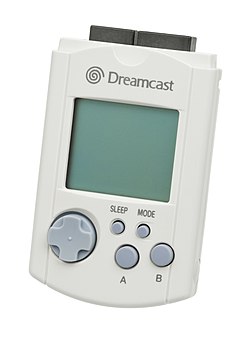
The Visual Memory Unit (VMU), also referred to as the Visual Memory System (ビジュアルメモリ, Bijuaru Memori) (VMS) in Japan, is the primary memory card produced by Sega for the Dreamcast home video game console. The device features a monochrome liquid crystal display (LCD), multiplayer gaming capability (via connectors at the top), second screen functionality, a real-time clock, file manager, built-in flash memory, and sound capability. Prior to the launch of the Dreamcast, a special Godzilla edition VMU, preloaded with a virtual pet game, was released on July 30, 1998, in Japan.[1]

While its most basic function is as a removable storage device, the VMU may also serve as an auxiliary display during normal gameplay and, through the use of additional software (distributed as extras on Dreamcast GD-ROMs), acts as a handheld game console. The VMU was mostly purchased separately from the console.[2] Console-like features of the VMU include a screen, speaker, proper directional pad, four action buttons, the ability to connect and interact with other VMUs, and the ability to download additional games.

Hardware

[edit]
VMUs attach through either of two slots on the controller; the screen of the VMU attached in the front slot is visible through a window on the controller.
The VMU shown inside the controller

For use as a memory card and second screen, the VMU is plugged directly into one of two slots on a Dreamcast controller (up to two VMUs may be plugged in each controller, and eight VMUs per Dreamcast console).

Upon initial use, the player is prompted to set the date and time, and then select from a group of bitmap images to serve as the default background for the VMU (various Dreamcast titles may offer players additional background images for the unit). This image is displayed while the Dreamcast console is in the operating system menu.

When operated independently of the Dreamcast console, the VMU acts as a file manager, clock/calendar (with selectable clock animations), and handheld game console. VMUs may also connect to each other directly to facilitate file transfer or multiplayer gaming.

The VMU runs on two CR-2032 lithium batteries which are inserted into the rear of the VMU under a screw-secured lid. Without battery power, the VMU still functions as a memory card and auxiliary display, but cannot play downloaded mini-games. Additionally, a VMU without battery power will beep when the Dreamcast is powered on (if the VMU is inserted into a connected Dreamcast controller)

The VMU has 128 KB of flash memory, but by default 28 KB is reserved for system use leaving 100 KB for data storage, which is divided into 200 'blocks' – one block equaling 512 bytes. In recent years, homebrew programs like Dream Explorer (aka VMU Tool) have allowed users to unlock an extra 44 blocks (22 KB) of this reserved space[3] increasing the overall VMU capacity to 244 blocks. However, a handful of games might be unable to detect the memory card if this is done, although none have been reported apart from DreamKey/DreamPassport and Metropolis Street Racer.[citation needed]

Minigames and in-game features

[edit]
VMUs can be coupled to trade files or for multi-player gaming.

Several titles for the Dreamcast include mini-games that can be downloaded onto a VMU. The Sonic Adventure series, for instance, include the Chao Adventure mini-games (Chao Adventure and Chao Adventure 2 which features more activities and items). In the games, players can transfer Chao eggs to the VMU and partake in various activities to increase the stats of their hatched Chao, whereupon they can upload their improved Chao back into the Dreamcast game. Sega GT includes Pocket GT, a top-down racer in the style of the 8-bit SpyHunter games.

In other video games, statistics such as the current health condition are displayed on the VMU for convenience (as in Resident Evil: Code Veronica) or to enhance multi-player gaming (for example, NFL 2K2 allowed the VMU to display secret plays not viewable to other players).

There are also numerous homebrew games, original creations and ports of famous games that are freely available on the internet and can be installed and played on a VMU. These games include: Metroid, VMU Mini Pacman, Breakout, Space Invaders, Tetris, VMU Fighter (a side-scrolling shoot 'em up), VMU Football (an American football game), VMU-a-Sketch (a digital Etch-a-sketch pad), and 3D FPS (a first-person-shooter).[4]

Dreamcast game VMU minigame In-game features
Cardcaptor Sakura: Tomoyo no Video Daisakusen Three mini-games:
  • Breakout
  • Oyatu
  • Tobakero

Clock (four themes)

?
Carrier Health condition
D2 Photo viewer Compass
Dino Crisis
  • Health condition
  • Ammo count
Evil Twin: Cyprien's Chronicles Four mini-games (downloadable) ?
Evolution: The World of Sacred Device ? Health condition
Evolution 2: Far Off Promise 12-hour clock
F355 Challenge Arcade connectivity
Godzilla Generations (Japanese version) Three mini-games:
  • Atsumete Godzilla
  • Gamera Dream Battle
  • Mothra Dream Battle
?
Jet Set Radio / Jet Grind Radio Graffiti transfer
Marvel vs. Capcom 2: New Age of Heroes Transfer characters, colors and stages Arcade connectivity
Namco Museum Pac-It
NBA 2K / 2K1 / 2K2 Team statistics
NFL 2K / 2K1 / 2K2 / Blitz ? Secret plays
Pen Pen TriIcelon Currently selected playable character
Pop'n Music series Pop'n Music Anywhere mini-game Virtual Pop'n Music controller
Power Stone Three mini-games:
  • Gunrock’s Gun-Gun Slot
  • Falcon’s Aerial Adventure
  • Ayame’s Shuriken Training
?
Power Stone 2 View and trade items ?
Quake III Arena Maze mini-game Animation
Ready 2 Rumble ?
  • Punch count
  • Hit percentage
Resident Evil series ? Health condition
Sakura Wars 3 ?
  • Kinematron messages
  • Area map
Seaman Organize and raise food for Seaman Seaman microphone status
Sega GT Pocket GT (Japan, Europe and US)
Sega Rally 2 Stats and records
Shenmue Shenmue Goodies Training instructions
Silent Scope ? Sniper rifle scope view
Skies of Arcadia Pinta's Quest Cham alert
Sonic Adventure Chao Adventure Chao animation
Sonic Adventure 2 Chao Adventure 2
Sonic Shuffle Revealed card numbers
Soulcalibur (Japanese version) Three mini-games Animated characters
Super Magnetic Neo Secret area alerts
Tech Romancer Three mini-games ?
Time Stalkers Five mini-games
Tokyo Bus Guide Traffic Signs Quiz ?
TrickStyle TrickStyle Jr. ?
Virtua Tennis ? Wireframe match
Zombie Revenge Three mini-games ?

Variants

[edit]

Multiple Dreamcast memory cards with no VMU features have been released. The cards therefore omit a display screen, input buttons, speaker and built-in clock. Some have the same 128 KB storage as the VMU, equivalent to 200 blocks, while others have multiple "pages" with each acting as a 128 KB memory card. In the latter case, a button or switch allows the user to select the desired memory card. This is due to the Dreamcast having a limit of 128 KB per individual memory card.

4x Memory Card

[edit]
The official Dreamcast 4x memory card has several lights on its front indicating the currently used storage "page".

Sega released an official 4x Memory Card which offered four times the data storage of a standard VMU, with 800 blocks. It was released in Japan on December 14, 2000,[5] as "Memory Card 4X", and in the US as "4x Memory Card". A button is used to select one of four "pages", and a series of four orange LED on the card indicates which of these is currently in use. Not all games are compatible, so Sega released a list of incompatible games.[6]

A limited edition Phantasy Star Online 4x Memory Card was also released in Japan to coincide with the game's release. It was coloured blue and featured the Phantasy Star Online logo printed onto the casing.[5]

The 4x Memory Card did not make it to retail in Europe, despite a planned release (along with the Dreamcast Broadband Adapter which was also unreleased in Europe) due to the Dreamcast's unforeseeably short lifespan – although unofficial third party 4x Memory Cards were released in Europe.

Third-party memory cards

[edit]

The Nexus Memory Card is a third party version of the Visual Memory Unit that features four times the memory of a stock VMU with 800 blocks (4 megabit / 512 kilobytes) but lacks an LCD screen. The card is divided into 4 pages each with 200 blocks, each page can be selected using a button on the top left of the card.[7] The Nexus Memory Card is slightly larger than the normal VMU and can be connected to a personal computer by USB, Parallel or Serial cable. A 3200 block (16 megabit / 2 megabytes) version of the Nexus is also available, but this model has been known to be unstable.[citation needed]

Nyko released two memory cards for the Dreamcast: the Jumbo Memory Pak X2 with twice the storage as a VMU, and the Hyperpak with four times the storage. The Hyperpak could also act as a Jump Pak by setting its switch to rumble mode.

The Performance Memory Card was a third-party basic memory card with the same 200 blocks of storage as a VMU. The Performance Mega Memory Card acted like a 4X Memory Card. It used a switch on its back to select the desired memory card "page". Unlike other memory cards however, the Performance model had to be removed from the controller before the "page" could be switched.

In September 2023, following a successful crowdfunding campaign, Dreamware Enterprises released an aftermarket VMU update called the VM2. The VM2 features a backlit screen, a rechargeable battery with USB-C support, and MicroSD storage.[8]

Reception

[edit]

In a 10-year retrospective, GamesRadar called the VMU "one of our favorite storage devices". They offered praise for the originality of the device, as well its flexibility and commented that newer systems should have revisited the concept. However, they lamented that most games didn't find a useful purpose for it and that the device drained batteries quickly.[9] In 2024, Time Extension called the VMU "an important evolution of the memory card concept".[10]

See also

[edit]
  • PocketStation, a similar device by Sony for the PlayStation, released six months later

References

[edit]
[edit]
Revisions and contributorsEdit on WikipediaRead on Wikipedia
from Grokipedia
The Visual Memory Unit (VMU), known as the Visual Memory (ビジュアルメモリ) in , is a multifunctional peripheral developed by for the , featuring an integrated monochrome (LCD), directional pad, four action buttons, and link ports for multiplayer connectivity, allowing it to serve as a device, secondary in-game screen, and standalone portable gaming system capable of running downloadable minigames and applications. Introduced as a key component of the Dreamcast ecosystem, the VMU debuted in on July 30, 1998, four months before the console's launch, bundled with the Atsumete Godzilla: Kaijuu Dai Shuugou, which demonstrated its standalone capabilities by letting players collect virtual cards on the device's 48×32 dot LCD screen. Powered by two CR2032 batteries for approximately two weeks of standalone use, the VMU utilizes 128 KB of organized into 200 blocks (512 bytes each) for saving game data, with 64 KB dedicated to user programs and the remainder for saves and system functions, while its 8-bit LC868700 processor enables execution of custom code at up to 6 MHz when connected to the Dreamcast via the controller's Bus interface. Beyond basic storage, the VMU's innovative design allowed Dreamcast games to leverage its screen for real-time displays like health meters, maps, or animations—such as in Sonic Adventure, where it showed Chao virtual pet interactions—while its built-in buzzer supported simple sound effects and a real-time clock enabled features like alarms and time-based events. Over 50 official minigames were released for the VMU, including titles like ChuChu Rocket! and Baseball 2000, which could be downloaded from compatible Dreamcast games or transferred between units via serial link cables, fostering a unique portable multiplayer experience. Sega produced VMUs in multiple colors (e.g., black, white, clear blue, green, and pink) to match Dreamcast controllers, with standard models offering 128 KB storage, though third-party variants from manufacturers like Mad Catz and Interact expanded capacity to 256 KB or 512 KB while maintaining compatibility. Despite the Dreamcast's short lifespan from 1998 to 2001, the VMU's blend of utility and interactivity influenced later portable devices and remains a collector's item, praised for enhancing immersion in Sega's final home console era.

Development and history

Conception and design

The Visual Memory Unit (VMU) originated from Sega's ambition to transcend conventional memory cards during the development of the console in the late , aiming to create an interactive peripheral that blended data storage with portable gaming elements. Drawing inspiration from the success of handheld virtual pet devices like Bandai's (1996) and (1997), sought to incorporate similar nurturing and standalone play mechanics into a console accessory, fostering deeper player engagement beyond mere save functionality. Under the leadership of Sega's hardware engineering team, headed by Hideki Sato—who directed the overall hardware development—the VMU was designed as a compact, controller-insertable unit to ensure ergonomic and seamless integration with the console. The core philosophy emphasized multifunctionality: combining reliable save data storage with a 48x32 monochrome LCD screen and directional controls to enable "" simulations, where users could interact with game characters or mini-applications independently of the main system. This approach reflected Sega's broader goal of innovating in portable interactivity, positioning the VMU as an extension of the console rather than a passive add-on. Development involved collaboration with Electric Co., Ltd., utilizing their LC86K series processor and tools from the SDK Version 1.3J, including assemblers and simulators, with key documentation revised in December 1998 and February 1999. Early prototypes, revealed at events like 1998, explored vibrant color schemes and tested the feasibility of executing code on the device's 8-bit LC868700 processor, operating at up to 6 MHz when connected to the . Engineering iterations focused on balancing power efficiency with functionality, culminating in the use of two CR2032 lithium coin-cell batteries to support approximately two weeks of standalone operation for mini-games and pet interactions. The first public iteration appeared in July 1998 as the Atsumete Godzilla: Kaijuu Dai Shuugou VMU, preloaded with a virtual pet title, four months ahead of the launch.

Release and market impact

The Visual Memory Unit (VMU) was publicly showcased at the in 1998 as part of the ecosystem, highlighting its innovative design ahead of the console's debut. It launched as a pack-in accessory with the on November 27, 1998, in , and on September 9, 1999, in . Priced at around $20 USD as a standalone item in , the VMU was typically bundled free with console purchases across most regions to encourage adoption. In the months following the Japanese release, over 500,000 VMU units sold in tandem with the , which moved approximately 500,000 consoles in by December 1998 despite limited initial stock. The VMU's unique capabilities, such as its built-in LCD screen and standalone functionality, set the apart from rivals like the PlayStation by enabling portable interactivity and deeper game integration, marketed as a "smart ." This feature helped drive the console's early momentum and overall market performance, contributing to global sales exceeding 10 million units. In , it was known as the Visual Memory (ビジュアルメモリ), sometimes referred to as VMS, while North American markets used the Visual Memory Unit (VMU) designation.

Hardware specifications

Physical design

The Visual Memory Unit (VMU) measures 47 mm in width, 80 mm in height, and 16 mm in depth, with a weight of approximately 45 grams, making it compact and lightweight for portable use. Its layout features a top-mounted monochrome LCD screen measuring 37 mm by 26 mm with a 48 by 32 dot resolution, positioned above a directional pad on the left side and four action buttons on the right: A and B for primary inputs, along with Mode and buttons for navigation and power control. A proprietary connector at the bottom allows insertion into Dreamcast controller slots, while a front-facing expansion port enables direct linking to another VMU for multiplayer or data transfer. The unit includes a power LED indicator that illuminates upon activation, and a high-pitched sound signals low battery during startup. Constructed from durable plastic, the VMU casing was available in various colors including white, black, and blue, with some regional variants featuring translucent finishes for aesthetic appeal. The design emphasizes for handheld operation during minigames, with a rear battery compartment housing two CR2032 cells that provide approximately 7 days of continuous game play or 130 days of clock-only operation, depending on usage.

Technical features

The Visual Memory Unit (VMU) employs an 8-bit LC8670 , a low-power custom processor also known informally as the "" for its basic architecture. Operating at 6 MHz when connected to the via the Bus, the CPU supports essential functions like and mini-game execution, while dropping to a 32 kHz clock in standalone mode to minimize energy consumption. This design prioritizes efficiency over high performance, aligning with the device's role as a portable peripheral. The VMU includes a 1-channel PWM for generating simple tones and effects. Memory in the VMU totals 128 KB of flash ROM, primarily for non-volatile storage of save files and downloadable mini-game code, with 100 KB (organized into 200 blocks of 512 bytes each) allocated for user data and the remaining 28 KB reserved for system operations. Complementing this is 16 KB of mask ROM housing the core BIOS and a modest 512 bytes of RAM, split between work areas, stack, and a display framebuffer to handle runtime tasks without external dependencies. These specifications enable reliable data persistence across sessions while fitting the constraints of a compact, battery-powered unit. The display is a , reflective dot-matrix LCD measuring 48 pixels wide by 32 pixels tall, controlled directly by the onboard RAM for simple rendering and icon overlays. This low-resolution screen supports essential visuals like file lists, battery status, and mini-game interfaces, with no color or backlighting to preserve power. In certain operational modes, it can utilize partial areas for optimized content display, such as volume icons or attention alerts. Connectivity relies on a specialized —comprising key signal pins for power, ground, and bidirectional —that inserts into one of the two slots on a controller, enabling synchronous serial communication over the Maple Bus at speeds sufficient for save transfers and program loading. VMUs support direct exchange via the front expansion port using serial link cables, in addition to indirect exchange facilitated by the console when multiple units are present. Power is supplied at 3 V, either from two parallel CR2032 lithium coin-cell batteries (each rated at 210 mAh, providing roughly 130 days of clock-only operation) or drawn directly from the controller when attached. Integrated sleep modes automatically reduce activity during idle periods, and low-voltage detection triggers warnings or shutdowns to prevent data loss, ensuring longevity in both docked and portable use. The includes a 16 KB stored in mask ROM, featuring a that initializes hardware, manages mode transitions between console peripheral and standalone device, and loads applications from flash into RAM for execution. Approximately 8 KB of this is dedicated to the core operating system, handling interrupts, timer functions, and basic I/O, with the remainder supporting specialized subroutines for flash access and maintenance.

Functionality and software

Memory and saving

The Visual Memory Unit (VMU) employs 128 KB of flash ROM for storage, divided into 200 blocks of 512 bytes each after accounting for system reservations, providing approximately 100 KB of usable space. This configuration accommodates up to 20-30 save files, with typical game saves requiring 4-16 KB (8-32 blocks) depending on the software's data needs. The utilizes a block-based structure akin to , restricted to a without subdirectories, and incorporates CRC checksums in file information forks for error detection to safeguard ; it supports up to 200 files total, enabling multiple games to coexist on a single VMU. Save data is transferred from the console to the VMU via the controller port using the Maple bus, which operates at a theoretical speed of 2 Mbps for . The process involves writing data in 512-byte block units, with automatic verification through routines that compare written content against the source for accuracy; successful saves also generate thumbnails as 48x32 icons displayed on the VMU's LCD, allowing immediate visual of file contents. During transfers, the console supplies power to the VMU, facilitating reliable flash writes even if the device's batteries are low. Notable limitations include non-expandable storage, as the flash ROM cannot accommodate additional modules, and a potential for if the CR2032 batteries fail mid-save in standalone mode—though console-powered sessions largely prevent this by bypassing battery dependency for writes. The VMU's internal menu, accessed via its directional buttons and LCD interface, provides tools for file management, including deletion and copying operations between VMUs or within the device, with icons aiding rapid identification and organization of saves.

Minigames and applications

The Visual Memory Unit (VMU) served as a standalone portable device capable of running utility applications and minigames, independent of the console. Built-in utilities included a and , accessible via the clock mode, which allowed users to view and set dates, times, and reminders using the device's LCD display and onboard controls. These features relied on the VMU's internal , powered by a 32.768 kHz oscillator, and were designed for basic productivity tasks like . The VMU's software ecosystem extended to entertainment through downloadable minigames and applications. Downloadable content significantly expanded the VMU's library, with over 50 official minigames available through compatible Dreamcast titles or the dedicated VMU Mode disc. A prominent example is the Chao Garden from Sonic Adventure, where users could download and raise virtual Chao pets on the VMU, fostering them with feeding and training mechanics that influenced the main game's progression. Third-party developers contributed titles like fishing simulations, adding variety to the ecosystem with themed activities such as casting lines and reeling in catches using the VMU's limited controls. VMU minigames and applications were developed using for the Sanyo LC8670 CPU, optimized for the device's constraints of approximately 64 KB for executables and up to 100 KB of usable flash storage across 200 blocks. This low-level programming enabled efficient use of the 512 bytes of RAM and supported features like (IR) communication for multiplayer modes, as seen in titles such as Soccer, which allowed up to four players to compete by linking multiple VMUs. User interaction emphasized simplicity, with the four directional buttons and A/B buttons handling , selections, and actions, while save states were written to non-volatile to preserve progress across sessions, though low battery levels could operations and trigger automatic backups. Among notable titles, Sega's VMU Soccer stood out for its support of up to four-player multiplayer via IR, simulating basic soccer matches on the tiny screen with team control and goal-scoring mechanics.

Integration with games

The Visual Memory Unit (VMU) enhanced gameplay by serving as an interactive peripheral that could receive data and executable code from games, allowing certain features to operate independently on its dedicated hardware. This integration enabled developers to offload simple tasks, such as animations or status updates, to the VMU's 8-bit LC8670 CPU, thereby reducing the processing burden on the console's main SH-4 processor and potentially shortening load times during play. A key aspect of this integration was the virtual pet system, where games transferred creatures to the VMU for ongoing care and evolution outside the main game session. In Sonic Adventure, players could raise Chao creatures on the VMU through mini-games that simulated nurturing, with the pets evolving based on interactions like feeding or training; these Chao could then be transferred back to the game or shared with other titles via VMU-to-VMU connectivity. Similarly, Seaman utilized the VMU as a persistent habitat for the virtual fish, where it "lived" and grew in real time using the device's clock, with interactions like voice commands handled via the console's microphone when attached. The VMU also functioned as an auxiliary display for in-game information, providing real-time updates without cluttering the main screen. For example, Resident Evil: Code: Veronica displayed the player's health status and other vital HUD elements on the VMU's LCD, making them visible at a glance during tense survival sequences. Through data exchange protocols, Dreamcast games could write custom executable code directly to the VMU, enabling sub-games or tools that interacted with the core experience. In NFL 2K2, players used the VMU to select plays during matches, keeping choices hidden from opponents in multiplayer and adding strategic depth; the controller supported up to four VMUs for simultaneous use in such modes. Representative examples include Shenmue, where winning soda cans from in-game vending machines could be redeemed online to download prizes or mini-games to the VMU, and Crazy Taxi, which featured a parking challenge sub-game downloadable to the unit for practice between drives. Titles like Phantasy Star Online required a VMU for full functionality, as it stored essential character data and guild cards necessary for online progression and multiplayer sessions.

Variants and third-party products

Official variants

The standard Visual Memory Unit (VMU), often bundled with the console, featured 128 KB of flash ROM, providing 200 blocks (512 bytes each) of storage for game saves and applications, with 100 KB effectively available after system reservations. This model, designated as HKT-7000 in some regions, was the most common official variant and served as the primary pack-in accessory across , , and . In response to third-party products, released the official 4× in December 2000 for , offering 800 blocks (~400 KB usable) of storage—four times the standard VMU—but without the LCD screen, controls, or capabilities. It featured a switch to toggle between segments and was priced around $30–$50, though it had compatibility issues with some titles. Themed editions of the standard VMU were released to coincide with specific games or promotions, featuring custom shells and colors without altering core specifications. In , examples include red variants bundled exclusively with select titles and a collaboration in November 1999, which came in blue and pink translucent designs as part of the Set. North American releases offered colorful translucent options like clear blue, green, red, and yellow, often included in holiday gift packs, while European models stuck to standard gray with limited colored alternatives. These aesthetic variants appealed to collectors and enhanced personalization. Official accessories for the VMU included infrared (IR) communicators for wireless data transfer between units and dedicated carrying cases for protection during travel. The IR communicator enabled multiplayer interactions and save sharing, while cases provided padded storage for multiple VMUs alongside controllers. These add-ons saw no major updates throughout the product's lifecycle. Production of official VMUs was phased out alongside the console's discontinuation in early 2001, marking the end of Sega's support for the peripheral. In the , fan communities have produced reproduction shells and components for collectors to restore or customize units, maintaining compatibility with original hardware.

Third-party memory cards

Third-party memory cards for the Visual Memory Unit (VMU) were produced by various manufacturers to provide alternative storage options, often at lower costs than official products. Licensed options from companies like and Interact included models with capacities ranging from 8x to 16x the standard VMU's 200 blocks, featuring LCD screens for basic VMU functionality such as support, though quality varied with components like cheaper batteries leading to shorter lifespans. Unlicensed clones, primarily imported from , emerged as budget alternatives emphasizing raw storage over VMU features, with some models offering up to 2 MB of space (e.g., equivalent to 16× or more the standard capacity) but lacking screens, speakers, or capabilities, thus limiting them to save data only. These clones focused on affordability, priced between $10 and $20 during the early , making them popular among consumers seeking expanded storage without the premium for official or licensed units. Compatibility issues plagued many third-party cards, including glitches in VMU minigames or save corruption when used with certain titles, as the non-standard hardware sometimes failed to adhere to Sega's save protocols. For instance, Nyko's card incorporated LED indicators for status feedback but was reported to cause instability in interactive features. Sega pursued legal challenges against fakes infringing on VMU trademarks, aiming to curb the influx of low-quality imports. Rare enhancements in third-party designs included USB readers for transferring saves to PCs, allowing easier backups, though none replicated official support for data exchange between units. These products filled a market gap for cost-effective storage during the Dreamcast's lifespan from 1999 to 2001.

Modern modifications and emulations

In recent years, fan communities have developed hardware modifications to enhance the VMU's functionality, transforming it into a more versatile portable device. In 2024, content creator Tito from Macho Nacho Productions converted a standard VMU into a standalone handheld emulation console by integrating a Zero W processor, a 128×128 LCD display, an 850mAh with built-in charger, and an slot for loading ROMs from various retro systems. This mod includes a built-in speaker for audio output and enables playback of games beyond the original VMU library, while retaining the device's compact form factor. A more advanced commercial fan project, the VMU Pro by 8BitMods, was announced in May 2025 with pre-orders opening on May 15. Priced at approximately $81, it features a dual-core 240MHz CPU, a 1.5-inch backlit IPS TFT color display at 240×240 resolution, up to 2TB storage via microSD card (equivalent to over 16,000 original VMUs at 1GB), charging for its 720mAh battery offering up to 6 hours of playtime, and /Bluetooth connectivity for features like cloud backups to . The device adds retro game emulation for systems including NES, Master System, Game Boy, Game Boy Color, and Game Gear, with support for SRAM saves and 8 save states per game, while remaining fully backwards compatible with original Dreamcast hardware and controllers. Pre-orders opened on May 15, 2025, with shipping beginning in November 2025, positioning it as a modern revival that expands the VMU's role as both a memory unit and independent handheld. Software emulations have also preserved and extended VMU capabilities on contemporary platforms. The Demul for PC supports VMU simulation, allowing users to interact with the secondary screen, manage saves, and run minigames during gameplay emulation. Similarly, Flycast, an open-source available on PC, Android, and other platforms, provides full VMU feature emulation, including on-screen controls, save management, and integration with games that utilize the VMU for progression or mini-games. These tools enable homebrew minigames developed via ports of the SDK, such as custom titles and utilities, to be tested and played without original hardware. Community-driven projects further support VMU maintenance and customization. Enthusiasts have created 3D-printable replacement shells to restore or personalize damaged units, with designs available for various colors and fits that match the original dimensions. Battery replacement mods, often using rechargeable LiPo cells with charging circuits, address the common failure of the original CR2032 batteries, extending standalone playtime and reliability. Online archives, including community compilations on platforms like the , have recovered and preserved over 50 lost or obscure minigames by 2023, compiling official titles, DLC content, and homebrew into accessible ROM packs for emulation or transfer to physical VMUs. These fan efforts focus on preservation and non-commercial enhancement, aligning with Sega's generally permissive stance toward unmonetized projects that do not infringe on active rights. By avoiding profit and respecting original game assets, such initiatives help sustain the VMU's legacy without legal conflicts.

Reception and legacy

Contemporary reception

The Visual Memory Unit (VMU) received widespread acclaim upon its 1999 launch for introducing groundbreaking interactivity to console peripherals, transforming a standard memory card into a portable gaming device with a built-in LCD screen, directional pad, and buttons. Reviewers praised its ability to download minigames and manage virtual pets, such as the Chao creatures from Sonic Adventure, allowing players to raise and train them independently of the main console. IGN described the VMU as a novel "128K memory card with a built-in LCD screen that plugs into the control pad," emphasizing its potential for enhanced gameplay through features like data exchange between units. This innovation was seen as a major draw for the Dreamcast, contributing to the console's recognition as Best New Hardware in the console category at the 1999 E3 Game Critics Awards. Despite the enthusiasm, the VMU faced notable criticisms regarding its practical limitations. The device's reliance on two CR2032 batteries led to frequent complaints about short battery life, with early users reporting depletion after just two months of intermittent use, even without heavy play. The 48x32 screen, while functional for simple tasks, was often deemed too small for comfortable extended play, and the 128KB storage capacity proved insufficient for games with larger save files, prompting some to purchase multiple units. These issues were highlighted in contemporary discussions, underscoring challenges in an era of evolving peripheral expectations. The VMU's integration significantly enhanced the 's overall appeal, encouraging frequent use among owners and differentiating Sega's ecosystem from competitors like the PlayStation's standard memory cards. In , where the and VMU debuted in late 1998, fans particularly appreciated the device's customization options, including variant colors and additional display features like unique fonts and animations not available in Western models. Western reception, however, sometimes pointed to a steeper for navigating minigames on the compact interface, though its portability was still lauded as a step forward in gaming convenience.

Cultural impact and modern relevance

The Visual Memory Unit (VMU) has exerted a significant cultural influence on gaming peripherals through its pioneering role as an interactive memory card with a built-in screen, speakers, and controls, predating and conceptually foreshadowing dual-screen handheld systems like the Nintendo DS, where the VMU functioned as a secondary display when inserted into a Dreamcast controller. This hybrid design emphasized portable, self-contained save management and mini-game functionality, contributing to broader trends in "smart" memory devices that evolved into more advanced virtual pet and save systems in subsequent console generations. The VMU's ability to host independent applications, such as raising digital pets like Chao from Sonic Adventure, fostered a sense of ongoing engagement beyond main gameplay, inspiring nostalgic attachments that resonate in modern gaming culture. In retro gaming circles, the VMU has become a highly collectible artifact, with original units valued between $20 and $100 on platforms like eBay in 2025, driven by demand from collectors seeking functional examples for Dreamcast setups or display purposes. Fan communities celebrate its legacy through online forums and events, where enthusiasts share stories of VMU mini-games and modifications, underscoring its status as a symbol of the Dreamcast's innovative spirit. The device's quirks, including memes depicting the "death" of neglected Chao pets due to battery drain or forgotten saves, have permeated internet humor, evoking both laughter and wistful memories of early 2000s gaming anxieties. The VMU maintains modern relevance via emulation projects and hardware revivals, such as the 2025 VMU Pro from 8BitMods, a backward-compatible upgrade that integrates microSD storage, a color IPS screen, and 8-bit emulation for libraries like NES and , reigniting interest among new and veteran players. Community-driven emulators, including standalone VMU cores like libElysianVMU, enable preservation and play of original mini-games on PCs and mobile devices, ensuring accessibility for future generations. Documentaries and retrospectives have cemented the VMU's place in gaming history, with features in productions like ' Dreamcast: 25 Years of Thinking (2024), which highlights its role in the console's enduring fanbase and innovative peripherals. Preservation initiatives in the , including Sega's re-releases of titles like Rainbow Cotton on modern platforms with nods to original hardware features, alongside mods extending VMU compatibility to 8-bit eras, demonstrate ongoing efforts to sustain its functionality and cultural footprint.

References

Add your contribution
Related Hubs
User Avatar
No comments yet.