Hubbry Logo
Type 63 (armoured personnel carrier)Type 63 (armoured personnel carrier)Main
Open search
Type 63 (armoured personnel carrier)
Community hub
Type 63 (armoured personnel carrier)
logo
8 pages, 0 posts
0 subscribers
Be the first to start a discussion here.
Type 63 (armoured personnel carrier)
from Wikipedia
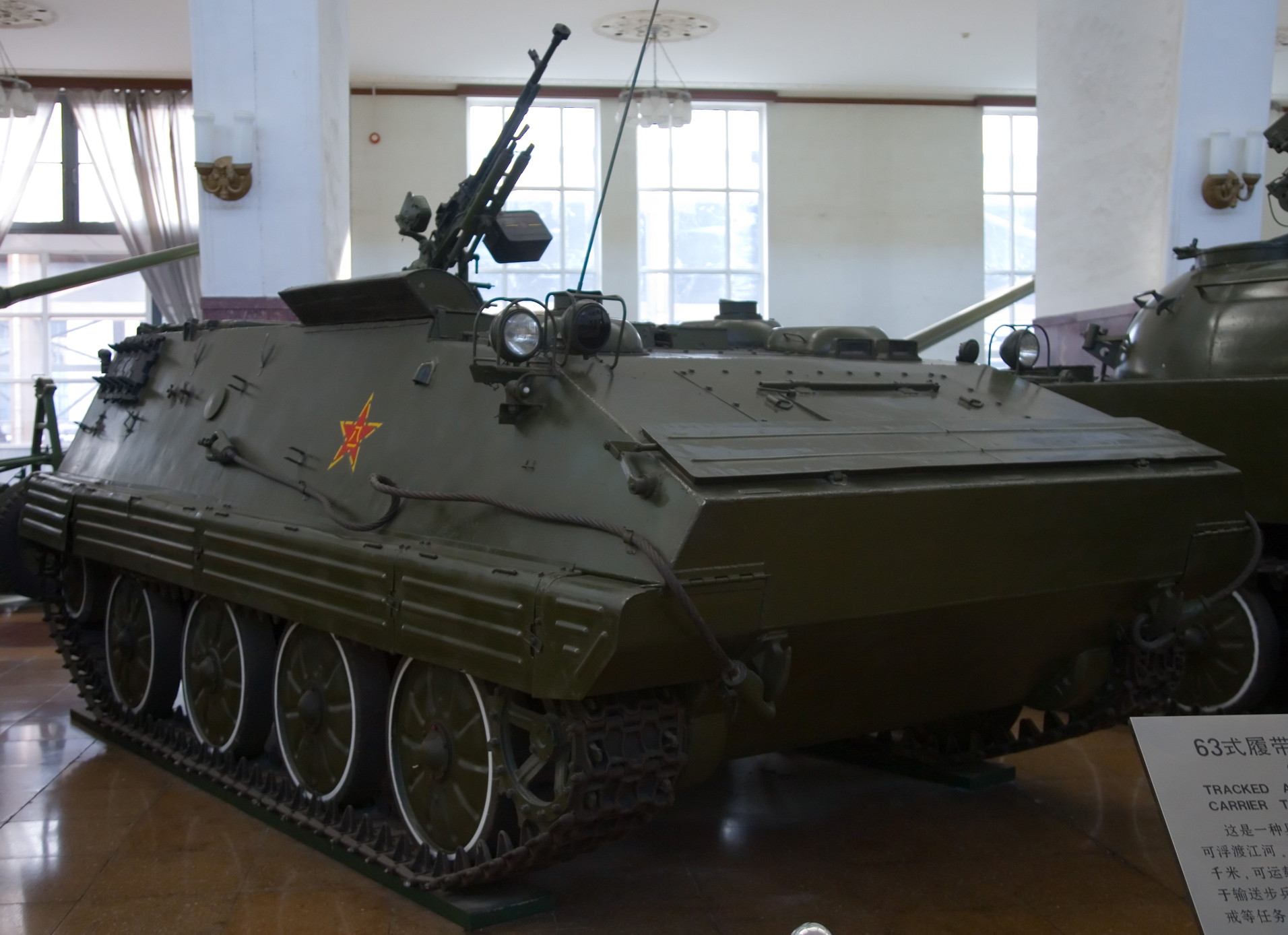
Top-shot of a Type 63 APC (A531) at the Beijing Military Museum

Key Information

The Type 63 (industrial designation YW531) is a Chinese armoured personnel carrier that entered service in the late 1960s. It was the first armoured vehicle designed in China without Soviet assistance.[1] The design is simple and is comparable to other APCs of its time such as the M113.

Approximately 8,000 all types and variants were produced by Norinco. It also equips several armies around the world and has seen action in different conflicts including the Vietnam War, the Sino-Vietnamese War, the Iran–Iraq War, and the Gulf War.

Development

[edit]

In July 1958, the central government of the People's Republic of China proclaimed in a national scientific development strategic plan that called for a tracked armoured personnel carrier that can be ready for mass production in 1960, in less than two years, and Yong Ding Machinery Factory (永定机械厂) – later incorporated into the NORINCO group was to be responsible for the manufacturing of the new APC.

The design work was left to No. 1 Institute of the First Machinery works (then focusing on tanks design) and the Fourth faculty of the Harbin Engineering Academy to be under the supervision of the Scientific department of the PLA Armour Corp., Fifth Department of First Machinery Works and Soviet experts.

Description

[edit]

The hull is made of welded steel, and provides protection against small arms fire. The vehicle carries a maximum of 15 including crew, which depending on the particular configuration may be two or four, the rest of the passengers are infantry who sit in a compartment at the rear of the vehicle. The driver sits in the front left of the hull, and has a single piece hatch, which opens to the left. The driver is provided with two day periscopes which cover the front and right of the vehicle. One of the drivers periscopes can be replaced by a night vision device. The commander sits on the front right of the hull, and has a single piece hatch which opens to the right. The commander hatch has a periscope on the top surface that may be rotated through 360 degrees. Export variants of the vehicle with BF8L engine did away with the commander's position in the front right of the hull. Behind the driver, on the left side of the hull is a third crew position, which is provided with a hatch that opens to the left, and like the commander's position has a 360-degree rotating periscope.

The engine sits to the right rear of the driver. It has a large intake located in the top of the hull, with an exhaust on the right hand side. The engine is either a Type 6150L 260 hp diesel engine or, on export versions, an 8-cylinder air-cooled, turbocharged diesel engine KHD BF8L 413F which develops 320 horsepower at 2,500 rpm. The engine feeds a manual transmission with five forward gears and one reverse gear. Track is driven at the front by a drive sprocket, and passes over four rubber-typed road wheels, then loops over an idler at the rear, before returning to the front again. No return rollers are fitted, the track rests on the top of the road wheels. Suspension is of the torsion bar type. The vehicle has a fuel capacity of 450 litres, which gives it a road range of around 500 kilometers.[2]

A 12.7 millimetre calibre machine gun is located in an open mount at the front of a small hatch in the center of the hull which opens into the troop compartment. The gun can traverse through 360 degrees and can be elevated to an angle of 90 degrees. Two roof hatches and a large rear door provide access to the troop compartment.

The vehicle is amphibious, a folding trim board stowed at the front of the hull needs to be raised, and the vehicle can then propel itself in the water using its tracks.

Variants

[edit]

Variants are often designated by their manufacturer. WZ stands for Wu Zhuang Jia (armored vehicle 5) and designates the vehicles produced by the Fifth Machinery Works. YW stands for Yongding Wai Mao (Yongding external trade).[3]

63-2 (WZ531) at the Military Museum
63 Amphibious APC at the Military Museum
  • Type 531 (1963[1] or 1961[3]) – Basic version with Type 56 7.62 mm machine gun, not mass-produced.[1]
  • Type A531 or Type 63 (1968[1] or 1963[3]) – Production variant with 12.7 mm machine gun Type 54, uprated engine and different transmission.[1] Also known as Type 531A.
  • Type B531 or Type 63-I (1981) – Improved version with stronger suspension, additional firing ports and two additional roof hatches.[1][5]
    • Type 63C – PLA version of the YW531C.[3]
  • Type 63CA – PLA version of the YW531E.[3]
  • Type WZ701 – Command version of the Type A531 with higher troop compartment and fitted with up to five radios (Type 889, Type 892, Type 70-2B) and a generator. Armament consists of a Type 56-1 machine gun of 7.62 mm.
  • Type WZ721 – Communications relay vehicle with higher roof line and ZZT1 set.
  • Type WZ750 – Armoured ambulance with higher roof line, unarmed.
  • Type WZ302 or Type 54-1/Type 63-1 SPHSelf-propelled artillery version of the Type B531 mounting a 122 mm Type 54-I howitzer. An improved version, the Type 70 [zh], has a longer chassis. Both vehicles also mount a Type 67 machine gun.[1][3][6]
  • Type WZ303 or Type 70 MRLRocket artillery version of the Type A531 with 19-tube 130 mm multiple rocket launcher (similar to the BM-14 MRL).[1][7]
  • YD801 – Fire fighting vehicle.[8]
  • ZZM88 – Cryptography vehicle. Program begun in July 1984 and entered service in August 1992. Used to provide cryptographic codes for other vehicles.
  • Type WZ534 (Type 89)
  • SPAAA Type WZ531 - ZSD63 with PG87 25mm dual barreled AAA gun

Export

[edit]
Former Iraqi YW701 command vehicle at the Puckkapunyal Military Museum
  • Type YW531C (1982)[1] – Export version of the 531 series with German Deutz engine KHD BF8L of 320 hp (240 kW). The machine gunner's position front right was deleted.[1][5]
  • Type YW531D – Modified version with only 1 instead of 2 firing ports on the left side.[5]
  • Type YW531E – As per YW531D but with one additional radio Type 892.[5]
  • Type YW701 – Export version of the Type WZ701 command post vehicle. Based on the Type YW531C and equipped with a commander's cupola with Type 54 machine gun. Improved version Type YW701A.[5]
  • Type YW750 – Export version of the Type WZ750 armoured ambulance. Based on the Type YW531C[5] and equipped with a commander's cupola with Type 54 machine gun.
  • Type YW304 – Self-propelled 82 mm mortar with 120 rounds, based on the Type YW531C/Type 531H.[5][8]
  • Type YW381 – Self-propelled 120 mm mortar with 50 rounds, based on the Type YW531C.[5]
  • Type YW531H (Type 85)

Combat history

[edit]
A destroyed Type 63 at the Iran-Iraq border.

The Type 63 has been fielded by Vietnamese and Chinese armies during the Vietnam War and the Sino-Vietnamese War.[5] During the Chinese invasion of Vietnam, it proved to be very valuable because of its protection and its cross-country abilities.[8] The Zairan forces used it during the Angolan Civil War,[citation needed] as did the Tanzanians during the Uganda–Tanzania War.[9] During the Iran–Iraq War, China exported quantities of Type 63s to Iraq.[5] These vehicles have seen further service during the Gulf War[10][11] and the 2003 invasion of Iraq.[12] The Peshmerga forces used at least one Type 63 APC against the Islamic State.[13] The Type 63 has also been used during the Sudanese civil war.[14]

Operators

[edit]

Current operators

[edit]

Former operators

[edit]

Evaluation purposes

[edit]
  • Australia - Captured and given to Australia in 1972 by the South Vietnamese government and then tested.[30]

See also

[edit]
Comparable vehicles of similar design

References

[edit]

Bibliography

[edit]
[edit]
Revisions and contributorsEdit on WikipediaRead on Wikipedia
from Grokipedia
The Type 63 (industrial designation YW531) is a tracked armoured personnel carrier developed by China and introduced into service with the People's Liberation Army in the late 1960s, marking the first domestically designed and manufactured APC for the Chinese military. This amphibious vehicle, weighing approximately 12.6 to 14 tons, is capable of transporting a crew of two plus up to 13 passengers at speeds of up to 65 km/h on land and 6 km/h in water, protected by welded steel armor up to 14 mm thick that offers limited resistance to small-arms fire and some artillery fragments. Primarily armed with a single 12.7 mm heavy machine gun mounted on the roof, it features torsion-bar suspension with four road wheels per side and is powered by a diesel engine, enabling a operational range of around 500 km. Development of the Type 63 began in the late at the No. 618 Factory with assistance from Soviet advisors, leading to initial prototypes in 1958 and the first production batch delivered in 1963, though mass production of the improved A531 variant commenced in 1968. Over 10,000 units were produced during the era by factories such as the Yong Ding Machinery Factory (later ), with ongoing upgrades including the YW-531C model in the 1980s that incorporated a more reliable German KHD air-cooled and enhanced ventilation. The vehicle saw combat deployment in conflicts including the , , Iran-Iraq War, the 1991 , operations against ISIS, and the , where it provided troop transport and fire support for infantry units. Numerous variants of the Type 63 have been developed to extend its utility beyond basic personnel transport, including the YW701 command post vehicle, YW750 , and artillery platforms such as the Type 70 122 mm self-propelled and YW304 82 mm mortar carrier. Later models like the Type 63-I featured improved suspension and additional roof hatches for better crew egress, while export versions such as the Type 81 adapted the design for international markets. The vehicle's simple construction and versatility contributed to its widespread production and adoption, with an estimated total of around 2,800 units in service across various configurations as of the 2010s. The Type 63 remains in limited use with the , supplemented by modern successors, but continues to serve as a foundational element of Chinese armored doctrine. Primary operators include (approximately 1,800 units), (500 units), (150 units), (132 units), , , , and , among others, highlighting its export success to allied nations in , , and the . Despite its age, the design's amphibious capabilities and ease of maintenance have ensured its longevity in second-line roles and reserve forces worldwide.

Development

Historical Background

Following the (1950–1953), Chinese military assessments revealed significant shortcomings in the Soviet-supplied and armored personnel carriers, which were primarily wheeled vehicles with limited amphibious capabilities and poor reliability in rugged terrain, hindering infantry support in riverine and coastal operations. These deficiencies underscored the need for a more versatile transport vehicle suited to China's diverse geography, particularly for amphibious assaults along its extensive waterways and borders. The escalating , beginning in the late 1950s and intensifying by 1960–1961, severed reliable access to Soviet military technology and aid, compelling to pursue indigenous development of armored vehicles to achieve self-reliance in defense production. This geopolitical shift aligned with the People's Liberation Army's (PLA) early 1960s requirements for a low-cost, mass-producible amphibious APC capable of transporting alongside tanks, emphasizing simplicity in design and adaptability to rough terrain without heavy dependence on imported components. Development was initiated in , with initial prototypes completed by , marking China's first fully domestic tracked effort, though early designs drew partial inspiration and assistance from Soviet advisors and amphibious concepts before transitioning to independent engineering. Initial batches entered PLA service in 1963-1964, addressing the urgent need for mobility in potential conflicts along 's southern and eastern frontiers.

Design and Production Phases

The development of the Type 63 armoured personnel carrier (APC), also known as the YW531, began in 1958 as China's first indigenous tracked APC design, marking a shift toward self-reliant production following the end of direct Soviet technical assistance due to the Sino-Soviet split. Engineers at the No. 618 Factory, in collaboration with the Military Engineering Institute and the No. 30 Research Laboratory, focused on creating a lightweight, amphibious vehicle to transport infantry while providing basic protection and mobility. The design emphasized simplicity for mass production, utilizing a welded steel hull with a torsion-bar suspension system featuring four rubber-tired road wheels per side, a front-mounted drive sprocket, and a rear idler to ensure reliable cross-country performance. Key engineering integrations included a rear-mounted water-cooled , initially the Type 6150L delivering 260 horsepower, derived from Soviet tank technology but adapted for the APC's needs. For amphibious capability, the vehicle incorporated a trim vane on the plate to reduce water resistance and bilge pumps to manage ingress, with provided by the tracks achieving speeds up to 6 km/h in water. Prototyping emphasized rapid iteration, with pilot vehicles completed by 1960, leading to initial land and water trials that validated the design's dual-role functionality despite challenges like limited armor thickness, which offered protection only against small-arms fire. Production commenced in 1963 at the No. 618 Factory (later part of ), transitioning from prototypes to serial manufacturing by 1964, when the Type 63 entered service with the (PLA) as its standard light APC. Early output focused on equipping motorized units, with approximately 2,300 units in PLA service as of recent estimates, though total production exceeded 8,000-10,000 including exports; initial challenges involved refining the powertrain for reliability, addressed through incremental upgrades like the YW531A variant in 1968. This phase established the Type 63 as a foundational for Chinese armored forces, influencing subsequent domestic variants.

Design and Specifications

Structure and Dimensions

The Type 63 armoured personnel carrier, designated YW531, features compact dimensions suited to its role as a lightweight, amphibious . It measures 5.48 meters in length, 2.98 meters in width, and 2.85 meters in height overall, with a ground clearance of approximately 0.45 meters. These proportions contribute to its low profile and maneuverability across varied terrain, while the combat-loaded weight of 12.6 metric tonnes enables air via such as the An-12. The hull is constructed from welded steel plates, providing protection against small arms fire and shell fragments, with armor thickness ranging from 6 mm on the roof to 14 mm on the front glacis and turret facings. The design emphasizes simplicity and buoyancy, featuring a monocoque structure without an open top; access for troops is via side firing ports, roof hatches, and a rear door rather than foldable sides or a bow ramp. Internally, the layout prioritizes operational efficiency in a confined space. The driver is positioned at the front left with a single-piece hatch and periscopes for visibility, while the occupies the front right seat, often doubling as the gunner. The rear compartment accommodates up to 10-13 passengers seated on bench-style positions along the sides, equipped with firing ports for en route engagement. Amphibious capabilities are integral to the design, with the vehicle's hull shaped for positive and a small trim vane at the bow to improve stability and prevent ingress during swims. Propulsion in water is achieved through the tracks at speeds up to 6 km/h, without auxiliary propellers, supported by a low freeboard that maintains seaworthiness in calm conditions.

Armament and Protection

The primary armament of the Type 63 armoured personnel carrier consists of a single 12.7 mm Type 54 , a Chinese copy of the Soviet , mounted on a atop the commander's for anti- and light vehicle suppression. This weapon carries approximately 500 rounds of ammunition and has an effective range of up to 1,500 meters, emphasizing the vehicle's role in providing for dismounted . Secondary armament includes an optional 7.62 mm Type 56 , which can be mounted coaxially or for side-firing use by the crew, alongside provisions for the personal weapons of up to 13 embarked troops, such as rifles, to enable firing through hull-side ports during operations. Protection on the Type 63 relies on a hull constructed from welded steel plates with a maximum thickness of 14 mm on the frontal glacis and key facings, offering ballistic resistance primarily against 7.62 mm small arms fire at ranges of 100 meters over the frontal arc but vulnerable to heavier calibers like 12.7 mm or larger. The design lacks nuclear, biological, and chemical (NBC) sealing, dedicated mine protection, or appliqué armor enhancements, and its relatively thin armor prioritizes mobility over robust defense, rendering it unsuitable for direct engagements against armored threats like tanks. Defensive equipment includes four 76 mm smoke grenade launchers, introduced on production batches from 1965 onward to provide obscuration for maneuvers or retreats, and an infrared night vision device for the driver, integrated starting in 1967 models to improve low-light operations. While the enclosed hull offers basic overhead cover, the vehicle's overall protection remains limited against artillery shrapnel or indirect fire due to its light construction.

Mobility and Capacity

The Type 63 armoured personnel carrier is powered by a Type 6150L producing 260 horsepower, enabling reliable propulsion across varied terrains. This , located at the rear, drives the tracked chassis through a with five forward gears and one reverse, contributing to the vehicle's overall mobility profile. Export variants may employ a KHD BF8L 413F air-cooled turbocharged rated at 320 horsepower for enhanced performance in international markets. The suspension system utilizes independent torsion bars with four rubber-tired road wheels per side, a front-mounted drive sprocket, and a rear idler, providing effective shock absorption for cross-country operations. This setup allows the Type 63 to achieve a maximum road speed of 65 km/h and a cross-country speed of approximately 45 km/h, while its amphibious design—propelled by the tracks in water—yields a speed of 6 km/h. The maintains operational range of 500 km on roads with a capacity of 450 liters, supporting extended missions, and can navigate gradients up to 60% and side slopes of 30%. It is capable of fording water amphibiously without preparation and climbing vertical obstacles up to 0.6 meters. In terms of capacity, the Type 63 accommodates a crew of two ( and ) plus up to 13 infantrymen in the rear compartment, for a total of 15 personnel, with provisions for external stowage of additional gear. The hull's buoyancy aids its waterborne endurance, allowing sustained amphibious operations for short durations. This combination of features makes the Type 63 suitable for rapid troop deployment in roles.

Variants

Domestic Upgrades

The domestic upgrades to the Type 63 armoured personnel carrier focused on addressing early design shortcomings in mobility, amphibious performance, and crew comfort, extending its utility within the (PLA) during the era. These modifications were carried out primarily by state-owned factories under oversight, emphasizing incremental enhancements rather than radical redesigns to maintain production efficiency and logistical compatibility with the base model. The Type 63-I (also known as Type B531), introduced in , represented the first significant domestic modernization. It incorporated a strengthened torsion-bar suspension for enhanced durability over rough terrain, additional firing ports along the hull sides to allow suppressive fire while mounted, two extra roof hatches for faster troop egress during assaults, and a built-in heater to mitigate the original model's limitations in low-temperature environments. A lengthened hull and rubber track blocks were also added in some descriptions. These changes collectively boosted the vehicle's habitability and tactical flexibility without altering its core 12.8-ton weight or 2 + 13 crew/troop capacity. The engine remained the 260 hp Type 6150L diesel. The Type 63A, emerging in the 1980s as a mid-life upgrade, built on these foundations with a heavier DShK 12.7 mm machine gun variant for improved anti-infantry and light vehicle suppression. Armor remained welded steel at 14 mm maximum thickness on the front, offering protection only against small-arms fire and shell splinters. The engine was the standard 260 hp Type 6150L diesel, with top road speed of 65 km/h. Manufacturing of the Type 63A occurred at Norinco facilities through the 1990s, with upgrades applied to existing hulls to modernize PLA stocks efficiently. The Type 81, an upgraded variant also used domestically, featured a licensed KHD BF8L 413F eight-cylinder turbocharged producing 320 horsepower. This power increase addressed criticisms of the base model's sluggish acceleration and poor , particularly in maneuvers. By the 2020s, the Type 63 family had largely been phased out of active frontline service, supplanted by the more advanced series, though examples persist in second-line roles, training, and reserve formations.

Specialized Variants

Numerous variants of the Type 63 have been developed to extend its utility beyond basic personnel transport. These include the YW701 command post vehicle with added communications equipment and raised roof; the YW750 ambulance capable of carrying 4 stretchers or 8 seated casualties; artillery platforms such as the ; and the YW304 82 mm . The Type 63C added an amphibious kit with trim vane and for marine operations.

Export Models

The Type 63 armoured personnel carrier was extensively exported starting in the 1970s, with variants customized to meet the operational needs of recipient nations, often building on the baseline domestic design but incorporating buyer-specific modifications for terrain, armament, and electronics. The YW531C served as the foundational export model, featuring a more reliable and enhanced protection elements like gun shields, which facilitated sales to diverse climates and environments. It was exported to over 10 countries across , , and the . A key early export package went to in the 1970s, where standard Type 63 vehicles were supplied for use in border conflicts and internal operations. Vietnam remains an operator with approximately 132 units as of recent estimates. In the , versions were provided to and . Albania operates the standard Type 63 for armored support. The North Korean variant evolved into a licensed production model known as the VTT-323 (Sinhung M1973), based on the Type 63A chassis with modifications including an extra road wheel for increased size and capacity, and armed with a 12.7 mm or 14.5 mm . Approximately 500 units are estimated in North Korean service. Myanmar operates standard Type 63 models, bolstering its armored capabilities in roles. Sudan also uses the Type 63 in conflict zones, continuing its role as a cost-effective platform for developing militaries. Primary export operators include (650 units), , , , , and , among others.

Operational Service

Combat Engagements

The Type 63 armoured personnel carrier (APC), designated YW531, saw its first major combat deployment during the of 1979, where Chinese (PLA) units employed it for infantry transport and support in border assaults. The vehicle's amphibious capabilities proved useful in crossing rivers and rugged terrain along the frontier, but its light armor and open-top design left it vulnerable to Vietnamese anti-tank weapons, resulting in significant losses among the deployed units. Vietnamese forces, having received Type 63 APCs as aid from during the earlier , continued to utilize the vehicle in operations through the 1970s and 1980s, including the 1978-1979 invasion of to overthrow the regime. By the mid-1970s, had integrated approximately 100 Type 63s into its inventory, leveraging their mobility for amphibious assaults and rapid troop deployment in riverine environments like the region. The APC supported mechanized advances into Cambodian territory, facilitating infantry maneuvers in wet and flooded areas where wheeled vehicles struggled. During the Iran- War (1980-1988), operated around 650 exported Type 63 APCs, primarily in marshy southern battlefields and urban engagements, where the vehicle's tracked design aided traversal of soft ground and water obstacles. However, its thin armor offered minimal protection against Iranian artillery, mines, and anti-tank guided missiles, leading to heavy attrition rates with many units destroyed or abandoned. Surviving Iraqi Type 63s continued in service during the 1991 , facing coalition air and ground attacks that further highlighted vulnerabilities in high-intensity , though some units were later used by Kurdish Peshmerga forces, including against in the 2010s. In African conflicts, employed Type 63 APCs during the insurgency starting in the early 2000s and the ongoing , using them for quick infantry insertion into remote desert and semi-arid zones to counter rebel groups. The vehicle's simplicity allowed for rapid deployment in low-intensity patrols and operations, though chronic maintenance challenges in harsh conditions limited sustained effectiveness and operational readiness. Across these engagements, the Type 63 demonstrated reliability in amphibious and low-threat scenarios, such as river crossings and patrols, but suffered disproportionately high losses—often exceeding 50% in prolonged battles—due to inadequate protection against modern anti-armor threats, underscoring its suitability for asymmetric rather than peer conflicts.

Operators and Usage Patterns

The Type 63 armoured personnel carrier continues to serve in limited capacities with several current operators, reflecting its enduring utility in secondary roles despite the vehicle's age. In , the has largely retired Type 63 variants, replacing them with modern successors as of 2025. fields over 300 units actively within border defense formations, leveraging the vehicle's amphibious capabilities for patrol and rapid deployment duties. maintains around 200 Type 63s in frontline service, primarily supporting mobility in rugged terrain. Former operators have largely divested the Type 63 due to obsolescence and conflict losses. received about 100 units in the 1960s and 1970s before retiring them in the 2000s, with most subsequently scrapped amid modernization efforts. imported significant numbers during the Iran- War but saw the majority destroyed or captured following the 1991 . acquired roughly 150 vehicles in the 1990s and early 2000s, with some remaining in service amid ongoing conflicts. Usage patterns for the Type 63 emphasize its role in rapid reaction forces and amphibious operations, capitalizing on its lightweight design for quick water crossings and troop transport. Within , by the 1990s, the vehicle had transitioned from primary assignments to territorial defense and internal security tasks. Exported fleets, constrained by spare parts availability from aging production lines, are typically relegated to second-line duties such as rear-area security and training in recipient nations. The conducted evaluation trials of captured or acquired Type 63 samples at in the 1970s solely for threat assessment purposes, without pursuing adoption. Globally, approximately 8,000 Type 63s and variants were produced since the , with an estimated several hundred remaining active worldwide as of 2025.
Add your contribution
Related Hubs
User Avatar
No comments yet.