


Community hub
Recent from talks
Contribute something
Nothing was collected or created yet.
Velificatio
View on Wikipedia
Velificatio is a stylistic device used in ancient Roman art to frame a deity by means of a billowing garment. It represents "vigorous movement," an epiphany,[1] or "the vault of heaven," often appearing with celestial, weather, or sea deities.[2] It is characteristic of the iconography of the Aurae, the Breezes personified, and one of the elements which distinguish representations of Luna, the Roman goddess of the Moon, alluding to her astral course.[3]
A figure so framed is a velificans (plural velificantes). Not all deities are portrayed as velificantes, but the device might be used to mark a member of the Imperial family who had been divinized (a divus or diva).[4]

Velificatio is a frequent device in Roman art,[5] including painting, mosaic, relief, and sculpture, though it poses technical difficulties for freestanding sculpture. The Athenian sculptor Praxiteles was able to achieve it.[6] The term is also used to describe Hellenistic art.[7] The device continued to be used in later Western art, in which it is sometimes described as an aura, "a breeze that blows from either without or from within that lifts the veil to reveal the face of an otherwise invisible being."[8]
Usage and examples
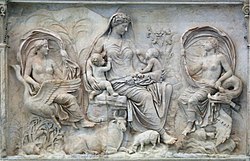
[edit]In classical Latin, the abstract noun velificatio is uncommon,[9] and refers to the act of setting sail, from velum, "sail" (but also "cloth, garment, veil") and the -fic- combining element from -ficio, -ficere (= facio, facere, "do, make"). The verbal form was the basis for modern scholarly usage. Pliny describes Aurae velificantes sua veste, the Breezes "making a sail with their own garment"[10] at the Porticus Octaviae ("Portico of Octavia").[11] Such depictions of the Aurae are known from extant Roman art, and have been used as comparative material to identify the pair of velificantes in a scene from the Augustan Altar of Peace. On the basis of a passage from the Carmen Saeculare of Horace, composed and performed for Augustus's staging of the Saecular Games in 17 BC, the central figure is often identified as Tellus (Earth):
Fertile in produce and cattle, let Tellus grant Ceres a crown of grain; let the healthful waters and breezes of Jove nourish offspring.[12]
Not all scholars agree on this analysis of the scene. The creatures on which the velificantes are seated also suggest Nereids, and the reference may point to the Cult of the Nymphs.[13]
The significance of the veil is sometimes explained in terms of the initiation rites of the mystery religions. Initiates wore drapery or a veil which was lifted by a priestess. The veil was a symbol of death, and its removal in the rite signified the initiate's rebirth. The velificatio thus appears in scenes on sarcophagi and in other funerary art.[14]
-
 Europa (mosaic, 1st–2nd century)
 -
 Pluto (cinerary urn, 2nd century)
 -

-
 Neptune (mosaic, 3rd century)
 -
 French Empire mantel clock (1822) depicting the nereid Galatea
 -
 Aura of Las Incantadas (marble relief, 2nd century AD)


_Aura.jpg)
Outside Greco-Roman culture
[edit]Greek deities were abundantly used in Greco-Buddhist art, so too their depiction elements, as with the Boreas and its velificatio element. Boreas became the Japanese wind god Fujin through the Greco-Buddhist Wardo/Oado and Chinese Feng Bo/Feng Po ("Uncle Wind"; among various other names), spreading the velificatio as an element of portraying deities of the sky.[15][16][17]
List of velificantes
[edit]The velificatio motif may be found with numerous deities, divine beings, and divi, including:[18]
.jpg)
See also
[edit]References
[edit]- ^ Paul Rehak, Imperium and Cosmos: Augustus and the Northern Campus Martius (University of Wisconsin Press, 2006), p. 111.
- ^ Robert Turcan, Les religions de l'Asie dans la vallée du Rhône (Brill, 1972), p. 21.
- ^ Stefania Sorrenti, "Les représentations figurées de Jupiter Dolichénien à Rome", in La terra sigillata tardo-italica decorata del Museo nazionale romano, «L'Erma» di Bretschneider, 1999), p. 370.
- ^ Lise Vogel, The Column of Antoninus Pius (Harvard University Press, 1973), p. 45.
- ^ Hélène Walter, La Porte Noire de Besançon (Presses Univ. Franche-Comté, 1984), vol. 1, p. 332.
- ^ Pliny, Natural History 36.29; Davide Stimilli, The Face of Immortality: Physiognomy and Criticism (State University of New York Press, 2005), p. 172.
- ^ Brunilde Sismondo Ridgway, Hellenistic Sculpture II: The Styles of ca. 200–100 B.C. (University of Wisconsin Press, 2000), passim.
- ^ The term is so used in the art criticism of Walter Benjamin; Aleida Assmann and Jan Assmann, "Air From Other Planets Blowing: The Logic of Authenticity and the Prophet of the Aura", in Mapping Benjamin: The Work of Art in the Digital Age (Stanford University Press, 2003), pp. 153–154.
- ^ It occurs in Cicero, Ad familiares 1.9.21, and not again in Latin literature until Fronto, 267,4–5; Michel P.J. van den Hout, A Commentary on the Letters of M. Cornelius Fronto (Brill, 1999), p. 608.
- ^ Pliny, Natural History 36.29.
- ^ Thomas Köves-Zulauf, "Plinius d. Ä. und die römische Religion," Aufstieg und Niedergang der römischen Welt II.16.1 (1978), p. 277.
- ^ Fertilis frugum pecorisque Tellus / spicea donet Cererem corona; / nutriant fetus et aquae salubres / et Iovis aurae.
- ^ Babette Stanley Spaeth, "The Goddess Ceres in the Ara Pacis Augustae and the Carthage Relief", American Journal of Archaeology 98 (1994), pp. 77–78.
- ^ Elisabeth Matelli, "Hieronymous in Athens and Rhodes", in Lyco of Troas and Hieronymous of Rhodes (Transaction Publishers, 2004), pp. 294–295.
- ^ Konidaris, Dimitrios (2020-06-12). Chinese Civilisation and Its Aegean Affinities (in Greek). ISBN 978-618-84901-1-6.
- ^ Tanabe, Katsumi (2003). Alexander the Great: East-West Cultural Contact from Greece to Japan. Tokyo: NHK Puromōshon and Tokyo National Museum. OCLC 937316326.
- ^ The Global Connections of Gandhāran Art. Archaeopress Archaeology. 2020. doi:10.32028/9781789696950. ISBN 978-1-78969-695-0.
- ^ Unless otherwise noted, the following examples are given by Babette Stanley Spaeth, The Roman Goddess Ceres (University of Texas Press, 1996), p. 223.
- ^ Particularly on Roman-era sarcophagi that depict the myth of Endymion; Sorrenti, "Les représentations figurées", pp. 370, 376.
- ^ The figure at the top of the figured cuirass on the Augustus of Prima Porta is most often identified as Caelus; he is barechested with arms uplifted to support the velificatio; Jane Clark Reeder, "The Statue of Augustus from Prima Porta, the Underground Complex, and the Omen of the Gallina Alba", American Journal of Philology 118 (1997), p. 109. The Caelus on the Belvedere altar is also a velificans; Rehak, Imperium and Cosmos, p. 111.
- ^ On the cuirass of a statue in Cherchel; Rehak, Imperium and Cosmos, p. 111.
- ^ On the Basilica Aemilia frieze in Rome; Rehak, Imperium and Cosmos, p. 111.
- ^ Vogel, The Column of Antoninus Pius, p. 45.
Velificatio
View on GrokipediaEtymology and Definition
Origin of the Term
The term velificatio derives from the Latin velum, denoting a veil, sail, or cloak, combined with facere, meaning to make or perform an action, thus literally signifying "the act of making a sail" or "veiling action." This etymology underscores the motif's resemblance to wind-inflated fabric in artistic representations. The verbal form velificans appears in ancient Roman texts, such as Pliny the Elder's Natural History (36.29), where he describes sculptural figures of "Aurae velificantes sua veste"—breezes spreading their garments like sails—in the decorations of the Porticus Octaviae in Rome.[4] Related imagery of wind-filled sails (vela) features prominently in classical literature, including Virgil's Aeneid, where phrases like plenis velis evoke ships propelled by gusts, as in Book 5, line 263: "subit ostia plenis velis" (enters the harbor with full sails). These literary precedents, evoking dynamic motion through fabric, informed the motif's development in Roman visual culture. In modern art historical scholarship, velificatio is used as a specialized term to denote this recurring billowing drapery convention, enabling systematic analysis and cataloging of Roman sculptures and reliefs in archaeological studies.[3]Description of the Motif
The velificatio motif in ancient art features a figure, often divine or personifying elements like wind or sea, who seizes and elevates a flowing garment—typically a himation, chlamys, or veil—overhead with both arms outstretched, producing undulating drapery that mimics the swell of sails caught in the breeze. This gesture frames the figure's head and upper body, creating a dynamic canopy effect that highlights the subject's ethereal or kinetic presence.[5] In typical compositions, the arms are raised in a near-symmetrical manner, though subtle asymmetries may occur to suggest natural motion, with hands gripping the fabric's edges to hoist it aloft; the resulting folds form triangular or curved sail-like contours, sometimes fringed for added texture. Wings frequently adorn the shoulders or ankles of the figure, amplifying the impression of ascent or propulsion, while the lower body remains grounded or slightly advanced, with one leg forward and knees flexed to convey poised energy.[6] Variations in the motif's execution allow for adaptation across media, appearing as isolated central elements or incorporated into broader scenes, such as processions or marine thiasoi; the garment's materiality is rendered with incised lines or deep carving in reliefs and sculptures to accentuate billowing volume and tactile depth, varying in scale from diminutive accents on coins to prominent features in monumental works.[7]Historical Origins
In Greek Predecessors
The prototypes of the velificatio motif—characterized by a billowing garment signifying divine flight or epiphany—emerge in Archaic Greek art around the mid-6th century BCE, primarily through depictions of winged deities in vase paintings and sculptures where lightweight drapery conveys motion.[8] Earliest examples include Attic black-figure vase paintings, such as a late 6th-century BCE amphora showing a four-winged Nike running or flying while carrying a victor's wreath, her peplos fluttering to suggest speed and aerial grace.[9] Similarly, the Delian Nike, a marble sculpture dated 570–560 BCE attributed to Archermos, portrays the goddess in a stiff Archaic running pose with wings and a peplos whose folds imply dynamic movement, possibly serving as an acroterion on Delos.[10] By the 5th century BCE, these elements evolved in Classical Greek works, with greater naturalism in drapery enhancing the illusion of flight. On the parapet of the Temple of Athena Nike (ca. 425 BCE), relief figures of Nike appear in wind-swept poses, such as adjusting a sandal or holding a cloak, their thin chitons clinging to the body with undulating, wet-look folds that emphasize subtle vitality without exaggerated billowing.[11] In Attic red-figure pottery, predecessors are evident in portrayals of winged deities like Iris and Eros, where drapery suggests ethereal motion; for instance, works in the manner of the Berlin Painter (ca. 480 BCE) depict Eros flying with a libation dish, his light garment fluttering naturally to evoke weightlessness. Iris appears on 5th-century BCE vases with flowing robes that link her role as sky messenger to dynamic, velificatio-like poses.[8] These Greek representations differ from later Roman iterations of the motif by prioritizing lightweight chitons that flutter organically and cling to forms, often without raised arms or sail-like expansion, focusing instead on harmonious naturalism and the body's underlying structure to convey flight.[12] The Nike of Paionios (ca. 420 BCE), for example, exemplifies this with a thin mantle billowing behind in undulating folds carved to simulate wind, highlighting the sculptor's skill in rendering motion through subtle, body-conforming drapery rather than dramatic framing.[13] Such conventions in Archaic and Classical art provided foundational influences for the motif's subsequent adoption and stylization.[8]In Roman Adoption and Evolution
The velificatio motif entered Roman art during the late Republic, around the 1st century BCE, primarily through Hellenistic influences and imported Greek sculptures that introduced dynamic drapery effects to depict divine movement. This early adoption is evident in Republican-era reliefs, such as the so-called Altar of Domitius Ahenobarbus (c. 100 BCE), which features a marine thiasos procession in a maritime context.[14] During the Imperial period (1st–3rd centuries CE), velificatio reached its peak proliferation, becoming a staple in monumental works like sarcophagi and triumphal arches, where artists exaggerated the billowing fabric for heightened dramatic impact and to convey motion in narrative scenes. On Trajan's Column (113 CE), for instance, the figure of Nox employs velificatio to symbolize nocturnal passage amid the Dacian campaigns, integrating the motif into historical reliefs for symbolic depth. Similarly, the device proliferated on funerary sarcophagi from the 2nd century CE onward, appearing as a framing element for deities, reflecting its widespread adaptation in elite burial art.[15] Over time, the motif evolved from primarily divine representations in public monuments to prominent funerary applications, particularly on sarcophagi, where it shifted toward themes of apotheosis and eternal journey. This change coincided with increased realism in rendering fabric folds, achieved through the influx of Greek-trained sculptors to Rome, who refined Hellenistic techniques for more naturalistic drapery.[16] By the late Empire (4th century CE onward), velificatio waned as Christian iconography supplanted pagan motifs, though vestiges persisted in transitional late antique art before fading with the dominance of new religious imagery.Symbolism and Interpretations
Associations with Deities and Winds
The velificatio motif is intrinsically linked to the wind gods of Greek and Roman mythology, the Anemoi and Venti respectively, where the billowing drapery evokes the capture or manifestation of winds themselves. This symbolism underscores the deities' role as elemental forces driving seasonal change and natural motion, with the raised garment forming an arch that mimics gusts in flight. In depictions, such as the Greco-Buddhist sculpture of Boreas from Hadda (now in the Musée Guimet, Paris), the north wind god is framed by a cloak billowed overhead, emphasizing his stormy vigor.[17] Similarly, minor wind spirits known as Aurae—daughters of the Anemoi—are iconographically defined by the velificatio, as seen in Roman reliefs where their garments arch to signify gentle breezes distinct from the fiercer principal winds.[18] Pompeian frescoes further illustrate this, portraying Zephyrus, the west wind, with flowing drapery that captures his springtime essence alongside Chloris, highlighting the motif's role in evoking ethereal propulsion.[19] The motif also ties closely to messenger deities like Hermes (Greek) and Mercury (Roman), as well as Nike (Greek) and Victoria (Roman), symbolizing divine speed and triumphant flight across realms. For these figures, the velificatio conveys rapid transit and epiphanic arrival, with the drapery's movement contrasting their agile, winged forms against more grounded poses. Mercury, as psychopomp and herald, appears with a billowing mantle in mosaics and statues, such as those from Paphos, Cyprus, where the attribute aligns him with nymphs and swift gods to denote boundary-crossing velocity.[20] Likewise, Victoria and Nike often bear the motif in victory iconography, as in Gandharan adaptations where they hold palm fronds under arched garments, blending Roman imperial symbolism with Hellenistic dynamism. The motif appears on Roman coins and gems in representations of winged Victoria, emphasizing themes of conquest and divine favor.[16] Beyond specific deities, the velificatio embodies broader elemental symbolism as a metaphor for the gods' breath animating the cosmos, evoking intangible forces like air currents that infuse divine presence with motion. This arching drapery, borrowed from maritime and aerial vocabularies, distinguishes ethereal deities from immobile ones, framing epiphanies as lively interventions in the mortal world. In contexts like the Ara Pacis reliefs, it subtly integrates wind motifs to suggest harmonious natural order under divine auspices, prioritizing fluid energy over rigid form.[21] Such usage reinforces the motif's conceptual depth, linking the visible swirl of fabric to the invisible pneuma or spirit of the gods.[18]Funerary and Apotheosis Contexts
In Roman funerary art of the 2nd and 3rd centuries CE, the velificatio motif frequently appears on sarcophagi through depictions of winged genii or Victoriae figures bearing aloft small soul-figures or flanking the deceased, symbolizing the apotheosis and upward journey of the soul to the heavens. These ethereal beings, often rendered as youthful males with spread wings and billowing drapery caught in the wind, represent guardian spirits facilitating the liberation from earthly ties and the transition to divine immortality. For instance, on the Phaedra sarcophagus (2nd century CE, now in the Camposanto, Pisa), four such winged genii support a canopy of draped fabric over the reclining deceased, evoking a divine pavilion and the soul's triumphant ascent, a composition that underscores the motif's role in conveying eternal elevation.[22][23] The billowing drapery in these representations serves as a symbolic "vehicle" for the soul's flight, aligning with ancient conceptions of the spirit as an aerial, nebulous entity propelled by winds toward celestial realms. This interpretation draws from broader pagan eschatological traditions, where the soul undergoes purification through elemental forces—earth, water, air, and fire—before achieving stellar immortality, as visualized in reliefs showing genii amid winds, tritons, and dolphins on sarcophagi and grave markers. Variations include paired genii symmetrically positioned on either side of the deceased's portrait on grave stelai, such as those from the 2nd century CE in Rome and Ostia, where they emphasize communal protection and the soul's release from mortal bonds, often with inverted torches signifying the end of earthly life. Solitary genii also appear on stelai, guiding the soul upward in isolation, reinforcing personal salvation.[23] These motifs reflect influences from Orphic and Pythagorean philosophies, which posited the soul's inherent immortality and potential for transmigration or eternal ascent to the stars following purification and moral judgment. Orphic gold tablets found in South Italian tombs (4th-3rd centuries BCE, influencing later Roman practices) instructed the soul to declare its divine origin and ascend past guardians to Elysian fields or the heavens, a journey echoed in the velificatio's dynamic imagery of flight. Pythagorean doctrines, emphasizing the soul's ethereal essence returning to the cosmic ether or moon after death, similarly informed depictions of genii aiding the ascent, as seen in Virgil's descriptions of souls rising through planetary spheres (Aeneid VI). By the 3rd century CE, such symbolism permeated elite Roman funerary commissions, blending with imperial apotheosis iconography to affirm the deceased's deification.[23]Representations in Art
In Sculpture and Reliefs
In Roman relief carving, the velificatio motif was executed through advanced techniques that emphasized the illusion of movement and depth in the billowing fabric. Sculptors employed deep undercutting, often using drills to hollow out the folds of garments, creating pronounced shadows that enhanced the perception of wind-swept drapery even in shallow bas-relief.[24] This method is evident in the friezes of the Ara Pacis Augustae (13-9 BCE), where female figures such as the Horae display raised arms holding cloaks aloft, with undercut channels accentuating the fabric's flow and generating dynamic light effects across the marble surface.[25] Such drilling and chiseling not only separated layered cloth from the background but also allowed for intricate detailing of pleats, contributing to the motif's epiphanic quality in imperial propaganda art. Free-standing sculptures adapted velificatio to three-dimensional forms, often in bronzes and marbles that highlighted the figure's contrapposto pose and elevated arms to evoke flight. A notable example is the bronze statuette of Isis Pharia (1st-2nd century CE), where the goddess raises her mantle in a velificatio gesture, her body twisted in contrapposto to suggest forward motion, with the metal's patina and casting allowing for fluid, lightweight drapery that contrasts with the solidity of her form.[26] Similarly, marble statues like the Roman depiction of Selene (2nd century CE) from the Capitoline Museums employ raised arms to billow the veil, utilizing the stone's translucency to model soft, voluminous folds that wrap dynamically around the contrapposto torso, emphasizing the deity's nocturnal ascent.[27] These works, often copies of Hellenistic prototypes, integrated the motif into full-round compositions, where the viewer's circumambulation revealed varying angles of the garment's tension and release.[28] Material choices influenced the rendering of velificatio, with marble favoring textured, carved drapery that captured static elegance and bronze enabling more kinetic, cast expressions of motion. Marble's fine grain, as in Proconnesian varieties from Asia Minor quarries, permitted precise incising of shallow folds and heavy swathes, ideal for monumental reliefs and statues where light played across polished surfaces to simulate weighty yet airborne cloth.[29] Bronze, conversely, supported thinner, more exaggerated billows through lost-wax casting, allowing armatures for extended poses without structural compromise, as seen in small-scale deities where the alloy's tensile strength conveyed swift, wind-driven epiphanies.[30] Regional workshops in Asia Minor, particularly at Aphrodisias and Perge, specialized in these adaptations, producing velificatio figures with localized stylistic traits such as deeper, more angular folds in marble sarcophagi and bronzes, reflecting the area's access to diverse quarries and Hellenistic influences that prioritized dramatic drapery for funerary and votive contexts.[31][32]In Painting and Mosaics
In Roman wall paintings, particularly those from Pompeii dating to the 1st century CE, the velificatio motif was rendered through linear drapery lines and subtle color gradients to evoke the illusion of wind-swept movement and ethereal quality. Artists employed fine brushwork to depict flowing mantles held aloft by figures such as Nikes, often in airy, open compositions that emphasized divine flight or victory; a notable example is the Fourth Style fresco of a winged Nike in the Great Gymnasium at Pompeii, where the billowing garment contrasts against a dark background to heighten the sense of dynamism.[33][34] This technique allowed painters to integrate the motif into domestic or public spaces, using vibrant hues like reds and blues to suggest transparency and depth in the fabric.[35] In mosaic applications, prevalent in North African Roman sites from the 2nd to 4th centuries CE, tesserae of glass, stone, and shell were meticulously arranged to simulate the transparency and billowing of velificatio garments, creating a shimmering effect that mimicked light passing through thin cloth. At the Bardo National Museum in Tunis, mosaics depicting marine processions or victory themes feature Nereids and personifications with raised veils, where varied tesserae sizes and colors convey folds and gusts.[36] These works often portrayed the motif in victory or sea-related contexts, with figures like sea nymphs holding mantles aloft amid tritons and fish, enhancing the narrative flow of larger floor panels.[21] Due to the inherent constraints of mosaic media, velificatio renderings in paintings and tessellated surfaces adopted a flatter, more stylized appearance compared to sculptural forms, prioritizing planar composition over volumetric depth while embedding the motif seamlessly into expansive narrative scenes rather than as isolated elements. This integration highlighted the motif's role in broader mythological or decorative schemes, with color and texture serving to unify the overall pictorial space.[33]Notable Examples and Figures
Mythological Velificantes
In ancient Roman art, the god Mercury (the Roman counterpart to the Greek Hermes) is commonly portrayed performing the velificatio gesture, characterized by a billowing chlamys that frames his dynamic, winged form in flight while he holds the caduceus. This depiction emphasizes his role as a swift messenger and psychopomp. A prominent example is the Mercury of the Belvedere, a marble statue from the 2nd century CE Roman copy of a 4th-century BCE Greek bronze original, now in the Vatican Museums' Museo Pio-Clementino, where the draped mantle flows behind the nude figure to convey motion and divine epiphany.[37] The personification of victory, known as Victoria in Roman mythology or Nike in Greek, frequently appears with the velificatio, her cloak and wings billowing to signify triumphant ascent and divine favor. These figures are often paired in compositions to amplify themes of imperial success. On the Gemma Augustea, an onyx cameo from the early 1st century CE housed in the Kunsthistorisches Museum in Vienna, two Victories execute the gesture while crowning seated imperial figures, their garments arching overhead in a stylized display of motion and celestial endorsement. The Anemoi, the personified wind deities equivalent to the Roman Venti, are depicted as vigorous blowing figures with cloaks caught in the velificatio pose to evoke the forceful gusts they embody. This artistic convention highlights their elemental power and directional attributes. The reliefs adorning the Tower of the Winds in Athens, constructed in the 1st century BCE during the Roman period, feature the eight Anemoi—such as Boreas with his heavy cloak billowing as he sounds a conch—each facing their respective cardinal direction in low-relief friezes that integrate the gesture with meteorological symbolism.[38][39] These mythological velificantes underscore symbolic ties to winds and ethereal transit, framing the deities as harbingers of divine intervention.Funerary and Historical Velificantes
In Roman funerary art, the velificatio motif frequently symbolizes the soul's ascent or maritime journey to the afterlife, often embodied by deities or personifications acting as psychopomps. A key example is the depiction of Isis velificans on a third-century AD painted linen shroud from a tomb in Memphis, Egypt, where the goddess stands at the prow of a boat, her himation billowing like a sail to guide the deceased through the perilous crossing of the cosmic waters. This imagery draws on Isis's established role as protector of navigators and the dead, blending Egyptian and Roman traditions to assure safe passage to divine realms.[40] Sarcophagi from the second and third centuries AD commonly integrate velificantes into marine thiasos scenes, where sea nymphs (Nereids) and tritons hold aloft flowing garments to evoke eternal motion and renewal for the deceased. The Sarcophagus with a Marine Thiasos in Rome's Galleria Borghese exemplifies this, featuring a central medallion portrait of the interred individual flanked by dynamic figures whose veils frame their forms, suggesting the soul's triumphant voyage amid divine attendants. Similarly, the accompanying lid portrays the Horae (personifications of the seasons) in velificatio, their billowing mantles linking cyclical time to the promise of rebirth beyond death.[1][41] Historical velificantes in funerary contexts often manifest as allegorical personifications rather than individualized figures, emphasizing virtues or cosmic forces relevant to commemoration. Victoria, the Roman personification of victory, appears on sarcophagi like the early third-century AD example in the Walters Art Museum, where winged Victories with dramatically inflated cloaks crown trophies and support garlands around the deceased's remains, signifying conquest over mortality itself. Another instance is the personification of Luna (the Moon) on a sarcophagus lid with the Capitoline Triad in the Galleria Borghese, her mantle forming a luminous velificatio that evokes celestial guidance for the soul's nocturnal ascent. These non-mythic embodiments underscore the motif's adaptability to imperial ideals of triumph and harmony in death.[42][43]References
- https://commons.wikimedia.org/wiki/File:WindGod2.JPG
- https://commons.wikimedia.org/wiki/File:Zeffiro-e-clori---pompeii.jpg