Hubbry Logo
VentricinaVentricinaMain
Open search
Ventricina
Community hub
Ventricina
logo
8 pages, 0 posts
0 subscribers
Be the first to start a discussion here.
Ventricina
Ventricina
from Wikipedia

Ventricina del vastese

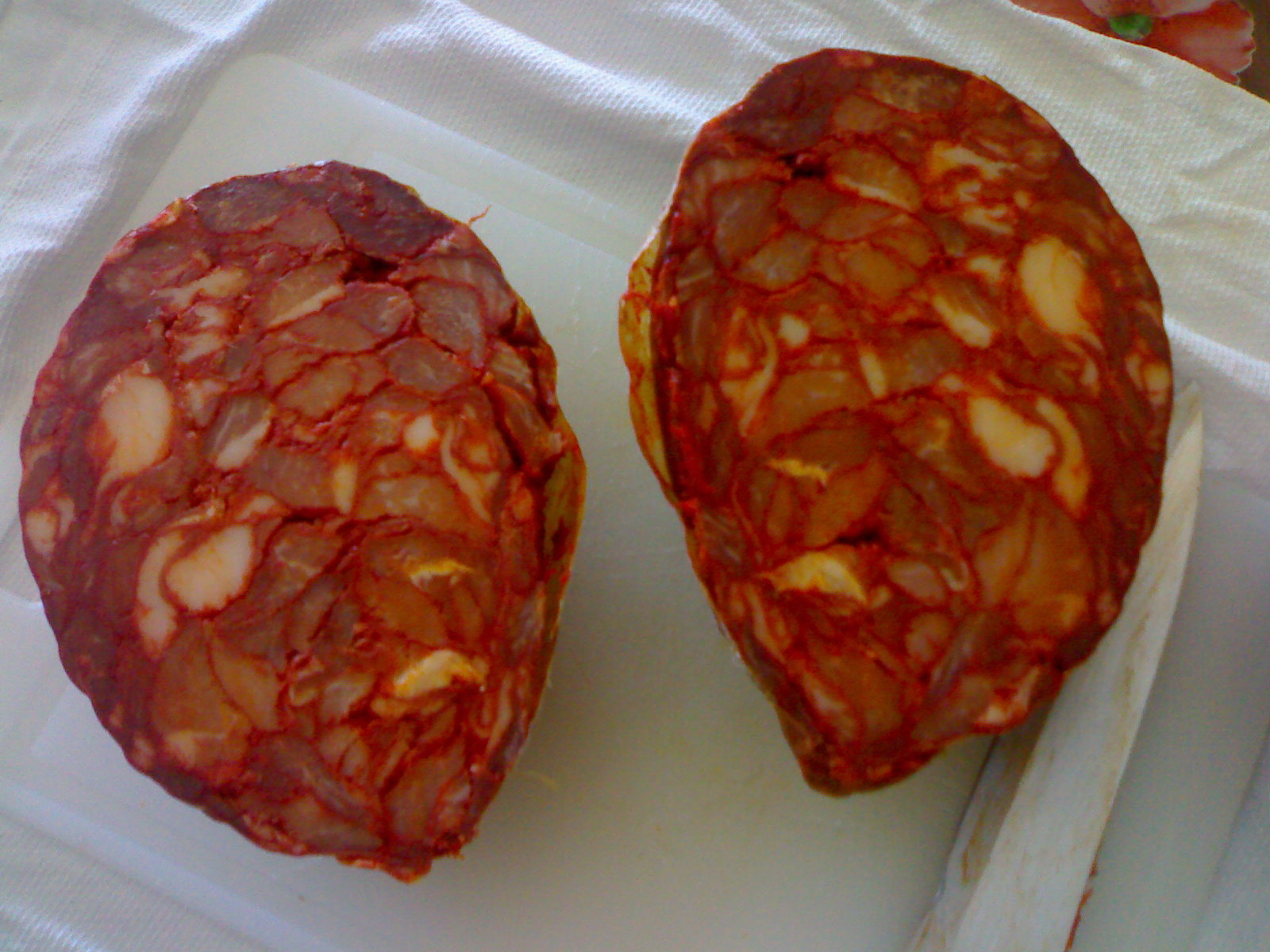
Ventricina is a dry fermented pork sausage commonly produced in the Abruzzo region of Italy.[1][2] Its most common artisanal version, ventricina del vastese, from the Vasto area, is made with large pieces of fat and lean pork.

The meat is pressed and seasoned with powdered sweet peppers and fennel and encased in dried pig stomach.[3]

The name derives from the belly of the pig giving the sausage its typical subovoid shape. It is officially recognised as a traditional agri-food product of Abruzzo (prodotti agroalimentari tradizionali abruzzesi).[4][5]

See also

[edit]

References

[edit]
[edit]
Revisions and contributorsEdit on WikipediaRead on Wikipedia
from Grokipedia
Ventricina is a traditional Italian cured originating from the and regions, renowned for its bold spicy flavor, coarse texture from hand-cut meat, and vibrant red-orange hue imparted by chili peppers and . Typically made from lean cuts such as , , , and ham mixed with fat or , ventricina is seasoned with salt, , wild seeds, , and varying levels of sweet or spicy peppers before being coarsely chopped by hand using a "knife tip" method. The mixture is then stuffed into natural casings like pig bladders or stomachs, which contribute to its characteristic oval or pear shape, and undergoes followed by extended air-drying in cool conditions, often lasting several months to develop its complex, balanced spiciness tempered by aromatic . Ventricina exists in distinct regional varieties that reflect local traditions and ingredients. The Ventricina del Vastese, from the in , features a firm, chewy consistency with 70% lean noble and 30% fat, aged for up to eight months and yielding sausages weighing 1–3 kg, often celebrated at annual festivals in . In contrast, Ventricina Teramana from the Teramo area is softer and more spreadable due to its higher fat content (50–60%) and finer grind, incorporating , orange peel, and , with initial drying near a for about one week to impart a smoky note, then curing in a cool environment, becoming edible after a few weeks but reaching ideal maturity after three months. Another variant from Montenero di Bisaccia in uses thigh meat aged for up to 1.5 years, available in sweet or spicy forms. Historically a product of rural necessity—once made from scraps by tenant farmers and used as —ventricina nearly faced in the mid-20th century due to industrialization but has seen revival through artisan producers and preservation efforts. Today, it is prized for its artisanal quality, with a high production failure rate underscoring the skill required, and is commonly enjoyed sliced on , in sandwiches, or paired with wine.

Etymology and Origins

Etymology

The name Ventricina derives from the Italian word ventre, meaning "" or "," which refers to the traditional stuffing of the into casings made from the pig's bladder or stomach. This Italian term ventre traces its roots to the Latin venter, denoting the or womb, a word that has influenced various through its Proto-Indo-European origins related to swelling or enclosure. The diminutive Latin form ventriculus, meaning "little ," further underscores this anatomical connection in historical linguistic evolution. Regionally, in the area, the product is known as Ventricina del Vastese, with "del Vastese" indicating its association with the territory around . This naming reflects a common pattern in Italian cured meat terminology, where designations often highlight geographic or preparatory specifics.

Historical Origins

originated in the and regions of , where it emerged as a traditional cured using local ingredients for long-term . By the 18th century, variants such as ventricina teramana (also known as ventresca) and ventricina vastese had gained notable recognition, reportedly appreciated by the King of Naples during the Bourbon era. This appreciation underscores its early status as a valued regional product, with the first documented evidence of the preservation technique—stuffing spiced pork into the animal's stomach or bladder—appearing in the early 19th century. Possible earlier allusions exist, such as in Boccaccio's Decameron (14th century). Specific documentation includes Gennaro Finamore's 1800 Abruzzese-Italian vocabulary defining it as "vendricine" (salami stuffed in pig tripe) and the 1811 Statistica Generale del Regno di Napoli. The method reflected peasant practices in these rural areas, where families preserved excess pork to sustain households through harsh winters and limited resources. A significant milestone in its recognition occurred in , when Ventricina del Vastese from secured first prize in a national Italian competition, highlighting its enduring quality and artisanal heritage.

Production Process

Ingredients

Ventricina, a traditional cured from , , is crafted primarily from select , with lean cuts such as the , , and being the most commonly used portions in authentic recipes, mixed with fat; these are coarsely chopped or ground to achieve the desired texture. The is sourced from local pigs raised in the region to ensure quality and flavor authenticity, reflecting the area's pastoral heritage. Pork fat constitutes a significant portion of the mixture, typically ranging from 30% to 40% by weight, which provides the necessary balance of richness and spreadability without overpowering the lean components; in some variants like Ventricina del Vastese, this ratio is maintained at around 30% to 70% lean meat. This is often derived from the belly or back, diced and incorporated to enhance moisture and tenderness during curing. The spice profile is bold and defining, featuring high quantities of chili peppers (peperoncino), both sweet and hot varieties, which impart the characteristic spiciness and vibrant red hue; these are usually ground or powdered and comprise a substantial part of the . Salt serves as the primary preservative, while adds sharpness; optional additions like seeds, , , and orange peel provide aromatic depth, with being particularly emblematic of Abruzzo's wild herb traditions. Traditional recipes employ natural casings such as bladders or stomachs, which give it its characteristic shape, to encase the mixture, allowing for proper air circulation during the curing process; in some historical preparations, particularly for Ventricina del Vastese, bladders or stomachs are used for their larger size and shape. Regional variations may adjust spice levels, with hotter profiles more common in inland areas.

Preparation and Curing

The preparation of ventricina begins with the selection and processing of meat, typically consisting of lean cuts such as , , or combined with fat from or . Traditionally, the meat is coarsely chopped by hand using the 'knife tip' (alla punta del coltello) method into medium-sized pieces to achieve a coarse texture, though in some regions like Teramo, it may be ground using a manual or mechanical grinder fitted with a 1-2 mm grid for a finer consistency. Once prepared, the chopped or ground is thoroughly mixed with salt and spices to initiate the curing and enhance flavor preservation. This mixture is allowed to rest for 24 to 48 hours—often overnight—to allow the salt to penetrate evenly and draw out moisture, facilitating . In historical contexts, this step was performed in wooden troughs using manual tools to ensure uniform distribution. The seasoned meat mixture is then stuffed into natural casings, preferably derived from the pig's or , to form logs or compact shapes. These are tightly tied with string to maintain form and promote even , preparing them for the maturation phase. Curing occurs through air- in controlled, cool, and humid environments, such as cellars or dedicated drying rooms, to prevent spoilage while developing the characteristic flavors. The sausages are then air-dried in controlled environments, often starting with a brief period in a warm for some variants to promote mold growth, followed by cooler conditions of 6–13°C (42–55°F). The process lasts ranging from a few weeks to over a year, depending on the variety and desired maturity, with regular monitoring for mold development—white molds are encouraged for protection, while excess is cleaned off before applying a thin layer of to seal the surface and control further weight loss. Hot chili peppers incorporated during mixing contribute to preservation by inhibiting .

Varieties

Spreadable Ventricina

Spreadable ventricina, also known as ventricina teramana, is a soft, paste-like variety of this traditional Abruzzese originating primarily from the in the region of . It is distinguished by its finer grind of meat and higher fat content, typically comprising 50-60% fat from selected cuts and , which contributes to its creamy, spreadable consistency after curing. This version contrasts with the firmer, compact form produced in other areas like by yielding a product that can be spread directly on or used in cooking rather than sliced. The production process begins with finely mincing high-quality cuts such as and scraps alongside , salt, , , fennel seeds, sweet and hot peppers, and orange peel, creating a homogeneous mixture dotted with coarsely chopped spices. The mixture is then stuffed into natural hog casings, often resulting in the characteristic pot-bellied shape, and undergoes initial near a for about one week to impart a smoky note, followed by a curing period of 1 to 3 months in controlled cool environments to develop its flavors without hardening. This relatively brief maturation allows for consumption as early as a few weeks post-preparation, though optimal taste is achieved around three months. A defining feature of spreadable ventricina is its intense spiciness, derived from a higher proportion of hot chili peppers relative to the volume, balanced by the richness of the and aromatic . The final product exhibits a light pink hue and a bold, pungent aroma that makes it a staple for direct spreading on crusty or incorporation into regional dishes like sauces.

Compact Ventricina

Compact Ventricina, also known as the sliceable or firm variety, is characterized by its coarser grind of meat into irregular cubes approximately 3 cm for lean portions and 1.5 cm for , creating a heterogeneous, dense texture suitable for cutting into thin slices. This results in a balanced content of around 30%, derived from a mix of 70% lean cuts like and and 30% from , which contributes to its marbled appearance with visible white flecks interspersed among and orange-red pepper grains. In production, the is manually chopped by rather than finely ground, mixed with salt (2.8-3.0%), dried sweet or spicy peppers (2.4-2.8%), , and wild seeds, then rested for 24-48 hours before stuffing into larger natural casings such as bladders or blind guts, forming subovoid or pear-like shapes weighing 1-3 kg. Curing occurs over a longer period of 3-6 months in controlled environments below 13°C, starting with 4-5 days at 6-7°C for , followed by drying and maturation in rooms, often with applied after 50-60 days to protect the surface and enhance flavor. This extended process yields a firm, compact product with an orange-red hue and subtle white mold on the rind. This variety predominates in the area of , where it is produced as Ventricina del Vastese, and extends into the Trigno Valley of , with local adaptations maintaining the compact form. In the variant from Montenero di Bisaccia, thigh meat is used and aged for up to 1.5 years, available in or spicy forms. It holds protected status through the Presidium, recognizing its cultural and artisanal significance, and has pursued Denominazione di Origine Protetta (DOP) recognition to safeguard traditional methods.

Characteristics and Flavor Profile

Texture and Appearance

Compact varieties of ventricina, such as Ventricina del Vastese, exhibit a distinctive reddish-orange hue throughout its interior, derived from the incorporation of dried and chopped chili peppers during preparation, which evenly permeates the lean meat and components. The cut surface reveals prominent marbling from visible chunks of pork , creating a heterogeneous pattern that highlights its coarse grain structure. Externally, the is encased in a hog bladder or intestine, often developing a thin layer of mold (piumatura) that contributes to a rustic, dry surface appearance, sometimes accented by traces of ground pepper or a light coating for protection. In its compact varieties, such as Ventricina del Vastese, the texture is firm yet sliceable, with a chewy consistency that allows for cohesive cuts without crumbling, reflecting a balanced moisture level achieved through extended curing. This form maintains a compact, non-excessively dry structure, where the even distribution of spices and ensures uniformity without oiliness or rancidity. Conversely, spreadable types like Ventricina Teramana feature a softer, creamier texture due to higher content (50–60%), making it easily scoopable and homogeneous when spread, with a light pink tone dotted by coarsely chopped ingredients. Compact varieties are typically produced in large formats, measuring 20 to 40 cm in length and weighing between 1 and 3 kg, often shaped as irregular sub-ovoid or pear-like logs that evoke the traditional hog bladder casing. Spreadable varieties like Teramana are smaller, typically 250–400 g, and often packaged in jars. Quality is indicated by the uniform integration of and spices across the interior, avoiding any signs of uneven drying or surface defects that could compromise the overall integrity.

Taste and Spices

Ventricina's flavor profile is characterized by a bold spicy heat primarily from hot chili peppers, or , which provides a sharp, lingering warmth that defines its regional identity in . This heat is balanced by the deep savory of coarsely ground , enhanced during the curing process, and a subtle contributed by the meat's and sweet peppers in the blend. The aroma of Ventricina is pungent and intensely peppery, evoking cured with prominent notes of chili, , and fresh seeds, while during aging introduces subtle earthy and tangy undertones. These sensory elements emerge fully after the maturation period, which typically ranges from a few weeks to several months depending on the variety. The composition varies slightly by producer and sub-variety, but typically features and for grounding pungency, sweet and hot chili peppers for layered heat, wild seeds for anise-like freshness, and occasional additions like , , or orange peel for nuanced depth. Heat levels range from mild, emphasizing aromatic balance, to very hot, where dominates, allowing adaptability while preserving the salami's robust character. Regional differences, such as more fennel-forward profiles in Vastese versus rosemary accents in Teramana, further tailor the spice intensity. This pronounced spiciness effectively cuts through the richness of the pork fat, rendering Ventricina particularly suited to bold palates and pairings that temper its intensity, such as robust wines or crusty breads.

Cultural and Culinary Significance

Regional Importance

Ventricina holds a central place in the cultural fabric of and , embodying the rural heritage of these regions through its ties to traditional festivals and communal celebrations. In , dedicated events such as the annual Ventricina Festival in Fresagrandinaria and the Sagra della Ventricina in Palmoli highlight its importance, where locals and visitors gather to sample the , participate in tastings, and honor the artisanal craft that reflects the area's agrarian roots and seasonal rhythms of and curing. These gatherings underscore ventricina's role as a of pride and historical continuity, linking modern festivities to ancient practices of in the hilly landscapes of the Vastese area. Economically, ventricina sustains small-scale producers in and , particularly through initiatives like the Presidium for Vastese Ventricina, which enforces traditional methods and supports a limited number of artisans using local heavy pigs raised without GM feed. In the Teramo province, the product's high local demand drives seasonal production, benefiting family-run operations that produce it in autumn for year-round sales, while commercial adaptations like jarred versions have emerged since the 1950s to meet broader markets without compromising heritage techniques. The Foundation's recognition, including Teramo Ventricina's inclusion in the , aids preservation by promoting and , fostering sustainable economic opportunities for these rural communities. Socially, ventricina's production reinforces intergenerational bonds, with family recipes passed down through generations in and , as seen in operations like Fattorie del Tratturo, where producers inherited and enhanced the craft from their forebears to emphasize local ingredients such as wild and chili. Community curing events, often tied to harvest seasons, bring families and neighbors together for the labor-intensive process of hand-chopping meat and stuffing casings, preserving not just the food but also the oral traditions and social rituals of these regions. This communal aspect has earned ventricina national acclaim, including awards for excellence in Italian production.

Uses in Cuisine

Ventricina is commonly featured in antipasti platters, where it is sliced thinly and arranged alongside other cured meats, olives, and cheeses to create a balanced charcuterie board. Its bold, spicy profile makes it an ideal component for appetizers, often paired with aged Pecorino cheese, whose sharp, salty notes complement the salami's heat and fattiness. In traditional Abruzzese meals, it is also incorporated into sandwiches or spread generously on crusty bread for a simple yet flavorful panino. The shines in dishes, where finely chopped or crumbled Ventricina is sautéed to render its fat and infuse sauces with spicy depth, as in a rustic served over or , finished with a grating of . For wine pairings, Ventricina harmonizes particularly well with robust reds like , whose fruity cut through the richness of the and spices. The compact variety is typically sliced paper-thin to allow its intense flavors to meld without overwhelming the , while the spreadable type lends itself to being slathered on warm or mixed into quick sauces. In contemporary cuisine, Ventricina has gained popularity as a topping, scattered over with and to add a piquant crunch after . It also appears in gourmet , where the spreadable form is dolloped onto toasted slices of with a drizzle of or alongside fresh arugula for contrast. Due to its potent spice and fat content, Ventricina is best served at room temperature to fully release its aromas and textures, enhancing its integration into both traditional and innovative dishes.

References

Add your contribution
Related Hubs
User Avatar
No comments yet.