


Community hub
Recent from talks
Contribute something
Nothing was collected or created yet.
Viili
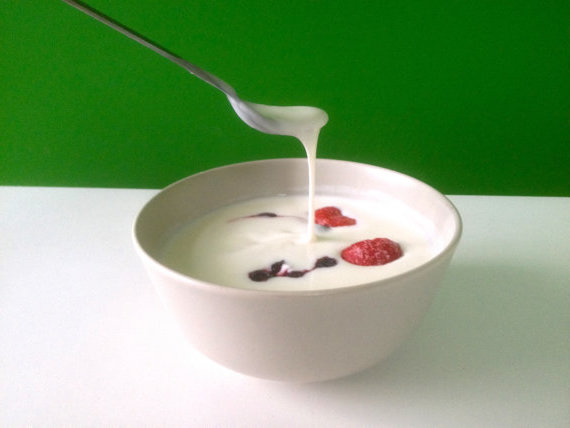
View on Wikipedia Finnish viili with strawberries and blueberries | |
| Type | Fermented milk |
|---|---|
| Place of origin | Nordic countries |
| Main ingredients | Milk, bacterial and yeast culture |

Viili (Finnish) or Fil (Swedish) is a mesophilic fermented milk product found in the Nordic countries, particularly Finland and Sweden. Viili is similar to yoghurt or kefir, but when left unmixed, its texture is malleable, or "long". The metabolism of the bacteria used in the fermentation also gives viili a slightly different taste.
This cultured milk snack resembles yoghurt and is the result of microbial action of lactic acid bacteria (LAB) and a surface-growing yeast-like fungus Geotrichum candidum present in milk, which forms a velvet-like surface on viili. In addition, most traditional viili cultures also contain yeast strains such as Kluveromyces marxianus and Pichia fermentans. The lactic acid bacteria identified in viili include the acid‐producing Lactococcus lactis subsp. lactis and L. l. cremoris as well as the aroma producers L. lactis subsp. lactis biovar diacetylactis and Leuconostoc mesenteroides.[1] Among those mesophilic LAB strains, the slime-forming Lc. lactis subsp. cremoris produce a phosphate-containing heteropolysaccharide, named viilian. Viilian is similar to kefiran produced by kefir grains. The production of exopolysaccharides (EPS) by the strain forms the consistency character of viili and it has been claimed to have various functional benefits toward the rheological properties of milk products and the health improving potential.
In modern practice, pasteurized milk is used, fermentation is carried out in a dairy plant in controlled conditions using laboratory-grown cultures and the product sold fresh. Viili is widely available in Finland and Sweden in grocery stores in several variants, both natural and with berries or other tastes. In Sweden it is also common to have different LAB and yeast strains that give the Fil different tastes.
Other variants
[edit] |
Several variants of fermented milk products are found in Western Finland and Sweden, such as filmjölk ("viili milk") or långfil ("long viili"), which vary in consistency and fermentation. In Norway, filmjölk is usually named "kulturmelk" ("cultured milk") or "surmelk" ("sour milk"), while in Gotland and Iceland, the name "skyr" is used to refer to fresh cheese that is eaten in ways similar to yoghurt variants. Additionally in Iceland "súrmjólk" is a local variant of filmjölk.
The Swedish variant most resembling viili is called filbunke.
Cream viili (Finnish: kermaviili) is made from cream instead of milk, and is used in cooking like sour cream, or with dill, chives and other spices as cold sauce for fish, or as a base for dip sauces.
References
[edit]- Leporanta, K. 2003. Viili and Långfil – exotic fermented products from Scandinavia. Valio Foods & Functionals. On line version
- Mistry, V. V. 2004. Fermented liquid milk products. In: Handbook of food and beverage fermentation technology. (Ed. Y. H. Hui, L. Meunier-Goddik, Å. S. Hansen, J. Josephsen, W. Nip, P. S. Stanfield and F. Toldrá) Marcel Dekker, Inc. New York, U.S.A.
- Ruas-Madiedo, P., M. Gueimonde, C. G. De los Reyes-Gavilán and S. Salminen. 2006. Short communication: Effect of exopolysaccharide isolated from “viili” on the adhesion of probiotics and pathogens to intestinal mucus. J. Dairy Sci. 89:2355-2358.
- Shurtleff, W. and A. Aoyagi. 2004. History of Fermented Soymilk and Its products: History of Soybeans and Soyfoods: 1100 B.C. to the 1980s. Soyfoods Center, Lafayette, California.
- ^ Kahala, M.; Mäki, M.; Lehtovaara, A.; Tapanainen, J.-M.; Katiska, R.; Juuruskorpi, M.; Juhola, J.; Joutsjoki, V. (2008). "Characterization of starter lactic acid bacteria from the Finnish fermented milk product viili". Journal of Applied Microbiology. 105 (6): 1929–1938. doi:10.1111/j.1365-2672.2008.03952.x. PMID 19120639.
External links
[edit]

Viili
View on GrokipediaDescription
Physical and Sensory Properties
Viili possesses a distinctive ropy and gelatinous texture, attributed to exopolysaccharides produced during fermentation, which imparts a malleable and stringy consistency when the product is fresh and unmixed. This allows it to form a thick, velvet-like surface layer that can be readily spooned off, contributing to its semi-solid, spoonable form with a tough yet elastic body that can be cut easily.[5] Visually, viili displays a white to off-white color reminiscent of fresh milk, often developing a cream layer on the surface in traditional preparations. Slight separation of whey may occur if left undisturbed for extended periods or in warmer conditions, resulting in a clearer liquid atop the denser curd. Its aroma is fresh and milky, with prominent diacetyl notes providing a buttery undertone.[5][6] In terms of taste and mouthfeel, viili offers a mildly sour profile with a pleasant sharpness from lactic acid, delivering a creamy and sticky sensation on the palate that is less tangy overall than yogurt. The combination yields a balanced, agreeable sensory experience, highlighting its smooth viscosity without excessive acidity.[7]Comparison to Similar Products
Viili, a traditional Nordic fermented milk, differs markedly from common counterparts like yogurt and kefir in its fermentation process, which occurs mesophilically at room temperature (20–22 °C) using lactic acid bacteria such as Lactococcus lactis subsp. cremoris, in contrast to the thermophilic fermentation of yogurt at higher temperatures (40–45 °C) that requires controlled heating for bacterial activity.[8] This ambient-temperature approach makes viili more accessible for home preparation without specialized equipment, unlike yogurt's need for warmth to achieve its characteristic tanginess.[8] In terms of texture, viili's unique ropey, gelatinous consistency arises from exopolysaccharides (EPS) produced by its dominant bacteria, resulting in a viscous, slimy quality that sets it apart from the smooth, creamy firmness of yogurt or the thinner, effervescent fluidity of kefir.[8][9] Kefir, fermented with grains containing yeasts and bacteria at similar mesophilic temperatures (20–25 °C), develops carbonation and a drinkable pourability, while viili remains spoonable and cohesive due to its EPS-driven structure.[8] Culturally, viili serves as a staple in Nordic cuisine, particularly Finland, where it traces origins to traditional practices possibly influenced by local flora like Pinguicula vulgaris, differing from yogurt's ancient roots in the Middle East and Southeast Europe or kefir's Caucasian heritage tied to nomadic herding.[8] This regional embedding reflects viili's role in cold-climate preservation techniques, unlike the more globally adapted yogurt or the ritualistic use of kefir in its origin areas.[8] Additionally, viili's inclusion of the yeast-like mold Geotrichum candidum alongside lactic acid bacteria imparts subtle diacetyl aromas and a mild, moldy fermented flavor with moderate acidity, features absent in plain yogurt, which relies solely on bacterial acetaldehyde for its sharp tang.[8][9] In comparison, kefir's yeasts contribute more pronounced alcoholic and yeasty notes, enhancing its effervescence but diverging from viili's softer, less effusive profile.[8]History
Origins and Traditional Use
Viili originated in pre-industrial Scandinavia as a form of mesophilic fermented milk, with roots tracing back to traditional Swedish practices where it was known as filbunke, before being introduced to Finland during the Swedish-Finnish union from the 12th to 19th centuries.[10] Folklore links its distinctive ropiness to the use of butterwort (Pinguicula vulgaris) leaves placed in milking vessels to promote fermentation.[4] The product's development likely arose from the natural fermentation of raw cow's milk in the region's cool climates, where ambient temperatures of 17–22°C facilitated spontaneous acidification by indigenous lactic acid bacteria without the need for heating.[11] This process suited the Nordic environment, allowing milk to be preserved through lactic fermentation in areas with limited access to refrigeration or other preservation methods.[8] In rural Finland and Sweden, viili was traditionally fermented in wooden barrels, often crafted from alder wood, at room temperature, using back-slopping techniques where a portion of the previous batch served as a starter culture.[10] This method produced a ropy, gelatinous texture from exopolysaccharides generated during fermentation, making it a staple for daily consumption as a nutrient-dense food that extended the shelf life of fresh milk.[11] Consumed fresh or as a full meal, particularly in summer, viili provided essential proteins, fats, and probiotics to sustain rural populations through harsh winters, when fresh dairy was scarce.[10] Its mild, tangy flavor and creamy consistency made it a versatile dietary component, often eaten communally from shared barrels with informal etiquette guiding portions.[10] The first documented mentions of viili in Finland appear in 19th-century records, reflecting its established role in agricultural communities, though oral histories suggest even earlier spontaneous fermentations.[10] Anecdotal evidence from generational traditions describes how consistent cultures emerged naturally from raw milk left in cool farm settings, with recipes and techniques passed down from mothers to daughters as an artisanal craft.[10] These stories highlight viili's cultural embeddedness, where the microbial basis of natural fermentation ensured reliable production across households without formal inoculation.[5]Evolution in the 20th Century
In the early 20th century, Finland's dairy sector transitioned from predominantly home-based fermentation to organized production through cooperatives. The first commercial viili was produced in 1929 near Sipoo, Finland, by Hjalmar Ingman.[10] The introduction of pasteurization in Finnish dairy processing marked a key advancement, enabling the use of pasteurized milk and defined starter cultures for viili, which standardized fermentation, minimized contamination risks, and reduced the variability inherent in traditional home methods.[12] Following World War II, viili underwent significant commercialization, with industrial manufacturing commencing in Finland during the 1950s, facilitating mass production, convenient packaging, and efficient distribution that made the product accessible nationwide in Finland.[8][13] Urbanization accelerated in the postwar decades, drawing rural populations to cities and contributing to a decline in home viili production as consumers increasingly favored commercially available options; however, interest in traditional and organic variants revived in the 1990s amid broader enthusiasm for artisanal and sustainable dairy practices.[14]Microbiology
Key Microorganisms Involved
Viili fermentation is driven by a symbiotic consortium of mesophilic lactic acid bacteria and a yeast-like fungus, enabling acidification and flavor development at ambient temperatures around 20–22°C without the need for heating equipment. The primary bacteria include Lactococcus lactis subspecies lactis and cremoris, which are responsible for lactic acid production and initial milk acidification, lowering the pH to preserve the product and create its tangy profile. These Lactococcus strains dominate the starter cultures, often comprising the majority of the microbial population.[15] A key secondary bacterium is Leuconostoc mesenteroides subsp. cremoris, which constitutes a smaller proportion (typically 1–10%) of the mixed starter and contributes to aroma formation through citrate metabolism, producing diacetyl and other volatile compounds that enhance the product's mild, buttery notes. Certain strains of L. lactis subsp. cremoris also produce exopolysaccharides (EPS) known as viilian, a heteropolysaccharide primarily composed of D-glucose, D-galactose, L-rhamnose, and glucosamine in a molar ratio of approximately 2:2:1, along with phosphate groups that confer an anionic nature; this EPS imparts viili's characteristic ropy, viscous texture. The symbiotic interactions among these mesophiles allow sequential growth, with Lactococcus initiating acidification to create an environment favorable for Leuconostoc aroma development.[15] Complementing the bacteria is the surface-growing yeast-like mold Geotrichum candidum, which plays a secondary role by contributing to aroma through fruity and musty volatiles and facilitating mild proteolysis that softens the curd structure without excessive breakdown. In commercial starters, G. candidum is present in low ratios relative to the bacteria, often as a minor component that forms a velvety surface layer, supporting the overall microbial balance for consistent fermentation at room temperature.[15]Fermentation Mechanisms
The fermentation of viili primarily involves lactic acid bacteria (LAB) that convert lactose in milk into lactic acid through glycolysis, a process where lactose is hydrolyzed into glucose and galactose, followed by the Embden-Meyerhof pathway to produce pyruvate, which is then reduced to lactic acid. This homolactic fermentation lowers the pH from approximately 6.5 to 4.2-4.5 over 12-24 hours at mesophilic temperatures (18-25°C), contributing to the product's mild acidity and gel-like consistency without excessive sourness.[16] Exopolysaccharide (EPS) biosynthesis in viili is driven by specific LAB strains, such as Lactococcus lactis subsp. cremoris, which polymerize sugar monomers into viilian, a high-molecular-weight heteropolysaccharide composed mainly of glucose, galactose, rhamnose, and glucosamine residues. The pathway begins with the formation of nucleotide-activated sugars, including UDP-glucose as a key precursor, which is synthesized from glucose-1-phosphate via UDP-glucose pyrophosphorylase; these precursors are then sequentially assembled by glycosyltransferases (e.g., EpsD, EpsE) and polymerized by enzymes like EpsF before export and chain elongation in the extracellular space. This EPS production imparts the characteristic ropy viscosity to viili.[17] Yeasts, such as Kluyveromyces marxianus or Geotrichum candidum, play a supportive role in viili fermentation by conducting lipolysis, which breaks down milk fats into free fatty acids and glycerol, contributing to flavor complexity. Additionally, these yeasts produce minor amounts of CO2 through alcoholic fermentation of residual sugars, resulting in a subtle effervescence that enhances the product's mouthfeel. Diacetyl, a key aroma compound, is primarily produced by LAB through citrate metabolism.[1] The mesophilic nature of viili's microbial consortium, optimized at 20-30°C, prevents rapid over-acidification by slowing metabolic rates compared to thermophilic fermentations, thereby preserving the mild flavor profile. Environmental factors like temperature significantly influence EPS yield, with optimal production at lower mesophilic ranges (e.g., 17-20°C) due to the plasmid-encoded eps genes' sensitivity; yields decrease above 30°C as these genes become unstable, reducing polymerization efficiency.[5][18]Preparation
Commercial Manufacturing Process
The commercial manufacturing of viili involves standardized industrial processes to produce a consistent, ropy fermented milk product on a large scale, primarily in Finland. Cow's milk is first standardized to a fat content of 1.0%–3.5% and pasteurized using high-temperature short-time methods, such as 90–95°C for 2–5 minutes in a continuous process or 85°C for 30 minutes in batch operations, to eliminate pathogens, denature whey proteins for improved texture, and prepare the milk for starter culture growth.[8] Following pasteurization, the milk is cooled to approximately 20°C to create optimal conditions for mesophilic fermentation.[11] The cooled milk is then inoculated with 1–2% of a mixed mesophilic starter culture, typically comprising Lactococcus lactis subsp. cremoris (for exopolysaccharide production contributing to ropiness), Lactococcus lactis subsp. lactis, and Geotrichum candidum for aroma development.[11][8] Fermentation occurs in large tanks or directly in retail packaging cups at 20–22°C for 16–24 hours, until the pH reaches approximately 4.4–4.5, at which point the product achieves its characteristic mild acidity, diacetyl flavor, and stringy viscosity.[8][19] This step is carefully controlled to ensure the symbiotic action of lactic acid bacteria and yeasts produces the desired gelatinous consistency without over-acidification. Post-fermentation, the viili is cooled to 4–6°C to halt microbial activity and is filled into cups under hygienic, aseptic-like conditions to prevent contamination.[11] The product is then distributed refrigerated, with a typical shelf life of 3 weeks when stored below 6°C.[19][8] For flavored variants, such as those with berries, fruits are added post-fermentation to preserve the live cultures while enhancing taste.[11] Quality control throughout the process focuses on achieving a ropy texture with cuttable consistency, monitored through viscosity assessments targeting a stringy, gelatinous feel and microbial enumeration to confirm lactic acid bacteria counts of around 10^9 CFU/g while minimizing contaminants.[8] Major producers like Valio in Finland employ automated systems for standardization, inoculation, and packaging to ensure uniformity and scalability, with industrial production beginning in the 1950s.[11] These measures maintain viili's traditional sensory profile in a commercial context.Home Production Methods
Viili can be produced at home using simple, traditional techniques that rely on backslopping—a method where a portion of a previous batch serves as the starter culture for the next. This approach has been passed down in Finnish households for generations, allowing families to maintain heirloom cultures that impart the characteristic tangy flavor and viscous, ropey texture. The process is accessible with basic kitchen equipment and emphasizes gentle handling to support the mesophilic fermentation by lactic acid bacteria. The primary ingredients for home production include fresh cow's milk, preferably whole or low-fat varieties, while ultra-high-temperature (UHT) processed milk should be avoided as it can inhibit bacterial activity due to prior heat treatment. A starter culture is essential, typically 1-2 tablespoons of an active viili culture or a portion from a previous batch per liter of milk; commercial mesophilic yogurt starters can substitute if an heirloom culture is unavailable, though they may yield a less authentic texture. To prepare viili, begin by heating the milk to approximately 85°C in a saucepan to pasteurize it and denature proteins for better setting, then allow it to cool to 20-25°C to create an optimal environment for the starter bacteria. Stir in the starter culture gently until evenly distributed, pour the mixture into clean glass jars, and cover loosely to allow gas exchange. Incubate the jars undisturbed at room temperature (around 20-22°C) for 12-24 hours, checking periodically for the desired firm, yogurt-like consistency with elongated strands when stirred. Once set, refrigerate the viili for at least 4 hours to halt fermentation and enhance flavor development; it can be consumed fresh or stored for up to a week. Practical tips for successful home production include using wide-mouthed glass jars to facilitate easy access and minimize contamination, as plastic can sometimes impart off-flavors. Stir the finished viili as little as possible after setting to preserve its signature ropey texture, which results from exopolysaccharide production by the bacteria. Over successive batches using backslopping, the culture typically strengthens, leading to more consistent results and a more pronounced traditional character after 3-5 cycles. Common errors to avoid include over-fermentation, which can cause whey separation and a sour taste if incubation exceeds 24 hours in warmer conditions, or using contaminated utensils that introduce unwanted microbes. In the traditional Finnish method, these family-maintained cultures often date back generations, ensuring continuity of the product's unique microbial profile without reliance on commercial inoculants.Nutritional Profile
Macronutrients and Micronutrients
Viili, a mesophilic fermented milk product, provides a balanced macronutrient profile similar to other dairy ferments, with values varying slightly based on the milk base used (e.g., whole, low-fat, or cream-enriched). Per 100 g serving, it typically contains 60-70 kcal of energy, derived primarily from its fat and residual carbohydrate content. Protein levels range from 3-3.5 g, consisting mainly of high-quality caseins and whey proteins inherent to milk, while fat content is 3-4 g in standard viili made from whole milk (3.5% fat), predominantly saturated fats like palmitic and stearic acids. Carbohydrates are present at 3.6-4.5 g per 100 g, largely as residual lactose of approximately 4 g. For cream-based variants like kermaviili, fat increases to approximately 10 g per 100 g, elevating energy to about 119 kcal while maintaining similar protein and carbohydrate levels.[20]| Nutrient | Amount per 100 g (Standard Viili) | Amount per 100 g (Kermaviili) |
|---|---|---|
| Energy | 62 kcal | 119 kcal |
| Protein | 3 g | 3 g |
| Fat | 3.5 g | 10 g |
| Carbohydrates | 4 g | 4 g |