Hubbry Logo
Vishnu SharmaVishnu SharmaMain
Open search
Vishnu Sharma
Community hub
Vishnu Sharma
logo
8 pages, 0 posts
0 subscribers
Be the first to start a discussion here.
Vishnu Sharma
Vishnu Sharma
from Wikipedia

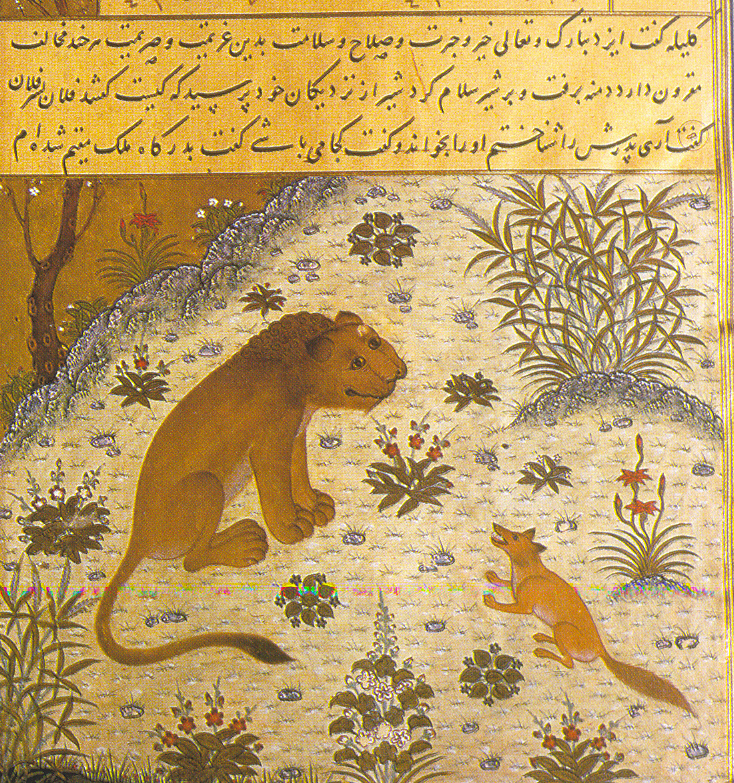
A page from Kelileh o Demneh dated 1429, from Herat, a Persian translation of the Panchatantra derived from the Arabic version – Kalila wa Dimna – depicts the manipulative jackal-vizier, Dimna, trying to lead his lion-king into war.

Key Information

Vishnu Sharma (Sanskrit: विष्णुशर्मन् / विष्णुशर्मा) was an Indian scholar and author who wrote the Panchatantra, a collection of fables.[1]

Works

[edit]

Panchatantra is one of the most widely translated non-religious books in history. The Panchatantra was translated into Middle Persian/Pahlavi in 570 CE by Borzūya and into Arabic in 750 CE by Persian scholar Abdullah Ibn al-Muqaffa as Kalīlah wa Dimnah (Arabic: كليلة و دمنة).[2][3] In Baghdad, the translation commissioned by Al-Mansur, the second Abbasid Caliph, is claimed to have become "second only to the Qu'ran in popularity."[4] "As early as the eleventh century this work reached Europe, and before 1600 it existed in Greek, Latin, Spanish, Italian, German, English, Old Slavonic, Czech, and perhaps other Slavonic languages. Its range has extended from Java to Iceland."[5] In France, "at least eleven Panchatantra tales are included in the work of Jean de La Fontaine."[4]

Legend

[edit]

The prelude to the Panchatantra identifies Vishnu Sharma as the author of the work. Since there is no other independent external evidence about him, "it is impossible to say whether he was the historical author . . .or is himself a literary invention".[6] Based on analysis of various Indian recensions and the geographical features and animals described in the stories, Kashmir[7] is suggested to be his birthplace by various scholars.

He has also been associated with the University of Taxila.[8]

The prelude narrates the story of how Vishnu Sharma supposedly created the 'Panchatantra'. There was a king called Amarshakti[citation needed] who ruled a kingdom, whose capital was a city called Mahilaropya (महिलारोप्य), whose location on the current map of India is unknown.[9] The king had three sons named Bahushakti, Ugrashakti and Anantshakti.[10] Though the king himself was both a scholar and a powerful ruler, his sons were "all dullards."[10] The king despaired of his three princes' inability to learn, and approached his ministers for counsel. They presented him with conflicting advice, but the words of one, called Sumati, rang true to the king.[11] He said that the sciences, politics and diplomacy were limitless disciplines that took a lifetime to master formally. Instead of teaching the princes scriptures and texts, they should somehow be taught the wisdom inherent in them, and the aged scholar Vishnu Sharma was the man to do it.[12]

Vishnu Sharma was invited to the court, where the king offered him a hundred land grants if he could teach the princes.[13] Vishnu Sharma declined the promised award, saying he did not sell knowledge for money, but accepted the task of making the princes wise to the ways of politics and leadership within six months.[12][13] Vishnu Sharma knew that he could never instruct these three students through conventional means. He had to employ a less orthodox way, and that was to tell a succession of animal fables – one weaving into another – that imparted to them the wisdom they required to succeed their father. Adapting stories that had been told for thousands of years in India, panchatantra was composed into an entertaining five part work to communicate the essence of diplomacy, relationships, politics and administration to the princes.[12] These five discourses — titled "The Loss of Friends", "The Winning of Friends", "Of Crows and Owls", "Loss of Gains" and "Imprudence" — became the Panchatantra, meaning the five (pancha) treatises (tantra).

References

[edit]
[edit]
Revisions and contributorsEdit on WikipediaRead on Wikipedia
from Grokipedia
Vishnu Sharma (Sanskrit: विष्णुशर्मन्) is the traditional author attributed with compiling the , an ancient collection of interrelated beast fables designed to impart practical wisdom on , , and statecraft, likely composed between the 3rd century BCE and 3rd century CE based on older oral traditions. According to the introductory in the text, Vishnu Sharma, an octogenarian scholar renowned for his expertise in various sciences, was approached by Amarashakti (also known as Immortal-Power) of the Mahilaropya (Maidens' Delight). The king sought to educate his three dull-witted sons—Bahushakti (Rich-Power), Ugrashakti (Fierce-Power), and Anantashakti (Endless-Power)—who showed no interest in learning despite their noble lineage. Vishnu Sharma accepted the challenge, promising to transform the princes into masters of niti-shastra (the science of prudent conduct) within six months by composing five books of instructive tales. The is structured as a nested , with fables featuring anthropomorphic animals illustrating and strategic lessons, divided into five sections: Mitra-bheda (The Loss of Friends), Mitra-lābha (The Winning of Friends), Kākolūkīyam (Crows and Owls), Labdhapranāśa (Loss of Gains), and Aparīkṣitakārakaṃ (Ill-Considered Action). This work, whose original version is lost and reconstructed from later translations like the lost 6th-century CE version and the 8th-century CE Kalila wa Dimna by Ibn al-Muqaffaʿ, has profoundly influenced global literature, spreading to over 50 languages and shaping collections such as the Arabian Thousand and One Nights and European fable traditions. Scholars note that while Sharma's identity remains unidentifiable and possibly legendary, the attribution underscores the text's role as a foundational pedagogical tool in ancient Indian education.

Life and Legend

Historicity and Dating

The historicity of Vishnu Sharma remains a subject of scholarly debate, with many experts viewing him as a legendary or pseudonymous figure rather than a verifiable historical individual. Traditional attributions link the authorship of the Panchatantra to Vishnu Sharma, portrayed as a wise scholar tasked with educating royal princes, but this narrative likely serves as a framing device within the oral and literary traditions of ancient India, rather than evidence of a single author's existence. Scholars such as Franklin Edgerton have argued that the name may represent a collective attribution to multiple compilers or redactors over time, reflecting the collaborative nature of didactic literature in the period. Estimates for the composition of the Panchatantra generally place it between 200 BCE and 300 CE, though some analyses narrow the origins to around 200 BCE in the region. German Sanskritist Hertel proposed this Kashmiri provenance based on linguistic and textual clues in early recensions, suggesting the work emerged during the early post-Mauryan era amid regional patronage of learning. Edgerton's reconstruction of the text from various manuscripts supports a similar timeline, indicating an original core that predates later elaborations by several centuries, with references to contemporary political motifs aligning it to the post-Vedic transition. While the exact date is elusive due to the absence of direct inscriptions or contemporary records, these estimates draw from comparative analysis with dated works and the text's internal allusions to historical events. The arose in the post-Vedic period of (circa 500 BCE–500 CE), a time marked by the proliferation of didactic fables aimed at imparting practical wisdom on , , and . This era saw the shift from ritualistic Vedic hymns to more accessible prose-verse narratives, influenced by the growing emphasis on nīti (policy and conduct) in Brahmanical and . The rise of such fables paralleled the expansion of Buddhist and Jain storytelling traditions, with the drawing evident inspiration from earlier Buddhist , which feature anthropomorphic animals and moral dilemmas to illustrate karmic lessons. Shared motifs, such as clever animals outwitting stronger foes, suggest cross-pollination between Hindu and Buddhist oral repertoires, positioning the as a synthesis of indigenous fable forms amid cultural exchanges in the Indo-Gangetic plains. Linguistically, the Panchatantra is composed in classical , characterized by its polished prose interspersed with śloka verses, which reflects the standardized grammar codified by in the mid-4th century BCE. However, its style bears traces of oral traditions, evident in the colloquial idioms, rhythmic dialogues, and fable structures that echo Middle Indo-Aryan vernaculars used in Buddhist literature like the Jātakas. This hybrid quality indicates the text's roots in pre-literate storytelling, where served as the spoken medium for disseminating morals among diverse audiences, before being elevated to classical for elite circulation. Such analysis underscores the work's role as a bridge between folk orality and literary sophistication in ancient .

Traditional Legend

According to traditional accounts, Vishnu Sharma was a revered scholar tasked with educating the wayward sons of a southern Indian . In the of Mahilaropya, King Amarashakti (also known as Sudarshan in some variants) ruled wisely but despaired over his three young princes—Bahushakti, Ugrashakti, and Anantashakti—who, despite their royal lineage, displayed profound dullness and disinterest in learning, endangering the kingdom's future. The princes showed no aptitude for governance or ethics, prompting the king to summon learned advisors to recommend a teacher capable of imparting niti—the principles of policy, morality, and practical —within a short time. Despite his advanced age of eighty, Vishnu Sharma, a master of ancient lore and , was selected for the formidable challenge. The king offered him vast and honors, but Sharma humbly declined material rewards, instead wagering his : he promised to transform the princes into scholars surpassing even himself in six months, or forfeit his name Vishnusharman if he failed. Reluctant at first due to the boys' obstinacy, Sharma accepted, recognizing that conventional lectures would fail; he devised a rooted in engaging narratives drawn from oral traditions and fables. Over the ensuing half-year, Vishnu Sharma composed and recited the Panchatantra, a series of interconnected animal fables embedded with layered morals on , enmity, strategy, and . By illustrating complex ethical dilemmas through anthropomorphic tales of cunning , wise lions, and treacherous crows, he captivated the princes, fostering their intellectual growth without overt instruction. At the deadline, the king tested them through a of scholars, only to find the princes so proficient in niti that they outshone their father in wisdom and judgment, securing the throne's stability. This success cemented Sharma's legacy as the archetypal wise storyteller, embodying the ideal of knowledge transmission through accessible, memorable prose—traditionally attributed to him as a figure from either or southern , though the legend firmly roots the events in a southern kingdom.

The Panchatantra

Overview and Purpose

The Pañcatantra is an ancient Indian collection of interrelated fables attributed to the scholar Vishnu Sharma, who was legendarily commissioned by a to impart to his ineffective princes through storytelling. The title derives from roots, with pañca meaning "five" and denoting "principles," "systems," or "treatises," thus referring to its organization into five foundational books that outline strategies for conduct and governance. Composed as a didactic work, the Pañcatantra aims to impart practical (nīti) and principles of statecraft (rājanīti), using anthropomorphic characters to explore dilemmas in , , and survival. Its core purpose is to educate on navigating social and political challenges, emphasizing cunning, alliances, and moral over abstract , thereby serving as a guide to worldly success and ethical decision-making. The narrative employs a sophisticated format, where outer tales enclose inner fables, creating layers of embedded stories that progressively reveal lessons through and events involving animal protagonists. This nested structure enhances the instructional depth, allowing complex ideas to unfold gradually within the broader context of a or animal kingdom. Originally written in classical , the text blends narratives with metrical verses (śloka) that encapsulate morals and proverbs, facilitating oral recitation, memorization, and transmission across generations.

Structure and Books

The is structured as a collection of five books, or tantras, each framed by a principal that branches into numerous sub-stories featuring anthropomorphic animals and humans. These books are titled Mitra-bheda (The Loss of Friends), Mitra-lābha (The Winning of Friends), Kākolūkīyam (Crows and Owls), Labdhapraṇāśa (Loss of Gains), and Aparīkṣitakārakaṃ (Ill-Considered Action). The overall framework begins with an introductory tale of a who composes the work for three ineffective princes, embedding the five tantras as the "five principles" imparted to educate them. In Mitra-bheda, the first book, the central frame story revolves around animal politics in a forest kingdom, exemplified by the tale of a king who, advised by a cunning , sows discord between a loyal and the to maintain his dominance. The second book, Mitra-lābha, shifts to themes of alliance-building through a involving a group of animals—a dove, , , deer, and —who unite against common threats. Kākolūkīyam, the third book, centers on interspecies conflict, highlighted by the frame story of a prolonged between and , where and determine the outcome. The fourth book, Labdhapraṇāśa, explores repercussions of decisions via stories nested within a tale of a and a navigating betrayal and survival. Finally, Aparīkṣitakārakaṃ concludes with fables framed by a of a and a , illustrating the consequences of ill-considered actions. The narrative structure is highly interconnected, with each book's main serving as a vessel for embedded sub-stories that interrupt and resume the primary plot, creating layers of tales within tales; across versions, this yields approximately 87 main tales alongside hundreds of shorter fables. This branching technique, characteristic of didactic literature, allows for seamless transitions between narratives while maintaining narrative momentum. Early manuscripts exhibit variations due to the work's origins in oral transmission, including differences in book order—such as placing Kākolūkīyam earlier in some recensions—and occasional inclusion or omission of specific sub-stories, reflecting regional adaptations before standardization in written forms around the 3rd century CE. Over two hundred versions have been identified, underscoring the text's fluidity across South Asian traditions.

Themes and Moral Lessons

The Panchatantra emphasizes realism over , portraying a world where survival demands cunning, , and vigilance against . Through animal allegories that mirror human society, the text explores themes of and , highlighting how can lead to ruin while shrewdness ensures triumph. For instance, cunning is depicted as a vital tool for the weak against the strong, as seen in tales where weaker animals outwit predators through intellect rather than force. Moral lessons in the offer pragmatic advice rooted in , such as the notion that "" in contexts of survival and competition, the importance of forming reliable alliances, and the need for caution against false friends who exploit trust. Stories warn that often stems from or , urging discernment in relationships to avoid disastrous consequences. These lessons promote worldly , teaching that ethical conduct involves balancing with mutual benefit, without descending into overt religious . Philosophically, the work draws from niti-shastra, the ancient Indian science of practical ethics and governance, blending Hindu principles of dharma (righteous duty) with secular strategies for prosperity and security. This fusion provides guidance on diplomacy, friendship, and conflict resolution, emphasizing integrated personal development over abstract morality. In the story of the tortoise and the geese from the section on gaining friends, two geese devise a cooperative plan to carry their tortoise companion to a new home using a stick, illustrating the value of alliances and mutual aid; however, the tortoise's naive talkativeness causes it to fall to its death, underscoring the perils of disregarding prudent advice. Similarly, the tale of the monkey and the crocodile in the section on loss of gains demonstrates betrayal when the crocodile's wife covets the monkey's heart, but the monkey's quick wit—claiming to have left his heart in the tree—forces the crocodile to ferry him back safely, teaching caution against treacherous companions and the power of deception in self-defense.

Legacy and Influence

Translations and Adaptations

The Panchatantra's dissemination began with early translations into (Pahlavi) around 550 CE, when the physician Borzuya, serving the Sasanian king , rendered it as Kalilag and Damnag during a quest for healing knowledge in . This version, now lost, served as the basis for the influential translation Kalila wa Dimna by in the 8th century, which adapted the fables with added Islamic moral and political commentary while preserving the core animal narratives. In the medieval period, the text reached through a Hebrew translation by Rabbi Joel in the , which became the source for the Latin Directorium Humanae Vitae by John of Capua around 1270, emphasizing ethical guidance for rulers. This Latin edition facilitated vernacular adaptations, including the 16th-century Italian Filosofia Morale by Anton Francesco Doni, which reinterpreted the fables for audiences with humanistic insights. French writer drew heavily from these lineages in his 17th-century Fables, incorporating Panchatantra-derived stories like "The Monkey and the Crocodile" to illustrate wit and folly, though he attributed them to an "Indian sage" Pilpay. Within India, the Panchatantra inspired derivative works such as the , composed between the 8th and 12th centuries, which reorganized select fables into four thematic books focused on friendship, enmity, war, and peace, often with simplified prose for didactic purposes. Regional adaptations proliferated, including the 19th-century Telugu retelling in the Niti Chandrika blending local , and Persian recensions such as Nasrullah's 12th-century Kalila wa Dimna that integrated Sufi elements for Mughal courts. Modern adaptations have revitalized the for global audiences, with Arthur W. Ryder's 1925 English translation from providing a direct, poetic rendering that emphasizes the original's narrative economy and has influenced subsequent editions. proliferated in the 20th century, including abridged collections in illustrated formats, while animations emerged, such as the 1970s Indian shorts by Films Division like The Lion and the Rabbit (1974), which used simple 2D techniques to convey lessons to young viewers. In 2024, a 15th-century illustrated manuscript was inscribed in 's Memory of the World Asia-Pacific Regional Register, highlighting its cultural significance. More recently, in 2025, multimedia performances reimagined the tales through forms like , Bharatnatyam, and for contemporary audiences.

Cultural and Literary Impact

The has exerted a profound influence on global literary traditions, particularly through its innovative use of frame stories and anthropomorphic animal characters to convey ethical and political . Its narratives parallel those in , where both collections employ animals to illustrate human vices and virtues, such as cunning and folly, likely stemming from shared Indo-European oral traditions rather than direct transmission. The text's adaptation into the Arabic by Ibn al-Muqaffa' in the 8th century marked a pivotal moment, transforming it into a of Perso-Arabic that emphasized political and spread across the Islamic world, influencing courtly and governance advice. This version evolved into the broader Bidpai cycle of fables, which permeated medieval Europe, echoing in works like Geoffrey Chaucer's Canterbury Tales and the Brothers Grimm's folk tale collections, where motifs of trickery and moral retribution recur. Culturally, the Panchatantra promoted secular wisdom adaptable to diverse societies, from Abbasid courts to Mughal India and medieval Europe, shaping proverbs, idioms, and political discourse on . For example, many proverbs, such as those warning against overambition through tales of failed schemes, originate directly from its stories, embedding practical ethics into everyday language. Its emphasis on pragmatic survival strategies influenced broader cultural narratives, including elements in and tales, fostering a tradition of fable-based across continents. In , the Panchatantra has long served as a tool for moral instruction in and , teaching virtues like discernment and consequence through engaging narratives. Its relevance persists in modern management studies, where stories illustrate and , and in , as an indigenous framework for understanding change and interpersonal dynamics. Contemporary reception underscores its enduring legacy, with the 2024 UNESCO inscription of a 15th-century manuscript affirming its role in preserving literary heritage and promoting . However, postmodern analyses critique its for perpetuating human-animal binaries and its cynical portrayal of politics, which some view as reinforcing pragmatic opportunism over idealism.

References

Add your contribution
Related Hubs
User Avatar
No comments yet.