



Community hub
Recent from talks
Contribute something
Nothing was collected or created yet.
WZT (Wóz Zabezpieczenia Technicznego – armoured recovery vehicle) was a Polish post-World War II armoured recovery vehicle series. It consists of five versions. The first two, WZT-1 and WZT-2 were built on T-55/T-55A hull, the WZT-3 was built on T-72M hull, the WZT-3M was built on PT-91 hull and the WZT-4 was built on PT-91M hull for Malaysia.
WZT-1
[edit]History
[edit]Key Information


In the early 50s USSR started developing an ARV built on the hull of T-54 that was just entering production. A prototype vehicle was completed after a short while and was named BTS-1 (BTS - Bronirowannyj Tjagacz Sriednij). Production was launched and it became the basic ARV of the Soviet army. In 1955 BTS-1 was upgraded with a hoist and a small folding crane. This upgraded version was given the name BTS-2. It was built on the T-54 hull and later on the T-55 hull. In the end of the 60s Poland and Czechoslovakia bought the BTS-2. Basing on BTS-2 technical data the Zakład Produkcji Doświadczalnej Zakładów Mechanicznych "Bumar-Łabędy" (Experimental Production Institute of "Bumar-Łabędy") prepared a prototype of WZT-1 ARV. It was accepted into the Ludowe Wojsko Polskie and became its basic ARV replacing the older designs. Production started in 1970 in "Bumar-Łabędy" and continued until 1978 when it was completely replaced by WZT-2.
The WZT-1 were used in the upgrade of Newa SAM system to Newa-SC standard. The launcher was mounted on a WZT-1 chassis (many sources claim the vehicle to be T-55 tank but as a matter of fact vehicles never had tank turret in the first place). The upgrade replaced many analogue components with digital ones for improved reliability, accuracy, and mobility, and also adds IFF capability and data links. Unlike the original ARV variant the Newa launcher is still in use in the armed forces of Poland.
Operators
[edit]
WZT-2
[edit]| WZT-2 | |
|---|---|
 WZT-2 | |
| Type | Armoured recovery vehicle |
| Place of origin | Polish People's Republic |
| Service history | |
| In service | 1973–present |
| Production history | |
| Produced | 1973–1992 |
| No. built | 600 |
| Specifications | |
| Mass | 34 tonnes |
| Length | 6.45 m |
| Width | 3.27 m |
| Height | 2.1 m |
| Crew | 4 + 3 wounded |
Main armament | 12.7 mm DShK |
| Engine | V-55W 12-cyl. 38.88 liter water-cooled diesel 591 hp (441 kW) |
| Power/weight | 17.4 hp/tonne (13 kW/tonne) |
| Suspension | torsion bar |
Operational range | 465 km |
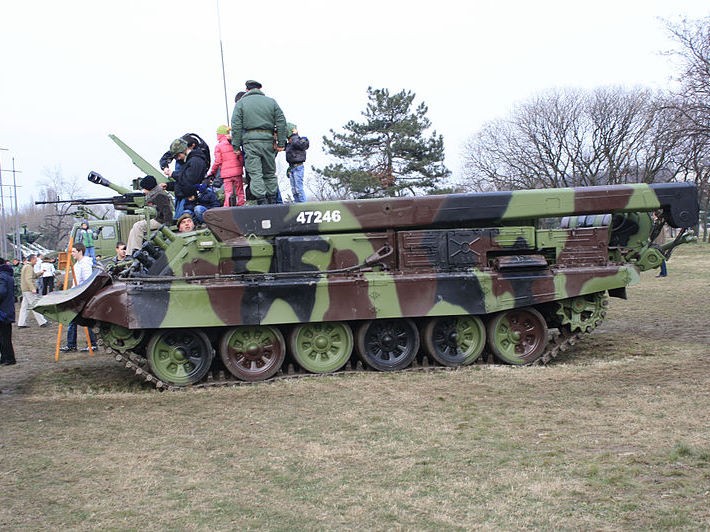
Polish ARV built on T-55 hull. It was built to perform repairs on T-55 and T-55A tanks. When it entered service in 1973 it was probably the best ARV in the Warsaw Pact. It is still able to carry out tasks that NATO gives ARVs of its class. Unlike the T-55 and the WZT-1, the WZT-2 is still the basic ARV of the Polish army used for field repairs. It can carry out repairs not only on Soviet tanks like the T-54/T-55 and T-72 but also on Polish PT-91 and German Leopard 2A4 tanks. However because all tanks currently in Polish service weigh more than 40 tonnes it is not able to tow them. It is used to tow lighter vehicles like BMP-1 and 2S1. A number of those vehicles are used by Ratownictwo Kolejowe (Railroad emergency response services).[1][2]
Operators
[edit] India - India bought 196 of those vehicles from Poland
 Iraq - most of them are scrapped in Gulf War
 Poland - a total number of 600 produced. 80 in service as of 2004. Some are used by Ratownictwo Kolejowe (Railroad emergency response services). Many have private owners who bought them from the Polish Army.
 Serbia - 16 in active service with Serbian Army, inherited unknown number of vehicles from Yugoslav Ground Forces.


WZT-3
[edit]| WZT-3 | |
|---|---|
 | |
| Type | Armoured recovery vehicle |
| Place of origin | Poland |
| Service history | |
| In service | 1989–? |
| Production history | |
| Produced | 1989–1999 |
| No. built | 40+ |
| Specifications | |
| Mass | 42 tonnes |
| Length | 8.30 m |
| Width | 3.27 m |
| Height | 2.71 m |
| Crew | 4 |
Main armament | 12.7mm NSW machine gun (200 rounds) |
| Engine | V-46-6 12-cylinder diesel 780 hp (582 kW) |
| Power/weight | 18.6 hp/tonne (13.8 kW/tonne) |
| Suspension | torsion bar |
Operational range | 450 km |
| Maximum speed | 60 km/h |
History
[edit]When the T-72 entered service with LWP in 1978 a need for a new ARV appeared. It was decided that T-72M hull will be used. Wojskowy Instytut Techniki Pancernej i Samochodowej (Military Institute of Automobile and Armour Technology) from Sulejówek pointed out the main requirements of the vehicle and Ośrodek Badawczo-Rozwojowy Urządzeń Mechanicznych in Gliwice made two prototypes caring out the Bizon (Bison) program. Tests and trials were carried out from 1986 to 1988 and it was immediately accepted into the Polish Army. During a short production run 20 of those vehicles were made until 2003 when they were all upgraded to the WZT-3M standard.
Operators
[edit] Croatia - unknown number, M-84AI version.
 Czech Republic - 8 sold in 2023.[3]
 Kuwait - 15 (built by Yugoslavia under license in 90s as M-84AI)
- Poland - 20 (all modernized to WZT-3M standard)
- Serbia - unknown number, M-84AI version.[4]


Former operators
[edit] Yugoslavia - 25 licence built as M-84AI, 40 knock-down kits ordered in 1989, status unknown, possibly passed on Serbia and Croatia

WZT-3M
[edit]| WZT-3M | |
|---|---|
 WZT-3M on a military parade in Warsaw, 15.08.2007. | |
| Type | Armoured recovery vehicle |
| Place of origin | Poland |
| Service history | |
| In service | 1999–present |
| Production history | |
| Produced | 1999–present |
| No. built | 9 + 20 upgraded WZT-3 for Polish Army and 352 built for Indian Army |
| Specifications | |
| Mass | 42 tonnes |
| Length | 8.30 m |
| Width | 3.27 m |
| Height | 2.71 m |
| Crew | 4 |
| Armor | PT-91 armour |
Main armament | 12.7mm NSW |
| Engine | PZL-Wola S12U 4-cyl. 38.9 liter diesel 850 hp (634 kW) |
| Power/weight | 20.2 hp/tonne (15.1 kW/tonne) |
| Suspension | torsion bar |
Operational range | 650 km road, 600 km cross-country |
| Maximum speed | 60 km/h |
History
[edit]When PT-91 entered service in Polish army it was decided that the WZT-3 which was based on T-72M should be upgraded with elements from PT-91. The upgraded variant was given WZT-3M designation. The main difference was the engine. The original WZT-3 had a 780 hp (582 kW) 12-cyl. diesel engine from T-72M. The WZT-3M has an 850 hp (634 kW) PZL-Wola S12U 12-cyl. 38.9 litre diesel from PT-91. During initial production run 9 vehicles were made before 2003 when 20 of the old WZT-3 were upgraded to the WZT-3M standard.
Operators
[edit]- India - 556 WZT-3M (In April 1999, India ordered 44 WZT-3M armored recovery vehicles; this order was followed by another two orders in April 2002 (another 80 vehicles) and in July 2005 (228 vehicles). Vehicles are used to support units equipped with T-72 and T-90 MBT. Deliveries began in 2001. In 2011 India placed follow-on order for additional 204 ARVs, vehicles are produced under licence by BEML Ltd using Polish components.[5] That gives the total number of 556 WZT-3M ARV ordered by Indian Army).
 Malaysia - 6 WZT-4 (upgraded WZT based on PT-91M)
- Poland - 29 WZT-3M (20 WZT-3 are modernized to WZT-3M standard)

References
[edit]- ^ WZT-2 [Polska] - Pancerni.net Archived 2007-10-12 at the Wayback Machine
- ^ "ratownictwo.org.pl". Archived from the original on 2007-10-12. Retrieved 2007-10-20.
- ^ Ciślak, Jarosław (2024-09-30). "Polska zwiększa eksport uzbrojenia. Ukraina i co dalej? [KOMENTARZ]". defence24.pl (in Polish). Retrieved 2024-11-07.
- ^ "Photo". Archived from the original on 2016-03-03. Retrieved 2012-11-14.
- ^ "More Armored Recovery Vehicles for Indian Army". Archived from the original on 2012-07-29. Retrieved 2012-04-21.

Overview
Role and background
The WZT (Wóz Zabezpieczenia Technicznego) series represents a family of armored recovery vehicles (ARVs) developed by Poland to provide essential support for main battle tanks (MBTs) and other tracked armored vehicles during military operations.[1] These vehicles are designed for battlefield recovery tasks, including towing damaged or immobilized assets, extracting stuck vehicles from terrain, righting overturned equipment, and performing on-site repairs to restore combat readiness.[3] Equipped with features such as hydraulic winches, cranes, dozer blades, and engineering tools, WZT ARVs enable crews to conduct these operations under armored protection, often in hazardous environments with CBRN (chemical, biological, radiological, nuclear) defenses.[1][3] The development of the WZT series stemmed from Poland's need to maintain its Soviet-era tank fleet, particularly the licensed T-54/55 MBTs, following the acquisition of Soviet BTS-1 recovery vehicles in the 1960s.[1] Production began in 1970 at the Bumar-Łabędy facility, with the inaugural WZT-1 model built on a T-54/55 chassis to directly support repairs and recovery of these tanks within the Polish People's Army.[5] Over time, the series evolved to accommodate upgraded chassis, such as the T-55A for the WZT-2 and later the T-72M and PT-91 Twardy for advanced variants, reflecting Poland's progression toward indigenous armored vehicle production.[1] Early variants feature a standard V-55 series diesel engine providing approximately 580 horsepower, enabling speeds up to 50 km/h and operational ranges around 470 km; later variants use upgraded engines up to 850 hp for improved performance.[1] Throughout its history, the WZT series has been operated primarily by the Polish Armed Forces, with exports to countries like India, Malaysia, and more recently Ukraine, underscoring its role in enhancing allied recovery capabilities in modern conflicts. Recent donations include WZT-3/3M units provided to Ukraine in 2024-2025 to enhance recovery capabilities amid the Russia-Ukraine conflict.[1][6] As of 2004, Poland maintained around 80 units across variants; by 2024, this had reduced to approximately 30 active WZT-3/3M units following upgrades and donations, which continue to support tanks like the PT-91 and Leopard 2A4, though limited by towing capacity for heavier models.[5][6] The series' emphasis on reliability and adaptability has made it a cornerstone of Polish military engineering, with total production exceeding 600 units by the 1990s.[5]General characteristics
The WZT (Wóz Zabezpieczenia Technicznego) series consists of Polish-designed armored recovery vehicles (ARVs) developed primarily to support main battle tanks and other tracked vehicles in battlefield conditions by performing recovery, repair, and evacuation tasks.[1] These vehicles are built on modified chassis derived from Soviet-era and Polish-upgraded main battle tanks, such as the T-54/55, T-72M, and PT-91 Twardy, allowing them to operate alongside the armored units they service.[1] Introduced starting in the 1970s, the series emphasizes high mobility, robust recovery equipment, and armored protection to function effectively in combat environments.[3] Key design features of the WZT series include a crew compartment for 3 to 4 personnel (typically comprising a driver, commander, mechanic-operator, and gunner), integrated recovery tools such as hydraulic cranes with lifting capacities ranging from 10 to 15 tons, and multiple winch systems for towing loads up to 35 tons.[7][3] Additional equipment often encompasses dozer blades for obstacle clearance and earth-moving, welding and cutting tools for on-site repairs, and towing devices compatible with heavy armored vehicles.[7] The vehicles are engineered for versatility, enabling tasks like securing damaged tracks, evacuating immobilized units across varied terrain, and providing limited engineering support such as fording assistance or bridge-laying preparation.[7] For protection, WZT vehicles inherit the base chassis' armor, typically composite or laminated steel plating effective against high-explosive anti-tank (HEAT) rounds and fragments, supplemented by nuclear, biological, and chemical (NBC) defense systems and automatic fire suppression.[3] Armament is generally light for self-defense, featuring a 12.7 mm anti-aircraft machine gun mounted on the roof for engaging low-flying threats, with some variants including a coaxial 7.62 mm machine gun and smoke grenade launchers for concealment.[3][7] Mobility characteristics align closely with their tank-derived hulls, powered by diesel engines delivering 580 to 850 horsepower, achieving maximum road speeds of 50 to 60 km/h and operational ranges of approximately 400 to 500 km on internal fuel.[1][7] They possess strong off-road performance, including the ability to ford water up to 5 meters deep with preparation and climb gradients up to 60%, ensuring they can keep pace with frontline armored formations during recovery operations.[7]WZT-1
History
The WZT-1 (Wóz Zabezpieczenia Technicznego-1), meaning "Technical Support Vehicle-1," was the inaugural model in Poland's postwar series of armored recovery vehicles, developed during the Cold War era under strong Soviet influence as a member of the Warsaw Pact. It served as the Polish equivalent to the Soviet BTS-2 ARV, adapted from the chassis of the T-55 main battle tank, which Poland produced under license. This design evolution stemmed from Poland's operational experience with earlier Soviet BTS-1 recovery vehicles based on the T-54 tank, imported in the late 1960s to support the Polish People's Army's growing fleet of T-54/55 tanks. The WZT-1 incorporated enhanced recovery capabilities, including a winch, crane, and dozer blade, to perform battlefield repairs and towing of damaged armored vehicles up to 40 tons.[8][1][9] Development of the WZT-1 prototype occurred at the Experimental Production Plant of the Mechanical Works Bumar-Łabędy in Gliwice, Poland, building on technical data from the BTS-2 to integrate local manufacturing with Soviet-standard components. The vehicle retained the T-55's V-55 diesel engine for mobility while modifying the turretless hull for engineering roles, such as towing, lifting, and minor repairs under combat conditions. This adaptation reflected Poland's emphasis on self-sufficiency in maintaining its mechanized forces, aligning with Warsaw Pact standardization.[1][9][10] Production began in 1970 at the Bumar-Łabędy factory and continued through 1978, marking the vehicle's primary manufacturing run before it was phased out in favor of the more advanced WZT-2 variant. Upon entering service with the Polish People's Army in 1970, the WZT-1 became the standard ARV for T-55-equipped units, replacing outdated prewar and early postwar recovery assets and enhancing the army's logistical resilience. Over its service life, select WZT-1 hulls were repurposed for non-combat roles, including the modernization of the S-125 Newa surface-to-air missile system into the Newa-SC configuration in the 1990s. By the early 2000s, remaining WZT-1s were largely retired from active Polish service due to obsolescence against heavier modern armor.[1][10][9]Design and specifications
The WZT-1 armored recovery vehicle was developed in Poland as a specialized engineering platform based on the chassis of the Soviet-designed T-55 main battle tank, retaining much of the original hull and suspension system for compatibility with existing logistic support. This design allowed for armored protection during frontline recovery operations, with the turret removed to accommodate recovery equipment and additional crew space. The vehicle was produced by Bumar-Łabędy and entered service with the Polish People's Army in the early 1970s, serving primarily as a technical support unit for tank battalions until its replacement by later variants in the late 1970s.[1][8] Key features included a rear-mounted spade for stabilization during towing and lifting tasks, a powered winch for pulling disabled vehicles, and storage compartments for tools, spare parts, and recovery gear, enabling the WZT-1 to perform tasks such as towing, engine swaps, and minor repairs under combat conditions. A small folding crane was incorporated for lighter lifting duties, while the front-mounted dozer blade facilitated obstacle clearance and self-entrenchment. The vehicle supported a crew of three (commander, driver, and mechanic-operator) and offered optional night vision equipment and chemical, biological, radiological, and nuclear (CBRN) protection systems to enhance operational survivability.[8][1] For self-defense, the WZT-1 could be fitted with a single 12.7 mm DShK 1938/46 heavy machine gun mounted on the superstructure roof, providing limited anti-infantry and anti-aircraft capability, though it lacked a primary offensive armament due to its support role. The powertrain consisted of a V-55A 12-cylinder, water-cooled diesel engine delivering 580 horsepower, paired with a manual transmission and torsion bar suspension for reliable mobility across varied terrain.| Specification | Details |
|---|---|
| Length | 7.1 m |
| Width | 3.27 m |
| Height | 2.1 m |
| Weight | 31,500 kg |
| Engine | V-55A 12-cylinder diesel, 580 hp |
| Maximum road speed | 50 km/h |
| Operational range | 470 km |
| Crew | 3 |
| Armament | Optional 1 × 12.7 mm DShK machine gun |
Operators
The WZT-1 entered service with the Polish People's Army in 1970, serving as the primary armored recovery vehicle for T-54/55 tank units during the Cold War era. It was produced domestically at the Bumar-Łabędy factory for Polish use, supporting frontline recovery and repair operations.[5] By 1978, the WZT-1 was phased out in favor of the more capable WZT-2, which offered enhanced towing capacity and equipment suited to heavier T-55 variants. All Polish units were subsequently retired or repurposed, with no remaining active service in the modern Polish Land Forces inventory, which now relies on newer models like the WZT-3M.[1][9] No confirmed exports or operations by other nations have been documented for the WZT-1, distinguishing it from later variants in the series that saw international sales.WZT-2
History
The WZT-2 (Wóz Zabezpieczenia Technicznego-2), meaning "Technical Security Vehicle-2," is the second model in Poland's postwar series of armored recovery vehicles, developed during the Cold War era under Soviet influence as a Warsaw Pact member. It served as an upgraded Polish equivalent to the Soviet BTS-2/3 ARV, adapted from the chassis of the T-55A main battle tank, which Poland produced under license. This evolution built on experience with the WZT-1 and imported Soviet BTS-1/2 vehicles from the late 1960s, supporting the Polish People's Army's T-55 fleet. The WZT-2 featured enhanced recovery capabilities, including a stronger winch, crane, and dozer blade, for towing and repairing damaged armored vehicles up to 42 tons.[9][1] Development of the WZT-2 occurred at the Bumar-Łabędy factory in Gliwice, Poland, incorporating improvements over the WZT-1 for better compatibility with T-55A tanks. The vehicle retained the T-55A's V-55W diesel engine for mobility while modifying the turretless hull for engineering tasks like towing, lifting, and field repairs in combat. This reflected Poland's push for logistical self-sufficiency within Warsaw Pact standards.[9] Production began in 1978 at Bumar-Łabędy and continued into the 1990s, serving as the primary ARV for T-55A units until supplemented by the WZT-3. Entering service with the Polish People's Army in 1978, the WZT-2 enhanced recovery operations for mechanized forces. Some WZT-2 units have been repurposed for civilian roles, such as railroad emergency response by PKP. As of 2025, around 40 WZT-2 remain in active military service in Poland, alongside modernization efforts for heavier systems.[1][9][11]Design and specifications
The WZT-2 armored recovery vehicle was developed in Poland as an upgraded engineering platform based on the T-55A main battle tank chassis, retaining the original hull and torsion bar suspension for logistical compatibility. This provided armored protection for frontline operations, with the turret removed to fit recovery equipment and extra crew space. Produced by Bumar-Łabędy, it entered service in 1978 with the Polish People's Army, supporting tank battalions until later variants arrived in the 1980s and 1990s.[1][9] Key features included a rear-mounted spade for stabilization during lifts and tows, a powered main winch with 49-ton pull (up to 64 tons with tackle) and 200 m cable, an auxiliary winch (1.5 tons, 200 m cable), and compartments for tools, parts, and gear to enable towing, engine changes, and repairs in combat. A remote-controlled hydraulic crane lifted up to 3 tons at 4.5 m, while the front dozer blade cleared obstacles and allowed self-entrenchment. The vehicle supported a crew of 4 (commander, driver, mechanic, operator) plus up to 3 casualties, with NBC overpressure protection, optional night vision, a 2 kW auxiliary power unit, and smoke grenade launchers for survivability.[9] For self-defense, it mounted a 12.7 mm DShK heavy machine gun on the roof for anti-infantry and anti-aircraft use, lacking primary armament due to its support role. The powertrain used a V-55W 12-cylinder turbocharged diesel engine producing 591 hp, with manual transmission for cross-country mobility.| Specification | Details |
|---|---|
| Length | 7.1 m |
| Width | 3.27 m |
| Height | 2.1 m |
| Weight | 34,000 kg |
| Engine | V-55W 12-cylinder turbocharged diesel, 591 hp |
| Maximum road speed | 50 km/h |
| Operational range | 465 km |
| Crew | 4 (+3 casualties) |
| Armament | 1 × 12.7 mm DShK machine gun |
Operators
The WZT-2 entered service with the Polish People's Army in 1978 as the main ARV for T-55/T-55A units during the late Cold War. It supported recovery and repair in armored formations, with production focused on domestic needs at Bumar-Łabędy. As of 2025, approximately 40 units remain active in the Polish Armed Forces, used for lighter recovery tasks alongside newer models like the WZT-3M. Some have been adapted for non-military roles, such as rail rescue operations.[9][11] Limited exports of the WZT-2 have been reported to former Warsaw Pact countries, though most international use is undocumented or phased out. Unlike later variants, it has not seen large-scale foreign sales.[9]WZT-3
History
The WZT-3 (Wóz Zabezpieczenia Technicznego-3) is a Polish armored recovery vehicle developed in the late 1980s by the Research and Development Center for Mechanical Appliances (OBRUM) in Gliwice to support the Polish People's Army's T-72 tank fleet. It was based on the chassis of the Soviet-designed T-72M1 main battle tank, providing enhanced recovery capabilities for heavier armored vehicles compared to earlier WZT-1 and WZT-2 models limited to T-55 support. The design drew from Soviet ARVs like the BREM-1, incorporating local adaptations for Warsaw Pact standardization while emphasizing battlefield repair and towing under combat conditions.[4][9] Prototype development occurred at OBRUM, with production commencing in 1988 at the Bumar-Łabędy factory in Gliwice. Approximately 20 units were built through 1989, entering service with the Polish Land Forces that year to bolster logistical resilience for mechanized units. The WZT-3 featured a turretless hull modified for engineering tasks, including winches, cranes, and dozer blades, and was optimized for operations in diverse terrains. It remained the primary ARV for T-72-equipped formations until the early 2000s, when upgrades to the WZT-3M standard began due to the introduction of the Polish PT-91 Twardy tank.[9][1]Design and specifications
The WZT-3 armored recovery vehicle was developed in Poland as a specialized engineering platform based on the chassis of the Soviet-designed T-72M1 main battle tank, retaining the original hull, suspension, and powertrain for compatibility with T-72 logistics. This design provided armored protection for frontline recovery operations, with the turret removed to accommodate recovery equipment and additional crew space. Produced by Bumar-Łabędy, it entered service with the Polish Land Forces in 1988, serving as technical support for tank battalions until upgrades in the 2000s.[1][9] Key features included a rear-mounted hydraulic crane with 15-ton lifting capacity at 5.8 m boom length, a main winch pulling up to 65.3 tons (83.5 tons with block and tackle) over 200 m cable, an auxiliary winch for 2 tons over 400 m, and storage for tools, spare parts, and recovery gear, enabling towing, engine changes, and repairs under combat conditions. A front dozer blade (3.61 m wide) facilitated obstacle clearance and self-entrenchment. The vehicle supported a crew of four (commander, driver, two mechanics) and offered NBC protection systems and optional night vision for operational survivability in temperatures from -25°C to +50°C.[9] For self-defense, the WZT-3 mounted a 12.7 mm NSV heavy machine gun on the superstructure roof for anti-infantry and anti-aircraft protection, lacking primary offensive armament due to its support role. The powertrain consisted of a V-46-6 12-cylinder, liquid-cooled diesel engine delivering 780 horsepower, paired with a manual transmission and torsion bar suspension for mobility across varied terrain.| Specification | Details |
|---|---|
| Length | 8.3 m |
| Width | 3.27 m |
| Height | 2.5 m |
| Weight | 42,000 kg |
| Engine | V-46-6 12-cylinder diesel, 780 hp |
| Maximum road speed | 60 km/h |
| Operational range | 500 km |
| Crew | 4 |
| Armament | 1 × 12.7 mm NSV machine gun |
Operators
The WZT-3 entered service with the Polish Land Forces in 1988 as the primary armored recovery vehicle for T-72 tank units during the late Cold War and post-Cold War era. Approximately 20 units were produced domestically at the Bumar-Łabędy factory for Polish use, supporting frontline recovery and repair operations.[9] By the early 2000s, the WZT-3 was phased out in favor of the upgraded WZT-3M variant, which offered improved engine power and hydraulics. Remaining units were retrofitted or retired, with no active service in the modern Polish inventory, which now uses WZT-3M and other systems. No major exports of the base WZT-3 have been confirmed, though limited supplies to Warsaw Pact allies may have occurred.[1]Former operators
The Polish Land Forces originally fielded the WZT-3 armored recovery vehicle starting in the 1980s, with an initial production run supporting T-72 tank units. Over time, as part of modernization efforts, the fleet was progressively upgraded to the enhanced WZT-3M variant, which incorporates a more powerful 850 hp engine derived from the PT-91 Twardy main battle tank, improved hydraulics, and better crew protection. By 2003, Poland had procured nine new-build WZT-3M vehicles, while the existing approximately 20 WZT-3 units were retrofitted to the same standard, effectively phasing out the original model from active Polish service.[3] In addition to domestic upgrades, Poland transferred an unspecified number of remaining WZT-3 vehicles to Ukraine as military aid amid the ongoing Russian invasion. These ex-Polish WZT-3s were codified and adopted by the Ukrainian Ministry of Defense in November 2024, bolstering Ukraine's battlefield recovery capabilities for T-72-series tanks. This donation marked the complete divestment of the WZT-3 from Polish inventories, with the Polish Army now relying solely on the WZT-3M and newer systems.[12][13]WZT-3M
History
The WZT-3M is an upgraded variant of the Polish WZT-3 armored recovery vehicle, developed in the 1990s by Bumar-Łabędy (now part of PGZ) to support the Polish Army's PT-91 Twardy main battle tanks. It builds on the T-72M1 chassis of the WZT-3 but incorporates enhancements from the PT-91, including improved engine power and recovery capabilities, to handle heavier modern armored vehicles. Development emphasized compatibility with Warsaw Pact standards while integrating Polish modifications for better mobility and engineering support in post-Cold War operations.[3][14] Prototype work began in the early 1990s, with production of nine new WZT-3M units completed by 2003 at the Bumar-Łabędy factory in Gliwice, Poland. Additionally, 20 existing WZT-3 vehicles were upgraded to the WZT-3M standard during the early 2000s. The upgrades addressed limitations in towing capacity and engine performance of the original WZT-3, enabling recovery of tanks up to 55 tons. The WZT-3M entered service with the Polish Land Forces around 2003, replacing older variants in armored brigades. Export production involved collaboration with Bharat Earth Movers Limited (BEML) in India, where contracts from 1999 to 2011 led to local assembly of hundreds of units designated as ARV Mk-2 or ARV-3.[3][14][1] In 2024, Poland donated WZT-3M and WZT-3 vehicles to Ukraine to support tank recovery efforts amid the ongoing Russo-Ukrainian War, with incorporation confirmed by the Ukrainian Ministry of Defense in November 2024. As of November 2025, these donations continue to bolster Ukrainian armored logistics.[4][12]Design and specifications
The WZT-3M is a turretless armored recovery vehicle based on the PT-91 Twardy main battle tank hull, providing enhanced protection and mobility for battlefield recovery tasks. It features a redesigned superstructure to house engineering equipment, including a 15-ton hydraulic crane for lifting components, a front-mounted dozer blade for obstacle clearance and stabilization, and welding/cutting tools for field repairs. The primary winch offers a pull force of 280 kN, capable of towing vehicles up to 55 tons, while auxiliary winches support lighter operations. The vehicle includes NBC protection, fire suppression systems, and optional night vision for operations in adverse conditions, ranging from -25°C to +50°C.[3][2] The powertrain consists of a PZL-Wola S12U 12-cylinder diesel engine producing 850 hp, driving a manual transmission and torsion bar suspension for cross-country performance. It supports a crew of four: driver, commander, mechanic-operator, and gunner. For self-defense, it mounts a 12.7 mm NSV or DShK heavy machine gun on the roof and 12 smoke grenade launchers. The design allows crossing 2.8 m trenches, 0.7 m vertical obstacles, and 1.2 m water fords.[3][1]| Specification | Details |
|---|---|
| Length | 8.5 m |
| Width | 3.3 m |
| Height | 2.7 m |
| Weight | 42,000 kg |
| Engine | PZL-Wola S12U 12-cylinder diesel, 850 hp |
| Maximum road speed | 60 km/h |
| Operational range | 650 km |
| Crew | 4 |
| Armament | 1 × 12.7 mm NSV/DShK machine gun |
Operators
The WZT-3M is operated by the Polish Land Forces, which maintain approximately 29 units as of 2023, following upgrades and new production. These support PT-91 and T-72 tank units in mechanized brigades.[1] India operates over 500 WZT-3M vehicles (locally produced as ARV Mk-2/ARV-3 by BEML under license), acquired through contracts totaling around $387 million from 1999 to 2011, with deliveries continuing until 2014. They support T-72 and T-90 tanks in the Indian Army. Approximately 35% of components are manufactured locally in India.[3] Ukraine received donations of WZT-3M and WZT-3 vehicles from Poland starting in 2024, with at least several units integrated into service by November 2024 to aid recovery operations in the Russo-Ukrainian War. The exact number remains undisclosed as of November 2025.[4][12] No other confirmed operators exist for the WZT-3M variant.WZT-4
History
The WZT-4 is an export-oriented armored recovery vehicle developed by Poland's Bumar-Łabędy (now part of PGZ) in the late 2000s, based on the chassis of the PT-91M Pendekar main battle tank. It was created as part of a broader defense package for Malaysia, incorporating modernized components to support the Malaysian Army's fleet of PT-91M tanks. Development drew from the experiences of earlier WZT series vehicles but adapted advanced features from the Polish PT-91 Twardy upgrades, emphasizing enhanced mobility, recovery capacity, and compatibility with contemporary armored forces. The first prototype underwent factory testing in 2009, with production focused on export rather than domestic use.[15][1] A contract signed in 2007 between Poland's Bumar Group and Malaysia's Defense Ministry included 48 PT-91M tanks, 6 WZT-4 recovery vehicles, 5 PMC-Leguan bridging vehicles, and 3 MID-M engineering vehicles, valued at approximately $800 million. Deliveries were completed by 2010, marking the WZT-4's entry into service. This deal highlighted Poland's role in Malaysian armor modernization and included technology transfer for local maintenance. Unlike earlier WZT models, the WZT-4 was not adopted by the Polish Armed Forces, which favored the domestically upgraded WZT-3M. As of 2025, the WZT-4 remains in active service with Malaysia, with potential upgrades under discussion as part of the PT-91M life extension program.[16]Design and specifications
The WZT-4 is a turretless armored recovery vehicle built on the modified hull of the PT-91M tank, providing ballistic protection equivalent to modern main battle tanks while allocating space for heavy recovery equipment. Produced by Bumar-Łabędy, it entered service in 2010 exclusively for export, serving as a technical support platform for tank battalions in combat and logistical operations. Key adaptations include a reinforced front dozer blade for earthmoving and stabilization, a hydraulic crane for lifting components up to 20 tons, and high-capacity winches for towing disabled vehicles. The design incorporates NBC protection, fire suppression systems, smoke grenade launchers, and day/night vision systems for operations in adverse conditions. A four-person crew (commander, driver, mechanic, and operator) manages tasks such as evacuation, repairs, obstacle clearance, and emergency medical support.[15][1] For self-defense, the WZT-4 mounts a 12.7 mm anti-aircraft machine gun on the roof. The powerpack features the PZL Wola S-1000R 12-cylinder diesel engine producing 1000 hp, enabling high mobility across rough terrain. An auxiliary power unit supports onboard systems when the main engine is off. The main winch provides 900 kN of pull force, with an auxiliary winch at 20 kN, and the crane extends to 8 meters. The vehicle can ford water up to 1.2 m deep without preparation and cross trenches up to 2.8 m wide.[15]| Specification | Details |
|---|---|
| Length | 8.5 m |
| Width | 3.59 m |
| Height | 2.2 m |
| Weight | 45,000 kg |
| Engine | S-1000R 12-cylinder diesel, 1000 hp |
| Maximum road speed | 65 km/h |
| Operational range | 500 km |
| Crew | 4 |
| Armament | 1 × 12.7 mm machine gun |