Hubbry Logo
WachbataillonWachbataillonMain
Open search
Wachbataillon
Community hub
Wachbataillon
logo
8 pages, 0 posts
0 subscribers
Be the first to start a discussion here.
Wachbataillon
Wachbataillon
from Wikipedia

Guard Battalion at the Federal Ministry of Defence
Wachbataillon beim Bundesministerium der Verteidigung
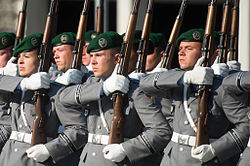
Wachbataillon members shoulder arms in formation at the Defense Ministry in Berlin.
Active15 February 1957 - present
Country Germany (West Germany to 1990)
Branch Streitkräftebasis Bundeswehr
TypeArmy, Navy, Air Force, Jägertruppe (Army part)
RoleDrill, ceremonial and guarding and security duties
Size7 active companies
Garrison/HQ Kommando Territoriale Aufgaben der Bundeswehr
Berlin
NicknameProtter or Protokollsoldaten
MottoSemper talis (always the same/great)
MarchYorckscher Marsch
Commanders
Current
commander
Oberstleutnant Maik Teichgräber
Insignia
Shoulder sleeve insignia of the Wachbataillon
Cuff title of the Wachbataillon
Beret badge of the Wachbataillon

The Wachbataillon (full name: Wachbataillon beim Bundesministerium der Verteidigung [WachBtl BMVg], lit.'Guard Battalion at the Federal Ministry of Defence') is the German Bundeswehr's honour guard. The Wachbataillon number about 1,000 soldiers stationed in Berlin. It consists of seven active companies (see list below) and belongs to the Streitkräftebasis (Joint Service Support Command) of the Bundeswehr. The soldiers of the Wachbataillon often refer to themselves as Protter or Protokollsoldaten, meaning protocol soldiers.

Mission

[edit]
German Wachbataillon soldiers on parade in Rome

The primary mission of the Wachbataillon is to perform the military honours for the German president, the German Chancellor, the Federal Minister of Defence and the Inspector General of the Bundeswehr during state visits or on comparable occasions.

The Wachbataillon executes the Großer Zapfenstreich ("Grand Tattoo") on special occasions (for example on the 50th anniversary of the Bundeswehr in front of the Reichstag in Berlin on the night of 26 October, 2005) or takes part in events like the ceremonial oath of the Bundeswehr ceremony, parades, state funerals, military tattoos and shows with its drill team which is the best trained special unit of the battalion.

A secondary mission is to perform (ceremonial) guard duty at the Ministry of Defence and other high-profile public places and to protect and guard members of the German government and the Ministry of Defence.

Another secondary mission is to secure and defend the alternate seat of the federal German government in conjunction with the Federal Police forces. Therefore, all soldiers of the Wachbataillon are trained as infantrymen and do regular exercises on military training areas (Truppenübungsplatz) in addition to their protocol duties.

Recruitment

[edit]
Wachbataillon personnel executing a Großer Zapfenstreich
Wachbataillon personnel in Army uniforms perform the military honours for the German Chancellor Angela Merkel and Greek Prime Minister Antonis Samaras on 24 August 2012.
Wachbataillon personnel in Navy uniforms greet U.S. Defense Secretary Robert M. Gates as he arrives in Berlin on 25 April 2007.
Wachbataillon personnel in Air Force uniforms at the boarding of U.S. President Barack Obama and Michelle Obama on Air Force One at the end of their visit to Germany on 19 June 2013.
Wachbataillon personnel executing a Großes Ehrengeleit at the state funeral of former Chancellor of West Germany Helmut Schmidt on 23 November 2015.

Until recently, the Wachbataillon protocol- and security companies only admitted male personnel that had a body height ranging from 1.79 meters (5 ft 10 in) up to 1.93 meters (6 ft 4 in), normal eyesight and body weight and are generally in good health. Wachbataillon personnel (especially protocol soldiers) still are not allowed to grow beards or moustaches as well as wearing glasses or being overweight (Bierbauch). These are internally known as the "three forbidden B's" (verbotene drei Bs – keine Brille, kein Bart, kein Bauch). At the "Ehrengeleit" (escort of honor) after the death of the well known and veteran politician Wolfgang Schäuble several soldiers were seen with beards. Since 2024 beards are officially allowed in the Wachbataillon. [1]

Since 2009, the 1./WachBtl BMVg staff- and supply company has admitted female personnel. In the Großer Zapfenstreich for Karl-Theodor zu Guttenberg in March 2011, the first female soldier performed the role of torchbearer. Until the end of conscription in Germany in July 2011, about 80 per cent of Wachbataillon's personnel were conscripts. The requirements for Wachbataillon personnel were relaxed to a body height ranging from 1.75 meters (5 ft 9 in) up to 2.00 meters (6 ft 7 in), no visible visual aids and having a good general fitness. In March 2012 the first female officer took command of a platoon of the Wachbataillon.

The soldiers of the Wachbataillon are from all three German armed services (i.e. army, navy and air force) and have the uniforms from all forces at their disposal to be able to perform any drill mission on every occasion. Green berets are used for army uniform, the (dark) blue beret for air force and the navy wears traditionally the sailor suit (Matrosenanzug). The beret badge for army and air force uniform shows the letter "W" as an abbreviation for Wachbataillon.

Equipment

[edit]

For reasons of tradition the Wachbataillon is the only unit of the Bundeswehr still using the Karabiner 98k bolt action rifle because the traditional Prussian rifle drills can be executed better with that historical weapon. In 1995 remaining swastikas and other Nazi-era markings were removed from these rifles, after criticism regarding the presence of such symbols on Wachbataillon kit by the SPD parliamentary party.[2] As of 29 October 2011 women are allowed to participate in the drill training with the Karabiner 98k.

During normal duty the Wachbattalion uses the Heckler & Koch G36 assault rifle and other kit like the other units of the Bundeswehr. Since 2006 the 1./WachBtl BMVg is the last unit in the Bundeswehr using ten Feldhaubitze 105 mm guns in the role of salute guns.[3]

Tradition

[edit]

The Wachbataillon has been granted exemption of the Traditionserlass and is thus continuing the traditions of the 1st Foot Guards and the Infantry Regiment 9 Potsdam, the only unit in the Bundeswehr to officially have such ties.[4] Veterans of these regiments are joined with active and former members of the Wachbataillon in the Semper Talis Union.[5]

Structure

[edit]

The Wachbataillon is stationed at the Julius Leber Barracks in the centre of Berlin. Since 2001 the Wachbataillon is part of the Streitkräftebasis. The battalion is organized into seven active companies (four of them honour guard companies) and two inactive military reserve companies.

List of Wachbataillon's companies

[edit]
Company Duty of company Arm
1./WachBtl BMVg Staff- and supply company Army
2./WachBtl BMVg Protocol- and security company Army: Jägertruppe
3./WachBtl BMVg Protocol- and security company Army: Jägertruppe
4./WachBtl BMVg Protocol- and security company Navy
5./WachBtl BMVg Protocol- and security company Air Force
6./WachBtl BMVg Security company Army: Jägertruppe
7./WachBtl BMVg Military training company Army: Jägertruppe
8./WachBtl BMVg Security company (inactive) Army: Jägertruppe non-commissioned personnel
9./WachBtl BMVg Security company (inactive) Army: Jägertruppe non-commissioned personnel

See also

[edit]

References

[edit]
[edit]
Revisions and contributorsEdit on WikipediaRead on Wikipedia
from Grokipedia
The Wachbataillon beim Bundesministerium der Verteidigung (WachBtl BMVg) is the ceremonial honour guard battalion of the German , responsible for rendering military honors to foreign state guests, the Federal President, , and Minister of Defence during official protocols in . Established on 15 1957 in Rheinbach as one of the inaugural units of the nascent West German armed forces, the battalion combines representational duties with operational readiness for the protection of government facilities in scenarios of tension or armed conflict. Stationed at the Julius-Leber-Kaserne in since the relocation of government functions from , the Wachbataillon maintains a integrating four companies, one each from the and , support elements, and reserve companies, drawing personnel from across the Bundeswehr's branches to symbolize unified national defense. Its dual mandate underscores a commitment to both and practicality, as the unit—Berlin's sole combat-ready formation—undergoes rigorous training in alongside precision drill for public ceremonies, ensuring disciplined execution of honors such as troop reviews and farewells. The battalion's significance lies in its embodiment of democratic resilience, having evolved from rearmament to represent Germany's military posture in international without notable operational deployments beyond roles.

History

Formation and Establishment

The Wachbataillon beim Bundesministerium der Verteidigung (WachBtl BMVg) was formally established on 15 February 1957 in Rheinbach, near , as one of the earliest operational units of the newly forming . This formation occurred amid the rapid buildup of West Germany's armed forces following the 's legal inception in 1955, with the battalion drawing initial personnel from provisional guard elements and training cadres relocated from sites such as Diez an der Lahn. At inception, the unit comprised approximately a staff company, supply elements, and ceremonial detachments, totaling around 500 personnel, equipped for both representational duties and contingency protection of government facilities. The battalion's primary mandate from establishment was to conduct military honors and ceremonial representation for the , including state visits, official receptions, and at the Federal Ministry of Defence in . In parallel, it held a defensive role to secure the ministry and federal leadership in the event of national emergency, reflecting the Cold War-era emphasis on rapid-response protection amid West Germany's rearmament under integration. Early emphasized traditions adapted for parade precision, with the integration of a training music corps from to support ceremonial music, enhancing the unit's role in formal military rituals. Initial command fell under the direct authority of the Federal Ministry of Defence, with the battalion headquartered in temporary facilities at the Tomburg-Kaserne in Rheinbach, which had been repurposed as a site that year. Recruitment prioritized volunteers with prior service experience or aptitude for drill and security tasks, aligning with the 's broader policy of citizen-in-uniform principles under the Innere Führung doctrine. By late , the unit had conducted its first public demonstrations, establishing its precedence in Bundeswehr protocol for honors and thereby solidifying its foundational status within the armed forces structure.

Post-Cold War Adaptations

Following on October 3, 1990, the Wachbataillon BMVg faced adaptations aligned with the 's broader restructuring amid reduced tensions and the absorption of limited elements. Personnel levels across the dropped to approximately 370,000 by the mid-1990s under the Two-plus-Four Treaty constraints, prompting efficiency measures including the disbandment of the unit's inactive field replacement company to focus resources on core guard and ceremonial functions. The 1991 parliamentary decision to relocate the federal capital from to significantly influenced the battalion's basing, initiating partial transfers in the mid-1990s to support emerging sites. On April 1, 1995, the 7th was established in and integrated into protocol services, alongside temporary postings of the 2nd , enhancing readiness for honors in the reunified capital. Full relocation from progressed gradually, with the unit consolidating exclusively at Julius-Leber Barracks by 2014, coinciding with the Ministry of Defence's move and bolstering protective duties at key Berlin installations amid evolving urban security demands. This shift preserved the battalion's exemption from the Traditionserlass, allowing continuity of historical practices despite force-wide modernization.

Modern Reforms and Expansions

In April 2024, German Defense Minister Boris Pistorius announced a major restructuring of the Bundeswehr to improve its war-readiness amid heightened geopolitical tensions, including Russia's invasion of Ukraine. This reform established the Unterstützungsbereich (Support Area) as a new organizational branch, effective October 1, 2024, to centralize logistics, medical, and security functions. The Wachbataillon was assigned to this branch under the Kommando Feldjäger (Military Police Command), enhancing coordination between ceremonial, protective, and military police operations. The integration, formalized by April 1, 2025, maintains the battalion's core strength of around 1,000 soldiers while aligning it with broader support capabilities, allowing for more efficient and rapid response in scenarios. This shift reflects a strategic emphasis on integrating elite guard units into unified command structures to bolster national defense without expanding personnel numbers. No significant numerical expansions have occurred, but the reforms enable expanded interoperability with other elements for protective duties at key installations.

Mission and Responsibilities

Ceremonial Functions

The Wachbataillon BMVg executes ceremonial duties as the primary honor guard unit of the , providing military honors during state visits, official receptions, and significant national events. These functions include forming Ehrenformationen, precise military alignments that demonstrate discipline and tradition, for foreign dignitaries and domestic leaders such as the Federal President, , and Minister of Defence. Key ceremonial responsibilities encompass participation in the , a traditional grand performed on state occasions like national holidays or farewells for high-ranking officials, involving synchronized with rifles and musical accompaniment from bands. The battalion also conducts changing of the guard ceremonies at the Federal Ministry of Defence and other government sites, upholding protocols aligned with international standards. In addition to static honors, performs dynamic displays of precision, including manipulation routines that highlight the soldiers' training in ceremonial expertise across all branches, ensuring representation of the armed forces' unity and professionalism. These activities serve to foster military tradition and public appreciation of the 's role.

Protective and Security Duties

The Wachbataillon BMVg is tasked with protecting federal government facilities and official seats in during periods of tension and defense, ensuring the operational capability of the Bundesregierung in crisis situations. This includes safeguarding key sites such as the and other high-profile locations against threats, functioning as the sole combat-ready unit stationed in a major German metropolitan area at Julius-Leber-Kaserne. Personnel maintain combat proficiency through ongoing infantry training, balancing representational roles with defensive preparedness, and are equipped with standard Bundeswehr infantry armament including the G36 assault rifle, P8 pistol, G22A2 , MG3, MG4, MG5 machine guns, and 40mm grenade launchers for security operations. The unit comprises active companies from the , , and branches, supplemented by two reserve companies dedicated to augmentation during heightened alert states. To validate these capabilities, the conducts intensive field exercises, such as the 72-hour Bärlin II maneuver, which simulates large-scale company-level defense of installations under stress conditions, emphasizing rapid response, perimeter , and urban tactics to counter potential aggressors. These drills underscore the unit's transition from ceremonial posture to active protection, with approximately 1,000 personnel—including 70 women—ensuring resilience in maintaining democratic governance continuity.

Organization and Structure

Command Hierarchy

The Wachbataillon beim Bundesministerium der Verteidigung (WachBtl BMVg) operates within the Bundeswehr's command structure as a subordinate unit of the Kommando Feldjäger der Bundeswehr, effective from 1 October 2024, as part of a broader reorganization to enhance focus on territorial and alliance defense tasks. The Kommando Feldjäger, headquartered in Hannover, is led by Brigadegeneral Sandro Wiesner, who oversees military police operations, protocol duties, and protective missions across the Bundeswehr. Prior to this reassignment, the battalion fell under the Streitkräftebasis (Joint Support Service) and elements of the Territoriales Führungskommando, reflecting periodic adjustments to align with evolving Bundeswehr priorities such as integrated support and security for government facilities. At the battalion level, command is exercised by Oberstleutnant Maik Teichgräber, who holds responsibility for operational readiness, ceremonial execution, and security protocols involving approximately 1,030 personnel stationed exclusively in Berlin's Julius-Leber-Kaserne since 2014. The battalion headquarters includes a staff element for planning and logistics, directly interfacing with the company commanders to ensure unified execution of missions ranging from honor guards to defensive operations in tension or wartime scenarios. Internally, the command hierarchy cascades through seven active companies, each led by a Kompaniechef typically holding the rank of (Captain) or higher, with platoons under (Lieutenant) or (First Lieutenant) officers. These include the 1st Company (Stabs- und Versorgungskompanie for staff and support functions), 2nd Company (Protokollkompanie for ceremonial protocol), and specialized Wach- and reserve companies (3rd through 7th) focused on security, infantry tactics, and augmentation roles, drawing personnel from all branches (Heer, , Marine) to maintain versatility. This structure ensures disciplined chain-of-command adherence, with non-commissioned officers ( ranks) managing daily drills and enlisted personnel execution. Ultimate authority traces upward through the Kommando Feldjäger to the Inspector of the Joint Support Service and the , General Carsten Breuer, under the political direction of the Federal Minister of Defence. This layered hierarchy prioritizes rapid response for protective duties while integrating ceremonial standards, with command changes—like the 2024 subordination—aimed at streamlining Bundeswehr-wide resilience without altering the unit's core capabilities.

Component Companies and Units

The Wachbataillon is structured into seven active companies dedicated primarily to protocol and security duties, comprising four companies from the , one from the , one from the , and one Sicherungskompanie (security company) for protective tasks. These protocol companies (1st through 6th) provide branch-specific honor guards for ceremonial events, ensuring representation of the Bundeswehr's unified structure during state visits, military honors, and official receptions. The 7th Company focuses on infanteristic operations, including perimeter defense and rapid response in tension or defense scenarios, integrating combat training with guard responsibilities. Support elements include , , and administrative units that enable sustained operations, such as equipment maintenance and personnel rotation for continuous duty coverage at key sites like the Federal Ministry of Defence in . The battalion also maintains two non-active reserve companies (8th and 9th), composed exclusively of reservists, which can be mobilized for augmentation during heightened security needs or large-scale events. This organization reflects the unit's dual role in ceremonial representation and operational readiness, with companies rotating duties to maintain proficiency across missions.

Recruitment and Personnel

Selection and Eligibility

Eligibility for service in the Wachbataillon beim Bundesministerium der Verteidigung requires candidates to meet standard Bundeswehr enlistment criteria, including German citizenship, completion of compulsory schooling, and a minimum age of 17 years (with parental consent) or 18 years without. Specific to the Wachbataillon, applicants must possess at least a Hauptschulabschluss accompanied by vocational training or a Realschulabschluss, demonstrating readiness for a 12-year commitment or shorter voluntary service terms of 7 to 23 months. Physical standards are stringent, particularly for ceremonial protocol duties, to ensure uniformity in formations and operational fitness. General minimum is 1.60 meters, but protocol soldiers (Protokollsoldaten) must measure between 1.75 and 2.00 meters, maintain a (BMI) below 24, and exhibit no visible deviations such as beards or excess abdominal fat. Broader protocol and roles require heights from 1.65 to 2.10 meters, sufficient baseline , and correctable vision to 100% without glasses during ceremonial duties (contact lenses are mandatory and provided). Selection begins with application through Bundeswehr career portals, followed by career counseling to verify suitability. Candidates undergo basic infantry training before specialized assessment for Wachbataillon assignment, emphasizing motivation, discipline, and aptitude for both ceremonial precision and security tasks. Protocol training includes a 40-day foundational course in drill and infantry skills, culminating in a Day 41 evaluation to determine placement in ceremonial companies. Women have been eligible since 2001, comprising about 70 of the unit's approximately 1,000 personnel as of 2024.

Training and Discipline Standards

The training regimen for Wachbataillon personnel emphasizes a dual focus on ceremonial precision and combat readiness, beginning with an intensive 40-day protocol basic training phase dedicated to honorary service duties. This phase prioritizes synchronized marching in formations, precise rifle-handling sequences with the , and uniform appearance standards, including the Heeresanzug, to ensure flawless execution during state ceremonies such as the and salutations. Trainees must demonstrate exceptional endurance, discipline, and perfectionism, with movements drilled repeatedly until performed automatically, fostering a high esprit de corps essential for collective protocol tasks. Following protocol , soldiers undergo a two-month Spezialgrundausbildung to develop proficiency, particularly for urban scenarios protecting facilities. This includes hands-on instruction in weapons such as the Gewehr G36 , machine guns, grenade pistols, and anti-tank systems, alongside tactics for group movement, building clearance, and small-unit combat dialogues. The balances the rigid collective discipline required for ceremonial roles with the individual initiative demanded in defensive operations, as noted by instructors who highlight the challenge of transitioning between "maximale Disziplin im Kollektiv" for protocol and adaptive decision-making in tasks. Discipline standards are exceptionally stringent, enforcing physical and mental resilience through culminating exercises like a 20-kilometer march followed by multi-day simulations defending against simulated attacks in abandoned industrial sites. Personnel must maintain vigilance, teamwork, and real-time threat response in complex urban environments, with minimum eligibility including a of at least 1.60 meters to meet uniform and formation requirements. Ongoing standards demand unyielding precision and adaptability, ensuring soldiers can shift seamlessly from ceremonial guards to active defense postures.

Equipment and Attire

Operational Gear

The operational gear employed by the Wachbataillon beim Bundesministerium der Verteidigung for protective and security duties aligns with standard Bundeswehr infantry equipment, emphasizing mobility and rapid response without heavy weaponry such as mortars or armored vehicles. Primary small arms include the Heckler & Koch G36 assault rifle, utilized in patrols, building securing, and urban defense scenarios. Machine guns, including the MG3, support squad-level suppressive fire during threat neutralization exercises. Personnel are equipped with the P8 9mm pistol as a standard sidearm for close-quarters engagements, alongside disposable anti-tank launchers to counter potential armored or fortified threats in protective operations. Protective elements feature combat helmets for ballistic defense, paired with modular load-bearing vests compatible with the unit's lightweight configuration to facilitate extended foot patrols around the and other secured sites. This setup prioritizes agility over sustained , reflecting the battalion's in high-profile without compromising ceremonial readiness.

Ceremonial Uniforms and Insignia

The ceremonial uniforms of the Wachbataillon are based on the Bundeswehr's standard service dress, as the armed forces maintain no dedicated parade or gala uniform distinct from daily service attire. For the Army (Heer) component, this consists of the stone-grey tunic and trousers (Dienstanzug Heer), featuring a four-pocket jacket secured with silver buttons. The Luftwaffe elements wear analogous blue service dress, while Marine personnel utilize the traditional sailor suit (Matrosenanzug). During ceremonial duties, such as state events or honor guards, soldiers add white leather belts or webbing over the uniform for drill precision and visual uniformity. Unit-specific insignia distinguish Wachbataillon personnel across branches. The (Verbandsabzeichen) is worn on the left upper arm of the service jacket, depicting a stylized eagle or unit in embroidered form. titles inscribed with "Wachbataillon" appear on both sleeves of the jacket, embroidered in silver thread to denote elite guard status. Berets, in for Heer, dark blue for , or appropriate for Marine, bear a metal featuring the unit's heraldic elements, including crossed rifles or guard motifs. A distinctive breast pendant with the Fraktur-script letter "W" is affixed to the right breast pocket on Heer and service uniforms, symbolizing the battalion's watch and protection role. Rank insignia follow standard patterns, with shoulder straps piped in green for Heer members, emphasizing the unit's heritage despite multi-branch composition. These elements ensure uniformity and tradition during public ceremonies, such as wreath-laying or troop reviews at the Federal Ministry of Defence.

Traditions and Protocols

Drill Procedures and Influences

The drill procedures of the Wachbataillon emphasize extreme precision, synchronization, and uniformity, achieved through repetitive execution of standardized movements during protocol basic training (Protokollgrundausbildung). Central to this is rifle drill with the Gewehr G21, a ceremonial adaptation of the historical bolt-action rifle, involving constant repetition of identical sequences such as shouldering, presenting, and manual handling to ensure flawless collective formations for honors and ceremonies. These routines demand soldiers maintain rigid posture, with movements executed in unison without deviation, often practiced for hours to instill automaticity under scrutiny. Marching drill incorporates the Stechschritt, a high-knee, locked-leg performed at approximately 120 steps per minute, reserved for special ceremonial occasions like state visits or commemorative events to evoke historical grandeur. The battalion's drill teams, such as the 7th , execute advanced sequences comprising up to 350 consecutive steps without verbal commands, showcasing spins, tosses, and balances with the to demonstrate mastery. Commands are issued in formal German military parlance, adhering to regulations (Dienstvorschriften Heer), with variations for honorary duties like the , where troops halt in perfect alignment for salutes and inspections. These procedures draw directly from Prussian military traditions, originating in the 18th- and 19th-century drill manuals of the Kingdom of Prussia, which prioritized mechanical obedience and aesthetic discipline to foster unit cohesion. The Wachbataillon preserves elements like the Stechschritt and rifle manipulations suited to the Karabiner 98k, which modern assault rifles like the G36 cannot replicate as effectively due to design differences. This continuity traces to pre-1945 guard units, such as the Weimar Republic's Wachregiment Berlin (1921–1933), adapting Imperial German protocols while omitting Nazi-era modifications post-1995. Unlike broader Bundeswehr norms, which favor practical post-WWII reforms emphasizing flexibility, the battalion's ceremonial focus retains Prussian rigidity to symbolize national continuity, though debated for evoking authoritarian associations.

Ceremonial Events and Protocols

The Wachbataillon performs the protokollarischer Ehrendienst, providing military honors during official state events, including state visits by foreign dignitaries and receptions for German federal officials. These duties encompass presenting honor formations such as Ehrenposten, the smallest ceremonial unit, and escalating to Ehrenkompanie or full Ehrenbataillon for highest-level honors. Soldiers execute precise rifle drills using unloaded rifles in the "Infanteriegriff" position to symbolize peaceful intentions alongside demonstrations of military discipline. During state visits, the battalion coordinates with the Stabsmusikkorps der for ceremonial marches and salutes, including artillery volleys from Haubitzen field guns fired in honor of visiting heads of state. Protocols emphasize synchronized movements and formations, with deployments occurring approximately 600 times annually across protocol companies, often in but extending nationwide and abroad. These events adhere to international diplomatic standards, ensuring uniformity in posture, timing, and presentation. A prominent ceremonial event is the , the Bundeswehr's most solemn parade, involving up to 257 soldiers from the Wachbataillon in torchlit formations, accompanied by musical performances. This tradition marks farewells for high-ranking officials or commemorative occasions, featuring elements like the Preußischer Zapfenstreichmarsch and strict adherence to historical protocols derived from Prussian military customs. In Berlin-based executions, the battalion provides the core honor guard contingent. Protocols for all events require soldiers to meet stringent physical standards, including heights between 1.75 and 2 meters, to maintain visual uniformity during drills and inspections. Training focuses on protokollarische Rituale, ensuring flawless execution under scrutiny, with only qualified personnel assigned to these duties after rigorous evaluations.

Controversies and Criticisms

Incidents of Extremism and Misconduct

In October 2021, the German Ministry of Defence launched an investigation into allegations of a right-wing extremist group within the Wachbataillon, prompting the temporary removal of an entire company from ceremonial protocol duties and the relief of several superiors from their positions. The probe focused on reports of "bizarre rituals," including excessive drinking and initiation ceremonies, alongside suspected right-wing extremist activities involving multiple dozens of soldiers. Officials confirmed the formation of a group exhibiting extremist tendencies, though specific details on ideologies or actions remained limited to protect the ongoing inquiry. This incident occurred amid broader concerns over right-wing extremism in the , where the number of suspected cases rose from 363 in 2019 to 477 in 2020, though the Wachbataillon case highlighted vulnerabilities in high-profile units responsible for representative duties. The unit's ceremonial role amplified scrutiny, as it serves as the 's public face during state visits and official events. In a separate case of , internal investigations in the early led to criminal proceedings against former Wachbataillon soldiers for the of a , described by defendants as part of an initiation ritual. On September 2, 2025, a court convicted two ex-soldiers of the assault, which involved violence against a fellow recruit, following confessions and evidence from the probe. This event underscored disciplinary lapses in and training protocols. Additionally, in September of an unspecified recent year, the Wachbataillon commander, Hans Domrich, was relieved of duty amid allegations of and disciplinary failures, though official statements cited general without detailing outcomes. These cases reflect isolated but notable breaches in a unit otherwise emphasizing strict standards, with responses including personnel reassignments and enhanced vetting to mitigate risks.

Debates on Utility and Symbolism

The Wachbataillon's establishment in 1957 addressed the post-World War II imperative for a minimal yet essential military presence in state representation, amid widespread skepticism toward ceremonial militarism in the . This reflected a broader on balancing democratic aversion to aggressive symbolism with the practical need for protocol in international diplomacy and national ceremonies, where military honors signal and commitments. Critics, particularly from antimilitarist perspectives, have scrutinized the unit's symbolic elements—such as the Gothic 'W' insignia and use of Karabiner 98k rifles—as evoking pre-1945 Prussian and Nazi-era traditions, potentially normalizing hierarchical military culture in civilian society. Regulations like the Traditionserlass of 1965 and service directives ZDv 10/8 and 10/9 govern these symbols to emphasize democratic values and discipline, yet they underscore ongoing tensions between historical continuity and rupture from authoritarian pasts. On utility, the battalion's protokollarische duties—honoring dignitaries and performing at state events—complement its core protective role in securing government facilities during tensions or defense scenarios, justifying specialized training for an elite force of approximately 1,000 personnel. Proponents argue this dual function enhances operational readiness and deterrence, while resource strains, including recruitment shortfalls noted since the 2011 reforms, have fueled questions about prioritizing such representation over frontline capabilities in a budget-constrained military.

References

Add your contribution
Related Hubs
User Avatar
No comments yet.