Hubbry Logo
Cuff titleCuff titleMain
Open search
Cuff title
Community hub
Cuff title
logo
8 pages, 0 posts
0 subscribers
Be the first to start a discussion here.
Cuff title
Cuff title
from Wikipedia
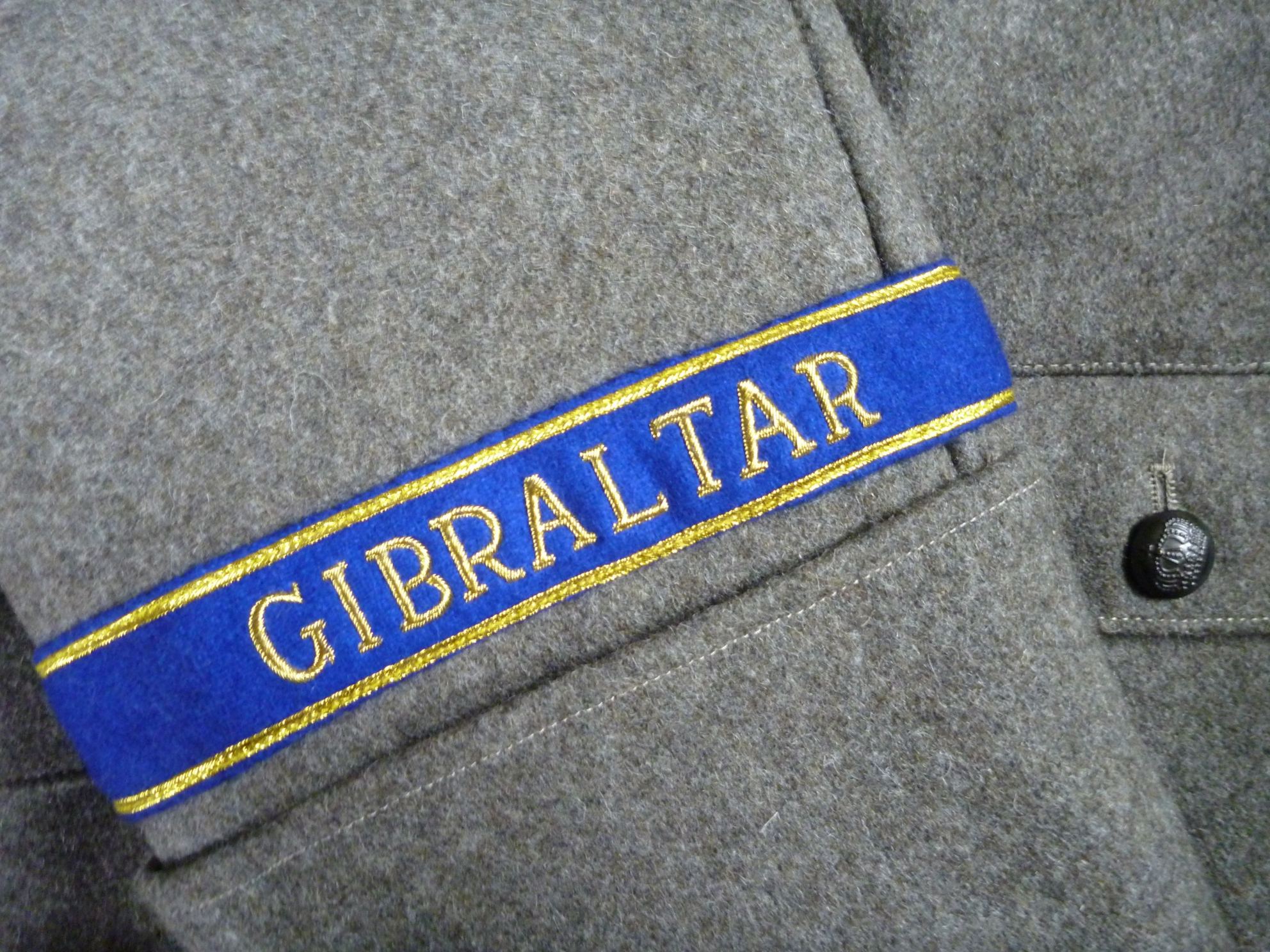
A Bundeswehr "Gibraltar" cuff title. The title was initially awarded by George III to Hanoverian Army troops which fought in the Great Siege of Gibraltar; Wilhelm II renewed the cuff title in 1901.

The cuff title (German: Ärmelstreifen) is a form of commemorative or affiliation insignia placed on the sleeve, near the cuff, of German military and paramilitary uniforms. The tradition can be traced back to the foundation of the "Gibraltar" cuff title, which was authorised in 1783 by George III for Hanoverian Army troops which fought in the Great Siege of Gibraltar during the American Revolutionary War.[1][2][3] Cuff titles are often associated with the Second World War and units of the Waffen SS but were widely used by all branches of the German military, including paramilitary and civilian organizations.[4]

Description

[edit]
Image of the Latin script "Großdeutschland" cuff title introduced in 1944. This was a uniform insignia of the Panzergrenadier Division "Großdeutschland", an elite combat unit of the army of Nazi Germany that fought on the Eastern Front in World War II.

The base portion of a cuff title is made of either wool, cotton, rayon or a cotton/rayon mix. It is approximately 4 cm (1.6 inches) wide and bears a name or symbol that identifies the wearer belonging to a particular unit or has served in a specific campaign. Machine woven cuff titles became more common as the second world war progressed and newer titles were introduced. The colors of the fabric as well as the lettering varied. The cuff titles of the Waffen-SS, the combat branch of the paramilitary SS organisation of Nazi Germany, reflected the colours of the SS (black and silver) and were generally black in colour with grey or white lettering.

Lettering could be in Latin, Gothic or Sütterlin style script, as shown on the Grossdeutschland cuff title. Block letters were also used.

Types

[edit]
The "Courland" campaign cuff title (Ärmelband Kurland in German) was a military decoration of Nazi Germany awarded to soldiers of Army Group Courland who fought in the Courland Pocket during World War II.
The "Afrika" campaign cuff band (Ärmelband Afrika) was awarded to soldiers who took part in Nazi Germany's North African campaign of 1941–43.
  • Unit Cuff Titles – These generally referred to the name of a division, although some regiments also had distinctive titles.
  • The Allgemeine or General SS, the paramilitary corps of the German Nazis, manufactured the largest amount in variations of cuff bands from Standarten to Oberabschnitte - https://en.wikipedia.org/wiki/Allgemeine-SS_regional_commands - Ref: Ian Blanthorn
  • Branch of Service Cuff Titles – These identified those who served in a specific branch of service like the military police and war correspondents. The cuff title of the Feldgendarmerie (Military Police) wore a distinctive cuff title, often in conjunction with a unit cuff title, if entitled.[5]

Both were named Ärmelstreifen. To differentiate it, there was another cuff title, named Ärmelband, which was used for

  • Campaign Cuff Titles – a total of four were authorised during the Second World War to reward participation in the campaigns in Crete, Africa, Metz and Courland.[6]

There are several patterns of cuff titles known to have been used; some units had several unique patterns. Among the more interesting designs were:

  • The British Free Corps had a cuff title in block Gothic script with the name of the unit in English.
  • The "Afrikakorps" cuff title was worn informally as a campaign title until replaced with an "Afrika" cuff title bearing that name as well as depictions of palm trees.[7]
  • The 3rd SS Division Totenkopf had a version of their cuff title that was only a skull and crossbones design.
  • The 1st SS Division Leibstandarte SS Adolf Hitler had "Adolf Hitler" written on their cuff title in the German Sütterlin script. Contrary to a common belief, the design did not bear any resemblance to Adolf Hitler's signature.

Method of wear

[edit]
Position of the cuff title. The Crete Cuff Title (Ärmelband Kreta) was a World War II German military decoration awarded to Wehrmacht servicemen who took part in the battle of Crete 1941.

As worn on Second World War uniforms, the bottom edge of German cuff titles were generally placed at the top of the split seam of a jacket cuff. This is how the measurement of 14.5 cm to 15 cm (5.7 to 5.9 inches) came about, because the split seam of the sleeve of a German enlisted man's field blouse is approximately 14.5 cm. The Germans had no defined measurement in their regulations as to how high the cuff title went, just that it was to be placed alongside the cuff's split seam. Wartime photographic evidence exists of jackets with the cuff title placed lower than 14.5 cm to 15 cm from the cuff edge. This is usually due to a reduced sleeve length. On jackets with a French cuff (the cuff turned back), the cuff title was placed above the cuff if it was an Army (Heer), Air force (Luftwaffe), or Navy (Kriegsmarine) uniform, and placed just below the cuff edge on the cuff itself on SS jackets (usually between the edge of the cuff and the seam of the cuff's edge, approximately 1 mm to 1.5 mm).

In the Bundeswehr the cuff title are worn at the cuff on both sides.[8]

Wearing two cuff titles; SS-Schule Tölz (SS-Junkerschule Bad Tölz) and Frikorps Danmark

In the Army, Air force or Navy the unit cuff title was, in tradition with the regranted GIBRALTAR cuff title, worn on the right arm.[9] In the SS the cuff title was worn on the left arm. All campaign cuff titles were worn on the left arm. For example; someone who was in the army and fought in North Africa and later transferred to Grossdeutschland had an "Afrika" campaign cuff title on their left arm and their Grossdeutschland cuff title on their right arm (General Manteuffel's leather coat was an anomaly to this rule). An SS soldier who fought in Crete as a paratrooper and later joined 2nd SS Division Das Reich would have both of his cuff titles on the left arm. In this case one would usually see the unit cuff title placed below the campaign cuff title because the chances are that the individual received his jacket with his unit cuff title beforehand and then had his campaign cuff title affixed after the fact, but this was not always the case.

More than one title could be worn if the soldier was entitled. General Manteuffel wore the "Afrika" campaign cuff title above his Grossdeutschland cuff title during the period he commanded that division. Unit cuff titles were not granted as a mark of prior service in the same manner that divisional patches were and continues to be worn on the right sleeve of US Army uniforms. However, members who were entitled to wear a unit cuff title, who were also military policemen,[5] combat correspondents, or members of the Führerhauptquartier (Hitler's headquarters), could wear both their unit's cuff title and the cuff title of their specialty service. An example of this would be a military policeman in the 17th SS Division "Götz von Berlichingen", who would or could wear both this SS-Feldgendarmerie (SS Military Police) cuff title and his Götz von Berlichingen cuff title. In this specific case, they would both be worn on the left arm. Soldiers sent to schools also wore the school's cuff over that of the unit, if any.

Status

[edit]

Cuff titles were considered a special honour. The book The History of the Panzerkorps Grossdeutschland by Helmuth Spaeter describes an instance in which the motorcycle company of the Infantry Regiment "Grossdeutschland" was held to account for losing a position; they were forbidden from wearing their cuff titles until they had earned the privilege back by success in a later battle.

When Waffen SS divisions failed to perform satisfactorily near Vienna in April 1945, Adolf Hitler ordered the units involved to remove their cuff titles as a punishment. SS-Oberstgruppenführer Sepp Dietrich was enraged, and reportedly sent his own back to Berlin in a night vase (chamber pot).

Soldiers in training were usually presented the cuff title only on completion of that training, and the award of the title was seen as a rite of passage. This rite is described in the book The Forgotten Soldier.

Post World War II

[edit]
Cuff title of the DDR Wachregiment "Feliks E. Dzierzynski".

The East German Nationale Volksarmee continued the tradition of cuff titles, most notably worn by Border Guards and Guard Regiments named after famous German communists and Personalities of the Eastern Bloc.

Cuff titles of the Luftwaffe

The West German Luftwaffe (Federal German Air Force) regranted the tradition of awarding cuff titles to its Traditionsverbände such as: "Jagdgeschwader Immelmann", "Jagdgeschwader Steinhoff", "Jagdgeschwader Richthofen" and "Jagdgeschwader Boelke", which were named after famous fighter pilots of the First and Second World Wars.[8][10] The cuff title for "Jagdgeschwader Mölders" was later withdrawn.

The German Army continues to wear some distinctive cuff titles today. The first, used by the German Army Aviation Corps is a stylized silver grey "wing" on a black band with silver piping on the top and bottom edges. The second for its Armoured Training Battalion (and School) which is a silver grey embroidered "Panzerlehrbrigade 9" in Gothic script. Also the schools "Offizierschule des Heeres" and "Unteroffizierschule des Heeres" have granted cuff title.[8]

Cuff title of the Wachbataillon.

The third for its Wachbataillon which is a silver grey embroidered "Wachbataillon" in Gothic script on a black band with silver piping on the top and bottom edges.

Sources

[edit]
  • Klietmann, Kurt-Gerhard (1981). Auszeichnungen des Deutschen Reiches, 1936–1945 (In German). Motorbuch, Stuttgart. ISBN 3-87943-689-4.
  • Littlejohn, David; Dodkins, Colonel C. M. (1968). Orders, Decorations, Medals and Badges of the Third Reich. R. James Bender Publishing, California. ISBN 978-0854200801.
  • Ian Blanthorn Military Historian.
  • Williamson, Gordon (2002). World War II German Battle Insignia. Osprey Publishing. ISBN 1841763527.

References

[edit]
[edit]
Revisions and contributorsEdit on WikipediaRead on Wikipedia
from Grokipedia
A cuff title (German: Ärmelstreifen or Ärmelband) is an embroidered or bullion-woven cloth insignia affixed to the lower sleeve near the cuff of a uniform, primarily used in the German military to denote affiliation with a specific unit, elite formation, or participation in a designated campaign. Originating in the 19th-century Prussian and Imperial German armies for identifying guards or special regiments, the practice expanded significantly during World War II across the Wehrmacht branches (Heer, Luftwaffe, Kriegsmarine) and Waffen-SS, where over 100 variants were issued to mark commemorative awards for grueling defensive actions, such as the Afrika, Kreta (Crete), and Kurland (Courland) bands, or to designate foreign volunteer legions like Freikorps Danmark. These titles, typically machine- or hand-embroidered in branch-specific colors (e.g., field-grey for army, black for SS), were mandatory for active service members in named units and served both practical identification and morale-boosting purposes amid prolonged attrition warfare. While most were awarded to frontline troops for verified service, postwar reproductions and forgeries have proliferated among collectors, complicating authentication based on weave quality, thread type, and historical issuance records.

History

Origins and Early Use

The tradition of cuff titles in German military uniforms originated with the "Gibraltar" band, authorized in October 1783 by King George III for personnel of three Hanoverian battalions that defended Gibraltar against Spanish and French forces during the Great Siege from July 1779 to February 1783. These units, serving under British command due to George III's dual role as Elector of Hanover, earned the right to wear a blue cloth sleeve band embroidered with "GIBRALTAR" in gold thread as a battle honor. Following German unification, Kaiser Wilhelm II revived this distinction through an Army Order (AKO) dated January 24, 1901, permitting the Hanoverian successor regiments—Füsilier-Regiment General-Feldmarschall Prinz von Preußen (Hannoversches) Nr. 73 and two others—to display the cuff title on the lower left sleeve. Constructed from blue wool with yellow-embroidered lettering, the denoted historical lineage rather than active unit affiliation and was authorized for all ranks. This early implementation represented the primary use of cuff titles in the prior to , limited to commemorative purposes for Hanoverian formations tracing to the 18th-century . The bands continued in service through , with photographic evidence indicating consistent wear despite occasional supply shortages. No widespread adoption for other units or campaign identifications occurred before the .

Interwar Period

In the , the adhered to the restrictive terms of the , which limited army size to 100,000 men and prohibited aggressive military displays, resulting in uniforms featuring primarily functional sleeve chevrons for rank indication rather than elaborate unit affiliation or commemorative cuff titles. Elite guard formations, such as Infanterie-Regiment 9 in —descended from Imperial Prussian guards—preserved some pre-1918 traditions but did not standardize cuff titles, focusing instead on subdued insignia to avoid international scrutiny. Cuff titles found limited application outside the regular army, particularly in veterans' associations like the Soldatenbund, where former personnel wore Ärmelband denoting affiliation with specific corps or overall service in the era. These were typically woven or embroidered bands worn on the lower for organizational identification during parades or meetings, reflecting a continuity of Imperial-era practices in non-combat contexts. The ascent of the Nazi regime after spurred rearmament and the expansion of forces, where cuff titles gained traction for denoting elite or unit status. Organizations such as the early and SA Standarten introduced Ärmelband for Standarte-specific identification as early as the mid-1930s, often in gothic script on black or brown fabric, signaling internal hierarchy and . This adoption influenced the Wehrmacht's later practices; for instance, the ceremonial Wachregiment , formed in for guard duties, evolved into a unit and received an official "Großdeutschland" cuff title on October 15, 1939, marking one of the final pre-invasion expansions of the practice. Such developments bridged the restrained era with the proliferated use in , prioritizing elite unit cohesion amid rapid militarization.

World War II Expansion

During , the German military significantly expanded the use of cuff titles (Ärmelband) beyond interwar traditions, incorporating them into a wider array of units and campaigns to enhance and recognize service in specific theaters. In the Heer, elite formations such as the adopted divisional cuff titles early in the war, with the third pattern issued for combat uniforms by 1940, reflecting their status as a mobile reserve unit. Similarly, personnel wore officer-quality cuff titles denoting their elite role in major offensives. Campaign-specific cuff titles emerged as a new category, awarded to commemorate participation in key operations. The Kreta Cuff Title was instituted for personnel who executed parachute or glider landings on from May 20 to 27, 1941, during Operation Mercury, the airborne invasion that captured the island despite heavy casualties. The Afrika Cuff Title followed on January 15, 1943, for soldiers serving with the Panzer Army Afrika in from its activation in February 1941 until the Axis surrender in May 1943, woven in with silver wire borders to symbolize the desert environment. In the , cuff title usage proliferated alongside divisional growth, evolving from regimental identifiers in the early war to titles for 38 divisions by 1945, including foreign volunteer units like the Freikorps Danmark, which received a dedicated cuff title for Danish recruits fighting on the Eastern Front. Machine-woven variants replaced embroidered ones around for cost efficiency, maintaining black wool bases with silver-gray lettering. Later defenses, such as in 1944–1945, prompted the Kurland Cuff Title for encircled troops holding the against Soviet advances. This expansion underscored the titles' role in bolstering morale amid prolonged conflict, though production strains led to simplified designs toward war's end.

Classification

Unit Affiliation Titles

Unit affiliation titles in the German military during World War II identified personnel's membership in specific regiments, divisions, battalions, or volunteer legions, distinguishing them from commemorative or campaign variants by their focus on permanent unit loyalty rather than temporary actions. These were primarily employed by the Heer (army) and Waffen-SS, embroidered with the unit's name or number in Fraktur (Gothic) script on a rectangular band worn on the lower left sleeve. In the Heer, such titles were authorized selectively for elite or motorized units to promote esprit de corps and facilitate identification. The Infanterie-Regiment Großdeutschland wore a "Großdeutschland" cuff title from the regiment's expansion into a division in 1939, using bullion wire for officers and flatwire or embroidered variants for enlisted ranks. Similarly, the Infanterie-Regiment List displayed its name on cuff titles, honoring its commander or historical ties, with production in machine-embroidered or BeVo-woven forms by 1940. Other examples included the Wachbataillon cuff title for guard units and limited regimental identifiers like those for early panzer or infantry formations, though not all units received approval—only about a dozen Heer types existed compared to broader SS usage. Waffen-SS unit affiliation titles were more systematic, assigned to each division or from the Verfügungstruppe era onward, with mandates expanding as formations grew from 3 divisions in 1939 to 38 by 1945. Early examples included "Leibstandarte " for the 1st Panzer Division, introduced around 1933 for guard units and formalized in 1938 regulations. Foreign volunteer units like "Freikorps Danmark" (Danish legion, activated ) and "Prinz Eugen" (7th Mountain Division, formed ) received named titles to integrate diverse recruits, often in Latin or national script variants. Production shifted from RZM-licensed to efficient BeVo machine-weaving by due to resource constraints, with enlisted titles in white thread on black wool and officers in aluminum bullion; local variants emerged in occupied territories like for divisions such as "Wallonien." These titles, measuring approximately 40-45 cm in length and 3-4 cm in height, were sewn directly to tunics or greatcoats, removable for laundering, and signified elite status— wearers often faced higher scrutiny for under Himmler's oversight. Unlike campaign bands awarded post-action, unit titles were issued upon assignment, remaining a core identifier even in battle groups like those on the Eastern Front from 1941.

Commemorative and Campaign Titles

Commemorative and campaign cuff titles in the during served to recognize personnel for participation in specific major operations or sustained engagements in theaters of prolonged combat, differentiating them from unit affiliation titles by emphasizing battle-specific service rather than assignment to a named formation. These awards were typically instituted post-operation via high-level directives, with eligibility tied to verifiable presence in the combat zone under defined conditions such as duration of service, wounding, or direct involvement in assaults. Regulations permitted wear on the left sleeve cuff of service and dress uniforms, positioned approximately 15 cm above the cuff edge, and only one such title alongside unit bands if applicable. The Ärmelband Kreta (Crete Cuff Title) was authorized following the airborne invasion of Crete from 20 to 27 May 1941, with formal directives issued on 16 October 1942 across army, Luftwaffe, and Kriegsmarine branches. Eligibility extended to those executing parachute or glider landings on the island during the operation, as well as personnel in supporting air operations over Crete or naval service in the theater until 27 May 1942. The design featured yellow-gold embroidered "KRETA" in Roman-style lettering on off-white cotton backing, 33 mm wide, flanked by acanthus leaf motifs and edged with 3 mm gold Russia braid. Manufactured primarily via machine embroidery, it was worn on field tunics 15 cm above the cuff and on dress uniforms at 7.5 cm, reflecting its status as a prestige decoration for the costly Fallschirmjäger-led assault that secured the island despite heavy casualties. The Ärmelband Afrika (Africa Cuff Title), distinct from the earlier Afrikakorps unit title, was ordered by on 15 January 1943 as a campaign award for all branches involved in the North African theater from 1941 to 1943. Criteria required at least six months' service in the region or earlier qualification through wounding or capture, acknowledging the grueling against Allied forces. Its construction utilized light brown or camel-hair felt with embroidered "AFRIKA" in Roman block letters between stylized palm trees, bordered in silver or aluminum wire, measuring around 35-40 mm in height. This title symbolized endurance in the Axis retreat culminating in the Tunisian surrender of , with production emphasizing durable materials suited to tropical conditions. The Ärmelband Kurland (Courland Cuff Title) ranks among the final Wehrmacht decorations, instituted on 12 March 1945 for soldiers of trapped in the Latvian pocket from 1 amid the Soviet . Awardees included those serving continuously in the defensive perimeter or wounded therein, honoring resistance until the capitulation on 8 May 1945 despite encirclement by superior forces. Typically woven or embroidered in black "KURLAND" Gothic script on white cotton, trimmed with black threading top and bottom, it measured about 35 mm wide and was rushed into production as frontline units faced imminent defeat. Awards were often dated around April 1945, underscoring the title's role in bolstering morale during the war's closing phases on the Eastern Front.

Design and Manufacture

Materials and Construction

German cuff titles, known as Ärmelbande, were typically manufactured from durable textiles suited to uniforms, with and as primary materials for the base fabric. Enlisted personnel and non-commissioned officers' versions employed machine-woven , often utilizing the Bevo flat-weaving process that integrated lettering and designs without separate edging, producing a seamless, flat band approximately 3-4 cm wide and 30-35 cm long. For the cuff title, the band consisted of olive-drab with a central dark green stripe, bordered top and bottom by aluminum wire for and visual distinction, reflecting adaptations to tropical environments. cuff titles frequently used black wool or felt bases with silver-gray thread for Gothic-script lettering, woven or embroidered to denote unit affiliation. Officer variants elevated with hand-embroidery in aluminum thread, providing a raised, metallic finish for rank-appropriate prestige, while maintaining the same overall dimensions and attachment method via stitching to the tunic's lower left . These methods ensured durability under field conditions, with wartime shortages occasionally leading to substitutions like blends, though original specifications prioritized wool-rayon composites for wear resistance.

Variations by Rank and Branch

In the German Heer (army), unit affiliation cuff titles, such as those for the Infanterie-Regiment Grossdeutschland introduced in 1939, were produced in distinct versions for enlisted men/non-commissioned officers (NCOs) and officers. Enlisted variants featured machine-embroidered lettering in grey thread on black wool backing with white cotton along the edges, measuring approximately 32 cm in length and 3.5 cm in height. Officer versions, by contrast, utilized hand-embroidered silver-aluminum bullion wire for the lettering and , providing a more ornate and reflective appearance suitable for dress uniforms. This differentiation extended to campaign titles like "Afrika," awarded to survivors of the from 1941 to 1943, where enlisted examples used tan cotton thread on matching tan backing, while officers received bullion equivalents. Waffen-SS cuff titles, worn by combat divisions from 1940 onward, followed a parallel but branch-specific pattern emphasizing ideological unit loyalty. Enlisted and NCO titles typically employed machine-embroidered or BeVo-woven white rayon lettering (RZM or "salt-and-pepper" backed variants) on black wool with narrow silver-wire borders, as seen in titles for divisions like "Das Reich" or "Wiking" issued from 1941. Officers' versions substituted silver bullion thread or flatwire embroidery for the lettering, often with hessian or cotton backings in early production (pre-1943), transitioning to locally manufactured crude weaves in 1944-1945 for units like "Landstorm Nederland." SS titles occasionally incorporated unit-unique fonts ( or block) or absent in Heer examples, reflecting decentralized production by firms like RZM licensees. Luftwaffe cuff titles, less common and primarily for elite units, adhered to conventions with aluminum thread for officers versus embroidered for enlisted. The "Kreta" title, instituted post the May 20, 1941, airborne invasion of , exemplified this: enlisted on blue-grey or black backing with gothic script, officers in fine hand-embroidered wire, limited to approximately 6,000 recipients across paratroop regiments. Other branches, such as or ground forces, rarely issued cuff titles, with variations confined to unit identifiers lacking standardized rank distinctions. Across branches, wartime shortages from 1943 led to simplified enlisted designs, blurring some differences while preserving bullion for officers where materials allowed.

Regulations and Wear

Official Guidelines

Official guidelines for cuff titles in the German Heer stipulated distinct positions based on type: unit affiliation titles were placed on the lower right sleeve, while commemorative or campaign titles, such as the Ärmelband Afrika, were worn on the lower left . For campaign titles on service and combat uniforms, the band was positioned approximately 15 cm above the cuff edge; on parade uniforms like the , it sat 7-8 cm above the lower edge; and on garments with turn-back cuffs, such as greatcoats, it was placed 1 cm above the cuff fold. When multiple campaign titles were authorized, the oldest was worn highest on the . Titles were required to be securely attached by machine or hand sewing, with hand sewing more prevalent in field conditions. In the , cuff titles—primarily denoting division or regiment—were uniformly positioned at the bottom of the left . They were authorized exclusively for the field (Feldbluse) and (Mantel), but prohibited on shirts, smocks, or drill uniforms to maintain uniformity and prevent wear in unauthorized contexts. Authorization typically followed unit assignment or specific divisional service, with black wool bands featuring white or silver borders for enlisted ranks and aluminum thread for officers. Across both branches, cuff titles required formal issuance: campaign variants came with an award document permitting wear and additional from approved manufacturers, while unit titles were distributed to serving personnel only. Regulations emphasized proper maintenance and inspection compliance, forbidding alterations or display on non-regulation garments; deviations, such as ad-hoc placements, were rare exceptions noted in specific commands but not standard practice. These rules, outlined in service-specific orders from the OKW for the Heer and RFSS for the , ensured insignia reflected verified affiliation or achievement without overlap or misuse.

Practical Application in Combat

Cuff titles were integrated into German field and combat uniforms during , positioned approximately 15 cm above the sleeve cuff on service and combat tunics to denote unit affiliation or campaign participation. Photographic records show soldiers, such as Gefreiters in the , wearing them on continental combat tunics amid active operations in from 1941 to 1943. In elite formations like the Panzergrenadier-Division Grossdeutschland, cuff titles appeared on M36, M40, and M43 uniforms during major engagements, including the invasions of in 1940 and the Eastern Front campaigns from 1941 onward, aiding in swift visual identification of division members amid battlefield confusion. This identification function supported and command efficiency in close-quarters fighting. Waffen-SS units adhered to similar protocols, affixing cuff titles to the lower left sleeve of the Feldbluse for combat wear, excluding or garments, as evidenced by variants issued to divisions engaged in prolonged fronts. High-ranking officers, including General , continued displaying campaign cuff titles like Afrika in subsequent battles, such as the Ardennes Offensive in December 1944. While primarily symbolic for , their retention in field conditions underscores a doctrinal emphasis on visible regimental pride over concealment risks in fluid warfare.

Post-War Legacy

In Germany, Section 86a of the prohibits the domestic dissemination, public display, or commercial trade of flags, , uniform parts, or similar items identifiable as symbols of unconstitutional organizations, such as the NSDAP or SS, with penalties up to three years' imprisonment. This encompasses Waffen-SS cuff titles, which are classified as SS due to their association with the organization declared criminal at the , rendering their public exhibition or sale illegal unless serving explicit purposes of art, , , , or countering . Exceptions under subsection (3) require that such use demonstrably lacks intent to promote unconstitutional aims, as determined by courts on a case-by-case basis. Private possession of cuff titles, including those with prohibited symbols, is not criminalized under Section 86a, allowing collectors to own them for personal or scholarly purposes without restriction, provided no dissemination or public use occurs. Wehrmacht cuff titles, lacking direct ties to banned political entities, face fewer constraints; campaign variants like those for Afrika, Courland, and Crete were reauthorized for Bundeswehr wear in 1957 via redesigned versions, honoring veteran service without ideological endorsement. This reauthorization applied to qualifying former Wehrmacht personnel integrating into the new armed forces, distinguishing military unit or theater identifiers from SS-specific bands. Export and import regulations add layers: German customs may seize items with unconstitutional symbols during border crossings unless exempted for approved uses, while intra-EU trade permits private ownership but prohibits commercial promotion. Internationally, jurisdictions like mirror Germany's bans on display and trade, whereas the imposes no federal restrictions on possession or sale, treating them as historical artifacts under First Amendment protections. Enforcement in Germany prioritizes context, with isolated display in private collections rarely prosecuted absent evidence of propagandistic intent.

Collecting and Reproductions

Collecting original German military cuff titles has been a niche pursuit within the broader militaria hobby since the late , driven by their role as unit affiliation and campaign insignia during , with particular interest in and examples due to their scarcity and historical specificity. Early acquisitions often came from battlefield souvenirs or veteran disposals, but by the 1960s, organized collecting emerged through specialist dealers and clubs, emphasizing from reputable sources like period photographs or groupings to verify authenticity. The market for originals remains robust among serious collectors, with rare campaign titles such as those for Kurland or fetching premium prices at auctions, though values fluctuate based on condition, maker marks, and documented —often exceeding several thousand dollars for pristine, attributable pieces. Reproductions proliferated from the onward to meet demand, initially as educational aids or costume items but increasingly as deliberate fakes targeting novices; these post-war imitations differ from wartime variants in subtle manufacturing inconsistencies, such as irregular borders or non-period dyes, rather than outright fabrications. Authentication relies on forensic examination of construction details: for BeVo-woven types common in SS units, originals exhibit precise reverse-edge selvedging with fine dotted lines or uniform thread density, absent in modern copies that show loose weaves or mismatched tension. Embroidered variants demand scrutiny of thread composition—authentic uses hand-wound wire with natural , while fakes employ synthetic or plated substitutes that lack period luster—and backing fabrics, where wartime or shows era-specific milling absent in reproductions. Lettering anomalies, like fused characters (e.g., "A" and "F" in "Afrika") or oversized Gothic script, further signal post-war origin, as do deviations in cable edging or tartan-like underweaves not matching machinery. Collectors mitigate risks by consulting reference galleries and forums, cross-referencing against known wartime production runs from firms like BeVo or machine-embroiderers, though sophisticated contemporary fakes challenge even veterans, underscoring the need for multiple verification methods including UV light for fluorescence and for stitch counts. While reproductions aid study without inflating prices, their abundance—estimated to outnumber originals by ratios exceeding 10:1 in common types—necessitates caution, with reputable dealers providing guarantees backed by material analysis.

References

Add your contribution
Related Hubs
User Avatar
No comments yet.