


Community hub
Recent from talks
Contribute something
Nothing was collected or created yet.
Wan Chien
View on WikipediaThe Wan Chien (Chinese: 萬劍; Tâi-lô: Bān-kiàm; lit. 'ten thousand swords') is an air to ground cruise missile developed and produced by the National Chung-Shan Institute of Science and Technology (NCSIST) of Taiwan.[2][3][4][5]
Key Information


Design and development
[edit]It partly resembles the AGM-154 Joint Standoff Weapon and the Storm Shadow. Serial production was expected to start in 2015.[2][6] Full operational capability was declared in 2018. It is functional in both a ground strike role and a naval strike role.[7] The codename for the development and initial production of the Wan Chien was "Project God’s Axe" (神斧).[8]
After the completion of initial production NCSIST began working on a long range variant with a 400km range.[8]
Service history
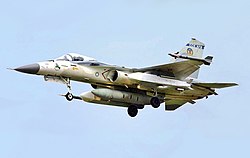
[edit]The Wan Chien entered service in 2011. The primary launch platform is the AIDC F-CK-1 C/D.[9]
In 2022 annual production was approximately 50 missiles a year. Production was expected to end in 2024 but in 2023 funds were allocated to extend production of the improved version through 2028. [10]
General characteristics
[edit]See also
[edit]- Hsiung Feng II – (Taiwan)
- AGM-158 JASSM – (United States)
- Storm Shadow – (France, United Kingdom)
- Taurus KEPD 350 – (Sweden, Germany)
- Ra'ad – (Pakistan)
References
[edit]- ^ "Taiwan Air Force test-fires domestic cruise missile | Taiwan News | 2020-11-13 11:55:00". 13 November 2020.
- ^ a b c J. Michael Cole. "Taiwan Unveils 'Wan Chien' Air-To-Ground Cruise Missile". The Diplomat. Retrieved 2017-03-16.
- ^ "Taiwan's 'Wan Chien' missile likely to be deployed 2014 - Taiwan News". Central News Agency. Archived from the original on 2017-03-16.
- ^ Raska, Michael (9 March 2017). "How China Plans to Win the Next Great Big War In Asia". The National Interest. Retrieved 2017-03-16.
- ^ "我遙攻武器 萬劍彈曝光 – 焦點 – 自由時報電子報". Retrieved 2017-03-17.
- ^ "Taiwan Unveils "Wan Chien" Air-to-Ground Standoff Weapon". Defense Update. 20 January 2014. Retrieved 2014-01-22.
- ^ Panda, Ankit. "Report: Taiwanese Air Force's New Stand-Off Cruise Missile Is Operational". thediplomat.com. The Diplomat. Retrieved 5 August 2019.
- ^ a b Chen, Kelvin (13 November 2020). "Taiwan Air Force test-fires domestic cruise missile". www.taiwannews.com.tw. Taiwan News. Retrieved 16 November 2020.
- ^ a b "Wan Chien". csis.org. CSIS. Retrieved 17 May 2019.
- ^ Strong, Matthew (2 September 2023). "Taiwan Air Force orders extra Wan Chien missiles". taiwannews.com.tw. Taiwan News. Retrieved 15 September 2023.
- ^ a b "Upgraded IDF jets to boost Taiwan's air defense | Politics | FOCUS TAIWAN – CNA ENGLISH NEWS". Retrieved 2017-03-16.

| Structure |
| _Logo.svg) |
|---|---|---|
| Facilities | ||
| Aircraft | ||
| History |
| |
| Equipment | ||
Wan Chien
View on GrokipediaDevelopment
Origins and Strategic Rationale
The Wan Chien air-to-ground cruise missile, known as "Ten Thousand Swords" in Chinese, originated from Taiwan's National Chung-Shan Institute of Science and Technology (NCSIST), with development efforts reported as early as 2005.[1] This indigenous program addressed the Republic of China Air Force's (ROCAF) requirement for precision stand-off munitions capable of targeting hardened infrastructure, amid escalating threats from People's Liberation Army (PLA) ballistic missiles and integrated air defenses.[1] Initial flight tests were completed by September 2012, validating the system's viability for operational integration.[9] Strategically, the Wan Chien was designed to suppress enemy air defenses and disrupt key PLA assets, including airfields, radar installations, missile sites, and ports, without exposing ROCAF fighters to short-range air defenses.[1] Its range, estimated at over 200 kilometers, permits launches from the Taiwan Strait's median line, enabling strikes on mainland targets while preserving aircraft survivability in a high-threat environment.[4][10] This capability aligns with Taiwan's asymmetric warfare doctrine, emphasizing cost-effective denial of invasion beachheads and logistical nodes against a militarily superior opponent.[11] The rationale underscores Taiwan's reliance on homegrown defenses due to procurement challenges with allies and the need for rapid response to PLA buildups, prioritizing munitions that maximize deterrence through preemptive degradation of offensive staging areas.[3] Unveiled publicly in January 2014, the system reflects a decade-long investment in subsonic cruise technology tailored for cluster dispersal over area targets like runways, enhancing ROCAF's role in multilayered deterrence.[12]Design Process and Testing
The Wan Chien air-to-ground cruise missile was developed indigenously by Taiwan's National Chung-Shan Institute of Science and Technology (NCSIST), with the program first publicly reported in 2005 as part of efforts to enhance the Republic of China Air Force's (ROCAF) standoff strike capabilities against ground targets.[1] The design emphasized a subsonic, powered glide vehicle capable of delivering cluster munitions over extended ranges exceeding 200 kilometers, incorporating GPS/inertial navigation and terrain contour matching for mid-course guidance, supplemented by terminal infrared imaging for precision.[4][8] Development proceeded under the code name "Project God's Axe," focusing on integration with ROCAF fighters like the F-CK-1 Ching-kuo, while prioritizing domestic production to reduce reliance on foreign suppliers amid arms embargo constraints.[13] Initial design iterations drew from Taiwan's experience with shorter-range munitions, incorporating a cluster warhead to maximize area effects against soft targets such as troop concentrations or logistics sites, rather than hardened structures.[14] The airframe featured low-observable elements and a turbofan engine for sustained loiter and evasion of integrated air defenses, with testing phases validating aerodynamic stability and warhead dispersion patterns in simulated high-threat environments.[9] Testing commenced in the mid-2000s, achieving initial operational evaluation by 2010, which confirmed the missile's guidance accuracy and payload reliability under combat-like conditions.[8] Flight trials culminated in successful ROCAF launches in September 2012 from F-CK-1 aircraft, demonstrating full-range performance and terminal homing against mock targets.[15][9] Further tactical assessments in September 2017 at Jioupeng Military Base in Pingtung County simulated real-world scenarios, including electronic countermeasures and group target engagements, leading to operational certification in 2018.[16] Subsequent live-fire demonstrations, such as those in November 2020, verified integration and reliability, with no reported failures in documented trials.[13]Production Milestones
The Wan Chien air-launched cruise missile program, managed by Taiwan's National Chung-Shan Institute of Science and Technology (NCSIST), commenced development around 2000 as part of efforts to enhance indigenous standoff weaponry.[1] The project was publicly unveiled in November 2005, marking a key disclosure of Taiwan's advancements in precision-guided munitions.[1] Initial testing occurred in the mid-2000s, leading to the missile achieving combat readiness in 2010 and formal entry into Republic of China Air Force service in 2011.[8] Mass production followed service induction, with full-scale output originally projected to ramp up by 2015; however, former President Ma Ying-jeou's administration opted to curtail planned quantities amid budgetary and strategic reviews.[1] In light of escalating regional threats, production accelerated in the early 2020s, yielding approximately 50 missiles annually from 2022 through 2024, for a subtotal of at least 150 units during that period.[6] The initial mass production phase concluded by December 2024, aligning with broader missile procurement goals met ahead of schedule.[7] Subsequently, the Republic of China Air Force initiated a NT$517.45 million commissioned production program extending from 2024 to 2028 to sustain and potentially expand inventory levels.[17]Operational Deployment
Integration with Aircraft
![Wan Chien missile integrated on AIDC F-CK-1][float-right] The Wan Chien air-to-ground cruise missile is primarily integrated with the AIDC F-CK-1 Ching-kuo multirole fighter aircraft, Taiwan's indigenous defense fighter serving as the Republic of China Air Force's (ROCAF) main launch platform for standoff munitions.[2] This integration enables the ROCAF to conduct long-range precision strikes against hardened targets such as airfields, radar sites, and troop concentrations from beyond enemy air defense ranges.[9] The missile, equipped with pop-out wings for extended glide and cruise capability, is carried externally on underwing pylons, allowing compatibility with the F-CK-1's weapon stations designed for cluster munitions and guided bombs.[18] Integration testing and operational certification for the F-CK-1 platform were completed by the ROCAF in 2012, following successful flight trials that validated release mechanisms, guidance handoff, and safe separation from the aircraft.[9] The system's design draws parallels to Western standoff weapons like the AGM-154 Joint Standoff Weapon, facilitating adaptation to the F-CK-1's avionics and fire control systems without requiring extensive aircraft modifications.[19] Mass production of Wan Chien missiles tailored for F-CK-1 deployment concluded by December 2024, enhancing the fighter's role in Taiwan's asymmetric defense strategy against potential invasions.[6] While the Wan Chien remains optimized for the F-CK-1 C/D variants, no public disclosures confirm full integration with other ROCAF platforms such as the upgraded F-16V fighters, which instead receive U.S.-sourced equivalents like the AGM-154 for similar missions.[20] This platform specificity underscores Taiwan's emphasis on bolstering indigenous aircraft capabilities amid arms embargo constraints, though future adaptations could expand compatibility as F-CK-1 upgrades incorporate advanced data links and targeting pods.[21]Combat Exercises and Demonstrations
In September 2022, the Republic of China Air Force (ROCAF) conducted its first operational live-fire test of the Wan Chien missile from an AIDC F-CK-1 Ching-kuo (IDF) fighter during a training exercise, confirming the system's launch and guidance performance.[22] F-CK-1 units stationed at air bases in Tainan and Taichung have since performed additional live-fire exercises, launching Wan Chien missiles at simulated targets mimicking airstrips, radar sites, and troop concentrations on China's southeastern coastal provinces of Fujian, Guangdong, and Zhejiang.[8] These demonstrations, executed from standoff positions near the Taiwan Strait median line, validated the missile's precision strike capability and integration with indigenous fighters for defensive counterstrikes against potential invasion staging areas.[8] Such exercises emphasize the Wan Chien's role in Taiwan's asymmetric warfare doctrine, prioritizing rapid, dispersed launches to degrade People's Liberation Army amphibious and air operations without exposing aircraft to frontline threats.[8] No public reports detail Wan Chien employment in major annual Han Kuang drills, though ROCAF F-CK-1 squadrons routinely arm the missile during heightened alert responses to Chinese incursions, as observed in January 2021 post-incursion patrols.[23]Current Inventory and Readiness
The Wan Chien air-to-surface missile achieved full operational capability with the Republic of China Air Force (ROCAF) in August 2018, following integration with the indigenous AIDC F-CK-1 Ching-kuo fighter aircraft.[1] This status enables deployment in anti-access/area denial (A2/AD) roles targeting mainland Chinese military infrastructure during potential conflicts.[24] Mass production concluded in late 2024, with annual output stabilizing at approximately 50 units from 2022 to 2024, augmenting earlier batches produced since initial service entry around 2011.[6][8] A commissioned production program budgeted at NT$517.45 million extends through 2028, supporting sustainment and potential upgrades amid ongoing procurement of over 1,000 domestic missiles in 2024.[17] Exact inventory levels remain classified, though the system's completion of production phases indicates a robust stockpile sufficient for ROCAF squadron-level operations.[25] Readiness is bolstered by routine integration into ROCAF exercises, including live-fire demonstrations validating subsonic cruise performance and cluster munition dispersal against simulated ground targets.[1] The 2025 Quadrennial Defense Review emphasizes immediate readiness training for such precision-guided munitions, aligning Wan Chien with Taiwan's asymmetric strategy to disrupt adversary amphibious and air operations.[26] Deployment across ROCAF bases enhances rapid response, though vulnerabilities to electronic warfare and air superiority challenges persist in high-threat environments.[24]Technical Specifications
Guidance and Propulsion
The Wan Chien missile utilizes a combined inertial navigation system (INS) and Global Positioning System (GPS) for mid-course guidance, providing reliable navigation over distances up to approximately 240 kilometers.[1][2] This dual-mode approach ensures precision in subsonic flight profiles, with INS compensating for potential GPS jamming or denial scenarios common in contested environments.[4] Additional terrain-matching or recognition capabilities are reported to refine terminal accuracy by comparing onboard sensors against pre-loaded topographic data, though official details remain classified.[27][2] Propulsion is provided by a turbofan engine, which sustains subsonic speeds throughout the cruise phase after air launch from platforms such as the AIDC F-CK-1 Ching-kuo fighter.[8] The engine's design supports the missile's square-bodied configuration with foldable wings and X-shaped control surfaces, optimizing aerodynamic efficiency and range without reliance on boost-sustain rocket stages typical of shorter-range munitions.[8] This propulsion method aligns with the system's role in standoff attacks, minimizing exposure to enemy air defenses while delivering cluster submunitions to area targets.[1]Payload and Warhead
The Wan Chien air-launched cruise missile features a warhead weighing approximately 350 kg, optimized for standoff strikes against hardened and area targets. This payload primarily consists of submunitions in a cluster munition configuration, enabling dispersion of up to 100 bomblets for anti-runway penetration, radar suppression, and disruption of troop concentrations.[28][8][29] Alternative warhead options include high-explosive or semi-armor-piercing variants, allowing flexibility for missions requiring concentrated blast effects or penetration of fortified structures, though the submunition loadout remains the standard for its primary anti-surface roles.[28][3] The bomblets incorporate anti-runway submunitions designed to crater and fragment airfield surfaces, with each capable of independent detonation upon impact or proximity fuse activation to maximize coverage over dispersed targets.[30] Developed by Taiwan's National Chung-Shan Institute of Science and Technology, the warhead draws conceptual parallels to the U.S. AGM-154 Joint Standoff Weapon's bomblet dispenser, emphasizing low-observable delivery of area-denial ordnance without requiring precision terminal guidance for all sub-elements.[1] This configuration prioritizes volume over singular precision strikes, aligning with Taiwan's asymmetric defense needs against massed invasion forces, though it raises concerns under international conventions restricting cluster munitions due to unexploded ordnance risks.[2] Production integrates domestically sourced explosives and fuzing systems to ensure reliability in contested environments.[31]Performance Metrics
The Wan Chien air-to-ground cruise missile has a reported maximum range of 240 kilometers, sufficient to target coastal military installations on the mainland from standoff distances within Taiwanese-controlled airspace.[1] This range is achieved through a turbofan propulsion system enabling sustained subsonic flight, with pop-out wings extending to a 1.5-meter span after launch to enhance aerodynamic efficiency.[1] Guidance relies on an integrated GPS and inertial navigation system (INS), allowing for autonomous flight paths and terminal adjustments against fixed or semi-fixed targets such as runways, radar sites, and troop assemblies.[1] The missile's cluster warhead disperses more than 100 submunitions over a designated impact area, prioritizing area-denial effects over pinpoint precision strikes.[2]| Metric | Specification |
|---|---|
| Range | 240 km |
| Speed | Subsonic |
| Length | 4.5–4.8 m |
| Wingspan (extended) | 1.5 m |
| Warhead Type | Cluster (100+ submunitions) |
| Guidance | GPS/INS |
Strategic Role and Effectiveness
Contribution to Taiwan's Asymmetric Defense
The Wan Chien air-launched cruise missile forms a key element of Taiwan's Overall Defense Concept (ODC), adopted in 2017, which prioritizes asymmetric capabilities to counter the People's Republic of China's (PRC) numerical advantages in a potential cross-strait conflict.[32] With a range of approximately 240 kilometers, the missile enables the Republic of China Air Force (ROCAF) to conduct precision strikes against PRC coastal targets, such as airfields, ports, and amphibious assembly areas, from standoff distances beyond the reach of many PRC air defense systems.[1] This capability supports a denial strategy, imposing significant costs on invading forces during the vulnerable amphibious phase by disrupting command, control, and logistics nodes.[11] Indigenously developed by the National Chung-Shan Institute of Science and Technology (NCSIST) and entering full operational service in August 2018, Wan Chien integrates with platforms like the F-CK-1 Ching-Kuo and upgraded F-16V fighters, allowing for dispersed launches from hardened shelters or forward bases to enhance survivability against preemptive PRC missile barrages.[1] Its 350-kilogram warhead options, including high-explosive, semi-armor-piercing, or cluster submunitions, facilitate area denial and suppression of enemy air defenses, aligning with the "porcupine" approach of leveraging numerous, cost-effective weapons to make an invasion prohibitively expensive.[1] Production ramp-ups under the Tsai Ing-wen administration, targeting over 100 units by 2017 and reaching 150 by late 2024, underscore its role in building a resilient inventory less vulnerable to external supply disruptions.[1][6] In the broader context of Taiwan's 2021 Quadrennial Defense Review, which emphasizes long-range conventional precision strike (LRCPS) for deterrence by denial, Wan Chien complements other asymmetric tools like anti-ship missiles by extending ROCAF's reach into PRC territory, potentially targeting C4ISR assets and thereby complicating operational tempo.[32] While aircraft vulnerability remains a challenge, tactics such as rapid dispersal and decoy employment mitigate risks, contributing to a layered defense that raises the threshold for PRC aggression without relying on symmetrical force matching.[32] This indigenous standoff weapon thus enhances Taiwan's self-reliant posture, fostering credible retaliation that deters escalation by signaling the high prospective costs of coercion.[11]Comparative Analysis with PRC Systems
The Wan Chien missile, as Taiwan's primary indigenous air-launched land-attack cruise missile, contrasts with the People's Republic of China's (PRC) CJ-10 (also designated DH-10) in scale, range, and strategic application, reflecting differing operational theaters and production capacities.[2][33] While the Wan Chien emphasizes short-range area denial against amphibious invasion forces across the Taiwan Strait, with a reported range of approximately 200-240 kilometers, the CJ-10 enables long-range precision strikes up to 1,500-2,000 kilometers, supporting broader power projection beyond regional contingencies.[34][33] Both systems operate at subsonic speeds around Mach 0.8 during cruise, but the CJ-10 incorporates advanced terrain contour matching (TERCOM) alongside inertial navigation and satellite guidance for improved accuracy in contested environments, potentially achieving a circular error probable (CEP) of 5-10 meters, compared to the Wan Chien's reliance on GPS-aided inertial systems suited for shorter, less contested flights.[35][36]| Feature | Wan Chien | CJ-10 (DH-10) |
|---|---|---|
| Range | 200-240 km | 1,500-2,000 km |
| Speed | Subsonic (Mach 0.8) | Subsonic (Mach 0.8) |
| Guidance | INS/GPS | INS/TERCOM/GPS |
| Warhead | Cluster (>100 submunitions) | Unitary (500 kg) |
| Primary Launch Platform | Air (F-16 via IDAS pod) | Ground/ship/air variants |