Hubbry Logo
Water slideWater slideMain
Open search
Water slide
Community hub
Water slide
logo
8 pages, 0 posts
0 subscribers
Be the first to start a discussion here.
Water slide
Water slide
from Wikipedia

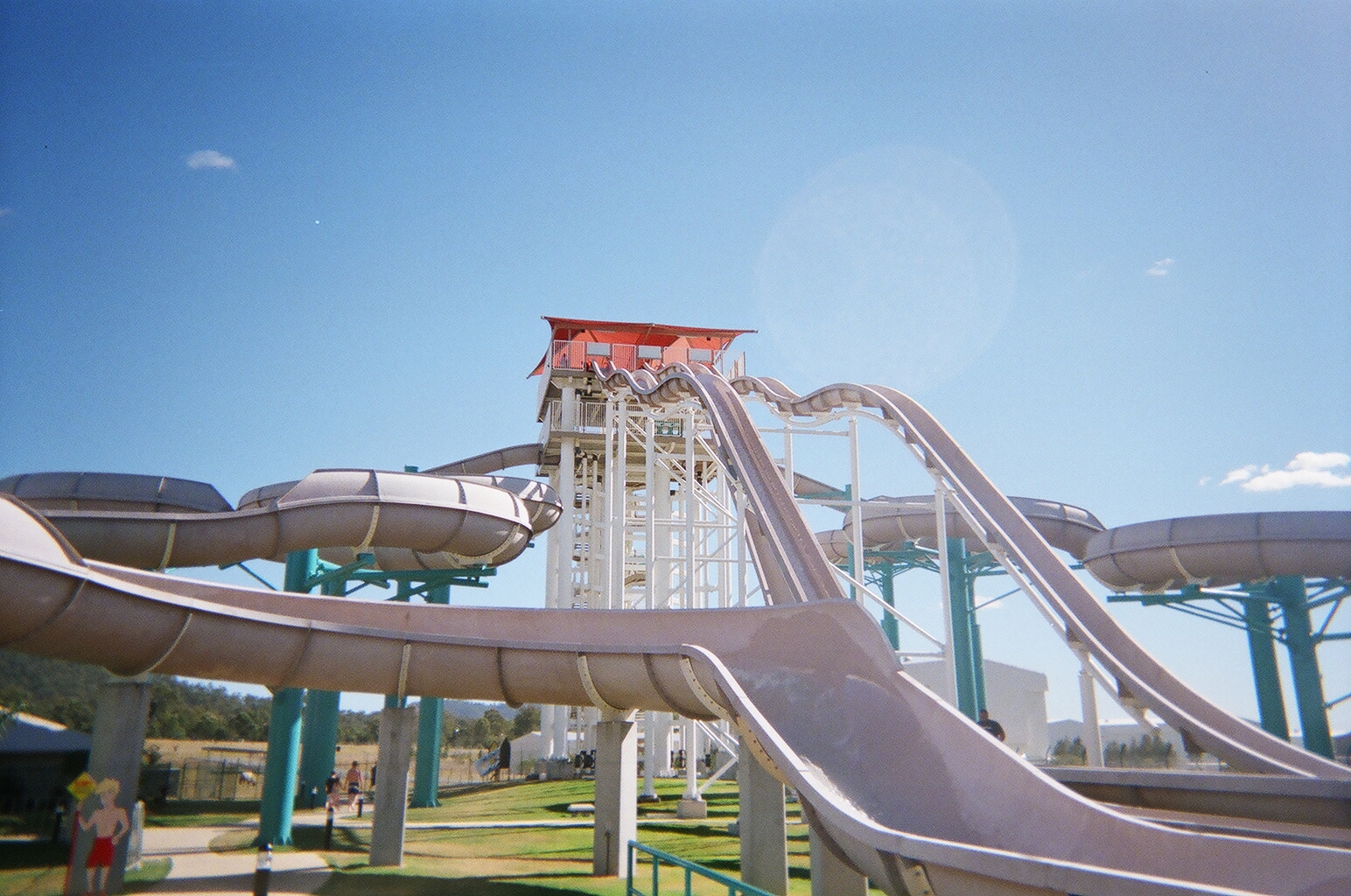
A collection of water slides at Wet'n'Wild Gold Coast on the Gold Coast, Australia. The outer two are traditional inline tube slides while the centre three are body speed slides.
Water slide at Toledo Beach, Michigan, 1911
Boy riding a water tube slide at The Colony Park in The Colony, Texas

A water slide (also referred to as a flume, water chute, or hydroslide) is a type of slide designed for warm-weather or indoor recreational use at swimming pools or water parks. Water slides differ in their riding method and therefore size. Some slides require riders to sit directly on the slide, or on a raft or tube designed to be used with the slide.

A typical water slide uses a pump system to pump water to the top which is then allowed to freely flow down its surface. The water reduces friction so sliders travel down the slide very quickly. Water slides run into a swimming pool (often called a plunge pool) or a long run-out chute.

Traditional water slides

[edit]
Two blue body slides, similar to playground slides, on the far side of a swimming pool
Simple body slides, into a large swimming pool
"Shoot the Chutes" at Wonderland Amusement Park in Indianapolis, 1906
A collection of inline tube slides at WhiteWater World on the Gold Coast, Australia
"Wild Water Rampage" at Dogpatch USA, an abandoned theme park in Marble Falls, Arkansas

Body slides

[edit]

Body slides feature no mat or tube, instead having riders sit or lie directly on the surface of the slide. The simplest resemble wet playground slides.

There are a variety of types of body slides including flumes, speed slides, bowls and AquaLoops; the latter three are explained below.

Inline tube slides

[edit]

Some slides are designed to be ridden with a tube which typically seats either 2 or 3 riders inline. Similar to a traditional body slide, these slides include many twists and turns and come in a variety of types including bowls, funnels and half-pipes.

Longest

[edit]

The world's longest water slide was a temporary installation in Waimauku, New Zealand, in February 2013. Constructed with a length of 650 metres (2,130 ft),[1] of which 550 metres (1,800 ft) functioned properly.[2] Its creators claimed the previous record holder had a length of ~350 metres (1,150 ft).[2] The slide was to be moved to Action Park in Vernon, New Jersey.[3][when?]

The "Waterslide" at Buena Vista Lodge in Costa Rica is a 400 metres (1,300 ft) long water slide where the rider sits directly on the slide, with an inner-tube around their upper body for safety.[4]

The longest multi-person water-coaster (see below) is the 1,763 foot (537 m) long Mammoth at Holiday World in Santa Claus, Indiana.[5]

The current longest water slide, "The Longest", is a permanent single-passenger tube waterslide located in Penang, Malaysia at the ESCAPE family theme park. Visitors access the attraction via a cable car system and ride down the slide for approximately 4 minutes whilst navigating through 1,111 metres (3,645 ft) of scenic jungle.[6]

21st century water slides

[edit]

Looping water slides

[edit]

The first known existence of a looping water slide was at Action Park in Vernon Township, New Jersey in the mid-1980s, named Cannonball Loop. This slide featured a vertical loop but was repeatedly closed due to safety concerns.[7][8][9] In the late 2000s, Austrian manufacturer Aquarena developed the world's first safe looping water slide, known as the AquaLoop. The company engineered a slide with an inclined loop rather than a standard vertical one.[10] The slide is currently licensed and distributed by Canadian water slide manufacturer WhiteWater West.[11] There are nearly 20 AquaLoop installations around the world.[12] The first installation was in Slovenia in 2008.[13] The largest collections are located at Wet'n'Wild Gold Coast and Raging Waters Sydney in Australia, which both house 4 AquaLoops that opened in 2010 and 2013, respectively. Wet'n'Wild Gold Coast was also the first to install more than one AquaLoop at a single location.[14][15][16] The AquaLoop uses a trap-door to release riders down a 17-metre (56 ft) near-vertical descent at a speed of up to 60 kilometres per hour (37 mph). Riders experience 2.5 Gs in less than 2 seconds.[17] The whole ride is over within 7 seconds.[18]

Bowl

[edit]
An example of a water slide bowl attraction

A bowl is a type of water slide where riders descend a steep drop into a round bowl. Under the effects of centrifugal force, the riders circle the outer area of the bowl before exiting down through the middle, often into a pool underneath but sometimes into an additional slide section.[19][20][21] This style of water slide comes in various styles and is manufactured by ProSlide,[22][23][24][25] WhiteWater West[26][27] and Waterfun Products.[28] The different variations can be ridden on a 4-person cloverleaf tube,[22] 2 person inline tube,[23][26] single person tube[24] or as a body slide.[25][27][28]

Family rafting

[edit]
A family rafting water slide attraction at Formosa Fun Coast in Taiwan

Family rafting water slides have the largest capacity of all the different types of tubing water slides averaging between 4 and 6 riders per dispatch. Riders hop in a circular raft and travel down long, twisted 4.5-metre (15 ft) channels to the ground.[29] This type of water slide is manufactured by Australian Waterslides and Leisure,[30] ProSlide,[31][32] Waterfun Products[33] and WhiteWater West.[34] All of these companies manufacture open-air slides while ProSlide also manufactures an enclosed version.[32]

Funnel

[edit]
A ProSlide Tornado at Wet'n'Wild Gold Coast on the Gold Coast, Australia

A funnel water slide requires riders to sit in a 2 or 4 seater round tube. Riders drop from inside a tunnel out into the ride's main element shaped like a funnel on its side. Riders oscillate from one side to the other until they exit through the back of the funnel and into a splash pool. The most common type of funnel is the ProSlide Tornado which is installed at almost 60 locations around the world dating back to 2003.[35] In 2010, WhiteWater West began developing a competing product known as the Abyss, utilizing a raft that holds up to six riders.[36]

Half-pipes

[edit]
A half-pipe at the Serena Waterpark in Lahnus, Espoo, Finland

Similar to a funnel, a half-pipe features a slide in which riders oscillate back and forth. However, this style of ride doesn't feature any enclosed sections. On a Waterfun Product Sidewinder or Sidewinder Mini, riders oscillate several times before coming to a rest at the base of the slide. Riders then need to walk off the slide returning their tube to the next riders.[37][38]

A variation of the half-pipe called a wall slide typically has a steep enclosed section that exits to a wider upward-rising section that the rider then slides back down the other direction to the end of the slide.[39][40]

Multi-lane racer

[edit]
A multi-lane racer at WhiteWater World on the Gold Coast, Australia

A multi-lane racer is a ride where between 4 and 8 riders dive head-first onto a mat and down a slide with several dips. As an additional component of this ride, some offer an additional enclosed helix at the top of the ride. ProSlide offer ProRacers,[41] Octopus Racers,[42] Kraken Racers[43] and Rally Racers,[44] while WhiteWater West have designed the Mat Racers[45] and Whizzards.[46] In 2016, WhiteWater West introduced the Mat Blaster, which combines the Whizzard model with elements of their MasterBlaster water coaster.[47] Australian Waterslides and Leisure have also manufactured a standard multi-lane racer.[30]

Speed slide

[edit]
A speed slide at Beach Park in Brazil

A speed slide is a type of body slide where riders are sent down steep, free-fall plunges to the ground. Almost all water slide manufacturers offer a variation of this type of slide. ProSlide & WhiteWater West both offer a speed slide with a trap door, the same trap door found on the AquaLoop.[30][48][49]

Water coaster

[edit]
A funnel slide and water coaster at WhiteWater World on the Gold Coast, Australia

A water coaster is a water slide that emulates a roller coaster by providing not only descents, but also ascents. There are three different ways water coasters operate: water jets,[50] conveyor belts,[51] and linear induction motors.[52] High-powered water jets power the first type of water coaster, generically known as “Master Blasters”. Originally manufactured by New Braunfels General Store (NBGS), the rights were sold in December 2006 to WhiteWater West of Canada.[53] The first installations of this type of ride were Dragon Blaster and Family Blaster, installed in 1994, at Schlitterbahn in New Braunfels, Texas. The following month, a third Master Blaster opened at Adventure Bay in Houston, Texas.[54] This type of ride features over 70 installations worldwide.[50] The largest collection of Master Blasters is at Wild Wadi Water Park in Dubai, where 9 of the park's 16 water slides utilize this technology, propelling riders to the top of a mountain.[55] In 2021, WhiteWater West opened their tallest Master Blaster, and tallest water coaster in the world, Tsunami Surge at Six Flags Hurricane Harbor Chicago.[56]

The first conveyor belt was installed at Kalahari Resort in Sandusky, Ohio. Known as the Zip Coaster, the ride carries guests quickly uphill and over steep slides using high-speed conveyor belts.[57] The third incarnation of the water coaster utilizes linear induction motors (LIM technology) and specially designed rafts.[58] The first installation to use LIM technology was Deluge, opening in 2006 at what was (at the time) Splash Kingdom at Six Flags Kentucky Kingdom.[59]

The longest water coaster utilizing this magnetic system is Mammoth, at Splashin' Safari in Santa Claus, Indiana.[60] This technology has been adapted to other ProSlide products, and is collectively known as the ProSlide HydroMAGNETIC.[61] In 2010, ProSlide announced that they would be combining the family rafting and water coaster technologies to create a Hydromagnetic Mammoth.[tone][62] The first installation of this variation was Mammoth, which opened in 2012 at Splashin' Safari in Indiana. It surpassed the park's Wildebeest as the longest water coaster in the world.

Drop-launch capsule

[edit]
Sky Drop at Plopsaqua, Belgium

A drop-launch capsule is a device that is placed at the start of a body slide. Riders step into a capsule, usually with a clear front. Once the capsule is closed, a hatch opens underneath the riders dropping them into a near-vertical portion of the slide. The feature is known by different names from various manufacturers. ProSlide calls it a SkyBox, WhiteWater West refers to it as an AquaDrop.[63][64]

River stream slide

[edit]

A river slide, also commonly referred to as "crazy river",[65][66] resembles a brook (small stream), and may feature buffer pools throughout the way down. Its mass sliding ability, meaning multiple people can safely slide simultaneously, clears its queue area at a faster rate.[67][68]

Inflatable water slides

[edit]
Children play in an inflatable water slide at their home

Inflatable water slides are typically made of a thick strong PVC or vinyl and nylon, and are inflated using a blower. The water slide is attached to a water hose in order to generate the supply of water. There are small-sized inflatable water slides for private house uses or larger inflatable water slides for school, picnic, corporate, or carnival style use.

References

[edit]
[edit]
Revisions and contributorsEdit on WikipediaRead on Wikipedia
from Grokipedia
A water slide is a recreational structure typically found in water parks and swimming pools, consisting of a continuously wetted chute or down which riders slide, often at high speeds, before splashing into a pool or splash zone at the end. These slides harness to propel participants along inclined paths, with serving as both and to reduce and enhance the thrill of the descent. The origins of water slides trace back to the early , with the first documented example at the 1906 International Exhibition in and the first U.S. by Herbert Sellner in 1923. The modern water park era began in the 1970s, exemplified by Wet 'n Wild in , which opened in 1977 and popularized designs. Water slides vary by rider experience, including body slides, tube or raft slides, and specialty types like racers and bowls. Engineering involves physics principles such as gravity-driven acceleration and water-lubricated flow, with speeds typically 20 to 50 mph (32 to 80 km/h), using durable fiberglass composites. Safety is paramount, governed by standards like ASTM F2376 for water slide systems, which require feet-first entry to prevent spinal injuries, manufacturer-specified water depths typically at least 3 feet (0.91 m) for safe splashdown, and height restrictions. Hazards such as collisions and are mitigated through supervision, single-rider rules, and inspections; slide-related injuries are the leading cause of water park incidents. Notable examples include the 2,723-meter (8,933-foot) mountain slide in , —the longest of its kind as of 2019—and the 4,283.701-meter (14,054.14-foot) glass-bottomed water slide in Sichuan, , verified by on June 9, 2025. Modern innovations feature safe vertical looping slides introduced in the late 2000s, such as the , alongside eco-friendly designs and integrations.

History and Evolution

Early Development

The origins of water slides trace back to the early , with the first documented installation appearing at the International Exhibition in , , as part of the "Wonderland" amusement area. This pioneering water chute, measuring approximately 240 feet (73 meters) in length, featured riders descending in small boats down an inclined track into a pool, marking an early fusion of sliding amusement and aquatic recreation. In the United States, the concept gained commercial traction in the 1920s through the innovations of Herbert Sellner, a inventor and woodworker. Sellner patented the Water-Toboggan Slide in 1923 (US Patent 1,447,522), a wooden structure about 30 feet high and 100 feet long, where riders used non-sinking sleds to glide down an inclined runway positioned above a , such as a lake or pool. This design emphasized safety and accessibility, occupying a compact 18-by-100-foot space and accommodating up to 12 sleds at 50 cents per ride, reflecting early efforts to integrate water slides into bathing beaches and fairgrounds. Post-World War II, water slides proliferated in the U.S. amid a surge in activities and public pool construction during the , often added to existing amusement parks and municipal facilities to cater to growing family-oriented trends. Early constructions relied on durable, low-cost materials like wood and for the slide surfaces, with prototypes transitioning to in the 1970s; notably, Robert "Budge" Brown developed one of the first modular tubular slides in the early 1970s for Manteca Waterslides in , which opened in 1974, enabling smoother rides and easier installation. These foundational slides typically featured gentle slopes of 10 to 20 degrees to ensure controlled speeds suitable for public pools, and water lubrication was initially provided by manual hose feeding rather than automated systems. This period's development was deeply influenced by the expansion of public pools and post-war suburban from through the , where water slides evolved from simple chutes at community pools to integral features of recreational parks, promoting affordable family entertainment amid rising interest in outdoor activities.

Key Milestones and Innovations

The 1970s marked a significant boom in water slide development, driven by the introduction of fiberglass materials that enabled more durable and versatile designs. Wet 'n Wild in Orlando, Florida, opened in 1977 as one of the first modern water parks, featuring pioneering fiberglass slides that set the standard for the industry. In 1978, Action Park in New Jersey expanded with water-based attractions, including fiberglass slides that contributed to the rapid commercialization of these features. Fiberglass construction facilitated modular assembly, allowing for taller structures up to 50 feet, which increased thrill levels and park capacities compared to earlier wooden prototypes. During the and , innovations in enclosed tube designs and thematic integration advanced the field through key s and park developments. A 1978 for a helical enclosed water slide system introduced safer, twisting tube configurations that became foundational for subsequent enclosed attractions. The 1980 of "Hydrotube" further popularized enclosed tube slides, enhancing rider immersion and safety. , opening in 1989, exemplified thematic advancements by weaving narrative elements—like a fictional typhoon's wreckage—into slide layouts and surroundings, elevating water parks from mere recreational spaces to story-driven experiences. The 2000s saw a shift toward extreme and multi-passenger configurations, led by ProSlide Technology's pioneering rides that pushed engineering boundaries. ProSlide's Hydromagnetic systems, introduced in the early , used linear induction motors for powered uphill sections, enabling longer and more dynamic slides. A notable example is the at Holiday World's Splashin' Safari, which opened in 2012 and was certified in 2016 as the world's longest multi-person tube water coaster at 1,763 feet, accommodating up to six riders per raft for family-oriented thrills. In the , water slide innovation continued with new record-breaking installations, such as the extreme water coasters at Meryal Water Park in , which opened in 2024 and feature Guinness-recognized tallest and fastest elements as of 2025. This era of innovation fueled substantial industry growth, expanding from fewer than 100 major U.S. water parks in 1980 to over 1,000 global attractions by 2020, significantly boosting through visitor spending and job creation. The broader industry, including water parks, had an economic impact of $219 billion in the U.S. as of 2015.

Design and Engineering Principles

Materials and Construction

Water slides are primarily constructed using fiberglass-reinforced plastic (FRP), a composite material consisting of glass fibers embedded in a resin matrix, which provides exceptional durability, corrosion resistance, and a smooth surface for safe rider passage. This material's high strength-to-weight ratio allows it to withstand constant exposure to water, chemicals, and mechanical stress while maintaining structural integrity over time. Supporting structures typically employ galvanized or stainless steel frameworks, such as columns, girders, and towers, engineered to ensure stability for slides reaching heights exceeding 100 feet, as seen in large-scale installations where these supports resist wind loads, vibrations, and rider impacts. Stainless steel hardware, including bolts and fasteners, is commonly used for its resistance to rust in chlorinated environments. The construction process begins with prefabricated FRP sections manufactured off-site using techniques like hand lay-up or resin transfer molding (RTM), where layers of matting are impregnated with polyester resin and cured to form seamless segments. These segments are transported to the site and assembled by bolting them together, with interlocking lips ensuring smooth transitions to prevent rider discomfort or safety hazards; steel supports are erected first to form the tower framework, followed by attachment of the flume via arms. UV-resistant finishes are applied to the FRP exterior during manufacturing to protect against sun degradation and color fading, while entry and exit platforms incorporate non-slip textured surfaces, often made from grated or coated composites, to minimize slip risks in wet conditions. For specialized designs, variations include acrylic panels integrated into FRP structures for transparent elements in themed slides, allowing visual effects or spectator views without compromising strength. Impact zones, such as landing areas, may feature EVA foam padding encapsulated in protective coatings to absorb shocks and enhance safety, particularly in high-speed or multi-rider configurations. Maintenance involves annual inspections by certified technicians to detect cracks, , or in FRP and components, often using non-destructive testing methods to ensure compliance with standards like EN 1069-1. Installation costs for a mid-sized water slide, including materials, , and on-site assembly, typically exceed $500,000, reflecting the complexity of custom fabrication and structural reinforcements.

Hydraulics and Flow Dynamics

Water slides operate on gravity-driven acceleration, where at the starting height converts to as riders descend, with serving as a to minimize frictional losses. This creates a between the rider and the slide surface, significantly reducing the coefficient of friction compared to dry conditions, allowing for smoother and faster motion. plays a key role in speed buildup, relating the decrease in and to an increase in fluid velocity along the slide path, approximating the rider's motion as an ideal fluid flow despite real-world losses due to and . Flow systems in water slides are typically pump-fed, recirculating water through the to maintain continuous and rider propulsion. Pumps deliver water at rates ranging from 600 to 800 gallons per minute for slides, ensuring a consistent thin layer that supports the rider without excessive splashing or drag. Nozzles positioned along the slide distribute this flow to achieve a water depth of approximately 1 to 2 inches in the , optimizing hydrodynamic while preventing dry spots that could increase friction. Rider dynamics involve the interplay of forces during descent and turns, where accelerates the rider to speeds governed by the slide's and length, modified by water's drag. In curved sections, is required to maintain the circular path, provided primarily by the normal force from the slide wall and a component of , calculated as F=mv2rF = \frac{mv^2}{r}, with typical curve radii of 10 to 20 feet influencing the intensity of lateral . Deceleration occurs at the slide's end in splash pools, where the sudden immersion absorbs through hydrodynamic drag and , gradually slowing the rider to a safe stop. Engineering trade-offs center on balancing thrill factors like peak speeds of up to 40 with rider control and comfort, achieved through strategic slope variations and braking sections such as runout flumes that reduce before pool entry. Designers adjust flow rates and curve geometries to prevent excessive g-forces, ensuring the ride remains exhilarating yet manageable, with splash pools sized to dissipate energy without causing abrupt stops.

Classification by Rider Experience

Body Slides

Body slides are a fundamental type of water slide in which riders experience the directly with their body, without the use of , rafts, or mats, typically featuring open designs that allow for unobstructed views and direct contact with the water-lubricated surface. These slides emphasize speed and thrill through straight or wavy paths, often constructed from smooth to minimize friction and maximize glide. Common in water parks as entry-level attractions, they range in height from 20 to 50 feet and can extend 20 to 330 feet in length, providing accessible yet exhilarating rides for solo participants. Variations in body slides include steep freefall drops, often with inclines up to 30 degrees for rapid acceleration, and layouts that twist and turn to extend the ride duration up to 300 feet or more. Freefall configurations deliver intense initial plunges, while wavy or paths build momentum gradually through curves, offering a balance of and control. These designs prioritize visibility and the sensation of exposure, distinguishing them from more enclosed experiences. Riders on body slides typically reach speeds of 20 to 30 mph, depending on the slide's slope and length, creating a thrilling descent that ends in a splash pool. Suitable for solo riders at least 42 inches tall, these slides serve as popular introductory thrills in , accommodating children and adults within standard weight limits of 250 to 300 pounds. Early examples of body slides emerged in the 1970s as part of the burgeoning industry, with attractions like those at Manteca Waterslides in , which opened in 1974 and featured and flumes for direct body riding. This era marked the shift to commercial constructions, evolving from rudimentary chutes to engineered slides focused on safety and speed. Modern iterations, such as the body slide at Six Flags Hurricane Harbor Splashtown, continue this tradition with high-speed turns and spiraling drops, maintaining the core appeal of open, individual thrill rides.

Tube and Inline Slides

Tube and inline slides are enclosed or semi-enclosed water attractions that rely on inner for rider flotation, emphasizing rotational dynamics and group experiences that differentiate them from slides. Inline slides typically accommodate single riders in tubes, while tube slides support groups of 1 to 4 riders. These slides typically feature dark, twisting tunnels with diameters ranging from 2.1 to 3.0 meters (approximately 7 to 10 feet), constructed from segments to accommodate smooth flow and immersive navigation. Propulsion occurs via continuous streams that carry riders, enabling shared thrills in a confined, winding path that heightens anticipation through limited visibility and unpredictable turns. Mechanically, these slides generate rotational spins through curved designs and targeted water jets that induce tube rotation, amplifying centrifugal forces for dynamic motion. Lengths often reach up to 1,000 feet (304 meters), as seen in extended configurations like Polin's at 240 meters (787 feet), with steep drops providing via , typically resulting in 1-1.5g forces to enhance thrill, while adhering to thresholds for seated positions in tubes. This combination of gravity-driven descent and hydraulic assistance ensures consistent throughput while delivering varied sensations of speed and disorientation. User guidelines prioritize balanced loading for optimal performance and safety, requiring minimum combined weights (e.g., around 400-500 pounds for 4-person tubes) to maintain , alongside maximums of 300 pounds (136 kg) per rider. These standards are prevalent in prominent parks like , where tube chutes such as the White Water Tube Chute enforce combined limits to prevent stalling or excessive strain on the structure. Riders must maintain upright seating and grip handles throughout to mitigate risks from spins and drops. The evolution of tube and inline slides traces back to the 1970s, when early inline single-rider versions emerged in pioneering parks like Wet 'n Wild, offering basic enclosed flumes for individual flotation. By the 1990s, advancements led to multi-tube parallel configurations, pioneered by manufacturers like ProSlide with innovations such as the 1990 Mammoth raft ride, expanding capacity and complexity for family groups. This progression culminated in elongated designs exceeding 1,000 feet, enhancing endurance-based thrills in global installations.

Advanced Slide Configurations

Looping and Capsule Slides

Looping water slides represent a pinnacle of high-thrill engineering in water parks, incorporating full 360-degree inversions that challenge traditional slide dynamics by relying on rider momentum augmented by strategic water flow. These slides typically feature loops with diameters ranging from 20 to 30 feet, where riders enter at high speeds—often 25-35 mph—gained from an initial steep drop, allowing them to complete the inversion without falling out due to the combination of , centrifugal force, and water lubrication on the slide surface. Unlike earlier failed attempts, such as the 1985 Cannonball Loop , modern designs use angled loops (around 45-60 degrees from vertical) and misting water jets along the loop walls to maintain slick conditions and consistent momentum, preventing friction buildup that could halt progress mid-inversion. The first successful commercial looping water slide opened in 2008 at Terme 3000 water park in , marking the debut of WhiteWater West's , which propelled the concept into widespread adoption with nearly 60 installations worldwide by the early 2020s. In the United States, Waterpark in introduced the first U.S. version in 2010, featuring a 55-foot entry chute leading to a 27-foot loop. These designs draw briefly on hydraulic principles to optimize water flow for propulsion, ensuring riders maintain the necessary velocity through the loop without excessive reliance on structural supports. Capsule drop slides elevate the thrill through sealed pod enclosures that release riders via trapdoors into near-vertical flumes, simulating freefall before transitioning to curved paths. Riders enter individual capsules elevated 50-70 feet above the drop, where a sudden release accelerates them downward at angles up to 90 degrees, achieving speeds of 40-50 mph in a matter of seconds due to gravitational pull and minimal air resistance within the enclosed start. The 's design—often with viewing windows—builds anticipation, and post-drop, riders exit into a deceleration lane or continue into twists, with water jets at the base providing a soft landing cushion. This configuration, pioneered in products like WhiteWater West's AquaDrop series, ensures controlled entry and exit, distinguishing it from open raft drops. More contemporary implementations prioritize enhanced through refined pod restraints and sensor-monitored releases, such as those in ProSlide's SkyBox launch systems integrated into looping variants since the mid-2010s, which have seen installations in over 20 parks globally without major incidents. The adrenaline rush in these slides stems from intense forces, including negative G-forces up to -1g at loop apexes or drop transitions, where riders experience brief as downward exceeds . To counter risks during inversions, modern looping and capsule designs incorporate passive restraint systems like padded walls, foot grips, and harnesses in pods, ensuring secure positioning while allowing natural body movement; these elements, combined with height and velocity restrictions, maintain rider security across speeds exceeding 50 mph. Recent advancements include integrations in some looping slides for enhanced immersion, as seen in installations as of 2024.

Bowl, Funnel, and Half-Pipe Slides

Bowl slides feature circular basins typically ranging from 20 to 40 feet in diameter, where riders enter at high speed and orbit the walls due to centrifugal force before exiting through a curved drop. This design creates a thrilling spinning sensation, with riders often climbing the basin walls to heights of up to 10 feet, relying on the balance between water flow, gravity, and momentum to prevent stalling. Early examples include the Time Warp at Noah's Ark Waterpark, an enclosed behemoth bowl slide that combines dips, spins, and thematic elements for an immersive experience, often referred to colloquially as a "toilet bowl" ride due to its flushing motion. Manufacturers like ProSlide introduced compact body slide variants such as the ProBOWL 30 in the late 1990s, enabling installation in space-constrained parks while maintaining the core rotational dynamics. Funnel designs, often boomerang-shaped, propel riders into wide, oscillating paths through a large conical , typically spanning track lengths of 100 to 200 feet, where they swing back and forth in high-speed arcs before dropping out. Introduced by ProSlide in the early , these slides use a reducing-radius —such as the TORNADO 60 with its 60-foot diameter—to generate zero-gravity moments and multiple oscillations, enhancing the sense of unpredictability and thrill. The patented design ensures riders experience intense lateral forces without inversion, distinguishing it from linear slides by emphasizing pendulum-like swings. Notable installations include the TORNADO 60 at Holiday World, which won the IAAPA Award for Best New Water Park Ride upon its 2003 debut. Half-pipe slides draw inspiration from skateboarding ramps, featuring elongated U-shaped channels that allow riders in tubes to build and release momentum in back-and-forth glides, often culminating in a steep drop or splash pool. These configurations, typically 40 to 60 feet tall, promote family-friendly excitement through controlled aerial maneuvers and water sprays along the walls. WhiteWater's Boomerango series exemplifies this, with riders ascending near-vertical walls before reversing direction, as seen in installations like the Banzai Pipeline at Whale's Tale Water Park. Modern fusions of these elements, such as the Revolution at Water World—a giant four-person raft bowl slide integrating rotational and half-pipe dynamics—blend solo and group experiences. Family raft adaptations of half-pipes briefly extend to multi-rider tubes for shared momentum, though they prioritize rotational banking over wide-group configurations.

Rafting and Family Slides

Rafting and family slides are designed for multi-rider experiences, utilizing oversized circular or cloverleaf measuring approximately 6 to 8 feet in diameter to comfortably seat 4 to 6 participants at once. These facilitate cooperative group riding, where riders face inward or outward to interact during the descent, often through wide flumes exceeding 10 feet in width to ensure stability and . Many configurations incorporate gentle waves, banking turns, and optional enclosed tunnels to provide a controlled environment, with accessibility features such as minimum requirements of 36 inches or lower to accommodate younger children and families. The dynamics of these slides prioritize social fun over intense thrills, with typical speeds ranging from 10 to 20 achieved through moderate slopes and water flow rates that create a rafting-like sensation without excessive drops. Ride lengths commonly span 400 to 800 feet, allowing for extended journeys filled with splashes and mild surges that encourage laughter and conversation among riders, rather than solitary speed rushes. This approach makes them ideal for mixed-age groups, as the rafts distribute weight evenly to maintain balance across varying participant sizes. Variations in rafting and family slides include inline configurations where riders sit in a line within the for a more streamlined feel, and open flumes that expose participants to ambient park views and sunlight. The format was pioneered in the with the introduction of ProSlide's in 1990, which revolutionized group by enabling high-throughput family attractions at parks like those in the White Water chain, where additions such as Run-A-Way River debuted in 1998. These evolutions built on basic tube principles by scaling up for multiple occupants, enhancing throughput and appeal. Inclusivity is a core aspect, with adaptive designs accommodating diverse ages, weights up to 300-400 pounds per , and mobility needs through stable seating and low entry points. Notable examples include Disney's Teamboat Springs at Blizzard Beach, a 1,200-foot family ride using 6-person vessels to simulate adventure for groups starting at 32 inches tall, promoting shared experiences across generations.

Racing and Speed-Oriented Slides

Multi-Lane Racers

Multi-lane racers are a type of water slide engineered specifically for head-to-head , where multiple riders descend parallel lanes simultaneously to determine the fastest finisher. These attractions emphasize , timing, and the thrill of rivalry, distinguishing them from solo descent slides by incorporating elements that test rider control and reaction to varying . Riders typically lie prone on mats, diving head-first into the lanes from an elevated starting platform, which promotes an intense, low-profile posture that maximizes speed while minimizing air resistance. The core structure of multi-lane racers features 4 to 8 parallel lanes, each measuring approximately 3 feet (0.9 meters) in width to accommodate individual mats or lightweight sleds for safe, controlled sliding. Slide lengths generally range from 200 to 400 feet (60 to 120 meters), with examples like the 392-foot (119.5-meter) configuration providing ample distance for building momentum. To ensure equitable starts, the design often incorporates staggered platforms at varying heights, allowing riders to launch in sequence and reducing the risk of collisions while heightening anticipation. Water flow is directed along the lanes to lubricate the surface and propel riders, with hydraulic principles aiding acceleration through consistent sheeting. Racing dynamics are enhanced by intentional variations in the slide path, including variable bumps and steep drops that introduce unpredictability and require riders to adjust their body position for optimal speed. These elements create alternating high-compression and near-weightless moments, simulating a dynamic where minor shifts in technique can influence outcomes. Electronic timing systems, integrated at the start and finish, record times with precision up to 0.001 seconds, displaying results on digital boards to fuel competitive spirit and allow for leaderboards. Multi-lane racers emerged in the amid the rapid expansion of water parks, which began incorporating competitive features to attract thrill-seeking crowds beyond basic flumes. Early installations, such as speed slides introduced in , evolved into dedicated mat racers as manufacturers refined designs for higher throughput and excitement. Notable examples include the Wahoo Racer at in , a 6-lane mat racer that opened in 2014 and remains a staple for group competitions. In competitive settings, participant rules prioritize safety and fairness, with minimum height requirements (often 42-48 inches) and maximum individual weights (typically 250-300 pounds) enforced to prevent structural strain; parks like also scale riders for multi-person variants to balance loads. Record-setting performances highlight the slide's potential, with riders achieving average speeds around 25 mph (40 km/h) on optimized tracks, as seen in an 8-lane mat racer where participants reached up to 24.6 mph (11 m/s) through helices and waves. These benchmarks underscore the focus on and precision, making multi-lane racers enduring favorites at major parks worldwide.

Speed Slides and Water Coasters

Speed slides are designed for near-vertical freefalls, featuring steep inclines typically ranging from 50 to 80 degrees to achieve high velocities of 40 to 60 over drops of 50 to 150 feet. Riders experience these in body or headfirst positions, where and minimal propel them down smooth, often straight or slightly curved flumes for an intense adrenaline rush focused on acceleration and speed. The near-freefall sensation creates terminal velocities approaching 65 in extreme cases, limited only by and rider positioning. A prominent example is the Insano at Beach Park in Aquiraz, , which opened in 1997 and stands at 41 meters (135 feet) tall, propelling riders from 0 to 100 kilometers per hour (62 miles per hour) in just 5 seconds down its steep incline. Water coasters, in contrast, mimic dynamics with propelled ascents and descents, often spanning lengths up to 1,000 feet and featuring multiple hills for air-time moments where riders feel weightless. These attractions use advanced propulsion systems, such as water jet technology like ProSlide's RocketBLAST, which employs high-pressure jets to drive rafts uphill, or HydroMAGNETIC systems utilizing linear induction motors (LIM) for electromagnetic acceleration without moving parts. Chain-lift mechanisms or conveyor belts occasionally supplement these for initial elevation, allowing for repeated peaks and valleys that build and release speed in a controlled, coaster-like sequence. The at in , exemplifies this with its 1,763-foot track—the longest water coaster—incorporating HydroMAGNETIC propulsion across multiple uphill sections and drops that generate speeds up to 20 miles per hour and thrilling air-time hills. Hybrid designs blending water coaster elements with traditional slides, such as the SlideCoaster on ships introduced in the 2020s, further innovate by combining magnetic launches reaching 31 miles per hour with water descents for extended layouts exceeding 500 feet. These configurations prioritize and changes, often requiring taller support structures to accommodate the vertical lifts essential for their dynamic profiles.

Portable and Inflatable Slides

Residential and Backyard Models

Residential and backyard water slide models are portable, structures designed for personal home use, typically featuring lengths of 10 to 20 feet and heights under 15 feet to suit limited spaces and ensure accessibility for children. These slides are constructed from durable PVC vinyl or lighter materials, which provide water resistance and puncture durability suitable for repeated outdoor exposure without requiring permanent installation. Common features include built-in water sprayers connected to standard garden hoses, climbing walls for ascent, and shallow splash pools for landings, as seen in popular models like the Banzai Splash 'N' Blast, which measures 12 feet long and 8 feet high and includes a hoop and for added play variety. Setup for these models is straightforward and blower-powered, with continuous airflow units inflating the structure in under three minutes, followed by securing with ground stakes and weighted bags to prevent movement on grass or soft surfaces. Priced between $200 and $1,000 depending on size and accessories, they require no specialized tools or foundations, making them ideal for seasonal backyard entertainment; for instance, the Banzai Hydro Blast inflates quickly and supports up to 150 pounds per user. Recommended for ages 5 and older with adult supervision, these slides emphasize ease of storage, often deflating and packing into included carry bags for off-season use. Safety adaptations in residential models prioritize lower-risk play compared to commercial designs, incorporating softer splash pool landings, non-slip surfaces on climbing areas, and reinforced Dura-Tech construction. These features, along with included repair kits and warnings against use for children under 5, help mitigate hazards like slips or impacts, with brands like Banzai gaining popularity during the inflatable toy boom for their family-oriented reliability. In the , trends in backyard water slides have shifted toward and , with manufacturers incorporating eco-friendly recyclable PVC and biodegradable elements to reduce environmental impact, as highlighted in recent designs emphasizing low-water usage.

Commercial Inflatable Designs

Commercial inflatable water slides are designed as large-scale, temporary attractions primarily for use in events, fairs, and seasonal parks, featuring modular constructions made from durable 15-30 oz PVC vinyl that allows for easy transport, setup, and disassembly. These structures typically range from 15 to 70 feet in length, with common models spanning 20 to 40 feet to accommodate high-traffic environments, and often include multi-lane configurations for competitive or single-lane themed designs such as tropical or motifs to enhance visual appeal. Anchoring systems, including D-rings (14-20 per unit) and stakes or sandbags, enable secure installation capable of withstanding winds up to 15-20 mph when properly fastened, ensuring stability during outdoor operations. These slides are widely rented for applications like county fairs, corporate events, summer camps, and temporary water parks, where they support throughput of dozens of users per hour—typically 10-50 depending on lane count and rider rotation—allowing for efficient crowd management in commercial settings. Purchase costs for units range from $2,500 to $8,000 or more for premium models, with rental operators often recouping investments after 10-15 events at $250-400 per day, making them a cost-effective option for seasonal businesses. Manufacturers emphasize versatility, with many slides usable wet or dry to extend usability beyond summer months. Innovations in the and beyond have incorporated integrated obstacle elements, such as climbing walls and pop-up barriers within slide paths, transforming basic descents into interactive courses that boost engagement for group play. Themed integrations, including custom graphics and modular connectors for combining multiple units, have become standard, while select models feature LED for evening to enhance visibility and atmosphere. Companies like BounceWave and EZ Inflatables have led in these developments, offering hybrid designs that blend slides with splash pools and quick-drain systems for rapid turnover. Durability is prioritized through features like triple-stitched, heat-welded seams, UV-resistant coatings, and flame-retardant materials, enabling these slides to endure 500+ rental cycles under heavy commercial use with proper maintenance. Well-maintained units can achieve lifespans of 5-10 years, supported by warranties of 1-3 years on seams and liners, though regular cleaning and storage in dry conditions are essential to prevent material degradation from water exposure and sun. Reinforced baffles and high-side walls further mitigate wear from repeated impacts, ensuring long-term reliability for rental fleets.

Safety, Regulations, and Records

Safety Standards and Incident Prevention

Safety standards for water slides are primarily governed by international and regional guidelines to ensure rider protection during , , and operation. In the United States, ASTM F2376 establishes practices for the classification, , manufacture, , and operation of water slide systems, including requirements for emergency shutoff mechanisms to halt operations in hazardous conditions and manufacturer-specified height and weight limits to prevent overloading or unsuitable riders. Similarly, in , EN 1069-1 outlines safety requirements and test methods for water slides in public swimming pools, mandating structural integrity checks, prevention, and rider restrictions based on age, height, and weight to minimize risks during use. These standards emphasize supervised operations, with recommended lifeguard-to-bather ratios around 1:50 in larger settings to maintain vigilance over crowds. Incident prevention measures focus on physical and informational safeguards integrated into slide design and park protocols. Padding on turns and high-impact areas, such as foam-lined barriers compliant with guidelines, reduces collision injuries, while clear warns of risks like prohibiting loose to avoid entanglements. Following the 2016 fatal incident at the water slide in , where a malfunction led to a , industry reforms included enhanced pre-opening testing for high-speed drop elements and stricter height restrictions on steep drops exceeding 50 feet, prompting updated state inspection mandates for all attractions. Water slide incidents remain rare relative to usage volume, underscoring the effectiveness of these standards. The International Association of Amusement Parks and Attractions reports a serious injury rate of 1 in 15.5 million rides across fixed-site amusement facilities, with water slides contributing to fewer than 1 injury per million rides annually on a global scale based on aggregated data from over 1.7 billion rides. Notable cases, such as the 2016 fatality, have driven further vigilance, but emergency room visits for injuries average around 4,200 per year in the U.S., mostly minor abrasions or strains rather than severe outcomes. Operator training is essential for maintaining these standards, covering water quality management and emergency response. levels must be kept between 1 and 3 parts per million (ppm) to disinfect effectively without causing irritation, with regular testing to ensure compliance. Evacuation protocols, as outlined in aquatic safety guidelines, require immediate area clearance during incidents, coordinated communication among staff, and drills to facilitate rapid response, often integrated into certified programs.

Notable Records and Largest Installations

The tallest water slide in the world is the Vertigo at Meryal Waterpark in , , standing at 76.35 meters (250 feet 8 inches) high, a record achieved in 2024 alongside its sister slide The Fractionator. This surpasses the previous record held by Kilimanjaro at Beach Park in Aquiraz, , which measures 49.9 meters (163 feet 8 inches) and propels riders at speeds up to 100 kilometers per hour (62 miles per hour). Earlier benchmarks include Insano at Beach Park, recognized as the tallest at 41 meters (135 feet) from 1989 until 1999. For length, the water coaster at in , holds the as the longest multi-passenger water coaster at 537 meters (1,763 feet), certified since its opening in and accommodating up to six riders on a family raft. This design emphasizes extended thrills through multiple lifts and drops, distinguishing it from single-drop slides. Speed records highlight extreme drops, with the highest verified speed of 100 kilometers per hour (62 ) achieved on Kilimanjaro during its record tenure. Family-oriented records include large-capacity rafts, typically designed for four to six riders to maximize group experiences on slides like those at Atlantis Aquaventure in , where multi-person tubes navigate extended courses up to 449 meters long. Major installations underscore global scale, with Asia hosting prominent mega-parks such as in , , which expanded in 2025 to include over 50 slides, including the world's first SlideWheel and innovative family raft systems, drawing millions annually. In , near , , features the largest with extensive slide complexes enhanced by 2020s expansions, accommodating high-volume throughput in a 66,000-square-meter facility. By 2025, the worldwide water park sector, encompassing thousands of slide installations, sees leading in attendance and innovation, with Chimelong among the top by visitor numbers exceeding 2 million yearly.

References

Add your contribution
Related Hubs
User Avatar
No comments yet.