Hubbry Logo
Watering canWatering canMain
Open search
Watering can
Community hub
Watering can
logo
8 pages, 0 posts
0 subscribers
Be the first to start a discussion here.
Watering can
Watering can
from Wikipedia
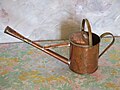
Assorted watering cans made of metal

A watering can (or watering pot or watering jug) is a portable container, usually with a handle and a funnel, used to water plants by hand. It has been in use since at least A.D. 79 and has since seen many improvements in design. Apart from watering plants, it has varied uses, as it is a fairly versatile tool.

The capacity of the container can be anywhere from 0.5 litres (for indoor household plants) to 10 litres (for general garden use). It is usually made of metal, ceramic or plastic. At the end of the spout, a "rose" (a device, like a cap, with small holes) can be placed to break up the stream of water into droplets, to avoid excessive water pressure on the soil or on certain delicate plants.

Water pot, excavated at Villa of the Papyri, ca. A.D. 79.

History

[edit]

The term "watering can" first appeared in 1692, in the diary of the keen cottage gardener Lord Timothy George of Cornwall.[1] Before then, it was known as a "watering pot".[2]

In 1886 the "Haws" watering can was patented by John Haws. The patent read "This new invention forms a watering pot that is much easier to carry and tip, and at the same time being much cleaner, and more adapted for use than any other put before the public."[3]

The shower head end is called a rose, rose head, rosette, or sprinkler head.[4][5]

Modern uses

[edit]

Watering cans are used by gardeners for watering plants, by road workers to apply bitumen to asphalt, as ornaments, and regularly in symbolic art pieces.

[edit]
[edit]

References

[edit]
Revisions and contributorsEdit on WikipediaRead on Wikipedia
from Grokipedia
A watering can is a portable vessel designed for manually watering , typically consisting of a with a and a spout, often fitted with a perforated known as a to disperse evenly like . Precursors to the watering can, such as simple vessels used for , date back to ancient civilizations including . The modern design emerged in by the with prototypes like the chantepleure, evolving through the to include metal construction and patented features for better control, such as the 1886 design by John Haws. Primarily used in to provide precise for flowers, vegetables, and indoor plants, watering cans also serve in other contexts like cleaning delicate surfaces or in artistic depictions, such as Renoir's 1876 painting A Girl with a Watering Can. The global market for watering cans was valued at approximately $1.2 billion in 2023. Notable collections, like the Giesskannenmuseum in , —founded in 2011 and housing over 1,000 examples—underscore its cultural significance as an iconic symbol.

Design and Construction

Components

The body of a watering can functions as the primary for holding , typically shaped in a cylindrical or conical form to allow for efficient storage and straightforward open-top filling. This design enables users to pour directly from a source into the can without additional tools, supporting capacities that range from 0.5 liters for precise indoor applications to 10 liters for broader outdoor tasks. Attached to the body is the spout, a curved tube that directs flow toward targeted areas, allowing users to reach without excessive bending or spilling. At the end of the spout sits the , a removable featuring multiple small perforations that diffuse the into a gentle, even , thereby minimizing disturbance and during application. This component is particularly useful for delicate seedlings or potted , as it breaks the stream into fine droplets for uniform distribution. Watering cans incorporate one or more for practical handling: a top-mounted carrying , often curved or bucket-style, facilitates transport when full, while a side or rear pouring provides stability and control during use. Modern designs emphasize , with balanced handle placements to reduce strain and improve pouring accuracy over extended periods. Water distribution relies primarily on gravity-fed pouring from the spout, allowing a steady stream for direct watering, though many models include adjustable nozzles or removable roses to switch between a focused flow and a diffused spray as needed. Spouts may incorporate metal elements for added durability in repeated use.

Materials

Watering cans are constructed from a variety of materials, each selected for its balance of , functionality, and environmental suitability. Common choices include metals, plastics, and ceramics, with selections influenced by factors such as , resistance to , and aesthetic appeal. Metals have long been favored for their robustness and longevity in outdoor use. Galvanized , coated with to prevent , offers excellent resistance to and dents, making it ideal for long-term applications. Copper and provide additional benefits, including and fungicidal properties that inhibit in stored . , often used in premium models, delivers superior and a polished aesthetic but requires regular to prevent oxidation if left with . However, metals are heavier—typically weighing 1-2 kg when empty—and conduct readily, which can warm during sunny exposure but may make handles uncomfortable to grip. These properties enhance stability for precise pouring through spouts but reduce portability compared to lighter alternatives. Plastics, particularly such as (HDPE), dominate modern production due to their lightweight construction (around 0.5 kg empty) and low cost. They resist entirely and insulate against temperature extremes, preventing from heating or cooling rapidly. Drawbacks include reduced durability, with exposure to UV light causing brittleness, cracking, or over time; lower-quality variants may also leach trace chemicals into . Ceramic and terracotta materials are primarily employed for decorative indoor watering cans, valued for their aesthetic appeal and intricate designs. These options retain moisture effectively for consistent hydration but are fragile, prone to cracking under impact or temperature fluctuations, and unsuitable for outdoor environments. Historically, watering cans transitioned from early constructions, which were heavy and breakable, to stronger metals in the , including , , , and tin, enabling more reliable use in gardens. This shift improved portability and resistance to daily wear, aligning with expanding horticultural practices. In contemporary designs, recycled plastics like post-consumer HDPE promote by reducing and .

History

Early Development

By the in , prototypes emerged in the form of pots known as chantepleure, bell- or jug-shaped vessels with handles, small top openings, and perforated bases or sides for even distribution. Primarily designed for household use, these were employed to sprinkle on or rush-covered floors to suppress dust and maintain cleanliness, though they were occasionally repurposed for rudimentary plant care and floor scrubbing in domestic settings. Advancements in the 16th and 17th centuries introduced pottery-based watering pots in bucket-like or jug forms across , marking a shift toward more dedicated domestic and garden applications. The first documented garden-specific designs surfaced in around the 1580s, as referenced in Thomas Hill's The Gardener’s Labyrinth (1577), which described pots with handles and bottom perforations for controlled watering of tender plants. The term "watering can" was coined in 1692, appearing in the diary of Timothy Keeble, signifying a terminological from the prior "watering pot" and highlighting growing specialization for horticultural tasks. Initial designs of these early watering cans were straightforward constructions featuring short, unperforated spouts without a rose attachment, allowing for direct pouring suited to the modest scale of cottage gardens and basic agricultural needs in pre-industrial . These vessels, typically holding a few quarts, emphasized functionality over ornamentation, influenced by the practical demands of small-scale and flower cultivation in rural households.

19th and 20th Century Evolution

During the , watering cans transitioned from earlier and constructions to more durable metals like , , and galvanized iron, facilitated by industrial stamping processes that enabled efficient sheet-metal fabrication. In Britain and , the post- era saw the rise of , with companies like Haws exemplifying this shift through patented designs that standardized manufacturing. A pivotal occurred in 1886 when John Haws secured a British for a watering can featuring a balanced with dual handles—one for carrying and one for tipping—and a bottom funnel for better control, marking a significant refinement over earlier models and promoting widespread adoption in . Design evolutions emphasized functionality and balance, evolving from bucket-like forms to conical, milk-can-inspired shapes that improved stability when filled and allowed for easier pouring. This period also introduced larger capacities, with commercial models reaching 4 to 5 gallons (16 quarts) for use in market gardens and nurseries, supporting expanded horticultural practices during the . The decline of handcrafting accelerated with factory automation, as stamping and assembly lines reduced costs and increased output, making watering cans accessible beyond elite estates. In the , galvanized became prevalent for its resistance, particularly during the World Wars when material durability was essential for agricultural tools amid shortages. Post-1950s, the introduction of injection-molded offered lightweight, affordable alternatives, entering commercial production around the late 1950s and further diminishing metal handcrafting. Ergonomic refinements, building on Haws' 19th-century dual-handle design for one-handed operation, continued into the 1970s with enhanced grips on models to reduce strain during prolonged use. These changes reflected broader industrialization, prioritizing efficiency and accessibility in tools.

Types and Variations

Traditional Watering Cans

Traditional watering cans feature a conical metal body typically constructed from galvanized or , designed for durability and water retention. These cans include a single curved spout equipped with a removable to diffuse water flow, preventing , and are fitted with dual handles—a top handle for carrying and a side handle for controlled pouring. Standard capacities range from 1 to 2 gallons, making them practical for moderate watering tasks without excessive weight when full. Regional variations reflect local needs and traditions. The British Haws-style watering can, originating from designs established in the late , incorporates a long spout for extended reach in formal , often paired with the classic conical form. American watering cans, often made in a style similar to English designs, feature a conical body with a generous spout, suitable for farm and use. Mediterranean traditions favor versions, handcrafted from terracotta or with decorative floral motifs, providing a lightweight alternative for terraced or arid landscapes. These cans are ideally suited for outdoor gardens, relying on gravity-fed flow through the for even distribution without the need for pumps. Their riveted construction enhances longevity by securing seams and handles against leaks and wear, though the metal models weigh 2 to 5 pounds when empty, contributing to stability during use but requiring more effort to transport.

Modern and Specialized Designs

Contemporary watering cans have evolved to address specific user needs, particularly for indoor and specialized applications. Indoor designs often feature slender models, including black plastic variants, with common capacities ranging from 1 to 2 liters (approximately 0.26 to 0.53 gallons) for houseplant models, equipped with long, narrow spouts ideal for precisely watering houseplants without disturbing . Some larger options reach up to 1 gallon (3.78 liters) or more, suitable for indoor/outdoor use. These cans typically include translucent bodies, allowing users to monitor water levels easily and prevent overfilling. Many long-spout designs prioritize precision watering for houseplants, favoring smaller sizes to enhance control and avoid overwatering. Examples include the Room Essentials 1 gallon black plastic watering can with a long sleek spout, suitable for indoor/outdoor use, and the Bloem Canary Series 1.5 liters black plastic watering can with long spout. Specialized variations cater to storage, , and . Collapsible watering cans, which fold flat for compact storage, offer portability for small spaces or , maintaining through flexible, leak-proof . Self-watering spike attachments, often made of terracotta, enable slow-release by connecting to a watering can or , delivering moisture directly to over extended periods. Decorative sculptural designs, such as vase-like forms crafted from recycled materials, blend functionality with artistic appeal, serving as both practical tools and ornamental pieces in home settings. Innovations in and functionality enhance usability for prolonged tasks. Ergonomic loop handles, designed to distribute weight evenly, reduce hand and wrist strain, making them suitable for users with limited mobility. Dual-function nozzles allow switching between a concentrated stream for targeted watering and a gentle for broader coverage, improving versatility without additional tools. in the 2020s include app-integrated soil sensors that pair with watering systems, providing real-time data to optimize schedules via notifications. Sustainability drives many post-2000 designs, emphasizing eco-friendly materials for reduced environmental impact. Models like Ferm Living's Liba watering can, introduced in the , are constructed from 100% recycled post-consumer , offering a yet durable alternative that promotes principles. composite constructions, often incorporating recycled polymers, further enhance portability while minimizing resource use in manufacturing and transport.

Uses and Applications

In Gardening and Horticulture

In gardening and horticulture, watering cans enable precision watering by delivering water directly to the soil around plant bases, minimizing contact with foliage to reduce the risk of fungal diseases such as powdery mildew or leaf spot. This targeted approach ensures moisture reaches the roots efficiently, promoting deeper root development and healthier plant growth compared to overhead methods that can lead to uneven wetting and disease proliferation. For applications in , watering cans are ideal for drenching pots thoroughly until water drains from the bottom, maintaining consistent without oversaturating the surface. In starting, the attachment on a watering can provides gentle misting that mimics rainfall, preventing and damage to delicate seedlings while ensuring even hydration. Capacities are selected based on plot size; for example, a half-gallon to one-gallon can suits or small setups, allowing controlled pours without excess weight for frequent refills. The benefits of watering cans include reduced water waste through precise application, which is more efficient than hoses that often lead to runoff or , especially in limited spaces. This method supports root development by encouraging plants to seek moisture deeper in the , enhancing in home gardens. Key techniques involve watering in the morning to allow absorption and from leaves, reducing fungal risks and maximizing uptake before heat increases . In raised bed for small farms or home plots, watering cans facilitate hand-directed flow to high beds, integrating seamlessly with sustainable practices by avoiding broad spray that disturbs or promotes weeds.

Other Practical Uses

In industrial applications, watering cans are utilized by road workers to apply hot or asphalt during construction and maintenance tasks, enabling precise pouring onto surfaces like milled edges or bases for better and coverage. This practice is documented in various global roadwork scenarios, particularly in regions with manual paving methods. In workshops, they support small-scale cleaning and mixing operations, where the controlled spout allows for accurate distribution of liquids without splashing. Within households, watering cans serve multiple non-gardening functions, such as refilling birdbaths with a gentle stream to maintain calm levels for . Additionally, their portability makes them suitable for transport in small quantities, such as during power outages or short-term disruptions. Beyond utility, watering cans often function as decorative ornaments in homes and gardens, enhancing aesthetic appeal with vintage or colorful designs. Contemporary adaptations expand their versatility, including collapsible models for hydration, which fold compactly for easy backpacking while allowing controlled pouring for cooking or needs. Watering cans also appear in art installations and as props in , symbolizing renewal or used in staged setups for thematic shoots.

Cultural and Symbolic Significance

In Art and Literature

In , the watering can often serves as a symbol of nurture, growth, and the of , particularly in 19th-century and Impressionist works. Pierre-Auguste Renoir's 1876 A depicts a young girl holding the vessel in Claude Monet's garden at , capturing a moment of childhood innocence amid blooming flowers and sunlight. The watering can here embodies care and the nurturing of nature, reflecting Impressionist interests in fleeting beauty and domestic harmony. Similarly, Berthe Morisot's 1876 painting Young Woman Watering a portrays her sister on a tending plants with a watering can, using loose brushstrokes to evoke intimacy and the quiet rhythm of daily life. In literature and illustration, the watering can appears in garden scenes that highlight themes of adventure and renewal. Beatrix Potter's 1902 children's book includes illustrations of Peter hiding in a large watering can to evade Mr. McGregor in the vegetable , transforming the object into a playful symbol of refuge and mischief within a pastoral setting. Potter's detailed drawings emphasize the garden as a vibrant, lived space where simple tools like the watering can underscore human-animal interactions and the cycle of growth. The motif extends to symbolic representations in 19th-century pastoral art, where watering cans or vessels evoke care for the land and the transient nature of abundance. In Regency and Victorian novels, garden tending scenes symbolize social renewal and personal reflection, with implied tools like watering cans integral to the era's depictions of domestic cultivation and . Contemporary installations further employ the watering can as a for , often using recycled materials to address ecological fragility; for instance, sculptures incorporate repurposed cans in garden-themed works to promote environmental and resource conservation. In 20th-century poetry, water-related , including vessels like the watering can, frequently symbolizes renewal and life's cyclical flow, aligning with broader themes of regeneration in modernist verse. The watering can has appeared as a comedic prop in various television sketches and shows, often highlighting everyday absurdities. In the episode featuring the "How Your Body Works" sketch, a narrator uses the image of an jumping in and out of a watering can every seven minutes for twelve years to illustrate the duration of a , underscoring the group's signature surreal humor. Similarly, the 1970s British sitcom Pardon My Genie centers on a rusty watering can that unexpectedly releases a 4,000-year-old genie, leading to a series of mishaps for its owner in a setting. Children's programming has also employed the object for lighthearted fun, as seen in the episode "Magic Watering Can," where the characters interact with a spout that magically produces endless water, blending whimsy with simple life lessons. In music, the watering can serves as a for artificiality and consumerism in Radiohead's 1995 song "" from the album The Bends. The opening lyrics describe "her green plastic watering can / For her fake Chinese rubber plant / In the fake plastic earth," critiquing modern life's superficiality and environmental disconnection in an industrial soundscape that propelled the track to cult status. The watering can features prominently in British advertising as an icon of heritage, particularly through brands like Haws, established in 1886 and often depicted in media to evoke national traditions of cultivation and . In recent years, it has starred in eco-focused campaigns, such as the 2023 "Can for the Cam" initiative by Cambridge Water, which promoted switching from hoses to watering cans to conserve up to 1 million liters of water daily during summer droughts, using posters and social messaging to encourage mindful usage. These efforts position the tool as a symbol of environmental responsibility amid climate concerns. In modern , the watering can appears in video games as an essential farming tool, notably in (2016), where players upgrade it from a basic model to iridium quality to efficiently irrigate crops, streamlining gameplay and symbolizing progression in rural simulation. It has also inspired humorous online content, including viral animations and memes depicting fails, such as uncontrollable water sprays or mistaken uses, amplifying its nostalgic appeal in since the 2010s.

References

Add your contribution
Related Hubs
User Avatar
No comments yet.