



Community hub
Recent from talks
Contribute something
Nothing was collected or created yet.
D'Alembert operator
View on WikipediaIn special relativity, electromagnetism and wave theory, the d'Alembert operator (denoted by a box: ), also called the d'Alembertian, wave operator, box operator or sometimes quabla operator[1] (cf. nabla symbol) is the Laplace operator of Minkowski space. The operator is named after French mathematician and physicist Jean le Rond d'Alembert.

In Minkowski space, in standard coordinates (t, x, y, z), it has the form
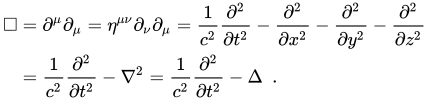
Here is the 3-dimensional Laplacian and ημν is the inverse Minkowski metric with

- , , for .




Note that the μ and ν summation indices range from 0 to 3: see Einstein notation.
(Some authors alternatively use the negative metric signature of (− + + +), with .)

Lorentz transformations leave the Minkowski metric invariant, so the d'Alembertian yields a Lorentz scalar. The above coordinate expressions remain valid for the standard coordinates in every inertial frame.
The box symbol and alternate notations
[edit]There are a variety of notations for the d'Alembertian. The most common are the box symbol (Unicode: U+2610 ☐ BALLOT BOX) whose four sides represent the four dimensions of space-time and the box-squared symbol which emphasizes the scalar property through the squared term (much like the Laplacian). In keeping with the triangular notation for the Laplacian, sometimes is used.


Another way to write the d'Alembertian in flat standard coordinates is . This notation is used extensively in quantum field theory, where partial derivatives are usually indexed, so the lack of an index with the squared partial derivative signals the presence of the d'Alembertian.

Sometimes the box symbol is used to represent the four-dimensional Levi-Civita covariant derivative. The symbol is then used to represent the space derivatives, but this is coordinate-chart-dependent.

Applications
[edit]The wave equation for small vibrations is of the form

where u(x, t) is the displacement.
The wave equation for the electromagnetic field in vacuum is

where Aμ is the electromagnetic four-potential in Lorenz gauge.
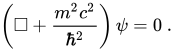
The Klein–Gordon equation has the form
Green's function
[edit]The Green's function, , for the d'Alembertian is defined by the equation


where is the multidimensional Dirac delta function and and are two points in Minkowski space.


A special solution is given by the retarded Green's function which corresponds to signal propagation only forward in time[2]

where is the Heaviside step function.

See also
[edit]References
[edit]- ^ Bartelmann, Matthias; Feuerbacher, Björn; Krüger, Timm; Lüst, Dieter; Rebhan, Anton; Wipf, Andreas (2015). Theoretische Physik (Aufl. 2015 ed.). Berlin, Heidelberg. ISBN 978-3-642-54618-1. OCLC 899608232.
{{cite book}}: CS1 maint: location missing publisher (link) - ^ S. Siklos. "The causal Green's function for the wave equation" (PDF). Archived from the original (PDF) on 30 November 2016. Retrieved 2 January 2013.
External links
[edit]- "D'Alembert operator", Encyclopedia of Mathematics, EMS Press, 2001 [1994]
- Poincaré, Henri (1906). – via Wikisource., originally printed in Rendiconti del Circolo Matematico di Palermo.
- Weisstein, Eric W. "d'Alembertian". MathWorld.