


Community hub
Recent from talks
Contribute something
Nothing was collected or created yet.
Bronx–Whitestone Bridge
View on Wikipedia
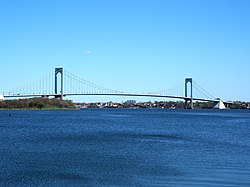
The Bronx–Whitestone Bridge (colloquially referred to as the Whitestone Bridge or simply the Whitestone) is a suspension bridge in New York City, carrying six lanes of Interstate 678 over the East River. The bridge connects Throggs Neck and Ferry Point Park in the Bronx, on the East River's northern shore, with the Whitestone neighborhood of Queens on the southern shore.
Key Information


Although the Bronx–Whitestone Bridge's construction was proposed as early as 1905, it was not approved until 1936. The bridge was designed by Swiss-American architect Othmar Ammann and design engineer Allston Dana and opened to traffic with four lanes on April 29, 1939. The bridge's design was similar to that of the Tacoma Narrows Bridge, which collapsed in 1940. As a result, extra stiffening trusses were added to the Bronx–Whitestone Bridge in the early 1940s, and it was widened to six lanes during the same project. The Bronx–Whitestone Bridge was also renovated in 1988–1991 to repair the anchorages, roadways, and drainage. The stiffening trusses were removed during a renovation in the mid-2000s, and the bridge's deck and approach viaducts were replaced soon afterward.
The Bronx–Whitestone Bridge is owned by New York City and operated by MTA Bridges and Tunnels, an affiliate agency of the Metropolitan Transportation Authority. With a center span of 2,300 feet (700 m), the Bronx–Whitestone Bridge once had the fourth-largest center span of any suspension bridge in the world. The bridge has a total length of 3,700 feet (1,100 m), and its towers reach 377 feet (115 m) above water level.
Description
[edit]The Bronx–Whitestone Bridge has a 2,300-foot (700 m) main span between its two suspension towers, with the span rising 150 feet (46 m) above mean high water.[3][4]: 115 [5] The side spans, between suspension towers and anchorages at each end, are 735 feet (224 m). Thus, the overall length, from anchorage to anchorage, is 3,770 feet (1,150 m).[6] As originally designed, the bridge approach on the Queens side descended to ground level via a 1,016-foot (310 m)-long plate girder viaduct, then another 194 feet (59 m) on a concrete ramp. The Bronx side's approach descended 1,861 feet (567 m) on a plate girder viaduct, then another 266 feet (81 m) on a concrete ramp. A toll booth was located on the Bronx side immediately after the end of the concrete ramp.[6]
The span is supported by two main cables, which suspend the deck and are held up by the suspension towers. Each cable is 3,965 feet (1,209 m) long and contains 9,862 wires, amounting to around 14,800 miles (23,800 km) of cable length.[5][7] Each cable contains 37 strands of 266 wires, which in turn measure 0.196 inches (5.0 mm) thick.[7] Each of the suspension towers has a height of 377 feet (115 m) above mean high water.[4]: 115 [5][8] The caissons, in turn, are submerged about 165 feet (50 m) beneath mean high water.[8] At each end of the suspension span are two anchorages that hold the main cables, both of which are freestanding concrete structures measuring 180 by 110 feet (55 by 34 m).[6] The width of the bridge deck between the cables is 74 feet (23 m).[5]
Unlike other suspension bridges, the Bronx–Whitestone Bridge originally did not have a stiffening truss system. Instead, 11-foot (3.4 m) I-beam girders gave the bridge an Art Deco streamlined appearance. After the 1940 collapse of the Tacoma Narrows Bridge, a bridge of similar design, trusses were added on the Bronx–Whitestone Bridge to minimize the span's oscillations.[4]: 124 [9][10] Further modifications to the bridge were made in 1988–1991[10][11] and in 2003–2005.[10][12]
Highway connections
[edit]The Bronx–Whitestone Bridge carries Interstate 678 (I-678). In Queens, the Whitestone Expressway (I-678) extends south to an interchange with the Cross Island Parkway, located just past the end of the bridge's approach ramps. There is an exit from the bridge to the southbound Whitestone Expressway service road, and an entrance and exit from the northbound Whitestone Expressway to the northbound service road. In the Bronx, the bridge leads to the Hutchinson River Expressway (I-678). The expressway has exits and entrances in both directions to the Hutchinson River Expressway service roads, which in turn connect to Lafayette Avenue. The expressway continues north to the Bruckner Interchange, where I-678 ends and becomes the Hutchinson River Parkway; there are also connections to the Cross Bronx Expressway (I-95) and to Bruckner Expressway (I-278 and I-95).[13]
As most trucks carrying over 80,000 lb (36,000 kg) have been prohibited from using the Throgs Neck Bridge (approximately 2 miles (3.2 km) east) since 2005,[14] the Bronx–Whitestone Bridge is suggested as an alternative route for heavy trucks.[15] Tractor-trailers exceeding 53 feet (16 m) and traveling between central Queens and the Bronx, as well as all heavy trucks over 53 feet that are banned from the Throgs Neck Bridge, are required to use the Bronx–Whitestone Bridge.[16]
History
[edit]
The idea for a fixed crossing between Ferry Point at Clason Point, Bronx, and Whitestone Point at Whitestone, Queens, was first proposed in 1905 by real estate speculators who wanted to develop Whitestone.[17] At the time, residents around the proposed area of the bridge protested construction in fear of losing the then-rural character of the community. Plans for the bridge were submitted to the Whitestone Improvement Association in 1909,[18] but they were not acted upon. Queens public administrator Alfred J. Kennedy later recalled that in 1911, while he was in the New York State Assembly, he had proposed such a bridge but that his plan was "ridiculed".[19]
In 1907, the Clason Point, College Point and Malba Ferry Company proposed a ferry route between Clason Point, Bronx, and Malba, Queens, close to the site of the planned bridge.[20] The company was incorporated in 1909,[21] and two years later it started constructing ferry terminals.[22] Ferry operations between Clason Point and Malba began on July 2, 1914.[23]
Development
[edit]Planning
[edit]In 1929, the Regional Plan Association (RPA) proposed a bridge from the Bronx to northern Queens to allow motorists from upstate New York and New England to reach Queens and Long Island without having to first travel through the traffic congestion in western Queens.[24] The RPA believed that it was necessary to connect the proposed Belt Parkway (now Cross Island Parkway) on the Queens side with the Hutchinson River Parkway and Bruckner Boulevard on the Bronx side.[4]: 116 The next year, urban planner Robert Moses formally proposed a Clason Point-to-Whitestone bridge as part of the Belt Parkway around Brooklyn and Queens.[25] At the time, it was expected that the bridge would cost $25 million to construct.[26]
In 1932, the New York City Board of Estimate started soliciting applications from private companies to build and operate the crossing as a toll bridge.[27] One such application was made by Charles V. Bossert, who submitted his plan to the Board of Estimate in 1933.[28] Bossert's plan went as far as U.S. Congress, where in 1935, a bill to approve the construction of Bossert's plan was introduced in the House of Representatives.[29] However, the idea of a private company operating a publicly used toll bridge was unpopular, so it was dropped.[30]
At the same time, the Queens Topological Bureau, Long Island State Park Commission, and Triborough Bridge Authority (TBA; later Triborough Bridge and Tunnel Authority, or TBTA) was conducting a study on the proposed Bronx–Whitestone Bridge. In 1935, the agencies jointly released a report on the connecting roads to be built as part of the bridge plans, and projected that the bridge would cost $20 million (equivalent to $373,452,000 in 2024).[31] The bridge would directly link the Bronx, and other points on the mainland, to the 1939 New York World's Fair and to LaGuardia Airport (then known as North Beach Airport), both in Queens. In addition, the Whitestone Bridge was to provide congestion relief to the Triborough Bridge, further to the west, which also connected Queens to the Bronx.[32][33] Real estate speculators predicted that the new bridge would also encourage development in the Bronx.[34][35] New residential units in the Bronx were being planned before construction on the bridge itself even started.[36] The RPA had also recommended that the Whitestone Bridge have rail connections, or space for such connections, but this would have required longer, shallower approach spans; Moses ultimately did not include any provisions for rail connections on the bridge.[4]: 116
Approval and land acquisition
[edit]In 1936, governor Herbert H. Lehman signed a bill that authorized the construction of the Bronx–Whitestone Bridge, which would connect Queens and the Bronx.[37][38] The following January, Lehman signed a bill that allowed the TBA to issue bonds for the construction of the bridge.[39][40] In February 1937, TBA chief engineer Othmar Ammann announced that the bridge was both "practical and necessary".[41] Allston Dana was also hired as the engineer of design.[42] The same month, approval of a suspension span between Ferry Point and Whitestone was given by Harry Hines Woodring, the United States Secretary of War.[43] Around the same time, the TBA made plans to issue bonds to fund the construction of the Bronx–Whitestone Bridge.[44] Moses recommended the TBA and the city should each be responsible for half of the bridge's $17.5 million cost.[1]
In April 1937, the TBA started selling $25 million in bonds to fund the bridge's construction.[6][45][46] A $1.13 million contract for the construction of the Bronx–Whitestone Bridge's towers was awarded in June 1937 to the American Bridge Company, which had beaten the only other competitor, Bethlehem Steel.[47][48][49] The same month, the city started buying property that was in the right-of-way for the Whitestone Bridge and Parkway;[50] shortly afterward, the rights-of-way for the bridge and parkway were legally designated.[51] All of the TBA bonds had been sold by July 1937.[52] The next month, the city had started evicting residents in the path of the bridge's approaches, and officials notified seventeen households in Whitestone that they had ten days to find new housing.[53] This raised controversy because of the short notice given, but Moses said such measures were necessary to complete the bridge on schedule.[54] In addition, land in Ferry Point was taken for the construction of the bridge; this land would become Ferry Point Park upon the completion of the bridge.[55]
Construction
[edit].jpg)
A groundbreaking ceremony was held in November 1937, when the Mayor of New York City, Fiorello H. La Guardia, laid the cornerstone for the bridge's Bronx anchorage.[56] Construction on the Bronx–Whitestone Bridge, along with several other road-improvement projects, was sped up so that the regional road network would be ready in time for the 1939 World's Fair.[57] To ensure that the bridge would be completed before the fair opened, the cofferdam for the Bronx tower had to be finished in February 1938, followed by the Queens tower in April 1938.[35] Moses anticipated that the bridge and connecting roads would need to be complete by June 1, 1939.[58] The project also included the construction of the Flushing River Lift Bridge, a drawbridge over the Flushing River a few miles south of the Bronx–Whitestone Bridge.[59]
The four sections of each of the two suspension towers were assembled in only 18 days.[5][60] The tower on the Bronx side was finished first, and in late May 1938, work began on the Queens tower. At the time, it was expected that the spinning of the suspension cables would begin that September.[61] By the first week of July 1938, the TBA reported that both of the Bronx–Whitestone Bridge's towers were completed, and that the bridge was on schedule to open on April 30, 1939, ahead of schedule.[62] In addition, the construction of connecting roadways on the Queens and Bronx sides of the bridge was being sped up. The Bronx side of the bridge would connect to the Hutchinson River Parkway, while the Queens side would connect to the Whitestone and Cross Island Parkways.[6]
The process of spinning the bridge's cables commenced in September 1938.[63][64][65] The first cable, which contained 266 strands, was completed within a week.[66] The suspender cables were completed within 41 days.[5] That October, work started on the Cross Island Parkway approach to the bridge in Queens.[67] The bridge's opening date was formalized in January 1939,[68] and the last girder was installed on February 13, 1939.[69][70] Afterward, the construction of the approach roads was sped up in anticipation of the 1939 World's Fair.[71] During construction, one worker died when he fell off the bridge deck.[72] There was another incident in August 1938 in which a 35-ton steel girder dropped from the side of the Whitestone Bridge, though no one was severely injured.[73] The bridge ultimately cost either $17.785 million (equal to about $402 million in 2024)[60] or $19.6 million (equal to about $443 million in 2024).[74]
Opening
[edit]The Bronx–Whitestone Bridge opened on April 29, 1939, with Moses and La Guardia leading a ceremony of 4,000 people.[8][75][76][77] Both the Whitestone and College Point neighborhoods had celebrations for the new project, which Moses described as a "logical and inevitable part of the Belt Parkway program".[75] The bridge featured pedestrian walkways and four lanes of vehicular traffic, and passenger vehicles were initially charged 25 cents.[77] The 2,300-foot (700 m) center span was the fourth longest in the world at the opening, behind the Golden Gate Bridge, the George Washington Bridge, and the double spans of the San Francisco–Oakland Bay Bridge.[3][4]: 115 [7][78] The bridge's opening, two months earlier than originally scheduled, coincided with the first day of the 1939 World's Fair.[76][79][80]
A custom model of lampposts, the "Whitestone" or Type 41 lamppost, was made for the bridge. The lamppost model was later installed on other roads, though it was longer being actively installed by the 1960s, and only a few such lamps remained as of 2013[update].[81] In preparation for the 1939 World's Fair, amber street lights were installed on the bridge's approach roads, as well as other key corridors around the city. These lamps were distinctly colored so motorists headed to the fair could follow them while driving.[82] At its north end, the Bronx–Whitestone Bridge was to connect with Eastern Boulevard (later known as Bruckner Boulevard) via the Hutchinson River Parkway.[83] At its south end, the bridge was to connect with the new Whitestone Parkway, which led southwest off the bridge to Northern Boulevard.[83][84] The connection between the Bronx–Whitestone Bridge and Whitestone Parkway opened in November 1940,[85] while the Hutchinson River Parkway between Pelham Bay Park and the bridge opened in October 1941.[86][87] The Whitestone and Hutchinson River parkways intersected Bruckner Boulevard at a traffic circle, where congestion worsened over subsequent decades until the Bruckner Interchange replaced the circle in the 1970s.[88] On the Queens side, an extension of Francis Lewis Boulevard opened in November 1939, connecting northeastern Queens with the new bridge,[89][90] while the Cross Island Parkway approach opened in June 1940.[91][92]
La Guardia said the bridge could carry up to 4,000 cars per hour in each direction.[8] Within the first two months of the Bronx–Whitestone Bridge's opening, it had carried just over a million vehicles, and the bridge was collecting an average of $4,232 a day in tolls.[93][94] In 1940, the American Institute of Steel Construction recognized the Bronx–Whitestone Bridge as the "most beautiful monumental steel bridge completed during the last year".[95][96] Additionally, two parks were opened following the bridge's completion. A 10-acre (4.0 ha) park under the Queens side of the Bronx–Whitestone Bridge, named for Declaration of Independence signatory Francis Lewis, was opened in 1940.[19] On the Bronx side, the blueprint for Ferry Point Park had been developed in conjunction with the bridge's construction, and additional facilities were added in the early 1940s.[97]
Truss installation
[edit]
As early as June 1938, engineers observed oscillations in the Whitestone Bridge's deck.[98] Concerns grew after the original Tacoma Narrows Bridge in Tacoma, Washington, collapsed during heavy winds in November 1940.[99] It had employed an 8-foot (2.4 m)-deep girder system, much like the 11-foot (3.4 m) I-beam girders of the Bronx–Whitestone Bridge. However, the Whitestone Bridge was shorter and wider than the Tacoma Narrows Bridge.[100] The Bronx–Whitestone Bridge's deck was also thicker than that of the Tacoma Narrows Bridge, which was only 8 feet (2.4 m) thick to the Bronx–Whitestone Bridge's 11 feet (3.4 m).[4]: 120 Overall, the Bronx–Whitestone Bridge was less prone to oscillation and critical failure, as it was not as flimsy as the Tacoma Narrows Bridge.[98] After performing a series of experiments on the bridge's design, Ammann concluded that additional measures to stiffen the Whitestone Bridge were unnecessary.[4]: 124 A Princeton University professor separately created a model of the bridge, finding that the Whitestone Bridge's main span could still oscillate in as many as three segments.[98]
Even so, the public was scared by the fact that the two bridges were similar in design, and this led to a belief that the Whitestone Bridge might be unstable, as Moses later related.[4]: 124 [101] Shortly after the Tacoma Narrows Bridge collapse, Moses announced that steel cable stays would be installed on the bridge's towers to reduce oscillation.[98][102][103] To mitigate the risk of failure from high winds, eight stay cables, two on each side of both suspension towers, were proposed for installation.[4]: 124 The stays were supposed to be completed in January 1941.[98][103] Although $1 million was initially allocated for the bridge-stiffening project, construction was deferred due to material and labor shortages during World War II.[104]
Planning for the project resumed in September 1945 at the end of the war,[105][106] and a low bidder for the project was announced that October.[107] The project's primary goal was to reinforce the bridge with trusses, thus ensuring the bridge's stability. The four lanes of roadway traffic were widened to six lanes, with the two additional lanes replacing the pedestrian walkways on each side. On both sides of the deck, 14-foot (4.3 m)-high steel trusses were installed to weigh down and stiffen the bridge in an effort to reduce oscillation. The stiffening project was completed in 1947.[9][10] The bridge was repainted in 1953,[108] and large overhead signs were installed on the bridge the same year to direct motorists toward the Whitestone and Cross Island parkways.[109]
Increases in traffic
[edit]By the late 1950s, the Bronx–Whitestone Bridge was carrying nearly 30 million vehicles a year.[110] Concurrently, the Whitestone Parkway and the portion of the Hutchinson River Parkway between the bridge and the Bruckner Interchange were converted to Interstate Highway standards. The Whitestone Parkway became the Whitestone Expressway, and the upgraded part of the Hutchinson River Parkway became the Hutchinson River Expressway.[111][112] In addition, the Van Wyck Expressway between John F. Kennedy International Airport and Kew Gardens was extended northward to connect with the Whitestone Expressway and the Bronx–Whitestone Bridge.[113] By 1966, the Bronx–Whitestone Bridge had been designated as part of Interstate 678, along with the Whitestone Expressway.[114] These highway upgrades were performed in preparation for the 1964 New York World's Fair, which was also held in Flushing Meadows-Corona Park.[113]
Also by the 1950s, the Bronx–Whitestone Bridge was nearing its traffic capacity because it was the easternmost crossing of the East River between the Bronx and Queens.[115][116][117] To alleviate traffic loads on the Bronx–Whitestone Bridge, planning for the Throgs Neck Bridge to the east, started in 1955,[118] and construction of that bridge began in 1957.[119] After the Throgs Neck Bridge opened in 1961, the Bronx–Whitestone Bridge recorded a corresponding 40% decline in traffic;[120] according to a TBTA executive, traffic on the bridge ultimately decreased by more than half.[121] Soon afterward, the 1964 World's Fair resulted in an increase in traffic on the Bronx–Whitestone Bridge.[122] In 1968, a heavy storm with winds of up to 80 miles per hour (130 km/h) caused the Bronx–Whitestone Bridge's deck to bounce,[123][124] though the additional trusses helped to reduce vertical movements.[60] No one was injured, and officials stated that the bridge was not in danger of collapsing during the storm.[124]
In the long run, use of the bridge continued to grow. By the bridge's 40th anniversary in 1979, there were about 31 million vehicles using the bridge annually.[60][74][125] The bridge had recorded a total of 858 million vehicular crossings over its lifetime.[60] By 1985, the Bronx–Whitestone Bridge carried 35 million vehicles annually, more than the 33 million recorded in 1960, before the Throgs Neck Bridge had opened as an alternate route.[121] There had been several plans to build a Long Island Sound bridge east of the Bronx–Whitestone and Throgs Neck bridges to relieve traffic on these crossings, although such a bridge remained unbuilt in the 21st century.[121][60] After concrete debris fell from the bridge's Queens approach viaduct in 1985, the TBTA repaired the approach.[126] Upon the bridge's 50th anniversary in 1989, a New York Times writer said: "The Bronx-Whitestone Bridge amounted to soaring evidence that dreams can come true."[127]
Major repairs
[edit]In March 1990, the TBTA announced that the Bronx–Whitestone Bridge would undergo a $20.3 million refurbishment. The anchorages, roadways, and drainage were to be repaired during off-peak hours for two years.[128] Actual work took place between December 1989 and December 1991.[11][10] As the Throgs Neck Bridge was being repaired simultaneously, this caused major traffic jams at both bridges.[129] During the renovation, the bridge's expansion joints were replaced by the American Bridge Company, which had originally built the suspension towers. However, in 1993, the sealant around the joints was observed to be deteriorating, necessitating additional repairs.[11]

By 2001, the TBTA's successor Metropolitan Transportation Authority (MTA) planned to spend $286 million in bridge renovations. In 2003, the MTA restored the classic lines of the bridge by removing the stiffening trusses and installing fiberglass fairing along both sides of the road deck.[130][12] The lightweight fiberglass fairing is triangular in shape, giving it an aerodynamic profile that allows crosswinds to flow through the bridge rather than hit the trusses.[131][132] The removal of the trusses and other changes to the decking reduced the bridge's weight by 6,000 tons, accounting for some 25% of the mass suspended by the cables, In addition, with the truss removals, the Bronx–Whitestone Bridge was able to withstand crosswinds of up to 150 miles per hour (240 km/h), whereas the trusses could resist crosswinds of no more than 50 miles per hour (80 km/h).[130][132][133] The truss removal project also involved upgrading the lighting systems, including the bridge's lightbulbs and the beacons atop the suspension towers, as well as replacing the sprinkler and electrical systems.[132]
In 2005, it was announced that the bridge's deck had to be replaced with a new steel orthotropic deck composed of prefabricated panels. One lane at a time needed to be closed and replaced, so as to minimize traffic disruptions.[132] During the deck replacement, five lanes were kept open at all times using a movable barrier, with three Bronx-bound lanes during the morning rush hour and three Queens-bound lanes during the evening rush.[132][134] Other renovations included adding mass dampers to stabilize the bridge deck; repainting the two towers and the bridge deck; and installing variable-message signs.[135] The deck replacement was completed by 2007.[136][135] However, cracks were soon observed in some of the new panels, and by 2014, cracks had been observed in 66 of 408 panels, necessitating approximately 1,000 feet (300 m) of rib welds.[137] The renovations were intended to extend the Bronx–Whitestone Bridge's lifespan indefinitely.[130] These improvements also accommodated the bridge's high traffic volumes: by 2008, the bridge was being used by an average of 120,000 vehicles a day, amounting to 43 million crossings that year.[136]
The Queens and Bronx approaches were replaced in a project that started in 2008.[136][135] As part of the project, each of the approaches' lanes was widened to 12 feet (3.7 m). The replacement of the bridge's approaches involved replacing 15 supporting piers and 1,785 feet (544 m) of roadway on the Bronx side, as well as 1,010 feet (310 m) of viaduct on the Queens side, which helped support the wider lanes.[138] The contract for the Bronx viaduct replacement was awarded in 2008,[135][139] and it was completed in late 2012 at a cost of $212 million.[138] The replacement of the Queens approach, which cost $109 million,[138] was completed in May 2015.[140][141] During the renovation of that approach, the exit from northbound I-678 to Third Avenue was closed and rehabilitated.[142]
Tolls
[edit]As of January 4, 2026[update], drivers pay $12.03 per car or $5.06 per motorcycle for tolls by mail/non-NYCSC E-Z Pass. E-ZPass users with transponders issued by the New York E‑ZPass Customer Service Center pay $7.46 per car or $3.25 per motorcycle. Mid-Tier NYCSC E-Z Pass users pay $9.79 per car or $4.18 per motorcycle. All E-ZPass users with transponders not issued by the New York E-ZPass CSC will be required to pay Toll-by-mail rates.[143]
The toll plaza of the Bronx–Whitestone Bridge, located on the Bronx side, originally contained 10 toll lanes but was later expanded.[80] Four self-service toll-collection machines were installed at the Bronx–Whitestone Bridge during the 1950s, but they were removed in 1959 because motorists repeatedly dropped their coins at the machines.[144][145] E-ZPass was introduced at the Bronx–Whitestone Bridge in June 1996.[146][147] Initially, the bridge's toll plaza contained three E-ZPass/cash lanes in each direction to reduce confusion; this contrasted with the Throgs Neck Bridge, where confusion between the E-ZPass-only lanes and cash-only lanes had caused congestion.[147]
Open-road cashless tolling began on September 30, 2017.[148] The tollbooths, which were at the Bronx end of the bridge, were dismantled, and drivers are no longer able to pay cash at the bridge. Instead, cameras and E-ZPass readers are mounted on new overhead gantries manufactured by TransCore[149] near where the booths were located.[150][151] A vehicle without E-ZPass has a picture taken of its license plate and a bill for the toll is mailed to its owner.[152] For E-ZPass users, sensors detect their transponders wirelessly.[150][151][152]
Historical tolls
[edit]| Years | Toll | Toll equivalent in 2024[153] | Ref. | ||
|---|---|---|---|---|---|
| Cash | E-ZPass | Cash | E-ZPass | ||
| 1939–1972 | $0.25 | N/a | $5.65–5.61 | N/a | [77] |
| 1972–1975 | $0.50 | $2.92–3.76 | [154][155] | ||
| 1975–1980 | $0.75 | $2.86–4.38 | [155] | ||
| 1980–1982 | $1.00 | $3.26–3.82 | [156] | ||
| 1982–1984 | $1.25 | $3.78–4.07 | [157] | ||
| 1984–1986 | $1.50 | $4.39–4.30 | [158] | ||
| 1986–1987 | $1.75 | $4.84–5.02 | [159] | ||
| 1987–1989 | $2.00 | $5.07–5.54 | [160] | ||
| 1989–1993 | $2.50 | $5.44–6.34 | [161] | ||
| 1993–1996 | $3.00 | $6.01–6.53 | [162] | ||
| 1996–2003 | $3.50 | $3.50 | $5.98–7.02 | $5.98–7.02 | [163] |
| 2003–2005 | $4.00 | $4.00 | $6.44–6.84 | $6.44–6.84 | [164] |
| 2005–2008 | $4.50 | $4.00 | $6.57–7.24 | $5.84–6.44 | [165] |
| 2008–2010 | $5.00 | $4.15 | $7.21–7.30 | $5.98–6.06 | [166] |
| 2010–2015 | $6.50 | $4.80 | $8.62–9.37 | $6.37–6.92 | [167][168] |
| 2015–2017 | $8.00 | $5.54 | $10.26–10.61 | $7.11–7.35 | [169][170] |
| 2017–2019 | $8.50 | $5.76 | $10.45–10.90 | $7.08–7.39 | [171][172] |
| 2019–2021 | $9.50 | $6.12 | $11.02–11.68 | $7.10–7.53 | [173][174] |
| 2021–2023 | $10.17 | $6.55 | $10.50–11.80 | $6.76–7.60 | [175] |
| 2023–2026 | $11.19 | $6.94 | $11.19–11.55 | $6.94–7.16 | [176] |
| 2026–present | $12.03 | $7.46 | $12.03 | $7.46 | [177] |
Public transportation
[edit]The bridge carries two MTA Regional Bus Operations routes, the Q44 SBS operated by MTA New York City Transit, and the Q50 Limited (formerly part of the QBx1), operated by the MTA Bus Company.[178]
After the removal of the sidewalks starting in 1943, bicyclists were able to use QBx1 buses of the Queens Surface Corporation, which could carry bicycles on the front-mounted bike racks. However, since the Metropolitan Transportation Authority absorbed the bus routes formerly operated by Queens Surface, the bike racks were eliminated.[179] In April 1994, bike racks were installed onto QBx1 buses,[180] but the bike-on-bus program was eliminated on February 27, 2005, the same day as the MTA's takeover of the QBx1 route.[181] After the QBx1 was replaced by the Q50, the MTA reintroduced bike racks on Q50 buses in early 2018.[182]
See also
[edit]


Notes
[edit]- ^ This table lists the peak tolls for two-axle vehicles. Motorcycle tolls and off-peak tolls are lower, and tolls for vehicles with additional axles are higher.
References
[edit]- ^ a b "Whitestone Bridge Plan; Moses Tells How He Thinks the $17,500,000 Cost Should Be Split" (PDF). The New York Times. April 23, 1937. ISSN 0362-4331. Retrieved December 19, 2017.
- ^ "New York City Bridge Traffic Volumes" (PDF). New York City Department of Transportation. 2016. p. 11. Archived (PDF) from the original on March 11, 2018. Retrieved March 16, 2018.
- ^ a b Jackson, Kenneth T., ed. (2010). The Encyclopedia of New York City (2nd ed.). New Haven: Yale University Press. p. 837. ISBN 978-0-300-11465-2.
- ^ a b c d e f g h i j Rastorfer, Darl (2000). "Chapter 5: The Bronx–Whitestone Bridge". Six Bridges: The Legacy of Othmar H. Ammann. Yale University Press. ISBN 978-0-300-08047-6. Retrieved September 18, 2018.
- ^ a b c d e f "Press Release – Bridges & Tunnels – Bronx–Whitestone Bridge: Celebrating 75 Years". MTA. April 8, 2014. Archived from the original on August 6, 2020. Retrieved October 1, 2018.
- ^ a b c d e "Whitestone-Bronx Bridge To Open In Time For World Fair" (PDF). North Shore Daily Journal. July 19, 1938. p. 2. Retrieved October 23, 2018 – via Fultonhistory.com.
- ^ a b c Walker, John H. (February 5, 1939). "Whitestone Bridge Rises Fast As Northern Gateway to Fair: Three-Year Job in Two Expected to Put Finishing Touches on $18,000,000 Span by April 30, When Exposition Opens Bridging East River With World's Fourth Largest Span". New York Herald Tribune. p. A1. ISSN 1941-0646. ProQuest 1243015454.
- ^ a b c d "Mayor Opens Whitestone Bridge to Fair: 4,000 Hear Attack on Foes of His Economy Drive to Build 'City of Tomorrow' Opening $18,000,000 Span That Will Provide a Short Cut to the Fair". New York Herald Tribune. April 30, 1939. p. 1. ISSN 1941-0646. ProQuest 1244863164.
- ^ a b "Battery Tunnel Needs Dough; Seek U.S. Loan". New York Daily News. July 28, 1947. p. 401. Archived from the original on October 30, 2018. Retrieved October 29, 2018 – via Newspapers.com.
- ^ a b c d e Barelli, Michael; White, Joshua; Billington, David P. (2006). "History and Aesthetics of the Bronx–Whitestone Bridge". Journal of Bridge Engineering. 11 (2): 230–240. doi:10.1061/(ASCE)1084-0702(2006)11:2(230). ISSN 1084-0702.
- ^ a b c Chang, Dean (January 21, 1993). "The Whitestone needs bridgework again...already". New York Daily News. p. 214. Archived from the original on January 25, 2024. Retrieved November 1, 2018 – via Newspapers.com.
- ^ a b Roth, Alisa (October 12, 2003). "A Onetime Thing of Beauty Gets a Little Prettying Up". The New York Times. ISSN 0362-4331. Archived from the original on May 27, 2015. Retrieved April 4, 2010.
- ^ "NYCityMap". NYC.gov. New York City Department of Information Technology and Telecommunications. Archived from the original on May 24, 2015. Retrieved March 20, 2020.
- ^ Chan, Sewell (September 1, 2005). "Cracks on Throgs Neck Spur a Daytime Ban on Heavy Trucks". The New York Times. ISSN 0362-4331. Archived from the original on October 8, 2018. Retrieved October 1, 2018.
- ^ "Truck/Commercial Vehicle Information". Metropolitan Transportation Authority. Archived from the original on October 8, 2018. Retrieved October 8, 2018.
- ^ "New York City Truck Route Map" (PDF). nyc.gov. New York City Department of Transportation. June 8, 2015. Archived from the original (PDF) on February 24, 2018. Retrieved September 12, 2017.
- ^ Antos, J.D. (2006). Whitestone. Images of America. Arcadia Pub. p. 95. ISBN 978-0-7385-4628-5. Retrieved October 20, 2018.
- ^ "From Whitestone to Bronx". Brooklyn Daily Eagle. August 30, 1909. p. 20. Archived from the original on October 20, 2018. Retrieved October 20, 2018 – via Brooklyn Public Library; newspapers.com.
- ^ a b "10-Acre Park Dedicated At Whitestone Bridge" (PDF). Long Island Daily Press. April 27, 1940. p. 3. Retrieved October 25, 2018 – via Fultonhistory.com.
- ^ "Inspect New Ferry Site; Aldermanic Committee Goes to Whitestone to Look Over the Project". The New York Times. April 21, 1907. ISSN 0362-4331. Archived from the original on October 20, 2018. Retrieved October 20, 2018.
- ^ "New Sound Ferry". Brooklyn Daily Eagle. July 10, 1909. p. 22. Retrieved October 20, 2018 – via Brooklyn Public Library; newspapers.com.
- ^ "New Ferry to Queens; Will Connect College Point with Clason Point in the Bronx". The New York Times. June 25, 1911. ISSN 0362-4331. Archived from the original on October 20, 2018. Retrieved October 20, 2018.
- ^ "Clason Point Ferry Now in Operation". July 2, 1914. p. 22. Archived from the original on October 20, 2018. Retrieved October 20, 2018 – via Brooklyn Public Library; newspapers.com.
- ^ "Highway Loop in Plan Skirts Busy Centers". The New York Times. May 30, 1929. p. 12. Archived from the original on June 16, 2018. Retrieved May 29, 2010.
- ^ "Asks New City Parks To Cost $20,000,000; Metropolitan Conference Urges Prompt Purchases, Chiefly in Queens and Richmond" (PDF). The New York Times. February 26, 1930. ISSN 0362-4331. Retrieved December 19, 2017.
- ^ Duane, John (April 19, 1931). "Queens-Bronx Bridge Urged". New York Daily News. Archived from the original on October 20, 2018. Retrieved October 20, 2018 – via Newspapers.com.
- ^ "Highway Loop Here Near Completion; Regional Plan Group Reports Three-fifths of Link Virtually Ready for Operation". The New York Times. June 10, 1933. ISSN 0362-4331. Archived from the original on October 20, 2018. Retrieved October 20, 2018.
- ^ "$40,000,000 Bridge in Bronx Proposed; C.V. Bossert to Ask Approval of Estimate Board for Span to Connect With Queens". The New York Times. April 21, 1933. ISSN 0362-4331. Archived from the original on October 20, 2018. Retrieved October 20, 2018.
- ^ "Bossert Plans Bridge, Bronx to Whitestone". New York Daily News. January 24, 1935. p. 380. Archived from the original on October 21, 2018. Retrieved October 20, 2018 – via Newspapers.com.
- ^ Weigold, M.E. (2004). The Long Island Sound: A History of Its People, Places, and Environment. NYU Press. pp. 193–194. ISBN 978-0-8147-9400-5. Retrieved October 20, 2018.
- ^ "Map Highway Plans for 2-Boro Bridge". New York Daily News. August 19, 1935. p. 174. Archived from the original on October 20, 2018. Retrieved October 20, 2018 – via Newspapers.com.
- ^ "New Road System Proposed For City; Regional Plan Offers 15 to 20 Year Program to Aid Whole Metropolitan Area". The New York Times. January 7, 1935. ISSN 0362-4331. Archived from the original on October 20, 2018. Retrieved October 20, 2018.
- ^ Morrow, C. Earl (March 28, 1937). "Whitestone Bridge Construction To Be Rushed as Important Link In World's Fair Road Projects: Regional Plan Official, in Citing Highway Improvements Scheduler to Facilitate Traffic Movements for 1939 Event, Stresses Aid Expected of New Long Island Connection Providing for Traffic Gains on Queens Routes". New York Herald Tribune. p. A6. ISSN 1941-0646. ProQuest 1240310207.
- ^ "New Bronx Bridge Will Aid Industry; Benefits of Whitestone Span to Borough Are Outlined by Roderick Stevens" (PDF). The New York Times. March 21, 1937. ISSN 0362-4331. Retrieved December 19, 2017.
- ^ a b Stephens, Roderick (January 30, 1938). "Bronx Property In Position for New Advance: Completion of Whitestone Bridge Expected to Herald New Development". New York Herald Tribune. p. C10. ISSN 1941-0646. ProQuest 1240449523.
- ^ "92 Bronx Lots Sold In Housing Project; Realty Firm Plans Homes in Area to Be Served by New Whitestone Bridge". The New York Times. April 15, 1937. ISSN 0362-4331. Archived from the original on October 22, 2018. Retrieved October 22, 2018.
- ^ "Lehman Signs Bill For Relief Bonds; Measure Authorizing Referendum on $30,000,000 Issue Is One of Many Approved" (PDF). The New York Times. May 21, 1936. ISSN 0362-4331. Archived from the original on January 18, 2023. Retrieved December 19, 2017.
- ^ "Bossert Plans Bridge, Bronx to Whitestone". New York Daily News. May 22, 1936. p. 471. Archived from the original on October 21, 2018. Retrieved October 20, 2018 – via Newspapers.com.
- ^ "Lehman Signs Bridge Bill; Triborough and Whitestone Spans Put Under Joint Authority" (PDF). The New York Times. January 29, 1937. ISSN 0362-4331. Retrieved December 19, 2017.
- ^ "Lehman Signs Bill Unifying Bridge Projects: Whitestone Bridge Joined With Triborough Authority and Refinanced 53 Million Provided 35 Million To Be Repaid to Finance Corporation". New York Herald Tribune. January 29, 1937. p. 11. ISSN 1941-0646. ProQuest 1243501259.
- ^ "Bronx-Queens Bridge Seen as Necessity". New York Daily News. February 15, 1937. p. 201. Archived from the original on October 22, 2018. Retrieved October 22, 2018 – via Newspapers.com.
- ^ Ferriss, Hugh (2012). The Power of Buildings, 1920-1950: A Master Draftsman's Record. Dover books on architecture. Dover Publications. p. 99. ISBN 978-0-486-13618-9.
- ^ "E. River Span Gets Approval of Woodring". New York Daily News. February 9, 1937. p. 514. Archived from the original on October 22, 2018. Retrieved October 22, 2018 – via Newspapers.com.
- ^ "Whitestone Bridge At Financing Stage; Authority Scans Two Plans for a Bond Issue to Build Bronx-Queens Span" (PDF). The New York Times. February 15, 1937. ISSN 0362-4331. Archived from the original on January 18, 2023. Retrieved December 19, 2017.
- ^ "Triborough Bridge Bonds Offered Today: $16,500,000 Sinking Fund 4s, $8,500,000 of Serial Revenue 4s on Market". New York Herald Tribune. April 21, 1937. p. 31. ISSN 1941-0646. ProQuest 1246877109.
- ^ "Bridge Authority Offers First Loan; $25,000,000 of Triborough's 4% Revenue Bonds Put on Market Today". The New York Times. April 21, 1937. ISSN 0362-4331. Retrieved December 22, 2022.
- ^ "Tower Contract Let For Whitestone Span; Triborough Authority Awards Work to American Bridge Company at $1,128,800" (PDF). The New York Times. June 24, 1937. ISSN 0362-4331. Retrieved December 19, 2017.
- ^ "American Bridge Contract Award". Brooklyn Daily Eagle. July 1, 1937. p. 25. Archived from the original on October 22, 2018. Retrieved October 22, 2018 – via Brooklyn Public Library; newspapers.com.
- ^ "American Bridge Co". Wall Street Journal. July 2, 1938. p. 2. ISSN 0099-9660. ProQuest 129783265.
- ^ "City To Purchase Land For Bridge; Plans Launched for Acquiring Property for Approaches to Whitestone Span". The New York Times. June 19, 1937. ISSN 0362-4331. Archived from the original on October 21, 2018. Retrieved October 20, 2018.
- ^ "City Gets Queens Land; 2 1/2-Mile Strip Being Taken for Link to Whitestone Bridge" (PDF). The New York Times. July 22, 1937. ISSN 0362-4331. Archived from the original on January 18, 2023. Retrieved December 19, 2017.
- ^ "Triborough Bridge Bonds Offered Today: $16,500,000 Sinking Fund 4s, $8,500,000 of Serial Revenue 4s on Market". New York Herald Tribune. July 22, 1937. p. 27. ISSN 1941-0646. ProQuest 1240397472.
- ^ "30 In Bridge Path Must Quit Homes; Court Orders Queens Sheriff to Evict Them by Sept. 9 for Whitestone Approach". The New York Times. August 31, 1937. ISSN 0362-4331. Archived from the original on October 21, 2018. Retrieved October 20, 2018.
- ^ "17 Families Ordered To Quit Bridge Site; Queens Home Owners Protest Notice of Only Ten Days to Find New Quarters". The New York Times. August 2, 1937. ISSN 0362-4331. Archived from the original on October 21, 2018. Retrieved October 20, 2018.
- ^ "Bridge Stone To Be Laid; Mayor to Mark Completion of Base for Whitestone Span". The New York Times. October 31, 1937. ISSN 0362-4331. Archived from the original on October 25, 2018. Retrieved October 25, 2018.
- ^ "Mayor Lays Stone For Bronx Bridge; Ceremony Marks Completion of Anchorage Foundation for Whitestone Span". The New York Times. November 2, 1937. ISSN 0362-4331. Archived from the original on October 20, 2018. Retrieved October 20, 2018.
- ^ Mathieu, George M. (March 20, 1938). "Long Island Projects Take Shape; Highway Improvements Expected to Relieve Traffic Congestion". The New York Times. ISSN 0362-4331. Archived from the original on October 22, 2018. Retrieved October 22, 2018.
- ^ Warren, Carl (May 10, 1938). "Moses Believes Fair's Traffic Solved by Long-Range Plan". New York Daily News. p. 114. Archived from the original on October 22, 2018. Retrieved October 22, 2018 – via Newspapers.com.
- ^ "Speed L Road Approach to Bronx Bridge". New York Daily News. February 6, 1938. p. 98. Archived from the original on October 22, 2018. Retrieved October 22, 2018 – via Newspapers.com.
- ^ a b c d e f Lewis, John (April 29, 1979). "Bronx–Whitestone spans 40 years". New York Daily News. p. 462. Retrieved October 1, 2018 – via Newspapers.com.
- ^ "Start Spinning Queens Bronx Cables in Fall". New York Daily News. May 23, 1938. p. 198. Archived from the original on October 22, 2018. Retrieved October 22, 2018 – via Newspapers.com.
- ^ "Queens-Bronx Bridge Due to Open for Fair". New York Daily News. July 3, 1938. p. 55. Retrieved October 22, 2018 – via Newspapers.com.
- ^ "Spinning Of Cables On New Span Begun; Moses, Leading Inspection Party, Gives Signal to Start Wire-Twisting Process" (PDF). The New York Times. September 15, 1938. ISSN 0362-4331. Retrieved December 19, 2017.
- ^ "Spinning Giant Span for Queens". Brooklyn Daily Eagle. September 15, 1938. p. 2. Archived from the original on October 26, 2018. Retrieved October 25, 2018 – via Brooklyn Public Library; newspapers.com.
- ^ "Wires Are Spun For Whitestone Bridge Cables: Officials and Engineers See First Trolleys Start on Supports for Roadway of Authority's New Span Cable Spinning Starts on Bridge Linking Bronx and Queens". New York Herald Tribune. September 15, 1938. p. 23. ISSN 1941-0646. ProQuest 1244563335.
- ^ "Bridge Cable Spun in Face of Storm". New York Daily News. September 25, 1938. Archived from the original on October 23, 2018. Retrieved October 23, 2018.
- ^ "Cross Island Link Started in Queens; Harvey, Praising New Project, Manipulates Steam Shovel at Ground-Breaking Ceremony". The New York Times. October 27, 1938. ISSN 0362-4331. Archived from the original on October 22, 2018. Retrieved October 22, 2018.
- ^ "Queens-Bronx Bridge to Open Day Before Fair: Whitestone Span Is a Month Ahead of Schedule: Triboro Traffic Increases". New York Herald Tribune. January 19, 1939. p. 15. ISSN 1941-0646. ProQuest 1253754507.
- ^ "Last Girder in Place On Whitestone Bridge". New York Herald Tribune. February 14, 1939. p. 2. ISSN 1941-0646. ProQuest 1254583949.
- ^ "Jersey 'softens' City Relief Bill; Legislature Gives Localities 18 Months to Pay Debt to Highway Department". The New York Times. February 14, 1939. ISSN 0362-4331. Archived from the original on December 22, 2022. Retrieved December 22, 2022.
- ^ "New Bridges Tied In; Work Is Speeded on Traffic Links With Whitestone and Triborough Spans" (PDF). The New York Times. February 26, 1939. ISSN 0362-4331. Retrieved December 19, 2017.
- ^ "Falls 105 Feet, Dies". New York Daily News. March 9, 1939. p. 45. Archived from the original on October 23, 2018. Retrieved October 23, 2018 – via Newspapers.com.
- ^ "35-Ton Girder Falls; 30 Jump to Safety". New York Daily News. July 11, 1936. p. 371. Archived from the original on November 12, 2018. Retrieved November 12, 2018 – via Newspapers.com.
- ^ a b Morris, Tom (April 29, 1979). "A Tie That Binds Has a Birthday: Birthday Anniversary for a Bridge". Newsday. p. 7Q. ISSN 2574-5298. ProQuest 964417888.
- ^ a b "Whitestone Span Opened By Mayor; New Bronx-Long Island Link Hailed as Symbol of City's Never-Ending Progress". The New York Times. April 30, 1939. ISSN 0362-4331. Archived from the original on June 16, 2018. Retrieved November 4, 2007.
- ^ a b "New Queens Span Opens in Time for Fair". Brooklyn Daily Eagle. April 30, 1939. p. 1. Archived from the original on October 26, 2018. Retrieved October 25, 2018 – via Brooklyn Public Library; newspapers.com.
- ^ a b c "Bronx–Whitestone Bridge is Opened". New York Daily News. April 30, 1939. p. 43. Retrieved October 25, 2018 – via Newspapers.com.
- ^ "Whitestone Span To Open Saturday; Mayor and Other City Officials Will Attend Exercises at Bronx End of Bridge". The New York Times. April 27, 1939. ISSN 0362-4331. Archived from the original on June 16, 2018. Retrieved October 1, 2018.
- ^ "1,000,000 to See Fair Opening". The New York Times. April 30, 1939. ISSN 0362-4331. Archived from the original on October 25, 2018. Retrieved October 25, 2018.
- ^ a b "HUGE BRONX SPAN OPENS TO PUBLIC" (PDF). The New York Sun. April 29, 1939. p. 20. Retrieved November 1, 2018 – via Fultonhistory.com.
- ^ Walsh, Kevin (August 1, 2013). "Whitestone Lamps". Greater Astoria Historic Society. Archived from the original on February 22, 2015. Retrieved February 22, 2015.
- ^ "Amber Road Lights Will Lead To Fair; 3,500 Special Globes Will Be Set Up Along Ninety Miles of Arterial Highways". The New York Times. February 7, 1939. ISSN 0362-4331. Archived from the original on October 25, 2018. Retrieved October 25, 2018.
- ^ a b New York (Map). Cartography by General Drafting. Esso. 1940.
- ^ New York with Pictorial Guide (Map). Cartography by General Drafting. Esso. 1942.
- ^ "Harvey To Open New Road; $700,000 Highway Links Whitestone Bridge to Fair Boulevard". The New York Times. November 13, 1939. ISSN 0362-4331. Archived from the original on June 18, 2018. Retrieved October 25, 2018.
- ^ "Whitestone Link To Be Open Today; Ceremonies to Mark the First Use of Hutchinson River Parkway Extension". The New York Times. October 11, 1941. ISSN 0362-4331. Archived from the original on October 25, 2018. Retrieved October 25, 2018.
- ^ "New Parkway In Bronx To Be Opened Today: Hutchinson Extension Leads to Whitestone Bridge; Rockaway Road Opened". New York Herald Tribune. October 11, 1941. p. 13. ISSN 1941-0646. ProQuest 1266836389.
- ^ Hershey, Edward (April 8, 1973). "Breakthrough on the Bruckner". Newsday. p. 17. Retrieved March 14, 2024.
- ^ "New Approach Opened For Whitestone Bridge: Francis Lewis Boulevard in Queens Dedicated". New York Herald Tribune. November 16, 1939. p. 21. ISSN 1941-0646. ProQuest 1253498756.
- ^ "New Boulevard Opened; Francis Lewis Road in Queens Is Whitestone Bridge Appoach". The New York Times. November 16, 1939. ISSN 0362-4331. Archived from the original on December 22, 2022. Retrieved December 22, 2022.
- ^ "Belt Road to Open to Traffic Today; in the $30,000,000 Belt Parkway System Built 'Around the Town'". The New York Times. June 29, 1940. p. 12. ISSN 0362-4331. Retrieved December 21, 2022.
- ^ "Belt Parkway To Open With Parade Today: Motor Cavalcade lo Leave Owl's Head Park at Noon, Go to Whitestone Bridge An Aerial Glimpse and Map of the Belt Parkway". New York Herald Tribune. June 29, 1940. p. 10. ISSN 1941-0646. ProQuest 1266809068.
- ^ "Whitestone Span Earns $4,232 A Day Report on 2-Month Operation Shows It Is Not Cutting Into Triborough Traffic". The New York Times. July 26, 1939. ISSN 0362-4331. Archived from the original on October 26, 2018. Retrieved October 25, 2018.
- ^ "1,054,295 Vehicles Cross New Whitestone Bridge". New York Herald Tribune. July 26, 1939. p. 19. ISSN 1941-0646. ProQuest 1252166472.
- ^ "Whitestone Bridge Wins Beauty Prize; Selected As Finest Bridge Erected In 1939". The New York Times. June 20, 1940. ISSN 0362-4331. Archived from the original on October 25, 2018. Retrieved October 25, 2018.
- ^ "Bronx–Whitestone Bridge Awarded Beauty Honors" (PDF). Long Island Daily Press. June 19, 1940. Retrieved October 7, 2018 – via Fultonhistory.com.
- ^ "City Recreation Center Nearing Completion". The New York Times. August 11, 1941. ISSN 0362-4331. Archived from the original on October 25, 2018. Retrieved October 25, 2018.
- ^ a b c d e "Cure Is Found For Whitestone Bridge Motion: Moses Says New Cables Will Halt Swaying, Which Is Not Dangerous Variety". New York Herald Tribune. December 5, 1940. p. 22. ISSN 1941-0646. ProQuest 1263336130.
- ^ "Big Tacoma Bridge Crashes 190 Feet Into Puget Sound; Narrows Span, Third Longest of Type in World, Collapses in Wind—4 Escape Death". The New York Times. November 8, 1940. ISSN 0362-4331. Archived from the original on October 25, 2018. Retrieved October 25, 2018.
- ^ "Ill-Fated Tacoma Bridge Was Similar to Whitestone Span" (PDF). Long Island Daily Press. November 3, 1940. p. 1. Retrieved October 23, 2018 – via Fultonhistory.com.
- ^ Maitland, Leslie (April 30, 1979). "Moses, 90, Nostalgic About Whitestone Bridge. 40". The New York Times. ISSN 0362-4331. Archived from the original on November 16, 2018. Retrieved October 1, 2018.
- ^ "Cables to End Sway in Whitestone Bridge; Moses Denies Tacoma Crash Caused Change". The New York Times. December 5, 1940. ISSN 0362-4331. Archived from the original on October 25, 2018. Retrieved October 25, 2018.
- ^ a b "Whitestone Bridge Stays To Reduce Oscillation". The Christian Science Monitor. December 5, 1940. p. 3. ProQuest 515673304.
- ^ "Triborough Bridge Plans Adjustment". Brooklyn Daily Eagle. May 27, 1943. p. 20. Retrieved October 29, 2018 – via Brooklyn Public Library; newspapers.com.
- ^ Mason, Richard (September 13, 1945). "Brooklyn Tunnel, Bronx Bridge Plans Pushed as War Bars Lift". New York Daily News. p. 612. Retrieved October 29, 2018 – via Newspapers.com.
- ^ "2 Projects Here to Go on; WPB Controls Off on Whitestone Bridge and Battery Tunnel". The New York Times. September 13, 1945. ISSN 0362-4331. Archived from the original on December 22, 2022. Retrieved December 22, 2022.
- ^ "Bid On Bridge Job 10% Over '42 Level; Widening, Stiffening, Painting of Whitestone Span Can Be Done for $1,312,225". The New York Times. October 24, 1945. ISSN 0362-4331. Archived from the original on October 29, 2018. Retrieved October 29, 2018.
- ^ "Steeplejacks Give 363-Foot Towers of the Bronx-Whitestone Bridge Their First Coat of Paint in Six Years". The New York Times. June 11, 1953. p. 31. ISSN 0362-4331. ProQuest 112805371.
- ^ "Overhead Signs to Sort Out Queens Parkway Traffic". The New York Times. March 17, 1953. ISSN 0362-4331. Retrieved March 14, 2024.
- ^ "Triborough Notes Traffic Problem; Authority's Report for 1957 Asks 'Realistic' Approach to Crossing Manhattan". The New York Times. February 3, 1958. ISSN 0362-4331. Retrieved March 14, 2024.
- ^ Rand McNally and Company (1962). Long Island and New York City (Map). 1:82,902. Chicago: Rand McNally and Company. Long Island (Western Section) inset. OCLC 55707497.
- ^ Esso; General Drafting (1963). New York Happy Motoring Guide (Map) (1963 ed.). 1:687,000. Convent Station, NJ: Esso. Northern approaches to New York City inset. OCLC 26606599.
- ^ a b "Highway Work Set on 3 New Projects" (PDF). Long Island Star-Journal. December 7, 1961. p. 2. Archived (PDF) from the original on January 18, 2023. Retrieved November 1, 2018 – via Fultonhistory.com.
- ^ Zinman, Dave (April 12, 1966). "Queries Meet Fork in Road In 678 Dispute". Newsday. p. 21. ISSN 2574-5298. ProQuest 915217479.
- ^ Asimov, Stan (January 17, 1955). "New Spans, Roads Urged, Llers Would By-Pass City". Newsday. p. 4. ISSN 2574-5298. ProQuest 875389539.
- ^ "Whitestone Span Traffic Dips" (PDF). Long Island Star-Journal. February 3, 1958. p. 5 – via Fultonhistory.com.
- ^ "Throgs Neck Span May End Tieups at Whitestone Bridge" (PDF). New York Post. December 29, 1960. p. 25. Archived (PDF) from the original on January 25, 2024. Retrieved October 6, 2018 – via Fultonhistory.com.
- ^ Ingraham, Joseph C. (April 21, 1955). "Study of Traffic for Bridge Made; Triborough and Whitestone Users Questioned to Give Data for Throgs Neck". The New York Times. ISSN 0362-4331. Archived from the original on October 7, 2018. Retrieved December 22, 2022.
- ^ "Bridge Started At Throgs Neck; Moses and 5 Other Officials Break Ground for First of 3 Traffic-Relief Projects". The New York Times. October 23, 1957. ISSN 0362-4331. Archived from the original on October 7, 2018. Retrieved October 7, 2018.
- ^ Stengren, Bernard (March 31, 1962). "Bridge Use Shows Shift In Traffic; Authority Reports a 40% Decline in Autos Using Whitestone Crossing". The New York Times. ISSN 0362-4331. Archived from the original on October 8, 2018. Retrieved October 7, 2018.
- ^ a b c Hanrahan, Michael (January 9, 1986). "Bridge chief refloats NY-Conn crossing". New York Daily News. p. 254. Archived from the original on January 25, 2024. Retrieved November 1, 2018 – via Newspapers.com.
- ^ "Toll Booths on Way To Queens Profited From Extra Traffic". The New York Times. October 19, 1964. ISSN 0362-4331. Archived from the original on July 8, 2023. Retrieved October 1, 2018.
- ^ Perlmutter, Emanuel (November 13, 1968). "Bridge and Ferry Users Have Rough Crossings; Bronx–Whitestone Bounces, Causing Many to Leave Cars – Boats Delayed 2 Hours". The New York Times. ISSN 0362-4331. Archived from the original on July 8, 2023. Retrieved October 1, 2018.
- ^ a b "Traffic Snarled by Heavy Snow". Elmira Star-Gazette. April 29, 1979. p. 2. Archived from the original on January 25, 2024. Retrieved October 1, 2018 – via Newspapers.com.
- ^ Maitland, Leslie (April 30, 1979). "Moses, 90, Nostalgic About Whitestone Bridge. 40". The New York Times. ISSN 0362-4331. Retrieved March 14, 2024.
- ^ Fried, Joseph P. (July 20, 1985). "Falling Concrete Causes Queens Park to Close". The New York Times. ISSN 0362-4331. Retrieved March 14, 2024.
- ^ Martin, Douglas (June 17, 1989). "About New York; Bridges Are Built Out of Dreams (And Resources)". The New York Times. ISSN 0362-4331. Retrieved March 14, 2024.
- ^ Davila, Albert (March 14, 1990). "Bridge to get 20M lift". New York Daily News. p. 433. Archived from the original on January 25, 2024. Retrieved November 1, 2018 – via Newspapers.com.
- ^ Lewis, John (August 1, 1991). "Closed lanes cause jams". New York Daily News. p. 433. Archived from the original on January 25, 2024. Retrieved November 1, 2018 – via Newspapers.com.
- ^ a b c Carleo-Evangelist, Jordan (October 5, 2003). "Whitestone face-lift". New York Daily News. p. 97. Archived from the original on October 29, 2018. Retrieved October 29, 2018 – via Newspapers.com.
- ^ "A New Look for a Classic Bridge". MTA Newsroom, Bridges & Tunnels. Archived from the original on March 5, 2009. Retrieved November 2, 2007.
- ^ a b c d e Wilson, Linda J. (May 25, 2005). "Bronx–Whitestone Bridge Rehab". Queens Gazette. Archived from the original on June 25, 2016. Retrieved October 1, 2018.
- ^ Chan, Sewell (February 18, 2005). "A Bridge Too Fat". The New York Times. ISSN 0362-4331. Archived from the original on January 25, 2024. Retrieved July 28, 2008.
- ^ Chan, Sewell (June 2, 2005). "Metro Briefing – New York: Bridge Repair Is Rescheduled". The New York Times. ISSN 0362-4331. Archived from the original on May 29, 2015. Retrieved October 1, 2018.
- ^ a b c d "Press Release – Bridges & Tunnels – Bronx–Whitestone Bridge:$192.8 Million Contract Awarded for Major Reconstruction at Bronx Approach". MTA. November 1, 2008. Archived from the original on August 6, 2020. Retrieved October 1, 2018.
- ^ a b c Chan, Sewell (April 29, 2009). "70th Birthday of the Bronx–Whitestone Bridge". City Room. The New York Times. Archived from the original on October 1, 2019. Retrieved October 1, 2018.
- ^ Fisher, John W.; Barsom, John M. (2016). "Evaluation of Cracking in the Rib-to-Deck Welds of the Bronx–Whitestone Bridge". Journal of Bridge Engineering. 21 (3). American Society of Civil Engineers (ASCE): 04015065. doi:10.1061/(asce)be.1943-5592.0000823. ISSN 1084-0702.
- ^ a b c "Bronx–Whitestone Bridge gets wider, safer lanes". Bronx Times. October 16, 2012. Archived from the original on March 30, 2013. Retrieved October 30, 2018.
- ^ "Bronx–Whitestone Bridge approach upgrade". Bronx Times. December 5, 2008. Archived from the original on March 12, 2018. Retrieved February 24, 2018.
- ^ "Press Release – Bridges & Tunnels – Bronx–Whitestone Queens Approach Reconstruction Project Completed With Reopening of Third Avenue Exit". MTA. May 8, 2015. Archived from the original on March 12, 2018. Retrieved February 24, 2018.
- ^ Du, Mangtao (Monty); Zellers, Daniela; Wang, Joe; Pepe, Frank; Saladino, Christopher (June 6, 2018). New Bronx–Whitestone Bridge Approach Foundations Design and Construction. Reston, VA: American Society of Civil Engineers. pp. 196–211. doi:10.1061/9780784481615.016. ISBN 978-0-7844-8161-5.
- ^ Toure, Medina (May 18, 2015). "Whitestone exit ramp now open to traffic". TimesLedger. Archived from the original on July 8, 2017. Retrieved October 30, 2018.
- ^ "2026 Car Toll Rates". Metropolitan Transportation Authority. Footnote 3. Archived from the original on August 29, 2019. Retrieved January 4, 2026.
- ^ "Drivers Can't Aim Toll, Bridge Discards Basket". The New York Times. June 10, 1959. ISSN 0362-4331. Archived from the original on December 22, 2022. Retrieved December 22, 2022.
- ^ Molleson, John (June 14, 1959). "On Art of Tossing Toll Into a Gadget: Most Motorists Have Fine Technique: Uippers, High Tossers, Reachers-- Missers". New York Herald Tribune. p. A1. ISSN 1941-0646. ProQuest 1322575031.
- ^ Barry, Dan (June 24, 1996). "EZ-Pass Meets Its Match: Summer". The New York Times. ISSN 0362-4331. Archived from the original on May 26, 2015. Retrieved October 1, 2018.
- ^ a b Adcock, Sylvia (June 21, 1996). "Next Up for the E-ZPass / Electronic tolls starts Sunday on Whitestone Bridge". Newsday. p. A27. ProQuest 278976278.
- ^ Castillo, Alfonso A. (October 2, 2017). "Cashless tolling arrives at all MTA bridges". Newsday. Archived from the original on February 17, 2018. Retrieved February 16, 2018.
- ^ "Project Profile Metropolitan Transportation Authority (MTA), New York". TransCore. Archived from the original on July 12, 2022. Retrieved July 11, 2022.
- ^ a b Siff, Andrew (October 5, 2016). "Automatic Tolls to Replace Gates at 9 NYC Spans: Cuomo". NBC New York. Archived from the original on December 25, 2016. Retrieved December 25, 2016.
- ^ a b "MTA rolls out cashless toll schedule for bridges, tunnels". ABC7 New York. December 21, 2016. Archived from the original on December 25, 2016. Retrieved December 25, 2016.
- ^ a b "What Is Cashless Tolling?". MTA Bridges & Tunnels. Archived from the original on September 1, 2019. Retrieved September 1, 2019.
- ^ 1634–1699: McCusker, J. J. (1997). How Much Is That in Real Money? A Historical Price Index for Use as a Deflator of Money Values in the Economy of the United States: Addenda et Corrigenda (PDF). American Antiquarian Society. 1700–1799: McCusker, J. J. (1992). How Much Is That in Real Money? A Historical Price Index for Use as a Deflator of Money Values in the Economy of the United States (PDF). American Antiquarian Society. 1800–present: Federal Reserve Bank of Minneapolis. "Consumer Price Index (estimate) 1800–". Retrieved February 29, 2024.
- ^ Prial, Frank J. (January 7, 1972). "Triborough Tolls Cause Snarls Inside and Outside Cars". The New York Times. Archived from the original on October 30, 2018. Retrieved October 29, 2018.
- ^ a b "New Fares and Tolls". The New York Times. September 2, 1975. Archived from the original on October 30, 2018. Retrieved October 29, 2018.
- ^ Goldman, Ari L. (May 17, 1980). "Tolls Are Raised For Two Tunnels And Six Bridges; Will Affect Four Boroughs --Some Trips to Cost $1 Expected to Yield $33 Million Verrazano-Narrows Is Exempt M.T.A. Increases Tolls for 2 Tunnels and 6 Bridges". The New York Times. Archived from the original on October 30, 2018. Retrieved October 29, 2018.
- ^ "Tolls Rise Tomorrow For Several Crossings". The New York Times. April 18, 1982. Archived from the original on October 30, 2018. Retrieved October 29, 2018.
- ^ Daley, Suzanne (December 17, 1983). "M.T.A. RAISES FARES AND TOLLS BY 20% ACROSS THE BOARD". The New York Times. Archived from the original on October 30, 2018. Retrieved October 29, 2018.
- ^ "Motorists - New Tolls on TBTA Bridges and Tunnels 11:59 PM Weds Jan 1, 1986". New York Daily News. December 31, 1985. p. 245. Archived from the original on October 30, 2018. Retrieved October 29, 2018 – via Newspapers.com.
- ^ Bronstein, Scott (February 8, 1987). "DRIVERS IRKED BY TOLL RISE AT 5 BRIDGES AND TUNNELS". The New York Times. Archived from the original on October 30, 2018. Retrieved October 29, 2018.
- ^ Pitt, David E. (July 18, 1989). "Toll Increase at Bridges Is Described as Smooth". The New York Times. Archived from the original on October 30, 2018. Retrieved October 29, 2018.
- ^ "Commuter Alert". The Journal-News. White Plains, NY. January 30, 1993. p. 9. Archived from the original on October 30, 2018. Retrieved October 29, 2018 – via Newspapers.com.
- ^ "Bridge and Tunnel Traffic Smooth as Tolls Rise". The New York Times. March 26, 1996. Archived from the original on October 30, 2018. Retrieved October 29, 2018.
- ^ "Tolls rise on Manhattan bridges and tunnels". Poughkeepsie Journal. Poughkeepsie, NY. May 19, 2003. p. 6A. Archived from the original on October 30, 2018. Retrieved October 29, 2018 – via Newspapers.com.
- ^ Lee, Jennifer 8. (March 14, 2005). "Bridge-and-Tunnel Blues: Paying More to Cross Over". The New York Times. Archived from the original on October 30, 2018. Retrieved October 29, 2018.
{{cite web}}: CS1 maint: numeric names: authors list (link) - ^ "Toll hikes start on bridges, tunnels". The Journal-News. White Plains, NY. March 16, 2008. p. 12. Archived from the original on October 30, 2018. Retrieved October 29, 2018 – via Newspapers.com.
- ^ Grynbaum, Michael M. (October 28, 2010). "M.T.A. Raises Bridge and Tunnel Tolls". The New York Times. Archived from the original on October 30, 2018. Retrieved October 29, 2018.
- ^ "2010 Toll Information". MTA Bridges & Tunnels. Archived from the original on May 14, 2011. Retrieved May 14, 2010.
- ^ "M.T.A. Is Raising Fares and Tolls; One Subway or Bus Ride Will Cost $2.75". The New York Times. January 23, 2015. Archived from the original on October 30, 2018. Retrieved October 29, 2018.
- ^ "2015 Toll Information". MTA Bridges & Tunnels. Archived from the original on April 22, 2015. Retrieved April 22, 2015.
- ^ "M.T.A. Votes to Raise Fares and Tolls: What You Need to Know". The New York Times. January 25, 2017. Archived from the original on March 6, 2019. Retrieved March 5, 2019.
- ^ "2017 Toll Information". MTA Bridges & Tunnels. Archived from the original on April 26, 2017. Retrieved March 16, 2017.
- ^ "Subway Fares Are Rising Again. But That Won't Solve the M.T.A.'s Crisis". The New York Times. February 27, 2019. ISSN 0362-4331. Archived from the original on March 4, 2019. Retrieved March 5, 2019.
- ^ "New Fares and Tolls Take Effect" (PDF). Metropolitan Transportation Authority (MTA). February 27, 2019. Archived (PDF) from the original on March 6, 2019. Retrieved March 5, 2019.
- ^ Guse, Clayton (February 18, 2021). "MTA jacking up tolls 7% across-the-board on New York City bridges and tunnels". New York Daily News. Retrieved March 14, 2021.
- ^ Bascome, Erik (August 6, 2023). "These are the new MTA bridge and tunnel toll rates". silive. Retrieved April 6, 2024.
- ^ Castillo, Alfonso A. (December 29, 2025). "Long Island commuters face new MTA fare changes in 2026". Newsday. Retrieved January 6, 2026.
- ^ "Queens Bus Map" (PDF). Metropolitan Transportation Authority. August 31, 2025. Retrieved September 29, 2022.
- ^ "Bronx–Whitestone Bridge (I-678)". Transportation Alternatives. Section 4-04(e)(2). Archived from the original (PDF) on July 19, 2008. Retrieved April 4, 2010.
- ^ "New York City Bicycle Master Plan" (PDF). nyc.gov. New York City Department of Transportation, New York City Department of City Planning. May 1997. Archived (PDF) from the original on March 5, 2016. Retrieved January 11, 2016.
- ^ "The New York City Bicycle Survey: A Report Based on the Online Public Opinion Questionnaire Conducted for Bike Month 2006" (PDF). nyc.gov. New York City Department of City Planning. May 2007. Archived from the original (PDF) on March 4, 2016.
- ^ "MTA Running Bus Routes with New Bike Racks This Summer". www.mta.info. Metropolitan Transportation Authority. Archived from the original on July 7, 2018. Retrieved July 7, 2018.
External links
[edit]
- Official website
- Historic American Engineering Record (HAER) No. NY-308, "Bronx–Whitestone Bridge, Spanning East River between Whitestone, Queens & the Bronx, Bronx County, NY", 11 photos, 1 photo caption page
- NYCRoads.com Bronx–Whitestone Bridge
- Bronx–Whitestone Bridge at Structurae
Crossings of the East River | ||||
|---|---|---|---|---|
| ||||


| International | |
|---|---|
| National | |
| Geographic | |
