


Community hub
Recent from talks
Contribute something
Nothing was collected or created yet.
Worrorra language
View on Wikipedia
| Worrorra | |
|---|---|
| Western Worroran | |
| Native to | Australia |
| Region | Western Australia |
| Ethnicity | Worrorra, Unggumi, Yawijibaya, Unggarranggu, Umiida, ?Maialnga |
Native speakers | 8 (2021 census)[1] |
Wororan
| |
| Dialects |
|
| Worora Kinship Sign Language | |
| Language codes | |
| ISO 639-3 | Variously:wro – Worrorraxgu – Unggumixud – Umiidaxun – Unggarranggujbw – Yawijibaya |
| Glottolog | west2435 |
| AIATSIS[3] | K17 Worrorra, K14 Unggumi, K49 Umiida, K55 Unggarrangu, K53 Yawijibaya |
| ELP | Worrorra |
 Worrorran languages | |
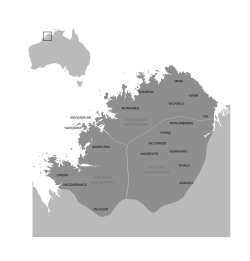
 Worrorran languages (purple), among other non-Pama-Nyungan languages (grey) | |
Worrorra, also written Worora and other variants, and also known as Western Worrorran, is a moribund Australian Aboriginal language of northern Western Australia. It encompasses a number of dialects, which are spoken by a group of people known as the Worrorra people.
It is one of a group of Worrorran languages, the other two being Wunambal and Ngarinyin.
Dialects
[edit]Worrorra is a dialect cluster; Bowern (2011) recognises five languages: Worrorra proper, Unggumi, Yawijibaya, Unggarranggu, and Umiida.[4] McGregor and Rumsey (2009) include the above dialects and also include Winyjarrumi (Winjarumi), describing Worrorra as a non-Pama-Nyungan language of the Worrorran group of languages known properly as western Worrorran.[3]
An alleged Maialnga language was a reported clan name of Worrorra proper that could not be confirmed with speakers.[5]
Notable people
[edit]Elkin Umbagai was a translator between English and Worrorra.[6]
Phonology
[edit]| Bilabial | Inter- dental |
Alveolar | Retroflex | Palatal | Velar | |
|---|---|---|---|---|---|---|
| Stop | p | t̪ | t | ʈ | c | k |
| Nasal | m | n̪ | n | ɳ | ɲ | ŋ |
| Rhotic | ɾ~r | |||||
| Lateral | l | ɭ | ʎ | |||
| Approximant | w | ɻ | j |
- A nasal occurring before a stop consonant, is then realised as a prenasalized voiced stop sound (ex. [ŋɡ]).
- /r/ can be heard as a trill or a flap, and is typically only voiced when preceding a sonorant, voiced phoneme, or lateral consonant. Elsewhere, it is voiceless as [r̥], or can be heard in free variation.
- /j/ can also be heard as a fricative sound [ç] in word-initial positions.
| Front | Central | Back | |
|---|---|---|---|
| High | i | u | |
| Mid | e | o | |
| Low | a |
- Long vowel sounds are noted as follows: /iː, ɛː, uː, ɔː, ɑː/.
- In between consonant clusters, an epenthetic vowel sound [ʉ̆] ~ [ɨ̆] occurs when breaking them up. Sometimes it can also be heard as a central vowel sound [ɨ].[8]
| Phoneme | Allophones[8] |
|---|---|
| /i/ | [i], [ɪ] |
| /a/ | [a], [ɒ], [æ], [ɛ̞], [ɑ], [ɐ] |
| /u/ | [u], [y], [ʊ] |
| /iː/ | [iː], [ɪː] |
| /ɛː/ | [eɪ], [ɛː] ~ [eː] |
| /ɑː/ | [ɑˑɪ], [ɑ] |
| /ɔː/ | [oʊ], [ɔː] ~ [ɒː] |
| /uː/ | [uː], [ʊː] |
Sign language
[edit]The Worora have (or at one point had) a signed form of their language, used for speaking to kin in certain taboo relationships,[9] but it is not clear from records that it was particularly well developed compared to other Australian Aboriginal sign languages.[10]
References
[edit]- ^ Australian Bureau of Statistics (2021). "Cultural diversity: Census". Retrieved 13 October 2022.
- ^ Clendon (1994, 2000), Love (2000), cited in Dixon 2002
- ^ a b K17 Worrorra at the Australian Indigenous Languages Database, Australian Institute of Aboriginal and Torres Strait Islander Studies (see the info box for additional links)
- ^ Bowern, Claire. 2011. "How Many Languages Were Spoken in Australia? Archived 2012-08-15 at the Wayback Machine", Anggarrgoon: Australian languages on the web, 23 December 2011 (corrected Archived 2012-07-03 at the Wayback Machine 6 February 2012)
- ^ Tindale, Norman B. (Norman Barnett); Jones, Rhys (1974), Aboriginal tribes of Australia : their terrain, environmental controls, distribution, limits, and proper names, University of California Press ; Canberra : Australian National University Press, ISBN 978-0-520-02005-4
- ^ Valda J. Blundell and Mary Anne Jebb. "Umbagai, Elkin (1921–1980)". Australian Dictionary of Biography. Retrieved 4 November 2013.
- ^ a b Capell, Arthur; Coate, Howard H. J. (1984). Comparative studies in Northern Kimberley languages. Pacific Linguistics Series C. Canberra: Pacific Linguistics. ISBN 0-85883-314-X.
- ^ a b c Clendon, Mark (2014). Worrorra: A language of the north-west Kimberley coast. Adelaide: University of Adelaide. pp. 24–39.
- ^ Love, J.R.B. (1941). Worora kinship gestures, Reprinted in Aboriginal sign languages of the Americas and Australia. New York: Plenum Press, 1978, vol. 2, pp. 403–405.
- ^ Kendon, A. (1988) Sign Languages of Aboriginal Australia: Cultural, Semiotic and Communicative Perspectives. Cambridge: Cambridge University Press
Further reading
[edit]- Clendon, Mark (2014). Worrorra: A language of the north-west Kimberley coast. University of Adelaide. doi:10.20851/worrorra. hdl:2440/84235. ISBN 978-1-922064-59-2.