Hubbry Logo
YJ-62YJ-62Main
Open search
YJ-62
Community hub
YJ-62
logo
8 pages, 0 posts
0 subscribers
Be the first to start a discussion here.
YJ-62
YJ-62
from Wikipedia

The YJ-62 (Chinese: 鹰击-62; pinyin: yingji-62; lit. 'eagle strike 62') is a Chinese subsonic land-attack[1] and anti-ship cruise missile. It is manufactured by the China Aerospace Science and Industry Corporation Third Academy.[2]

Key Information

Description

[edit]
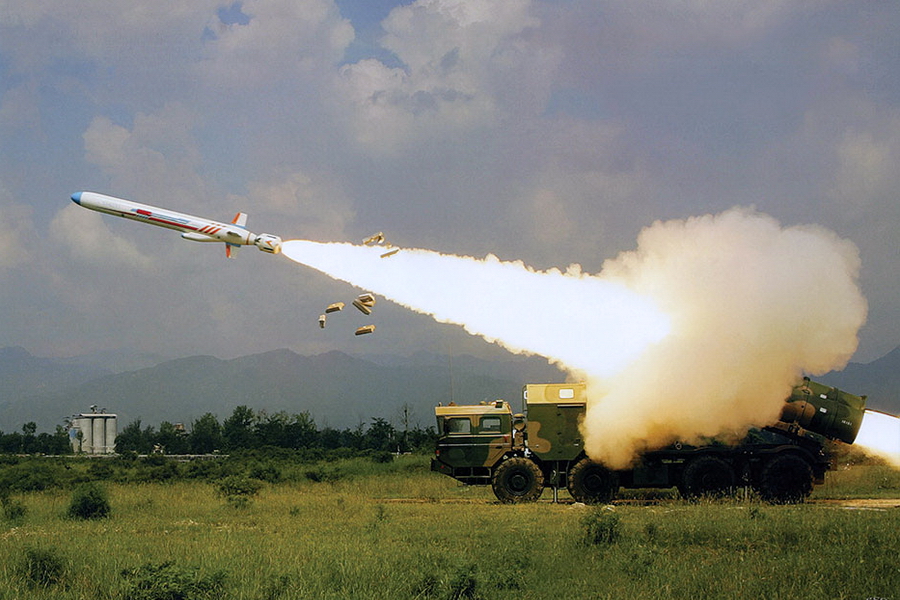
YJ-62A on a TA580/TAS5380

In a September 2014 article published in Joint Forces Quarterly, the YJ-62 is credited with a 210 kg (460 lb) warhead, a speed of Mach 0.6 – Mach 0.8 (735–980 km/h; 457–609 mph), and a sea-skimming terminal attack height of 7–10 m (23–33 ft); The missile has an inertial guidance system using GPS and BeiDou data, and an active terminal sensor.[2] A 2017 China Maritime Studies Institute (CSMI) report credits the active radar seeker with an acquisition range of 22 nautical miles (41 km).[3]

In 2015, the United States Navy's Office of Naval Intelligence considered the YJ-62 to have longer range than the 150 nautical miles (170 mi; 280 km) of the C-602 export version,[4] Figures of at least 400 km have been given.[5][3] The 2017 CSMI report notes that such long range suggests that the missile receives targeting from other platforms.[3] YJ-62A is credited with a range of up to 400 km (250 mi; 220 nmi).[2]

C-602

[edit]

The C-602 is the export version of the YJ-62, claimed to have a range of 280 km, a 300 kg (660 lb) semi-armour-piercing warhead, and GPS guidance. The reduced range is in accordance with Missile Technology Control Regime restrictions.[2]

The C-602 was revealed in September 2005,[2] and displayed outside of China for the first time at the African Aerospace and Defence exhibition in 2006.[6]

CM-602G

[edit]

The CM-602G is a land-attack version of the C-602. It is advertised as having a range of 290 km (180 mi), a 480 kg (1,060 lb) penetrating blast/fragmentation warhead, and an inertial guidance system using GPS data which may be augmented to provide man-in-the-loop control.[7]

The missile was revealed at the China International Aviation & Aerospace Exhibition in 2012.[7]

Variants

[edit]
YJ-62
Original variant.
YJ-62A
Extended range variant.
C-602
Export variant.[1]
CM-602G
land-attack version of the C-602.[7]

Operators

[edit]
Chinese sailors standing next to Haikou's anti-ship missile launchers in 2012.
 People's Republic of China
 Pakistan

References

[edit]

See also

[edit]

Revisions and contributorsEdit on WikipediaRead on Wikipedia
from Grokipedia
The YJ-62 (Chinese: 鹰击-62; "Eagle Strike-62"), also known as the C-602 in its export variant, is a subsonic, turbojet-powered anti-ship and coastal defense cruise missile developed by China. It features active radar homing guidance, a sea-skimming trajectory, and a high-explosive warhead weighing approximately 300 kg, enabling it to target surface vessels effectively. With a reported maximum range of 280 to 400 kilometers and speeds reaching Mach 0.8-0.9, the missile supports China's anti-access/area denial strategies in maritime theaters. The YJ-62 is launched from mobile coastal batteries, naval ships such as Type 052C destroyers, and potentially aircraft, enhancing the People's Liberation Army Navy's precision strike capabilities against larger naval targets. Exported versions have been acquired by Pakistan for its coastal defense systems, broadening its operational footprint beyond Chinese forces.

Development

Origins and Design Phase

The YJ-62, designated as a third-generation anti-ship cruise missile within the (PLAN), emerged from China's strategic push in the late 1990s to modernize its naval inventory with indigenous, long-range subsonic weapons capable of sea-skimming trajectories. This development addressed gaps in prior generations, such as the shorter-range series, by prioritizing extended standoff distances for surface ship and coastal defense platforms amid the PLAN's expansion of blue-water capabilities. The missile's origins trace to requirements for equipping emerging destroyer classes, including the Type 052C, reflecting broader investments in precision-guided munitions to counter potential naval threats in regional contingencies. Primary responsibility for the YJ-62's design fell to the China Haiying Electro-Mechanical Technology Academy (CHETA), a specialized entity under the Aerospace Science and Industry Corporation (CASIC) with expertise in systems dating to its establishment in 1961. The academy focused on integrating propulsion, , and a modular to enable versatile launch from vertical launch systems (VLS) or ground transporters, while maintaining subsonic speeds (Mach 0.6-0.8) for reduced detectability. Initial design goals emphasized a 200-300 km range, 210 kg warhead, and resistance to electronic countermeasures, positioning it as a cost-effective alternative to supersonic alternatives like the YJ-12. The core design project ran from 1999 to 2005, culminating in state trials between 2004 and 2006 that validated integration with the (DDG-170), the lead commissioned in 2004. Finalization occurred in 2004, enabling initial operational capability by 2005, with production scaling for shore-based units and export as the C-602. This phase incorporated iterative testing for aerodynamic stability and inertial/GPS navigation hybrids, though details remain limited due to Chinese opacity on military R&D.

Testing and Initial Deployment

The YJ-62 anti-ship entered operational service with the (PLAN) in 2004, marking its initial deployment aboard the lead Lanzhou (hull number 170), which was commissioned in July of that year. This platform integration represented the missile's transition from development to frontline use, equipping the vessel with up to eight YJ-62 missiles in cylindrical vertical launch canisters aft of the superstructure. Specific details on pre-deployment remain limited in open sources, though the missile's readiness for service on an advanced Aegis-like destroyer implies successful validation of its subsonic turbojet propulsion, inertial/GPS/ guidance, and active radar seeker in prior trials conducted by the China Aerospace Science and Industry Corporation. Subsequent shore-based deployments followed, with the YJ-62 integrated into coastal defense batteries by 2009, expanding its role beyond naval platforms to ground-launched configurations. The missile's export variant, designated C-602 with a restricted range of 280 km under guidelines, received authorization for foreign sales in 2005 and was first publicly displayed at the Airshow in 2006. Early export deliveries included 120 units to the Pakistani Navy by June 2008, with operational testing of the Zarb system (based on C-602) conducted in April 2016 from shore launchers. These steps underscored the YJ-62's maturation into a versatile system, though Chinese and Western analyses note ongoing refinements, such as the extended-range YJ-62A variant, without disclosing comprehensive test data.

Design and Technical Features

Propulsion and Aerodynamics

The YJ-62 employs a solid-propellant booster rocket for initial launch acceleration, followed by sustained cruise propulsion provided by a single WS-500 turbofan engine developed by the China Gas Turbine Establishment. The WS-500, weighing approximately 200 kg, delivers a thrust of 510 kgf and features a trapezoidal air intake positioned on the ventral surface of the fuselage to optimize airflow during low-altitude flight. This configuration enables a maximum speed of Mach 0.9 and supports extended range operations up to 280 km. Aerodynamically, the YJ-62 adopts a conventional layout with a , ogival nose fairing for reduced drag, and mid-body folding wings that deploy post-launch to generate lift for sea-skimming trajectories. The fixed ventral and overall design prioritize stability at cruise altitudes of around 30 m, dropping to 7-10 m in the terminal phase to evade detection while maintaining subsonic speeds of 0.6-0.8 Mach. This profile resembles Western analogs like the but incorporates a forward-mounted for improved aerodynamic in maritime environments.

Guidance Systems

The YJ-62 employs a composite guidance architecture, utilizing strapdown inertial navigation—known as a platformless system—for midcourse trajectory control, supplemented by satellite corrections from China's system and for the domestic version. A radio enables sea-skimming flight at altitudes of 7-10 meters over water or 30 meters over land to evade detection. In the terminal phase, commencing approximately 40 km from the target, an seeker assumes control, featuring a monopulse antenna configuration for high-precision and resistance to electronic countermeasures. The seeker's specifications include a 40 km detection range, 30 km lock-on range, and a ±40° , with frequency-agile operation to enhance immunity against jamming. Export variants such as the C-602 substitute GPS receivers for BeiDou/GLONASS integration, reflecting international limitations, while retaining the core inertial and active elements. This setup supports the missile's subsonic, low-observable profile against naval targets, though its reliance on active exposes it to potential spoofing without midcourse updates from external sensors.

Warhead and Performance Characteristics

The YJ-62 is equipped with a 300 kg high-explosive of the armor-piercing type, optimized for penetrating ship hulls before detonating to maximize internal damage through blast and fragmentation effects. This configuration employs an electronic fuse enabling delayed impact detonation, enhancing lethality against armored naval targets. In terms of performance, the missile achieves a subsonic cruise speed of Mach 0.6 to 0.8, powered by a sustainer following solid-propellant booster ignition. Its effective range reaches approximately 400 km in the domestic variant, though export versions like the C-602 are limited to about 280 km to comply with international proliferation controls, with the trade-off potentially allowing for enhancements in some configurations. The flight profile features a low-altitude cruise at around 30 above the surface to evade detection, transitioning to a terminal sea-skimming phase at 7-10 for precision targeting and reduced interception vulnerability. Minimum engagement range is estimated at 40-60 km, reflecting the missile's reliance on mid-course inertial navigation before active homing activation. These characteristics position the YJ-62 as a standoff weapon suited for saturation attacks on high-value surface combatants.

Variants

Baseline YJ-62

The baseline YJ-62 is the original variant of the Chinese subsonic anti-ship , developed primarily for naval deployment from surface combatants such as the . It entered service with the (PLAN) in 2005, following design work from 1999 to 2005 and state trials between 2004 and 2006. The missile measures 6.1 meters in length, with a of 0.54 meters, a wingspan of 2.9 meters, and a launch weight of approximately 1,240 kg. Propelled by a engine, the YJ-62 achieves a cruise speed of Mach 0.8 to 0.9, with a reported range of up to 280-400 kilometers depending on configuration and . It employs inertial navigation augmented by GPS or satellite data for mid-course guidance, transitioning to in the terminal phase. The follows a low-altitude flight profile, cruising at up to 30 meters over land or 10 meters over water, and descending to 7 meters for sea-skimming attacks to evade detection. The baseline model carries a 300 kg high-explosive penetrating optimized for anti-ship strikes against medium to large surface vessels, featuring an electronic fuse for detonation upon impact. Unlike later variants such as the YJ-62A, which extends range beyond 400 km and supports ground launchers, the baseline YJ-62 is optimized for shipboard vertical launch systems, as seen on platforms like the (DDG-170). Its design emphasizes export restrictions in the C-602 variant, capping international sales range at 280 km to comply with guidelines, though domestic baseline performance aligns with higher figures reported in PLAN exercises.

YJ-62A

The YJ-62A represents an upgraded variant of the baseline YJ-62 subsonic anti-ship cruise missile, primarily distinguished by its extended operational range exceeding 400 kilometers. This improvement enhances its utility for coastal defense and long-range maritime strike capabilities within the People's Liberation Army (PLA) arsenal. Like the original, it employs turbojet propulsion for subsonic flight, with a reported cruise speed around Mach 0.8, and integrates inertial navigation supplemented by GPS/BeiDou satellite updates for mid-course guidance, transitioning to active radar homing in the terminal phase. Deployment of the YJ-62A has focused on ground-based launchers for shore-to-ship roles, enabling strikes against naval targets from extended standoff distances. Reports indicate initial fielding along China's southeast coast by 2015, positioning it to cover areas including the and . The variant retains compatibility with shipboard vertical launch systems, such as those on Type 052C destroyers, broadening its integration across PLA Navy platforms. Warhead specifications align closely with the YJ-62, featuring a high-explosive fragmentation or semi-armor-piercing estimated at 300-450 kilograms, optimized for penetrating and disabling larger surface combatants. Operational testing and exercises have demonstrated the YJ-62A's role in (A2/AD) strategies, with units from theater commands conducting live-fire drills against simulated sea targets. Its enhanced range addresses limitations in the export-restricted C-602 variant, which caps at approximately 280 kilometers to comply with guidelines, underscoring China's prioritization of indigenous capability advancements over international export constraints. While specific production numbers remain classified, the variant's proliferation reflects broader PLA modernization efforts to counter potential naval threats in contested maritime domains.

Export C-602

The C-602 serves as the export variant of the YJ-62 anti-ship missile, with its development focused on compliance with international export controls, including range limitations under the Missile Technology Control Regime. Chinese authorities authorized the C-602 for export in 2005, restricting its operational range to 280 kilometers to adhere to treaty obligations that cap missile ranges at 300 kilometers for non-proliferation purposes. This adjustment differentiates it from domestic versions, which reportedly achieve greater distances, though independent verification of exact capabilities remains limited due to the classified nature of the system. In terms of technical attributes tailored for export markets, the C-602 retains the core subsonic and active seeker of the YJ-62, enabling sea-skimming flight profiles for anti-ship engagements or potential land-attack roles. It carries a 300-kilogram high-explosive designed to penetrate and detonate within vessels displacing up to 5,000 tons. Launch platforms compatible with the C-602 include surface ships, coastal batteries, and potentially , mirroring the versatility of its baseline counterpart while emphasizing integration into allied naval forces. Manufacturer claims highlight its resistance to electronic countermeasures and mid-course updates for improved accuracy, though real-world performance data from export users is sparse. Pakistan emerged as the primary recipient of the C-602, acquiring approximately 120 units from in 2009 to bolster its naval capabilities against regional threats, particularly India's BrahMos-equipped surface fleet. The integrated these missiles under the local designation Zarb, deploying them in shore-based configurations for coastal defense and on surface combatants for extended anti-ship strike options. Initial deliveries equipped a single battery, with subsequent tests demonstrating successful launches; for instance, a shore-based firing occurred on April 12, 2016, validating the system's operational readiness. No other confirmed exports have been publicly detailed, reflecting limited market penetration possibly due to competition from established Western and Russian alternatives.

CM-602G

The CM-602G is a ground-launched land-attack derived from the export-oriented C-602 , developed by the China Aerospace Science and Industry Corporation (CASIC). Unlike the baseline C-602, which primarily targets maritime vessels, the CM-602G is optimized for striking ground-based infrastructure, incorporating adaptations for terrain-following flight and precision suitable for fixed or semi-fixed land targets. It maintains the subsonic propulsion of its predecessor, achieving speeds around Mach 0.8 during cruise phase. Key specifications advertised for export include a range of 290 km, constrained to comply with (MTCR) restrictions on proliferation-sensitive systems, and a 480 kg penetrating blast-fragmentation designed for enhanced structural damage against hardened targets—larger than the 300 kg typical of the C-602. Guidance integrates (INS) with satellite-aided corrections (likely compatible with GPS or ) for mid-course updates, transitioning to active or semi-active terminal homing for accuracy in land-attack roles. Launch occurs from mobile transporter-erector-launcher (TEL) vehicles, enabling rapid deployment in coastal or inland batteries. As of October 2025, no confirmed foreign operators or combat deployments of the CM-602G have been reported, distinguishing it from the C-602, which has seen export success such as to Pakistan's for anti-ship applications. Promotional materials emphasize its versatility for , but limited transparency from Chinese state sources raises questions about verified performance in real-world conditions versus advertised claims.

Operational Deployment

Launch Platforms

The YJ-62 missile is deployed on select surface combatants of the (PLAN), with the Type 052C Luyang II-class destroyers serving as the primary naval launch platform. These destroyers feature two quad cylindrical launchers amidships, enabling the carriage and firing of up to eight YJ-62 missiles in salvos. The system entered service on these vessels around 2004, providing extended-range anti-ship capability beyond shorter-range predecessors like the YJ-83. Later PLAN destroyer classes, such as the Type 052D, have transitioned to vertical launch systems compatible with more advanced missiles like the , reducing reliance on dedicated YJ-62 canisters. Land-based launch platforms consist of mobile truck-mounted systems, primarily the YJ-62A variant adapted for coastal defense roles within PLA Ground Force and missile brigades. These transporter-erector-launchers (TELs) allow for rapid setup, firing, and relocation, supporting (A2/AD) strategies along China's coastline and outlying islands, including deployments on Woody Island in the as of 2016. Units such as the 333rd Coastal Defense Brigade have conducted exercises with these systems, demonstrating shore-to-sea strikes in northern theater commands. While air-launch configurations exist for export variants like the C-602, no confirmed operational air platforms have been publicly documented for PLA use of the baseline YJ-62.

People's Liberation Army Navy Usage

The YJ-62 entered service with the People's Liberation Army Navy (PLAN) in 2004, initially equipping the Type 052C Luyang II-class destroyer Lanzhou (hull number 170). This class of air defense destroyers features eight YJ-62 missiles housed in four twin-arm launchers positioned aft, providing the PLAN with a subsonic, medium-range anti-ship capability integrated into its surface fleet operations. The six commissioned Type 052C vessels—Lanzhou, Haikou (171), Changchun (150), Zhengzhou (151), Jinan (152), and Xi'an (153)—represent the primary surface ship platforms for the missile, emphasizing its role in fleet air defense and strike missions. Beyond surface combatants, the PLAN employs land-based YJ-62 variants in coastal defense roles through dedicated guided missile forces, such as brigades under theater commands. Deployments include approximately 120 YJ-62C missiles at naval bases in Province by 2009, oriented toward potential contingencies. These shore-based systems, often truck-mounted, enhance PLAN littoral denial capabilities, with concentrations in the Eastern and Southern Theater Commands. The missile's turbojet propulsion and active seeker enable salvo launches against high-value naval targets, though its subsonic speed limits penetration against modern defenses compared to successors like the YJ-18.

Recent Exercises and Tests

In January 2024, the (PLA) conducted exercises featuring the YJ-62 anti-ship missile, emphasizing coastal defense operations in Shandong Province. The deployed land-based YJ-62 systems for training, simulating strikes against maritime targets. A test firing of the YJ-62 was reported during these activities, validating the missile's shore-to-ship capabilities. In May 2024, a PLA Navy shore-based missile unit executed sea attack and defense drills using the YJ-62, focusing on integrated coastal defense tactics against simulated enemy fleets. These exercises highlighted the missile's role in rapid response scenarios within the PLA's expanding coastal defense network. More recently, in October 2025, tested its vast coastal defense missile arsenal, including YJ-62 systems, in anti-shipping exercises that stressed mobility, quick deployment, and coordination with other assets like YJ-12 missiles. The drills underscored the YJ-62's integration into layered defenses, with launchers positioned for over-the-horizon strikes. For the export variant C-602, conducted shore-based tests of its Zarb missile—a localized version—in , confirming operational readiness with a reported range exceeding 250 km, though no verified tests have been publicly detailed since.

Operators

Primary Operator:

The YJ-62 anti-ship is primarily operated by the () Coastal Defense Missile Force, forming a core element of 's asymmetric maritime denial strategy in the near seas. First entering service around , the missile equips mobile truck-based launchers for rapid deployment along coastal areas, enabling flexible responses to naval threats. Its integration into PLAN units emphasizes saturation attacks against surface fleets, leveraging subsonic speed and for . By 2009, the PLAN had deployed approximately 120 YJ-62C variants to bases in Province, opposite , enhancing deterrence in the . These systems are concentrated in eastern and southern theater commands, with confirmed deployments to forward positions such as Woody Island in the by the mid-2010s, supporting area denial operations. While primarily land-based, limited shipboard integration occurs on select platforms like Type 052C destroyers, though coastal batteries remain the dominant mode. Ongoing training underscores operational maturity; in January 2024, units conducted live-fire exercises with YJ-62 systems simulating anti-ship strikes. Similarly, a May 2024 drill by an unspecified shore unit focused on attack and defense tactics using the YJ-62. These activities demonstrate sustained emphasis on mobility, survivability against countermeasures, and coordination with networked sensors for over-the-horizon targeting. As of 2024, the YJ-62 continues to serve as a cost-effective complement to longer-range missiles in China's layered anti-access/area-denial architecture.

Potential Exports and Foreign Interest

The export variant of the YJ-62, designated C-602 with a reduced range of 280 km to comply with guidelines, has seen limited but notable foreign adoption. In 2009, acquired 120 C-602 missiles to bolster its anti-ship capabilities, particularly for coastal defense against larger regional naval assets, integrating them into frontline surface units. This marked the first confirmed export of the system, reflecting Pakistan's reliance on Chinese armaments for asymmetric maritime deterrence. China has actively marketed the C-602 at international defense exhibitions, such as the Airshow where an early variant was unveiled in , targeting nations with emerging navies and budgets constrained from acquiring pricier Western or Russian alternatives. Despite this promotion, no additional confirmed exports have materialized beyond , with reports of potential interest from other developing coastal states—such as —remaining unverified and possibly conflated with acquisitions of unrelated Chinese missile systems. The missile's appeal lies in its subsonic speed, propulsion for extended loiter, and semi-armor-piercing suited to medium-displacement targets, though proliferation concerns and competition from more advanced supersonic options may limit broader uptake.

References

Add your contribution
Related Hubs
User Avatar
No comments yet.