Hubbry Logo
Dongfeng (missile)Dongfeng (missile)Main
Open search
Dongfeng (missile)
Community hub
Dongfeng (missile)
logo
8 pages, 0 posts
0 subscribers
Be the first to start a discussion here.
Dongfeng (missile)
Dongfeng (missile)
from Wikipedia
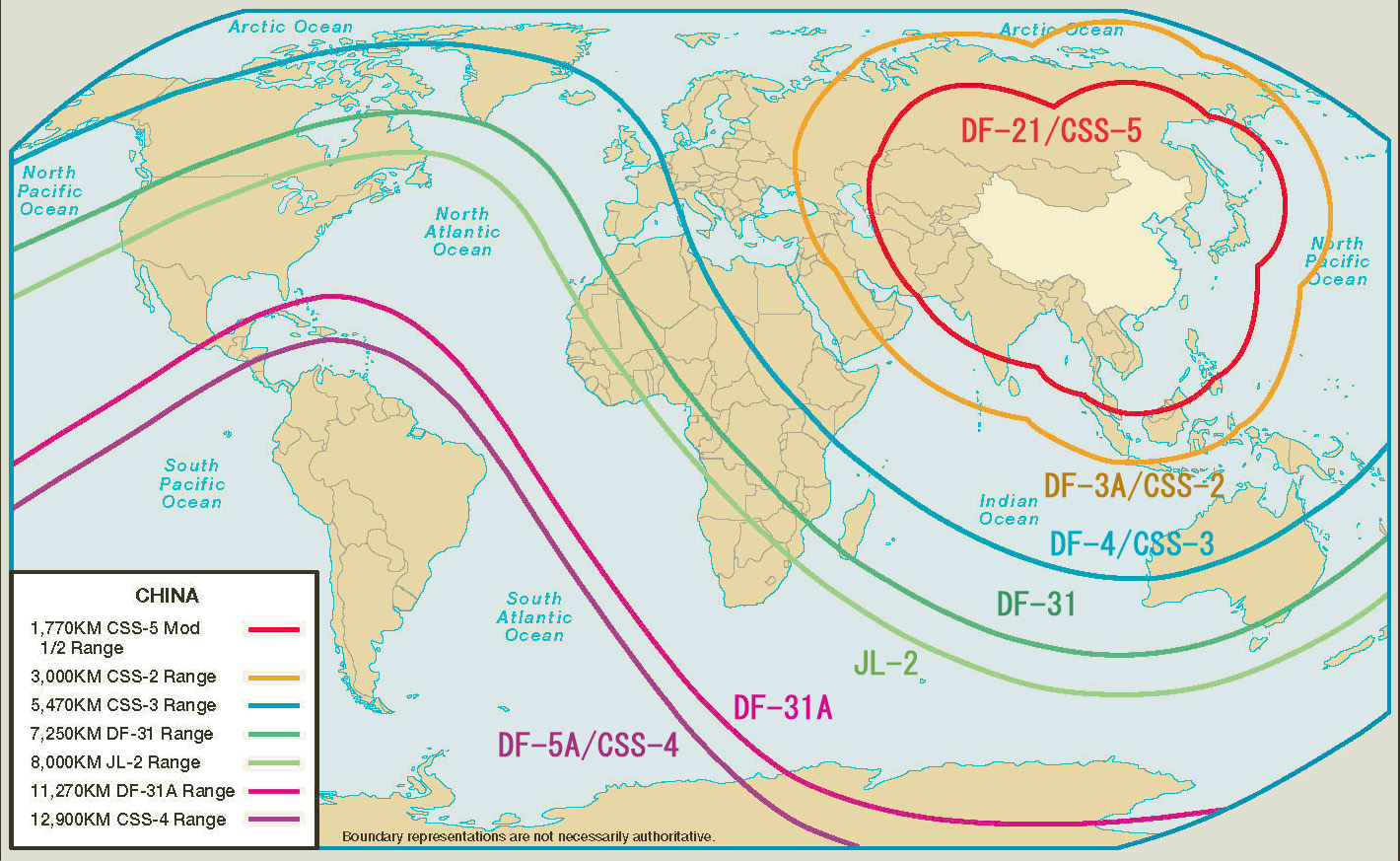
Medium and Intercontinental Range Ballistic Missiles (2007). Note: China currently is capable of targeting its nuclear forces throughout the region and most of the world. Newer systems, such as the DF-31, DF-31A, and JL-2, will give China a more survivable nuclear force.

The Dongfeng (Chinese: 东风; lit. 'East Wind') series, typically abbreviated as "DF missiles", are a family of short, medium, intermediate-range and intercontinental ballistic missiles operated by the Chinese People's Liberation Army Rocket Force (formerly the Second Artillery Corps).

History

[edit]

After the signing of the Sino-Soviet Treaty of Friendship, Alliance and Mutual Assistance in 1950, the Soviet Union assisted China's military R&D with training, technical documentation, manufacturing-equipment and licensed production of Soviet weapons. In the area of ballistic missiles, the Soviets transferred R-1 (SS-1), R-2 (SS-2) and R-11F technology to China.[1] The PRC based its first ballistic missiles on Soviet designs. Since then, China has made many advances in its ballistic-missile and rocket technology. For instance, the space-launch Long March rockets have their roots in the Dongfeng missiles.

Dongfeng missiles

[edit]
Dongfeng 1

Dongfeng 1 (SS-2)

[edit]

The first of the Dongfeng missiles, the DF-1 (SS-2, codenamed '1059', initially 'DF-1' , later the DF-3[1]), was a licensed copy of the Soviet R-2 (SS-2 Sibling) short-range ballistic missile (SRBM),[2] based on the German V-2 rocket. The DF-1 had a single RD-101 rocket engine, and used alcohol for fuel with liquid oxygen (LOX) as an oxidizer. The missile had maximum range of 550 km and a 500 kg payload. Limited numbers of DF-1 were produced in the 1960s, and have since been retired.[1]

Dongfeng 2 (CSS-1)

[edit]
A Dongfeng 2 at the Beijing military museum

The DF-2 (CSS-1) is China's first medium-range ballistic missile (MRBM), with a 1,250 km range and a 15-20 kt nuclear warhead. It received the western designation of CSS-1 (stands for "China Surface-to-Surface").[3] It was long noted by western observers that the DF-2 could be a copy of the Soviet R-5 Pobeda (SS-3 Shyster), as they have identical look, range, engine and payload. The entire documentation for R-5 had been delivered from Soviet Union to China in the late 1950s.[4][unreliable source?] But some western authors still attribute the design to Chinese specialists Xie Guangxuan, Liang Sili, Liu Chuanru, Liu Yuan, Lin Shuang, and Ren Xinmin. The first DF-2 failed in its launch test in 1962, leading to the improved DF-2A. The DF-2A was used to carry out China's test of a live warhead on a rocket on 27 October 1966 (detonated in the atmosphere above Lop Nor), and was in operational service from the late 1960s. All DF-2 were retired from active duty in the 1980s.[5]

Dongfeng 3 (CSS-2)

[edit]

The DF-3 (CSS-2) is often considered China's first "domestic" intermediate-range ballistic missile (IRBM). The common ICBM design was greatly influenced by the Soviet R-14 Chusovaya missile and the first stage engine itself was a direct copy of the С.2.1100/С.2.1150 La-350 booster engine developed by Aleksei Isaev at OKB-2 (NII-88). Design leadership has been attributed to both Tu Shou'e and Sun Jiadong. The missile was produced at Factory 211 (Capital Astronautics Co., [首都航天机械公司], also known as Capital Machine Shop, [首都机械厂]). The 2,500 km DF-3 was originally designed with a 2,000 kg payload to carry an atomic (later thermonuclear) warhead. A further improved DF-3A with 3,000 km range (~4,000 km with reduced payload) was developed in 1981, and exported to Saudi Arabia with a conventional high-explosive warhead.[6] The DF-3's range of 2,810 km means it is just short of being able to target Guam, although the 2012 DOD report on China's military power states that they have a range of 3,300 km, which would be enough to target Guam.[7] The 2013 Pentagon report on China's military power confirms the DF-3's 3,300 km range, and its maps show Guam being within the DF-3's range.[8] All DF-3/DF-3A's were retired by the mid-2010s and replaced by the DF-21.[9]

Dongfeng 4 (CSS-3)

[edit]

The DF-4 (CSS-3) "Chingyu" is China's first two-stage ballistic missile, with 5,550-7,000 km range and 2,200 kg payload (3 Mt nuclear warhead). It was developed in late 1960s to provide strike capability against Moscow and Guam. The DF-4 missile also served as basis for China's first space launch vehicle, Chang Zheng 1 (Long March 1). Approx. 20 DF-4's remain in service, and are scheduled to be replaced by DF-31 by 2010–2015.[10][11]

Dongfeng 5 (CSS-4)

[edit]

The DF-5 (CSS-4) is an intercontinental ballistic missile (ICBM), designed to carry a 3 megaton (Mt) nuclear warhead to distance up to 12,000 km. The DF-5 is a silo-based, two-stage missile, and its rocket served as the basis for the space-launch vehicle Fengbao-Tempest (FB-1) used to launch satellites. The missile was developed in the 1960s, but did not enter service until 1981. An improved variant, the DF-5A, was produced in the mid 1990s with improved range (>13,000 km). Currently, an estimated 24-36 DF-5A's are in service as China's primary ICBM force. If the DF-5A is launched from the eastern part of the Qinghai province, it can reach cities like Los Angeles, Sacramento and San Francisco. If it is launched from the most eastern parts of northeastern provinces, it can cover all of the mainland of the United States.

Dongfeng 11 (CSS-7)

[edit]
A DF-11 TEL.

The DF-11 (CSS-7, also M-11 for export), is a road-mobile SRBM designed by Wang Zhenhua at the Sanjiang Missile Corporation (also known as the 066 Base) in the late 1970s. Unlike previous Chinese ballistic missiles, the DF-11 use solid fuel, which greatly reduces launch preparation time to around 15–30 minutes, while liquid-fuelled missiles such as the DF-5 require up to 2 hours of pre-launch preparation. The DF-11 has a range of 300 km and an 800 kg payload. An improved DF-11A version has increased range of >825 km.[12] The range of the M-11 does not violate the limits set by the Missile Technology Control Regime (MTCR). Estimates on the number of DF-11s in service vary between 500 and 600.[13][14]

Dongfeng 12 (CSS-X-15)

[edit]

The DF-12 (CSS-X-15) is an SRBM formerly known as the M20. The change in designation signalled a shift in fielding to the Second Artillery Corps, making it possible the missile could be armed with a tactical nuclear warhead. Images of it bear a resemblance to the Russian 9K720 Iskander missile which, although not purchased by China from Russia, could have been acquired from former Soviet states. Like the Iskander, the DF-12 reportedly has built-in countermeasures including terminal maneuverability to survive against missile defense systems. Range is officially between 100–280 km (62–174 mi),[15] but given MTCR restrictions, actual maximum range may be up to 400–420 km (250–260 mi). With guidance provided by inertial navigation and Beidou, accuracy is 30 meters CEP; since the missile is controlled throughout the entire flight path, it can be re-targeted mid-flight. The DF-12 is 7.815 m (25.64 ft) long, 0.75 m (2.5 ft) in diameter, has a take-off weight of 4,010 kg (8,840 lb), and an 880 lb (400 kg) warhead that can deliver cluster, high explosive fragmentation, penetration, or high-explosive incendiary payloads. They are fired from an 8×8 transporter erector launcher (TEL) that holds two missiles.[16][17][18]

An anti-ship ballistic missile export variant of the M20, called A/MGG-20B (M20B), was unveiled at the 2018 Zhuhai Airshow.[19]

Dongfeng 15 (CSS-6)

[edit]
DF-15

The DF-15 (CSS-6, also M-9 for export) was developed by the China Aerospace Science and Technology Corporation (CASC, previously known as the 5th Aerospace Academy)'s Academy of Rocket Motor Technology (ARMT, also known as the 4th Academy). The missile is a single-stage, solid-fuel SRBM with a 600 km range and a 500 kg payload. During the 1995-1996 Taiwan strait crisis, the PLA launched six DF-15's near Taiwan in a demonstration of the missile's capability. Although the DF-15 is marketed for export, its range would violate the Missile Technology Control Regime (MTCR) agreement, and thus no DF-15 has been exported to date. Approximately 300-350 DF-15's are in service with the PLA Rocket Force.[20][21]

Dongfeng 16 (CSS-11)

[edit]
DF-16 as seen after the 2015 Beijing military parade.

The DF-16 (CSS-11)[22] is a new-model missile that has a longer range than the DF-15 (between 800–1,000 km (500–620 mi)). A Taiwan official announced on 16 March 2011 that Taiwan believed China had begun deploying the missiles.[23] The DF-16 represents an increased threat to Taiwan because it is more difficult to intercept for anti-ballistic missiles systems such as the MIM-104 Patriot PAC-3. Due to its increased range, the missile has to climb to higher altitudes before descending, giving more time for gravity to accelerate it on re-entry, faster than a PAC-3 could effectively engage it.[24] The DF-16 is an MRBM longer and wider than previous models with a 1,000–1,500 kg (2,200–3,300 lb) warhead and 5-10 meter accuracy. Its bi-conic warhead structure leaves room for potential growth to include specialized terminally guided and deep penetrating warheads. It is launched from a 10×10 wheeled TEL similar to that of the DF-21, but instead of a "cold launch" missile storage tube it uses a new protective "shell" to cover the missile.[25][26] Nuclear capable.[27]

The missile was shown to the public during the 2015 China Victory Day Parade in Beijing celebrating 70-year anniversary of the end of World War II.[28][29][30][31]

Dongfeng 17

[edit]

The DF-17 is a medium-range ballistic missile used to launch the DF-ZF hypersonic glide vehicle.[32] The DF-ZF is a conventional warhead,[33] although US intelligence considers it to be nuclear capable as well.[34] The system entered service in the second half of 2019.[35]

Dongfeng 21 (CSS-5)

[edit]
The DF-21D missile as seen after the military parade on 3 September 2015.

The DF-21 (CSS-5) is a two-stage, solid-fuel MRBM developed by the 2nd Aerospace Academy (now China Changfeng Mechanics and Electronics Technology Academy) in late 1970s. It was the first solid-fuelled ballistic missile deployed by the Second Artillery Corp. The missile carries a single 500 kt nuclear warhead, with up to 2,500 km (1,600 mi) range. The DF-21 also served as the basis for the submarine-launched ballistic missile (SLBM) JL-1 (CSS-N-3),[36] used on the Xia-class SSBN. In 1996, an improved variant, the DF-21A, was introduced. As of 2010, 60-80 DF-21/DF-21A were estimated to be in service; this number may have increased since then.[37][38] Sources say Saudi Arabia bought a DF-21 in 2007.

The latest variant, the DF-21D, has a maximum range exceeding 1,450 kilometres (900 mi; 780 nmi) according to the U.S. National Air and Space Intelligence Center. It is hailed as the world's first anti-ship ballistic missile (ASBM) system, capable of targeting a moving carrier strike group from long-range, land-based mobile launchers. The DF-21D is thought to employ maneuverable reentry vehicles (MaRVs) with a terminal guidance system. It may have been tested in 2005–2006, and the launch of the Jianbing-5/YaoGan-1 and Jianbing-6/YaoGan-2 satellites offering targeting information from synthetic aperture radar (SAR) and visual imaging respectively.

Dongfeng 25

[edit]

The DF-25 was a mobile-launch, two-stage, solid-fuel IRBM with a range of 3,200 kilometres (2,000 mi). Development was allegedly cancelled in 1996.[39] The U.S. Department of Defense in its 2013 report to Congress on China's military developments made no mention of the DF-25 as a missile in service.[40]

Dongfeng 26 (CSS-18)

[edit]
DF-26 as seen after the 2015 Beijing military parade.

The DF-26C is an IRBM with a range of at least 5,000 km (3,100 mi), far enough to reach U.S. naval bases in Guam. Few details are known, but it is believed to be solid-fuelled and road-mobile, allowing it to be stored in underground bunkers and fired at short notice, hence difficult to counter. It is possible that the DF-26C is a follow-up version of the DF-21. Possible warheads include conventional, nuclear or even maneuverable anti-ship and hypersonic glide warheads.[41]

Dongfeng 27

[edit]

The DF-27 (CH-SS-X-24) is an intermediate-range ballistic missile (IRBM) equipped with a hypersonic glide vehicle (HGV) warhead.[42] The ballistic missile was in development as of 2021, with a range of 5,000 km to 8,000 km.[43]

Dongfeng 31 (CSS-10)

[edit]
DF-31 in Military Museum of the Chinese People's Revolution.

The DF-31 (CSS-10) is a solid-fuel ICBM developed by China's 4th Aerospace Academy (now ARMT). The DF-31 has range of 8,000+ km, and can carry a single 1,000 kt warhead, or up to three 20-150 kt MIRV warheads. An improved version, the DF-31A, has range of 11,000+ km, far enough to reach Los Angeles from Beijing. The DF-31 was developed to replace many of China's older ballistic missiles, and served as basis to the new JL-2 (CSS-NX-4/CSS-NX-5) SLBM. In 2009, approx. 30 DF-31/DF-31A are estimated to be in service; it is possible this number may have increased since then.[44][45] 12 were displayed at the 2009 military parade in Beijing commemorating the 60th anniversary of the PRC's founding.

The DF-31AG uses a mobile launcher with improved mobility. It made its first official public appearance in the 2017 PLA Day Parade.[46]

Dongfeng 41 (CSS-20)

[edit]

The DF-41 (CSS-20) is a solid-fuel ICBM equipped to carry ten or twelve MIRV warheads. With an estimated range between 12,000 - 15,000 km, it is believed to surpass the range of the US's LGM-30 Minuteman ICBM to become the world's longest range missile.[47][48]

Dongfeng 61

[edit]

The DF-61 is a solid-fuel ICBM and the newest addition to China's nuclear arsenal. It was first unveiled during the 2025 China Victory Day Parade.[49]

See also

[edit]

References

[edit]
[edit]
Revisions and contributorsEdit on WikipediaRead on Wikipedia
from Grokipedia
The Dongfeng (DF) series designates a family of ballistic missiles developed by the , spanning short-range ballistic missiles (SRBMs) to intercontinental ballistic missiles (ICBMs), and operated by the (PLARF). These weapons form the core of China's land-based strategic and conventional missile arsenal, with capabilities including nuclear and conventional payloads, road-mobile launchers, and in some variants, anti-ship roles. Initiated in the late 1950s through imitation of Soviet Scud (P-1) technology, the Dongfeng program progressed to indigenous designs after the , culminating in China's first successful launch with a live nuclear on , 1966. Early models like the liquid-fueled DF-2 (MRBM) achieved operational status in the 1970s, extending China's reach to regional targets. Subsequent advancements introduced solid-propellant propulsion for improved mobility and survivability, as seen in the DF-21 MRBM deployed since 1991 and the DF-31 ICBM with a range of 7,200–11,200 km. Modern Dongfeng variants emphasize precision and versatility, including the intermediate-range ballistic missile (IRBM) with a 4,000–5,000 km range capable of striking targets like , and the DF-5C ICBM featuring multiple independently targetable reentry vehicles (MIRVs) for potential. Specialized models such as the DF-21D and incorporate (ASBM) configurations, designed to threaten naval assets through maneuverable warheads. These developments reflect China's prioritization of asymmetric capabilities in regional deterrence, though assessments of operational reliability and accuracy vary across technical analyses from defense research institutions.

Overview

Nomenclature and Designations

The Dongfeng (Chinese: 东风; : Dōngfēng; lit. 'East Wind') designation refers to a family of ballistic missiles developed by for the , encompassing short-range to intercontinental systems. Missiles in the series are abbreviated as DF-#, where "DF" derives from the transliteration of Dongfeng, and the numeral denotes the model variant in approximate order of development initiation rather than strict correlation to range, generation, or performance metrics. For instance, the DF-2 represents China's first domestically produced , while later designations like DF-41 indicate more advanced intercontinental systems. Subvariants append letters to the base numeral to signify upgrades in propulsion, payload, accuracy, or mobility, though conventions are not rigidly standardized across all models. Examples include the DF-5A, an enhanced silo-based intercontinental missile with multiple independently targetable reentry vehicle (MIRV) capability compared to the liquid-fueled DF-5; the DF-21D, a conventionally armed anti-ship variant of the solid-fueled DF-21; and the DF-31AG, featuring improved cross-country mobility over the road-mobile DF-31A. Such modifiers often reflect iterative improvements driven by technological advancements or operational requirements, with "A" typically indicating initial upgrades, "G" denoting high-mobility enhancements in some cases, and payload-specific adaptations like nuclear (e.g., DF-21A) versus conventional (e.g., DF-21C for land attack). Western military and intelligence communities, including , employ reporting names prefixed with CSS-# (Chinese Surface-to-Surface) followed by a sequential numeral for identification in assessments and doctrine, independent of Chinese numbering. These began with early systems like CSS-1 (DF-2) and progressed to CSS-10 ( family), aiding standardization without revealing classified details; for example, the corresponds to CSS-4, and the to CSS-5. The CSS system originated in Cold War-era conventions for non-Western threats and persists in U.S. Department of Defense reports for consistency in threat evaluation.

General Technical Characteristics

The Dongfeng missile family encompasses a range of ballistic missiles utilizing both liquid and solid propellants, with early designs like the employing two-stage liquid-fueled propulsion for intermediate to intercontinental ranges, while subsequent models transitioned to solid propellants for improved storability, rapid launch preparation, and operational flexibility. Modern solid-fueled variants, such as the and , feature multi-stage configurations—typically three stages—to achieve intercontinental reach, enabling boosts to suborbital trajectories with payloads including nuclear or conventional warheads. Guidance systems predominantly rely on inertial navigation for midcourse flight, providing autonomy against jamming, though advanced iterations incorporate satellite-assisted corrections via or GPS equivalents for terminal-phase precision, yielding (CEP) accuracies from tens of meters in legacy systems to as low as 5 meters in newer short- to medium-range models. Some variants integrate terminal active or electro-optical to counter missile defenses through evasive maneuvers or fine adjustments. Warhead configurations vary by missile, supporting single warheads with yields up to several megatons in liquid-fueled ICBMs like the , or multiple independently targetable reentry vehicles (MIRVs) in solid-fueled systems such as the , which can accommodate up to 10 warheads totaling 2,500 kg alongside penetration aids like decoys or to overwhelm defenses. Launch platforms emphasize mobility and survivability, with road-mobile transporter-erector-launchers (TELs) standard for most post-1990s designs to enable dispersal and reduce vulnerability to strikes, complemented by basing for select ICBMs.

Historical Development

Origins and Early Soviet Influence (1950s–1970s)

China's ballistic missile program originated in the mid-1950s amid efforts to build strategic capabilities, with initial progress dependent on Soviet technological transfers under bilateral agreements. In October 1956, the Soviet Union committed to aiding China's missile development, supplying technical documentation, training, and sample missiles including the R-1 (a copy of the German V-2) and R-2 short-range ballistic missiles. The establishment of the Fifth Academy in 1956 centralized research, focusing on reverse-engineering Soviet designs with hundreds of engineers trained in the USSR. Early tests demonstrated growing proficiency in Soviet-derived technology. China received two R-2 missiles in December 1957 and conducted its first static firing of a Chinese-built R-2 in June 1958, followed by a successful launch later that year. By 1959, Soviet provision of R-11 (Scud-A) technical data enabled work on the Dongfeng-1 (DF-1), a licensed variant with a range of approximately 250 kilometers using liquid propulsion. The DF-1's maiden flight occurred on November 5, 1960, just after the 1960 severed ongoing cooperation, leaving China to rely on existing blueprints and hardware. The rupture in Soviet aid accelerated indigenous efforts, though early designs retained foundational Soviet influences in and guidance. Development of the Dongfeng-2 (DF-2), China's first with a range exceeding 1,000 kilometers, commenced in the early using liquid-fueled engines adapted from prior technology. Initial DF-2 tests launched in June 1964, with the system achieving operational deployment by 1966 despite technical challenges. Into the 1970s, this base supported expansions like the DF-3, an improved inertial-guided variant tested from 1964 and fielded around 1971, marking a transition toward greater autonomy while underscoring the enduring impact of 1950s Soviet inputs on structural and subsystem designs.

Independence and Expansion Post-1979

Following the disruptions of the (1966–1976), which had stalled progress in missile development, China's Dongfeng program experienced renewed focus and expansion in the post-1979 era under Deng Xiaoping's emphasis on military modernization and technological self-sufficiency. On October 30, 1979, Marshal , who had spearheaded early missile efforts, was reinstated to oversee defense science and technology, enabling recovery from prior setbacks and acceleration of indigenous projects free from foreign dependencies. This period marked the operationalization of fully domestic designs, culminating in the deployment of the DF-5, China's inaugural (ICBM), in 1981. Developed since 1966 using entirely internal resources, the two-stage, liquid-fueled DF-5 featured a range of approximately 13,000 kilometers, enabling strikes on targets throughout the continental from silo launchers in . Initial deployments involved a limited number of missiles—starting with two in hardened for improved survivability—reflecting a strategic shift toward a minimal but reliable nuclear deterrent capable of penetrating U.S. defenses. Expansion extended to intermediate-range systems, with the achieving operational status in the early 1980s, providing a range of about 5,500 kilometers for targeting Soviet and Asian sites from fixed sites. These liquid-fueled missiles prioritized range and over mobility, with production scaling to support a modest arsenal growth amid resource constraints. construction and testing, including a key pre-deployment flight on December 7, 1981, from , underscored efforts to enhance second-strike reliability without external aid. By the mid-1980s, these deployments had established as self-reliant in strategic missile production, with the program emphasizing quantitative buildup and infrastructural hardening to counter perceived threats from superpowers, though vulnerabilities like lengthy fueling times persisted until solid-fuel transitions in subsequent decades.

Modern Advancements and Hypersonic Integration (1990s–Present)

Following the maturation of indigenous solid-propellant technology in the , accelerated development of road-mobile ballistic missiles under the Dongfeng series, emphasizing survivability against preemptive strikes through mobility and reduced launch preparation times. The , 's first domestically developed solid-fueled (ICBM), underwent its initial flight test in August 1999 but faced delays in procurement, entering service with the in 2006 with a range of approximately 7,000–8,000 kilometers. This marked a shift from silo-based liquid-fueled systems to transporter-erector-launchers (TELs), enhancing second-strike capabilities amid growing concerns over U.S. missile defenses. Subsequent variants, such as the DF-31A (deployed around 2007) and DF-31B (around 2017), extended ranges to 11,000 kilometers and incorporated multiple independently targetable reentry vehicles (MIRVs) for improved penetration. The further advanced this trajectory, featuring a three-stage solid-propellant design capable of ranges between 12,000 and 15,000 kilometers, with potential for up to 10 MIRVs or a mix of decoys and penetration aids. First publicly displayed in and entering operational deployment by , the DF-41's 16-wheel TEL enables off-road mobility across China's vast interior, complicating adversary targeting. These developments reflected iterative improvements in , materials, and inertial , drawing on lessons from earlier Dongfeng iterations while prioritizing countermeasures to ballistic missile defenses, such as terminal-phase maneuvering. Hypersonic integration emerged prominently in the 2010s, with the representing a milestone in boost-glide technology paired with Dongfeng boosters. The , utilizing the hypersonic glide vehicle (HGV), achieved its first successful test in January 2014 following developmental flights, achieving speeds of Mach 5–10 and ranges of 1,800–2,500 kilometers through atmospheric maneuvering that evades traditional interceptors. Deployed operationally by 2020, it integrates a solid-fueled first stage with a gliding capable of unpredictable trajectories, enhancing precision strikes against fixed and mobile targets like aircraft carriers. This system, road-mobile on TELs, underscores China's focus on asymmetric capabilities in regional contingencies, though U.S. assessments note challenges in sustained and thermal management remain. Further iterations, including potential air-launched variants, indicate ongoing refinement of hypersonic reentry vehicles across the Dongfeng lineage for both conventional and nuclear roles.

Ballistic Missile Variants by Range

Short-Range Ballistic Missiles (SRBMs)

The Dongfeng short-range ballistic missiles (SRBMs) comprise the , , and DF-16 series, providing the (PLARF) with mobile, solid-fueled systems for precise regional strikes, primarily conventional but with nuclear options, targeting operational areas such as the . These missiles emphasize road mobility, rapid deployment, and improved guidance to counter defenses in anti-access/area-denial (A2/AD) scenarios. The (CSS-7), developed from 1984 and entering PLARF service in 1992, is a single-stage, solid-propellant SRBM measuring 7.5 m long, 0.8 m in diameter, and weighing 3,800 kg at launch. Its baseline range reaches 280-300 km with a 500-800 kg , accommodating high-, submunition, fuel-air , chemical, or nuclear warheads yielding 2-20 kt; (CEP) stands at 600 m, though upgrades enhance this. The DF-11A variant, operational since 1999, extends range to 500-600 km and improves accuracy to 150-200 m CEP, potentially 20-30 m with , while the DF-11AZT adds earth-penetrating capability. Launched from WS-2400 transporter-erector-launchers (TELs) with about 30 minutes preparation, deployments include 700-750 missiles and 120-140 launchers as of 2009 estimates, concentrated at bases like Jiangshan and near ; exports as M-11 occurred to in 1992. The (CSS-6), a single-stage solid-fueled system operational since the early , spans 9.1 m in , 1 m , and 6,200 kg launch weight, achieving 600-800 km range with 500-800 kg warheads including high-explosive, nuclear (50-350 kt), chemical, or submunitions payloads. Road-mobile on eight-wheeled TELs, it supports vertical launch and variants like DF-15A/B/C integrate inertial and satellite for precision against fixed and mobile targets, with some bunker-busting configurations. Deployed in significant numbers for theater suppression, it complements longer-range systems in PLARF brigades focused on regional contingencies. The DF-16 (CSS-11), a two-stage solid-propellant advancement entering service around 2011-2012, delivers 800-1,000 km range via a 1.2 m body and WS-2500 TELs, carrying 500-1,000 kg high-explosive or submunition warheads optimized for hardened and deeply buried targets. Developed by Science and Industry Corporation (CASIC) in the 2000s to succeed DF-11/15 models, it features maneuvering reentry vehicles in Mod 1/2 variants for enhanced penetration; by 2021, approximately 36 launchers operated, including in Guangdong Province, supporting strikes on and Southeast Asian sites.

Medium-Range Ballistic Missiles (MRBMs)

The Dongfeng-21 (DF-21, NATO: CSS-5) is a road-mobile, two-stage, solid-fueled medium-range ballistic missile (MRBM) with a range of 1,700 to 2,800 kilometers, enabling strikes across regional theaters including parts of East Asia and the Western Pacific. Developed by the Academy of Rocket Motor Technology and entering service around 1991, it marked China's shift toward mobile, survivable MRBMs capable of carrying nuclear or conventional warheads with payloads up to 600 kilograms. Key variants include the baseline DF-21 (CSS-5 Mod 1), an inertial-guided system with a (CEP) of about 300-400 meters; the DF-21A (Mod 2), incorporating for improved accuracy to under 100 meters CEP; and the DF-21B (Mod 3), featuring a for enhanced penetration of defenses. The DF-21C (Mod 4) is a conventional land-attack variant with submunitions or unitary warheads for precision strikes, while the DF-21D (Mod 5), operational since around 2010, is an (ASBM) designed to target moving naval assets like aircraft carriers using from satellites, , and infrared seekers, with reported ranges up to 1,500-2,700 kilometers depending on . The DF-21's transporter-erector-launcher (TEL) vehicles, typically 6x6 or 8x8 wheeled platforms, enhance survivability through rapid deployment and dispersal, supporting China's (A2/AD) strategy. Deployment estimates suggest over 100 launchers and missiles in the inventory as of the mid-2010s, with production continuing amid upgrades for hypersonic elements in later iterations. Earlier DF-2 (CSS-1), a liquid-fueled MRBM with 1,250-kilometer range introduced in the 1960s, served as a precursor but was phased out due to logistical vulnerabilities.

Intermediate-Range Ballistic Missiles (IRBMs)

The Dongfeng series includes the DF-3 as its early intermediate-range ballistic missile, developed during the era, and the modern , which forms the backbone of China's current IRBM capabilities. These missiles enable strikes against targets at distances of 3,000 to 5,500 kilometers, supporting both nuclear deterrence and conventional precision operations in the theater. The DF-3, also known as CSS-2, was a liquid-fueled, single-stage that entered service in 1971 with a range of up to 4,000 kilometers when carrying a 2,000-kilogram . It featured inertial guidance and could deliver a nuclear warhead of approximately 3 megatons, primarily targeting regional adversaries like the . Production ceased in the 1980s, and all DF-3 units have been retired from active service by the as of the early 2000s, replaced by more advanced systems. The , introduced operationally around 2015, is a two-stage, solid-fueled, road-mobile IRBM measuring 14 in length with a of 1.4 and a launch weight of about 20,000 kilograms. It achieves a range of 3,000 to 5,000 kilometers, depending on payload, enabling it to reach U.S. bases in from . Capable of carrying a 1,200 to 1,800 kilogram warhead—either nuclear or conventional—the supports both land-attack and anti-ship missions, with variants like the DF-26C optimized for maritime strikes against moving naval targets such as aircraft carriers. Guidance combines inertial systems with satellite and possibly terminal-phase sensors for (CEP) accuracies estimated at 10 to 100 . As of 2024, the PLA Rocket Force maintains an estimated 250 launchers with around 500 missiles, reflecting significant expansion from initial deployments of about 16 launchers in 2018. This force has fully supplanted older dual-capable systems like certain variants for intermediate-range roles, emphasizing mobility via transporter-erector-launchers (TELs) to enhance survivability against preemptive strikes. The 's versatility underscores China's anti-access/area-denial (A2/AD) strategy, particularly in potential contingencies involving or the .

Intercontinental Ballistic Missiles (ICBMs)

![DF-31 ICBMs][float-right] The Dongfeng series includes several intercontinental ballistic missiles (ICBMs) with ranges exceeding 5,500 kilometers, primarily developed to provide with strategic nuclear deterrence capabilities. These systems encompass both silo-based liquid-fueled designs like the and road-mobile solid-fueled variants such as the and , reflecting advancements in propulsion, mobility, and payload delivery. The , China's first domestically developed ICBM, is a two-stage, liquid-fueled deployed in silos since the early . It achieves a range of approximately 12,000 kilometers, sufficient to target much of the continental , and carries a of up to 3,900 kilograms, typically a single nuclear warhead with yields of 1 to 3 megatons. Upgraded variants, including the DF-5A with improved accuracy and the DF-5B capable of multiple independently targetable reentry vehicles (MIRVs), have extended its service life into the , though its lengthy preparation time—up to two hours—limits rapid response compared to solid-fuel systems. The DF-31 family represents a shift to solid-propellant, three-stage, road-mobile ICBMs, with initial deployment around 2006. The baseline DF-31 has an estimated range of 7,000 to 8,000 kilometers, while the extended-range DF-31A reaches 11,200 kilometers, enabling coverage of most U.S. targets from Chinese territory. These missiles, transported on transporter-erector-launchers (TELs), enhance survivability through mobility and quick launch readiness, with payloads supporting single warheads or limited MIRVs in later models like the DF-31AG, which features an 8-axle TEL for improved off-road capability. The , the most advanced Dongfeng ICBM, is a three-stage solid-fueled with a range of 12,000 to 15,000 kilometers, deployable from road-mobile TELs or rail platforms. Operational since the mid-2010s, it can carry up to 10 MIRV warheads, significantly increasing its target coverage and complicating missile defenses. Chinese media claims emphasize its high speed—up to Mach 25—and penetration aids, positioning it as a of second-strike capability. Deployment estimates suggest dozens of launchers, often camouflaged for evasion.

Advanced and Hypersonic Variants

Hypersonic Glide Vehicles and Maneuverable Reentry Vehicles

The (Dongfeng-17) represents China's primary operational integration of a (HGV) within the Dongfeng family, utilizing a solid-fueled booster to launch the glider, which separates post-apogee to perform skipping maneuvers at altitudes of 20-100 km and speeds exceeding Mach 5. This boost-glide architecture enables quasi-ballistic trajectories that challenge interceptors by altering speed, altitude, and course during the glide phase, with estimated ranges of 1,800-2,500 km and potential for both conventional and nuclear payloads. The system enhances penetration against theater defenses, as the HGV's maneuverability reduces predictability compared to traditional reentry vehicles. Development of the DF-17 traces to mid-2010s flight tests of the DF-ZF prototype, with operational deployment occurring by 2019, as evidenced by its unveiling during China's parade on October 1, 2019. Subsequent evaluations, including 2021 assessments by U.S. intelligence, confirmed its road-mobile TEL (transporter-erector-launcher) configuration for rapid deployment and survivability. In September 2025, the was prominently featured in a parade, underscoring its role in conventional precision strikes. Recent reports indicate expanded basing near as of October 2025, signaling integration into regional anti-access/area-denial (A2/AD) postures. Maneuverable reentry vehicles (MaRVs) in Dongfeng variants, such as the and , employ terminal-phase guidance—likely infrared seekers combined with inertial updates—to execute evasive maneuvers during atmospheric reentry, achieving effective speeds up to Mach 10 while adjusting for moving targets like aircraft carriers. The , an variant of the DF-21 MRBM, incorporates a MaRV with a range exceeding 1,500 km, first tested in 2005-2006 to validate terminal homing against simulated naval assets. Operational since approximately 2010, it relies on over-the-horizon targeting data from satellites and radars for initial cueing. The IRBM extends MaRV capabilities to intermediate ranges of 3,000-5,000 km, with its anti-ship subvariant (DF-26B) featuring a maneuvering for precision strikes on high-value maritime targets, including U.S. bases at . Introduced around 2015 and publicly displayed in 2015 and 2019 parades, the DF-26 integrates dual conventional/nuclear roles, with MaRV maneuvers enhancing accuracy to (CEP) estimates under 10 meters in terminal phase. The DF-27, a newer hypersonic system potentially blending HGV and MaRV elements, offers extended ranges of 5,000-8,000 km and flight-path maneuverability, entering service by 2022-2023 based on test data from 2019 onward. These MaRV-equipped Dongfeng missiles prioritize countering U.S. carrier strike groups, though real-world efficacy against defended targets remains unproven in combat and subject to electronic warfare vulnerabilities.

Anti-Ship and Dual-Capable Systems

The Dongfeng series features (ASBMs) tailored for precision strikes against naval targets, including aircraft carriers, as part of China's strategy in the Western Pacific. These systems integrate advanced and maneuverable reentry vehicles to engage moving ships at extended ranges, relying on , , and over-the-horizon sensors for . The D, derived from the DF-21 , represents the first operational ASBM, with a range exceeding 1,500 kilometers and terminal velocities reaching Mach 10. Its maneuverable enables evasion of ship-based defenses, posing a direct threat to large surface combatants such as U.S. Navy carriers operating beyond 1,000 kilometers from China's coast. Deployed by the since approximately 2010, the DF-21D employs inertial guidance augmented by active or seekers in the terminal phase for terminal homing. The DF-26 extends anti-ship capabilities to greater distances, with a range of up to 4,000 kilometers, allowing strikes on assets as far as . Dual-capable by design, the DF-26 supports rapid interchange between conventional high-explosive and nuclear payloads without dismounting from its transporter-erector-launcher, enhancing operational flexibility for both land-attack and maritime missions. The anti-ship variant, designated DF-26B, incorporates a similar to the DF-21D, enabling precision targeting of time-sensitive maritime targets through integrated battle networks. Fielded since the mid-2010s, the DF-26 force has expanded significantly, with estimates indicating dozens of launchers operational by 2025. In August 2025, revealed the DF-26D variant during preparations for a , featuring enhanced guidance for improved accuracy against dynamic naval targets and fortified bases, further blurring lines between conventional and nuclear roles in regional deterrence. This development underscores ongoing refinements in warhead survivability and , tested in simulations and live-fire exercises targeting mock carrier groups in the . U.S. Department of Defense assessments highlight the DF-26's role in complicating freedom-of-navigation operations, though its effectiveness against defended carrier strike groups remains subject to debates over terminal-phase interception by systems like the SM-3.

Strategic and Operational Role

Nuclear Deterrence and Second-Strike Capability

The Dongfeng series of intercontinental ballistic missiles (ICBMs), particularly the , , and silo-based variants, constitute the primary land-based component of China's nuclear deterrent, designed to ensure a survivable second-strike capability under its no-first-use policy. These systems enable assured retaliation by complicating enemy targeting through mobility, hardening, and payload diversity, thereby deterring nuclear aggression via the credible threat of overwhelming response. China's strategic posture prioritizes minimal but robust deterrence, with an estimated 600 warheads deliverable by land-based ballistic missiles as of 2025, reflecting expansions driven by concerns over arsenal survivability amid advancing adversary countermeasures. Road-mobile ICBMs like the solid-fueled , operational since around 2017 with a range exceeding 12,000 kilometers and capacity for 10-12 MIRVs, exemplify enhancements in second-strike reliability by evading detection and pre-launch destruction through rapid deployment and terrain concealment. The 's variants, including rail-mobile options, further bolster this by distributing forces across vast territories, reducing vulnerability to first strikes compared to fixed silos. Similarly, the family, deployed since the early 2000s, provides intermediate with ranges up to 11,000 kilometers, serving as a transitional force multiplier in China's nuclear modernization to counter potential U.S. or Russian preemptive capabilities. Silo-based systems such as the liquid-fueled DF-5C, publicly displayed in September 2025 with global reach and multimegaton yields, complement mobile assets by offering hardened, dispersed launch points that demand disproportionate attacker resources for neutralization. This diversification—evident in China's ongoing silo field expansions since 2021—addresses historical vulnerabilities in legacy forces, ensuring that even partial survival guarantees retaliatory strikes capable of inflicting unacceptable damage. Recent parades, including the September 2025 event unveiling the full nuclear triad, underscored the Dongfeng ICBMs' integration into a layered deterrent, signaling prioritization of strategic stability through visible second-strike proficiency.

Conventional Precision Strike and A2/AD Doctrine

The (PLARF) employs conventional variants of Dongfeng short-range and medium-range ballistic missiles (SRBMs and MRBMs) for precision strikes against fixed and mobile targets, enabling rapid, high-volume attacks with (CEP) accuracies of 5–50 meters. Systems such as the (600–900 km range) and DF-16 (800–1,000 km range) are road-mobile SRBMs optimized for submunitions warheads that crater runways and taxiways at air bases, with inventories estimated at approximately 300 launchers and 900 missiles across SRBM variants. MRBMs like the series (1,000–3,000 km range), including the DF-21C land-attack variant and DF-21D (ASBM), support strikes on infrastructure and naval assets, backed by 300 launchers and 1,300 missiles. These capabilities are enhanced by advanced inertial navigation, satellite guidance, and maneuverable reentry vehicles, allowing terminal-phase adjustments for improved hit probability against defended targets. In China's anti-access/area denial (A2/AD) doctrine, conventional Dongfeng missiles form the core of counter-intervention operations, particularly to deter or disrupt U.S. and allied forces in a Taiwan contingency by targeting forward air bases in Japan and Guam. Salvo fires—potentially hundreds of missiles—can close fighter runways for 40–280 hours and tanker operations for longer durations, denying sortie generation and air superiority within the First Island Chain. The DF-21D and extended-range DF-26 ASBM variants extend this denial to carrier strike groups beyond 1,500 km, using over-the-horizon radars and satellite reconnaissance for terminal homing, thereby complicating U.S. naval power projection in the Western Pacific. This approach prioritizes saturation of defenses through sheer volume and mobility, with road-transportable launchers dispersed across eastern and southern theater commands to enhance survivability. Integration with intelligence, surveillance, and reconnaissance (ISR) systems, including AI-enhanced targeting, has improved operational tempo, as demonstrated in 2022 exercises where DF-series missiles simulated blockade and strike missions. U.S. assessments indicate these forces could execute a "fait accompli" , seizing objectives rapidly before external reinforcement, though vulnerabilities like command and silo-based dependencies persist.
Missile VariantRange (km)Estimated CEP (m)Primary Role in A2/AD
/DF-16 (SRBM)600–1,0005–50Airfield cratering, strikes
DF-21C/D (MRBM)1,000–3,00010–50Land/ship targets, carrier denial

Technological Features and Innovations

Propulsion, Guidance, and Mobility Systems

The propulsion systems of Dongfeng missiles have transitioned from -fueled designs in early variants to solid-propellant configurations in later models, enhancing launch readiness and operational flexibility. The employs a two-stage engine, necessitating extensive fueling procedures prior to launch. In comparison, the utilizes a solid- motor, which reduces preparation time, maintenance requirements, and logistical vulnerabilities while supporting ranges up to 2,150 km. Advanced intercontinental variants like the incorporate three-stage solid engines, enabling payloads to achieve ranges of 12,000 to 15,000 km. This shift to solid fuels across the series, including the and , prioritizes survivability through quicker deployment cycles. Guidance mechanisms in Dongfeng missiles primarily rely on inertial systems, often augmented for precision in terminal phases. The DF-15 integrates a strapdown inertial guidance package with a warhead-mounted miniature propulsion system for mid-course corrections, contributing to its reported (CEP) of under 30 meters. While details on many systems remain classified, intermediate-range models such as the and are assessed to employ inertial systems potentially enhanced by inputs, enabling accuracies suitable for both nuclear and conventional missions. Specialized variants, including anti-ship ballistic missiles, feature capabilities to engage dynamic targets, though exact modalities like or electro-optical seekers are not publicly confirmed. Mobility is achieved through road-mobile transporter-erector-launcher (TEL) vehicles, allowing rapid repositioning to evade detection and strikes. The is transported and launched from a wheeled HTF5680 TEL, supporting its dual-capable role with modular components for quick reconfiguration. The DF-31 rides on an 8-axle tractor-trailer launcher, facilitating deployment across varied terrain, while the DF-16 uses a 5-axle WS2500 TEL produced by Wanshan for short-range operations. This emphasis on high-mobility systems, evident in multi-axle configurations for models like the DF-21, underscores China's focus on second-strike assurance through dispersal and deception tactics.

Warhead Configurations and MIRV Development

The Dongfeng series missiles, especially intercontinental variants, are configured with nuclear warheads for strategic deterrence, featuring yields ranging from hundreds of kilotons to megatons depending on the model and . Shorter-range Dongfeng missiles, such as the and , often employ conventional high-explosive or submunition warheads for precision strikes, while ICBMs like the , , and prioritize nuclear payloads with options for penetration aids to counter missile defenses. The DF-5 series represents China's early adoption of large-yield configurations, with the baseline carrying a single estimated at 4–5 megatons (Mt). Subsequent upgrades introduced multiple warhead options: the , operational by around 2015, accommodates up to five independently targetable reentry vehicles (MIRVs) each with yields of 200–300 kilotons (kt), enabling targeting of hardened sites. The DF-5C variant, tested with up to 10 MIRVs on January 21, 2017, further enhances this capability, though its full deployment remains uncertain and yields are not publicly specified beyond multi-megaton potential in some assessments. MIRV development for Dongfeng missiles accelerated in the 1980s as part of modernization efforts to increase targeting flexibility and overcome defenses, with initial modifications to the explored as early as November 1983. The series, however, remains primarily single-warhead configured with a 200–300 kt yield, lacking confirmed MIRV capability due to size constraints unless paired with miniaturized warheads, which analysts deem unlikely without further evidence. In contrast, the , developed from July 1986 with first flight in 2012, incorporates advanced MIRV from inception; tests in December 2014 and August 2015 demonstrated multiple guided reentry vehicles, with Chinese claiming capacity for up to 10 warheads totaling 2,500 kg, though U.S. assessments limit operational loads to 3 warheads of 200–300 kt each for reliability. These configurations reflect iterative progress in miniaturization and bus technology, allowing Dongfeng ICBMs to balance mass with accuracy, but actual fielded MIRV numbers are lower than maximum claims due to technical and strategic factors like post-boost vehicle stability.

Deployment, Testing, and Recent Developments

Operational Deployments and Basing Strategies

The People's Liberation Army Rocket Force (PLARF) employs a basing strategy for Dongfeng-series missiles that prioritizes mobility, dispersal, and concealment to ensure survivability in potential conflicts, with most systems road-mobile via transporter-erector-launchers (TELs) capable of rapid repositioning to evade satellite detection and precision strikes. This approach contrasts with fixed silo-based deployments for older liquid-fueled variants like the DF-5, which are concentrated in hardened underground facilities and silos across central and northern China to provide second-strike assurance despite vulnerability to counterforce targeting. As of 2024, the PLARF maintains over 400 intercontinental ballistic missile (ICBM) launchers, including mobile DF-31 and DF-41 variants dispersed across six major bases, supplemented by tunnel networks for storage and launch preparation. Short- and medium-range Dongfeng missiles, such as the and , are primarily deployed in eastern coastal provinces under the , with brigades positioned near and to enable precision strikes against and regional targets within 1,000–2,000 km. Intermediate-range systems like the , operational since 2018 with an estimated 200–350 TELs, are based in both eastern and central regions, including sites in and , to extend coverage to U.S. bases in while incorporating anti-ship capabilities through mobile road basing. These deployments leverage highway infrastructure for quick dispersal exercises, often conducted nocturnally to minimize overhead reconnaissance. ICBM basing emphasizes northern and western interiors for strategic depth, with DF-31AG brigades at locations like , (643 Brigade) and , (632 Brigade), replacing older DF-31A systems to improve cross-country mobility via wheeled TELs. The , a road-mobile MIRV-capable ICBM with ranges exceeding 12,000 km, is deployed in lower operational tempos across northern bases such as , (644 Brigade), focusing on rail and highway transport for survivable second-strike postures. Recent expansions include silo fields in northern for DF-5 upgrades and potential DF-41 conversions, totaling over 300 new silos identified by 2024, alongside mobile forces to hedge against silo vulnerabilities. This hybrid strategy reflects a doctrinal shift toward absorbing initial attacks while preserving retaliatory capacity, with training emphasizing deception through decoy launchers and electronic countermeasures.

Key Tests and Demonstrations (Including 2024–2025 Events)

The Dongfeng-2 (DF-2), China's first operational , achieved a successful nuclear-armed on October 27, 1966, launching from and detonating at the test site after a 9-minute, 14-second flight, marking a milestone in the program's shift to indigenous liquid-fueled systems. Subsequent early tests in the 1970s and 1980s validated upgrades to the DF-3 and , with the demonstrating silo-based ICBM reliability through multiple launches from , though early failures highlighted challenges in cryogenic fueling. The transition to solid-fueled, road-mobile variants accelerated testing in the 1990s and 2000s; the , fielded in 1991 as China's inaugural mobile solid-propellant , underwent operational trials confirming its 2,150 km range and inertial guidance accuracy. The , deployed around 2006, completed initial flight tests in the late 1990s, with upgrades like the DF-31A extending reach to 11,200 km via three-stage propulsion validated in subsequent launches. For intermediate-range systems, the achieved its first reported operational test in early 2017, following developmental flights from 2015, demonstrating dual conventional-nuclear capabilities and a range exceeding 4,000 km, though full anti-ship variant efficacy against moving targets remains unverified in public data. In 2024, the (PLARF) conducted a rare publicized launch on September 25, dropping into the Pacific within a predetermined zone east of , described by 's Defense Ministry as a "routine exercise" to assess performance without entering other countries' or exclusive economic zones. Analysts assessed the as likely a DF-31AG, based on data showing an 11,698 km range, marking China's first such over-water ICBM test since 1980 and signaling expanded second-strike validation amid U.S. nuclear posture reviews. In August 2025, state media released footage of this launch, depicting a mobile DF-31AG transporter-erector-launcher in arid terrain, reiterating the test's success in hitting a remote Pacific impact area. Demonstrations in 2025 included a September 3 parade in unveiling the DF-5C, a silo-based liquid-fueled ICBM with multiple independently targetable reentry vehicles (MIRVs) capable of global reach, showcased alongside upgraded infrastructure to affirm potential against hardened targets. The event also debuted the DF-61, a new solid-fueled ICBM likely incorporating hypersonic elements, displayed in formation to highlight PLARF modernization without live-fire details released. On October 1, 2025, a test—potentially atop a booster—produced a distinctive silver-white plume trail observable from ground sensors, confirming maneuverable reentry at Mach 5+ speeds over inland ranges, though official attribution to specific Dongfeng variants was withheld. These events underscore PLARF's emphasis on verifiable full-system integration amid opaque reporting, with Western assessments noting improved reliability but questioning operational tempo against simulated peer adversaries.

International Reactions and Controversies

Assessments of Capabilities by US and Allies

The assesses that China's Dongfeng missile family, operated by the , includes over 400 intercontinental ballistic missiles (ICBMs) such as the , DF-31A, DF-31AG, and , with ranges exceeding 10,000 km, enabling strikes on the continental ; these systems feature solid-fuel propulsion, road-mobile launchers, and multiple independently targetable reentry vehicles (MIRVs) on the DF-41, supporting a and projected expansion to over 1,000 warheads by 2030. Intermediate-range variants like the , with a range of 3,000–4,000 km, are dual-capable for conventional and nuclear payloads, achieving circular error probable () accuracies of 150–450 meters and enabling precision strikes on ground targets or naval assets, including U.S. bases on ; the DF-26B anti-ship variant was tested against moving maritime targets in 2020. Medium-range Dongfeng systems, including the series with ranges up to 2,150 km, incorporate maneuverable reentry vehicles for enhanced terminal accuracy, with the DF-21D variant—deployed since around 2010—designed as an (ASBM) capable of targeting large surface combatants like aircraft carriers at CEPs as low as 20 meters, bolstering China's anti-access/area-denial (A2/AD) posture in the Western Pacific. U.S. intelligence evaluates the DF-27, fielded with a and range of 5,000–8,000 km, as extending China's capacity for high-speed, difficult-to-intercept strikes against regional targets, while the , operational since 2020, employs hypersonic glide vehicles for rapid precision attacks on fixed and mobile assets. Overall, the notes that these capabilities represent China's first precision nuclear strike options via systems like the DF-26, with inventories exceeding 200 IRBM launchers and multiple brigades deployed along coastal and interior regions to support theater operations. Analyses from U.S. think tanks such as the Center for Strategic and International Studies emphasize the DF-21D and 's role in challenging U.S. naval , with road-mobile transporters enabling survivable launches and modular warheads allowing rapid reconfiguration for conventional or nuclear missions; assessments highlight the PLA's ability to salvo hundreds of ballistic missiles, including Dongfeng variants, against U.S. air bases in , potentially cratering runways and disrupting operations through sheer volume and improved accuracy. Allied evaluations, including from Australia's Strategic Policy Institute, view the as threatening northern bases like Darwin, with ranges permitting strikes from Island, underscoring vulnerabilities in logistics and the need for enhanced missile defenses. U.S. assessments consistently project continued PLARF modernization, with silo expansions for ICBMs and hypersonic advancements eroding traditional U.S. advantages in interception and second-strike assurance.

Chinese Defensive Rationale Versus Accusations of Aggression

The (PLARF) maintains that the Dongfeng (DF) missile series constitutes a core element of China's "active defense" strategy, emphasizing deterrence against potential rather than offensive operations. Official statements portray these systems as essential for ensuring a survivable second-strike nuclear capability and conventional precision strikes to safeguard , particularly in scenarios involving or maritime disputes in the . For instance, in October 2024, President instructed missile troops to enhance deterrence and , framing the buildup as a response to external threats and a means to "resolutely safeguard national sovereignty, security, and development interests." Similarly, analyses of deployments like the DF-5C silo-based ICBM underscore its role in "guaranteeing peace through credible deterrence," with mobility and concealment features designed to counter preemptive strikes rather than enable first-use . This rationale aligns with China's longstanding no-first-use nuclear and a doctrinal focus on counterattacks following defensive operations, as outlined in PLA writings on amphibious defense and positional warfare. Critics, primarily from the United States and its allies, contend that the scale and sophistication of DF deployments—exceeding 500 operational missiles by some estimates, including intermediate-range systems like the DF-26—indicate ambitions beyond mere defense, potentially enabling coercive or preemptive actions that destabilize the Indo-Pacific. U.S. Department of Defense assessments highlight how DF-21D and DF-26 "carrier killer" variants, with ranges up to 4,000 km, form an anti-access/area-denial (A2/AD) network targeted at U.S. naval assets, complicating alliance responses to Chinese coercion in the Taiwan Strait. These capabilities, tested in exercises simulating strikes on Guam and other forward bases, are viewed as offensive enablers that erode regional stability by blurring conventional-nuclear thresholds, as evidenced by the dual-use nature of DF-26 warheads. Beijing counters such accusations as projections of U.S. hegemony, noting that American global strike systems and alliances encircle China, yet Western analyses from institutions like the Stimson Center often prioritize threat assessments rooted in strategic competition, potentially amplifying perceptions of aggression absent empirical evidence of Chinese initiation of hostilities. Empirical data supports elements of both perspectives: China's missile inventory has expanded rapidly since 2010, with over 100 ICBM launchers added by 2024, enhancing deterrence credibility but also raising escalation risks through entanglement, where conventional DF strikes could prompt nuclear miscalculation. No verified instances exist of DF missiles used offensively, aligning with defensive claims, though parades unveiling advanced variants in September 2025 were explicitly framed as deterrence signals amid U.S. freedom-of-navigation operations. This tension underscores a causal dynamic where U.S. forward deployments incentivize Chinese countermeasures, yet the —China's regionally focused arsenal versus America's global reach—fuels debates over whether DF proliferation primarily bolsters or hedges toward .

Implications for Regional Stability and Arms Control

The deployment and modernization of Dongfeng-series missiles, including intermediate-range systems like the and , have intensified anti-access/area-denial (A2/AD) capabilities in the , enabling to threaten U.S. carrier strike groups and forward bases such as those on and in , thereby raising the potential costs of intervention in regional contingencies like a crisis. This posture contributes to crisis instability, as dual-capable missiles blur nuclear-conventional thresholds, increasing escalation risks during heightened tensions, such as the 2024–2025 PLA exercises simulating blockades around . China's arsenal, encompassing over 1,300 launchers as of 2024 with ongoing expansions in mobile and MIRV-equipped variants like the , has spurred a regional , prompting investments in missile defenses and offensive capabilities by the , , , and . These developments erode mutual deterrence equilibria, as opaque growth—projected to exceed 1,000 nuclear warheads by 2030—fosters perceptions of preemptive incentives amid disputes in the and along the India border. On , China's reluctance to engage in verifiable limits, citing U.S. missile defenses and qualitative superiority, hinders multilateral frameworks akin to , despite U.S. overtures for trilateral talks with . The absence of transparency in Dongfeng deployments exacerbates trust deficits, as rapid silo construction and hypersonic integrations like the challenge strategic stability without reciprocal constraints, potentially perpetuating an unconstrained buildup. While maintains a no-first-use policy, of arsenal diversification suggests a shift toward expanded deterrence, complicating bilateral risk-reduction measures.

References

Add your contribution
Related Hubs
User Avatar
No comments yet.