Hubbry Logo
JL-2JL-2Main
Open search
JL-2
Community hub
JL-2
logo
8 pages, 0 posts
0 subscribers
Be the first to start a discussion here.
JL-2
JL-2
from Wikipedia

JL-2 at 70th anniversary of the People's Republic of China

Key Information

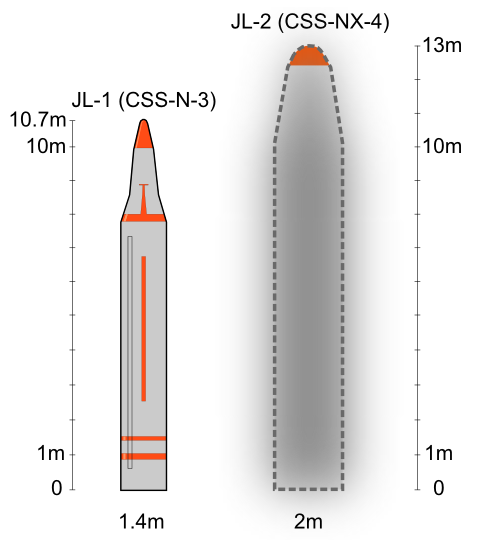
The JL-2 (Chinese: 巨浪-2; pinyin: Jù Làng Èr; lit. 'Giant Wave 2', NATO reporting name CSS-N-14) is a Chinese second-generation intercontinental-range submarine-launched ballistic missile (SLBM) deployed on the People's Liberation Army Navy's (PLAN) Type 094 submarines. It succeeds the JL-1 SLBM deployed on the Type 092 submarine.[7]

The JL-2 provides China with its first viable sea-based nuclear deterrent.[7]

Development

[edit]

The JL-2 is a naval variant of the land-based DF-31.[8][9] Their common 2-metre diameter solid fuel rocket motor was successfully tested in late 1983,[8] and research and development efforts were reorganized starting in 1985 to produce both missiles.[9]

The first JL-2 at-sea launch occurred in 2001 from a Type 031 submarine.[8][9] The program was delayed after a failed test in 2004.[8] Successful launches occurred in 2005 and 2008. The missile was successfully fired from a Type 094 submarine, the intended operational platform, for the first time in 2009.[8] A series of test launches occurred in 2012.[10]

During the development of the missile, it was reported that China was considering modifying the missile to accommodate an anti-satellite warhead to give it a sea-based anti-satellite capability.[11]

Type 094 deterrence patrols with JL-2 missiles began in December 2015.[1]

As of 2017, 48 JL-2 launchers are deployed on submarines.[3]

Description

[edit]

The JL-2 is a three-stage, solid-fueled missile,[3] with a maximum range of 7,200 km (4,500 mi).[6] Its payload is a single[3] 1 Megaton warhead[5] or 3-8 MIRVs with yields of 20, 90, or 150kt.[2]

References

[edit]
[edit]
Revisions and contributorsEdit on WikipediaRead on Wikipedia
from Grokipedia
The JL-2, also designated Julang-2 (CSS-NX-14), is a three-stage, solid-fueled (SLBM) developed by the as a key element of its . With a range estimated between 7,200 and 9,000 kilometers and a payload capacity of up to 2,800 kilograms, it can deliver a single of up to one megaton yield or multiple independently targetable reentry vehicles (MIRVs) numbering three to eight, each around 90 kilotons. The employs inertial guidance for an estimated (CEP) of 150 to 300 meters, enabling it to target locations across the continental from patrol areas in the . Development of the JL-2 proceeded in parallel with the land-based (ICBM), with research initiating in the mid-1980s and initial of the variant occurring in 1999. The first underwater launch test took place in January 2001 from a modified , marking a milestone in China's pursuit of a credible sea-based second-strike capability. Operational deployment began around 2010 aboard Type 094 (Jin-class) nuclear-powered ballistic submarines, with at least four such vessels equipped and up to 48 in service as of recent assessments. This system significantly bolsters China's strategic deterrence by providing survivable nuclear forces less vulnerable to preemptive strikes compared to - or road-mobile land-based assets. The JL-2's introduction has heightened regional security dynamics, extending China's nuclear reach to cover U.S. territories and bases while prompting advancements in missile defense technologies among adversaries. Estimates of its accuracy and MIRV capabilities derive primarily from U.S. and allied intelligence analyses, given China's limited transparency on military programs, though independent verification remains constrained by the opacity of state-controlled disclosures. China continues development of successors like the JL-3, indicating ongoing enhancements to its underwater nuclear posture amid broader modernization efforts.

Origins and Development

Initial Design Phase

The JL-2's initial design emerged as a submarine-launched variant of the land-based intercontinental ballistic missile, with development commencing after the successful test-firing of a 2-meter-diameter solid-propellant motor in late 1983 by the China Academy of Launch Vehicle Technology (CALT). This joint program prioritized the DF-31's ground-mobile architecture while adapting it for sea-based deployment, incorporating three solid-propellant stages to enable rapid launch preparation compared to liquid-fueled predecessors. The solid-fuel design facilitated storability in submarines and quicker response times, addressing the need for a credible second-strike capability in China's . Key engineering hurdles centered on miniaturizing the DF-31's components to fit within constrained launch tubes, typically requiring a of around 2 meters and reduced for vertical ejection from submerged platforms. Designers shifted from potential hot-launch ignition—which risks damaging the 's pressure hull with exhaust gases—to a cold-launch using high-pressure gas to eject the above the surface before first-stage ignition, enhancing safety and reliability under water . This adaptation demanded precise integration of control, encapsulation to prevent seawater ingress, and robust reentry vehicle scaling to maintain payload capacity despite volume limits. The JL-1's operational shortcomings profoundly shaped these decisions; its two-stage solid-propellant design achieved only 1,700–2,150 km range with a single and limited accuracy, confining Xia-class submarines to regional targets and exposing them to preemptive strikes. In response, JL-2 engineers targeted reach exceeding 7,000 km and incorporated provisions for multiple independently targetable reentry vehicles (MIRVs) with lighter s around 700 kg, enabling penetration of missile defenses and broader strategic coverage without increasing overall size. This emphasis on and extended performance marked a programmatic pivot toward survivable sea-based deterrence, distinct from the JL-1's intermediate constraints.

Testing and Operational Maturation

The first at-sea launch of the occurred in mid-January 2001 from a modified Type 031 (, marking 's initial underwater test of the system. This trial submarine, originally a Soviet-designed platform acquired and refitted by , served as the primary testbed for early JL-2 evaluations. Subsequent underwater launches took place in 2002, with additional tests reported in 2003 and 2004, though the program encountered setbacks including a notable in 2004 that delayed advancement. A successful launch on June 16, 2005, from an platform demonstrated progress in reliability, followed by further trials in 2008. These efforts addressed prior issues in flight performance, contributing to iterative refinements in the 's underwater ejection and ascent phases. A series of testing failures persisted into the early for the sea-launched variant, but the cycle of trials in August 2012 achieved success, enhancing overall system maturation. Additional launches occurred in , with public reporting indicating at least a dozen documented underwater tests by that point, though the exact total remains classified and likely higher. By the late , cumulative testing outcomes enabled the JL-2 to reach operational readiness for integration aboard Type 094 (Jin-class) submarines, transitioning from developmental proofs to deployment-capable status.

Technical Design and Specifications

Missile Architecture and Propulsion

The JL-2 employs a three-stage solid-propellant optimized for operations, with each stage utilizing cased rocket motors to deliver sequential thrust for ascent and separation. This design draws directly from the DF-31 land-mobile , sharing core solid-fuel propulsion elements but adapted for underwater launch constraints, including a reduced overall of approximately 13 meters and a 2-meter diameter to accommodate canister encapsulation within Type 094 Jin-class tubes. The missile's launch weight is around 42,000 kilograms, enabling cold-launch ejection via gas generators before first-stage ignition. Solid-propellant motors across all stages provide inherent advantages for naval deployment, such as extended without pre-launch fueling and resistance to in submerged environments, contrasting with liquid-fueled predecessors like the JL-1. Stage separation occurs via pyrotechnic devices post-burnout, with the upper stages employing high-energy composites for efficient velocity increments toward intercontinental ranges. Development testing of the shared 2-meter solid-fuel motor began successfully in late 1983, validating the propulsion baseline for both DF-31 and JL-2 variants. The architecture prioritizes structural integrity under hydrostatic pressure, featuring composite materials in motor casings for weight reduction and filament-wound fibers to withstand launch tube ejection forces up to several hundred meters depth. Nozzle designs incorporate thrust vector control via flexible joints or jet vanes for initial trajectory corrections during boost phase, enhancing stability without reliance on complex gimbaled engines typical of liquid systems. This configuration supports rapid reaction times critical for second-strike scenarios, with propellant formulations tuned for values exceeding 250 seconds in for upper stages.

Guidance, Payload, and Performance Metrics

The JL-2 employs an (INS) as its primary guidance mechanism, which relies on onboard gyroscopes and accelerometers to track position and trajectory from launch. This system is potentially augmented by the satellite navigation constellation for mid-course corrections, enhancing accuracy over long distances. Reported (CEP) values for the JL-2 range from 150 to 300 meters, reflecting improvements from earlier Chinese SLBM designs through refined INS and possible satellite integration. Payload capacity for the JL-2 is estimated at 1,050 to 2,800 kilograms, accommodating nuclear warheads in either single or (MIRV) configurations. It typically carries a single warhead with a yield of approximately 1 megaton, though it is capable of deploying 3 to 8 lower-yield MIRVs, each potentially in the 90-300 kiloton range, to increase target coverage. Performance metrics include a minimum operational range of 2,000 kilometers and a maximum range exceeding 8,000 kilometers, enabling launches from submerged platforms to strike distant targets. These parameters are derived from data and operational deployments, with the missile's solid-fuel design supporting rapid launch sequences.
ParameterSpecification
Guidance SystemInertial + possible
CEP150-300 meters
Payload Capacity1,050-2,800 kg
Warhead OptionsSingle 1 MT or 3-8 MIRVs
RangeMin: 2,000 km; Max: >8,000 km

Deployment and Platforms

Integration with Submarines

The JL-2 missile is integrated into the vertical launch tubes of the Navy's Type 094 (Jin-class) ballistic missile submarines, which are equipped with 12 such tubes arranged in a single row within the missile compartment. This configuration enables the submarine to carry and potentially launch a full salvo of 12 JL-2 missiles, though practical limitations arise from the sequential firing process and the need to maintain stability during underwater operations. Launch from submerged depths employs a cold-launch mechanism, where compressed gas or steam generated by onboard systems ejects the from its tube to breach the surface before the solid-fuel rocket motor ignites, avoiding underwater combustion that could damage the or compromise stealth. This method, tested in pop-up trials as early as and refined through subsequent underwater simulations, ensures the JL-2 can be fired from depths of up to approximately 50 meters while minimizing immediate structural stress on the launch platform. Reload procedures for the JL-2 tubes cannot be performed at sea due to the complexity of handling large-diameter missiles (about 2 meters) or on the surface without specialized dry-dock facilities, necessitating a return to port for rearming, which exposes the to detection risks. Acoustic stealth in the submarine-missile interface is challenged by the Type 094's hull design, particularly the enlarged "turtleback" fairing over the section, which contributes to elevated noise levels comparable to 1980s-era Soviet , potentially increasing detectability during transit or pre-launch positioning. The itself generates transient hydrodynamic disturbances and gas bubbles, requiring procedural adaptations such as deep submergence and directional stability controls to mitigate signatures post-ejection.

Operational History and Fleet Status

The JL-2 achieved initial operational capability with the (PLAN) around 2015, marking the start of deterrence patrols by Type 094 (Jin-class) submarines based at the on Island. These early patrols represented China's first credible sea-based nuclear deterrent patrols, with submarines conducting sorties into the and Western Pacific. By 2023, U.S. Department of Defense assessments reported that maintained at least one JL-2-equipped SSBN at continuously for the first time, reflecting an intensification of operational tempo amid expanding fleet operations. Patrol numbers have increased from sporadic deployments in the mid-2010s to more routine sorties, though constrained by the Type 094's relatively high , which limits extended undetected operations. As of 2024, the PLAN fields six operational Type 094 SSBNs, each fitted with 12 JL-2 missiles in vertical launch tubes, yielding an estimated inventory of 72 missiles. No JL-2 missiles have been used in , and the system undergoes regular maintenance and upgrades even as the longer-range enters service on select platforms, ensuring JL-2's continued role in the interim fleet structure through 2025.

Strategic Capabilities and Role

Deterrence Function and Second-Strike Potential

The JL-2 (SLBM) enhances China's nuclear posture by introducing a sea-based component to its triad, enabling a survivable second-strike option against potential adversaries. Deployed aboard Type 094 (Jin-class) nuclear-powered submarines (SSBNs), the JL-2 allows for launches from concealed underwater positions, reducing the vulnerability of fixed land-based and mobile to preemptive attacks. This capability aligns with China's of "assured retaliation," where the emphasis is on maintaining a minimal deterrent sufficient to impose unacceptable costs on an aggressor following a first strike on Chinese territory. U.S. intelligence assessments, including from of Naval Intelligence, have characterized the Jin-class SSBNs armed with JL-2 missiles as China's "first credible at-sea second-strike nuclear capability," marking a shift from reliance on less survivable terrestrial systems. By ling in China's near seas, JL-2-equipped SSBNs can achieve operational ranges exceeding 2,000 km, positioning them to retaliate against attacks on the homeland without needing to traverse contested . This deployment strategy leverages the submarines' mobility and stealth relative to land assets, complicating enemy targeting and bolstering deterrence stability through the prospect of inevitable retaliation. Chinese strategic analyses underscore this as a key evolution in maintaining nuclear balance, with official statements portraying sea-based forces as essential for countering advanced missile defenses and ensuring dynamics. However, some Western analysts question the full reliability of this deterrent, citing evidence of limited SSBN durations—often measured in days rather than weeks—which may constrain sustained second-strike readiness despite the platform's theoretical advantages.

Coverage, Range, and Targeting Implications

The (SLBM) has an estimated range of 7,000 to 8,000 kilometers, sufficient to target U.S. military installations in and when launched from patrol areas in the . From such positions, approximately 1,500–2,000 kilometers east of China's mainland coast, the missile can reach on (roughly 3,000 km distant) and key bases in Okinawa, (under 2,000 km), enabling strikes on forward-deployed U.S. assets critical to regional operations. However, this range falls short of reliably striking the continental from coastal or near-coastal launch points, limiting coverage to at best from eastern patrol zones, with distances exceeding 10,000 km to West Coast targets. Operationally, the JL-2 is configured with a single nuclear of approximately 1 megaton yield as its standard , though some assessments posit potential for multiple independently targetable reentry vehicles (MIRVs) carrying 3 to 8 lower-yield warheads (around 90 kilotons each). This MIRV capability remains unverified in deployed systems, with evidence suggesting single- use predominates to maximize range and simplify guidance amid technical constraints. If realized, MIRVs would facilitate saturation attacks to overwhelm (ABM) defenses like those on Aegis-equipped ships or ground-based systems in the , allowing distributed targeting of hardened sites or dispersed forces. Absent confirmed MIRV deployment, however, the missile's targeting relies on unitary warheads, constraining its ability to engage multiple high-value targets simultaneously from a single launch. These attributes position the JL-2 as a tool for regional access denial, bolstering China's anti-access/area-denial (A2/AD) strategy by threatening U.S. logistical hubs and airfields within the and beyond. Proponents of China's sea-based forces highlight how this coverage extends deterrence against interventions near or the , complicating adversary basing without necessitating deep-ocean patrols vulnerable to detection. Critics, including U.S. defense analysts, contend that the JL-2's range and payload limitations preclude true overmatch against advanced ABM networks or resilient U.S. forces, necessitating upgrades like the longer-range (over 10,000 km with verified MIRV potential) for comprehensive Pacific theater dominance.

Criticisms, Limitations, and Debates

Technical Reliability and Accuracy Concerns

The JL-2's (CEP) is estimated at 150-300 meters based on U.S. intelligence assessments, which is less precise than contemporary Western SLBMs such as the Trident II's sub-100 meter CEP. This accuracy level supports area-denial nuclear strikes but raises concerns for targeting hardened or dispersed sites, potentially necessitating multiple missiles or warheads in a salvo to achieve high-confidence destruction probabilities in simulations. Western analysts note that the JL-2's inertial guidance, augmented by potential corrections, has not been verified through extensive full-range over-water tests, limiting confidence in real-world performance metrics. Early development faced reliability setbacks, including a failed test flight in summer 2004 that delayed the program by several years, as reported by defense intelligence sources. Subsequent tests, such as a 2005 at-sea launch from a , demonstrated progress, but the overall test record remains opaque due to China's restricted disclosure of failure rates or detailed data. U.S. Department of Defense evaluations highlight that limited public evidence of successful cold launches from submerged platforms—critical for SSBN survivability—fuels debates over the missile's operational maturity, with engineering critiques emphasizing potential inconsistencies in solid-propellant ignition under variable conditions. Chinese state media and official statements assert post-2010 enhancements to guidance and propulsion reliability, including integration with navigation for CEP reductions, though independent verification is absent and Western simulations question the extent of these gains given persistent testing gaps. Analysts from organizations like for Strategic and International Studies argue that this data sparsity—contrasting with transparent U.S. and Russian test regimes—undermines assessments of the JL-2's mean-time-between-failures or reentry vehicle stability, potentially inflating perceived deterrence value beyond empirical foundations.

Strategic Vulnerabilities and International Critiques

The Type 094 (Jin-class) submarines, which deploy the JL-2, exhibit elevated acoustic signatures comparable to Soviet SSBNs from the , rendering them highly detectable by advanced U.S. (ASW) assets such as the Virginia-class attack submarines and P-8 aircraft. This noise profile confines JL-2 operations primarily to protected bastions in the or near Chinese coastal waters, where patrols are more easily tracked and neutralized by superior U.S. and allied ASW networks, undermining second-strike survivability. Analysts note that without venturing into the open Pacific—exposing them to heightened detection risks—these submarines struggle to achieve credible deterrence against distant targets. The JL-2's estimated range of 7,200–8,000 km further exacerbates these constraints, as launches from bastion areas fall short of reliably covering the continental United States, necessitating riskier forward deployments that amplify vulnerability to preemptive strikes. With only six operational Jin-class boats, each capable of carrying up to 12 JL-2 missiles, China's sea-based deterrent remains quantitatively limited compared to the U.S. Ohio-class fleet of 14 SSBNs with over 20 Trident II missiles each, highlighting systemic gaps in patrol endurance and warhead numbers despite triad completion. International observers, particularly from U.S. defense think tanks, critique China's opaque JL-2 expansion as destabilizing, arguing it erodes strategic stability by prompting an without transparency on deployments or testing, even as the platform's modest scale tempers immediate threats. Realist assessments emphasize that while the JL-2 addresses U.S. conventional superiority, its vulnerabilities invite damage-limitation strategies by adversaries, potentially escalating crises. In contrast, some advocates minimize the JL-2's role, viewing it as insufficient to alter global balances given persistent technological shortfalls.

Chinese Responses and Counterarguments

Chinese authorities assert that the underpins a policy of minimum nuclear deterrence, with routine patrols by Type 094 (Jin-class) submarines validating its role in assured retaliation and second-strike viability against potential aggressors. This capability, achieved through the JL-2's deployment since the mid-2010s, counters skepticism about sea-based reliability by demonstrating operational survivability in contested waters, aligning with Beijing's emphasis on a lean but credible triad to deter nuclear coercion without first-use intent. In response to critiques of the JL-2's (CEP) and test inconsistencies, Chinese defense analyses highlight iterative upgrades, including the JL-2A variant with extended range exceeding 12,000 km and potential (MIRV) configurations, which enhance payload flexibility over absolute precision. Strategists prioritize arsenal scale—projected at dozens of deployable JL-2s across six or more submarines—for saturation tactics that overwhelm defenses, arguing that deterrence hinges on aggregate destructive potential rather than pinpoint targeting, sufficient for retaliatory strikes on urban or military concentrations. Beijing portrays JL-2 expansion as a measured counter to U.S. ballistic missile defense deployments, such as and THAAD systems, which threaten to neutralize China's limited retaliatory forces, alongside alliances like that extend U.S. reach into the . Official statements frame this modernization as defensive restoration of strategic balance, not escalation, with warhead numbers kept proportionate to perceived threats while adhering to no-first-use pledges, rebutting narratives of unchecked aggression by noting China's arsenal remains far below U.S. levels.

References

Add your contribution
Related Hubs
User Avatar
No comments yet.