Hubbry Logo
Yakima Air TerminalYakima Air TerminalMain
Open search
Yakima Air Terminal
Community hub
Yakima Air Terminal
logo
8 pages, 0 posts
0 subscribers
Be the first to start a discussion here.
Yakima Air Terminal
Yakima Air Terminal
from Wikipedia

McAllister Field (IATA: YKM[2], ICAO: KYKM, FAA LID: YKM) (known for the Yakima Air Terminal) is a public airport three miles south of Yakima, in Yakima County, Washington.[1] Owned by the City of Yakima,[1] it is used for general aviation and commercial air service. Yakima is served by one scheduled passenger air carrier (Alaska Airlines with service to Seattle/Tacoma International Airport) and two non-scheduled carriers (Sun Country Airlines and Xtra Airways). Sun Country Airlines operates charter flights to Laughlin, NV and Xtra Airways operates charter flights to Wendover, NV.[citation needed]

Key Information

This airport is in the National Plan of Integrated Airport Systems for 2011–2015, which called it as a primary commercial service airport.[3] Federal Aviation Administration records say the airport had 36,383 passenger boardings (enplanements) in calendar year 2022, 57,076 in 2014,[4] 60,028 in 2009 and 53,832 in 2010.[5]

History

[edit]

The airfield first officially operated in 1926 (Goodman’s pasture had been in use unofficially before 1928) in an 80 acre field cleared from sagebrush with a runway added in 1932.[6] During World War II the airfield was used by the United States Army Air Forces.

Historical airline service

[edit]

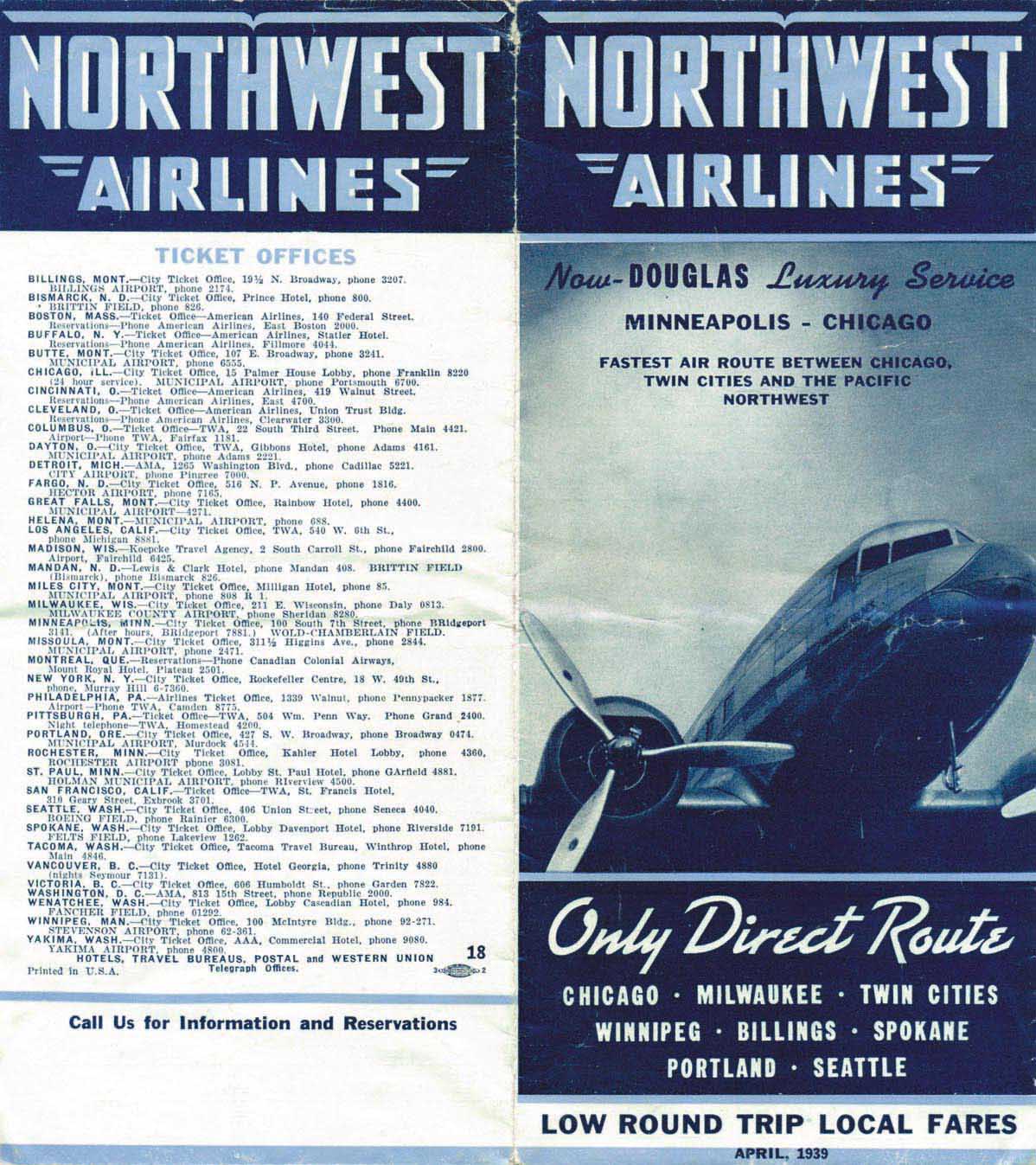
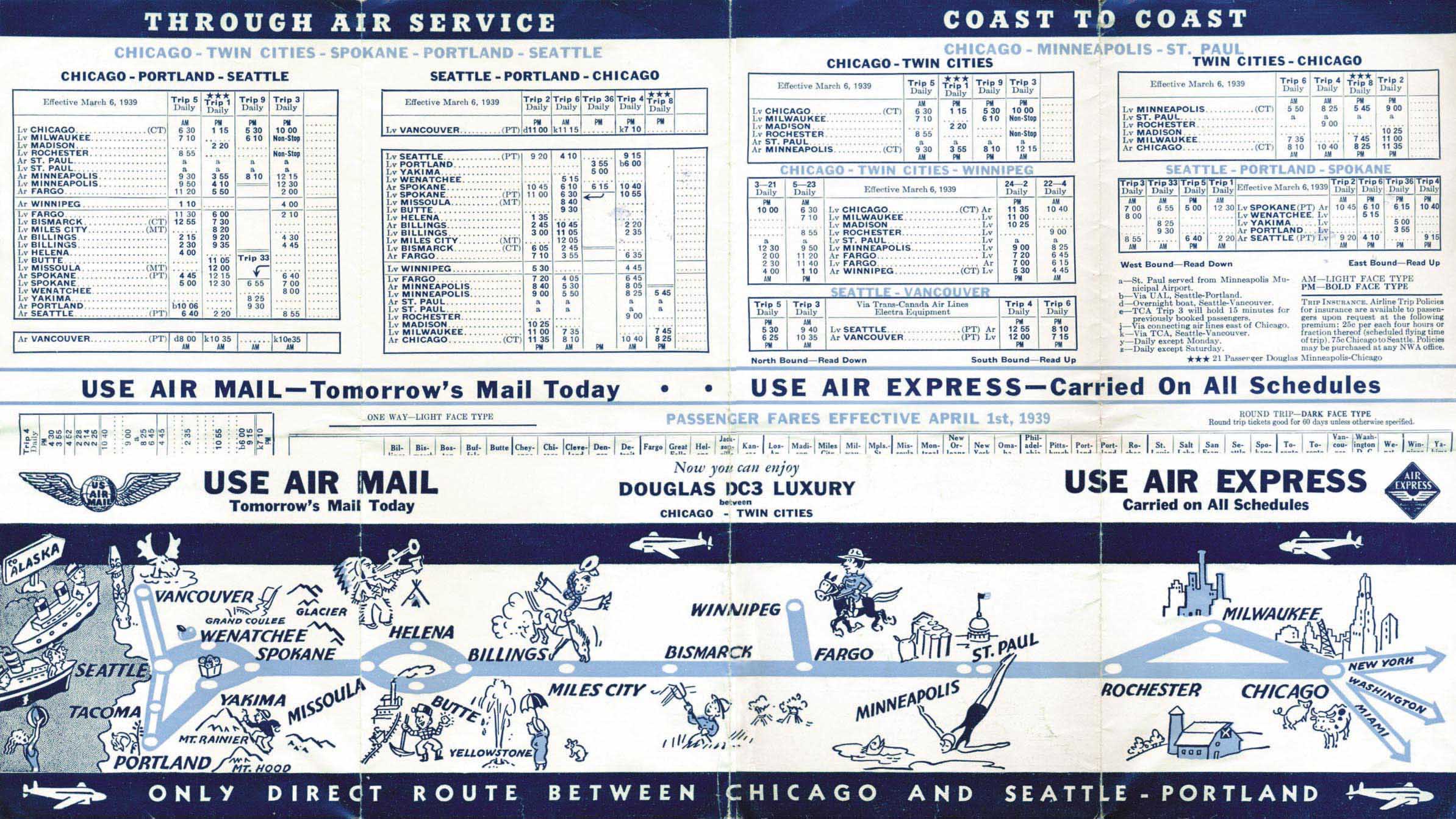
Northwest Airlines was serving the airport in 1939 with a daily roundtrip Portland, OR - Yakima - Spokane flight operated with a Douglas DC-3.[7][8] By the early and mid 1960s, Northwest was operating daily, no change of plane Lockheed L-188 Electra propjet service from Yakima to the U.S. east coast via a number of intermediate stops as well as nonstop Electra service to Seattle/Tacoma International Airport (SEA), Portland (PDX) and Spokane (GEG).[9] In early 1962, Northwest was operating a daily eastbound Seattle - Yakima - Spokane - Great Falls, MT - Billings, MT - Bismarck, ND - Minneapolis/St. Paul - Milwaukee - Detroit - New York City (via Newark Airport) flight with an Electra.[9] By late 1965, Northwest was operating a daily eastbound Seattle - Yakima - Spokane - Missoula, MT - Helena, MT - Butte, MT - Bozeman, MT - Billings - Fargo, ND - Minneapolis/St. Paul - Washington D.C. National Airport flight also with an Electra.[9] Northwest was continuing to serve the airport in early 1966 with daily nonstop Electra propjet service to Seattle/Tacoma, Portland, OR and Spokane as well as direct, no change of plane Electra service to Billings, Minneapolis/St. Paul, Washington, D.C. and other destinations; however, the airline was no longer serving Yakima by late 1966.[9]

West Coast Airlines was serving Yakima in 1954 with nine daily Douglas DC-3 departures from the airport with flights to Seattle Boeing Field (BFI), Portland, OR, Spokane, Baker, OR, Coeur d'Alene, ID, Ellensburg, WA, Ephrata, WA, La Grande, OR, Lewiston, ID, Ontario, OR, Pasco, WA, Pendleton, OR, Pullman, WA and Walla Walla, WA.[10] By the spring of 1968, West Coast was operating Douglas DC-9-10 jet service nonstop from the airport to Seattle Boeing Field, Portland and Pasco as well as direct, no change of plane DC-9 jet flights to San Francisco (SFO), Spokane, Eugene and Medford in addition to flying Fairchild F-27 turboprop service to a number of regional destinations.[11]

West Coast Airlines then merged with Bonanza Air Lines and Pacific Air Lines to form Air West which was subsequently renamed Hughes Airwest. In the summer of 1968, Air West was operating Douglas DC-9-10 and McDonnell Douglas DC-9-30 jet service from the airport nonstop to Portland, OR and Pasco as well as direct DC-9 service to San Francisco (SFO), Spokane, Eugene, Medford, San Jose, CA, Fresno and Las Vegas in addition to nonstop Fairchild F-27 turboprop flights to Seattle Boeing Field (BFI) with nonstop and direct F-27 service to other regional destinations.[12] In 1975, Hughes Airwest was operating all of its flights from the airport with Douglas DC-9-10 and McDonnell Douglas DC-9-30 jets with nonstop service to Seattle/Tacoma International Airport (SEA) and Pasco in addition to direct, no change of plane DC-9 jet flights to Los Angeles (LAX), Orange County Airport near Santa Ana, CA, Salt Lake City, Phoenix, Tucson, Portland, OR, Santa Maria, CA and Eugene and was also operating direct, no change of plane DC-9 service to two international destinations: Guadalajara, Mexico and Mazatlan, Mexico.[13] Also in 1975, Cascade Airways, a commuter air carrier, was operating nonstop Beechcraft 99 turboprop flights to Yakima from Seattle/Tacoma, Portland, OR, Spokane, Pullman, WA and Wenatchee, WA.[14]

Hughes Airwest was then acquired by and merged into Republic Airlines in 1980. In late 1980, Republic was operating McDonnell Douglas DC-9-30 jet service from the airport nonstop to Seattle/Tacoma and Pasco as well as direct, no change of plane DC-9-30 jet flights to San Francisco, Los Angeles, Denver, Boise and Eugene.[9] However, by the summer of 1982 Republic was no longer serving Yakima.[15]

Horizon Air began serving the airport on September 1, 1981, as a new independent regional air carrier with nonstop Fairchild F-27 turboprop service to Seattle/Tacoma (SEA) with Yakima being the first destination served by Horizon.[16][17] By early 1985 Horizon Air was operating F-27 turboprops as well as smaller Fairchild Swearingen Metroliner propjets into the airport with nonstop flights from Seattle/Tacoma, Portland, OR, Pasco and Pullman while Cascade Airways was operating its flights with Beechcraft 1900C and larger Hawker Siddeley HS 748 turboprops with nonstop service from Seattle/Tacoma, Portland, OR, Spokane, Lewiston, ID, Moses Lake, WA, Pasco, Pullman, WA and Walla Walla, WA.[18] According to the Official Airline Guide (OAG), Cascade and Horizon were operating a combined total of thirteen nonstop flights a day on weekdays from Seattle/Tacoma to Yakima in February 1985.[19] Horizon Air was then acquired by Alaska Airlines in November 1986 as a wholly owned subsidiary and continues to currently serve Yakima with Alaska Airlines branded service.[20]

Jet service had returned to Yakima by early 1988 when Pacific Southwest Airlines (PSA) was operating twice daily direct service to San Francisco with both flights making an intermediate stop in Pasco with one of these flights then continuing on from SFO to Orange County Airport in southern California.[21] That same year, PSA was acquired by and merged into USAir which in late 1988 was operating McDonnell Douglas MD-80 jetliners twice a day nonstop from Seattle/Tacoma with both of these flights originating in San Francisco with twice daily jet service from SFO to Yakima thus being flown on a direct one stop basis.[22] At this same time, both Horizon Air (operating code sharing service on behalf of Alaska Airlines) and United Express (operated by North Pacific Airlines on a code sharing basis on behalf of United Airlines) were also operating nonstop flights from Seattle/Tacoma to the airport, Horizon Air with de Havilland Canada DHC-8 Dash 8 and Fairchild Swearingen Metroliner propjets, and United Express with British Aerospace BAe Jetstream 31 propjets with both air carriers also operating nonstop service from Portland, OR to Yakima at this time.[22] According to the OAG, Horizon Air, United Express and USAir were operating a combined total of 19 nonstop flights every weekday from Seattle/Tacoma to Yakima in late 1988.[22] However, USAir was no longer operating jet service into Yakima by the summer of 1989.[23]

During the early and mid 1990s, both Horizon Air (on behalf of Alaska Airlines) and United Express (operated by WestAir Commuter Airlines on behalf of United Airlines) continued to serve Yakima primarily with nonstop flights operated with twin turboprop aircraft from Seattle/Tacoma with Horizon operating nonstop turboprop service from Portland, OR as well.[24][25] In the spring of 1995, Horizon Air was operating all of its nonstop flights from Seattle/Tacoma to Yakima with Dornier 328 propjets while United Express was operating all of its flights from SEA to the airport with British Aerospace BAe Jetstream 31 propjets.[25] By June 1999, Horizon Air was operating all of its flights to Seattle/Tacoma (SEA) with de Havilland Canada DHC-8 Dash 8 turboprops while United Express (operated by SkyWest Airlines on behalf of United Airlines) was operating all of its flights to SEA with Embraer EMB-120 Brasilia turboprops with a combined total of 16 daily nonstop flights operated by the two air carriers from the airport to Seattle/Tacoma at this time.[26]

As of 2023, the airport has two daily passenger flights to Seattle–Tacoma International Airport operated by Alaska Airlines by their affiliate Horizon Air. The airport has entered discussions with Allegiant Airlines and Avelo Airlines to establish a flight to Las Vegas in the future.[27]

Facilities and aircraft

[edit]
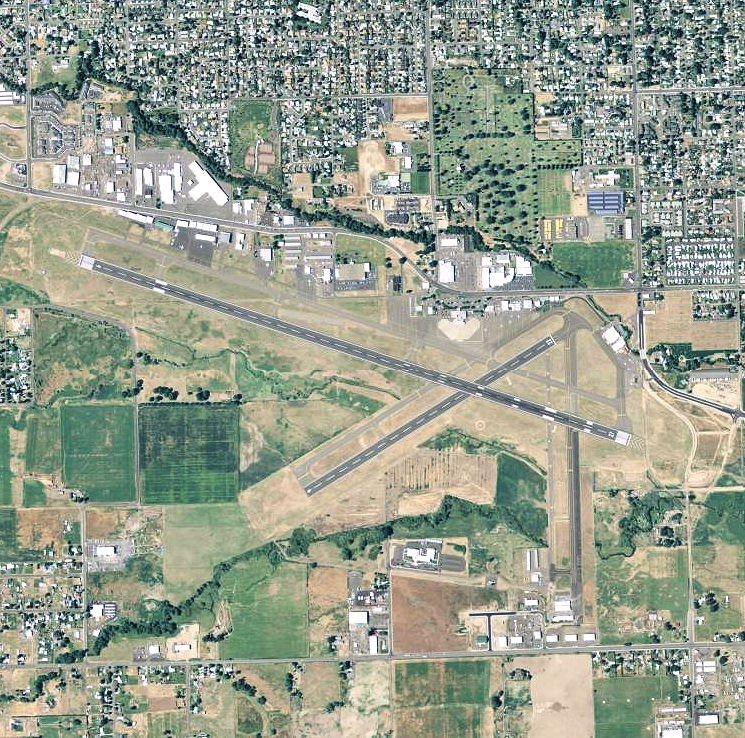
Photograph of McAllister Field in Yakima taken from the east in June 2006

McAllister Field covers 825 acres (334 ha) at an elevation of 1,099 feet (335 m) above mean sea level. It has two asphalt runways: 9/27 is 7,604 by 150 feet (2,318 x 46 m) and 4/22 is 3,835 by 150 feet (1,169 x 46 m).[1] The Yakima Air Terminal is equipped with a contract Air Traffic Control Tower, operated by SERCO under a contract with the FAA. The tower operates daily from 0600 to 2200.

In the year ending December 31, 2022, the airport had 35,588 aircraft operations, average 97 per day, 80% general aviation, 10% military, 7% air taxi and 3% airline. 133 aircraft were then based at this airport, 106 single-engine, 15 multi-engine, 5 jet, 6 helicopters and 1 glider.[1]

The airport is home to Cub Crafters, a manufacturer of light sport and light utility aircraft. The airport has one full-service fixed-base operator (FBO), McCormick Air Center, which provides hangar leasing, aircraft rental, flight instruction, and fuel. The airport has one aviation museum known as McAllister Air Museum.

Yakima Air Terminal is designated as the primary diversion site for flights unable to reach Seattle–Tacoma International Airport. In December 2023, an Airbus A330 on an international Delta Air Lines flight from London Heathrow Airport landed at Yakima due to heavy fog in the Seattle area. It was the largest commercial airliner to land at the airport; due to the lack of customs facilities, passengers were processed by officials who arrived from Western Washington by car.[28] Yakima has been proposed as a potential reliever airport for the Seattle area by local officials.[29]

Airlines and destinations

[edit]

Passenger

[edit]
AirlinesDestinations
Alaska Airlines Seattle/Tacoma[27]

Cargo

[edit]
AirlinesDestinations
AirPac Airlines Seattle–Boeing
Ameriflight Seattle, Spokane
FedEx Feeder Moses Lake, Spokane

See also

[edit]

References

[edit]
[edit]
Revisions and contributorsEdit on WikipediaRead on Wikipedia
from Grokipedia
Yakima Air Terminal/McAllister Field (IATA: YKM, ICAO: KYKM, FAA LID: YKM) is a public-use located three miles south of , on the southwest edge of the city in Yakima County. Owned by the City of Yakima and situated at an elevation of 1,099 feet (335 m) above , it serves as the primary commercial and facility for the Yakima Valley region, supporting scheduled passenger flights, cargo operations, and diverse aviation activities including and military use. The airport's history dates back to 1926, when it began as an 80-acre sagebrush field known as Yakima Airport. Key developments followed, including the addition of a 2,600-foot landing strip in 1932 and the construction of in 1940—a 5,000-foot primary (now 9/27) and a 4,000-foot secondary (now 4/22). A passenger terminal with an FAA control tower was built in 1949, and the primary was extended to 7,604 feet (2,318 m) between 1978 and 1979 as part of a major rehabilitation project. In 1982, a joint use agreement between the City of Yakima and Yakima County established a to oversee operations, reflecting its role as a shared community asset. Today, the airport features two runways: the main Runway 9/27, measuring 7,604 by 150 feet (2,318 by 46 m) with asphalt surface, grooved pavement, high-intensity runway lights, and an instrument landing system (ILS/DME); and Runway 4/22, at 3,835 by 150 feet (1,169 by 46 m) with asphalt/porous friction course and medium-intensity lights. It operates under Class Delta airspace with a control tower active from 6:00 a.m. to 10:00 p.m. local time, accommodating approximately 40,000 annual aircraft operations as of 2025, including commercial, air taxi, general aviation, and military flights. Scheduled passenger service is provided by Alaska Airlines to Seattle–Tacoma International Airport, alongside cargo operations by Empire Airlines to Spokane International Airport, FedEx, and UPS, emergency medical services, and two on-site flight schools. As a vital economic hub, Yakima Air Terminal supports over 2,300 jobs in the region as of 2025, facilitating travel for , healthcare, , and other industries that drive the Yakima Valley's growth. Passenger enplanements reached approximately 75,000 as of 2025, underscoring its importance to local connectivity and business stability. The facility remains self-funded through revenue sources and continues to evolve as a multi-use essential to the community's .

Overview

Location and general characteristics

Yakima Air Terminal, also known as McAllister Field, is a public located three miles south of downtown , in Yakima County, serving the broader Yakima Valley region as a key transportation hub. The facility is situated at geographic coordinates 46°34′05″N 120°32′39″W and sits at an elevation of 1,099 feet (335 m) above mean . Publicly owned by the City of Yakima, the airport is managed as a combined and commercial service facility, accommodating a mix of private, business, and scheduled passenger operations. Its identifiers include the FAA YKM, IATA code YKM, and ICAO code KYKM. Designated as a primary commercial service in the Federal Administration's National Plan of Integrated Airport Systems (NPIAS) for 2023–2027, with estimated annual enplanements of 46,658, it facilitates regional connectivity for vital local sectors such as , healthcare, and . The airport's strategic position enhances accessibility, with direct proximity to and providing efficient ground transportation links approximately three miles from the I-82/State Route 12 interchange. (see operational statistics).

Operational statistics

In 2022, Yakima Air Terminal recorded 35,588 total operations, averaging 97 per day. As of 2025, records approximately 40,000 operations annually, including about 300 air carrier operations. supports 150 based , comprising a mix of single-engine, multi-engine, jets, and helicopters. Passenger enplanements totaled 36,383 in 2022, demonstrating growth in commercial service. This figure declined to 24,044 in 2023 before rebounding to 41,471 in 2024, a 72.48% increase. traffic at the airport is dominated by general and business , accounting for the majority of operations, supplemented by scheduled air carriers, services, and itinerant military activity, primarily helicopters. Following the resumption of a second daily commercial flight to in November 2023—which was made permanent in 2025—overall operations and passenger volumes have shown upward trends tied to enhanced regional connectivity.

History

Early establishment and development

The Yakima Air Terminal, originally known as Yakima Municipal Airport, was established in 1926 on an 80-acre field of sagebrush south of , to serve the region's growing aviation needs amid the post-World War I boom in general flying. Initially a simple graded dirt airstrip on what had been Goodman's Pasture, the site was purchased by Yakima County and formally dedicated on June 2, 1928, with an featuring over 30 aircraft that drew thousands of spectators, highlighting early exhibitions common to small municipal fields of the era. Local aviation pioneers, including the McAllister brothers—Charles and Alister—who had relocated to Yakima that year, established one of the state's earliest flight schools and repair operations there, fostering initial uses for pilot training, recreational flying, and support for the agricultural Yakima Valley through activities like early crop-dusting experiments. Infrastructure improvements began in the early 1930s to accommodate increasing traffic from mail carriers and private pilots. In 1932, the airport added its first official runway—a 2,600-foot gravel strip equipped with drainage—to replace the rudimentary dirt landing area, enabling more reliable operations for local farmers and exhibitors. By 1936, amid the Great Depression-era Works Progress Administration (WPA) initiatives, the facility expanded by 45 acres, and two paved runways were constructed: Runway 9/27 at 3,750 feet and Runway 4/22 at 3,000 feet, marking a shift toward scheduled commercial and mail services that connected Yakima to broader networks. In 1939, Northwest Airlines inaugurated passenger and airmail service, solidifying the airport's role in regional transportation and agricultural logistics, such as transporting produce and supporting aerial applications in the valley's orchards. Pre-World War II preparations in the late and early drove further development under the National Defense Program, anticipating military demands while enhancing civilian capabilities. In , the original runways were converted to taxiways as part of major upgrades, with construction completing a longer 9/27 (5,000 feet) and an extended Runway 4/22 (4,000 feet) by 1941; these works added 133 acres to the airport's footprint, improving capacity for heavier aircraft used in mail delivery and agricultural operations. These expansions positioned the facility for its impending wartime role, transitioning from a modest municipal airfield to a key regional asset.

Military use and World War II era

In December 1940, under the National Defense Program, the Yakima Air Terminal was activated and significantly expanded by the U.S. Army Corps of Engineers and the Works Progress Administration to fulfill requirements set by the U.S. War Department. This marked the beginning of its transformation into a key asset for military aviation amid escalating global tensions leading into World War II. During the war, the airfield—designated as Yakima Army Airfield—functioned primarily as a training facility for pilots from the U.S. Army Air Forces and the U.S. Navy. The McAllister Flying School integrated into the federal Civilian Pilot Training Program and the subsequent War Training Service, delivering essential flight instruction to civilians preparing for military roles, including ground school classes at the Yakima fairgrounds. In 1941, Central Aircraft operations at the site were established as the smallest U.S. Naval Air Base, focusing on training naval aviators alongside mechanic instruction programs. Trainees, including notable figures such as actors Jon Hall and John Payne who served as Army pilots, lived in newly constructed barracks on the south side of the field while honing their skills under instructors like Charles McAllister. To support these expanded military operations, substantial infrastructure enhancements were undertaken. The original Runway 9/27 was converted into a taxiway, while new pavements were laid: a 5,000-foot , a 4,000-foot , and a 4,000-foot equipped with parallel taxiways using lean mix . Additional features included taxi strips, runway lighting, and the construction of two hangars in 1941; the first control tower followed in 1942, with telephone and power lines relocated in 1943 to align with standards. With the conclusion of World War II, Yakima Army Airfield was deactivated and reverted to civilian control, allowing surplus military structures such as hangars and barracks to be repurposed for purposes. By 1946, a notable increase in civilian pilot training resumed at the site, fueled by the GI Bill's support for veterans pursuing careers.

Post-war commercial growth

Following , Northwest Airlines resumed scheduled passenger service to Yakima Air Terminal using aircraft on routes connecting to and Portland, building on its pre-war operations that had begun in 1939. By the mid-1950s, West Coast Airlines had established regular flights to the airport, initially with DC-3s and later introducing turboprops for daily service primarily to . In 1965, Northwest transferred its operating authority at Yakima to West Coast Airlines, allowing the local service carrier to expand its presence in the region. West Coast Airlines continued operations until 1971, when it merged with and to form Air West, which was subsequently acquired by and rebranded as . introduced jet service with aircraft to Yakima starting in the early 1970s, offering flights to via intermediate stops such as Pasco, though service lasted only until 1975 amid financial challenges and route consolidations. To accommodate the arrival of jet traffic, the airport underwent significant infrastructure upgrades in the late 1960s and 1970s, including a 1967 extension of Runway 27 to 6,600 feet with a new concrete apron for larger aircraft, followed by a new FAA control tower in 1974 and further runway lengthening to 7,603 feet in 1978–1979. The period following in 1978 brought fluctuations in service at Yakima, with reduced frequencies and carrier instability affecting small-market airports like YKM, leading to a temporary gap in scheduled operations during the late 1970s. launched service in 1981 with its inaugural flight from to Yakima using aircraft, later upgrading to and Q400 for multiple daily roundtrips. Brief additions included in the 1990s, operating flights to under codeshare agreements. In 1982, a joint use agreement between the City of Yakima and Yakima County established a to oversee operations, reflecting its role as a shared community asset. These developments marked a period of regional focus amid broader industry shifts, setting the stage for later consolidation under .

Recent developments and expansions

In response to ongoing pilot shortages, , operating as part of , reduced its commercial service at Yakima Air Terminal to a single daily roundtrip to Seattle-Tacoma International Airport starting , 2022, down from multiple daily flights prior to the . This temporary cutback affected smaller regional routes across the Pacific Northwest, including Yakima, as the airline transitioned to an all-Embraer E175 fleet. Service expansion resumed on November 17, 2023, when reinstated a second daily roundtrip between Yakima and , operated by using E175 jets; by 2024, this schedule provided consistent connectivity with early morning and late-evening options to accommodate regional travelers. The additional flights were made permanent in early 2025 amid growing passenger demand, reflecting improved operational capacity post-shortage. Ongoing discussions for further route expansions have included tentative talks with low-cost carriers and for potential twice-weekly service to starting as early as 2024, though no new routes had been implemented by November 2025 due to market and operational considerations. Infrastructure enhancements in the 2020s have focused on airfield and terminal improvements to support resumed growth. Pavement rehabilitation for the crosswind 4/22 is scheduled to begin in 2025, addressing wear from increased operations and ensuring safety for diverse aircraft types. A multi-phase terminal modernization project launched in May 2025 includes replacing the aging roof and HVAC systems, expanding the baggage claim area by doubling its size, demolishing outdated structures, and adding new canopies over sidewalks for better passenger shelter and flow. These upgrades, funded partly by federal grants, aim to modernize facilities unchanged since the 1950s and enhance amenities like restrooms and pilot lounges. A notable incident underscoring the airport's role in regional weather challenges occurred on December 20, 2023, when a Airbus A330 international flight from to diverted to Yakima due to dense at Seattle-Tacoma International Airport and low fuel reserves, marking one of the largest commercial aircraft to land there and requiring coordinated ground support for passengers and customs processing.

Facilities and infrastructure

Runways and airfield features

Yakima Air Terminal/McAllister Field features two asphalt runways designed to accommodate a range of operations. The primary runway, designated 09/27, measures 7,604 feet in length by 150 feet in width and is grooved for improved traction. This runway supports commercial jet up to the size of a , with declared distances for takeoff run available (TORA), takeoff distance available (TODA), accelerate-stop distance available (ASDA), and landing distance available (LDA) all at 7,604 feet. As of 2025, runway 09/27 is in excellent condition. The secondary runway, 04/22, is 3,835 feet long by 150 feet wide and primarily serves , such as the . As of 2025, runway 04/22 is in poor condition. The airfield encompasses a total area of 825 acres (334 hectares), providing space for , , and support infrastructure. A runs parallel to 09/27 with a 400-foot centerline separation, while B parallels 04/22 at 313 feet, enabling efficient aircraft movement. Multiple aprons are available, including an airline apron south of the terminal building that can accommodate up to four commercial aircraft, as well as dedicated areas for tiedowns (29 spaces in the northwest quadrant and 35 near the terminal) and operations. edge lighting is provided for night operations on most , though lights on certain sections (B1, B2, and B south of 09/27) are out of service when the tower is closed, and C uses reflectors; high-intensity edge lighting is on 09/27 and medium-intensity on 04/22. Safety features enhance operational reliability at the airfield. Runway safety areas (RSAs) extend beyond the ends: for 09/27, the RSA measures 9,604 feet by 500 feet, and for 04/22, it is 4,315 feet by 120 feet. Visual approach slope indicators are installed on all four ends: a 4-box VASI on runway 9 and 4-light PAPIs on runways 27, 4, and 22, all providing a 3.00-degree glide path. Lighted wind indicators, including segmented circles and windsocks, are positioned at each end to assist with wind assessment during .

Terminal and ground facilities

The Yakima Air Terminal features a modest single-story terminal designed to accommodate operations, including check-in counters, security screening checkpoints, baggage claim areas, and two gates primarily serving flights. The terminal provides essential facilities for arriving and departing passengers, with recent enhancements focused on improving functionality and comfort. In 2023, a new vending area was added, featuring four machines offering snacks and beverages alongside tables and chairs for seating. Ongoing modernization efforts, initiated in May 2025, include installation of a new roof, upgraded HVAC units, improvements to the baggage claim system, and a new canopy project. The project, originally slated for completion by October 2025, experienced delays due to federal grant issues and remains underway as of November 2025. Fixed-base operators (FBOs) at the airport support needs, with McCormick Air Center serving as the sole full-service FBO. Located at 3210 W. Washington Ave., it offers aircraft fueling through its Avfuel dealership, maintenance and services, rentals, and flight instruction programs, operating daily from 6:00 a.m. to 6:00 or 7:00 p.m. depending on the day. Adjacent to the terminal , which provides access from the runways for aircraft parking and taxiing, McCormick facilitates efficient ground handling for transient and based aircraft. Additionally, Cub Crafters maintains an on-site manufacturing and sales facility at 1918 South 16th Ave., specializing in light sport and such as the Top Cub and Carbon Cub models, contributing to the airport's role as a hub for production. Passenger amenities within the terminal emphasize convenience for a regional traveler base, including rental car desks from providers such as Hertz—conveniently located inside the building and open seven days a week—and Enterprise, with additional options like and Thrifty available nearby. Dining is limited but includes Reno’s on the for snacks and meals, complemented by the 2023 vending upgrades. Free is accessible throughout the terminal, supporting connectivity for passengers. Parking facilities consist of short-term lots for quick drop-offs (under two hours at $2) and long-term options for extended stays (up to $15 per day), utilizing a license-plate recognition system for payments via , text, or app, with an overflow lot under construction as part of the 2025 upgrades. Ground transportation options connect the terminal to the broader Yakima area without direct rail or bus terminals on-site. are readily available curbside at the front entrance, with a list of local providers posted between the main doors, and typical fares to Yakima range from $15 to $19 for a short trip. Rideshare services like operate from designated pickup zones near the terminal, offering flexible on-demand access. Shuttle services include the Airporter for transfers to local hotels and longer routes to Seattle-Tacoma International Airport (Sea-Tac), with frequent daily departures; several hotels provide complimentary shuttles upon request. Air traffic control at Yakima Air Terminal is provided through an FAA contract tower operated by Inc., ensuring safe and efficient operations. The tower operates daily from 0600 to 2200 , with services reduced outside these hours for activities. Primary communication frequencies include the tower on 133.25 MHz and 257.8 MHz, ground control on 121.9 MHz, and ATIS on 125.25 MHz; approach and departure services are handled by Spokane Approach on 123.8 MHz or Seattle ARTCC on 132.6 MHz when Spokane is closed. Navigation aids supporting aircraft guidance include the Yakima VORTAC (YKM) operating at 116.00 MHz, located approximately 4 nautical miles northeast of the airport, which enables VOR/DME approaches to 27. Precision approaches are available via ILS or LOC/DME to 27, while non-precision options encompass RNAV (GPS) and RNAV (RNP) procedures for both 09 and 27; no ILS is installed for 09 due to surrounding constraints in the Yakima Valley. These systems facilitate safe amid the region's hilly , with additional DME support from the Ellensburg VOR/DME at 117.90 MHz, 27.6 nautical miles north. Weather services are provided by an located 7 nautical miles northeast of the airport, broadcasting on 118.15 MHz and accessible via telephone at 509-426-3051, delivering real-time data on , , , and conditions. Winter operations often encounter dense in the Yakima Valley, reducing and prompting advisories or diversions, as seen in incidents affecting inbound flights from . Approach and departure procedures emphasize terrain avoidance due to nearby hills and the . Standard instrument departures include the GROMO FOUR, NACHES FOUR, WENAS SEVEN, and YAKIMA SEVEN RNAV , with the ZILLA THREE obstacle departure incorporating specific climb gradients to clear surrounding elevations; these routes support connections to Seattle-area . Arrivals utilize the aforementioned RNAV and ILS approaches, with pilots advised of activity near the river 5 nautical miles east of 27.

Airlines and destinations

Passenger services

Yakima Air Terminal (YKM) is served exclusively by as its sole scheduled passenger carrier, providing four daily nonstop flights to (SEA). These flights, designated AS2040 (approx. 6:15 a.m.), AS2159 (4:54 p.m.), AS2215 (6:20 p.m.), and AS2172 (11:20 p.m.), have durations of about 50 minutes aboard Embraer E175 regional jets. The service connects passengers primarily for through Seattle's major hub, facilitating onward connections to domestic and international destinations. Passenger demand has shown steady recovery and growth, with enplanements totaling 36,383 in and rising to 41,471 in 2024, reflecting resumptions and increased utilization post-pandemic. Average one-way fares for these routes typically range from $89 to $150, influenced by seasonal demand and advance booking. This builds on prior service patterns, including operations by as a regional affiliate of .

Cargo operations

Yakima Air Terminal serves as a key hub for regional cargo operations in the , primarily handling freight through small feeder aircraft operated by specialized carriers. Active cargo airlines include , which operates aircraft such as the Beechcraft 99 and EMB-120 on routes to Pacific Northwest hubs like Spokane, providing scheduled and contract services as part of broader networks for UPS. Additionally, FedEx feeder operations are managed by , which flies to (GEG) and connects to the national FedEx hub in , with flights such as 7744, 7726, 8737, and 8744. Cargo volumes at the airport contribute to the overall approximately 300 annual air carrier operations, supporting the transport of perishable and high-value goods, including agricultural exports like apples and hops from the Yakima Valley. These operations are essential for quick distribution of local produce to regional and national markets. Key routes include daily feeder flights to Spokane operated by , enabling seamless integration into larger freight networks. The airport features dedicated space near the secondary for parking and loading, though it lacks a large dedicated terminal. Instead, handling is facilitated through partnerships with fixed-base operators (FBOs), such as McCormick Air Center, which provides support for loading, unloading, and ground services. This setup accommodates the primarily small-plane operations while ensuring efficient freight processing for carriers like and UPS.

Economic and community role

Regional economic impact

The Yakima Air Terminal–McAllister Field (YKM) generates approximately 2,366 direct and indirect jobs in the region, encompassing roles in operations, (FBO) maintenance, and handling, contributing to local stability and skill development in aviation-related sectors. This workforce support aligns with broader economic analyses showing the airport's role in sustaining labor income of over $161 million annually through on-site and ripple effects. According to a 2018 Washington State Department of Transportation study, the airport drives an annual regional economic output of $591 million, primarily fueled by passenger and activities that facilitate the of agricultural produce such as apples, cherries, and from the Yakima . These operations underscore YKM's integral ties to key industries, including healthcare through patient transport services to facilities in via air ambulance providers, via efficient , and tourism by enabling visitor access to the valley's attractions. The airport's contributions extend through a multiplier effect on the local GDP, estimated at 1.5 to 2.0 based on standard economic models applied in regional studies, amplifying initial spending into broader community benefits. Sustained growth is further bolstered by federal , including a $1.4 million FAA Improvement Program grant in 2025 for terminal enhancements, which improve reliability and attract additional .

Associated institutions and community ties

The McAllister Museum of Aviation, located on the grounds of Yakima Air Terminal-McAllister Field, serves as an on-site institution dedicated to preserving Central Washington's aviation heritage, with a focus on World War II-era contributions and the achievements of local pioneers such as Charles McAllister, an early aviator who helped establish the region's flying infrastructure. The museum features over 10,000 artifacts across 55 displays, including two aircraft and seven engines, with notable exhibits on Stearman trainers used for military instruction during the war, highlighting their role in pilot training and local aviation milestones. Open to the public Thursday through Saturday with free admission and donations encouraged, it offers guided tours and educational outreach to foster community appreciation for aviation history. The airport strengthens community ties through educational initiatives and public events that promote aviation interest among residents, particularly youth. Partnerships with local organizations, including school programs hosted by the McAllister Museum, provide hands-on STEM learning opportunities in aviation topics such as and flight principles. Annual events like Aviation Day, held in June, feature aircraft displays, helicopters, and interactive demonstrations, drawing over 5,000 visitors to engage families in aviation exploration and career inspiration. These gatherings, coordinated with the museum, include fly-ins that showcase vintage and modern planes, enhancing public access to the airfield while avoiding commercial operations. Yakima Air Terminal supports regional emergency and environmental needs, hosting bases for critical services that extend its role beyond . Airlift Northwest, a University of Washington-affiliated air ambulance program, operates from the airport to provide rapid medical evacuations across Washington and neighboring states. For wildfire response, the Washington Department of Natural Resources stations helicopters at the terminal, enabling swift deployment for initial attack and suppression in the surrounding -prone areas. Community involvement in airport governance is facilitated through advisory groups, such as the Airport Master Plan committee, which includes local stakeholders to guide development, review plans, and ensure decisions align with regional priorities. Public engagement is further supported by digital and on-site resources for enthusiasts. A live , streaming from the airport grounds and refreshing every five minutes, allows remote monitoring of runway activity for pilots and observers. Additionally, a free public viewing area south of the McAllister provides an accessible spot for in-person observation of takeoffs, landings, and events, promoting safe community interaction with airport operations.

References

Add your contribution
Related Hubs
User Avatar
No comments yet.